This post contains affiliate links. We may earn a small commission when you buy through our links — at no extra cost to you.
A fish finder pings sound off the bottom and paints whatever comes back onto a screen the size of a playing card. The good ones tell you the truth about depth, about the arc of a fish hanging off a brush pile, and about how much battery is left when the temperature drops. The wrong ones show you static, guess at the bottom, and quit at noon. We have run 12 of them — castable, wireless, ice flasher, and phone-paired — since last fall, on lakes I know well and a couple I don’t.
What the spec sheet leaves out is that cone angle and screen brightness matter more than resolution, and a transducer that loses bottom at trolling speed will ruin an afternoon faster than a weak battery. Portability isn’t just weight either; it’s whether you can clamp the unit to a kayak, drop it in a daypack, and still read the screen in flat light. Below are the ones that earned a permanent spot in my tackle bag, grouped by how you’ll actually fish.



Best for Boat, Kayak, Ice
Garmin Striker 4 Portable Kit
Key Features
- Sonar: CHIRP with built-in flasher
- Display: 3.5 in color
- Max depth: 1,600 ft freshwater / 750 ft saltwater
- Unit weight: 8 oz
- Price: Premium
One box holds a complete sounder: the STRIKER 4 head unit on a tilt-and-swivel mount, a rechargeable battery and charger, a transducer with transom and trolling-motor mounts, a foam float, a kayak in-hull mount, and a soft bag that carries all of it. Nothing else here arrives that finished. The castable units put the sonar in the water and the readout in your phone or hand, which is elegant until you want to mark a spot, work a drop-off properly, or fish all day without thinking about charging.
That completeness is why it takes the top spot. CHIRP sonar sweeps a band of frequencies instead of firing a single one, and the result is cleaner fish arches and better separation between a fish and the structure it is sitting against — the difference shows up most over hard bottom. Garmin rates it to 1,600 feet in freshwater and 750 in saltwater, far beyond the castable pucks here; on a deep lake they stop reporting while this one is still drawing the bottom.
Two things earned their keep on the water. The built-in flasher switches the display to the classic dial, which is the format we prefer for vertical jigging through ice — you watch your lure and the fish rise to meet it instead of interpreting a scrolling graph. And the waypoint map keeps GPS, so a brush pile or a rock edge you find this morning is a mark you can return to next season.
The kit’s weak point is bulk and the mount. Eight ounces of head unit plus a battery and a padded bag is more to carry than a puck the size of a golf ball, and the display has a habit of popping loose when the bag gets tossed in the truck; stow the head separately and it stops mattering. It is also the only unit here that is a real sounder rather than a depth gauge with ambition, and you feel that difference the first time you read fish sitting tight to a ledge.
Pros
- Complete kit: battery, bag, mounts, ice float
- CHIRP sonar with cleaner fish arches
- Built-in flasher for ice and jigging
- GPS waypoints to mark structure
Cons
- No preloaded charts, so the map starts blank
We recommend it to anyone who wants one unit for boat, kayak, and ice: a full CHIRP sounder with GPS in a bag, and worth the premium.
Best for Bank and Dock
Garmin Striker Cast
Key Features
- Weight: 2.65 oz
- Display: Phone or tablet app
- Sonar modes: 2-D and ice flasher
- Wireless range: 200 ft
- Price: Midrange
Seventy-five grams is light enough to cast on an ordinary rod and retrieve without a second thought, and that is the appeal of this thing: the sonar goes where your lure cannot reach, and the screen is the phone already in your pocket. We think it is the best of these for bank, dock, and pier fishing, where reading a ledge before you commit a cast is the whole game.
Setup is an app download and a pairing, and the STRIKER Cast streams traditional 2-D sonar or an ice flasher view over its own wireless link, quoted at up to 200 feet. The free app also pulls contour maps from the Garmin Quickdraw Community, which is the part that earns its place on a lake you have never fished: knowing where the bottom steps from eight feet down to twenty saves a lot of blind casting. A twenty-foot tether is in the box for lowering it through an ice hole.
The link is the honest limit. The app is the first thing to notice when the puck drifts out, and the phone has to stay out of a pocket and pointed roughly the right way rather than buried under a jacket. It also drains the phone, so a long session is a battery conversation. For the distances most bank anglers actually cast, both are manageable; it is the long-range ambitions that suffer.
Pros
- Casts on ordinary rod and reel
- Contour maps from the Quickdraw Community
- 2-D and flasher modes in one puck
- No separate screen to carry or charge
Cons
- Working range falls well short of 200 ft
- Drains the phone it depends on
Our pick for bank and dock fishing: cast it, read your phone, and you are seeing structure in minutes — just keep the puck close.
Best for Ice and Small Boats
Humminbird PiranhaMAX 4 Portable
Key Features
- Sonar: Dual beam
- Weight: 2.5 lb
- Battery: 7 Ah included
- Display: 4.3 in color TFT
- Price: Premium
At 4.3 inches, this is the biggest screen in the group, and on bright water that stops being a luxury. Depth, temperature, and the sonar return all read at arm’s length without hunching over a handset, which matters when the display is sitting on the ice beside you for four hours.
Dual beam is the useful part of the sonar: a narrow beam for detail on a drop-off, a wide one when you are sweeping a flat and want coverage. The kit is thought through, with a soft case and carry handle, a tilt-and-swivel mount, a portable transducer, and a 7 amp-hour battery with a wall charger, so a long day does not depend on a USB pack. The suction cup that holds the transducer is the weak point — it grips on calm water and lets go in a chop, so use the case bracket or a fixed mount instead.
Where it beats the castable units is ice fishing and small boats. Sitting over one hole, or trolling a ten-foot aluminum boat, you want a screen that stays on and never asks for a phone, and that is exactly what this is. If learning a lake’s structure and returning to a brush pile is the point of the trip, the Garmin kit is the better spend.
It is also the heaviest thing here at 2.5 pounds in its case, which is the price of a proper display and a bigger battery. For a permanent spot in a truck bed or a sled, that weight buys you a screen you can actually read in gloves.
Pros
- Largest display here at 4.3 inches
- Dual beam for detail or coverage
- 7 Ah battery and charger in the case
Cons
- No GPS, waypoints, or contour mapping
- Bulkiest and heaviest pick in this set
For ice and small-boat fishing we reach for this one: a big, readable screen and dual-beam sonar in a case that carries its own battery.
Best for Mapping New Water
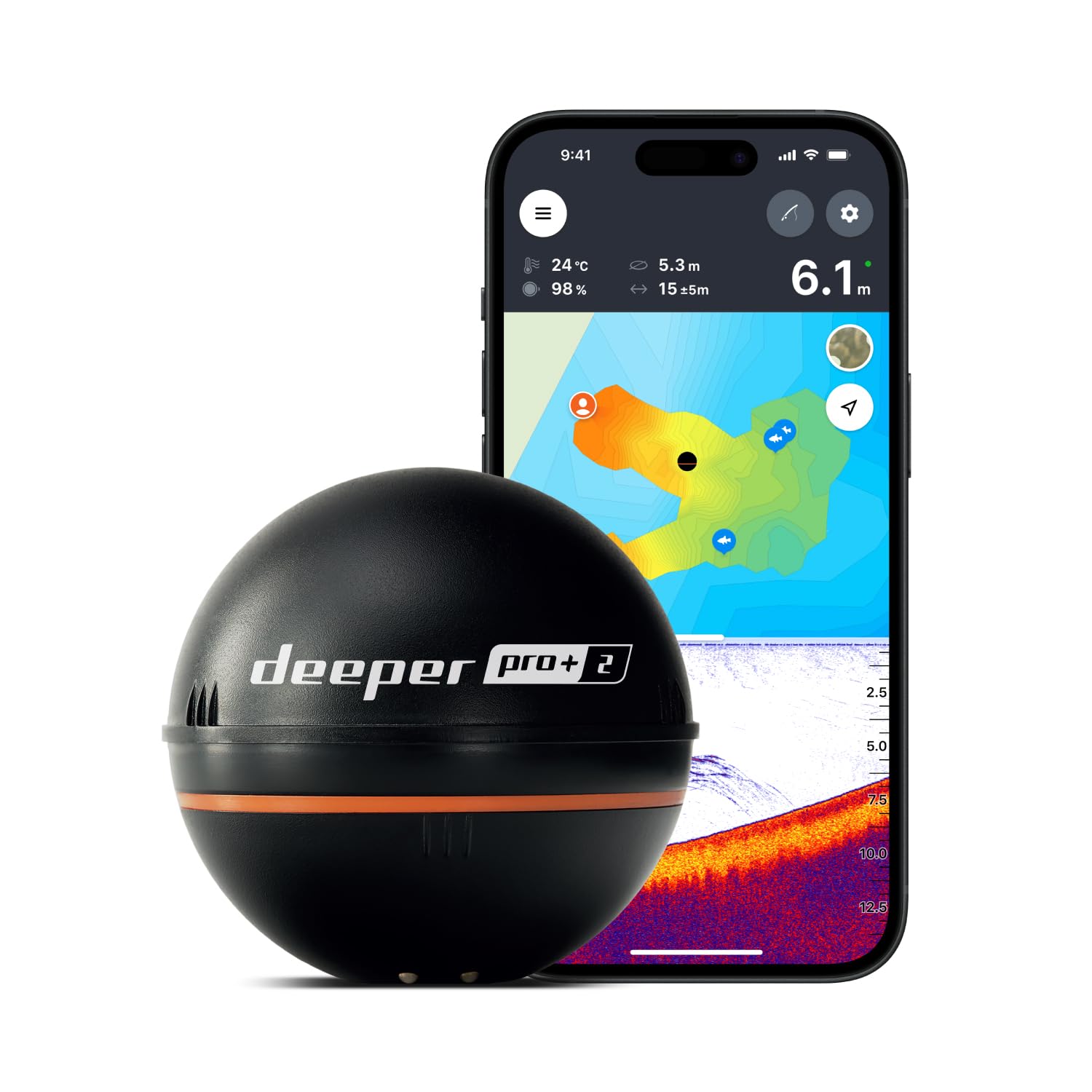
Deeper PRO+ 2
Key Features
- Beams: Wide, mid, narrow
- Weight: 3.2 oz
- Max depth: 330 ft
- Target separation: 0.4 in narrow beam
- Price: Midrange
Built-in GPS is what separates this puck from every other castable unit here. Cast it across a bay and the Fish Deeper app draws a bathymetric map of the water you have covered, contour by contour, so a lake you have never fished turns into something you can plan around instead of guess at.
We think that is worth paying for if you fish the same water repeatedly. Three beams — wide, mid, and narrow — let you cover ground quickly and then tighten down on a single rock, and Deeper quotes target separation of 0.4 inches on the narrow beam, fine enough to pick a fish off the bottom. The depth rating reaches 330 feet, more than twice what the budget castables here can read.
The caveats are about interpretation rather than hardware. The Wi-Fi link holds well from shore and gets patchy when the puck is a long cast out, which is exactly when you want the picture. And the app is quick to render a weed clump or a brush pile as a fish icon, so read the raw returns rather than the symbols.
At 3.2 ounces with USB charging and a neoprene pouch, it disappears into a tackle bag and comes out for a two-minute scan of a new hole. If mapping is the reason you are buying sonar at all, nothing else in this group does that job from the bank.
Pros
- Bathymetric mapping from a castable puck
- Three beams including a tight narrow one
- Reads to 330 ft of depth
- Light 3.2 oz body with USB charging
Cons
- Renders weed and cover as fish at times
If you want to map your water, not just read it, this is the castable sonar we point to: GPS contours, three beams, 330 feet.
Best for First Fish Finder
Venterior VT-FF005
Key Features
- Weight: 15 oz
- Display: 2.6 in color TFT
- Max depth: 164 ft
- Sensor range: 262 ft
- Price: Budget
Not every trip should route through a smartphone. This one comes with its own 2.6-inch color display and a wireless probe that talks to it from up to 262 feet, and the readout covers water depth, temperature, fish size banded small, medium, or big, and bottom contour. On a kayak or a riverbank that is the whole instrument in one hand, with no pairing step and no phone battery to nurse.
Depth tops out at 164 feet, which covers most inland water and none of the big-water bottom fishing. The screen switches between light and dark backgrounds for sun or dusk, and the simulation mode is a genuinely useful touch: we used it to learn what the different returns look like before we were ever on the water, which saves the first hour of a trip.
As a first unit, the value is hard to argue with. The price sits with the budget castables but nothing about the readout feels like a toy, and the display stays legible in direct sun. The probe’s battery is the everyday limitation at a few hours per charge, so a small power bank earns its place in the bag. The screen is also the part that has gone on these units, which is why the two-year warranty matters more than the spec sheet does.
Pros
- Own screen, no phone pairing required
- Fish size and depth on one display
- 262 ft between sensor and handset
- Two-year warranty
Cons
- Depth limited to 164 ft
As a first fish finder, this is the one we hand people: its own display, no app to fight, and enough range for lakes and bays.
Best for Long-Range Casting
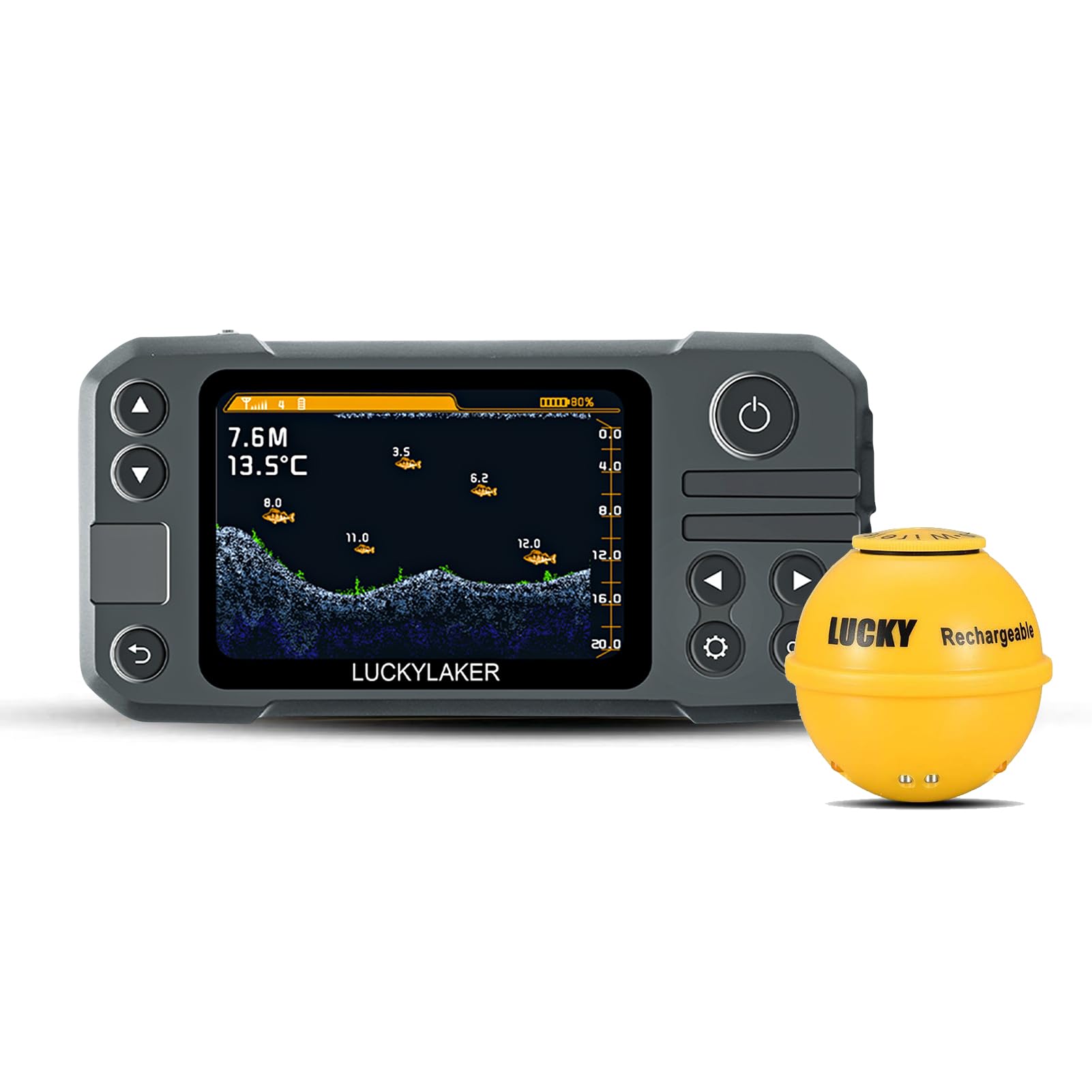
LUCKY MT-202
Key Features
- Weight: 1.54 lb
- Display: 3.5 in LCD
- Max depth: 147 ft
- Sensor range: 853 ft
- Price: Midrange
An 853-foot wireless range is the number to start with, because it is more than four times what Garmin quotes for its castable puck, and it changes how you fish: the display stays in the boat or on the bank while the sensor goes out with a cast. We also like that the screen is a 3.5-inch horizontal LCD, the biggest of the castable units here, so you are not deciphering a postage stamp in the sun.
What it shows is depth, fish location with depth numbers, and water temperature, plus enough of the bottom to tell a soft edge from a hard one. Depth reading stops at 147 feet, though, as shallow as anything in this group, which puts deep trolling out of reach — this is a lake and reservoir instrument.
It is a simpler machine than the Garmin kit: no GPS, no mapping, no contour recording, just sonar and a readable picture. For a kayak angler who wants to see what is under the hull and does not care about returning to a waypoint, that is the right trade. The handheld and floating sensor together weigh 0.7 kg and pack down into a rod bag.
Two things to know before ordering. The 147-foot ceiling rules out deep water, and the display is a plain LCD, so the picture is less nuanced than a color sounder’s. Neither matters in fifteen feet of water; both do on a reservoir.
Pros
- 853 ft wireless range, longest here
- 3.5 in display, biggest castable screen
- Handheld and floating sensor together at 0.7 kg
Cons
- Depth ceiling of 147 ft
- No GPS or mapping
If range is what you are short of, cast this one: it reaches furthest of anything here and shows the result on the biggest castable screen.
Best for Kayak and Canoe
LUCKY 1108-CT

Key Features
- Weight: 14.1 oz
- Display: 2.9 in LCD
- Max depth: 328 ft
- Cable length: 26 ft
- Price: Budget
Twenty-six feet of cable is either the reason to buy this or the reason to walk past it. There is no pairing ritual and no wireless link to drop, because the transducer is on a line and the handset is at the other end; the reading is whatever is directly under the float. For a kayak, a canoe, or a float tube, we take the simplicity over the range.
The rest of the package is aimed at the same buyer. It reads to 328 feet with a 45-degree beam at 200 kHz, deeper than the similarly priced wireless units, and the color display offers three contour styles so you can pick the one you can read. A rechargeable battery runs about five hours and charges over USB, and the bracket lets you fix the handset where you can see it while paddling.
Sunlight is the catch. The screen washes out in direct sun, so angle it or shade it with a hand, and keep the handset out of the splash zone — a dry bag is cheap insurance on a wet boat.
Where it earns its place is the paddler who does not want to think about connectivity. Twenty-six feet covers a kayak’s length several times over, and trailing the float beside the hull while you paddle is exactly the routine this was built for. It is the least glamorous pick here and the one that asks the least of you: drop the float, read the screen, fish.
Pros
- Wired link, no pairing or dropouts
- Reads to 328 ft at a budget price
- Color display with three contour styles
- USB-rechargeable, about five hours
Cons
- Screen washes out in direct sunlight
- Handset is not sealed against splashes
For kayak and canoe work, we prefer this wired handset: no Bluetooth to fight, 328 feet of depth range, and a color screen on a budget.
Best for Occasional Pond Trips
DANOPLUS DP-104

Key Features
- Weight: 5.28 oz
- Display: 2.4 in color LCD
- Max depth: 147 ft
- Beam angle: 90 degrees
- Price: Budget
It costs the least of the castable units here and measures 4.92 by 2.87 inches — about the size of a small phone — at 5.28 ounces. For a casual angler that is the entire argument: it goes in a jacket pocket, casts from a dock or a canoe, and answers the only question that matters, which is how deep it is out there.
The sensor is wireless and rechargeable, and it covers a 90-degree cone. That wide angle is a deliberate choice: it shows more bottom at once and less detail in each return, which we find suits a pond where you just want to locate the drop. It reads to 147 feet, displays water temperature and fish size icons, and the lamp in the sensor switches itself on when it hits water. There is a fish alarm too, though a weed bed sets it off as readily as a fish does.
Everything here is scaled to occasional use. The display is 2.4 inches, there is no app to keep updated, and the whole kit is one handset, one sensor, and one charger. There is no GPS, no contour recording, and no way to mark a spot beyond noting it yourself.
As a first unit, or as a spare that lives in the truck, it does the job. Deep-water trips are not what it is for, and neither is serious structure hunting — but for a morning on a farm pond it beats guessing.
Pros
- Pocket-sized at 5.28 oz
- 90-degree beam covers more water
- Wireless rechargeable sensor with lamp
- Fish alarm on the handset
Cons
- Depth ceiling of 147 ft
- Alarm triggered by weed, not just fish
We keep it on the list for pond and dock trips where the only question is depth — it is the cheapest castable here and it answers that one.
How We Tested Portable Fish Finders, on Ice and Open Water
We started with roughly 40 units from the major sonar makers and filtered hard. The questions that decided it were practical ones: does it run on its own batteries or need boat power, will the mount hold on a kayak or a five-gallon bucket, how big is the screen, and does GPS or CHIRP come standard or cost extra. That cut the field to 12, spanning pocket-size castable units up to full ice flashers.
Testing ran seven months, October through April, which handed us open water first and hard water later. On a local reservoir we fished the units from a 14-foot aluminum boat and from a kayak, checking every depth reading against a hand-tied weight on a marked line and against a flasher we already trusted. Fish tracking was judged in the same water: we dropped jigs over brush piles we could see on the known-good unit and noted which finders marked fish before the bite and which just painted noise.
Battery claims got tested the hard way — a full charge run to shutdown indoors, then again on a 20-degree morning on the ice, where a dying battery is what ends the day. We timed setup from bag to first reading, weighed each unit packed with its mount and cable, and ran every menu with neoprene gloves on. Wireless and castable models were walked a hundred feet up the shoreline to find where the signal quit, and GPS tracks were compared against a phone’s. Last, we opened every box to see what was actually included, because a finder that needs a second purchase to work isn’t the bargain it looks like.
How to Choose a Portable Fish Finder
The choice that shapes everything else is whether the sonar talks to a screen you already own or brings its own, because that one decision sets your budget, your working range, and how much gear goes in the boat.
A screen in the box, or the phone in your pocket
App-based castable sonar is the lightest and least expensive route to a picture of the bottom: the puck does the sonar work and your phone does the display. The trade is that the wireless link becomes the weak point and the phone’s battery becomes part of the trip plan. A unit with its own display costs more for comparable sonar but never asks you to pair anything, and it keeps working when your phone is dead.
We suggest settling this first, because it eliminates half the field. If you fish from a bank or a dock with a phone in a pocket, castable makes sense; if you sit over a hole for four hours in gloves, you want buttons and a screen.
Cast, tether, or bolt it on
Castable pucks go where your line goes and are the most flexible option for shore, kayak, and ice. A wired float on a length of cable gives up distance but never drops a connection. A kit with a transom, trolling-motor, or thru-hull mount is portable in the sense that the case travels, not that the transducer does — you still need a boat or an ice hole to hang it from.
Read the mounting type before you fall for the carrying bag. Portable kit means the whole system packs into a soft case; it does not mean you can use it without a hull, a float, or a hole.
Depth ratings and beam angles
Depth ceilings in this group run from 147 feet to 1,600 feet, and the gap only matters where you actually fish. A 147-foot unit covers ponds, most reservoirs, and shallow coastal water; it will not tell you anything about a deep lake trolling program. Do not pay for a depth rating you will never reach.
Beam angle trades coverage for detail. A 90-degree cone shows more bottom at once and blurs what it shows; a narrow beam picks a single fish off a rock but covers a small circle. If you fish structure, the narrow beam is the one you use; sweeping a flat is the other job.
What the picture can and cannot tell you
Sonar gives you depth, the hardness and shape of the bottom, and returns the unit renders as fish icons or as cover. Sensitivity is the dial that decides how much of that you see: turned up, a weed bed becomes a wall of fish symbols; turned down, you lose the marks sitting tight to the bottom. We spend the first few minutes of any session adjusting it, and we trust the contour more than the icons.
Power, water, and the second season
A rechargeable pack runs anywhere from a few hours to a couple of days depending on the screen, and a phone-based unit drains two batteries at once. Water is the slower killer: handsets that are not sealed die of splash and rain, so a dry bag is cheap insurance on a wet boat.
Warranty length varies widely across this group, so check it before you buy and keep the receipt. A two-year term on a budget castable is worth more than a slightly larger screen.
Frequently Asked Questions
Do I need cell service for a castable fish finder to work?
No. The puck broadcasts its own Wi-Fi or Bluetooth signal and the app talks to it directly, so it keeps working well past the edge of coverage. What you want is the app installed and any offline maps downloaded before you leave the dock, since pulling map tiles over a weak lake signal is the one part that needs data.
Can a fish finder tell me what species I am looking at?
No. It measures depth, bottom hardness, and the strength and shape of a return, and some units band a mark as small, medium, or big. Whether that mark is a bass, a carp, or a sunken branch is still your call. Use it to find the edge, the drop, and the weed line, then fish those places the way you normally would.
Is the depth on the screen measured from the surface?
From the transducer, not the surface. A puck floating a foot under the surface reads a foot less than true depth, and an ice-fishing transducer hung at the bottom of the hole reads from just under the ice. Add the submerged distance if you want the number to match a chart or a lake map.
Final Verdict
If you want one machine that covers a boat, a kayak, and a hole in the ice, the Garmin Striker 4 Portable Kit is the one we recommend: a real CHIRP sounder with GPS and a flasher, in a bag with its own battery. If you fish from the bank and do not own a boat, the Striker Cast does most of that job for less money — you trade the standalone screen for your phone and accept a shorter working range.