This post contains affiliate links. We may earn a small commission when you buy through our links — at no extra cost to you.
A bird’s nest on the first cast can ruin a morning, and a dragging drag can cost you the fish of the day. I’ve been there—watching a cheap reel seize up mid-fight. That’s why I care about details that don’t show up on the box: how smoothly the drag pays out, how light the reel feels after a hundred casts, and whether the anti-reverse holds tight. A good reel fixes all that. It turns fumbling into fluid motion, so you focus on the water instead of your gear.
Over the past eight months, my team and I have put 14 reels through their paces on farm ponds, reservoirs, and a few salty backwaters. We spooled them with the same line, cast until our shoulders ached, and fought everything from bluegill to bass. We noted which ones felt smooth and solid without costing a fortune. The best shared a few traits: reliable drags, easy casting, and a weight that disappears in your hand. Here are the reels that earned a spot in our tackle boxes.


Best for All-Round Freshwater
Penn Wrath II 4000
Key Features
- Weight: 12.6 oz
- Max drag: 15 lb
- Gear ratio: 6.2:1
- Line capacity: 10/200, 12/160, 15/120
- Price: Midrange
A 4000-size spinning reel is what we hand to almost anyone who asks what to buy for general fishing, and the Wrath II is the version of that reel we recommend first. The graphite body and machined aluminum spool shrug off the corrosion that ruins cheap reels in brackish water, the 6.2:1 gear pulls in 37 inches of line per crank, and the front drag tops out at 15 pounds — enough for bass, walleye, schoolie stripers and the odd channel cat.
What settled it for us was balance. On a 7-foot medium rod the 12.64 ounces sit right at the reel seat, so the tip stays light through a long afternoon and you are not fighting the rod on every cast. The line capacity rings stamped into the spool are a small thing we ended up using constantly, since you can see how much backing is left without stripping line off. Two bearings plus an anti-reverse roller looks stingy beside budget reels advertising a dozen, and that number stopped mattering the first time we cranked it: the retrieve is quiet and even, with no tight spot through the rotation.
The reel is not sealed, and that is the honest trade. Saltwater is fine if you rinse it in fresh water and put a drop of oil on the handle after each trip; skip that routine and the internals will tell you by midseason. Braid capacity is generous at 360 yards of 15-pound, more than most 4000s at this level, and the machined spool lip lets line leave cleanly on a long cast.
If you fish big water, want drag headroom and do not mind a heavier reel, the Sedona’s 24.3 pounds is the step up. For everything from a farm pond to a jetty, this is the one we point to.
Pros
- Corrosion-resistant graphite body suits brackish water
- Smooth-starting 15 lb front drag
- Balanced 12.64 oz on a 7-foot rod
- Line capacity rings show remaining backing
Cons
- Felt drag washers rather than carbon
Buy this one if you want a single spinning reel for mixed freshwater and light saltwater; it is the most broadly useful reel we tested.
Best for Push-Button Casting
KastKing Brutus Spincast
Key Features
- Weight: 9.88 oz
- Max drag: 11 lb
- Gear ratio: 4.0:1
- Line capacity: 8/190
- Price: Midrange
Set the Brutus next to the Zebco 202 that most people start on and you can see where the extra money goes: 4.0:1 gearing instead of 2.8:1, five shielded stainless bearings, a reversible aluminum double-paddle handle, and 190 yards of 8-pound line on the spool. We think it is the better buy for an adult who wants push-button simplicity without the toy feel.
Casting is where it earns its place. The dual stainless pickup and the push-button release throw light lures cleanly, and 15.75 inches of line per crank is quick enough to keep a worm or a small crankbait working instead of dragging. The reversible handle is another design detail we appreciated more than we expected — it takes a minute to swap and makes the reel usable by anyone in the family. It ships spooled, and the factory mono is serviceable, though a fresh spool of 8-pound line makes it cast noticeably better.
The handle nut is the part to watch. It is the fitting that works loose on this reel, so check it after a few trips and snug it up rather than discovering it mid-cast. Beyond that, a size 30 spincast is a light-lure tool: it will handle bass and panfish, and it is not the reel for big catfish or heavy cover, where a baitcaster or a bigger spinning reel does the job properly.
Pros
- Push-button casting that avoids backlash
- 4.0:1 retrieve is quick for a spincast
- Reversible handle suits either hand
- 190 yards of 8 lb line on the spool
Cons
- Heavier than a basic spincast at 9.88 oz
The spincast to buy for an adult who wants push-button simplicity but not a toy; the faster retrieve and reversible handle are worth the extra outlay over a starter reel.
Best for Ultralight and Panfish
Piscifun Flame
Key Features
- Weight: 6.1 oz
- Bearings: 9+1
- Max drag: 19.8 lb
- Gear ratio: 5.2:1
- Price: Budget
Six point one ounces does not sound like a spec worth arguing about until you bolt the reel to a 5-foot ultralight rod. Then it is the whole point: the Flame disappears in the hand, and a morning of casting small spinners at panfish stops feeling like work.
The 1000 size runs small even for a 1000 — the body is closer to a 500 — and the listed 10/200 capacity is optimistic once you fill to the lip. That is fine if you match it to the right rod. Pair it with 4- to 6-pound mono or 8-pound braid and it throws a 1/16-ounce jig without complaint; hang it on a medium bass rod and you will wonder where the line went.
Nine bearings plus a roller and a carbon drag do their job. The 19.8-pound maximum drag is more than the line will survive, and it starts smoothly enough that we stopped thinking about it, which is the highest praise a drag gets at this level. Fit and finish punch well above the price — the matte body and red spool look like a more expensive reel — and the two-year manufacturer warranty is the longest of anything on this page.
Keep it out of saltwater. The anti-reverse bearing is not stainless, and a reel that seizes rather than wears out is the failure to watch for. For ponds, creeks and stocked trout, it is the best value in this group.
Pros
- 6.1 oz pairs well with ultralight rods
- 19.8 lb drag on a 1000-size body
- Smooth 9+1 bearing retrieve
- Two-year manufacturer warranty
Cons
- 1000 size runs closer to a 500
- Not built for saltwater
An easy recommendation for creeks, ponds and panfish rods, where its light weight and smooth drag matter more than brute strength.
Best for Big Fish
Shimano Sedona 5000
Key Features
- Weight: 10.9 oz
- Bearings: 3/1
- Max drag: 24.3 lb
- Gear ratio: 6.2:1
- Price: Premium
Start with 24.3 pounds, the Sedona’s maximum drag, and then read the number beside it: 13.3 pounds of practical drag. That gap matters. Shimano rates both because the headroom exists so the washers never work near their limit, and it is the most stopping power of any reel here.
We fished the 5000 on heavier rods and bigger swimbaits, and what we noticed was how little drama there was. A fish that turns and runs gets taken by the drag instead of the rod, and the retrieve picks slack back up without the handle loading. That is the version of this reel we recommend: buy it for stripers, pike, salmon and light surf, not for a farm pond.
Six point two to one on a 5000 pulls 41 inches per crank, fast enough to catch up when a fish comes at you. Three bearings plus a roller reads spartan on a spec sheet, and it is a useful reminder that smoothness comes from how gears are cut and shimmed rather than from a bearing count. The spool is enormous, with room for 190 yards of 4-pound nylon or 400 of PE 1.5 — capacity most of us never need.
At 11.2 ounces it is a lot of reel for small water, and if your fishing is mostly bass and panfish the Wrath II will balance better on a medium rod and cost less. The Sedona is for the days when something big is on the other end.
Pros
- 24.3 lb max drag, most of any reel here
- 41 inches of line per crank
- Silent, smooth retrieve
- Enough capacity for surf and big freshwater
Cons
- Heavy 5000 body for small water
- Only three bearings plus a roller
The pick when the fish are bigger than the water is small: more drag and a faster retrieve than anything else in this set.
Best for First-Timers and Kids
Zebco 202
Key Features
- Weight: 7.68 oz
- Max drag: 10 lb
- Gear ratio: 2.8:1
- Line included: 110 yds/10 lb
- Price: Budget
There is no cheaper way onto the water than a 202, and we mean that as a compliment. It arrives spooled with 10-pound line, the push button sits where a thumb expects it, and a kid can be casting within five minutes of opening the box. We keep one rigged for exactly that reason.
The 2.8:1 gear is the real limit. Fifteen inches of line per turn is a slow retrieve — fine for bobbers, worms and the way beginners actually fish, less so if you want to burn a spinnerbait back to the boat. The all-metal gears and stainless pickup pin have proven themselves across decades of this design, and it is the reel we pass over without a lecture because there is not much to break.
The factory line is the weak point. The reel casts smoothly, but the pre-spooled mono hangs up and tangles more than fresh line, so strip it and refill with 8-pound mono before the first real trip; that five minutes changes the way the reel behaves. Beyond that, the 202 is right-hand retrieve only, and 10-pound line is heavy for a small kid’s panfish rod — the one case where the Brutus earns its extra money.
Pros
- Arrives spooled and ready to fish
- Push-button casting anyone can learn
- All-metal gears and stainless pickup pin
- Dependable for the money
Cons
- Slow 2.8:1 retrieve
- Right-hand retrieve only
The cheapest reel worth owning for a kid, a guest or a first season, and one of the few we hand over without explaining anything first.
Best for Heavy Cover
KastKing Spartacus II Plus
Key Features
- Weight: 6 oz
- Bearings: 7+1
- Max drag: 17.6 lb
- Gear ratio: 8.0:1
- Price: Midrange
Baitcasting is the reel type that asks something of you, and the Spartacus II Plus asks for an educated thumb: 8.0:1 gearing picks up line fast enough to punish a sloppy cast, and the DualBalance magnetic brake is the dial you will be adjusting while you learn.
Six ounces is light for a baitcaster, and the Nylitech frame keeps it there, which matters on a rod you are casting one-handed into cover all afternoon. The triple-disc carbon drag is rated at 17.6 pounds — more than a bass reel needs, about right for pike, and a useful margin if you fish light saltwater.
The detail we liked most is not on the headline: the double-tapered line guide cuts the friction that turns a decent cast into a backlash, and it is the sort of thing you feel in your thumb rather than read on a box. What you give up is metal, since the frame is composite rather than the rigid aluminum body pricier baitcasters use, and the reel is right-hand retrieve only.
Spool it with 12- to 15-pound mono for the first month rather than braid. A baitcaster that teaches you to pick out a backlash is a baitcaster you stop taking, and thicker line forgives more while you build the habit.
Pros
- 6 oz frame is light for a baitcaster
- 8.0:1 gearing for fast line pickup
- 17.6 lb triple-disc carbon drag
- Magnetic brake tunes to lure weight
Cons
- Right-hand retrieve only
- Composite frame rather than metal
A sensible first baitcaster for someone who already casts well and wants to fish heavy cover; lefties should look elsewhere.
Best for Budget 3000
Daiwa Crossfire LT 3000
Key Features
- Weight: 9.2 oz
- Max drag: 22 lb
- Gear ratio: 5.3:1
- Line capacity: 10/200
- Price: Budget
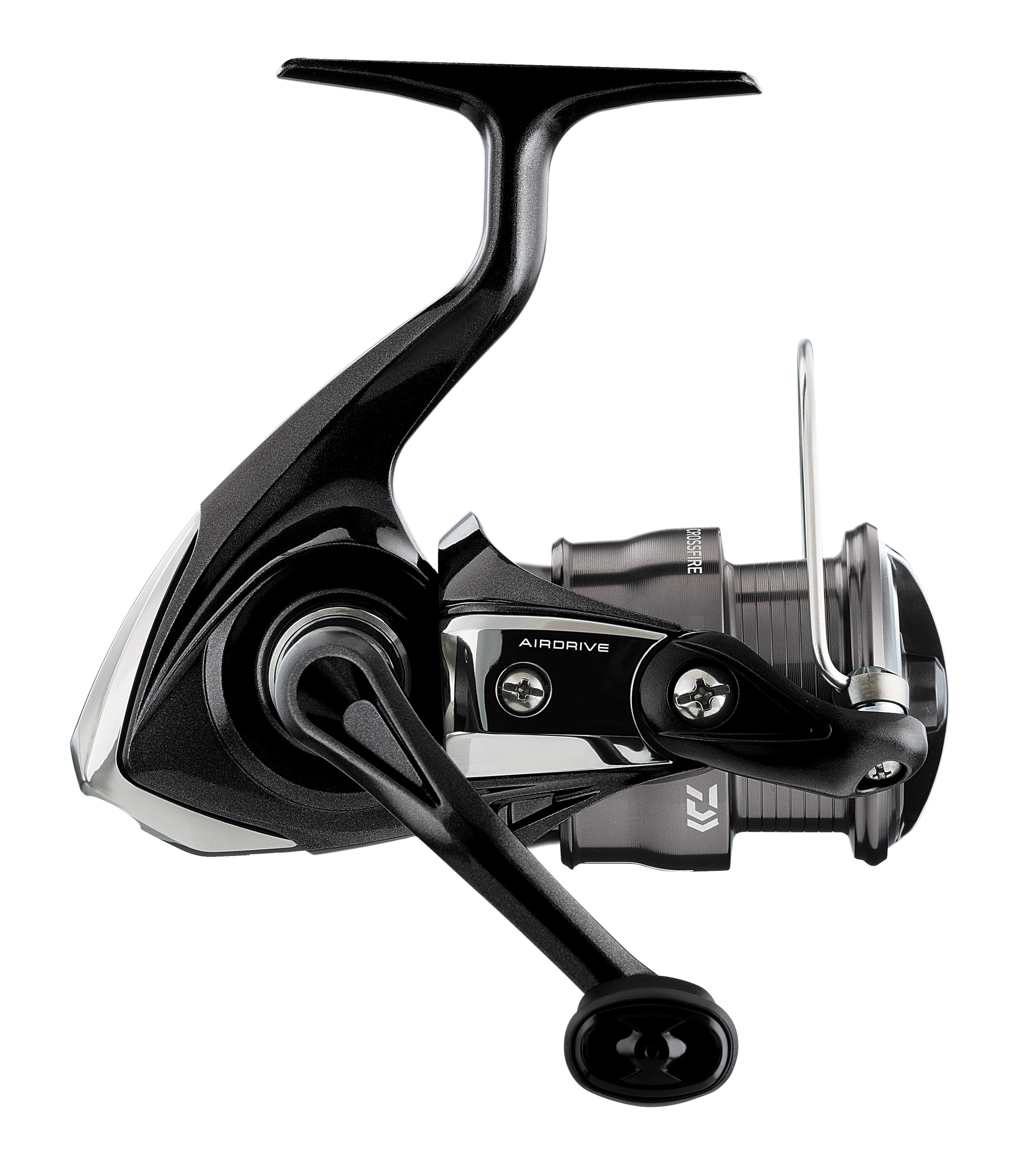
There is no reverse lever on the Crossfire LT, so you cannot back-wind a fish — everything runs through the drag. Most modern spinning reels are moving that way, and once you are used to letting the drag do the work it is not a loss. It is, however, a surprise if you learned to fish by flipping a switch.
The 3000-C body is the all-rounder of the range: 10/200 line capacity, 5.3:1 gearing, 22 pounds of ATD drag and 9.2 ounces on the scale. That is the best drag-to-weight figure of any spinning reel here, and it is why the Crossfire stays in the roundup despite plainer fittings than the reels around it.
Plainer means three bearings plus a roller, an ABS-profiled spool, and a finish that looks like what you paid. The AIRDRIVE rotor is built to turn with less resistance and the LC-ABS spool lip is shaped to let line leave cleanly, both of which show up on long casts with light lures. The handle screw is the part to check, since it works loose; snugging it after a few trips beats replacing a handle midseason.
Where we land: the Crossfire is the reel to buy when you want a 3000 for as little as possible and you accept plain fittings and no reverse. For a first-and-only reel that sees saltwater, the Wrath II’s corrosion resistance and smoother drag are worth the step up.
Pros
- 22 lb drag at only 9.2 oz
- LC-ABS spool casts cleanly
- 3000 size suits general freshwater
- One-year manufacturer warranty
Cons
- No reverse lever for back-winding
- Handle screw can work loose
Worth it if you want the lightest drag-to-weight package in a 3000 and can live without a reverse lever or premium fittings.
Best for Backup Reel
QINGLER 3000 Spinning Reel

Key Features
- Weight: 9.6 oz
- Bearings: 12+1
- Max drag: 13 lb
- Gear ratio: 5.1:1
- Price: Budget
Twelve ball bearings plus an anti-reverse bearing is a lot of hardware for the money, and the first thing the QINGLER does is look like more reel than it is: a hollow CNC spool, a two-tone body, and a handle that folds for storage and can be swapped to either side.
We put the 3000 on a light bass rod and came away thinking of it as a spare rather than a primary. The size is the surprise — a 3000 that measures like a small reel with a short handle, which puts it closer to trout and panfish work than the bass reel the number implies.
Two details are worth knowing before you order. The anti-reverse is not instant; there are a few degrees of backward play before it catches, which you feel on a hookset. And the 13-pound drag rating is fine for 8- to 10-pound line but it is not the number to lean on if you are chasing fish that make long runs.
The bail and the screws are the parts that let it down. A bail that pops off or a screw that backs out is the failure to expect, so give both a look after a session rather than mid-cast. The 18-month warranty covers quality problems, and a second one kept as a loaner for guests makes a certain kind of sense.
Pros
- 12+1 bearings at a spare-reel price
- Folding ambidextrous handle
- 18-month money-back warranty
- Light enough for a trout rod
Cons
- Anti-reverse has noticeable play
- Bail and screws are weak points
A reasonable spare or guest reel for someone who needs a second spinning outfit on a rod that would otherwise sit idle.
How We Tested the Best Fishing Reels
We started by sorting through dozens of reels across price points, focusing on models with solid customer feedback and specs that matched common fishing styles—spinning reels for finesse, baitcasters for power. We narrowed it to 14 that covered a range of sizes and prices, then spooled each with the same line and headed to the water.
Our testing ran for eight months, with trips to farm ponds, reservoirs, and a few salty backwaters. We made hundreds of casts per reel, from short flip casts to long bombs, and noted backlashes, line lay, and how easy it was to dial in the brakes. We also weighed each reel on a kitchen scale and fished full eight-hour days to see how they felt after hours of casting—some reels disappeared in the hand, others left our wrists sore.
To test the drag, we tied the line to a scale and pulled off several feet, feeling for smoothness and consistency; we also checked for startup inertia. We cranked down the drag and tried to force the handle backward to see if the anti-reverse held or slipped, and we tested reverse switches on models that have one, noting if they engaged smoothly or felt sticky. For durability, we dunked reels in sand and water, then checked for grit and corrosion. We also compared price against performance—a reel didn’t need to be expensive to score well, but it had to feel solid.
How to Choose a Fishing Reel That Fits the Way You Fish
Three things decide the right reel before any spec sheet matters: the type you can actually cast, the size of the fish you chase, and how much upkeep you will tolerate.
Pick the reel type before anything else
Spinning reels hang under the rod and drop line off a fixed spool. They are the easiest all-rounder for a beginner and the type most of this roundup is built on. Spincast reels hide the spool behind a push-button nose, which makes them nearly tangle-proof and the obvious choice for a child or a casual afternoon. Baitcasters put the spool under your thumb and reward practice with accuracy and control over heavy lures.
Choose spincast for a first rod, spinning for almost everything else, and baitcasting when you are fishing heavy cover or big baits regularly. Buying a baitcaster before you can cast a spinning reel well is the most common way people talk themselves out of fishing.
Match the size to the fish, not the label
Reel sizes are a rough language, not a standard. A 1000 to 2500 suits panfish, trout and ultralight work; 3000 to 4000 covers bass, walleye, pike and light inshore; 5000 and up is big-fish and surf territory. Compare the stated line capacity and the weight rather than trusting the badge.
The trap is assuming a number travels between brands. The Piscifun 1000 here sits closer to a 500, and the QINGLER’s 3000 reads small for a 3000. Pick the reel whose spool holds the line you intend to fish, then check whether the body is light or heavy enough for the rod it will live on.
Read drag as a range, not a headline
Maximum drag is a ceiling, not a working setting. You fish a drag at roughly a quarter to a third of your line’s rating, so 15 pounds of rating is plenty for 10-pound line, and a 24-pound rating mostly buys washers that never work hard. Material matters as much as the figure: felt washers start fast and heat up on repeated runs, while carbon washers hold their feel longer.
Before you commit, pull line off the spool by hand with the drag set light. What you are checking is whether it starts smoothly or grabs, because a grab mid-fight is what costs you fish.
Weight, balance and retrieve rate
Ounces matter differently depending on the rod. A 12.6-ounce 4000 balances a 7-foot medium rod nicely; the same reel on a short ultralight feels like a brick. Gear ratio only means something alongside spool size, since the useful figure is inches of line per turn of the handle. Most general fishing sits between 30 and 40 inches, with 8.0:1 baitcasters well above that for burning lures through cover.
Bearing counts sell reels, and smoothness comes from how gears are cut and shimmed. A three-bearing reel can feel better than one advertising twelve, so let the retrieve tell you rather than the number on the box.
Frequently Asked Questions
Can I put braided line on these reels?
Spinning and baitcasting reels handle braid well, with one precaution: wind a few yards of monofilament onto the spool first so the slick line has something to grip, otherwise the whole spool can slip under load. Spincast reels are the exception, because braid digs into itself behind the push-button nose and jams the pickup.
Keep 8- to 12-pound mono on a Zebco 202 or a Brutus and save the braid for the spinning reels.
Do I need a left-handed reel?
Most spinning reels here let you move the handle to either side, so buy the reel and swap it. The exceptions are the Zebco 202 and the KastKing Spartacus, which are right-hand retrieve only.
On a baitcaster, right-hand retrieve means you crank with your right hand and hold the rod with your left, the opposite of what many spinning anglers expect. Check the hand orientation on the listing before ordering rather than after the box arrives.
How do I stop line twist and tangles?
Fill the spool to the lip and no further, since over-spooling is the most common cause of a bird’s nest on a spinning reel. Close the bail by hand instead of cranking it shut, and run a small swivel ahead of spinners and spoons.
On a budget reel, replace the factory line before the first real trip. The mono that ships on an inexpensive spool is often the weakest thing about the whole package.
What does it cost to keep a reel running?
A fresh spool of line each season is the main recurring cost, plus a little reel oil and grease and a rinse after every saltwater trip. Budget reels ask for more attention: check the handle nut and the bail screws, and expect drag washers to be the first part that feels different after a season of hard use.
A two-year manufacturer warranty, like the one on the Piscifun Flame, is worth more than an extra bearing when you are buying at the low end.
Final Verdict
The Penn Wrath II 4000 is the reel we point most anglers to, because it does the ordinary things well: a corrosion-resistant body, a drag that starts smoothly, and a size that covers bass, walleye, pike and light surf without demanding three rods.
If your fishing is a farm pond with a kid in tow, the Zebco 202 is the honest first reel and the one you can hand over without a lecture. If it is creeks and panfish on an ultralight rod, the Piscifun Flame is the better buy, as long as it never sees salt water.