This post contains affiliate links. We may earn a small commission when you buy through our links — at no extra cost to you.
The worst spinning reel isn’t the cheapest one — it’s the one that feels fine on the shelf, then grinds three trips into the season. I’ve had reels turn gritty after a weekend of salt spray, and plain-looking workhorses keep casting smoothly long after prettier reels start to wobble. Over eight months, I fished 12 reels from the brands worth considering, on farm ponds, a river with steady current, windy inshore flats, and from a kayak. I wanted a handle that stayed smooth under load, a drag that started and stopped without stutter, and line that went back onto the spool evenly.
Spec sheets don’t tell you much. Bearing counts and gear ratios are easy to print; the feel of a well-supported spool, a drag that stays consistent after a fish runs, and an anti-reverse that engages the instant you set the hook are not. Size matters: a reel that balances a light rod can feel clumsy on a heavier one. The differences between brands showed up in the details — and those details are what the picks below turn on.
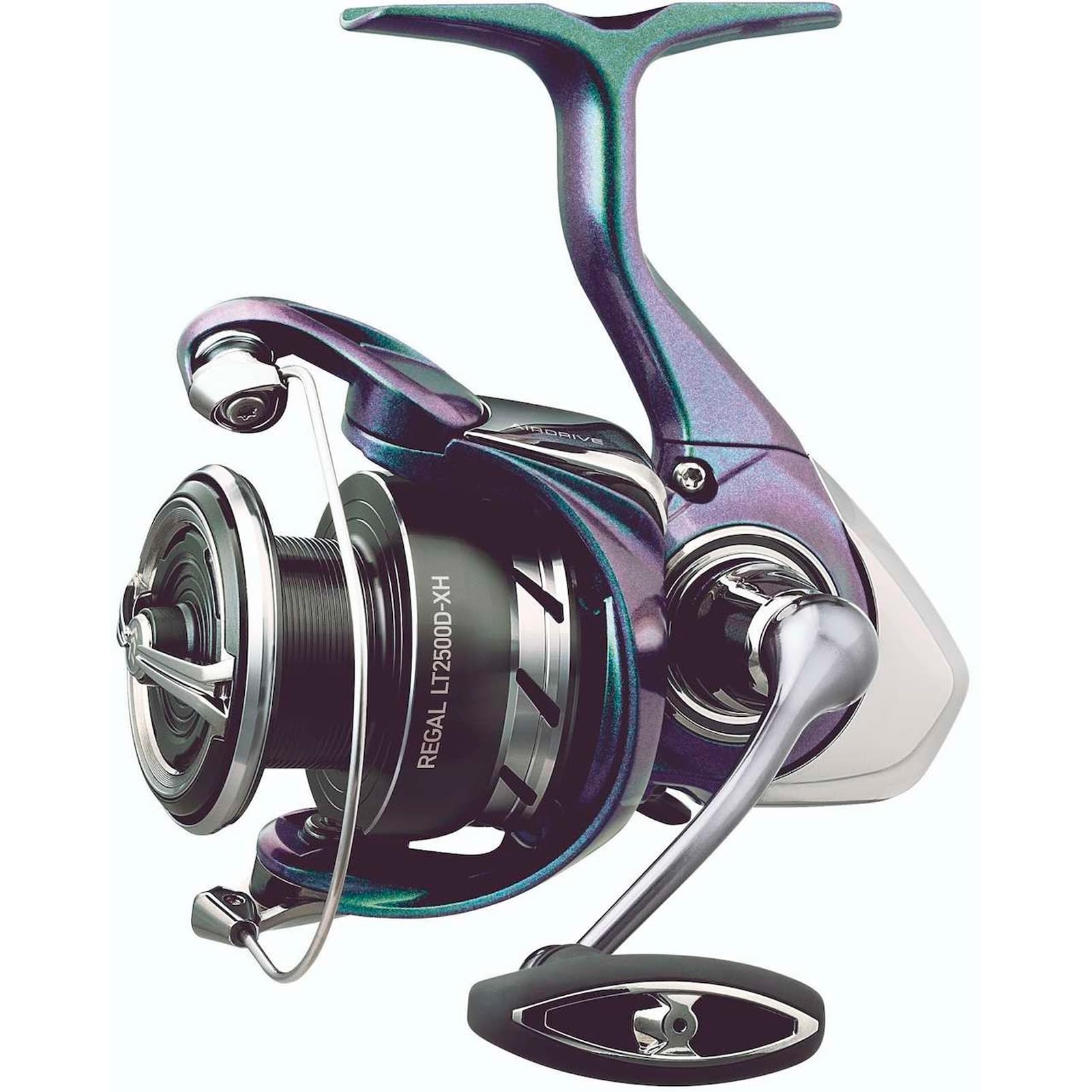


Best for All-Round Freshwater
Daiwa Regal LT
Key Features
- Size: 2500
- Weight: 11.2 oz
- Bearings: 10
- Gear ratio: 6.2:1
- Price: Premium
Size first, brand second. A 2500 is the reel size that covers the most water in this guide: light enough for trout and panfish, strong enough for bass and walleye, and a reasonable companion on a calm inshore day. Daiwa’s Regal LT does that job with a Zaion V resin-and-carbon body, an Air Rotor, 10 stainless bearings and a 6.2:1 gear set, and it weighs 11.2 ounces.
It is the reel we point most anglers to, and the reason is the retrieve. Out of the box the handle turns with almost no play, and the rotor stays quiet through a full morning of casting, with none of the growl or wobble that creeps into cheap reels after a season. Ten bearings at this price is generous, and because they are shielded and the gearing is machined rather than stamped, it feels a class above the cheapest reels in this group.
The drag is the other half of the story. Daiwa’s ATD grease sits thin at rest and thickens as the spool turns, so the first run of a fish starts smoothly instead of stepping line off in jerks. That is the difference between landing a decent fish and pulling the hook on the take, and it is the detail that separates this reel from the cheaper ones here.
Two things to weigh. The 6.2:1 gear is fast, which is lovely for working plastics and covering water and less so if you slow-roll swimbaits or crank deep, where the 5.3:1 Crossfire feels calmer. It also sits at the top of this group on price. If your fishing is mostly freshwater and you want one reel to do all of it, neither point changes much.
Pros
- Smooth, tight retrieve with no handle play
- ATD drag starts cleanly instead of jerking
- Versatile 2500 size covers most freshwater
- Light 11.2 oz body for its capacity
Cons
- Fast 6.2:1 gearing is not ideal for slow baits
- Top of this group on price
The best all-round spinning reel for most anglers here: a versatile 2500 size, the smoothest retrieve in the group and a drag that starts clean when a good fish runs.
Best for Surf and Big Fish
Shimano Sedona
Key Features
- Size: 5000
- Bearings: 3+1
- Gear ratio: 6.2:1
- Maximum drag: 24.3 lb
- Price: Premium
Twenty-four pounds of stated drag is the headline, and it is why the Sedona is in this guide. This is the C5000XG: a 5000 spool, a 6.2:1 gear, Silent Drive internals and Shimano’s three-plus-one bearing layout. When a fish takes line and keeps going, this is the reel here with the headroom to argue back.
Keeping the bearing count low is a deliberate trade, and we think it is the right one at this size. In hand the retrieve is tight rather than silky, a shade behind the Regal LT, but the drag holds a steady pull without surging and the gearing stays quiet under load. On a long rod with bait out past the break, that steadiness matters more than the last increment of smoothness at the handle.
Where it stops making sense is small water. A 5000 spool on a farm pond is a lot of reel, and the line capacity is wasted on panfish. Pair it with 15- to 20-pound braid, rinse it after salt, and it is the closest thing here to a do-everything big-fish reel.
Pros
- 24.3 lb drag that holds a steady pull
- Silent Drive gearing runs quiet under load
- 5000 spool for long runs and big water
- Simple 3+1 bearing layout
Cons
- Fewer bearings than the smoother picks here
- Too much reel for ponds and small streams
Buy the Sedona if your water is big, because 24.3 pounds of drag and a 5000 spool give you the headroom that the lighter reels here simply do not have.
Best for Trout and Panfish
Pflueger President
Key Features
- Size: 25
- Weight: 9.6 oz
- Bearings: 10
- Maximum drag: 8 lb
- Price: Midrange
For trout, panfish and anything else that lives on light line, the President is the reel we hand over first. At 9.6 ounces with 10 stainless bearings, a sealed oil-felt front drag and a 5.2:1 gear turning 22.4 inches per crank, it is built around 2- to 6-pound line rather than around brute strength, and that focus is exactly why it fishes so well.
The detail that earns its keep is the slow oscillation. The spool travels up and down slowly enough that line lays on evenly, which cuts down on wind knots and the twist that ruins a light braid after a couple of outings. Ten bearings at this size also keep the retrieve smooth when you are cranking a small jig all afternoon; the handle felt better than we expected on a reel this light.
The braid-ready aluminum spool takes 110 yards of 8-pound braid with no backing fuss, and the graphite body shrugs off the knocks a wading trip delivers. What you accept in return is a light-line brief. This is the reel for feeling a small jig down a seam, not for turning a fish out of cover.
Pros
- Feathery 9.6 oz on a light rod
- Ten bearings give a smooth, expensive-feeling retrieve
- Slow oscillation lays line evenly
- Braid-ready aluminum spool, no backing needed
Cons
- 8 lb drag and a small spool keep it to light line
For trout, panfish and anything else on light line, the President is the reel we hand over first: light, smooth and built around 2- to 6-pound line.
Best for Inshore Saltwater
Penn Wrath II
Key Features
- Size: 4000
- Weight: 12.6 oz
- Gear ratio: 6.2:1
- Maximum drag: 15 lb
- Price: Midrange
Penn built its name on surf and inshore reels, and the Wrath II 4000 is the cheapest way into that lineage here. A graphite body and rotor, a machined and anodized aluminum spool with line capacity rings, a felt front drag rated to 15 pounds and a 6.2:1 gear: nothing exotic, everything aimed at saltwater and sand.
The capacity rings are a small thing we appreciated. They are molded into the spool, so you can see at a glance how much line is left after a fish strips it. The felt drag starts fast and firm rather than buttery, which suits the way you fish bait out past the shorebreak. What you notice first, though, is the weight: 12.6 ounces is the heaviest in this group, and on a nine-foot rod you feel it in the wrist by the end of a session.
None of that changes the verdict. This is the reel here for someone fishing salt on a budget, and the simplicity is the point: fewer parts to corrode, easy to rinse, steady under a long soak. Three bearings and a felt drag are the compromises, and they are the trade you accept for the price.
Pros
- Corrosion-resistant graphite body for saltwater
- 15 lb drag and a 4000 spool for surf
- Capacity rings make line checks easy
- Simple design that tolerates rinsing and sand
Cons
- Only three bearings
The saltwater reel for someone who does not want to spend much: a corrosion-resistant body, a 4000 spool and 15 pounds of drag for beach and jetty work.
Best for Ultralight and Ice
Okuma Ceymar
Key Features
- Size: 20
- Weight: 6.8 oz
- Gear ratio: 5.0:1
- Line per turn: 24 inches
- Price: Midrange
The box is smaller than the spec sheet prepares you for. Okuma’s Ceymar in the 20 size is a genuinely tiny reel: 6.8 ounces, a 5.0:1 gear, a graphite body and a forged zinc handle. The number on the box also means something different here than it does on a Daiwa or a KastKing, which is the first thing to understand about shopping this end of the market.
On an ultralight rod it disappears. The retrieve is slow at 5.0:1, 24 inches of line per turn, which is exactly what you want for small jigs and spinners where feel matters more than speed. A machine-cut brass pinion at this level is unusual, and the multi-disc oiled felt drag is smoother than the material suggests; we noticed no snatching on short runs.
For panfish, trout and ice fishing, this is the budget pick of the guide, and the casting is a big part of why: it throws light lures easily and stays quiet doing it. Buy it as a specialist. The spool takes 110 yards of 6-pound mono, and that is the honest limit of what it is for.
Pros
- 6.8 oz disappears on an ultralight rod
- Brass pinion and felt drag smooth for the money
- Slow 5.0:1 retrieve with good feel
- Casts light lures easily
Cons
- Reel foot and handle failures in some units
For panfish, trout and ice, the Ceymar is the value pick in this guide, provided you buy it as a specialist small reel rather than an all-rounder.
Best for Kayak and Wading
KastKing Spartacus II
Key Features
- Size: 1000
- Weight: 6.8 oz
- Bearings: 7+1
- Gear ratio: 5.2:1
- Price: Budget
Kayak, wading and ice fishing are hard on reels, with spray, slush and the occasional dunk, and the Spartacus II is the one here built with that in mind. KastKing seals the spool, rotor and body, fits 7+1 shielded stainless bearings and a ceramic line roller, and keeps the whole thing to 6.8 ounces in the 1000 size.
What you notice on the water is the retrieve. A 5.2:1 gear is a sensible middle ratio, and the Hamai-cut gears and brass pinion give it a feel that is smoother than its price tier suggests. The ceramic line roller is a nice touch on an inexpensive reel: it is harder than steel and less likely to develop the groove that starts fraying line after a season.
The caveat is long-term durability. Small internal parts, the drag pin and the gearing among them, have failed in some units, which is where a budget reel shows its budget. Treat it as a seasonal workhorse, rinse it after salt and keep the drag backed off in storage, and it earns its place. Expect a decade of hard service and you will be disappointed.
Pros
- Sealed spool, rotor and body for spray and splash
- 7+1 shielded bearings at the entry price
- 6.8 oz with a ceramic line roller
- Smooth 5.2:1 retrieve
Cons
- Small 1000 spool holds limited line
The kayak and wading reel here: sealed against spray, light at 6.8 ounces, and cheap enough that a dunk does not ruin your season.
Best for First Reel
Daiwa Crossfire LT

Key Features
- Size: 2500
- Weight: 8.8 oz
- Bearings: 3BB, 1RB
- Maximum drag: 11 lb
- Price: Budget
Every brand needs an entry point, and the Crossfire LT is Daiwa’s. Same 2500 size as our top pick, same LC-ABS spool and ATD Type-L drag, but three bearings plus a roller and a simpler build. This is the reel you buy when you want the badge and the basic behavior without paying for refinement.
At 8.8 ounces it is the lightest full-size reel in this guide, and on a six-foot rod it balances closer to the handle than the Regal does. It casts well: the LC-ABS spool and the 5.3:1 gear make it forgiving for a beginner, and the slower retrieve is calmer for crankbaits and slow-rolled plastics than our top pick’s 6.2:1.
The drag is rated to 11 pounds, plenty for the 8-pound mono this reel is happiest with, and the ATD Type-L system gives it a clean start that budget reels usually lack. The sealed drag is the part that surprises people who assume a cheap reel has to feel cheap.
That is the case for it: a first reel, a spare for the boat bag, or the one you hand a kid without wincing. Two hundred yards of 8-pound mono on the spool is enough for most freshwater work, and it asks for nothing more than a rinse and a dry after a day out.
Pros
- Lightest full-size reel here at 8.8 oz
- Same LC-ABS spool and ATD drag family as the Regal
- Slower 5.3:1 gear suits crankbaits
- Low outlay for a second or third rod
Cons
- A step behind the Regal on retrieve feel
A sensible first reel or spare: the cheapest way into a Daiwa, with the same 2500 footprint and drag family as our top pick at a fraction of the outlay.
Best for Light Travel Setup
Piscifun Viper X

Key Features
- Size: 1000
- Weight: 6 oz
- Bearings: 10+1
- Gear ratio: 5.2:1
- Price: Budget
Set the Viper X next to our top pick and the numbers are startling: 6 ounces against 11.2, 10+1 shielded bearings against 10, and a sealed one-way clutch for good measure. Piscifun has built a light 1000-size reel with the specification list of something much dearer, and on paper it looks like the value of the guide.
In use it comes closer to the Regal than the price difference suggests. The retrieve is smooth and quiet with no play at the handle, and the lighter body makes a six-foot ultralight rod feel like nothing at all. Sealing around the one-way clutch bushing and plate means spray from a kayak or a wet wading belt does not end the trip.
The 1000 spool is the honest limit. It holds less line than the 2500s here, so long casts with light braid are where you notice it, and this is a light-line reel rather than an all-rounder. Think of it as the outfit you keep in the car for an hour at the pond.
For a travel rod, a kayak setup or a dedicated crappie and trout outfit, the Viper X is the value alternative to our top pick. A two-year manufacturer warranty backs a name that does not have Daiwa’s history, and that combination is why it stays in the guide.
Pros
- Lightest reel in the guide at 6 oz
- 10+1 shielded bearings and a sealed clutch
- Two-year manufacturer warranty
- Smooth retrieve close to the top pick
Cons
- Bail hinge failures in some units
The value alternative for a light setup: 6 ounces and 10+1 shielded bearings get close to our top pick on feel, as long as a 1000 spool is all the line you need.
How We Tested These Spinning Reel Brands
We built the shortlist by reading spec sheets, owner reviews, and the reels that keep coming up in tackle-shop conversations, then filtered by size, price class, and the features that matter for freshwater and light inshore use. That left 12 reels, which I spooled with both braid and monofilament, mounted on rods I already knew, and fished for eight months on farm ponds, a river with steady current, windy inshore flats, and from a kayak. Not every trip produced fish, but every trip produced a few hundred casts, a handful of snags, and enough time reeling against current and wind to feel where each reel was strong or vague.
On the water, I turned the handle under load and noted when a reel stayed smooth, when it developed grit, and when the rotor started to feel flexy after a few weeks. I pulled line off by hand and with a spring scale to find where the drag started, whether it slipped in small increments, and whether it stayed consistent after a short run. For line connectivity, I watched how line came off the spool and went back on, and I kept track of loops and wind knots after long casts. I also swapped reels between light and heavier rods to judge size and balance, and tried back-reeling and anti-reverse engagement until I knew which ones had slop.
Rain, salt spray, and being knocked around in a truck bed were part of the test. After each trip I rinsed and dried the reels, then checked for corrosion, handle play, and drag inconsistency. Value got settled at the end: which reels still felt solid after eight months, not which ones felt best in the first five minutes. The brands that rose didn’t always have the flashiest finishes — they were the ones that kept performing when the line was wet and the fish were not cooperating.
How to Choose a Spinning Reel
Brand reputation gets a reel onto your shortlist; size, drag and sealing decide whether it suits the water you actually fish.
Size first, brand second
Reel sizes are not standardized between makers. Okuma’s 20, Pflueger’s 25 and KastKing’s 1000 all sit at the light end, while a Daiwa or Shimano 2500 is the classic all-round size and a 4000 to 5000 is big-fish territory. Pick by the line you plan to fish and the fish you expect: 2- to 6-pound line and a 20-to-25 size for trout and panfish, 8- to 12-pound line and a 2500 to 3000 for bass and walleye, and a 4000 or larger when there is a real chance of something that runs. Check the capacity printed on the spool before you commit.
Drag: the ceiling matters less than the start
Maximum drag figures in this group run from 8 pounds on the Pflueger President to 24.3 on the Shimano Sedona, and the bigger number is not automatically the better reel. What you want is a drag that starts smoothly and holds a steady pull; a jerky drag on a light rod is how hooks pull. Set the drag against your line so the line gives before the reel does, and lean toward carbon-fiber washers over felt if you plan to put real pressure on a fish.
Bearings, gears and what smoothness costs
Bearing counts here run from three to eleven, and the count alone tells you little. Shielded stainless bearings, a machined brass pinion and cut rather than stamped gears do more for a retrieve than two extra bearings, which is why a ten-bearing reel can feel tighter than an eleven-bearing one. Turn the handle before you fish it: a new reel should feel tight with no lateral play at the rotor. If it grinds out of the box, send it back rather than hoping it beds in.
Saltwater, sealing and where reels fail
A reel sold as a saltwater model is usually corrosion-resistant rather than waterproof. Graphite bodies and anodized aluminum spools resist the damage; sealed spools, rotors and one-way clutches keep spray out of the works. Rinse with fresh water after every salt trip, back the drag off for storage, and do not dunk a reel that is not rated for it. If you fish the beach a few times a year, corrosion resistance is enough; if you fish the salt weekly, pay for the sealing.
Line, capacity and braid-ready spools
Listings usually quote mono capacity, and braid packs far tighter for the same strength, so a spool rated for 200 yards of 8-pound mono holds considerably more 20-pound braid. A braid-ready spool, like Pflueger’s aluminum spool or Daiwa’s LC-ABS, grips the line; on a smooth spool a few yards of mono backing stops the whole line mass from spinning on the arbor. Fill to within about an eighth of an inch of the lip and check the line lay after your first twenty casts.
Frequently Asked Questions
Is an expensive spinning reel actually better for a casual angler?
Up to a point. More money buys smoother gearing, lighter bodies, better seals and a drag that stays consistent, and those show up as fewer frustrating moments rather than more fish. If you fish freshwater a handful of times a season, a budget reel like the Crossfire or the Spartacus II does the job. Spend up when you fish salt, fish often, or chase fish that run, and put the difference into good line first.
Can I spool braid straight onto these reels?
On the braid-ready spools, yes: the Pflueger President and Daiwa’s LC-ABS spools are built for it. On a smooth aluminum spool with no grip, wind on a few yards of mono first as backing so the braid does not spin on the arbor. Leave roughly an eighth of an inch of spool lip showing, then check the line lay after the first twenty casts.
Do I need a reverse switch on a spinning reel?
Most anglers do not. Reverse lets you back-wind line out under a light drag, which some live-bait and vertical-jigging anglers prefer, but instant anti-reverse is what matters for a hookset. Several reels here are anti-reverse only, and features can change between sizes of the same model, so confirm the switch exists on the exact size you order if back-winding matters to you.
Final Verdict
For most people the Daiwa Regal LT 2500 is the reel to buy: it covers the widest range of freshwater fishing, its retrieve is the smoothest in this group, and its drag starts cleanly under load instead of jerking line off in steps.
Go to the Shimano Sedona when your water is bigger, surf, inshore or heavy freshwater, where the 5000 spool and 24.3 pounds of drag earn their keep. And if your fishing is trout, panfish and light line, the Pflueger President will feel like far more reel than its drag rating suggests.