This post contains affiliate links. We may earn a small commission when you buy through our links — at no extra cost to you.
A spin bike is one of the few home fitness purchases that can earn its footprint: a quiet, stable ride in the corner of a room, ready when you are. The catch is that the wrong bike makes itself known fast — a seat that turns every 20-minute ride into a countdown, a frame that rocks during standing climbs, or a drivetrain that whines loud enough to wake the neighbors. The right one fixes all of that. It adjusts to your body, stays planted, runs quietly, and feels sturdy enough that you stop thinking about the machine and just ride.
We’ve spent the past nine months riding eight spin bikes through early-morning intervals, weekend sessions, and the less glamorous work of unboxing and adjusting them for riders of different heights. Price didn’t reliably predict comfort, and a generous adjustment range mattered more than a long feature list. A bike can look solid online and still leave you shifting on a too-small seat by minute 30, or wobbling through a standing climb. The picks below are the ones that held up.


Best for Studio-Style Riding
Schwinn IC4
Key Features
- Resistance: 100 magnetic levels
- App pairing: Peloton, Zwift, JRNY
- Frame warranty: 10 years
- Weight capacity: 330 lb
- Price: Premium
This is the bike we recommend to anyone who wants a spin bike that feels like gym equipment rather than a fitness gadget. The IC4 carries a 112-pound steel frame rated to 330 pounds, and the 100 magnetic resistance levels turn with a small twist instead of a clunk. What tipped it for us is the Bluetooth: it pairs with Peloton, Zwift and the JRNY app, so you aren’t locked into one company’s classes for as long as you own the thing.
Stability is where it earns the extra money. Standing climbs and sprint intervals on a frame this heavy feel planted, and the belt drive keeps it quiet enough that a 6 a.m. ride won’t carry through the wall. Schwinn lists a ten-year frame warranty with three years on parts, the kind of coverage that makes a premium price easier to justify.
The console is the weak spot. It shows the basics and picks up a heart-rate strap, but it looks and behaves like a decade-old LCD, and the app on your tablet is what you’ll actually watch. Riders much past six feet should check the reach first — the cockpit is roomier on the Peloton.
Two things to plan for: the saddle is firm enough that long rides send you shopping for a replacement or a pair of padded shorts, and the built-in display won’t be your coach. Both are cheap fixes, and neither touches what you’re paying for — the frame, the resistance and the warranty, which are the strongest combination in this group.
Pros
- Works with Peloton, Zwift and JRNY
- 100 magnetic levels on a belt drive
- 330 lb capacity on a 112 lb frame
- Ten-year frame warranty
Cons
- Console feels a decade old
- Firm saddle for long rides
Buy it if you want the bike to outlast the subscription: 100 magnetic levels, a planted 330-pound frame and Bluetooth that works with any class app.
Best for Value-First Riders
pooboo Spin Bike
Key Features
- App: Bluetooth with Merach app
- Resistance: 100 magnetic levels
- Weight capacity: 350 lb
- Price: Budget
Yellow and silver is a bold choice for a bike that lives in a spare bedroom, and the pooboo is the loudest-looking machine in this group. Everything else about it is quiet — the belt drive, the hundred-step magnetic resistance, and the way it holds still when you stand up out of the saddle.
The frame is rated to 350 pounds, as much as any bike here, and the triangular steel build keeps it from feeling like a compromise. Assembly is a half-hour job with the tools in the box, and the tablet rack is generous enough for an iPad or a small laptop, so you can run a class without buying a screen.
On a fixed budget this is the bike we keep coming back to. Nothing else here matches the combination of 100 resistance levels, a 350-pound rating and a belt drive, and the seat and handlebars move through enough range to be shared between riders of very different heights. The resistance knob has real travel, from a flat spin to a climb you feel in your calves.
What you give up is polish. The built-in LCD covers time, speed, distance, calories and pulse, but the class itself comes from your phone or tablet, so the experience is only as good as what you mount on it. That’s the trade, and it’s an easy one when the bike stays this quiet and this still under a hard effort.
Pros
- 100 magnetic levels at a budget price
- 350 lb capacity on a stable frame
- Quiet belt drive
- Tablet rack takes an iPad or laptop
Cons
- Basic LCD; classes need your own device
The value pick: 100 magnetic levels, a 350-pound frame and a quiet belt drive, with your own tablet supplying the coaching.
Best for Small Rooms
CHAOKE Spin Bike
Key Features
- Footprint: 32.3" D x 19.2" W
- Resistance: 100 magnetic levels
- Rider height: 4.7 to 6.1 ft
- Weight capacity: 300 lb
- Price: Budget
At 32.3 inches deep and 19.2 inches wide, the CHAOKE takes up less floor than most of this group — small enough to leave out in a room that has to do another job, rather than folding it away after every ride.
That footprint is why we rate it the best small-space pick here. It’s also among the quietest: the belt-driven magnetic resistance barely registers, and at 48 pounds you can tip it onto its transport wheels and move it for vacuuming without asking for help. It arrives mostly assembled, and the tools come in the box.
The limits are the ones you’d expect at this size. The 300-pound capacity is below the 350-pound pooboo and SLUNSE, riders past six feet should check the reach, and the saddle is firm enough that a replacement is a likely first purchase. Give the handlebar collar a final tighten after assembly — it’s the joint that works loose if you rush the last step.
Pros
- 32-inch footprint fits small rooms
- Near-silent belt-driven magnetic resistance
- Arrives mostly pre-assembled
- Light enough to roll aside at 48 lb
Cons
- Firm saddle
- 300 lb capacity below the 350 lb picks
The one to buy when floor space is the constraint: a 32-inch footprint, near-silent belt drive and enough adjustability for most riders.
Best for Heavier Riders
SLUNSE 6-in-1
Key Features
- Footprint: 39.4" D x 22.8" W
- Resistance: 100 magnetic levels
- Weight capacity: 350 lb
- Resistance bands: Two included
- Price: Budget
The 350-pound weight rating is the headline, and only the pooboo matches it. For heavier riders, or anyone who drives real force through the pedals standing up, this is the frame in the group with the most headroom — and the extra capacity doesn’t come with an oversized footprint, since 39.4 by 22.8 inches still tucks into a corner.
Underneath the rating sits a 59.5-pound steel frame with 100 magnetic resistance levels and a belt drive that keeps the ride quiet. The seat and handlebars adjust for riders from about four foot eight to six foot one, and there are transport wheels at the front for pushing it out of the way. The two resistance bands clipped to the frame are a bonus rather than a reason to buy — worth a few minutes of arm work, easy to ignore otherwise.
Where it gives ground is at the edges. The console is basic and the phone mount is what you’ll actually use for classes, and the frame is heavy enough that the wheels earn their place. Neither changes the case for buying it: headroom is the whole point, and this bike has more of it than anything else on the page.
Pros
- 350 lb capacity, joint highest here
- 100 magnetic levels and a quiet belt drive
- Two resistance bands included
- Transport wheels for moving it
Cons
- Small, firm stock saddle
Built for bigger, stronger riders: the joint-highest 350-pound rating here on a frame that stays quiet and planted under load.
Best for Guided Classes
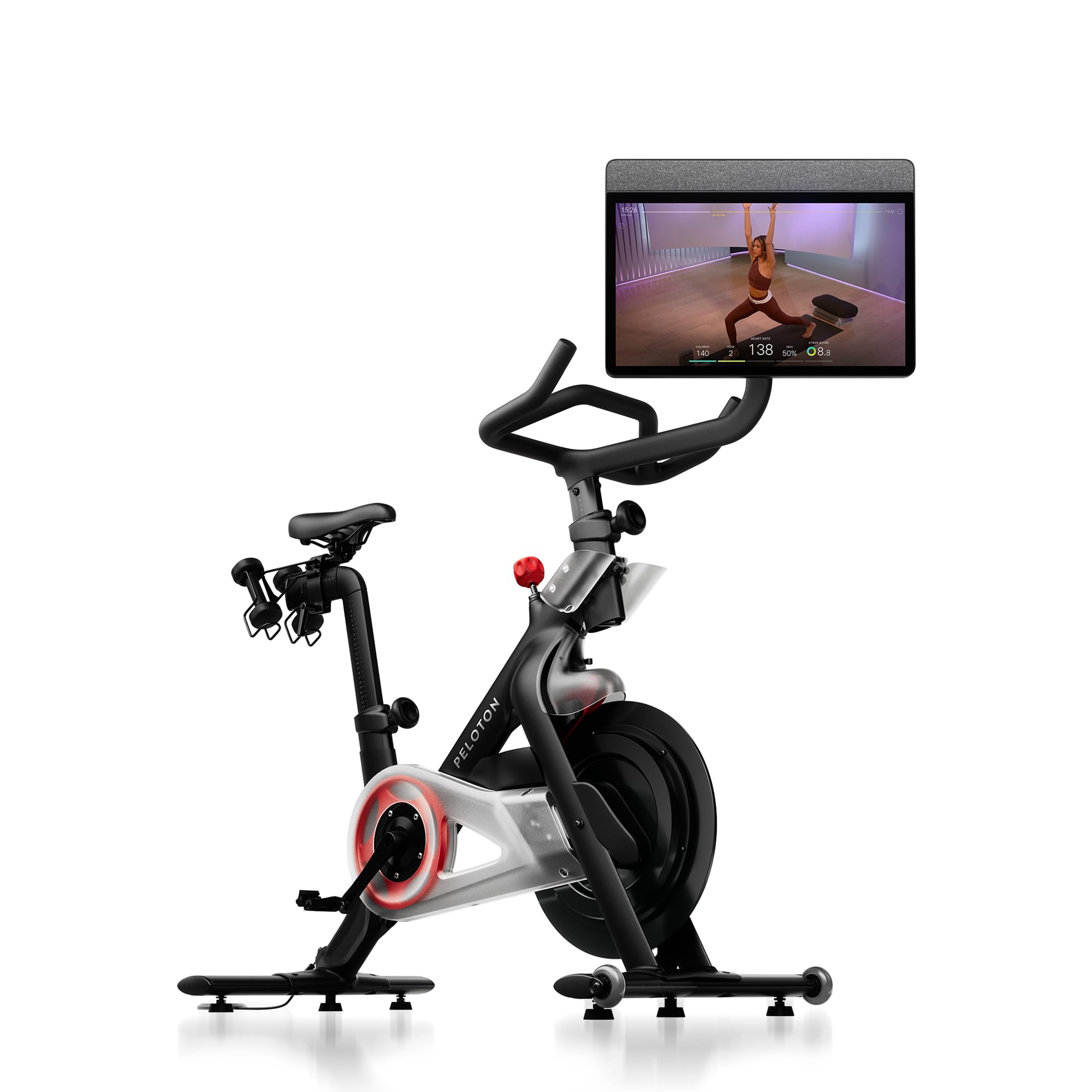
Peloton Bike
Key Features
- Screen: 21.5" swivel touchscreen
- Resistance: 100 magnetic levels
- Rider height: 4’11" to 6’5"
- Weight capacity: 297 lb
- Price: Premium
The 21.5-inch swivel screen is the product; the bike is what holds it up. It tilts and turns through 360 degrees, so a strength or yoga class can happen off the bike in the same corner of the room, and resistance, cadence and heart rate all feed into the on-screen class in a way none of the other bikes here can match.
This is the pick for someone who wants one subscription, one screen and no setup decisions. The catch is that the membership is a running cost which outlasts the hardware, so it only makes sense if you’ll use several classes a week. The bike itself is well built, rated to 297 pounds — the lowest here — and at 178 pounds it needs a permanent spot and a second person to move.
Everything else is competent rather than remarkable: magnetic resistance with 100 levels, a fit range from four foot eleven to six foot five, and a frame as solid as the money implies. You’re paying for the content and the integration. If that’s not what you want, a Bluetooth bike and your own tablet get you most of the way there for far less.
Pros
- 21.5-inch swivel touchscreen
- Cardio, strength and yoga in one place
- 100 magnetic resistance levels
Cons
- Membership is an ongoing cost
- 178 lb, with the lowest capacity here
For people who want the classes to be the plan: a 21.5-inch swivel screen, live and on-demand sessions, and a solid bike underneath.
Best for Shared Households
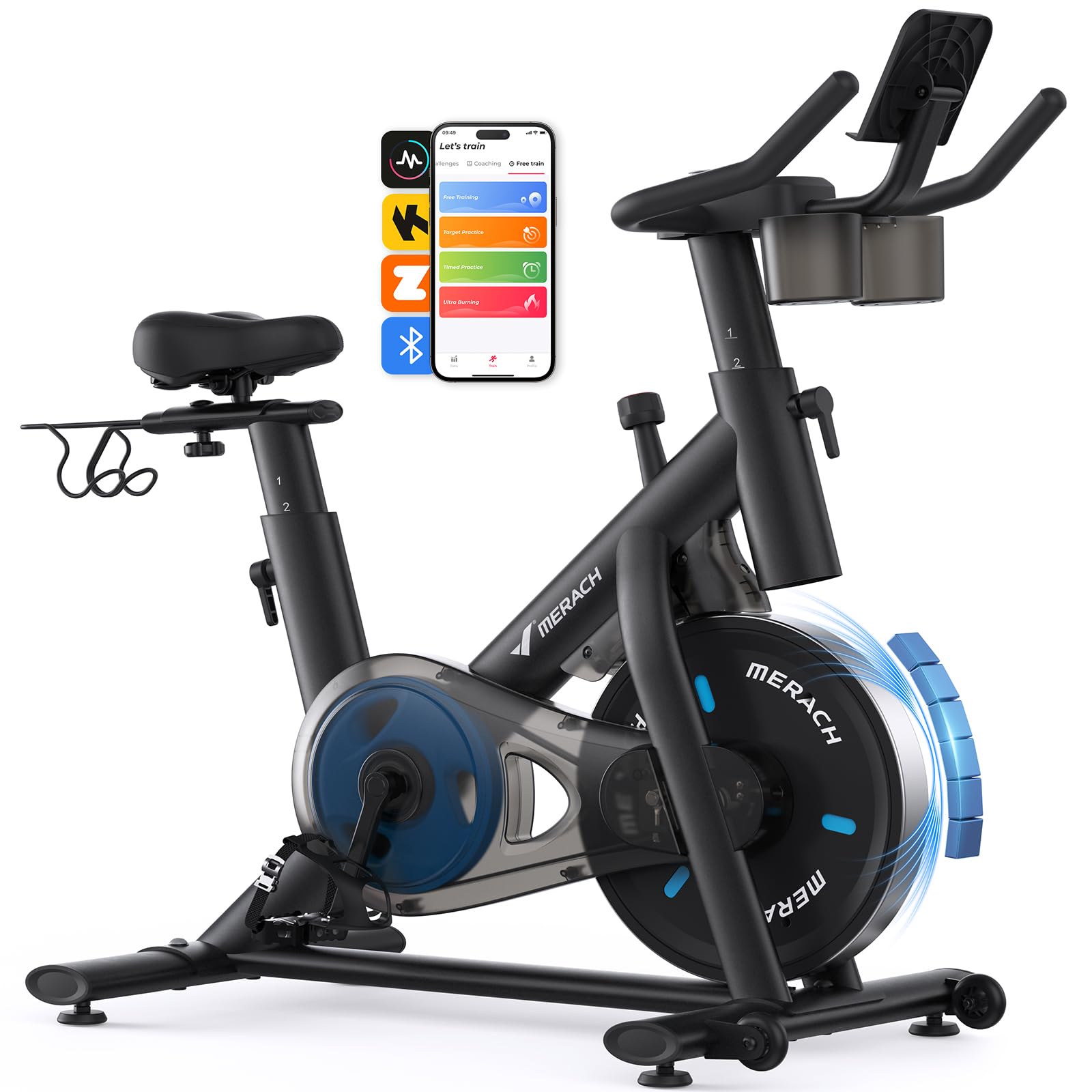
MERACH S26
Key Features
- Resistance: 8 magnetic levels
- Item weight: 62 lb
- Rider height: 4’8" to 6’2"
- Weight capacity: 300 lb
- Price: Midrange
Eight resistance levels is the number to know here. Where the IC4 and the pooboo let you nudge resistance in fine increments, the MERACH moves in eight steps — fine for steady endurance work, clumsy the moment a class asks for small changes on a climb.
The rest of the bike is pleasant. The 62-pound frame stays stable under standing efforts, the belt drive is quiet, and the seat and handlebars adjust across four foot eight to six foot two, which covers most pairs of riders in one household. The Merach app tracks your numbers and offers classes, and it does the job without being a reason to choose this bike over another.
The saddle is the other soft spot. It’s hard enough that a half-hour ride is about its limit for most people, and it’s the part of this bike most likely to be swapped first. Budget for that and the value picture improves.
Where it fits is straightforward: a household of two or three riders who want one quiet bike for steady miles and won’t miss fine-grained resistance. If you know you’ll be chasing cadence targets in a live class, spend a little more and get the hundred-level adjustment.
Pros
- Quiet belt drive on a stable frame
- Fits riders from 4’8" to 6’2"
- Merach app with workout tracking
Cons
- Only eight resistance steps
- Hard stock saddle
A quiet, stable everyday bike for a shared household, held back by eight resistance steps and a hard saddle.
Best for Quick Setup
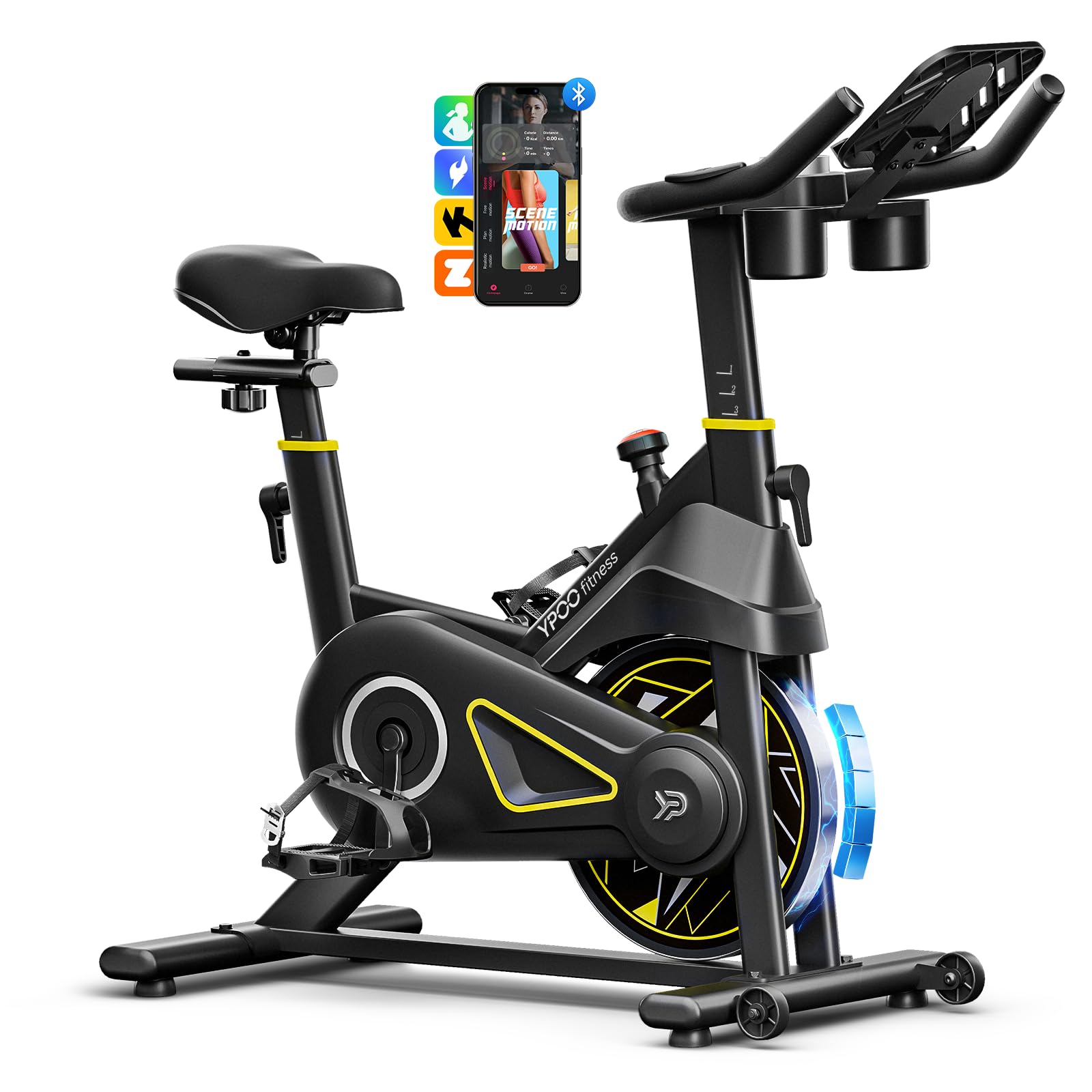
YPOO BC710
Key Features
- Footprint: 32.9" D x 19.3" W
- Resistance: 16 magnetic levels
- Pre-assembled: 80%
- Weight capacity: 300 lb
- Price: Budget
Eighty percent of the YPOO arrives already built. What’s left is the handlebars, the pedals and the console — about half an hour with the included tools, and the least fiddly flat-pack job in this group.
On the bike, the 16 resistance levels are the compromise: enough for a climbing session, not enough to fine-tune a sprint interval the way a hundred-level bike lets you. The magnetic belt drive is quiet, and the 44-pound frame is light enough to roll into a corner after each ride, which is the point of a bike that only claims 32.9 by 19.3 inches of floor.
As a first spin bike or a second one for a small flat, it does the job for very little money. Watch the monitor — display failures turn up within the first few months on this one, so buy where a replacement is easy. Riders under five feet or over six should check the fit before ordering, because the adjustment range is narrower than the pooboo’s.
Pros
- 80% pre-assembled, about 30 minutes
- Quiet magnetic belt drive
- Light 44 lb frame rolls away
Cons
- Only 16 resistance steps
- Monitor can fail within months
The quickest bike here to set up and one of the cheapest: 16 resistance steps, a quiet belt drive and a light frame you can roll away.
Best for Tight Budgets
CURSOR CBE10

Key Features
- Footprint: 31.5" D x 21.3" W
- Resistance: Friction
- Seat adjustment: 4-way, 7 heights
- Weight capacity: 300 lb
- Price: Budget
A friction pad presses on the flywheel here rather than magnets doing the work. That’s the oldest way to build a spin bike and still a sound one: resistance comes on continuously, and a quarter turn adds load without stepping through levels.
At 39.7 pounds it’s the lightest bike in the group, and 31.5 by 21.3 inches of floor puts it second only to the CHAOKE for tight rooms. Assembly is quick and largely tool-free, and the seat has seven height settings plus fore and aft movement — more adjustment than you’d normally find at this end of the market.
Two things follow from the mechanism. The pad wears and needs readjusting as it does, and the resistance is least even at the very bottom of the range, where a magnetic bike feels silky. Neither will bother someone doing steady half-hour sessions, which is who this bike is for.
Think of it as a first bike, a spare-room bike, or a test of whether you’ll actually ride at home before spending more. The 300-pound capacity and the simple frame won’t flatter a serious rider, but a beginner chasing half-hour sessions through a winter won’t notice the difference.
Pros
- Lowest-cost bike in the group
- Light 39.7 lb, easy to move
- Seven seat heights plus fore-aft
Cons
- Friction pad wears and needs readjusting
- Less even at the lightest settings
The least expensive way into home spinning: a light, simple friction bike that suits steady sessions and first-time riders.
How We Chose and Tested the Best Spin Bikes
We started by comparing frames, flywheels, resistance systems, and the range of seat and handlebar adjustment, then narrowed the field to eight bikes that covered different footprints and price points. I assembled every one solo in a spare room, timing the process and noting whether the instructions matched the hardware and whether the included tools were actually usable. Then we rode: 20-minute intervals before work, 45- to 60-minute weekend sessions, and repeated standing climbs while watching for side-to-side rock. For noise, I rode at 5:30 a.m. with a bedroom door closed and listened for belt whine, pedal clunk, and floor vibration.
Fit and comfort got equal attention. Riders from 5-foot-2 to 6-foot-3 took turns, changing seat height, fore-aft position, and handlebars each time, and we noted whether the bike truly fit or merely adjusted. We logged pressure points at 10, 30, and 45 minutes, with and without padded shorts, and paid attention to seat size and shape rather than assuming a bigger saddle was better. We also checked welds, pedals, and resistance mechanisms for finish and play, because a bike that feels fine on day one can develop a squeak or a loose crank later.
After nine months, we rechecked resistance smoothness, frame wobble, and any new noises, then weighed what each bike included against its cost. Value wasn’t about the lowest price; it was whether the build, seat, and adjustment range felt worth living with. The bikes that made the list were the ones that stayed quiet, stable, and comfortable enough that we kept choosing them over the alternatives.
How to Choose a Spin Bike
Two decisions do most of the work — what you’re pedalling against, and whether the bike actually fits you — and a cheap bike that gets both right will serve you better than an expensive one that doesn’t.
Magnetic or friction resistance
Magnetic bikes move a magnet closer to or further from the flywheel, so there are no wearing parts and the effort changes quietly and smoothly. Friction bikes press a felt or wool pad against the flywheel instead: cheaper to build, continuous in feel, but the pad wears, needs readjusting, and adds noise under load.
For an apartment or a house with early risers, choose magnetic. For steady endurance riding on a tight budget, friction is workable — just expect to tighten or replace the pad every few weeks. Every bike here except the CURSOR is magnetic, and the Schwinn IC4 and the pooboo both give you 100 levels to work through.
Fit comes before features
A reach that’s too long or a seat that won’t rise high enough ends with a sore back and an unused bike, so check the stated height range before anything else. How the seat moves matters just as much: four-way adjustment (up, down, fore, aft) is worth more than two-way, especially when two people share the machine.
The field here spans roughly four foot seven on the CHAOKE to six foot five on the Peloton, so measure rather than assume. And read the word compact carefully — on a listing it describes the footprint, not the fit.
Floor space, weight and where it lives
Spin bikes are deeper than they look: around 32 inches at the small end (CHAOKE, CURSOR, YPOO) and 54 inches for the IC4 and Peloton. Leave a couple of feet behind the bike for getting on and off, and put it somewhere you’ll see it — a bike that lives behind a door gets ridden less.
Weight decides how that goes. A 40-pound bike rolls into a corner after each ride; a 112- or 178-pound bike is furniture, and it should be treated as a permanent resident before you order it. If it’s going upstairs, settle that question before delivery day.
Built-in screen or your own tablet
Only the Peloton bundles a screen and classes, and its membership is a running cost on top of the hardware. Everything else here is a Bluetooth bike: it pairs with an app — Peloton’s own, Zwift, Kinomap, JRNY or a brand app — and you supply the phone or tablet.
If you already pay for a cycling app, a Bluetooth bike is the better buy, because you aren’t paying twice and you can switch apps later. If you want one bill, one screen and no setup decisions, that’s exactly the case the Peloton makes.
Plan for a saddle swap
Almost every bike in this group ships with a firm, narrow saddle, and the first week of longer rides is where that shows. Give it two weeks and a pair of padded shorts before you decide, then buy a wider saddle with a cutout if you’re still shifting around in the second half of every ride.
It’s the cheapest change you can make and it alters more than any other. Match the seat post diameter when you order — check the listing or take the old saddle with you — and keep the original for anyone else who rides.
Frequently Asked Questions
Do I need special shoes for a spin bike?
No. Most bikes here come with adjustable toe straps or cages that take ordinary trainers, and the Schwinn IC4’s pedals flip to accept clip-in cleats on one side and regular shoes on the other. If you already own SPD or Delta shoes, check the pedal type before ordering — swapping pedals is an extra job and an extra cost.
How do I stop the pedals in a hurry?
Push down on the resistance knob. On nearly every spin bike it doubles as the brake, adding load until the flywheel slows and stops. Practice it once at low speed before your first hard interval so your hand knows where it is — on the magnetic bikes here the knob is the only brake you have.
What maintenance does a home spin bike need?
Less than you might expect, but not none. Check the pedals and crank bolts every few weeks, because they carry the load in standing efforts and are the parts that fail first. Wipe sweat off the frame and flywheel after each ride, tighten the seat and handlebar collars when they work loose, and readjust or replace a friction pad once resistance starts to slip.
Will a spin bike mark my floor?
It can, through sweat and through vibration. Put a dense rubber mat underneath — a yoga mat is too thin — and wind the leveling feet down so the frame doesn’t rock. Sweat is the bigger threat to the bike than to the floor, so wipe the frame and flywheel housing after every session and keep a towel over the handlebars.
Final Verdict
The Schwinn IC4 is the spin bike we recommend to most people: it’s the one here that feels like studio equipment, it pairs with whichever class app you already pay for, and its ten-year frame warranty suggests Schwinn expects it to stay in the room. The dated console and firm saddle are annoyances, not reasons to walk away.
If the price is more than a first bike deserves, the pooboo gives you 100 magnetic levels, a 350-pound frame and a quiet belt drive for a fraction of it, and gives up only polish. Choose the Peloton instead only if the classes themselves are what gets you onto the bike — that’s a content decision, not a hardware one.