This post contains affiliate links. We may earn a small commission when you buy through our links — at no extra cost to you.
There’s a half-second on a wet root where you feel your foot start to slide, and everything after that is damage control. Flat pedals are supposed to be the answer — a wide platform and a wall of pins holding your shoe exactly where you put it. The trouble is the spec sheet tells you almost nothing: a big platform can be so thick there’s nothing to wrap your foot around, and pins that feel aggressive in the driveway can disappear under a muddy sole by the second lap.
A dozen pairs have been under my feet for the past eight months: rock gardens, a bike park weekend, wet morning laps, and the paved ride to the trailhead. Nobody tells a first-time buyer that grip comes from how pin height, platform thickness, and shoe rubber work together rather than from pin count — or that the least expensive pair here out-held several that cost far more. The picks below are the ones my feet kept reaching for.



Best for Trail and Enduro
OneUp Composite
Key Features
- Pins: 10 per side
- Thread: 9/16 inch
- Weight: 12.5 oz
- Platform: 115 x 105 mm
- Price: Midrange
Thirteen point three millimetres at the thinnest point, a 115 by 105 millimetre platform, and a body that bulges gently through the middle: the OneUp Composite is the pedal we point most trail riders toward. That slight convex shape is the detail we came to appreciate, because the platform settles into the arch of a foot instead of pressing on it, and the thin body leaves more room between the pedal and the rocks.
Ten hexagonal pins a side give it the bite that makes a flat-soled shoe feel attached, and every one of them is replaceable, so a season of rock strikes does not retire the pair. The width does real work too: 115 mm catches the whole shoe, which means you can shuffle your foot back for a descent without hunting for the edge of the platform.
At 355 g it is not the lightest composite pedal here, but the weight sits in a chromoly axle and a body that feels solid underfoot rather than flexy. Against the alloy picks it gives up a little stiffness and the machined finish; against the cheap nylon pedals it gives up nothing that shows up on a trail.
The caveat is longevity. Some of these have cracked or torn a pin out of the plastic under repeated hard hits, and a pedal that fails mid-descent is worse than one that just feels vague. Ride rocky terrain every weekend and the Race Face Atlas is the sturdier spend; ride trails a few times a week and replace a pedal every few seasons, and this is still the one we buy.
Pros
- Large 115 x 105 mm platform
- Ten replaceable pins per side
- Thin 13.3 mm leading edge
- Convex shape sits into the foot arch
Cons
- Body can crack under repeated hard hits
Our default recommendation: the OneUp Composite puts a large, thin, ten-pin platform under your foot for trail riding, and nothing else here balances grip, weight and width as well.
Best for Budget Alloy Build
GEWAGE CNC Alloy
Key Features
- Body: Aluminum alloy
- Pins: 8 per side
- Weight: 10.6 oz
- Platform: 100 x 104 mm
- Price: Budget
An aluminium pedal at nylon money is the sort of claim that usually falls apart on inspection, and the GEWAGE pair mostly holds up. CNC-machined alloy body, chromoly spindle, three sealed bearings inside, 300 g — lighter than several plastic pedals in this guide.
Value is the whole argument, and it wins. Eight replaceable pins a side give a secure, easily refreshed platform, the black gloss finish has more depth than the money suggests, and the 100 by 104 mm body supports most shoes without the overhang you feel on a stock pedal.
Width is where the compromise sits: at 100 by 104 mm it is a few millimetres narrower than the OneUp and the FIFTY-FIFTY, which only matters if your feet already hang off what you ride now. The box includes an installation tool and the warranty runs a year, which is the least we expect at this end of the market.
Pros
- Machined alloy body at budget money
- Sixteen replaceable pins, eight a side
- 300 g, light for an alloy pedal
- Three sealed bearings
Cons
- Narrower platform than the wide picks
We point value hunters at the GEWAGE pair: an alloy body, chromoly spindle and sixteen pins for about what the nylon pedals here cost.
Best for First Pedal Upgrade
FOOKER Nylon
Key Features
- Body: Nylon fiber
- Thread: 9/16 inch
- Weight: 12.64 oz pair
- Platform: 4.30 x 3.94 in
- Price: Budget
If your mountain bike still carries the pedals it shipped with — narrow, moulded in one piece, slick as soon as the trail turns wet — the FOOKER pair is the cheapest convincing way out. Nylon fibre body, chromoly spindle, sealed bearings, anti-skid studs on both faces, and 12.64 oz for the pair.
Grip is why it works. The studs are long enough to hold a flat sole through roots and rock rolls, and they can be replaced or swapped when they wear down or shear off. The 4.30 by 3.94 inch body takes most shoes comfortably, and the 9/16 inch thread is the standard size on modern mountain cranks.
For the money we think it is the least risky first upgrade here: the box carries the installation tool, spare screws and washers, and the two-year warranty is longer than most pedals at this price offer. Nothing about it feels expensive — the body is plain nylon and the finish is basic — but as a first real pedal it earns its place.
Pros
- Long studs hold a flat sole
- Tool, spare screws and washers included
- Two-year manufacturer warranty
Cons
- Long studs punish a slipped shin
- Narrower platform than the wide picks
For a first real pedal on a tight budget, we recommend the FOOKER pair — long studs, a spare-pin kit in the box, and a two-year warranty.
Best for Big-Footed Riders
Crankbrothers Stamp 1
Key Features
- Body: Composite
- Weight: 13.9 oz
- Platform: 3.94 x 3.94 in
- Warranty: 5 years
- Price: Midrange
Buying a Stamp means settling a question most pedals never ask: which size. Crankbrothers builds the range around foot length rather than one body stretched to fit everybody, so work out which size you are ordering before you commit, because the platform that arrives should sit under your shoe rather than the other way round.
On the bike it is a comfortable, confidence-inspiring platform: 3.94 inches square of composite, a pinned face that holds a flat sole, and 395 g that disappears underfoot. We rate it the best of these for riders with big feet, because a sized body solves a problem the others only widen.
Two things to know before you buy. Grip divides riders — push hard on steep, loose ground and it feels less locked-in than the sharpest pedals here — and some units develop side-to-side play between body and axle. The five-year manufacturer warranty is the longest in this guide and is the reason the Stamp stays on the list despite those notes.
Pros
- Body sized around foot length
- Five-year manufacturer warranty
- Light 395 g composite body
Cons
- Grip is not the strongest on aggressive terrain
- Some units develop play between body and axle
If your feet overhang a stock platform, buy the Stamp: it is the only pedal here sized around foot length rather than widened for everyone.
Best for Aggressive Descending
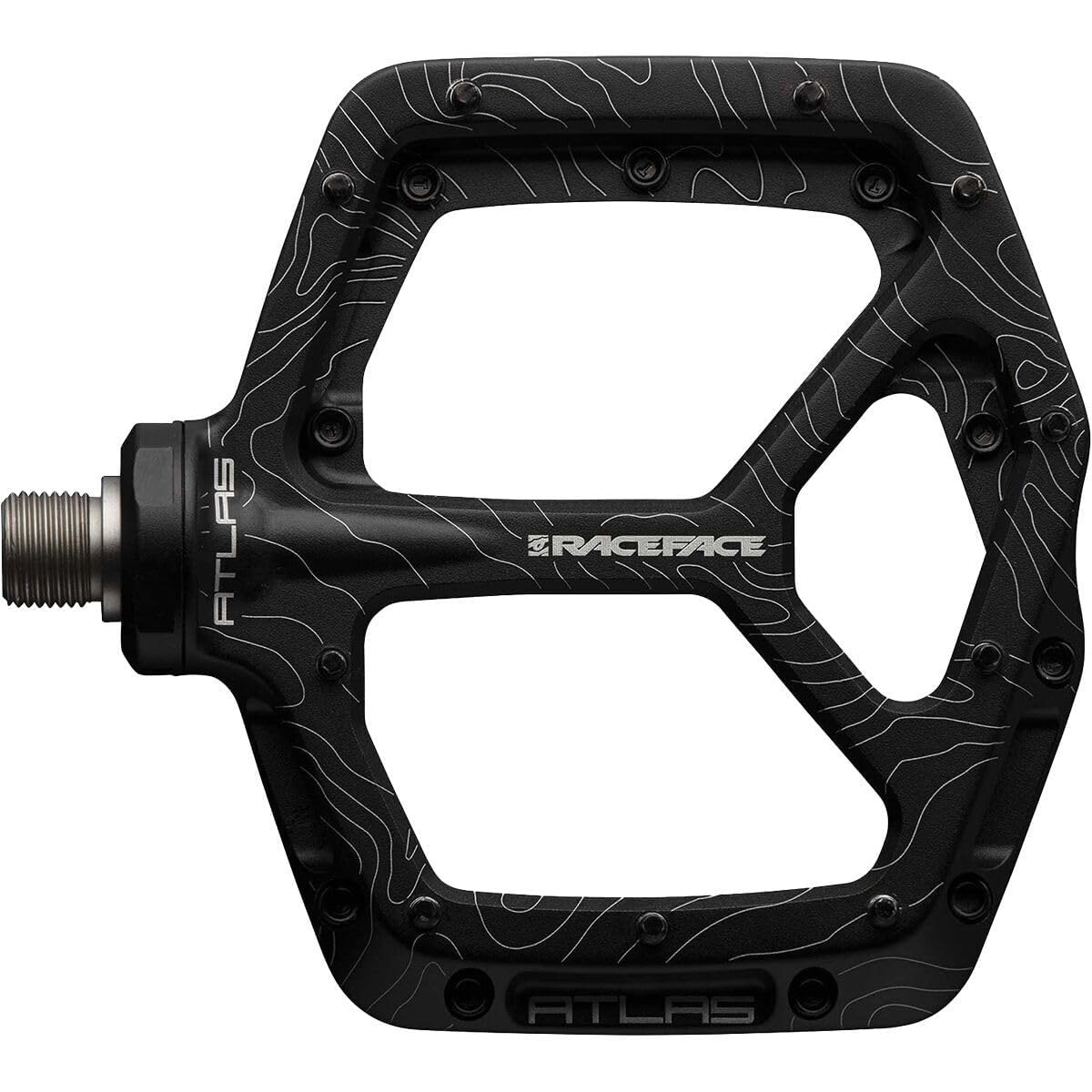
Race Face Atlas
Key Features
- Thread: 9/16 inch
- Weight: 13.3 oz
- Platform: 110 x 108 mm
- Thickness: 12 mm
- Price: Premium
The most expensive pedal in this guide is also the most heavily machined: a 110 by 108 mm aluminium body, 12 mm thick, dished from edge to edge, with replaceable pins and four spares plus 36 washers in the box. We rate it the premium pick for riders who descend hard and want a pedal they can keep rebuilding around fresh pins.
The concave shape is what sells it. Pins at the perimeter sit higher than the middle, so the sole drops into the platform instead of skating across a flat slab, and the effect on rough ground is a planted feeling the budget pedals cannot match. At 376 g it is not a weight-weenie part, and the long pins that make the grip also make a slipped pedal expensive for your shin.
Set it up properly and it stays put. A dab of threadlocker on each pin before the first ride is five minutes well spent, because they can back out otherwise. Downhill park riders who treat pedals as consumables will get more pedal than they need here; for enduro and all-mountain riding it is the premium choice in this set.
Pros
- Machined, dished aluminium body
- Spare pins and washers in the box
- Thin 12 mm platform
Cons
- 376 g is heavy next to the composite picks
Spend up if you ride hard and keep pedals for years: the Atlas is the machined, rebuildable premium choice here, and its concave body is why.
Best for Wide Platform Value
FIFTY-FIFTY Composite
Key Features
- Pins: 9 per side
- Weight: 12.4 oz
- Platform: 106 x 104 mm
- Thickness: 0.7 inch
- Price: Midrange
The gum colourway is the one that gets noticed, but the useful number is the platform: 106 by 104 mm, nine replaceable steel pins a side, and a body only 0.7 inch thick. At 351 g with a chromoly spindle, it is a mid-weight composite pedal that ships with spare pins, nuts and washers.
Grip is the strong suit. The pins are small and numerous, which lets a flat sole settle onto the platform instead of perching on spikes, and the width gives your foot somewhere to go when you shift weight back for a descent.
Two maintenance notes worth hearing. Check and tighten the spindle before the first ride — a loose one works against the crank threads — and expect the bushings to develop some play after a hard season. Neither is unusual at this price, and both are far cheaper than a new crank arm.
Where it lands for us is the middle of the range: it costs more than the budget nylon pedals and less than the composite leaders, and the extra buys width and finish rather than a different class of grip. If your frame has an accent colour you want to pick up, that counts for something too.
Pros
- Wide 106 x 104 mm platform
- Nine replaceable pins per side
- Slim 0.7 inch body
- Frame-matching colourways
Cons
- Bushings can develop play with hard use
We like the FIFTY-FIFTY for riders who want a wide platform and a colour that matches the frame without paying premium money.
Best for Light Trail Duty
ROCKBROS Alloy

Key Features
- Body: Aluminum
- Thread: 9/16 inch
- Weight: 11.3 oz
- Platform: 101 mm wide
- Price: Budget
Run a finger around the outside edge of these and you find what the photos hide: the machining leaves an edge sharp enough to catch skin. It is a small thing, and it tells you where the money went — into a CNC aluminium body and sealed bearings rather than into finishing.
The hardware is better than the price implies: aluminium body, chromoly spindle, sealed bearings, 320 g, and a 101 mm wide platform on a standard 9/16 inch thread. It is one of the lightest aluminium pedals here, and on a commuter or an e-bike that weight is the point.
Grip is where it gets inconsistent. With stiff-soled shoes the studs hold well enough; with softer or wet soles it feels slicker than the pinned faces on the OneUp or the FOOKER, which is the last thing you want on a rooty climb.
Then there is the long game. Bearings have let go early on some of these, and a pedal that works loose can chew the threads in a crank arm, turning a cheap set into an expensive repair. Our read is that it suits light trail, commuting and e-bike duty, where its looks and weight count for more than outright bite, rather than hard descending.
Pros
- Light 320 g aluminium body
- Machined finish that looks dearer than it is
- Chromoly spindle and sealed bearings
Cons
- Grip varies with shoe sole
- Bearings have failed early on some units
We rate the ROCKBROS alloy pedal for light trail and commuting duty, where its low weight and looks count for more than outright grip.
Best for Budget First Swap
JETCAT Alloy

Key Features
- Body: Aluminum
- Pins: 8 anti-skid
- Thread: 9/16 inch
- Weight: 10.7 oz
- Price: Budget
An aluminium pedal near the bottom of the price range is usually a heavy one. This JETCAT is not: 302 g, eight anti-skid pins, three sealed bearings, a 9/16 inch thread, and a hex key in the box so it can go on the same afternoon it arrives.
The pins are the interesting part. They are rounded rather than pointed, which is kinder to shins and shoe soles than the sharp spikes elsewhere in this guide, and it costs some bite in wet, loose conditions. On dry hardpack and gravel they hold fine; on a rooted descent you notice what you gave up.
That trade-off is exactly why we keep it on the list. For a rider swapping the stock pedals on a first hardtail, or someone who keeps catching a calf on a pinned platform, this is the least intimidating way into a real flat pedal, and the one-year warranty is the usual cover at this price.
Pros
- Light 302 g alloy body
- Rounded pins are gentle on shins and soles
- Hex key included for installation
Cons
- Rounded pins give up bite in wet, loose conditions
A gentle, light, inexpensive first upgrade: the JETCAT’s rounded pins suit riders who would rather not shred their shins or their soles.
How We Tested a Dozen Flat Pedals
We started with roughly 40 pairs pulled from brand catalogs, rider forums, and the parts wall at a local shop, then cut the list to 12 based on platform dimensions, whether spare pins came in the box, and whether the bearings and spindle could be serviced with tools most people already own. Over eight months, every pair went on the same two bikes — a hardtail and a 150mm trail bike — so the only thing changing between rides was the pedals.
Grip got judged on a root-and-rock loop we rode after rain, always in the same pair of shoes, counting how often a foot had to be repositioned and whether the pedal body could be felt through the sole. We added a bike park weekend and a few paved commutes, because a pedal that feels locked in on dirt can be miserable to spin across town. Out-of-the-saddle sprints and off-camber traverses were where stability sorted the group: some platforms let the foot roll toward the outside edge under hard cornering, and some didn’t.
In the garage, we measured each platform’s length, width, and thickness with calipers and weighed every pair with pins installed, since a wider body doesn’t help if it’s so thick your foot sits on top of it instead of around it. Once a month we grabbed the body and rocked it to check for bearing play, hosed everything down and listened for water, and logged bent or missing pins after rock strikes — the pins that sheared off were almost always the ones with no spares in the box. Finish wear got noted too, because anodizing that scuffs to bare silver in a month tells you plenty about the rest of the build.
How to Choose Mtb Flat Pedals
The right flat pedal comes down to platform size against your shoe and pin bite against your shins; the rest is materials and upkeep.
Match the platform to your shoe
Platforms in this group run from about 100 mm to 115 mm wide, and that span covers most riders. If your shoe overhangs the pedal, the foot rolls off the edge when the trail gets rough; if the platform is much wider than your shoe, you gain support and lose clearance. Trace your sole against the width before you buy — a platform within a few millimetres of your shoe is the sweet spot.
The trap is the word compact. A 100 mm pedal is compact beside a 115 mm one, and it is still wider than the pedal most bikes ship with, so do not talk yourself out of a genuine upgrade.
Pins, shoes and the grip you actually get
Pin count matters less than pin shape and what you wear. Tall, sharp pins bite a soft rubber sole and hold it, and they also open a shin. Rounded or shorter pins are kinder and let go sooner on wet roots. Ride in proper flat-soled cycling shoes and buy bite; ride in whatever trainers you own and start milder.
Replaceable pins are worth paying for. A rock strike that shears one pin should cost you a minute with an Allen key, not a new pair of pedals.
Composite or alloy, thin or thick
Composite bodies are cheaper and lighter, and they survive rock strikes by flexing; alloy bodies are stiffer underfoot and can be machined thinner. Thickness decides how often you clip a rock — the pedals here run from 12 mm to about 18 mm, and the thin ones sit noticeably higher off the ground on the same cranks.
Weight is the least important number on the page. Anything from 300 to 400 g a pair is normal, and saving 50 g is worth less than the extra platform width the same money usually buys.
What your money actually buys
Cheap pedals are not automatically worse and expensive ones are not automatically stronger. At the bottom you are buying a body and pins; in the middle you are buying better bearings and a more accurate shape; at the top you are buying machining, rebuildability and a longer warranty. Decide which of those you personally wear out.
If you kill a pedal on rocks every season, buy cheap and replace it. If you keep a set for years and rebuild it around new pins, the premium alloy pick earns its price.
Frequently Asked Questions
Can I fit these pedals to any mountain bike?
Every pedal here uses the 9/16 inch thread that modern mountain cranks take, so check your crank before ordering and you are set. The left pedal threads backwards and tightens counter-clockwise. Grease the threads and start them by hand so you never cross-thread an expensive crank arm.
Is it worth replacing the pedals that came on my bike?
Usually, yes. Stock pedals on budget bikes are narrow, moulded in one piece and have no steel pins, which is exactly why feet slide off in the wet. A wider pinned platform changes how secure a bike feels more than most upgrades at the same money.
If your current pedals are already metal and pinned, measure them first — you may only be gaining a few millimetres.
How much upkeep do flat pedals need?
Less than you expect, but not none. Every few rides, hold the crank and rock the pedal side to side; any movement means the bearings or spindle need attention before the pedal damages the crank. Swap bent or missing pins, and accept that shoe soles wear where the pins sit.
Final Verdict
We keep coming back to the OneUp Composite because it fixes the two things that make a flat pedal feel wrong — too little platform and too much thickness — without premium money. Start there unless a specific requirement pushes you elsewhere.
If your feet overhang a stock pedal, the size-specific Stamp is the better buy. If the budget decides, the GEWAGE puts an alloy body and sealed bearings under you for what nylon usually costs, and the FOOKER adds spares and a longer warranty for less again. Choose on platform width first, pins second, price third.