This post contains affiliate links. We may earn a small commission when you buy through our links — at no extra cost to you.
Mountaineering boots ask for a strange bargain. The stiffness that lets you kick steps into firm snow and edge on ice is the same stiffness that turns a long approach into an argument with your feet. Get the fit wrong, or buy a pair that needs 60 miles before it stops biting, and you’ll pay for it above treeline. What a good boot fixes is that arithmetic: ankle support under a heavy pack, warmth through a cold belay, a break-in you can finish in one season.
I’ve owned boots that climbed beautifully and hiked like cinder blocks, and comfortable ones that folded at exactly the wrong moment on a sidehill. So we didn’t chase climbing suitability alone — my team wore seven pairs for ten months on approach trails, scree, and refrozen morning snow, and noted the unglamorous stuff: blisters, sole wear, sizing exchanges, and whether the priciest pair actually felt better than the cheapest. What follows is what survived.


Best for First Alpine Boots
Salewa Condor EVO GTX
Key Features
- Sizing: Men’s
- Boot type: Mountaineering
- Listed weight: 1.7 lb
- Waterproof membrane: Gore-Tex (GTX)
- Price: Midrange
Salewa sells the Condor EVO GTX as a mountaineering boot, and it is the least expensive boot here that is built for that job rather than adapted to it. That matters more than it sounds. The money you keep is money toward crampons, and crampons are not optional — the boot is only half the system. We made it the top pick because it is the pair we can hand someone buying their first alpine boots without adding a warning about what it costs.
The long-run picture is what sold us. Pairs in this line get replaced after years of trekking and rocky walking rather than after a season, and the wear that shows up is cosmetic before it is structural. There is no obvious weak point in the way the upper and the sole are put together, which is not something we can say about every boot in this group. Sturdy is a dull word to use about a boot; it is also the word that keeps you from buying twice.
Fit is the thing to settle before you commit. The boot suits a narrow, flat foot at the usual size, and a fuller or higher-volume foot wants the half size up. Order both if you can and send one back. A mountaineering boot that pinches is not a boot you break in; it is a boot you sell at a loss.
Against the Makalu, which is wider and heavier-built and has the bigger following on support, the Condor is the one that fits more feet out of the box and asks less for the privilege. That is the whole case, and for most people it is enough.
Pros
- Real mountaineering boot, not a stiffened hiker
- Cheapest proper alpine boot in this group
- Years of service rather than a season
- Close fit for narrow, low-volume feet
Cons
- Fuller feet need a half size up
Our pick for a first alpine pair: a real mountaineering boot, the least expensive of its kind here, and steady over years rather than one season.
Best for Wide Feet, Heavy Loads
La Sportiva Makalu
Key Features
- Sizing: Men’s
- Boot type: Mountaineering
- Listed weight: 2 lb
- Price: Premium
Width decides the Makalu. It is built on a generous last, and that single fact settles most of the fit questions people bring to it: broad feet and high-volume feet get in and stay comfortable, narrow feet swim, and no amount of lacing rescues a boot that is too wide.
What the extra room buys is support under a load. Ankle and arch support are this boot’s reputation, and they hold: point it at a rough, steep trail with weight on your back and it behaves like a climbing boot rather than a trail shoe with a tall collar. That is the reason it earns a place here even though it costs more than our top pick and is fussier to live with.
The two costs are fit and time. The run is at least a half size small and often a full one, and the boot wants a few weeks of short walks before it stops announcing itself. Buy the size up, wear them around the house first, and the break-in stops being a gamble. Treat those as the entry fee rather than a defect and the rest of the boot makes sense.
Inspect the sole bond at the toe after each hard season. That habit, more than any specification, is what keeps a heavy boot like this in service year after year instead of turning a good pair into a wet-footed walk out.
Pros
- Generous width for a broad forefoot
- Strong ankle and arch support under load
- Climbs and carries weight on rough ground
Cons
- Sole separation can appear after about a year
- Runs half to a full size small
For wide feet and heavy packs, this is the boot: a generous last, strong ankle and arch support, and a break-in that pays you back.
Best for Steep, Hard Ground
SCARPA Fuego
Key Features
- Sizing: Unisex adult
- Boot type: Mountaineering
- Listed weight: 2 lb
- Price: Premium
Nothing about the Fuego is broken in when it arrives. It is the stiffest boot in this group by a distance — rigid through the sole, tight across the instep, unforgiving on anything flat — and the first weeks are work. Then it stops, and what is left is a boot that feels like equipment rather than a shoe.
That trade buys real support. On steep, broken ground the Fuego holds its shape instead of moulding to the lump under your arch, which is exactly what you want on rock steps, ladders and a fire line. It is as close to a work boot as anything here, and that is meant as the compliment it sounds like. Once it gives, comfort stops being the issue and long days on it stop being an event.
Fit catches people out. The Fuego runs small and snug, so half a size up is the norm rather than the exception, and the boot is narrow enough that a broad foot belongs in the Makalu instead. If you want something that feels good on day one, this is not it. If you want the boot that still feels like a boot when everything else has gone soft, the first month is a fair price.
Pros
- Stiffest, most supportive sole in this group
- Comfortable and blister-free once broken in
- Built for hard, professional-grade use
Cons
- Sole separation around the toe with hard use
Buy it if you want the stiffest, most uncompromising boot here and can live with a long, uncomfortable break-in.
Best for Alpine Approaches
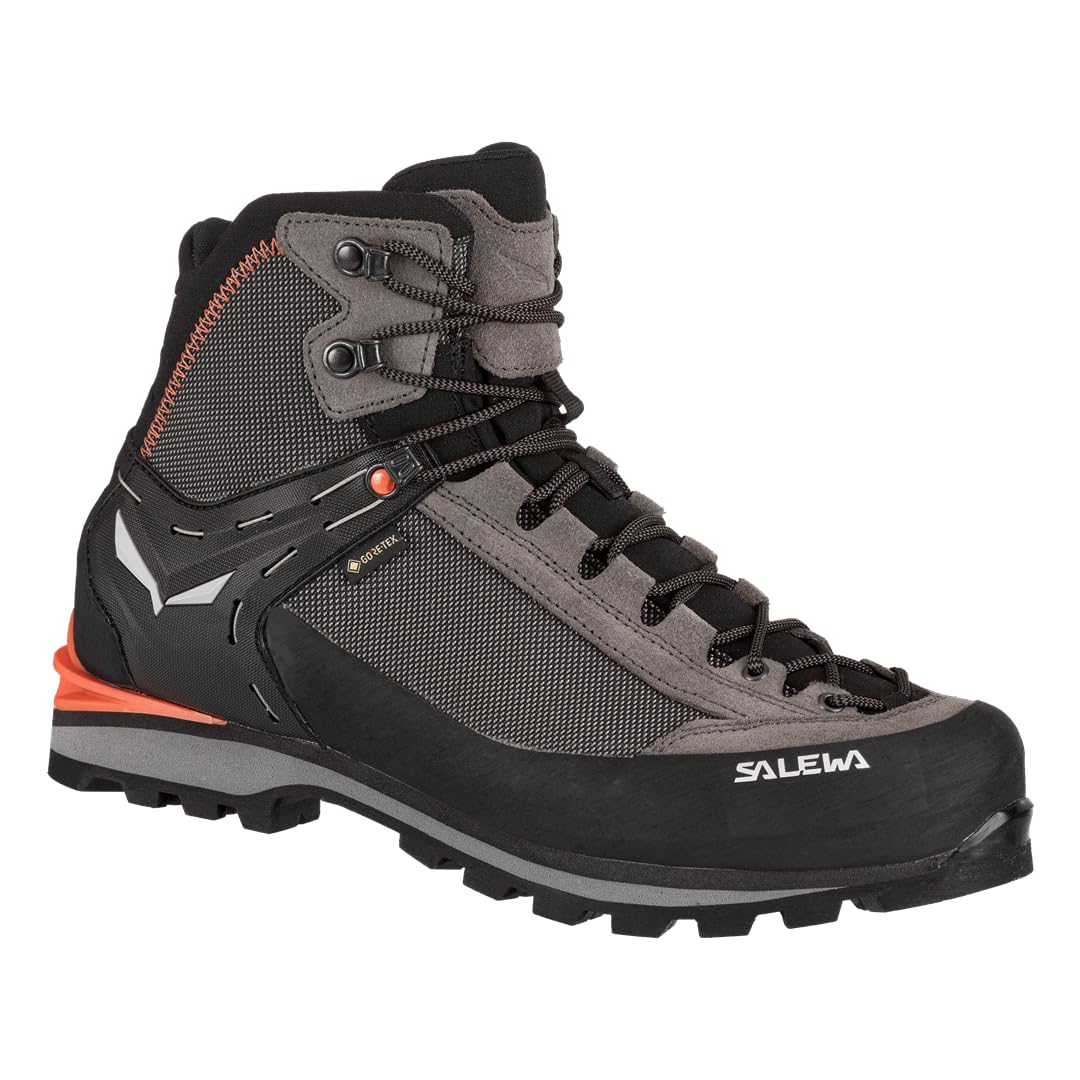
Salewa Crow GTX
Key Features
- Sizing: Men’s
- Boot type: Hiking boot
- Waterproof membrane: Gore-Tex (GTX)
- Price: Midrange
The Crow GTX is the boot we point people to when their mountaineering is really alpine rock, scree and the odd snow patch. It is sold as a hiking boot, it has a genuinely stiff sole and a supportive upper, and it undercuts the two heaviest alpine boots here. It is also the one boot in this group that does not belong on a glacier, and we would rather say that plainly than let the price do the persuading.
The sole is the interesting part. It is stiff enough to hold an edge on rock and stiff enough for spike and gaff work, which is an odd thing to be able to say about a hiking boot and says a lot about the midsole underneath. It also handles long days without blister trouble, and it does that at a price that makes the approach feel less like a chore than it does in a full alpine boot.
Where it gives up ground is water and slush. Deep puddles get through in a way a full alpine boot should not, and the fit runs snug enough that a half size up is worth planning for. For summer rock, a long approach and the occasional snowfield, neither of those matters much — and the money you save buys a better pair of socks than the ones in your drawer.
Pros
- Stiff sole that edges and holds on rock
- Long days without blister trouble
- Durable, supportive build for less money
Cons
- Not built for deep slush or standing water
- Sizing runs small and snug
A stiff, supportive boot for alpine approaches and rocky ground at a lower price than the heavy alpine pairs — just not a glacier boot.
How We Tested: Ten Months, Seven Pairs, One Long Season
The shortlist came from spec sheets rather than marketing copy: crampon compatibility, last width, insulation, rand height, and weight per pair. We filtered for boots spread across price tiers so value could be judged honestly, and seven pairs made the cut, from a burly winter model to lighter three-season boots.
For ten months they went where boots actually go: loaded approaches with a heavy pack, long talus fields, sidehills on refrozen snow, kick-stepping up a firm slope, and one short front-pointing pitch. We noted where each boot felt planted and where it rolled, whether the stiffness that helped on ice made the walk in miserable, and how well the ankle collar locked the heel down under weight.
Break-in got its own log. Every pair started with short two-mile walks, and we checked the heel, instep, and toe box for hot spots afterward, then counted the miles before a boot stopped needing attention. Warmth was judged standing still in wind for twenty minutes — the belay test, not the hiking test — and durability by inspecting toe rands, welt seams, and lace hardware after each rocky outing.
We ordered a half size up and down where we could, recorded how accurate each sizing chart turned out, how quickly exchanges came back, and whether returns were free. Every pair got the same final question: does this feel like the money it costs?
How to Choose Mountaineering Boots
The first question is not which boot but whether you need one: a mountaineering boot exists to hold a crampon and to keep your foot rigid on ground that will not hold it. Everything else follows from how much rigidity you actually need.
How much stiffness you actually need
Stiffness is the thing you are buying, and you pay for it in comfort. A rigid sole lets you edge on rock and puts your leg, rather than your foot, behind a crampon point; it also turns the walk to the snow into a flat-footed plod. The Fuego sits at the uncompromising end of this group and the Condor at the forgiving end. Match the boot to the ground you will really be on: mostly trail with a short snow section is a stiff hiking boot and strap-on crampons, not a rigid alpine boot you resent carrying.
Match the boot to your crampons first
Crampons and boots have to agree mechanically. Strap-on bindings go around almost any boot; step-in bindings need a welt at the heel and, for full step-in, at the toe, and hybrid bindings split the difference. Decide which crampons you are buying before the boot, or confirm the interface a boot takes before you commit. It is the one specification worth an email to the maker, because a boot that does not match your crampons cannot be used on the trip you bought it for.
Fit: width before length
Mountaineering boots are fitted with the socks you will climb in, for a heel that stays down. Width matters at least as much as length: the Makalu runs wide and suits a broad forefoot, the Condor a narrower one, and the Fuego and Crow both come up snug. Size for feet that swell over a long day, and treat a half size up as normal when a boot runs small. A boot your toes touch on the descent costs you a toenail and a lot of goodwill.
Break-in, and the sole as a wear item
Stiff boots of this type are not broken in when you unbox them. Give them weeks of short walks before a long day, laced looser at the top and firm across the instep, and accept that the first outing will not be the best one. The other long question is the sole: the bond between sole and upper is where boots in this category fail, and a look at the toe after each hard season catches it before a trip does.
Frequently Asked Questions
Do I need mountaineering boots if I already own stiff hiking boots?
Only if you are going where the hiking boot stops working: sustained snow, ice, or ground steep enough that you want your foot locked and a crampon driven by a rigid sole. For summer trails, rock and the odd snowfield, a stiff hiking boot with strap-on crampons covers the same ground for less money.
Will mountaineering boots keep my feet warm?
Not by themselves. Most boots in this group are uninsulated; warmth comes from the sock and from a fit that leaves room to move. A boot laced tight enough to climb in can still be cold, because a cramped foot has no circulation, so size for your thickest sock and keep the toe box loose enough to wiggle. For serious cold, look at an insulated or double boot instead.
How do I stop my heel lifting on steep ground?
Treat it as a lacing problem before a sizing problem. Lock the laces at the ankle with a second knot or a heel-lock eyelet so the lower boot holds your instep while the upper stays free to flex, and wear a sock with some substance rather than a liner alone. If the heel still lifts with the boot laced properly, the boot is the wrong shape for your foot.
Final Verdict
The Salewa Condor EVO GTX is the boot to buy first: a genuine mountaineering boot, the least expensive of its kind here, and a pair that keeps going rather than a season. Change the requirement and the answer changes.
Wide feet and heavy packs point to the Makalu. Ground hard enough to need the stiffest boot in the group points to the Fuego. A summer of alpine rock rather than glacier ice points to the Crow, which costs less and asks less of your first month.