This post contains affiliate links. We may earn a small commission when you buy through our links — at no extra cost to you.
Mountain bikes ask for a compromise: light enough to pedal up a climb, sturdy enough to survive the rock garden at the bottom. The wrong one makes every root feel like a warning shot; the right one just disappears under you. I’ve spent enough Saturdays fixing friends’ poorly assembled bikes to know the spec sheet rarely tells the whole story. What matters is how the bike holds up after the third muddy ride, whether the brakes still feel sharp, and if the seat leaves you sore before the trail does. A well-built bike fixes that: it stays tight, shifts cleanly, and lets you think about the line instead of the machine.
We rode seven mountain bikes for eight months on local singletrack, fire roads, and a couple of lift-served days. The best ones weren’t always the priciest; they arrived nearly ready to ride, stayed true after hard landings, and had front gearing that didn’t skip under load. Seat comfort and weight separated the good from the great; the picks below are the ones that got both right.


Best for Trail Riding
AVASTA Earth 27.5
Key Features
- Frame: Aluminum
- Speeds: 21
- Warranty: Lifetime frame; 2-year parts
- Wheel size: 27.5 inches
- Price: Midrange
Aluminum frame, trigger shifters, and a lifetime warranty on the frame: no other bike here puts those three together, and that combination is why the Earth is the one we recommend first. Aluminum keeps the weight down, the trigger shifters are easier to work with cold or gloved hands than the twist grips on most of the budget bikes here, and 21 speeds with a front derailleur give you a gear low enough for a real climb.
The fork switches off for pavement, which we appreciated more than we expected. On a towpath or a commute, a locked-out front end feels quicker and wastes less of your pedaling; flick it back on and the cushioning returns for roots and gravel. The 27.5-inch wheels roll over chunky ground better than the 26-inch bikes here without making the bike feel clumsy at walking pace.
It arrives 75 percent assembled, and the printed sheet is the weakest part of the package — follow the assembly video on the product page instead, especially when you set the front derailleur. Then spend an evening with the barrel adjusters or take it to a shop: new cables stretch, and a 21-speed drivetrain that’s slightly out of adjustment is the difference between a bike you ride and a bike you leave in the garage.
Nothing at this price is built like a bike-shop machine, and the Earth isn’t either — the derailleurs are entry-level, and the frame is the part worth keeping. What you get is the right set of compromises for mixed riding: a frame that lasts, gears that climb, and warranty cover on the part most likely to matter. Ride twice a week on trail, gravel, and pavement, and it’s the easiest of these to recommend.
Pros
- Aluminum frame keeps the weight down
- Trigger shifters beat twist grips
- Lifetime frame warranty plus two years on parts
- Switchable fork for pavement and trail
Cons
- Front-only suspension lets the rear kick through
- Wear parts excluded from the warranty
We recommend the Earth to most riders: it’s the only bike here with an aluminum frame, trigger shifters, and a lifetime frame warranty together, and it handles trail and pavement alike.
Best for Budget Trail Rides
WEIZE 27.5 Mountain Bike
Key Features
- Frame: Aluminum
- Brakes: Mechanical disc
- Speeds: 21
- Wheel size: 27.5 inches
- Price: Budget
The WEIZE is where the money stops going into the badge. For less than the midrange picks here you get an aluminum frame — the same material advantage the top pick has over the steel bikes in this group — plus 21 speeds with front and rear derailleurs, mechanical disc brakes, and 27.5-inch wheels. Where the savings land is the controls: twist grips rather than triggers, and a cockpit that feels a rung below the Earth’s.
We think it’s the best value in this group. What you’re buying is the important half of a mountain bike — a light frame, a wide gear range, and brakes that work — and what you’re giving up is polish. For a first trail bike, a commuter that sees gravel on weekends, or a second bike for someone who rides occasionally, that trade makes a lot of sense.
Plan for assembly. It shows up 85 percent built, the box doesn’t include every tool you need, and both derailleurs and the brakes want a proper adjustment before the first ride. That’s normal for a mail-order bike, and the aluminum frame and 27.5 wheels make the effort worthwhile. If you’d rather not touch a barrel adjuster, put the money into a shop assembly instead of a more expensive bike.
Pros
- Aluminum frame at a budget price
- 21 speeds with front and rear derailleurs
- Best value in this group
Cons
- Twist shifters are harder on the hands than triggers
Pick the WEIZE if you want the aluminum frame and 21 speeds without paying midrange money; we think it’s the best value in this group.
Best for Heavier Riders
Ktaxon 27.5 Mountain Bike
Key Features
- Frame: High-carbon steel
- Weight: 35.3 lb
- Wheel size: 27.5 inches
- Max rider weight: 264 lb
- Price: Midrange
Ride quality is where the Ktaxon earns its place. The 27.5-inch wheels and the steel frame add up to a planted, smooth ride over chopped gravel and rooty towpaths, and the trigger shifters are the real thing — you can run through the cassette without moving your hand off the bar, which the twist-grip bikes here can’t match.
The steel is also the catch. At 16 kg it’s one of the heavier bikes in this group, and you feel it on a long climb or when you lift it onto a rack. In exchange you get the highest stated rider limit here, 264 pounds, and a frame that doesn’t chase every ripple in the surface. Warranty cover is the shortest in this group at 30 days, so treat the first month as your window to find problems.
Where it lands for us is a comfortable, well-equipped hardtail for a rider who wants stability more than speed. Durability is the open question: the chain and rear derailleur are the parts to watch, and keeping chain tension right and the derailleur adjusted is what keeps them working. If you’re a heavier rider, or you ride broken surfaces and want the bike to feel settled underneath you, this is the pick.
Pros
- Smooth, planted ride on 27.5-inch wheels
- Highest stated rider limit here
- Trigger shifters at a midrange price
Cons
- 16 kg steel frame is heavy on climbs
- 30-day warranty is the shortest in this group
A solid choice for heavier riders: the 264-pound rating and smooth steel ride make the Ktaxon the most planted bike here, if you can live with the weight.
Best for Fat-Tire Comfort
Mongoose Dolomite
Key Features
- Speeds: 7
- Weight: 52 lb
- Wheel size: 26 inches
- Rider height: 5’4" to 6′
- Price: Premium
The Dolomite’s oversized knobby tires are the whole reason to look at it. On sand, loose gravel, and root-laced towpaths they float where a 27.5 hardtail skitters, and the steel frame underneath feels planted rather than nervous — sturdiness is the most consistent thing about this bike, and it holds up under bigger riders.
It’s also the heaviest thing here at 52 pounds, and the seven-speed drivetrain is the trade that comes with fat tires. On a steep climb you’ll run out of gears and get off and push; on a flat rail trail, neither matters, and the ride is genuinely fun. Assembly is the easiest in this group: it goes together quickly and the instructions are good enough to follow without help.
We like it for exactly what it is — a fat-tire cruiser for loose, flat ground — rather than for what the mountain-bike label implies. The rigid frame, the weight, and the seven gears all point away from climbs and technical descents. Bed the brakes in properly before you trust them on a hill, and keep the chain clean and tensioned; those are the parts that decide whether a good bike stays good.
Pros
- Fat tires float over sand and gravel
- Sturdy under bigger riders
- Easiest assembly in this group
Cons
- 52 pounds is a lot to push uphill
- Seven speeds run out on steep climbs
Buy the Dolomite for sand, gravel, and flat towpaths; the fat tires and sturdy steel frame are worth the weight if climbs aren’t on your route.
Best for Smaller Riders
AVASTA Thrax 24

Key Features
- Frame: Carbon steel
- Speeds: 21
- Warranty: 1 year manufacturer
- Wheel size: 24 inches
- Price: Budget
Not every rider wants a 27.5-inch wheel underneath them, and the Thrax is the bike here for anyone who finds a full-size frame a stretch. Twenty-four-inch wheels plus adjustable handlebars and seatpost mean a shorter adult or a teenager can reach the controls comfortably and get a foot down at a stop. It’s a 21-speed bike with a front suspension fork, mechanical disc brakes, and a kickstand, and 75 percent of it is assembled in the box.
For the money, this is the small-frame mountain bike we point shorter riders to: a steel frame, a one-year manufacturer warranty, and enough gears for a genuine hill. Two things to know before you order. The printed instructions are thin and the product video does the real teaching, and the front derailleur wants a careful setup before it shifts cleanly, so budget for a shop check if you’re not comfortable with limit screws. The 24-inch wheels are the real limit — they’re quick and easy to handle, but they don’t roll over roots the way the 27.5 bikes here do. For a shorter rider who wants confidence rather than speed, that’s a fair trade.
Pros
- 24-inch wheels suit shorter riders
- 21 speeds and disc brakes at a budget price
- One-year manufacturer warranty
Cons
- 24-inch wheels rule out taller riders
The one to buy for a shorter adult or a teenager: 24-inch wheels, adjustable bars, and a one-year warranty in a package that fits.
Best for Casual Paths
CamPingSurvivals Explorer 26
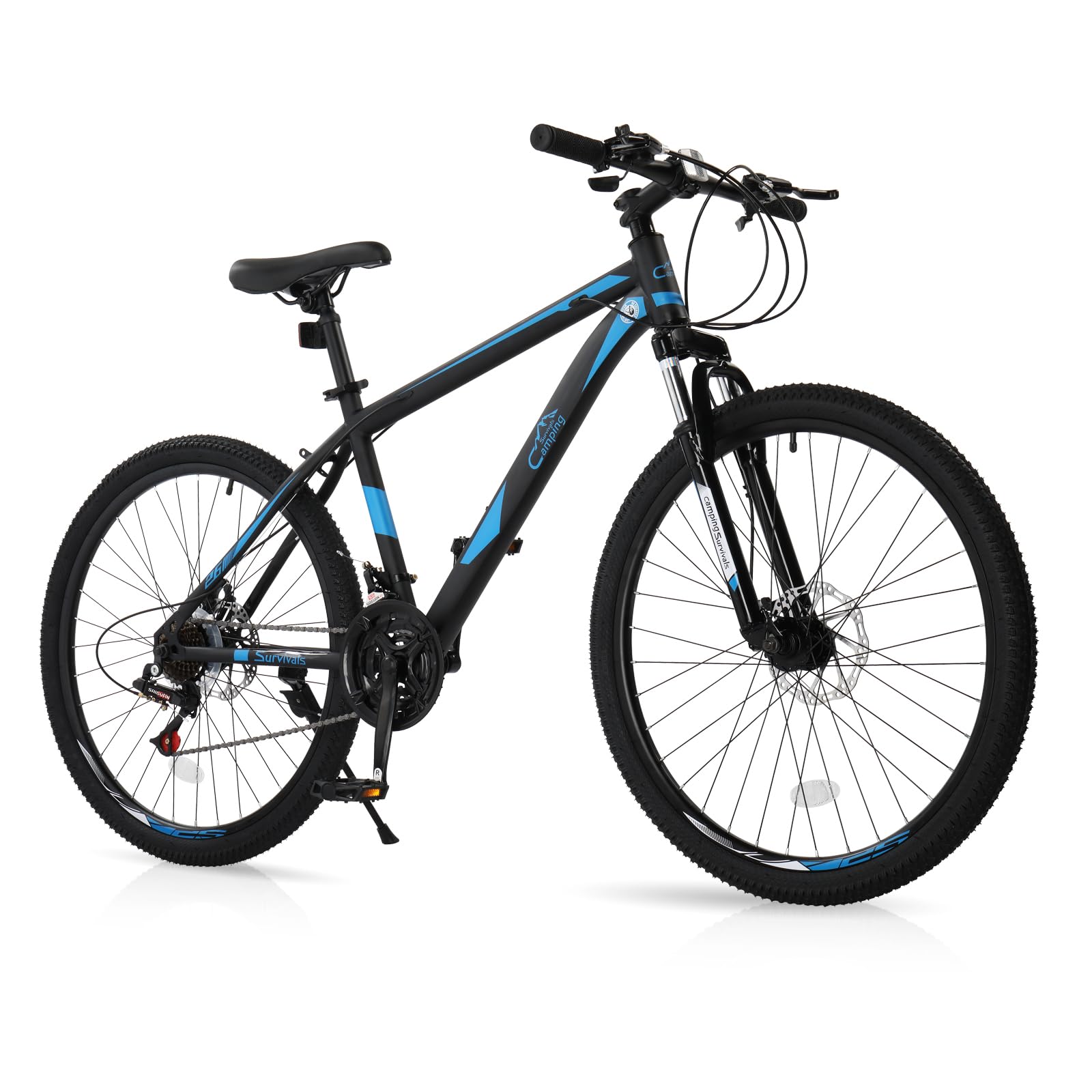
Key Features
- Frame: High-carbon steel
- Speeds: 21
- Suspension: Dual
- Wheel size: 26 inches
- Price: Budget
This is the cheapest way into a mountain bike here, and it buys a lot of hardware on paper: a high-carbon steel frame, dual suspension, 21 speeds, and disc brakes at both ends. It also arrives 85 percent assembled, so the first evening goes on the front wheel, bars, and pedals rather than a full build. What it doesn’t buy is the parts quality of the rest of this group.
Where it makes sense is a flat path, a campsite, or a commute — a bike that lives in a shed and gets used a few times a month. Where it doesn’t is a trail center: the suspension is comfort hardware rather than trail hardware, and if you get serious about riding you’ll outgrow it quickly. If you’re still working out whether you’ll actually ride at all, this is the least expensive way to find out.
Pros
- Lowest price in this group
- 21 speeds, disc brakes, and dual suspension
- Arrives 85% assembled
Cons
- Heavy steel frame and dual suspension
- Parts quality is a step down from the rest
Worth it only as a cheap first experiment: it puts 21 speeds and disc brakes under you for the least money here, with hardware to match.
How We Tested These Mountain Bikes
We started by pulling together the mountain bikes that kept surfacing in shop visits, owner forums, and staff picks, then filtered that list by frame-size availability, suspension travel, and price bands that made sense for most riders. From there, we bought seven bikes outright—no loaners—and rode them for eight months.
Assembly happened in a garage with a torque wrench and a floor pump, not a showroom. We timed how long each bike took to build from the box, noted whether the included tools were actually usable, and checked derailleur hangers, stem bolts, and brake alignment before the first ride. A few bikes needed only a front wheel and handlebar; others required careful front-gear adjustment before they stopped skipping under load.
On the trail, we ran the same loop—a punchy climb, a rooty descent, and a loose fire road—on every bike, repeated it in wet conditions, and took two lift-served days to push the descents harder. We paid attention to braking feel after mud, whether the seat stayed comfortable past the hour mark, and how much weight we noticed on steep switchbacks. After each ride, we checked wheel true, bolt tightness, and pivot play; by month eight, the bikes that held up were the ones that stayed quiet and shifted cleanly without constant fiddling. At the end, we stacked each bike’s trail performance against its price—brake spec, suspension feel, and how many parts needed replacing early—to judge value.
How to Choose a Mountain Bike That Fits and Lasts
Two things decide whether you actually ride the bike you buy: whether it fits you, and whether the frame and drivetrain survive a season of it. Everything else is detail.
Frame material and what it costs you
Aluminum and high-carbon steel both work at this price; they feel different. Aluminum is the lighter of the two, and the aluminum bikes here are the ones you can carry up a flight of stairs or lift onto a roof rack without thinking about it. Steel is cheaper and takes some of the buzz out of rough ground, but it adds weight — the steel Ktaxon here is listed at 16 kg, roughly a third more than you’d expect from a comparable aluminum frame.
If two bikes are otherwise close, pay the difference for aluminum. You’ll notice it on stairs, on a rack, and on the last climb of the day, and it’s the one upgrade that doesn’t wear out.
Fit comes before component count
A 27.5-inch wheel suits most adults, but wheel size is a rough proxy rather than a fit chart, and a 26-inch wheel doesn’t make a bike small — the frame does. The number that matters is standover clearance: straddle the frame with both feet flat and you want an inch or two between you and the top tube. Then check the seatpost; if it’s near its minimum insertion mark just to reach your pedal stroke, the frame is wrong.
The Mongoose Dolomite states its range as 5’4" to 6′, and the 24-inch AVASTA Thrax is built for riders who find a full-size frame a stretch. If you’re between sizes, take the smaller one.
Gears, brakes, and the suspension worth paying for
All six bikes here run disc brakes, so the real differences are gearing and suspension. Twenty-one speeds with a front derailleur give you a low gear for climbs; if you’ll ride anything steep, look at the cassette range rather than the headline number, because a seven-speed is a flat-ground setup. On suspension, a front fork is the useful part at this price — dual suspension on a heavy steel frame mostly adds weight.
Whatever you buy, plan for a brake bedding-in and a derailleur adjustment before your first real ride. Mechanical discs feel wooden until the pads seat, and a front derailleur set up in a hurry will rub under load.
Assembly, tools, and the warranty line
Mail-order bikes arrive 75 to 85 percent assembled, and the last stretch is the part that matters: bars, front wheel, pedals, brake alignment, and derailleur limits. Tools are not guaranteed — one bike here includes a kit, others expect you to own Allen keys and a Phillips screwdriver. Keep the box until the bike is dialed in.
Warranty cover varies more than it should. A lifetime frame with two years on parts is the best in this group; a thirty-day window is the weakest, and it turns your first month into the period when you need to find any problems. Read that line before you order, not after.
Frequently Asked Questions
Do steel mountain bike frames rust?
They can, and the paint is what protects them. Wipe the frame down after wet rides, dry and re-lube the chain, and touch up any chip that reaches bare metal before it blooms. Store the bike under cover rather than leaving it out in the rain, and check the chain, derailleur bolts, and seatpost clamp after a wet week.
The steel bikes here — the Ktaxon, the Thrax, the CamPingSurvivals, and the Dolomite — are all painted, so a chip you ignore is the only place rust gets a start.
Can I fit a rack, basket, or child seat to a mountain bike?
Check the frame before you order accessories. Rack eyelets — small threaded holes above the rear axle — aren’t a given on mountain frames. If yours has none, a seatpost rack carries light loads and a frame bag takes the rest.
For a child seat, use one that clamps to the seatpost and stay inside the post’s stated maximum, or use a trailer that hitches at the axle. Don’t clamp anything to a suspension fork.
Do I need to swap the pedals or saddle right away?
Ride what comes in the box for a few weeks first. Stock flat pedals are fine in dry conditions; if your feet slip on wet roots, flat pedals with metal pins are the first upgrade worth making.
Saddle soreness in the first two rides is normal. If it persists, have a shop measure your sit bones and match the saddle width rather than buying the softest one you can find — width solves more than padding does.
Final Verdict
The AVASTA Earth is the bike we recommend. It’s the only one here that pairs an aluminum frame with trigger shifters and a lifetime frame warranty, and that combination is what keeps a midrange bike worth riding after the novelty wears off.
If the budget is the hard limit, the WEIZE gets you aluminum and 21 speeds for less. If your riding is sand, gravel, and flat towpaths rather than climbs, the Dolomite’s fat tires are the better answer — just accept the weight and the seven gears that come with them.