This post contains affiliate links. We may earn a small commission when you buy through our links — at no extra cost to you.
The first climb usually tells you everything: the rear derailleur skips under load, the fork flexes like a pogo stick, and you start doing math on what a new drivetrain is about to cost. A cheap mountain bike doesn’t have to be disposable, though — the ones worth buying put money into the frame and the parts that actually wear, and stay honest about the rest. What you’re really paying for is a season or two of proper trail time without a repair bill landing every month.
I’ve been burned by bargain bikes before, so this spring my team and I gathered ten of the most promising budget hardtails and rode them the way you would — green singletrack after work, gravel paths on weekends, a few laps at the local bike park, and one memorably muddy stretch of spring. Eight months on, some still shift cleanly and feel tight, and a couple are already showing exactly why they cost so little. The picks below earned their place, and I’ve flagged what each one gives up to hit its price.



Best for All-Round Trail Use
WEIZE 26-inch Mountain Bike
Key Features
- Brakes: Linear-pull V-brakes
- Rider fit: 5’2" to 6’2"
- Drivetrain: 18-speed twist shift
- Suspension: Front fork + rear coil shock
- Price: Midrange
Two figures tell you most of what this bike is: a rated rider weight of 275 pounds and a fit range of 5’2" to 6’2". Both are printed plainly on the listing, so you can check them against yourself before you order. That’s a big part of why the WEIZE is the one we point most riders toward. It also has the deepest track record of anything in this group, and when the parts are this inexpensive, that history counts for more than a spec-sheet advantage.
The suspension is genuine dual suspension — a front fork plus a rear coil shock, both working on the washboard gravel and root steps that make a rigid bike chatter. We think it’s worth being honest about what the rear shock buys: it takes the edge off, it doesn’t turn a steel frame into a trail machine. Up front, the 18-speed twist shifters take about one ride to learn, because you rotate the whole grip instead of flicking a trigger.
Linear-pull V-brakes handle stopping. They’re the low-tech option, and we appreciate that more the longer we spend with budget bikes: pads, cables and springs are all inspectable and adjustable with a couple of hex keys, and there’s no fluid to bleed or hose to damage. The tires are 2.13 inches wide, which is enough float for gravel paths and packed dirt without turning every pedal stroke into a slog.
High-carbon steel is the frame material, as it is on nearly everything at this price, and it shapes daily life with the bike: this is a machine you ride rather than a machine you carry. If it lives in a garage and rolls straight onto a path, you’ll never think about the heft. If it goes up apartment stairs or onto a rack twice a day, you will. A kickstand, reflectors and a one-year limited warranty round out a package that’s hard to argue with.
Pros
- Dual suspension front and rear
- Published 275 lb limit and 5’2"-6’2" fit
- V-brakes are simple to service at home
- Kickstand, reflectors and a one-year warranty
Cons
- Twist shifter can be nudged out of gear while carrying
We recommend it as the default cheap mountain bike: published fit and weight limits, real dual suspension and a year of warranty make it the easiest buy to get right for most adults.
Best for Budget Trail Riding
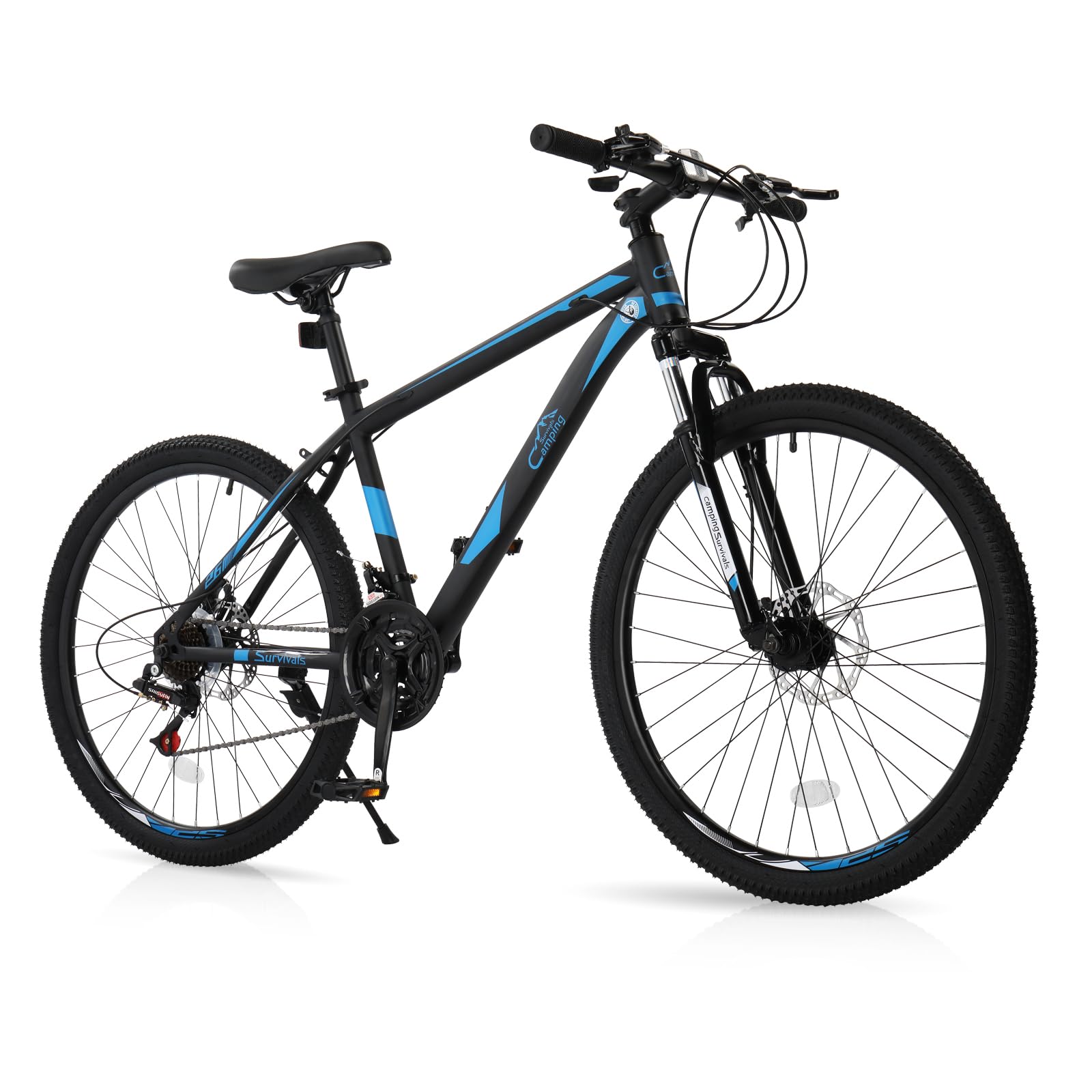
CamPingSurvivals 26-inch Mountain Bike
Key Features
- Brakes: Dual disc
- Assembly: 85% pre-assembled
- Drivetrain: 21-speed trigger shift
- Suspension: Dual, front and rear
- Price: Budget
Dual disc brakes at budget money is the reason this bike is on the list. Most cheap mountain bikes make do with rim brakes; the CamPingSurvivals fits a rotor at each wheel, pairs it with a 21-speed trigger-shifted drivetrain, and adds front and rear suspension on top. In the hand it feels like more bike than the price suggests.
We think the gearing is the underrated part. Twenty-one speeds with trigger shifters give you closer steps between gears than the 7- and 18-speed setups here, which is exactly what you want on a long fire-road climb where the next ratio up is too big a jump. The trade-off is that the parts doing that work are the least expensive on the bike — derailleurs, cables and brake hardware are what let a budget build down first. Check that the rotors aren’t dragging and the derailleur stops are set before your first proper ride; a slack chain and a rubbing pad are easy fixes in the driveway and miserable discoveries two miles out.
Setup is a genuine plus: it arrives 85% assembled, so handlebars, front wheel, pedals and seatpost are your job and the tools come in the box. That matters more than it sounds, because the two adjustments deciding whether a budget bike shifts cleanly and stops straight — derailleur indexing and pad alignment — are the ones a shop charges for and a video teaches for free.
Pros
- Dual disc brakes on a budget build
- 21 speeds with trigger shifters
- Arrives 85% assembled with tools
- Dual suspension front and rear
Cons
- No published rider height or weight limit
- More indexing to keep up than a 7-speed
Buy it if you want the most equipment for the money — disc brakes, 21 speeds and dual suspension; we think it suits riders who will learn to check and adjust their own gears.
Best for Low-Maintenance Riding
Max4out 26-inch Mountain Bike
Key Features
- Wheels: Quick-release
- Rider fit: 5’2" to 6’2"
- Drivetrain: 7-speed twist shift
- Suspension: Dual, front and rear
- Price: Midrange
Seven speeds looks like a step down next to the 18- and 21-speed bikes here, and on a steep, loose climb it is. Everywhere else it’s a feature: one shifter at the right grip, one derailleur to index, and a bike that spends its life between rides doing nothing at all instead of quietly going out of adjustment.
The rest of the package is sensible rather than exciting. Front and rear coil suspension takes the sting out of roots and gravel, the V-brakes are easy to live with, and the wheels are quick-release — the detail we were happiest to see. A quick-release skewer turns a roadside tube change from a chore into a quick stop, and it makes the bike easier to fit into a car. It’s sized for riders from 5’2" to 6’2", and a tool kit and a one-year warranty come with it.
We wondered whether seven gears would feel like a compromise on the rolling, rooty trails most of us actually ride, and the answer is that the range matters less than the jumps between gears do — until the road tilts up properly. Where it runs out is a long, sustained climb, where you’ll be standing and pushing while a 21-speed rider is still spinning. If steep climbing is your regular terrain, one of the 21-speed bikes here is the better buy.
Pros
- Seven speeds mean fewer adjustments
- Quick-release wheels simplify tube changes
- Dual suspension and a stated 5’2"-6’2" fit
Cons
- Wide gaps between gears on steep climbs
It’s the low-fuss pick: seven speeds and quick-release wheels mean fewer adjustments and faster fixes, and the fit range covers most adults.
Best for Heavier Riders
Omelaza 26-inch Mountain Bike
Key Features
- Warranty: 24 months
- Drivetrain: 7-speed twist shift
- Suspension: Front, with lockout
- Max rider weight: 330 lb
- Price: Budget
The number that earns this bike its place is 330 pounds — the highest rider weight rating in this guide and the reason it’s here at all. Around that rating sits a high-carbon steel frame, a front suspension fork with a lockout, and a 24-month warranty. If you’re a heavier rider who has been steered toward specialty bikes, this is the budget answer we point to, and the cover behind it is the longest of the four.
Seven speeds is the compromise, and the lockout fork is the consolation. Flip the fork closed on pavement and the front end stops bobbing with every pedal stroke; open it on gravel and it soaks up the small stuff. We were glad to see a lockout at this price, because it’s the difference between a bike that feels sluggish on a bike path and one that doesn’t. The 24-month warranty is the longest coverage here, and for a bike that’s going to get used hard, that’s the reassurance that matters most.
Pros
- 330 lb rider rating, the highest here
- Lockout fork stiffens for pavement
- 24-month warranty, longest in the set
Cons
- Wide gear gaps with only seven speeds
- Front-only suspension is firm over rocks
For heavier riders it’s the straightforward answer — the highest stated weight limit here, on a hardtail that’s simple to own and easy to keep running.
How We Tested the Best Cheap Mountain Bikes
We started with a shortlist of about 40 budget hardtails sold both direct-to-consumer and through shops, then narrowed it down on the things that actually separate a good cheap bike from a bad one: frame material and weld quality, whether the fork had a lockout or just a coil spring, hydraulic versus mechanical disc brakes, and whether the frame had mounts for a rack, fenders, or a second bottle cage. We bought ten of them ourselves and built each one in a garage with the tools most riders already own — the included multi-tool, a floor pump, and a torque wrench.
Every bike went through the same first month: a handful of commutes, a rooty green loop with loose gravel corners, and one deliberately wet ride. I re-checked every bolt after the first few rides, squeezed pairs of spokes to judge tension, and noted which bikes arrived with a derailleur hanger already slightly out of line. Then came the longer haul — eight months of regular riding, with a chain-wear gauge dropped in every few weeks, brake pads pulled and measured, and a running note of every creak, rattle, and part that worked itself loose.
Durability is where the field split. A few bikes needed nothing but air in the tires; others had wheels that wouldn’t stay true past the second month or a bottom bracket clicking away under load. For value, we priced out a realistic tune-up and a full drivetrain swap on each bike, then compared that against what the bike cost — a cheap bike with off-brand consumables can eat a third of its own price in replacement parts within a year, and the ones that held up best were the ones that needed the least.
How to Choose a Cheap Mountain Bike
At this price the frame is rarely the problem — the parts bolted to it are, so judge a budget mountain bike by its brakes, its gearing and whether it actually fits you.
Where the Money Goes
Every bike here uses a high-carbon steel frame, and that’s fine: steel is strong, forgiving and easy to repair. What decides whether you enjoy owning one is a level down — the fork, the brakes, the derailleurs, the wheels. A cheap bike with a decent fork and well-set brakes rides better than a slightly fancier frame with scrap parts hung on it.
So pick the bike whose brakes and gearing suit your terrain, then confirm the fit, and only then look at colour and graphics. Cosmetics are the one thing that never makes a ride better.
Disc Brakes or V-Brakes?
V-brakes squeeze the rim; discs grip a steel rotor at the hub. Discs keep more of their bite when the rim is wet or muddy, which matters if you ride through winter or splash through stream crossings. V-brakes are lighter, cheaper to replace and easy to adjust at home with one hex key, and on dry gravel and packed dirt they stop perfectly well.
The trap is assuming discs are automatically better. A budget disc setup that rubs, or whose pads were never bedded in, can feel worse than a well-adjusted V-brake. If you go for discs, check the rotor runs true and the pads are aligned; if you ride dry paths and want to handle your own maintenance, a V-brake is not a downgrade.
How Much Suspension You Actually Get
Dual suspension means a fork up front and a coil shock at the rear. On a budget bike that rear shock is a simple spring without much damping: it softens roots and washboard gravel, but it won’t make a heavy steel bike feel plush, and it adds pivots and hardware to keep an eye on.
A hardtail with a lockout fork is often the more honest trail tool at this price — lock it out for pavement and climbing, open it for gravel. Choose dual suspension when comfort on rough ground matters more than simplicity.
Gearing: 21 Speeds or 7?
More gears means smaller steps between them, which lets you hold a comfortable pedal rhythm on a long climb instead of lurching between ratios. Fewer gears means one shifter, one derailleur and much less to keep indexed, and the parts that wear out cost less to replace.
If your riding is hilly or you plan to build fitness, take the 21-speed. If it’s flat paths, a commute and the occasional trail, a 7-speed will ask less of you over a season.
Fit, Weight Limits and Wheel Size
Most 26-inch adult mountain bikes are built around a height range, and 5’2" to 6’2" is common here. The better listings also publish a maximum rider weight, and those numbers are not decoration: outside the range the bike handles badly and the frame works past its rating. If you’re over 6’2", look at a 27.5- or 29-inch model rather than stretching a 26.
If you’re a heavier rider, start with the rated weight rather than the frame material. And budget for one shop visit or one long evening with a video after the first few rides — that’s when cables stretch and budget components show whether they were set up right.
Frequently Asked Questions
Do I have to assemble a mountain bike bought online?
Most arrive largely built — the CamPingSurvivals ships 85% assembled, and some listings claim 95% — so your job is handlebars, front wheel, pedals and seatpost with the included tools. Spend your time on the two jobs that decide how it rides: centering the brake pads so nothing rubs, and indexing the rear derailleur so it shifts cleanly through every gear.
If either feels beyond you, a shop’s first-check service before your first proper ride is money well spent.
Can a cheap mountain bike handle real singletrack?
It will handle gravel paths, dirt paths, rooty wooded trails and rocky fire roads — that’s what the all-terrain tires and the suspension are for. What it is not built for is jumps, drops and lift-served downhill, where the loads run far past a budget fork, wheelset and V-brake.
If a trail has drops in it or a bike park in its name, it’s the wrong bike.
Are 26-inch wheels too small?
Not for this category. Twenty-six inches is the standard size at budget prices, and smaller wheels spin up faster, turn quicker and are easier to handle at low speed on tight paths. Larger wheels roll over roots and rocks better.
If you’re over 6’2" or ride mostly fast, chunky terrain, look at a 27.5- or 29-inch model instead.
What does upkeep cost after the first month?
Cables stretch as they bed in, so the gears and brakes that felt perfect on day one will need a small adjustment within the first few weeks. That’s normal, not a fault. After that it’s pads, tubes and chain lube.
Learning to index a derailleur and swap a pad yourself turns a recurring shop bill into an evening’s work, and it’s the biggest saving in budget bike ownership.
Final Verdict
If we’re choosing one, it’s the WEIZE. It publishes both a fit range and a rider weight limit, pairs real dual suspension with V-brakes you can service yourself, and carries the longest track record in this group. For most adults riding gravel paths and easy trails, that combination is the easiest buy to get right.
The requirement that flips it: if you’re a heavier rider, the Omelaza’s 330-pound rating decides before anything else does. If you ride wet, gritty trails, the CamPingSurvivals’ disc brakes are the reason to spend there instead. And if you want the least fiddling over the years, the Max4out’s seven speeds are the simpler machine to own.