This post contains affiliate links. We may earn a small commission when you buy through our links — at no extra cost to you.
Cheap tents fail at 2 a.m., not at checkout. That’s when the fly starts misting through, the floor turns into a shallow pool, and you’re doing math on whether a motel is worth abandoning the trip. I’ve been that camper, which is why I’m picky about the budget end of this category: a tent that costs less than a good dinner out still has to keep you dry through a wet night and go up without a fight when you’re tired and losing the light.
The good news is that budget backpacking tents have gotten genuinely decent. The trick is knowing which corner was cut to get there. Over eight months, my team and I pitched 12 of them in rain, on hard-packed ground, and once in a dark campsite at ten at night with a headlamp, and the differences that mattered weren’t the ones on the spec sheet. One thing nobody tells a first-time buyer: the weight printed on the box is usually the bare tent body, so we weighed the whole kit, stakes and sack included. Below are the ones whose trade-offs you can actually live with.


Best for Two-Person Trips
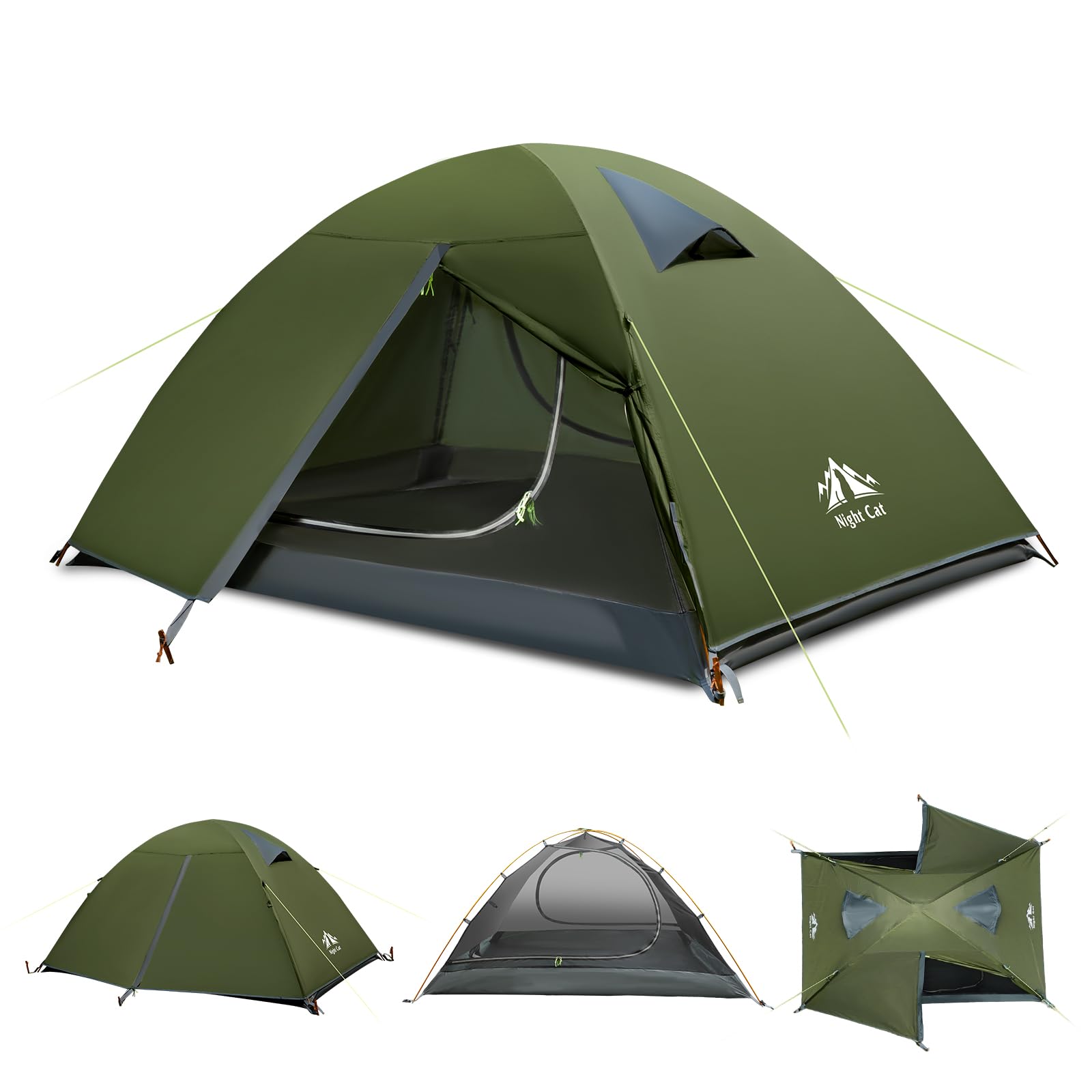
Night Cat 2-Person Backpacking Tent
Key Features
- Floor size: 82.6 x 55.1 in
- Packed weight: 4.4 lb
- Sleeping capacity: 2 person
- Doors and vestibules: 2 doors, 2 vestibules
- Price: Midrange
Two doors and two vestibules on a tent this affordable is what settled it for us. A second door means nobody climbs over a sleeping partner at two in the morning, and the paired vestibules keep wet boots and packs out of the sleeping space instead of between your shoulders. The floor is 82.6 by 55.1 inches — about 31 square feet — which takes two 25-inch pads with a little room to spare, and the frame is aluminum, the upgrade that matters most in a budget tent.
The two-pole clip design is a one-person job in a breeze: stand the poles, clip the body on, throw the fly over. The fly itself is full-coverage with a welded floor and taped seams, and that combination separates a tent that survives a wet night from one that doesn’t — a fly that stops short of the ground is how cheap tents earn their reputation.
What you give up is storage depth. The two vestibules together measure about 4.3 square feet, so a 60-liter pack sits outside rather than under cover, and the dome has no extra pole to lean on in a real blow. Neither is a reason to look elsewhere; they are things to know before the first trip rather than after it.
One more figure worth saying out loud: at 4.4 pounds this two-person tent weighs exactly what the one-person Night Cat in this guide does. If you hike with a partner even occasionally, that is the clearest argument on this page for going bigger.
Pros
- Two doors and two vestibules
- Aluminum poles rather than fiberglass
- Full-coverage fly with welded, taped floor
- 4.4 lb for a two-person tent
Cons
- Shallow vestibules for large packs
We point most backpackers here: two doors, two vestibules and aluminum poles, in a package light enough to actually carry.
Best for Roomy Two-Person Trips
Clostnature 2-Person Backpacking Tent
Key Features
- Floor size: 86.6 x 59 in
- Packed weight: 5.3 lb
- Sleeping capacity: 2 person
- Waterproof rating: PU 5000 mm
- Price: Midrange
Thirty-five square feet is the figure that defines this tent: 86.6 by 59 inches of floor, wide enough for two full-size pads and a duffel down the middle, with 45 inches of headroom so you can sit up and change. Against our top pick it gives up roughly a pound and gains several inches in every direction.
We think that is the right trade for two people who don’t travel light. The fly is PU 5000 mm with factory-sealed seams, the highest coating stated on any tent here, and the two doors are offset so each sleeper gets their own exit and their own mesh panel for a cross-breeze. You carry 5.3 pounds, or about 4.5 with the stuff sack and spare stakes left at home — the listing gives both numbers, and the lower one is achievable.
The frame is the weak point. A pole can fold under a gust or a clumsy pitch, which is why a pole splint belongs in the bag with this one, and the stock stakes bend the first time they meet rocky ground. Swap the stakes for aluminum before your first trip and you have removed half the risk for very little money.
Two things that turn out to matter: 14 stakes and four guylines give you enough anchors to tie the whole thing down for a windy night, and the doors open from either side, so the early riser doesn’t wake the other one.
Pros
- Roomiest two-person floor here
- 5000 mm fly with sealed seams
- Two offset doors and vestibules
- About 4.5 lb at minimum trail weight
Cons
- Stock stakes bend on rocky ground
We choose this one when two people and two packs need real room — 35 square feet of floor, two doors and a 5000 mm fly.
Best for Budget Solo Trips
Night Cat Upgraded 1-Person Tent
Key Features
- Floor size: 83 x 45 in
- Packed weight: 4.4 lb
- Sleeping capacity: 1 person
- Waterproof rating: PU 3000 mm
- Price: Budget
This is the least expensive solo tent in the group that we’re happy to recommend, and it earns that on space rather than cleverness: 83 by 45 inches of floor and 45 inches of peak height, enough to sit up in and to keep a pack beside you instead of in the dirt.
Clips instead of sleeves is the right call at this price. You stand the single pole and clip the body around it, which is far easier in wind or by headlamp than threading a long sleeve in the dark, and the roof-level mesh window does real work on a still night. Packed, it is a 16.5-inch bundle that disappears into a 40-liter pack.
Water is the honest caveat. The fly is PU 3000 with taped seams on paper, and in ordinary rain that is enough; in a long, wind-driven soak, water can work through the fly. Seam-sealing it yourself before the first trip is the best hour you will spend on this tent.
Two guylines is a thin anchor set, so pick a sheltered pitch rather than an exposed ridge — a fair trade at this price. What you get back is a 150D Oxford floor, a heavier weave than the taffeta floors on most budget tents, and the floor is the part that takes the abrasion.
Pros
- Sit-up height and room for a pack
- Fast clip pitch on one pole
- Least expensive solo tent here
- 150D Oxford floor fabric
Cons
- Rain protection fades in sustained storms
- Only two guylines for anchoring
This is the cheapest solo tent here we’re happy to recommend: 26 square feet of floor, a taped 3000 mm fly and a fast clip pitch.
Best for Long Approaches
KAZOO Ultralight 1-Person Tent
Key Features
- Floor size: 83 x 36 in
- Packed weight: 3.3 lb
- Pole material: Aluminum
- Sleeping capacity: 1 person
- Price: Midrange
Three point three pounds is the number that makes this tent: it is more than a pound lighter than our top pick while still sleeping one, and on a long approach that shows up in your shoulders rather than on a scale. A single aluminum pole and a clip-on body keep the bundle short enough to strap along the outside of a small pack.
The double-wall build is the next thing worth pointing to: a breathable inner under a full-coverage fly is the arrangement that keeps condensation off your sleeping bag, and the side walls come up high enough that splash stays out when the ground wets up.
We call the interior a sleeping space rather than a living one. At 83 by 36 inches and 40 inches of peak, it is comfortable for one person on a pad with a pack at the foot, and cramped the moment you try to sit up and sort gear. The single pole also takes all the stress in wind, so pitch it end into the weather and keep the fly tensioned.
What you get back is a genuinely light tent with an aluminum frame and a repair kit in the bag — the two things that decide whether a solo tent finishes a long trip.
Pros
- 3.3 lb, the lightest tent here
- Aluminum pole with clip setup
- Double-wall build with full-coverage fly
- Repair kit included
Cons
- 36-inch floor leaves no gear space
- Single pole takes all the wind stress
We hand this one to solo hikers counting ounces: at 3.3 pounds it is the lightest tent here and still has a full-coverage fly.
Best for Wet-Weather Trips
Forceatt 2-Person Backpacking Tent
Key Features
- Floor size: 88.6 x 53 in
- Packed weight: 5.5 lb
- Sleeping capacity: 2 person
- Waterproof rating: PU 3000 mm
- Price: Midrange
When rain is in the forecast, this is the tent we reach for. The fly is PU 3000 mm over a welded polyethylene floor, which lifts the seam line off the ground where water pools, and each of the two doors has its own vestibule. On a wet trip, staying dry is worth more than a pound of pack weight.
We think it is the most weather-ready tent in this group, and it pairs that with the tallest peak here at 43 inches. The floor is 88.6 by 53 inches, which is tight for two broad adults but fine for a couple, or for one person and a dog.
The cost is weight. At 5.5 pounds it is the heaviest tent we’re recommending, and that is the whole reason it sits behind the Night Cat for most people: fine for five miles into a lake and two nights out, a real tax on a long traverse.
Two smaller things: the reflective guylines are easy to find with a headlamp at midnight, and the stuff sack is cut generously enough that the tent goes back in without a wrestling match.
Pros
- Strongest rain protection here
- Two doors, one vestibule each
- 43-inch peak height
- Reflective guylines for night pitching
Cons
- 5.5 lb is heavy for the floor space
For wet trips we take this one: the best rain protection in the group, two doors, and 5.5 pounds you have to be willing to carry.
Best for Tall Solo Campers
camppal 1-Person Backpacking Tent
Key Features
- Floor length: 98.4 in
- Packed weight: 3.8 lb
- Sleeping capacity: 1 person
- Waterproof rating: 3500-4000 mm
- Price: Midrange
Ninety-eight inches of floor length is unusual in a one-person tent, and it is the entire argument for this one: an 8.2-foot interior gives a six-foot-four sleeper room at both ends, with space past your head for a pack. The trade is width — 35 inches at the floor — so it is a lie-down-and-sleep tent, not one you will be sitting up in to sort gear.
A single ridge pole through a sleeve is the old-fashioned way to build a tent, and it is slower to pitch than the clip designs here. What you get for that is one pole to lose, break or replace, and an outer fly rated 3500 to 4000 mm with taped seams and a velcro wrap over the zip.
We rate this highly for tall hikers and less highly for everyone else. The narrow floor and single pole mean it moves in wind unless it is guyed out properly — two guylines come in the bag, so add two more — and sitting up is a lean rather than a stretch. For a tall solo camper on three-season trips, those are acceptable terms.
Two small details: the twin pockets at the head end hold a phone and a headlamp where you can reach them in the dark, and the khaki fabric is a lot less conspicuous at a roadside campsite than the orange and yellow tents here.
Pros
- 8.2-foot interior for tall sleepers
- 3500-4000 mm fly with taped seams
- 3.8 lb minimum trail weight
- Two head-end pockets
Cons
- 35-inch floor is narrow
- Depends on two guylines in wind
We recommend this to anyone over six feet: the 8.2-foot floor lets you stretch out, and the narrow cut is the price.
Best for Frequent Use
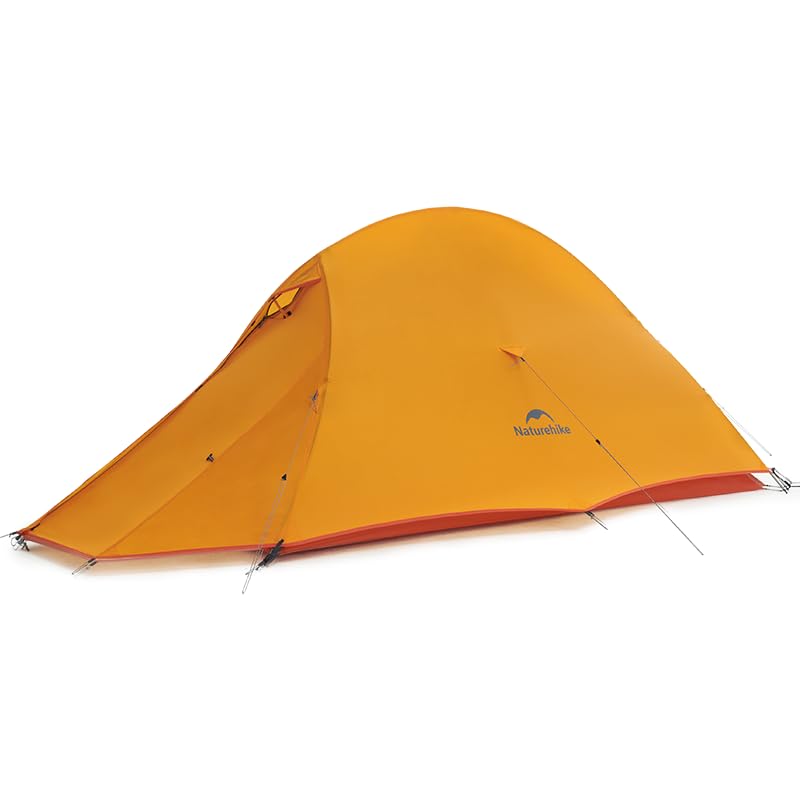
Naturehike Cloud-Up 1 Tent
Key Features
- Floor area: 20.3 sq ft
- Packed weight: 3.7 lb
- Pole material: 7075 aluminum
- Sleeping capacity: 1 person
- Price: Premium
The most expensive tent in this group raises the obvious question: what does the extra money buy? A 7075 aluminum frame instead of fiberglass, a 210T polyester fly rated at PU 3000 mm or better, and 14 stakes with five guylines in the bag — the most complete anchor kit on any tent here.
The feature that matters more than it sounds is the vent window above the front door. Condensation is the quiet failure of small solo tents — you wake with the inside of the fly wet and the foot of your bag damp — and a dedicated vent over the door plus a mesh inner gives that moisture somewhere to go.
Space is where it gives ground. The floor is 20.3 square feet and the vestibule is a token 0.45 square feet, so boots go under the fly edge and a big pack stays outside. You sleep in this tent; you don’t live in it.
We still put it in the guide, because the parts that fail first on budget tents — poles, zips, fly coating — are exactly where this one spends the money. Pitch it thirty nights a year and it is the better buy; two weekends a season and it isn’t. It also packs to 15.3 by 5.1 by 5.1 inches, short enough to sit at the bottom of a 30-liter pack.
Pros
- 7075 aluminum pole frame
- Vent window over the door
- 14 stakes and five guylines included
- 3.7 lb packed
Cons
- Most expensive tent here
- Vestibule barely covers a pair of boots
We think it is worth stretching for if you pitch it often: 7075 poles, a vented 3000 mm fly, and the best hardware here.
Best for Fair-Weather Weekends
JELUCAMP 2-Person Dome Tent

Key Features
- Floor size: 86.6 x 59.1 in
- Packed weight: 4.3 lb
- Sleeping capacity: 2 person
- Waterproof rating: PU 3000 mm
- Price: Budget
There is a lot of tent here for the money: 86.6 by 59.1 inches of floor and 43 inches of peak, which is genuinely enough for two adults with a pack between them. Nothing about those numbers reads like the least expensive two-person tent in the group.
The savings show up in the hardware. The poles are 7.9 mm fiberglass, which flexes more than aluminum and is the material that snaps first on budget tents, and there is a single door with a 2.5-square-foot vestibule, so one of you is always climbing over the other.
Water is the bigger question. The fly is coated to PU 3000 mm on paper, but this is a tent for showers rather than a night of steady rain, and the zips are the other part that can let it down. Treat it as a three-season fair-weather shelter and it does what you paid for.
We recommend it with that boundary drawn clearly: for Scouts, festival weekends and the first couple of trips of someone working out whether they like backpacking, the space and the quick pitch are genuinely good. The double-layer door is the detail that lifts it above the usual cheap dome — you can vent it hard without letting the midges in.
Pros
- Big floor for the money
- Quick to pitch
- Double-layer door vents without bugs
- 4.3 lb packed
Cons
- Fiberglass poles flex under load
- Single door for two sleepers
Our fair-weather two-person pick: a big floor and a quick pitch, though the fly is not built for an all-night soak.
How We Tested Budget Backpacking Tents
We started with roughly 40 tents at the budget end of the category and cut anything with fiberglass poles, a single door on a two-person model, or a packed size that wouldn’t ride inside a pack rather than on top of it. That left 12 tents, which we bought at retail and used for eight months.
Each one was weighed on a kitchen scale twice: as shipped, and as we’d actually carry it, with stakes, guylines, and fly. We then packed it into a 50-liter bag next to a sleeping bag and three days of food to see whether it dropped in horizontally or had to be strapped outside.
Setup was timed solo, once in daylight and again at dusk with a headlamp, and we noted which tents needed two hands to thread a pole versus which stood on their own while we clipped the fly. Every tent spent five minutes under a garden hose, got checked inside with a paper towel, then sat out a gusty night to see whether the poles flexed or the stakes pulled free.
Inside, we laid out two full-size sleeping pads and a 65-liter pack to see what actually fit and how much room was left to sit up and change clothes. Across the eight months we kept watching the seams, zippers, and pole joints, and checked the floors for abrasion after nights pitched on rock and roots.
How to Choose a Cheap Backpacking Tent
The money in a budget tent has to come from somewhere, and the trick is knowing which part the maker skimped on and whether you will ever stress it.
Floor space matters more than the person count
The number on the box is a rough guide at best: two-person tents in this group run from 31 to 35 square feet of floor, one-person tents from 20 to 27. What actually decides comfort is width. Two 25-inch pads need 50 inches of floor before you have anywhere to put a pack, so a 53-inch two-person tent is a couple’s tent and a 59-inch one is a tent for two friends who don’t want to touch shoulders.
Measure your pad before you measure anything else, then subtract a few inches for the walls sloping in at the foot.
Poles are where budget tents fail
Fiberglass is the tell. It is heavier than aluminum for the same strength, it splinters, and a splintered pole is a tent you carry out in pieces. Aluminum — 7001 or 7075 — is the upgrade worth paying for, and two poles crossing in a dome spread the load better than a single ridge pole running end to end.
Whatever the frame, carry a pole splint and pitch the fly tensioned but not drum-tight, because a flapping fly works the joints loose all night.
Weight, packed size and what a pound costs
One-person tents here run 3.3 to 4.4 pounds packed; two-person tents, 4.3 to 5.5. A pound matters on a long climb and almost nothing on a two-mile walk-in, so be honest about the trips you actually take rather than the ones you plan.
Packed length is the spec nobody prints and everybody notices. Short pole segments strap to the outside of a small pack; long ones push you into a bigger one, which costs more weight than the tent did.
Doors and vestibules are livability, not luxury
With two people, one door means somebody climbs over somebody else at two in the morning, and a 2.5-square-foot vestibule means two packs sit out in the rain. Two doors and two vestibules cost well under a pound and change how a tent feels by the third night.
Solo, a single door and a small vestibule for boots is all you need, and the saved weight is better spent on a warmer sleeping bag.
What a waterproof rating does and doesn’t tell you
A 3000 mm coating is a real coating and 5000 mm is better, but neither replaces a fly that reaches the ground, taped seams and a floor that curls up at the edges. The failure common to budget tents is water driven through the fly in sustained wind-driven rain, and the cheapest insurance is a tube of seam sealer applied before the first trip.
If you camp in the wet regularly, pay for the higher coating and a fly that reaches the ground rather than a clever door.
Frequently Asked Questions
Do I need a footprint under a backpacking tent?
Not always. The floors on these tents are coated and seam-taped, and a footprint mostly buys abrasion protection from roots and gravel. The footprints listed for tents in this guide run 6.5 to 8 ounces, which is real weight in a solo pack.
If you want the protection without the ounces, cut a sheet of plastic to the floor size and trim it so no edge sticks out past the tent floor — an exposed edge channels rain under the tent instead of away from it.
Can one person carry and pitch a two-person tent?
Yes. The two-person tents here run 4.3 to 5.5 pounds packed, which is an ordinary solo load, and the two-pole dome designs stand up before the fly goes on, so a gust won’t flatten them while you are clipping.
The compromise is room, not effort: you get 31 to 35 square feet to yourself. If most of your trips are solo, buy the one-person tent and split the two-person between two packs when someone comes along.
How long should a cheap backpacking tent last?
Its life is set by the poles and by UV exposure more than by what you paid. Store it dry and loose rather than packed and damp, and don’t leave it pitched in the sun for days at a time.
Check the pole ferrules at the start of every season and replace a bent section before it splits the one next to it. Two minutes with the frame is the cheapest maintenance a tent asks for.
Can I use a three-season backpacking tent in snow?
No. Treat the season labels loosely: even the tents here sold as four-season are mesh-panelled domes with one or two poles, so spindrift comes through and snow sits on the roof instead of sliding off.
Real winter camping needs a solid inner, a stronger frame and steeper walls. If snow is in the forecast, rent or borrow a proper winter shelter rather than pitching a budget tent and hoping.
Final Verdict
Start with the Night Cat two-person. It is the lightest two-person tent here, it has the two doors and vestibules that make sharing a tent bearable, and the frame is aluminum — the part budget tents usually get wrong. If you hike alone, the one-person Night Cat costs less and fits you and your pack; if you’re tall, the camppal’s 8.2-foot floor is worth giving up width for. On a trip where rain is likely, take the Forceatt.