This post contains affiliate links. We may earn a small commission when you buy through our links — at no extra cost to you.
My first exercise bike was a $200 impulse buy that wobbled so badly during sprints that my downstairs neighbor started texting me. I eventually sold it for $40 and went back to the gym—until I realized the real problem wasn’t my motivation but the bike. A good exercise bike fixes the biggest excuse: time. It lets you ride at home, on your schedule, without a commute, and it should feel solid enough that you actually want to get on it.
Over the past nine months, my team and I have ridden eight different bikes, from budget-friendly models to near-gym-quality machines, paying attention to the things that matter after the novelty wears off: quiet operation, a comfortable seat, sturdy build, and easy assembly. One thing I’ve learned: a heavier flywheel usually means a smoother, quieter ride, but it also makes the bike harder to move around. The picks below are the ones we’d actually keep in our own homes.



Best for Everyday Home Cardio
CHAOKE 520A Exercise Bike
Key Features
- Footprint: 32.3 x 19.2 x 39.4 in
- Resistance: Magnetic, 100 levels
- Rider height: 4.7 to 6.1 ft
- Max user weight: 300 lb
- Price: Midrange
The first thing that struck us about the CHAOKE 520A was how little we heard. A belt drive and a magnetic brake make a soft whir at cruising pace rather than the whine that travels through a floorboard, and in a small flat that is the difference between a bike you use before work and one you feel guilty about. It is the main reason this is the one we recommend first.
Forty-eight pounds is light next to the premium pick here, but the braced H-frame and the wide rear base do the work. Ours stayed level through standing efforts, and the 300-pound capacity means a shared household does not have to think about who is on it. The resistance dial runs through 100 steps, from a light spin to a real grind, which is finer control than most of the cheaper bikes here give you and the spec we cared about most after quiet.
Setup is the part we braced for and did not need to. Most of the bike arrives together, and what is left, the mainframe, bars, monitor, pedals, seat and feet, is an evening’s job rather than a lost afternoon. The LCD is where the money ran out: it shows time, speed, distance and calories and little else, and it feels like the cheapest part of the machine. Kinomap pairing is there if you want virtual courses, but nothing about the bike depends on it.
It fits riders from roughly four foot seven to six foot one, and the 32.3 by 19.2 inch footprint is small enough that ours stayed out between sessions rather than being folded away. Tighten the handlebar clamp before the first ride; it can work loose and put a wobble in the bars that has nothing to do with the frame.
Pros
- Whisper-quiet belt and magnetic drive
- 100 resistance steps, finer than most here
- Mostly pre-assembled; about half an hour
Cons
- Firm saddle; budget for a cover or swap
We think this is the bike most home riders should buy: quiet, stable, quick to assemble, and cheaper than the two step-up options here.
Best for Hard Indoor Sessions
MERACH S26 Exercise Bike
Key Features
- Resistance: Magnetic, 8 levels
- Bike weight: 62 lb
- Rider height: 4 ft 8 in to 6 ft 2 in
- Max user weight: 300 lb
- Price: Midrange
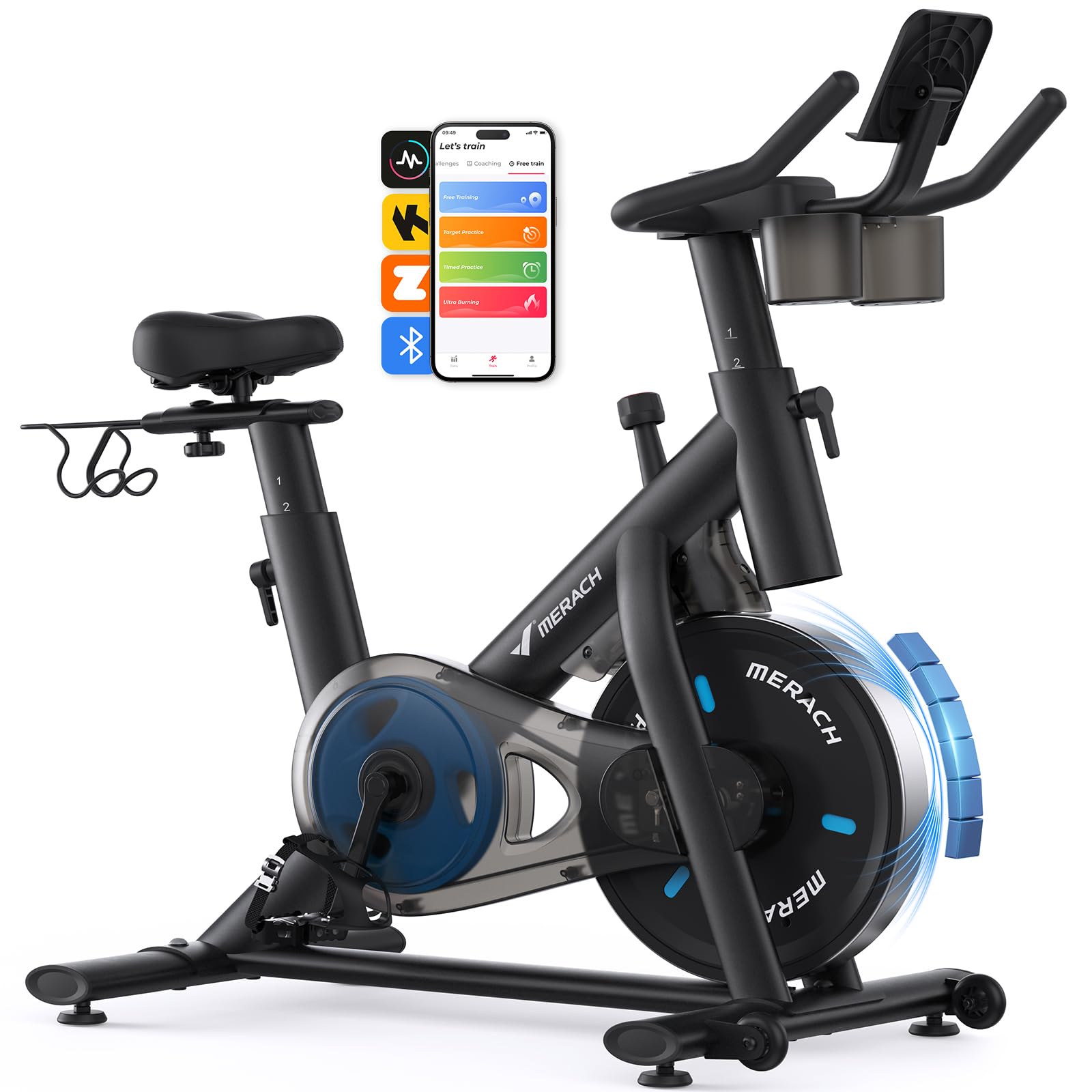
Sixty-two pounds of steel is a nuisance to carry up a flight of stairs, and it is the best thing about the MERACH S26. The frame is built from 2.00mm tubing in an inverted triangle, and the difference shows the moment you stand and push: the bike stays where you put it instead of rocking under you.
That weight is the whole argument. Most bikes around here ask you to trust a light frame; this one makes the case physically, and the 300-pound capacity backs it up. The magnetic belt drive is genuinely quiet, the four-way seat and two-way bars cover riders from four foot eight to six foot two, and the Merach app adds guided sessions if you want a coach’s voice in the room.
The resistance is where we part company with the listing. The dial has eight steps, not the continuous sweep the marketing implies, and the jump between them is sharp: the first few feel like nothing and then it is suddenly heavy. You learn the steps, but a smoother ramp is easier to ride to a class with a call-out.
Two smaller notes. The saddle is the first thing to change on this bike, and because it is a standard rail mount, a replacement is a ten-minute job rather than a reason to send the whole thing back. And at this weight the bike wants a permanent spot, not a rug you drag it onto each time.
Pros
- 62-pound frame stays planted under effort
- Quiet magnetic belt drive
- Fits riders from 4 ft 8 in to 6 ft 2 in
Cons
- Hard saddle; plan on replacing it
- Resistance ramps sharply across eight levels
We pick the MERACH when a rider wants a gym-solid feel at home: the 62-pound frame is the point, and the saddle is the trade.
Best for App-Led Classes
Schwinn IC4 Indoor Cycling Bike
Key Features
- Warranty: 10-yr frame, 3-yr parts, 1-yr labor
- Resistance: Magnetic, 100 levels
- App pairing: Bluetooth; Peloton, Zwift, JRNY
- Max user weight: 330 lb
- Price: Premium
The Schwinn IC4 is the most expensive bike here, and it is the only one that reads as a long-term purchase rather than a first bike. Two things justify the step: Bluetooth that pairs with Peloton, Zwift and JRNY without fuss, and a warranty running ten years on the frame and three on parts.
Underneath, it is the most solid thing in this guide. A 112-pound frame rated to 330 pounds, 100 micro-adjustable magnetic resistance levels, and a flywheel that stays whisper-quiet through a hard session. The resistance is the finest here, small nudges rather than jumps, which is exactly what you want when an instructor calls for two more turns.
Our reservation is the console, which looks and behaves like the bike was designed a decade ago; cadence and heart rate are the readouts people stop trusting first. The fix is the one Schwinn clearly expects: put a phone or tablet on the mount, let the app do the counting, and treat the built-in display as a backup for when your battery dies.
Measure the corner before you order. At 54.6 by 30.7 inches this is the largest footprint in the guide by a distance, and nothing about it folds or tucks. In a garage gym that is irrelevant; in a studio flat it is the entire decision, and an upright or folding bike is the better answer.
Pros
- Pairs with Peloton, Zwift and JRNY over Bluetooth
- 100 micro-adjustable magnetic resistance levels
- Ten-year frame warranty backs the price
- Very stable 112-pound frame
Cons
- Thin, hard stock saddle
If you are subscribing to classes and want one bike to last, we think the IC4’s Bluetooth, fine resistance and ten-year frame warranty justify the leap.
Best for Small Apartments
pooboo Folding X-Bike
Key Features
- Footprint: 27.2 x 15.8 x 46 in
- Resistance: Magnetic, 8 levels
- Bike weight: 39.3 lb
- Max user weight: 300 lb
- Price: Budget
The moment a folding bike earns its keep is nine at night, when the workout is over and the living room has to be a living room again. The pooboo folds at the frame, the seat back folds with it, and the whole thing rolls away on the wheels built into the front feet. In a one-bedroom flat that ritual is the difference between owning a bike and owning a clothes rack.
It is also the folding bike here we came away trusting most, because it does not feel like a folding bike under you. The steel frame takes a 300-pound rider, the magnetic resistance is quiet enough to use while someone else watches television, and 39 pounds is light enough to lift into a closet rather than negotiate with.
Where it gives ground is range and mounting. Eight resistance levels is the smallest count in this guide, so the steps between easy and hard are wide, and the frame sits tall enough that shorter riders can find it awkward to get on. Plan to keep it out if you have the floor, because the fold is a storage answer rather than an everyday one.
Pros
- Folds and rolls into a closet
- Rated for a 300-pound rider
- 39 pounds, easy to move alone
Cons
- Only eight resistance levels
- Tall frame is awkward to mount
If space is the reason you have not bought a bike, the pooboo folds down, rolls away and still takes a 300-pound rider; it is the folding pick we trust most.
Best for Seniors and Rehab
GOIMU 5-in-1 Folding Bike
Key Features
- Footprint: 27.6 x 16 x 43.7 in
- Resistance: Magnetic, 16 levels
- Bike weight: 50.6 lb
- Max user weight: 330 lb
- Price: Budget
A backrest changes who can use an exercise bike. The GOIMU’s seat pan, back cushion and side handles put a rider in a supported, semi-recumbent position that is far easier on a bad back or a healing knee than a racing crouch, and that, more than the five-in-one label, is the reason to look at it.
The rest of the package is sound: a steel X-frame rated to 330 pounds, 16 magnetic resistance levels, and a fold that takes it down to something you can stand in a closet. The resistance bands anchor at three heights and give you a rowing or pressing option between rides, which is more use than it sounds for anyone rebuilding strength.
Our caution is the seat. It is wide and short, comfortable for some riders and crowding for others, and taller riders in particular find the reach to the bars long. The adjustment knobs are fussier than they need to be too, especially the seat tilt, which is the one you will want to set once and leave alone.
For a senior rider, a rehab plan, or a household where the bike has to disappear afterwards, those are small complaints against a design that solves the real problem. For someone who wants to stand and sprint, it is the wrong bike entirely, and the fixed frames here serve that rider better.
Pros
- Backrest and side handles support upright riding
- Arm bands add upper-body work
- 16 magnetic levels, quiet in use
Cons
- Wide, short seat crowds taller riders
- Adjustment knobs are fiddly
We recommend the GOIMU to riders who want back support and an easy step-on; the backrest, side handles and arm bands do more than another resistance level would.
Best for Quick Setup
YPOO BC710 Exercise Bike
Key Features
- Assembly: 80% pre-assembled
- Resistance: Magnetic, 16 levels
- Bike weight: 44 lb
- Max user weight: 300 lb
- Price: Midrange
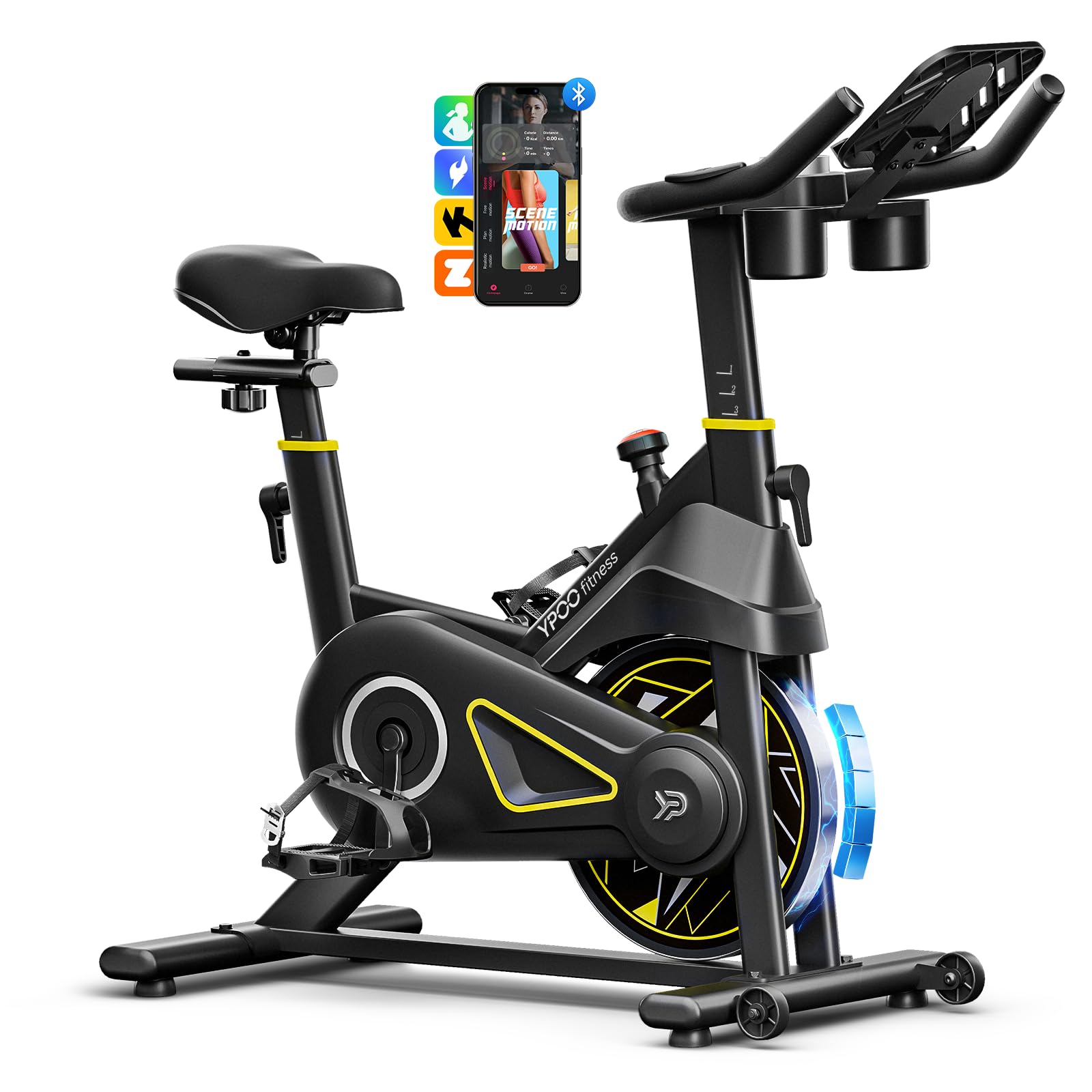
Eighty percent pre-assembled is the kind of claim that usually means an hour of swearing. The YPOO mostly delivers: the mainframe, brake and crank come assembled, and what is left, the bars, monitor, pedals, seat and feet, is a job for one person and a video rather than a lost afternoon.
On the bike it is a compact upright: 44 pounds, 16 magnetic levels, a belt drive quiet enough for a shared flat, and a fit range from about four foot eight to six foot one. The 32.9 by 19.3 inch footprint is among the smallest here for something that does not fold, and the transport wheels mean it can live against a wall and come out for a session.
The console is the weak point. It can quit within the first few months, and it is the component the warranty clock runs out on first. Treat the display as a convenience rather than the reason you bought the bike, and use the app for anything you want to keep a record of.
Our read is that this is the best value upright here for someone who wants a small, quiet bike and does not care about a screen. If the console matters to you, that is the point at which the Schwinn starts to make sense.
Pros
- 80 percent pre-assembled; fast to finish
- 16 magnetic levels, quiet belt drive
- 44-pound frame is easy to reposition
Cons
- Monitor can fail within the first months
- Small, firm saddle
We like the YPOO as a first bike for a small flat: quick to build, quiet and compact, with the console treated as a bonus rather than a feature.
Best for Heavier Riders
SLUNSE 509A Exercise Bike

Key Features
- Footprint: 39.4 x 22.8 x 47.3 in
- Resistance: Magnetic, 100 levels
- Bike weight: 59.5 lb
- Max user weight: 350 lb
- Price: Midrange
Three hundred and fifty pounds is the highest rider rating in this guide, and it is the reason we kept the SLUNSE on the page at all. The frame is 59.5 pounds of thickened steel on a curved rear base, the sort of machine that stays put when a big rider stands to climb instead of skittering across a mat.
What we did not expect at this money is the rest of it: 100 magnetic resistance levels, app pairing with Zwift and Kinomap, and a six-in-one design that adds arm bands and a standing position to the ordinary upright ride. The LCD tracks time, speed, distance and calories, and the phone mount sits where you will actually use it.
The six-in-one label is mostly marketing, but two of the modes are real: resistance bands anchored behind the bars for arm work, and a standing position the wide base genuinely supports. For a rider who wants one machine for light strength work as well as cardio, that is an extra rather than a bullet point, and it is why this one stays in the roundup despite the compromises below.
Pros
- 350-pound capacity, the highest here
- 100 magnetic resistance levels
- 59.5-pound frame with a wide rear base
- App-compatible with Zwift and Kinomap
Cons
- Small, firm saddle
- Wide 22.8-inch base needs floor room
We keep the SLUNSE on the list for one reason: a 350-pound rider rating, the highest here, on a frame that does not flex.
How We Tested the Best Exercise Bikes
We started by researching the market, reading customer reviews, and filtering by price, footprint, and resistance type. We settled on eight bikes—a mix of budget, mid-range, and premium models—and tested each for nine months in homes, garages, and a small apartment.
Assembly was the first test: we timed how long each bike took to put together solo, noted whether the instructions were clear and the hardware was labeled, and checked for wobble after tightening everything down. Ease of use came next—how simple it was to adjust the seat and handlebars, clip in and out, and change resistance mid-ride. We also measured seat size and shape, then rode for at least 30 minutes to see if discomfort showed up.
Quiet mattered most during early morning rides, so we pedaled at 6 a.m. in apartments and listened for flywheel whoosh, clicking, and creaking. Sturdiness was tested by standing up for sprints and climbs, and we noted any side-to-side sway. We also moved each bike across carpet and hardwood to see how hard it was to reposition.
After nine months, we checked for wear on pedals, seats, and resistance mechanisms. We compared what each bike cost against what it delivered—features, build quality, and comfort—to judge value. Fit was the wild card: we had riders from 5’2" to 6’1" try each bike, and noted whether the seat and handlebars adjusted enough for a comfortable reach.
How to Choose a Home Exercise Bike
The bike you actually ride is the one that fits your body, stays quiet enough to use when you want to, and does not need a spare room, so start with fit and noise rather than the feature list.
Resistance: Magnetic, Friction, and How Many Steps
Magnetic resistance is the default for a reason: magnets never touch the flywheel, so nothing wears and nothing squeals. Friction bikes press a felt or leather pad against the wheel. They work, and they are cheap, but the pad glazes, the ride gets louder and eventually you replace it. That is why every bike on this list is magnetic.
Then count the steps, because that is what you feel mid-workout. Eight levels means a real jump between easy and hard; 16 is workable for steady riding; 100 lets you nudge resistance the way a class instructor asks. We treat 16 as the minimum for anyone following structured sessions.
Fit Is a Range, Not a Number
Listings quote a height range, and the top of it is usually optimistic. Set the saddle so that with one pedal at the bottom of the stroke your knee is almost straight, and check that the seat post is still above its minimum-insertion mark. If the post is near the limit, or your knees come up toward the bars, the bike is too small however the listing phrases it.
Weight ratings matter just as much, and the frames here run from 300 to 350 pounds. A shared bike also needs a four-way seat and height-adjustable bars so two people of different builds can each find a position and return to it.
Budget for a Saddle
Almost every bike in this guide saves money on the seat, and the pattern is always the same: fine for twenty minutes, painful at forty. Do not reject a bike over it. Nearly all of these use a standard rail mount, so a wider saddle with a cutout, or a gel cover for the first month, fixes the problem cheaply.
Check the seat post diameter before you assume a swap is easy, and give any new saddle two or three rides before you decide it is wrong. The one thing worth rejecting is a proprietary post that takes no standard saddle.
Measure the Floor, Then Think About Sound
Riding footprint is bigger than the stored one. A folding bike is compact when it is folded, not while you are on it, and a spin bike wants depth behind the bars for your arms. Allow roughly two feet behind and to each side, plus a mat on hardwood.
Sound travels through floors more than walls, so a belt-driven magnetic bike on a thick mat is the combination that keeps the room below unaware. If you live above someone, this is worth more than any other feature on the spec sheet.
Assembly, Electronics, and What Extra Money Buys
The pre-assembly percentage is the most useful line in a listing: 80 percent done means half an hour with a video, a bare frame means an evening. Spend any upgrade on the frame and the warranty rather than the console, because screens are the first thing to fail and the least useful part of a budget bike.
A phone or tablet does everything a built-in display does and gets replaced for free. On the premium bikes here you are paying for the frame, the resistance mechanism and a warranty measured in years rather than months.
Frequently Asked Questions
Do I need a subscription to use an exercise bike?
No. Every bike here works without an app; the console tracks time, speed, distance and calories on its own. Coaching is an add-on, and Kinomap, Zwift, JRNY and Peloton all run over Bluetooth where the bike has it.
Schwinn includes a two-month JRNY mobile trial, which is a sensible way to find out whether you are a class rider before you commit to a monthly fee. If you are not following a class within a month, you will not miss one.
Why do exercise bikes start squeaking, and can it be fixed?
Almost always one of three things: pedal threads that were never greased, a seat post that needs a smear of grease, or stabilizer feet that were not wound down onto the floor. Work through them in that order, with the bike stationary.
A rhythmic click once per pedal revolution is different. Check the crank bolts, and stop riding until they are tight, because a loosening crank is the failure that ends a bike’s life early.
Can a folding bike take a heavy rider?
Check the rating, then look at how the hinge is braced. The folding bikes here are rated 300 and 330 pounds, which covers most riders, and both use an X-brace to compensate for the joint.
A folding frame is the right answer for space, not for standing sprints. If you are near the top of the rating and you ride hard, a fixed frame is the more durable buy.
What is the difference between an upright bike and a spin bike?
Uprights sit you more vertically with a wider saddle, and they suit steady half-hour to hour-long rides. Spin bikes copy studio geometry: narrower saddle, lower bars, heavier flywheel, and resistance you change in small turns so you can follow an instructor’s call.
Spin bikes cost more and take more floor. In a flat where the bike has to share a room, an upright or a folding bike is usually the one that stays in use.
Final Verdict
The CHAOKE 520A is the bike we point most people to, and the reason is unglamorous: it is quiet, it sits still under you, it goes together in an evening, and it costs less than the two bikes that beat it on one thing each.
If you are going to ride hard and often, the extra for the MERACH’s 62-pound frame is well spent. If you are paying for classes, the Schwinn’s Bluetooth pairing and ten-year frame warranty are what the money actually buys.