This post contains affiliate links. We may earn a small commission when you buy through our links — at no extra cost to you.
A stationary bike is the most optimistic purchase in the home-fitness aisle. It arrives in a box the size of a small refrigerator, takes an evening to assemble, and then spends three years holding a towel. The ones that actually get ridden get three unglamorous things right: a seat that doesn’t bruise you by Thursday, a frame that doesn’t wake the neighbors at dawn, and enough adjustment for everyone in the house.
The spec sheet won’t settle any of it. Flywheel weight gets all the attention, but the seat is the part your body argues with, and no one advertises how loud a bike is when you stand out of the saddle. Over six months my team and I assembled and rode eight of them, through 5:45 a.m. spins and long weekend sessions, and the line between keepers and returns wasn’t drawn where the prices were. The picks below earned their floor space.



Best for Most Home Riders
CHAOKE 520A Exercise Bike
Key Features
- Dimensions: 32.3"D x 19.2"W x 39.4"H
- Resistance: Magnetic, 100 levels
- Rider height: 4 ft 7 in to 6 ft 1 in
- Weight capacity: 300 lb
- Price: Midrange
A quiet belt drive, magnetic resistance with real range, and a frame that stays put when you stand up — that’s the shortlist for a home bike, and the CHAOKE 520A clears all three. We kept it in the front room rather than the basement because there’s nothing to manage about it: roll it out, set the seat, ride, roll it back.
The plain numbers do the work. The seat adjusts for height and fore-aft, the handlebars move too, and the bike is rated for riders from 4 feet 7 inches to 6 feet 1 inch and up to 300 pounds, which covers most couples. At 48 pounds it moves easily on its transport wheels, and the frame is just over 32 inches deep, so it parks against a wall without taking over the room.
Two things to know. The saddle is firm and narrow enough that a padded cover or a replacement is a sensible first purchase — a small spend that decides whether you ride for forty minutes or ten — and the resistance is a manual knob, so structure comes from your phone or your own intervals rather than from the bike. It pairs with apps like Kinomap, but the CHAOKE doesn’t ship with a coaching app of its own.
What we keep coming back to is the resistance itself: it climbs smoothly across its range instead of stepping, which is what you notice when you’re holding a pace rather than following a program. If you want a screen telling you what to do, the MERACH is the better buy; if you want a quiet, stable bike that disappears into the routine, this is it.
Pros
- Quiet belt-and-magnet resistance
- Stable 48-pound frame, compact footprint
- Fits 4 ft 7 in to 6 ft 1 in, 300 pounds
- Mostly pre-assembled, quick setup
Cons
- Fit tops out at 6 ft 1 in
- No coaching app of its own
The bike we point most people to: quiet belt-and-magnet resistance, a stable frame and a fit range that covers a household, at mid-range money.
Best for Guided Workouts
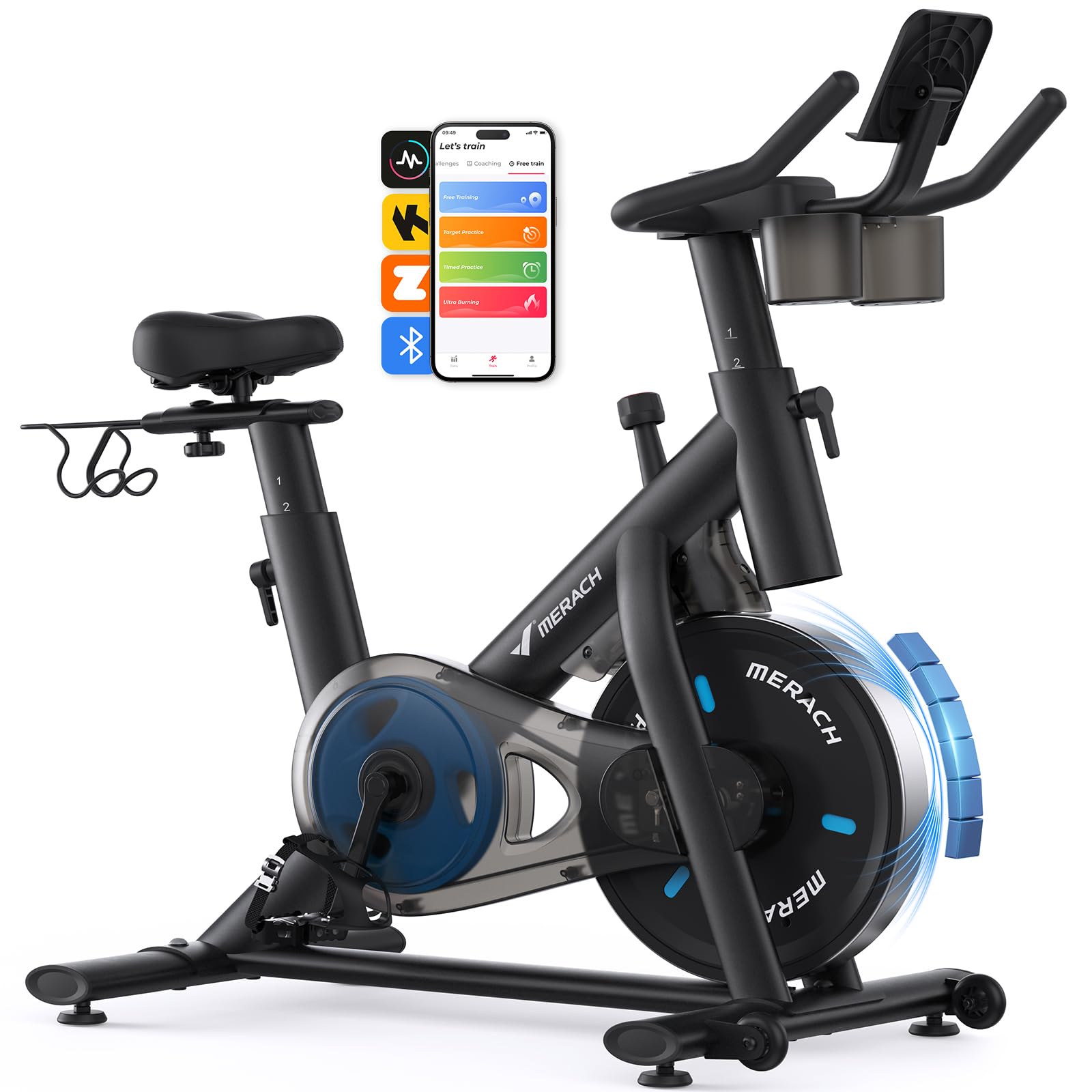
MERACH S26 Exercise Bike
Key Features
- Resistance: Magnetic, 8 levels
- Item weight: 62 lb
- Rider height: 4 ft 8 in to 6 ft 2 in
- Weight capacity: 300 lb
- Price: Premium
If you want a coach in the room, this is the bike built for you. The MERACH app runs the session and pulls distance, time, calories and heart rate off the bike in real time, and it also pairs with Kinomap and Zwift for virtual courses. That pairing is the reason to pay more here rather than less.
The frame backs it up. MERACH specs 2 mm steel in a reinforced inverted-triangle frame, and at 62 pounds this is the heaviest upright in the group — we rate it at the top of this set for stability, the kind of bike that doesn’t rock when you come out of the saddle. The seat adjusts four ways and the handlebars two, covering riders from 4 feet 8 inches to 6 feet 2 inches, and the belt-driven magnetic resistance stays quiet enough for a shared wall.
Two caveats. Resistance runs through eight levels, and the step from easy to hard can arrive abruptly mid-interval, which is fine for steady efforts and less so for sprints. And the saddle is the firmest here: narrow, hard, and the first thing to replace if you plan on rides past half an hour.
The weight is the other half of that trade. Sixty-two pounds is steady to ride and awkward to move, so this is a bike you set up once and leave. That suits anyone with a dedicated corner and a training plan; if the bike has to share a living room, the CHAOKE gives you most of the quiet for less.
Pros
- Self-developed coaching app with live metrics
- Heaviest, most reinforced frame here
- Fits 4 ft 8 in to 6 ft 2 in
- Quiet belt-driven magnetic resistance
Cons
- Resistance steps feel abrupt mid-interval
- 62 pounds is heavy to move
Buy this one if you want coached sessions on a rock-solid frame; it is the heaviest and steadiest upright here, and the app is the reason.
Best for Small Rooms
PLENY 5-in-1 Folding Bike
Key Features
- Flywheel: 6.6 lb
- Resistance: Magnetic, 16 levels
- Item weight: 45 lb
- Weight capacity: 300 lb
- Price: Budget
Where does the bike go when the living room has to be a living room again? That’s the question the PLENY answers. It folds, it weighs about 45 pounds, and it arrives 85 percent assembled, so the frame and resistance unit are already together before you open the hardware bag.
What you trade for the fold is flywheel mass. The 6.6-pound wheel is a fraction of what a full-size upright carries, and you feel it at the top of the pedal stroke: momentum doesn’t carry you around, so hard efforts feel more like pushing and less like riding. Below a moderate resistance the difference fades, and that’s where most home sessions live.
We think it earns its place in a studio apartment or a spare bedroom. The 16 magnetic levels run from a warm-up to a genuine climb, the backrest and padded handles let you sit back for longer sessions, and the X-frame stays planted for seated riding. Getting on takes more care than the pictures suggest — the step-over is higher than it looks and the compact frame puts the bars close to your knees — so if your hips are stiff, an upright with a low step-through serves you better.
Two details worth knowing: the console is a basic LCD showing time, speed, distance and calories, and the resistance is a manual dial, so you aren’t buying coaching here. What you are buying is a bike that fits under a window and folds into a corner, and at that job it’s the best of the ones we tested.
Pros
- Folds away for small-space storage
- Backrest and padded handles
- 16 magnetic levels, quiet ride
- 85 percent pre-assembled
Cons
- Light 6.6-pound flywheel limits the stroke
- Higher step-over than it looks
For small rooms, this is the folding bike we recommend: it stores in a corner and still gives you 16 magnetic levels and a backrest.
Best for Low-Impact Riding
GOIMU 5-in-1 Folding Bike
Key Features
- Resistance: Magnetic, 16 levels
- Item weight: 50.6 lb
- Rider height: 4 ft 4 in to 7 ft
- Weight capacity: 330 lb
- Price: Budget
The backrest is what sets the GOIMU apart. Add the side handles and the wide saddle and you get a bike you sit back into rather than perch on top of, and that changes how long you’re willing to stay on it.
We like it most for anyone rebuilding fitness, riding with a temperamental back, or sharing a bike with a parent. It’s rated to 330 pounds, the second-highest capacity here, the X-frame folds for storage, and its 16 magnetic levels run quietly enough for a bedroom. The resistance bands that come with it add an arm option the uprights in this group don’t offer at all.
The saddle is where opinions split, and the split is about width rather than padding: the seat is broad, comfortable under you and intrusive between your legs if you’re long-legged. The adjusters are also more effort than the lever-style setups on the CHAOKE — workable for one rider, tedious if two people change the seat height every session.
Where it lands: this is a low-impact machine, not a spin bike. If you want to sweat through intervals standing on the pedals, look at an upright. If you want to sit back, hold a steady pace for half an hour and fold the thing away afterwards, this is the friendliest bike here.
Pros
- Backrest and side handles for supported riding
- 330-pound capacity, second highest here
- 16 quiet magnetic levels and folding frame
- Resistance bands included
Cons
- Wide saddle divides opinion
- Fiddly adjustment for shared use
Our pick for supported, low-impact riding — the backrest and side handles make it the easiest bike here to settle into for a long session.
Best for Tight Budgets
NEWBULIG Magnetic Exercise Bike
Key Features
- Resistance: Magnetic, continuous dial
- Item weight: 54 lb
- Seat adjustment: 7-way seat, 5-way handlebars
- Weight capacity: 265 lb
- Price: Budget
The NEWBULIG is the value pick, and unusually for a budget bike it doesn’t look like one on paper: a steel frame, magnetic resistance on a continuous dial, and a seat with more travel than several bikes higher up this list.
That seat is the reason to buy it. Seven-way adjustment gets you height, fore-aft and tilt, the five-way handlebars move with it, and that’s the difference between a bike that fits and one you tolerate. Pairing with FITSHOW, Kinomap and Zwift covers the training side, and the belt drive keeps it quiet enough for a small apartment.
We were also surprised by the assembly: the bike arrives mostly together with the tools in the box, so setup is a short job rather than an afternoon. At 54 pounds it isn’t a featherweight, but the front transport wheels do the moving.
Where it fits is as a first bike, a second bike for a partner, or a machine for a room that can’t spare the space. Nothing here is fancy — the console is basic and the saddle divides opinion — but the adjustment range is what you’d normally move up a price tier to get.
Pros
- Seven-way seat and five-way handlebars
- Pairs with FITSHOW, Kinomap and Zwift
- Quiet belt-driven magnetic resistance
- Quick assembly, tools included
Cons
- 265-pound capacity is the lowest here
Our budget pick, with seven-way seat adjustment and app pairing; check the 265-pound capacity before you fall for the price.
Best for Heavier Riders
SLUNSE 6-in-1 Exercise Bike

Key Features
- Resistance: Magnetic, 100 levels
- Item weight: 59.5 lb
- Rider height: 4 ft 8 in to 6 ft 1 in
- Weight capacity: 350 lb
- Price: Budget
350 pounds is the highest rider rating in this group, and that alone puts the SLUNSE on the shortlist for bigger riders — most of the bikes here stop at 300, and one stops at 265.
There’s more to it than the number. The steel frame is thickened and the rear base is curved rather than straight, the sort of detail that shows up as a bike that doesn’t walk across the floor mid-interval. The 100-step magnetic resistance climbs smoothly, it pairs with Kinomap and Zwift, and the package includes a set of arm resistance bands for upper-body work between rides.
The saddle is small and firm, and it’s the first thing most people will want to change — a padded cover costs little and fixes most of it. At 59.5 pounds and just under 40 inches long, it’s also a bike you place once rather than move around, so measure the space before it arrives.
Against the CHAOKE it’s heavier and longer, and the saddle is less accommodating; what it gives back is capacity and the arm bands. If you’re over 300 pounds, this is the pick — the other uprights here simply don’t cover you.
Pros
- 350-pound capacity, highest in this group
- 100-level magnetic resistance
- Arm resistance bands included
- Pairs with Kinomap and Zwift
Cons
- 59.5 pounds and nearly 40 inches long
The one to choose if you need the highest weight rating here: 350 pounds, 100 magnetic levels and arm bands, on a bike you place once.
Best for Light and Quiet
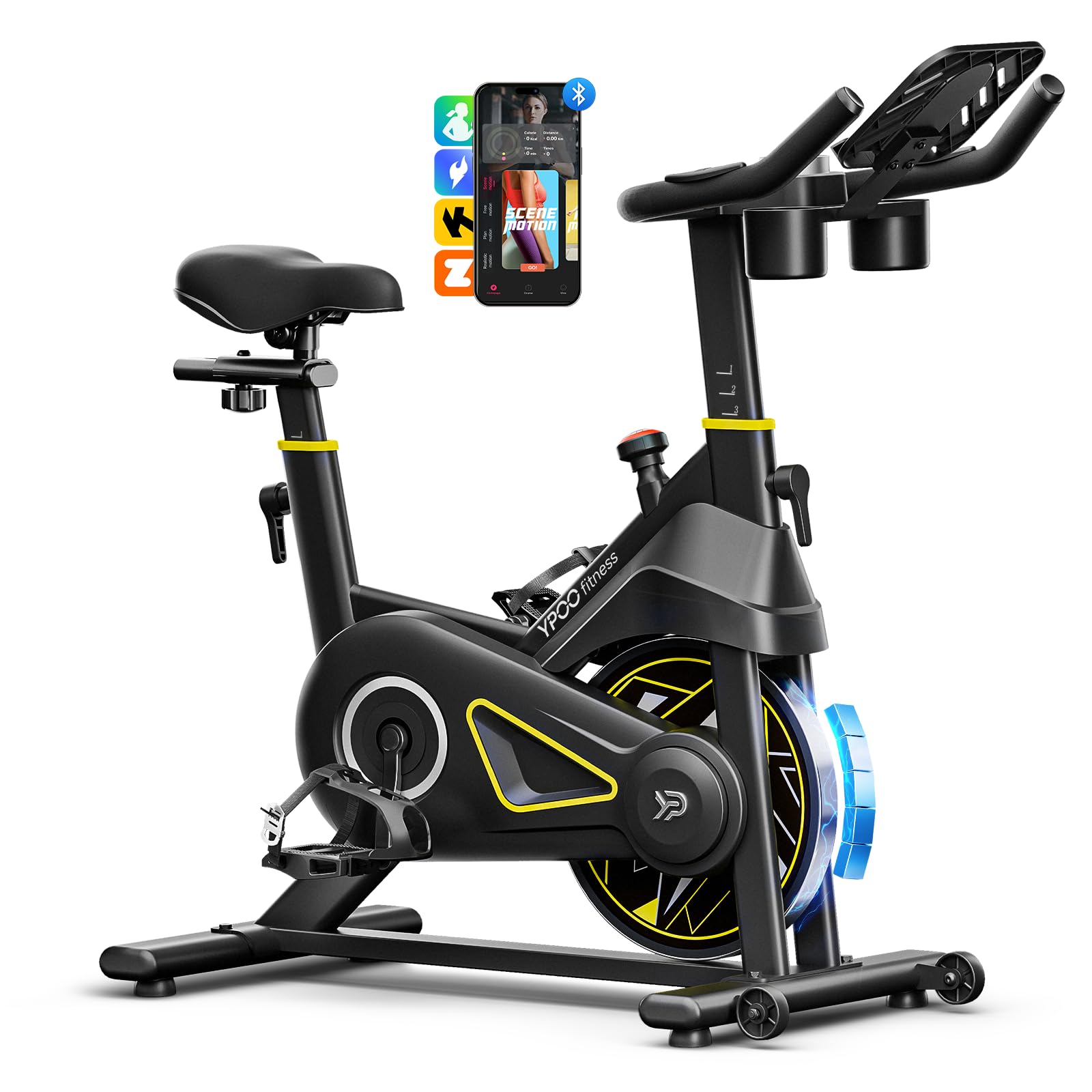
YPOO BC710 Exercise Bike
Key Features
- Resistance: Magnetic, 16 levels
- Item weight: 44 lb
- Pre-assembled: 80%
- Weight capacity: 300 lb
- Price: Budget
At 44 pounds the YPOO is one of the lightest full-size uprights here — only the CURSOR is lighter — and that changes how the bike lives in a small home. It’s the one you can shift out of the way with one hand when the room has to be something else.
It arrives 80 percent assembled, so setup is a short job, and the spec sheet is the modern standard: 16 magnetic levels, a maintenance-free belt drive, resistance that stops the flywheel when you press the knob, and pairing with YPOO’s own app plus Kinomap and Zwift. The frame is rated to 300 pounds.
We rate it near the top of this set for quiet and for fitting into a small room. At 33 inches long and 19 wide it tucks against a wall without a debate about furniture. The seat is on the small side, which shorter riders tend to like and taller ones don’t, and the resistance dial is manual, so bring your own structure.
The console is the soft spot. Displays that stop working are the failure to watch for on this one, and the warranty is what protects you if it happens, so keep the paperwork. Otherwise this is a well-sorted bike at a fair price a step below the CHAOKE.
Pros
- 44 pounds, easy to move
- Quiet magnetic belt drive
- 80 percent pre-assembled
- Own app plus Kinomap and Zwift
Cons
- Console display can fail early
A light, quiet, app-friendly upright for small rooms, and the pick if you move the bike between rooms — watch the console.
Best for Lowest Price
CURSOR CBE10 Exercise Bike

Key Features
- Resistance: Friction, 100 levels
- Item weight: 39.7 lb
- Rider height: 4 ft 8 in to 6 ft 2 in
- Weight capacity: 300 lb
- Price: Budget
The CURSOR is the least expensive bike in this group and the only one that uses a friction pad rather than magnets. That’s the trade in a sentence: you save money, and you take on a wear part that needs adjusting as the pad thins.
The rest of the package is more than you’d expect at the bottom of the market: a 300-pound rating, a four-way seat with seven height settings, belt drive, 100-step resistance, and a frame light enough at 39.7 pounds to move into a corner on its own. It’s 31.5 inches long, and assembly is a half-hour job.
What you give up is weight under you. At 39.7 pounds the frame shifts under hard pedaling in a way the 62-pound MERACH doesn’t, so this suits steady riding more than sprint intervals. The friction pad is the other trade: it works, and it will eventually want attention, which is the one maintenance job the magnetic bikes here never ask for.
Where it makes sense is as a first bike or a winter machine in a house that isn’t ready to give up floor space permanently — light enough to move, rated for 300 pounds, and cheap enough to try.
Pros
- Lowest price in this group
- 39.7 pounds, the lightest here
- 300-pound capacity in a compact frame
- Quick tool-free assembly
Cons
- Friction pad wears and needs adjustment
- Light frame moves under hard pedaling
The least expensive way into a full-size home bike: light, rated to 300 pounds, easy to build, with a friction pad to look after.
How We Chose and Tested the Best Stationary Bikes
We started with more than 30 bikes on paper and cut the list using frame adjustability, resistance type, warranty length, and price, then bought eight to live with for six months. Each one was assembled solo in a spare room with a stopwatch running, from opening the box to the first pedal stroke, and we noted which builds genuinely needed a second person and which sets of instructions matched the hardware actually in the bag.
Fit and comfort got the most attention, because that’s where most returns begin. Four riders between 5 foot 2 and 6 foot 2 adjusted each bike’s seat and handlebars and rode a 20-minute session, then a 45-minute one; we measured every seat with a tape measure and asked each rider where the pressure landed after the longer ride. Across six months of weekly riding we logged every creak, wobble, drifted resistance knob, and loose bolt.
Quiet was judged with a decibel app held at ear height and at floor level while pedaling at a steady cadence, with a second person sitting in the room below. We changed resistance mid-ride to see how smoothly it responded and whether the console kept up, and we compared what each price tier actually included, since more than one bike rode beautifully but only made sense with a subscription attached.
How to Choose a Stationary Bike for Home
The bike that gets used is the one that fits you properly and doesn’t make you rearrange the room; everything else is a detail.
Magnetic or friction: what you’re actually paying for
Magnetic resistance pulls against a spinning flywheel without touching it, so it stays quiet and nothing wears down. A friction pad presses on the wheel instead. It’s the cheaper build and it works, but the pad thins, the feel changes, and it eventually wants adjusting — only the CURSOR in this group goes that route. The number on the dial matters less than it suggests: 100 levels usually means a continuously variable knob rather than a hundred distinct clicks, so judge resistance by how smoothly it climbs.
Our rule is simple. If you ride before work or live above someone, pay for magnetic. If the bike lives in a garage and the budget is tight, friction is survivable.
Fit comes before features
Seat height and seat fore-aft decide whether you’ll ride. A four-way seat slides forward and back as well as up and down; a two-way seat only rises, which is the adjustment budget bikes skip and the one most riders need. Set the seat so your knee is almost straight at the bottom of the stroke, then check that the bars reach without locking your elbows.
The trap is the listed height range. It’s a generous envelope, and the top of it usually means the seat post is near its limit — where a bike is least stable. Weight ratings are the other hard number: 265 to 350 pounds across these picks, and the ceiling is a limit, not a suggestion.
Footprint, weight and whether folding is worth it
The uprights here run from about 40 to 62 pounds and roughly 32 to 43 inches long. A lighter bike moves between rooms on its transport wheels; a heavier one gets placed once. Folding frames save the room, not the effort — they cut flywheel mass to stay light, so the pedal stroke feels thinner when you push the resistance up.
The trap is the word compact. Compact in a listing means it fits a corner, not that it disappears into a closet. If the fold is the whole point, check the folded dimensions before you count on storing it out of sight.
The saddle, the pedals and the parts that go first
Nearly every saddle in this group is firmer and narrower than a casual rider expects, and it’s the cheapest thing to fix: a padded cover or a replacement seat decides whether you ride for forty minutes or ten. Don’t let a saddle talk you out of an otherwise good bike; do budget for it.
The parts that actually end a bike’s life are the pedals, the resistance knob and the console. Check that pedals thread in cleanly and stay tight, and read what the warranty covers before you buy — a display that quits in month four is the most common way a good bike becomes a frustration.
Frequently Asked Questions
How long does assembly take?
Plan on about an hour. Several bikes arrive mostly built — PLENY ships its frame 85 percent assembled and YPOO 80 percent — and those are realistic 30-to-45-minute jobs with the tools in the box. The rest run closer to an hour, and the pedals and handlebars are the steps worth doing slowly: a cross-threaded pedal is the one mistake that’s hard to undo.
Can I use a stationary bike in an upstairs apartment?
Yes, with two precautions. Put a dense rubber mat under the bike to spread the load and cut vibration through a wooden floor, and keep it off a shared wall. Weight matters as much as noise: the lightest bike here is just under 40 pounds and the heaviest is 62. A belt-driven magnetic bike is the quiet choice if you ride early or late.
Do I need a subscription to use the apps?
No. The bikes that pair with phones connect over Bluetooth to free options — MERACH’s and YPOO’s own apps track a ride at no cost, and Kinomap pairing is included on several. A service like Zwift is a separate subscription if you want its races, but the bike works without it, and you can ignore all of it and use the console.
Is an upright bike or a folding bike with a backrest better for a bad back?
They’re different jobs. An upright puts you over the pedals with your weight on the saddle and your hands forward, which suits hard cardio and standing efforts. A bike with a backrest and side handles, like the GOIMU, supports your lower back and lets you sit further behind the pedals, which is friendlier for long easy sessions or coming back from an injury. Fit decides more than frame style in either case.
Final Verdict
If we were buying one bike for a spare room and a weekly habit, it would be the CHAOKE 520A. It’s quiet enough for a shared wall, stable enough to stand up on, and adjustable enough that two people can share it — and it does all of that for mid-range money.
Step up to the MERACH S26 only if you want coached sessions and a heavier frame, and drop to the PLENY if the bike has to fold away between rides. Above 300 pounds, the SLUNSE is the pick, because nothing else here covers you.