This post contains affiliate links. We may earn a small commission when you buy through our links — at no extra cost to you.
The pitch for a bike trainer is simple: keep riding when the weather turns. The reality is less simple. The wrong one rattles the floorboards, fights you on resistance, or takes twenty minutes to assemble before every session. The right one disappears under you—quiet enough for a 6 a.m. interval, stable enough to sprint out of the saddle, and simple enough that mounting your bike becomes muscle memory.
I’ve spent the past seven months riding eight trainers, from wheel-on units to direct-drive setups, and my team helped me track the details that matter after the honeymoon. We mounted bikes with quick releases, thru-axles, and disc brakes, and paid attention to how each trainer adjusted to fit different frames. One thing I wish every first-time buyer knew: noise is a system, not a spec—your tire, floor, and cadence matter as much as the machine. Value counts, too: a trainer is only a good deal if it stays sturdy and smooth after a season of hard efforts. The picks below are the ones that made indoor riding feel like a ride.


Best for Year-Round Indoor Training
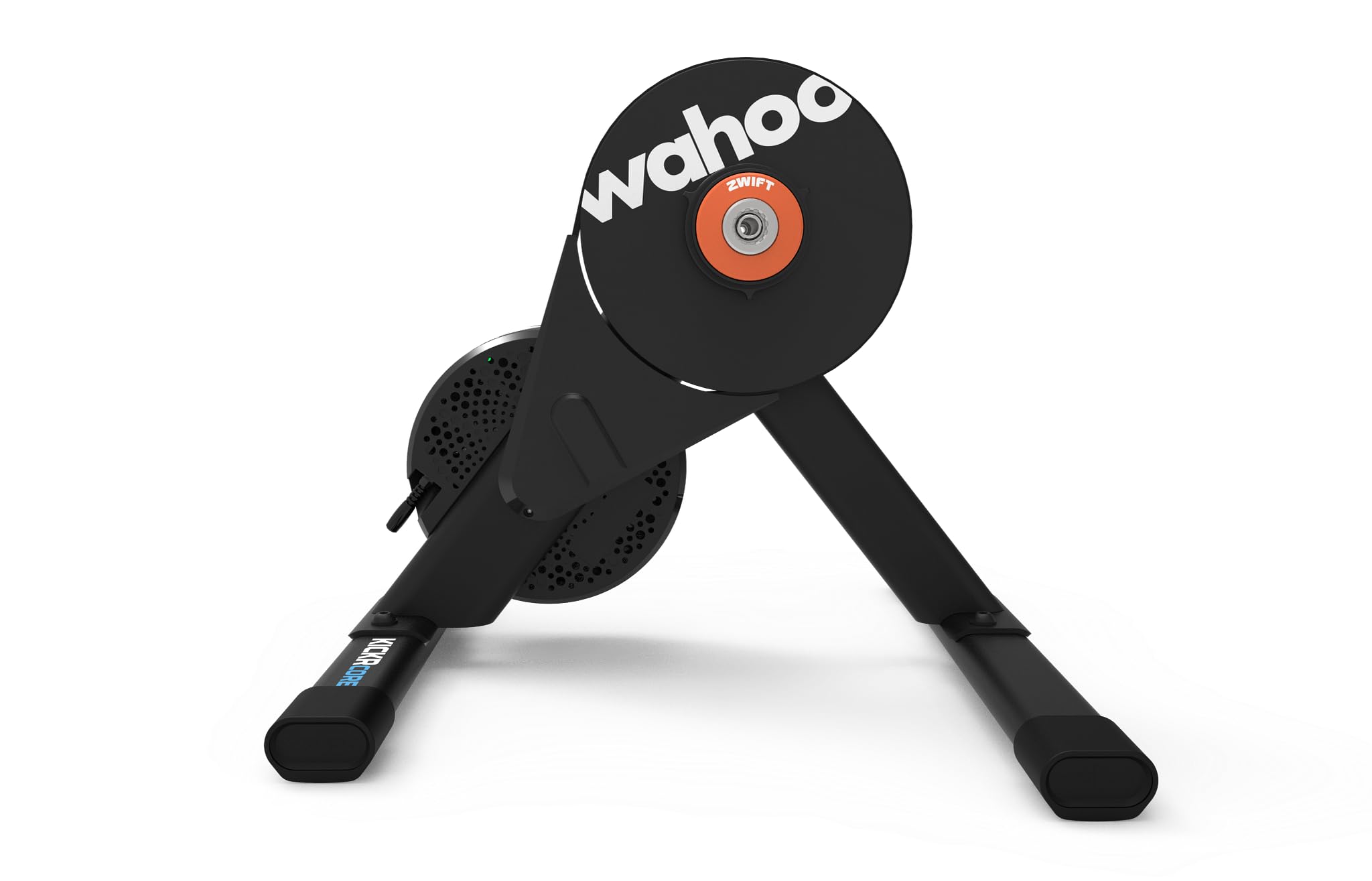
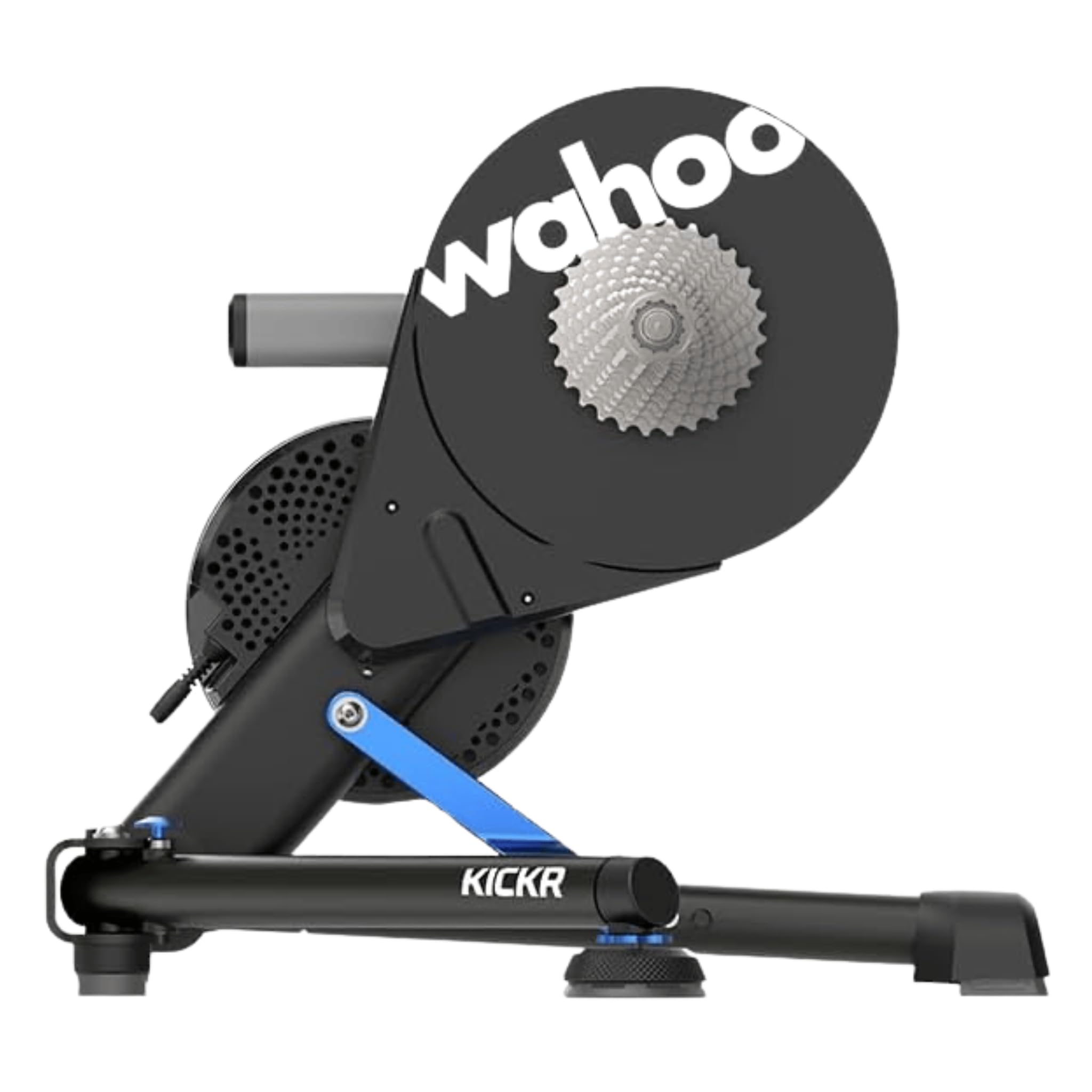
Wahoo KICKR CORE 2
Key Features
- Drive type: Direct drive
- Resistance: Electronic
- Item weight: 30 lb
- Connectivity: Wi-Fi
- Price: Premium
What settled the KICKR CORE 2 as our top pick is the box it arrives in. Instead of a bare freehub, Wahoo ships it with a Zwift Cog and a pair of Click buttons that handle the shifting, so you are not spending the evening after delivery hunting for a cassette and a lockring tool. The rear wheel comes off, the bike drops onto the adapters, and you ride. It is the least annoying entry into serious indoor training in this group.
The hardware underneath is just as considered. The box covers both frame standards, with adapters for 130 and 135 mm quick-release and 12×142 and 12×148 thru-axle, plus a disc-brake caliper spacer that saves a trip to the hardware store. One snag to clear before you start: a kickstand or an awkwardly placed rear caliper turns mounting into a wrestling match. Take the kickstand off first and the whole job takes minutes.
On the bike, this is the ride we keep coming back to. The heavy flywheel gives a weighted, rolling feel rather than the drag of a brake, and hard efforts stay smooth instead of turning gritty. It holds steady when you stand up, and it is quiet enough that the drivetrain, not the trainer, is what you hear. If you want one unit to see you through a full winter of structured sessions, start here.
Pros
- Zwift Cog and Click come in the box
- Adapters for both axle standards
- Quiet and stable under hard efforts
Cons
- Wi-Fi is 2.4 GHz only
- Often ships in 8 to 14 days
We tell most riders to buy this one: direct-drive feel, Zwift shifting hardware included, and axle adapters for nearly any modern bike.
Best for Budget Smart Training
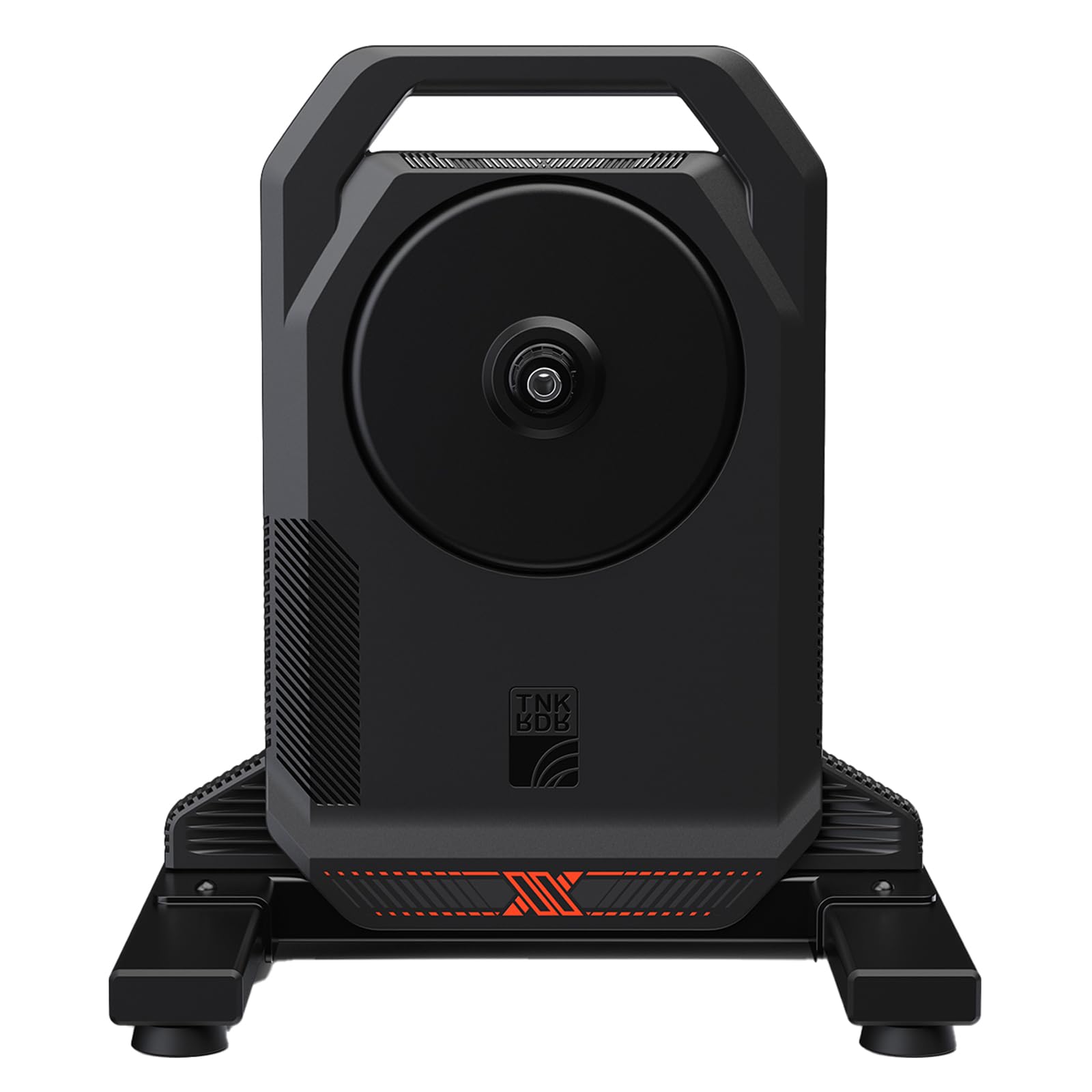
ThinkRider XXPRO
Key Features
- Max power: 2,500W
- Max slope: 25%
- Drive type: Direct drive
- Connectivity: ANT+, Bluetooth
- Price: Midrange
A direct-drive trainer claiming 2,500 watts, a 25% slope simulation, ±1% power accuracy and no calibration is usually the point where the price climbs out of reach. We went looking for the catch in the ThinkRider XXPRO and did not find one that changes the recommendation.
The detail that surprised us most is that it generates its own power. You can set it up in a garage or a shed with no outlet within reach and it still runs, which is a small thing until you have spent a winter stepping over a power brick. Paired over Bluetooth, it holds ERG mode and follows the gradients of whatever route you are riding, and the resistance builds smoothly instead of stepping through detents.
Two limits worth knowing. Virtual shifting is not fully supported in Zwift, so the gear controls do less there than the name implies, and the drive can slip at very low cadence under heavy load — grind up a virtual climb out of the saddle and you may feel it let go for a beat. Fit needs attention too, because the rear wheel comes off: check your axle adapters and budget for a cassette if you are supplying your own. For the money, this is the smart trainer we point budget-minded riders to first.
Pros
- Runs without a power cable
- 2,500W ceiling and a 25% slope
- ±1% accuracy with no calibration
- Quiet enough that you hear the chain
Cons
- Virtual shifting isn’t fully supported in Zwift
- Can slip at low cadence under heavy load
Buy this if you want smart direct-drive training on a tight budget and can live without full Zwift virtual shifting.
Best for Folding Wheel-On Setup
Alpcour Magnetic Trainer
Key Features
- Drive type: Magnetic wheel-on
- Item weight: 20.6 lb
- Folding frame: Yes
- Resistance levels: 6
- Price: Midrange
The Alpcour folds. For anyone training in a living room and putting the stand away afterwards, that is not a gimmick: the stainless frame collapses, the included bag swallows it, and the floor comes back into view.
The rest of the package is sensible too. Six resistance levels run through a cable to a handlebar remote, so you can change the load without unclipping, and the box includes a front wheel riser block and anti-slip pads for the feet. At a bit over twenty pounds it is light enough for one person to carry into another room, which is more than we can say for the cheaper stands here.
Where this one separates from the budget wheel-ons is sturdiness. The stainless frame and wide stance do not wander when you stand on the pedals, and it holds a line through a hard interval instead of rocking sideways. It is the wheel-on we reach for when the bike goes back outside in the morning and the stand has to vanish into a cupboard.
Pros
- Folds into a bag for storage
- Handlebar remote for six levels
- Steadiest wheel-on frame in this group
Cons
- Resistance steps are subtle at the top end
Buy this if the stand has to disappear between sessions and you still want a wheel-on frame that doesn’t wander under you.
Best for Maximum Indoor Realism
Wahoo KICKR V6
Key Features
- Max power: 2,200W
- Drive type: Direct drive
- Connectivity: Wi-Fi (2.4 GHz)
- Power accuracy: ±1%
- Price: Premium
The AXIS feet are the tell. Where most trainers sit rigid on the floor, the KICKR V6 rocks a few degrees side to side under load, and over an hour that small movement is the difference between pedaling a bike and being clamped into a bench vise.
It is the kind of detail you pay for at the top of this group, and the V6 earns its keep elsewhere too: over 2,200 watts of resistance accurate to ±1%, no calibration routine to run before a session, and quiet under load even when you are working hard. It paired with Zwift, Rouvy and the Wahoo app without complaint, and nothing creaks when you jump out of the saddle.
Two things give us pause. It costs well above the CORE 2, which does most of the same job for a lot less, and swapping the stock cassette and freehub is a genuine fight — allow an evening and the right tools. Neither stops it being the best ride in this group; they just narrow who should buy it.
Pros
- AXIS feet add side-to-side movement
- 2,200W at ±1% accuracy
- Works with Zwift, Rouvy, Garmin and Wahoo
Cons
- Costs well above the CORE 2
- Freehub swap takes patience and tools
Buy this if indoor riding is your main training and you want the most realistic, quietest ride here, at the highest price.
Best for Simple Winter Base
Yaheetech Magnetic Trainer
Key Features
- Wheel fit: 26–28 in, 700C
- Drive type: Magnetic wheel-on
- Item weight: 13.8 lb
- Load capacity: 265 lb
- Price: Budget
There is one resistance setting on the Yaheetech, and it is not a dial on the handlebar — it is your bike’s gears. That reads like a limitation, and it is one, but it is also why there is almost nothing here to go wrong and why the whole stand is so easy to live with.
What you get is a steel frame rated to 265 pounds that takes 26- to 28-inch and 700C wheels, weighs under fourteen pounds, and stands on four adjustable non-slip feet. A quick-release skewer is in the box, setup is a matter of minutes, and the footprint is small enough to leave up between sessions. Nothing needs charging, pairing or updating before you ride.
Ride it with a smooth rear tire and it does everything a winter base-mile stand needs to do: steady under pedaling, simple to get on and off, and inexpensive enough to leave in the garage without a second thought. It is the one we suggest to anyone who wants to try indoor riding before committing to a smart trainer.
Pros
- Lowest price of the stands here
- Rated to 265 pounds
- Fits 26–28 in and 700C wheels
Cons
- Loud with a knobby mountain bike tire
- Thru-axle bikes need an adapter that isn’t included
Buy this if you want to try indoor riding with almost no outlay and are happy to let your gears do the resistance work.
Best for Budget Remote Resistance
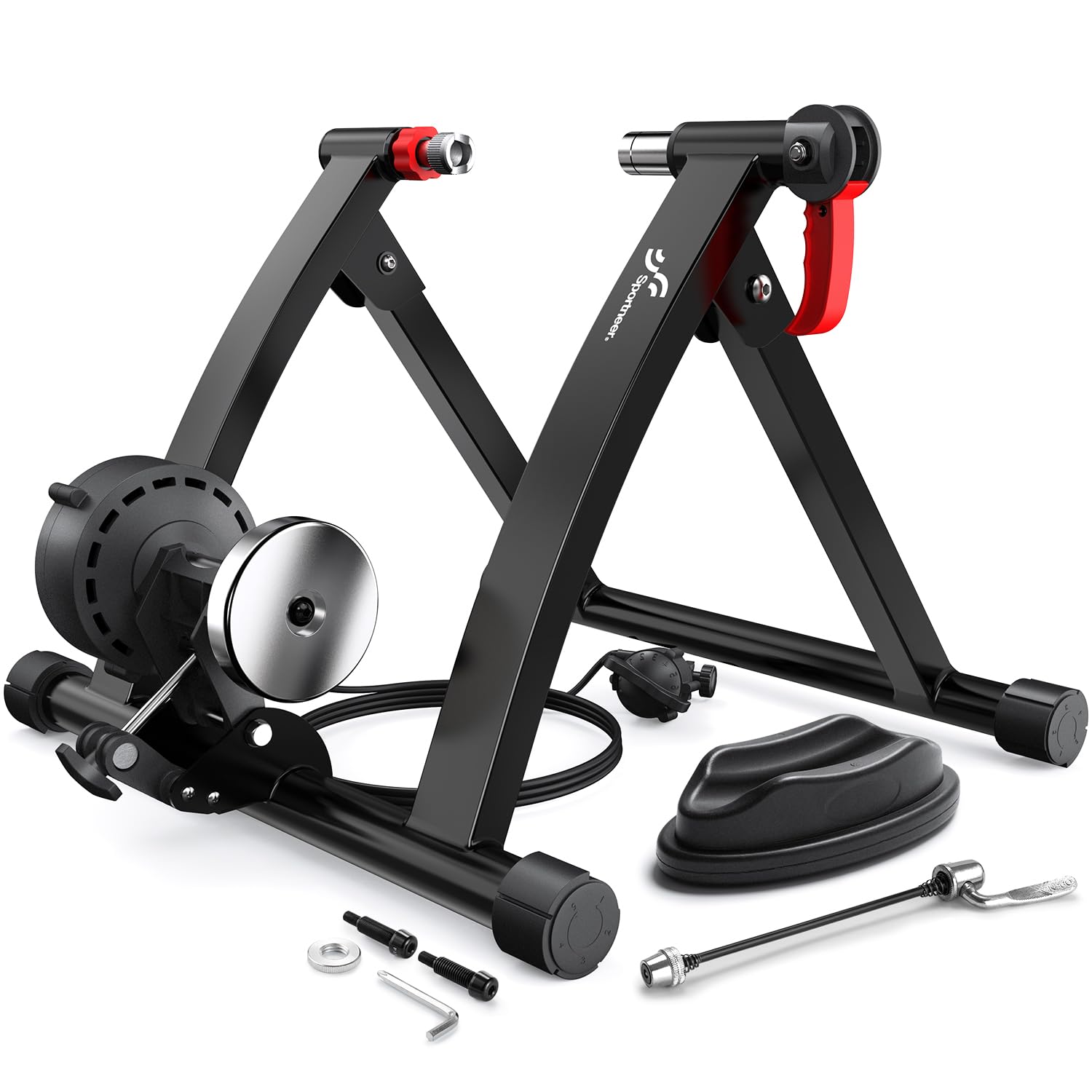
Sportneer Magnetic Trainer
Key Features
- Drive type: Magnetic wheel-on
- Load capacity: 300 lb
- Rear axle fit: 4.92–6.57 in
- Resistance levels: 6
- Price: Budget
The Sportneer puts the resistance on your handlebar. A cable runs from the stand to a bar-mounted remote with six detents, so you can go from a flat spin to a climb without stopping to reach down at the roller.
Setup is the other thing it gets right. The press-down lever clamps the rear axle in seconds, the box includes a front wheel riser and a skewer, and there is no assembly to speak of — unfold it, clamp the bike, ride. At a little over nineteen pounds it is easy to shift out of the way when the session ends, and the one-year warranty is longer than some of the cheaper stands offer.
For a rider who wants resistance at their fingertips on a budget, this is the stand we point to, and a 300-pound rating means it takes a heavier rider without complaint. The mount is the catch: the clamps want a removable quick-release axle measuring between 4.92 and 6.57 inches, so a thru-axle bike is simply out.
Pros
- Handlebar remote for six levels
- Press-down lever clamps in seconds
- 300-pound capacity
- Front wheel riser and skewer included
Cons
- Loud under hard efforts, especially on wood floors
- Resistance runs out for strong riders
Buy this if you want six resistance levels at the handlebar without paying direct-drive money, and your bike has a quick-release rear axle.
Best for Small-Space Folding Stand
CXWXC Folding Trainer

Key Features
- Wheel fit: 26–29 in, 700C
- Drive type: Magnetic wheel-on
- Load capacity: 330 lb
- Resistance levels: 6
- Price: Budget
The spec claims 26 to 29 inches and 700C. The 29 is the number to be careful with: a 29-inch mountain bike is where this stand runs out of room, and the included skewer is short enough to make some installations harder than they need to be.
Get past that and there is a lot of stand for the money. The frame folds flat in about a minute, which is the whole reason to buy this one over a fixed stand, and it carries a 330-pound rating — the highest of the wheel-on models here. Six resistance levels run to a handlebar remote, and both the skewer and a front wheel riser come in the box.
Mounting is where it gets fussy. The remote’s clamp will not open wide enough for some handlebars, and fitting it means pulling a grip off first. Some frames do not line up cleanly with the cup ends, and unusual axle standards — a Cannondale, for instance — can need a brand-specific part before the bike goes on at all.
For a quick-release road or hybrid bike in a room where the floor has to come back afterwards, it is a sensible budget buy, and we like that the folded package slides behind a door. For a 29er or an odd axle standard, keep looking.
Pros
- Folds flat in about a minute
- 330-pound capacity, the highest here
- Handlebar remote with six levels
- Skewer and wheel riser included
Cons
- 29-inch mountain bikes can be a stretch to fit
- Remote clamp won’t clear wide bars
Buy this if you have a quick-release road or hybrid bike, limited storage, and no intention of putting a 29er on it.
How We Tested Bike Trainers
To build the shortlist, I started with the trainers our editors and cycling friends already owned or asked about, then narrowed by price, footprint, and the bikes each one claimed to fit. We ended up with eight trainers and rode them for seven months—through early-morning intervals before work, weekend endurance blocks, and the occasional messy sprint session in a living room and a garage. We assembled each one from the box, timed how long it took one person to get from unboxing to first pedal stroke, and noted whether the instructions matched the hardware.
Mounting was its own test. We fitted a rim-brake road bike, a disc-brake gravel bike, and a thru-axle bike to each trainer, checking whether the adapters were included, whether the frame cleared the resistance unit, and whether one person could lift the bike into place without a second set of hands. Once riding, we moved through the resistance range in steady efforts and hard intervals, paying attention to lag, dead spots, and whether the steps felt even. We also rode at low and high cadence with the windows closed, listening from the saddle and from the next room, and noted whether vibration traveled through carpet or hardwood.
Sturdiness showed up during out-of-the-saddle sprints: we rocked the bars, watched for flex at the legs, and checked whether the trainer crept across the floor. We adjusted each unit for different riders and bikes, noting whether the knobs and levers were reachable while straddling the frame. After seven months, we looked for loosened bolts, worn belts, corrosion, and any play that made a trainer feel less solid than it did on day one—the kind of wear that separates good value from a false economy.
How to Choose a Bike Trainer
The decision that shapes everything else is whether your bike keeps its rear wheel: a direct-drive trainer takes it off, and a wheel-on trainer presses a roller against the tire.
Wheel-On or Direct Drive
Wheel-on trainers clamp the rear axle and press a roller against the tire. The bike stays whole, so it goes back on the road in a minute, and the stand costs less. In return you get more noise and a little wheel slip under a hard sprint, and the tire becomes a wear item.
Direct-drive units take the rear wheel off and run the chain onto a cassette mounted on the trainer. They are quieter, they feel more like a road, and they cost more. Because the wheel comes off, switching back to outdoor riding is a job rather than a moment. Ride outside midweek and a wheel-on makes more sense; train indoors all winter and direct drive earns its price.
Fit Comes Before Features
Two measurements decide whether a trainer works with your bike: the rear axle standard and the wheel size. Quick-release frames are the easy case, and most wheel-on stands include a skewer for them. Thru-axle bikes need a specific adapter, and it is not always in the box — Yaheetech sells its thru-axle adapters separately.
Wheel-size claims deserve the same suspicion. A stand that lists 26 to 29 inches can still be a tight fit on a 29-inch mountain bike, which is what the CXWXC runs into. Measure your axle width and check the adapter list before you order anything.
Noise Is About the Room as Much as the Trainer
Every trainer is quiet in a carpeted basement and loud on a second-floor apartment floor. Direct drive removes the biggest source of noise by taking the tire out of the equation. A wheel-on stand presses rubber against steel and turns tread and roller pressure into a hum that travels through the structure.
A dense mat helps, a smooth rear tire helps more, and a knobby mountain bike tire never will. If you live above someone, choose direct drive or accept that your sessions have a curfew.
What Smart Resistance Actually Buys You
A smart trainer hands control of the resistance to an app. In ERG mode it holds a set wattage whatever cadence you turn; in simulation mode it follows the gradient of the route on screen. That needs ANT+ or Bluetooth, so check which protocols the unit speaks and whether your app of choice supports them.
Power accuracy matters if you train by numbers: ±1% is a serious figure, while ±5% is fine for fitness. None of it is compulsory. A magnetic stand with a handlebar remote and your own gears will still get you through the winter.
Frequently Asked Questions
Can I use a carbon frame on a bike trainer?
Yes. Both designs hold the bike at the rear axle, the same place the wheel sits, and a correctly fitted adapter spreads the load the way the frame expects. Direct-drive units are gentler on the bike because the rear wheel and tire are out of the picture entirely.
Respect the trainer’s stated load capacity — 265 pounds on the Yaheetech, 330 on the CXWXC — and if your frame manufacturer publishes its own guidance, follow that instead.
How long does it take to switch between the trainer and riding outside?
On a wheel-on stand, seconds: release the press-down lever or clamp, lift the bike off, and the rear wheel is already on it. Direct-drive trainers need the rear wheel refitted, so it is a several-minute job and you need somewhere to keep the wheel while you train.
If you ride outdoors between sessions, that difference matters more than most of the numbers on the box.
How much floor space does a bike trainer need?
Less for the stand than for the bike. The Alpcour’s frame measures 21.5 by 19 inches, but your bike stays full length on top of it, so plan for the bike plus a mat and a little room to swing a leg over.
Folding stands — the Alpcour and the CXWXC — collapse to a flat package that goes behind a door or into a closet between sessions.
Do I need to buy anything else to get started?
With a wheel-on stand, usually nothing: the Sportneer, the CXWXC and the Yaheetech all include a quick-release skewer, and two of them add a front wheel riser. Direct-drive trainers are the ones that surprise people — a cassette and lockring tool unless the unit ships with a Zwift Cog, plus the adapter for your axle standard.
A floor mat is worth having in either case.
Final Verdict
If you want one trainer to carry you from October to March, the Wahoo KICKR CORE 2 is the pick. It gives you direct-drive road feel, Zwift shifting hardware in the box, and adapters that cover both axle standards, with none of the cassette shopping that usually follows a direct-drive purchase.
Budget is the only good reason to look elsewhere, and the ThinkRider XXPRO is a genuinely capable answer for a lot less money. If you ride outside between sessions, the Alpcour’s folding frame gets your floor back in under a minute.