This post contains affiliate links. We may earn a small commission when you buy through our links — at no extra cost to you.
A cushy saddle sounds like the answer until mile ten, when the padding that felt so good in the parking lot starts pressing exactly where it shouldn’t. Comfort has less to do with how much foam sits under you than with how your sit bones land and whether the shape lets your legs pedal without rubbing. What a good comfort saddle actually fixes is the reason most people quit riding: the numb, chafed, aching backside that turns a twenty-minute cruise into a chore.
I’ve been fitted for saddles at shops that measured my sit bones on a gel pad, and I’ve also bolted one on and hoped for the best, and the difference between those two experiences is not subtle. Over the past six months my team and I have put 12 comfort saddles through commutes, rail-trail loops, and long weekend rides, moving them between cruisers, hybrids, and upright city bikes. The plushest model wasn’t the kindest, and two saddles that looked nearly identical rode completely differently once the rails flexed. The picks below are the ones we’d bolt back onto our own bikes.


Best for Upright Comfort Riding
Bikeroo Wide Cruiser Saddle
Key Features
- Padding: Memory foam
- Dimensions: 12 x 10.2 x 7 in
- Suspension: Steel springs and elastomer
- Max rider weight: 350 lb
- Price: Budget
Two suspension systems on one saddle looked like catalog padding to us until we worked out what each one does. The steel springs under the rear soak up the single big hit — a curb, a pothole, a tree root — while the elastomer block between the rails and the shell damps the constant chatter of chip-seal pavement. Having both is the reason this is the first saddle we point upright riders toward.
It earns the top spot by covering the whole job instead of one part of it. The shell measures 12 by 10.2 inches, with about 7 inches of height once the springs are counted, and the 350-pound weight rating sits near the top of this group. In the box you get two hex keys, a multi-hole wrench, a seat adapter, a rain cover, and printed instructions, so a first-time swap doesn’t stall because the right tool is missing.
Mostly, though, this is about support rather than squish. The foam is dense and holds its shape, which is what keeps a platform this wide from turning into a pressure point of its own — a soft cruiser seat that bottoms out under you is worse than a firm one that doesn’t. Sit fully upright with the full width under you and the springs have something to work against, which is exactly the posture a cruiser, a hybrid, or an indoor bike puts you in.
Pros
- Springs and elastomer absorb two different kinds of shock
- Complete fitting kit, including adapter and rain cover
- 350 lb rating sits near the top of this group
- Wide, dense platform built for upright riding
Cons
- Wide rear wings rub on forward-leaning rides
Two suspension systems, dense foam that holds its shape, and every tool in the box — the least fussy way to make an upright bike comfortable.
Best for Pressure Relief
Bikeroo Comfort Saddle
Key Features
- Included: Tools and rain cover
- Dimensions: 10.2 x 7.8 x 2.36 in
- Pressure relief: Deep center cutaway
- Max rider weight: 350 lb
- Price: Budget
Seven-point-eight inches across is the number that separates this Bikeroo from the ten-inch cruiser at the top of our list. That’s still generous — wider than anything that comes stock on a hybrid — but it stops short of the armchair end of the spectrum, which matters if a wide seat has ever left the backs of your thighs sore.
What puts it on the list for a specific kind of pain is the center channel. It’s a genuine cutout running from the nose back through the seating area rather than a decorative groove, so weight lands on your sit bones instead of the soft tissue between them, and the memory foam is layered deeply through the pelvic area where that pressure builds. At roughly a pound and a half it’s also one of the lighter saddles here, light enough that hauling the bike upstairs doesn’t turn into a chore.
The kit is complete — mounting tools, a waterproof rain cover, and a one-year warranty — and the rail clamp on most hybrids, city bikes, and indoor bikes takes it without an adapter. Installation is a five-minute job with the hardware in the box, and that rain cover is worth keeping in a pocket rather than a drawer if the bike lives outside.
Pros
- Deep center cutout puts weight on the sit bones
- 7.8-inch width clears the thighs on upright bikes
- Light at around a pound and a half
- Tools, rain cover, and a one-year warranty included
Cons
- Deep padding feels like too much at a forward lean
For pressure and numbness rather than soreness: a genuine full-length cutout in a platform that’s wide without being a sofa.
Best for General Replacement
LCYMD Comfort Bike Seat
Key Features
- Padding: High-density foam
- Warranty: 2 years
- Dimensions: 9.7 x 8 x 3.7 in
- Suspension: Dual shock-absorbing ball
- Price: Budget
The adapter in the box is the small inclusion that makes this one worth a second look: it gives you another way to mount the saddle when your bike’s clamp is older or non-standard. Measure your seat post before you order, though, because 1.25-inch posts are the ones that end up needing improvisation. For the common two-rail clamp, this goes on in minutes with a wrench.
At 9.7 by 8 inches it sits in the middle of this group, wide enough to support an upright rider and narrow enough that most people won’t feel it against the backs of their thighs. Under the cover there’s a shock-absorbing ball at the rear and a center vent that keeps air moving over the seating area; the cover itself is waterproof faux leather that wipes clean after a wet commute.
What earns it the widest-fit label is that middle-ness plus the backing: a two-year manufacturer warranty, the longest in this group, at a price near the bottom of it. The one thing it doesn’t do is pressure relief — there’s a vent down the middle rather than a channel — so if numbness rather than soreness is what sends you shopping, the Bikeroo cutaway is the better call.
Pros
- Included adapter helps with older or odd seat posts
- Longest warranty here at two years
- 8-inch width suits a wide range of bikes
- Center vent and waterproof cover for wet commutes
Cons
- Dense foam feels firm rather than plush
Our safest general swap — an 8-inch platform, an adapter for awkward seat posts, and the longest warranty in this group.
Best for Heavy, Upright Riders
Twomaples Oversized Bike Seat
Key Features
- Padding: Memory foam with gel
- Dimensions: 13.39 x 12.2 x 5.51 in
- Saddle weight: 2.1 lb
- Max rider weight: 650 lb
- Price: Midrange
Thirteen-point-four inches long and over twelve wide, this is the biggest saddle in the group, and that is the entire recommendation. If you are a heavier rider, or you sit fully upright on a cruiser or an e-bike and have never found a seat that felt like it was properly under you, extra surface area changes the experience more than any padding compound does.
The shape is doing as much work as the size. The side wings are concave rather than convex, a deliberate change aimed at the sliding that wide saddles often cause, and the fill is memory foam under a cooling gel layer. The shell is rated to 650 pounds, the highest figure here by a wide margin, and it ships with two wrenches, an adapter, and a reflective band.
Two practical things to plan for. At 2.1 pounds it’s the heaviest saddle on the list, which nobody buying for an e-bike will notice and a weight-conscious rider will. And the tilt needs patience: a nose-down slope sends you sliding forward, and the clamp takes a couple of attempts to get level. Set it right and the size stops being a novelty and starts being the point.
Pros
- Widest platform here at 13.39 by 12.2 inches
- Rated to 650 lb, far above the rest
- Concave wings designed to stop sliding
- Memory foam with a cooling gel layer
Cons
- No warranty stated by the manufacturer
If you’re a heavier rider or you sit fully upright, this is the one: the widest platform here, with the weight rating to back it.
Best for E-Bikes and Indoor
ROCKBROS Bike Seat
Key Features
- Extras: Carry handle and reflective strip
- Dimensions: 10.2 x 8.6 x 3.9 in
- Suspension: Dual shock-absorbing balls
- Max rider weight: 220.5 lb
- Price: Budget
The handle built into the nose is the detail that makes this one worth considering for an e-bike. Hauling a heavy bike onto a rack or dragging a spin bike across a room is exactly when you notice that most saddles give you nothing to grab, and this one hands you a full grip without an add-on part to lose.
Around that handle it’s a capable mid-width saddle: 10.2 by 8.6 inches, dual shock-absorbing balls under the rear, a dotted non-slip top that keeps you from creeping forward, and a reflective strip across the back for visibility. The wrench is included, which not every saddle here manages, and the warranty runs two years.
The catch is the weight rating. At 100 kilograms, roughly 220 pounds, it’s the lowest figure in this group, so a heavier rider should look at the Bikeroo or the Twomaples instead. Everyone else gets a wide, grippy platform that doesn’t slide around under hard pedalling on pavement, plus a handhold that makes the bike easier to live with.
Pros
- Built-in carry handle for lifting heavy bikes
- Dual shock balls soften bumps and potholes
- Grippy dotted top and reflective rear strip
- Two-year warranty and a wrench in the box
Cons
- 220 lb maximum rider weight
- Can work loose on the rails
The e-bike and indoor-bike pick — a built-in carry handle, a grippy top, and a two-year warranty, provided you’re under 220 pounds.
Best for Mtb and Road
Wittkop 5-Zone Bike Seat
Key Features
- Cover: Waterproof
- Zones: 5-zone concept
- Padding: Memory foam
- Dimensions: 10.8 x 6.7 x 3.5 in
- Price: Premium
At 6.7 inches across, this is the narrowest saddle we’re recommending, and it’s a decision rather than a compromise. Everyone else on this list is trying to put more surface under you; Wittkop’s five-zone design puts padding where a rider who actually pedals carries weight — under the sit bones and along the edges — and leaves the rest slim enough that your thighs never touch it.
It’s built for mountain, gravel, and road bikes rather than cruisers, and the profile shows it: 10.8 inches long, a waterproof cover, and a shape that lets you shift forward on a climb without the nose catching your shorts. The memory foam runs firm, which is what you want on a bike where you change position constantly.
Setup matters more here than anywhere else on the list. The shell has a pronounced curve, and a saddle that isn’t level will have you sliding toward the nose or bracing against the back for the whole ride; ten minutes with a wrench and a level is the difference between a seat you forget about and one you fight. Once it’s set, the narrow shape stops being noticeable, which is the highest compliment a saddle gets.
We think it earns its place because it’s the only saddle here that doesn’t punish you for riding properly. A wide cruiser seat is lovely for five miles and miserable once you start pushing; this one lets you move around, and there’s no spring-loaded platform shifting beneath you when you do. What you give up is the sit-up-and-look-around cushioned feel, and if that’s the ride you want, this is the wrong end of the list.
Pros
- 6.7-inch profile clears the thighs while pedalling
- Five-zone padding under sit bones and edges
- Waterproof cover for wet trails and commutes
- Designed for mountain, gravel, and road bikes
Cons
- The most expensive saddle in this group
For riders who actually pedal: a slim 6.7-inch shell that’s padded where you sit and out of the way everywhere else.
Best for Wet-Weather Commuting
Velmia Ergonomic Saddle
Key Features
- Cover: Waterproof
- Width: 7.3 in
- Sizing: Three models by ride position
- Padding: Memory foam
- Price: Midrange
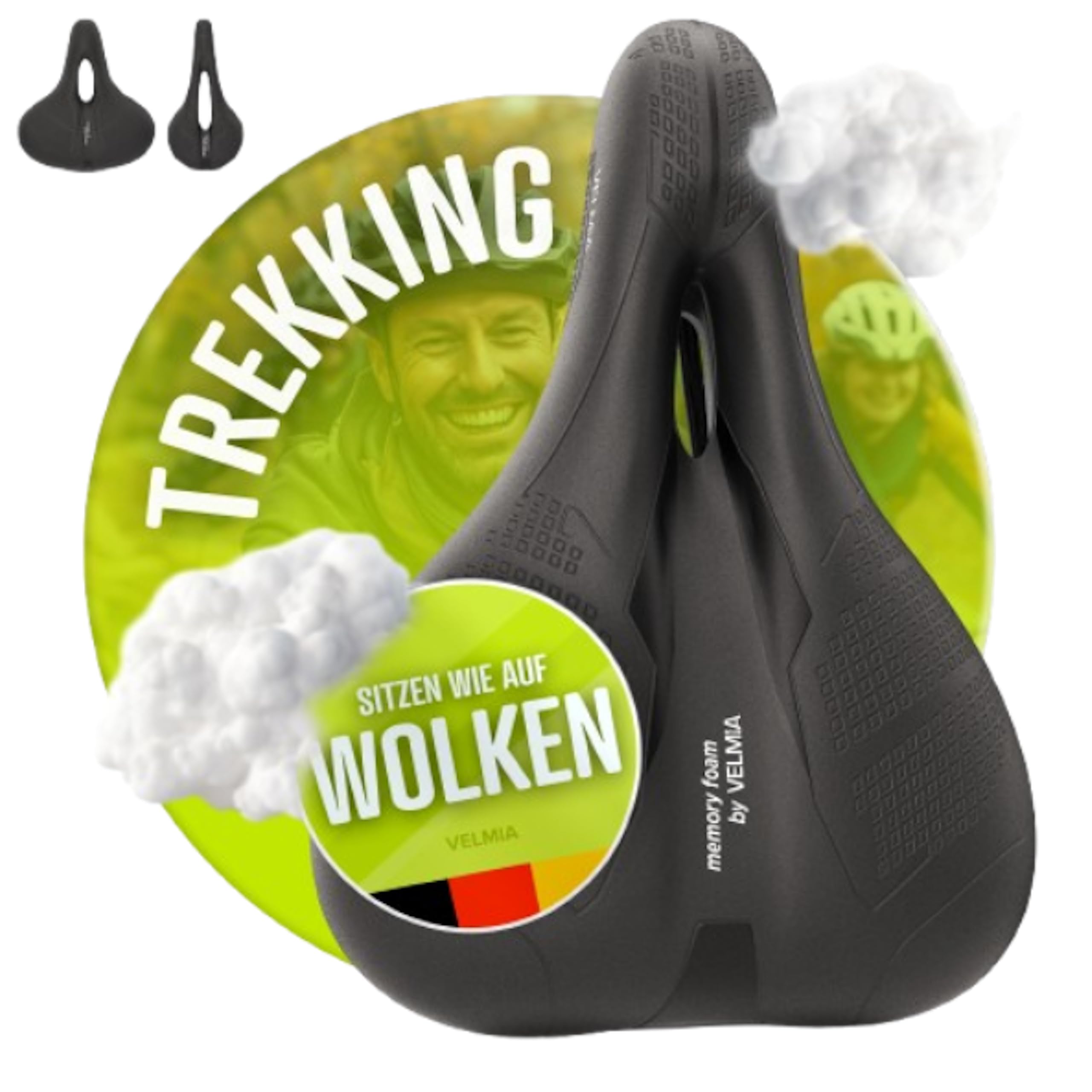
Velmia does something none of the others here bother with: the saddle comes in three versions sized to your riding position, so you choose the one that matches how far forward you lean rather than guessing at width. That’s the right question to ask, and it’s a big part of why this one stays on our list despite a caveat.
The middle version measures 7.3 inches across — narrow enough to pedal freely, wide enough for a city bike — with memory foam, a ventilation slot down the center, and a fully waterproof cover. A saddle clamp and illustrated instructions come in the box, which helps if your seat post uses the older clamp style rather than modern rails.
The caveat is the rails. They have snapped under heavier riders, which is a durability question you can’t see in a product photo and the reason we haven’t ranked it higher. A light rider doing a few rides a week is unlikely to meet the problem; a heavy daily commuter should take the 350-pound-rated Bikeroo instead.
Where it does earn attention is the buying logic and the waterproofing. If you ride through winter and you’ve never been able to guess which saddle width suits you, choosing by riding position removes most of the guesswork, and the cover shrugs off spray in a way the faux-leather seats here don’t. That’s a real advantage for a commuter, and it’s why the saddle stays on the page.
Pros
- Three models matched to riding position
- Fully waterproof cover with a vented center
- 7.3-inch width pedals freely
- Clamp and illustrated instructions included
Cons
- Firm foam that needs a few rides to soften
A waterproof saddle that takes the width guesswork out of buying, worth it for lighter riders who commute through wet weather.
Best for Thigh-Rub Relief
Bluewind Noseless Bike Seat

Key Features
- Shape: Noseless
- Dimensions: 13 x 9 x 5 in
- Foam thickness: 2.5 in
- Max rider weight: 300 lb
- Price: Midrange
Cutting the nose off a saddle is the most direct answer to thigh and soft-tissue friction we’ve seen on this list, and the Bluewind commits to it: 13 inches long, 9 wide, with nothing between your legs to chafe against on the downstroke. If friction rather than pressure has always been what ends your rides, that’s a genuine fix rather than a padding upgrade.
The platform is enormous — 2.5 inches of high-density foam over a 300-pound-rated shell — and it arrives with mounting tools and a reflective armband. The cover is stitched microfibre leather with a seamless edge, which keeps water out of the seams and wipes down easily after a wet ride.
What goes wrong is the mounting geometry. With no nose to brace against, the shape makes steering feel lighter than a conventional seat until you’re used to it, and a saddle this long needs to sit dead level or you’ll spend the ride bracing. On a cruiser or an exercise bike that’s a fair trade. On anything you lean into, it isn’t.
Pros
- Noseless shape removes nose and thigh friction
- 2.5 inches of high-density foam
- 300 lb rating on a wide platform
- Tools and reflective armband included
Cons
- Can slide forward on some rail setups
- 90-day warranty is the shortest here
For friction rather than pressure, the noseless platform solves what padding can’t — best on cruisers and indoor bikes.
How We Tested 12 Comfort Saddles Over Six Months
We built the shortlist around width first, since most upright riders need something in the 155-millimeter-and-up range, and we limited the field to saddles with a center cutout or a pronounced channel. From there we filtered out models with a pattern of split covers or rusting rails in customer reviews, and we deliberately included budget options alongside saddles costing three times as much so we could talk about value honestly rather than assuming price equals comfort.
Every saddle went through the same install: we timed the swap with a standard hex key and torque wrench, checked whether the rails left enough fore-and-aft room to match the rider’s old position, and made sure each one clamped flat without rocking in the seatpost cradle. Then we rode, on a 12-mile round-trip pavement commute, gravel rail-trail loops, and weekend rides of two hours or more.
Comfort we judged at the 30-minute mark rather than the first block, noting where pressure landed, whether the nose caught the back of our thighs on upright bikes, and whether anyone went numb. For firmness, we pressed each saddle at the nose, midsection, and rear, then compared that to how it felt at mile fifteen, since a saddle that packs down early stops supporting you. Over six months we watched covers for scuffing and seam separation, listened for rail creaks and checked for rust after rainy rides, and noted stitching and finish, because a saddle is the part of the bike you look at all day.
How to Choose a Comfort Bike Saddle
Comfort saddle shopping goes wrong in the same place almost every time: the seat is the wrong width for the position you actually ride in, and no amount of gel or springs rescues that.
Width is a riding-position question, not a padding question
An upright rider on a cruiser, hybrid, or e-bike puts nearly all their weight on the saddle, so a broad platform of ten inches or more spreads it across the sit bones. Lean forward and that changes: hands and feet carry part of the load, the pelvis rotates, and a wide rear wing starts sawing at the backs of your thighs with every stroke. It’s why a ten-inch cruiser seat feels wonderful for five upright miles and miserable on a road bike.
Pick by where your current saddle hurts. Sore sit bones with no thigh contact means you can go wider, toward the Bikeroo Wide Cruiser. Red, rubbed inner thighs mean you’ve already gone too wide, and a shell around seven or eight inches like the LCYMD or the Wittkop is the correction. Stuck between the two, the 7.8-inch Bikeroo center-cutaway is the safer middle.
Dense foam beats deep foam
A comfort saddle’s job is to hold you up, not to swallow you. Foam that compresses fully under your sit bones bottoms out, and what you feel through it is the shell — which is why a soft, thick seat can hurt more than a firm one. Dense memory foam keeps a little give while spreading the load, and a gel layer adds a slow, conforming feel on top of it.
Treat firmness as a feature rather than a compromise. If you want a hammock, most of the saddles here will disappoint you and you’ll keep replacing them; if you want to finish a two-hour ride without bruising, dense is what does it. Suspension is the better place to buy softness — let springs take the road and let the foam keep its shape.
Suspension and cutouts fix different problems
Springs, elastomer blocks, and shock balls absorb movement coming up from the road. A center cutout or channel takes pressure off soft tissue. They’re often sold together and they never substitute for each other — a sprung saddle without a channel still presses where it presses, and a cutout does nothing about a pothole.
Buy the one that matches your complaint. Numbness, or pressure running down the middle, calls for a genuine cutout like the one on the Bikeroo center-cutaway. Rough pavement, gravel, or a stiff e-bike frame calls for suspension — the paired springs on our top pick, or the shock balls under the ROCKBROS. If both apply, pick a saddle that has both and accept the extra weight.
The clamp is where most swaps go wrong
Nearly every saddle here mounts on the same two-rail clamp, and that’s the part to check before anything else. Older bikes and some budget models use a narrower post or an older clamp style, which is why an included adapter — as on the LCYMD — is worth more than it sounds. Measure the post diameter rather than assuming it.
Once it’s on, tighten the clamp properly and check it again after the first ride. A saddle that tilts or creeps is usually a mounting problem rather than a bad seat, and the fix is a wrench, not a return. Keep the old saddle in a drawer; it’s the fastest way to diagnose a fit problem later.
Frequently Asked Questions
Can I put a comfort saddle on a Peloton or another indoor bike?
Usually yes. Most indoor bikes use the same two-rail clamp as a road bike, and the saddles here slide straight on with the wrench in the box. The exception is Peloton’s Bike+, which has a horizontal bar under the seat that blocks some very wide shells, so measure that gap before ordering an oversized model. Keep the original saddle so you can put it back.
Do I still need padded shorts with a comfort saddle?
For short, upright rides, no — that’s what the padding is for. Shorts help with friction over distance rather than pressure, so if you’re riding two hours or more they still earn their place. Don’t stack both: a thick saddle plus a padded liner is a reliable way to create chafing. Do three or four normal-clothes rides first and add shorts only if rubbing shows up.
How do I work out which saddle width I need?
Sit on a piece of corrugated cardboard, lean slightly forward, and measure the distance between the two dents your sit bones leave. Add roughly an inch of platform on each side for an upright position, and less as you lean forward. That puts most upright riders between eight and ten inches, which is where the majority of the saddles here land; committed leaners come out nearer seven.
Final Verdict
For most riders replacing a painful stock saddle on a cruiser, hybrid, e-bike, or indoor bike, the Bikeroo Wide Cruiser is the answer: two suspension systems, dense foam that doesn’t bottom out, a 350-pound rating, and every tool you need in the box. Narrow the choice by riding position rather than by budget.
If numbness rather than soreness is what sends you shopping, take the Bikeroo center-cutaway and its full-length channel. If you lean forward and pedal hard, the Wittkop’s 6.7-inch shell is the one that stays out of your thighs’ way.