This post contains affiliate links. We may earn a small commission when you buy through our links — at no extra cost to you.
Many RV campers buy a power station expecting it to run their fridge all weekend, only to find it dying after a few hours. That gap between advertised capacity and real-world use is the biggest headache in this category.
The real issue isn’t just watt-hours; it’s matching the unit to your actual draw and usage pattern. A 1000Wh unit might run a modern fridge for 8-10 hours, not 24. And fast charging often requires app activation. This guide prioritizes units that deliver on their promises and helps you pick the right capacity and features for your camping style.
Weighing portability against raw output is the central trade-off. Lighter units are easier to move but may struggle with a microwave; heavier ones offer more headroom but become a burden at every setup. The picks below balance these factors for different needs.



Best for Mid-Capacity Rv Camping
Jackery Explorer 1000 v2
Key Features
- Capacity (Wh): 1070Wh
- AC Output: 1500W
- Weight: 23.8 lbs
- Charge Speed: 1 hour fast charge
- Expandable: No
- Price: $$
The Explorer 1000 v2 weighs just under 24 pounds — light enough to carry one-handed — yet delivers 1500W continuous AC output and a 3000W surge. Its LiFePO4 battery is rated for 4000 cycles, meaning a decade of weekend trips before noticeable degradation. The 1-hour full recharge from a wall outlet is the quickest in this weight class, though it requires one tap in the Jackery app to activate that speed mode.
In practice, the station handles a typical RV fridge (about 60W running, 150W startup) for 12-16 hours, runs a 700W microwave for a few cycles, and powers CPAP machines overnight without tripping. The 23.8-pound frame and built-in handle make it easy to move from truck bed to campsite table. Fan noise is present during charging but quiet enough to sleep next to when discharging at moderate loads.
This unit suits RV campers who want a self-contained power source for weekend trips and short home outages, not someone planning to run a 30A rig or expand capacity later. There is no expansion port — if you outgrow 1070Wh, you must buy a separate larger unit. The app-activated fast charge is a minor extra step each time you plug in, but the default slower charge (about 3 hours) still beats most competitors.
Pros
- Light enough to carry one-handed at 23.8 lbs for its 1070Wh capacity
- Recharges fully in about an hour from a wall outlet (app-enabled)
- Runs RV fridges, microwaves, and CPAP without stalling
- LiFePO4 cells rated for 4000 cycles – lasts through years of frequent use
Cons
- To get the advertised 1-hour recharge, you must manually enable fast charge via the app each time you plug in
- Occasional units arrive with a non-functioning AC outlet or charging port
For RV campers who value weight and a fast top-off more than expandability, this is the most balanced mid-capacity station available right now.
Best for Expandable for Longer Trips
EcoFlow Delta 2
Key Features
- Capacity (Wh): 1024Wh
- AC Output: 1800W
- Weight: 27 lbs
- Charge Speed: 50 min fast charge
- Expandable: Yes, to 3kWh
- Price: $$
Where the top pick delivers a lightweight all-in-one package, the Delta 2 takes a different approach: it starts at 1kWh but can be doubled or tripled in capacity with add-on batteries, all while charging to 80% in under an hour. This expandability, paired with 1800W of continuous AC output, covers most RV appliances like refrigerators, coffee makers, and laptops without issue.
This makes it a natural choice for RV campers who plan to grow their power system over time rather than buying a single large unit upfront. That said, running heavy loads like a microwave or air conditioner at full power may trigger intermittent shutdowns on some units – so it’s best suited for moderate appliance draws. Additionally, customer service response times can be slow if warranty questions come up, which should factor into the decision for those prioritizing support.
Build quality is solid, and owners report consistent performance with typical camping electronics and appliances. At a mid-range price, the feature set – including 15 ports and USB-C 100W – delivers strong value relative to similarly priced alternatives. Fast recharging also means less downtime between uses, a practical benefit when you have limited time at a campsite.
Pros
- Charges from 0-80% in 50 minutes – noticeably faster than competing models.
- Expandable up to 3kWh with add-on batteries, letting you scale capacity as needs grow.
- Solid build quality holds up well during transport and daily use.
Cons
- When multiple high-wattage appliances run simultaneously, the unit may shut down – less likely with moderate loads.
- Customer service can be slow to respond to warranty inquiries.
If you need a power station that can grow with your RV camping setup and you’re okay with occasional heavy-load quirks, the Delta 2 delivers where expandability matters most.
Best for Rv 30A Hookup
BLUETTI AC200L
Key Features
- Capacity (Wh): 2048Wh
- AC Output: 2400W
- Weight: 61.4 lbs
- Charge Speed: 45 min fast charge
- Expandable: Yes, to 8kWh
- Price: $$
The AC200L sets itself apart with a built-in 30A RV port that connects directly to your camper’s shore power inlet – no adapters needed. While compact portable stations like the Jackery Explorer 1000 v2 focus on mobility, this unit prioritizes seamless RV integration. Its 2048Wh capacity can expand to 8192Wh with extra batteries, and the 2400W AC input refills from 0-80% in 45 minutes, keeping downtime short at camp.
This station fits RV owners who park for days and need reliable juice for appliances like mini-fridges, microwaves, and electronics. At 61 pounds, it stays put – not a carry-around solution. Some units may show AC output glitches that require a firmware update, so checking BLUETTI’s support resources before a trip is wise. For stationary setups with a 30A outlet, the AC200L delivers convenience that lighter competitors lack.
Pros
- Dedicated 30A RV port for direct hookup – no adapter required
- Expandable capacity from 2048Wh up to 8192Wh for longer trips
- Fast charging via 2400W AC input, 0-80% in 45 minutes
Cons
- Heavy at 61 lbs – not suitable for frequent relocation
- AC output may glitch in some units, requiring firmware updates
If your camping routine involves staying put with a 30A RV hookup, the AC200L gives you a direct power tap without adapters – just account for its weight and check firmware before extended use.
Best for Lightweight Daily Carry
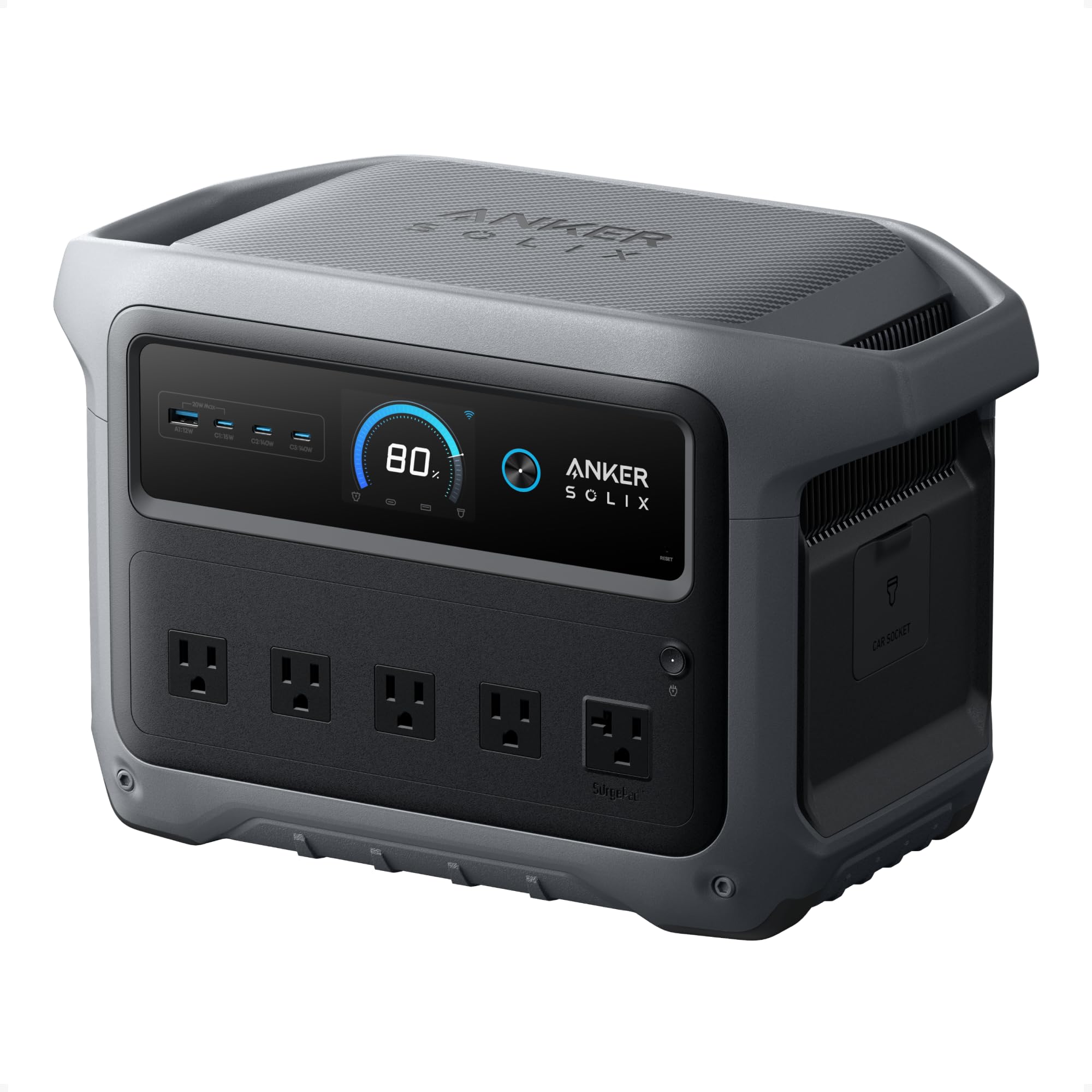
Anker SOLIX C1000 Gen 2
Key Features
- Capacity (Wh): 1024Wh
- AC Output: 2000W
- Weight: 24.9 lbs
- Charge Speed: 49 min full charge
- Expandable: No
- Price: $$
At 24.9 pounds, the Anker SOLIX C1000 Gen 2 is the lightest 1kWh power station on the market, while delivering a 2000W continuous output (3000W peak) that can handle most RV appliances. It recharges from 0-100% in 49 minutes — faster than the top pick’s one hour — though fast charge requires activation via the app. Compared to the larger 2kWh sibling, this unit sacrifices capacity for a much lighter carry, making it easier to move between RV and tent.
Build quality is solid, with consistent positive feedback on reliability. The 49-minute recharge time is a genuine differentiator, and the included 5-year warranty reflects confidence in the LiFePO4 battery. For daily RV use, this unit handles coffee makers, laptops, and lighting without issue. At a mid-range price, it offers strong value for those who prioritize weight and speed.
This unit suits RV campers who need a lightweight daily-use power station rather than extended off-grid capacity. If you move between campsites with hookups or want a portable backup for electronics, the C1000 Gen 2 is a strong fit. For boondocking, pairing with a solar panel extends usability, though the 1kWh capacity remains a limiting factor.
Pros
- Lightest 1kWh unit at 24.9 lbs for easy daily carrying.
- Fast recharge from 0-100% in under an hour.
- Robust construction with a long 5-year warranty.
- High 2000W output powers most RV appliances except rooftop ACs.
Cons
- Battery may drain slightly when left idle for days.
- 1kWh capacity provides only 5-8 hours of fridge run time, not enough for multi-day boondocking without solar.
For RV campers who need a lightweight, fast-charging power station for daily use rather than extended off-grid stays, the Anker SOLIX C1000 Gen 2 offers a compelling balance of portability and output.
Best for Budget Max Capacity
AFERIY P210
Key Features
- Capacity (Wh): 2048Wh
- AC Output: 2400W
- Weight: 48.5 lbs
- Charge Speed: ~2 hours
- Expandable: No
- Price: $$
With 2048Wh of capacity under $600, the AFERIY P210 offers more watt-hours per dollar than any other unit in this roundup. It charges from empty to full in about two hours, and its 16 ports — including a 100W USB-C — handle phones, laptops, and CPAP machines without adapters.
This station is a strong fit for budget-focused RV campers who need to run a coffee maker, microwave, or small fridge during boondocking. The tradeoff is weight: at 48.5 lbs, it’s best left in the vehicle rather than carried to a campsite. Also be aware that a small number of units may shut down when reaching full charge, requiring a manual reset to resume operation.
For home backup use, the P210 can power essential circuits like lights, a fridge, and a CPAP for several hours. It lacks a built-in 30A RV outlet, but the plentiful AC outlets and solar input make it a capable stationary power source for those less concerned about brand recognition.
Pros
- More than 2kWh capacity for under $600 — strong capacity per dollar
- Full recharge in roughly 2 hours limits downtime between uses
- 16 ports with 100W USB-C cover most device needs without extra adapters
- Powers typical RV appliances like coffee makers and microwaves without issue
Cons
- At 48.5 lbs, it’s better suited for stationary use than for moving around a campsite
- Some units may require a manual reset after reaching full charge
For RV campers on a budget who can handle the weight and don’t need a 30A RV port, the AFERIY P210 offers the best capacity-per-dollar in this category.
Best for Full-Time Off-Grid
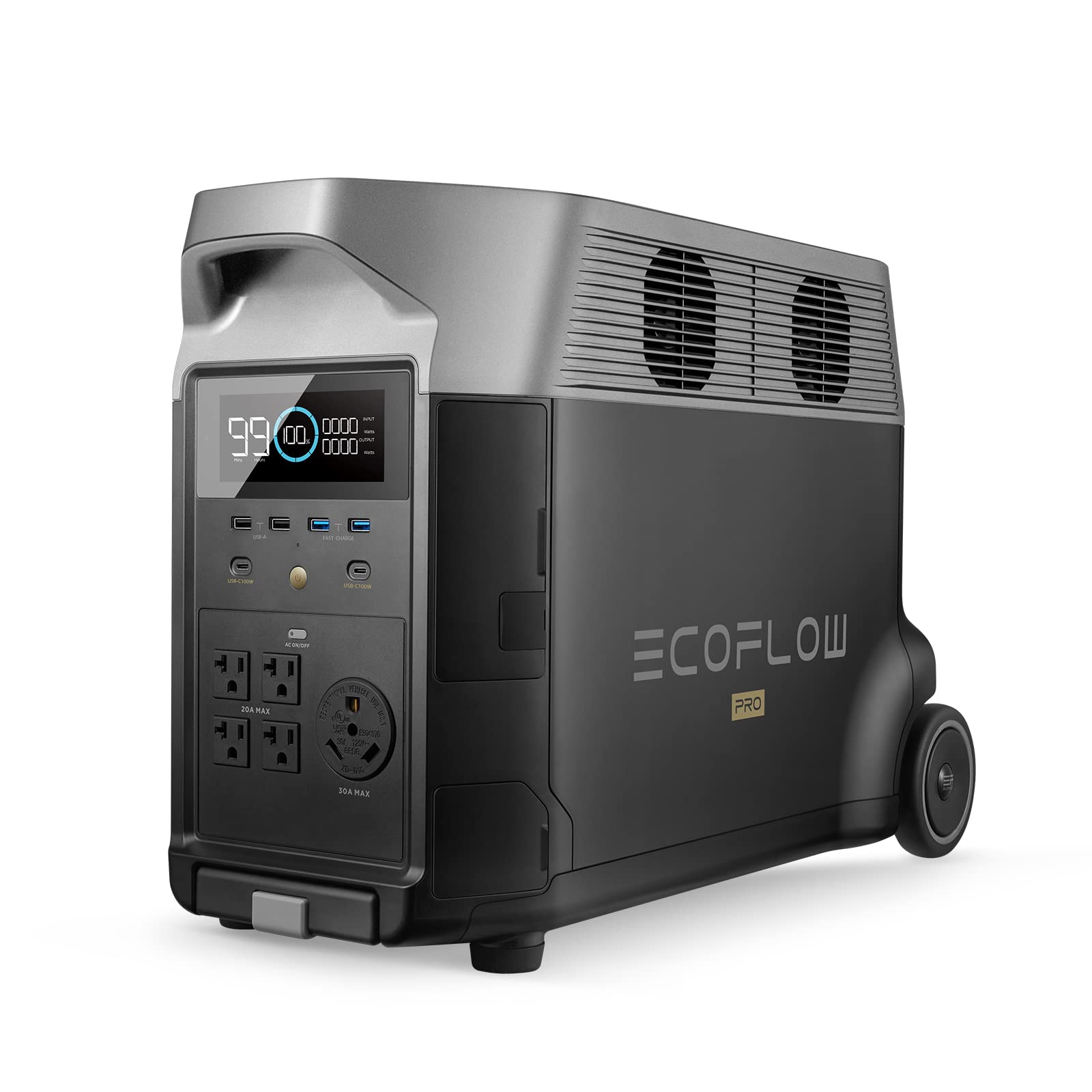
EcoFlow Delta Pro
Key Features
- Capacity (Wh): 3600Wh
- AC Output: 3600W
- Weight: 99 lbs
- Charge Speed: 1.8 hours fast charge
- Expandable: Yes, to 25kWh
- Price: $$$$
The Delta Pro delivers unmatched capacity for running a 30A RV or home critical loads for days, with 2.7-hour wall charging and solid build quality. But at 99 lbs and a luxury price tag, it only makes sense for full-time off-grid living or whole-home backup where weight and cost aren’t primary concerns. Handle breakage and battery management glitches have been noted, reinforcing that this is a stationary power station, not a portable companion for weekend trips.
Pros
- 3600Wh capacity expandable to 25kWh runs entire RV or home loads for days.
- Fast 2.7-hour wall recharge for a station this size.
Cons
- At 99 lbs, moving it requires a cart or permanent placement — not a portable station.
- Handle breakage and battery management glitches have been noted, reducing reliability during frequent moves.
For full-time off-grid living or whole-home backup where the weight and premium price are acceptable tradeoffs for unmatched capacity.
Best for Balanced 2Kwh Capacity
Anker SOLIX C2000 Gen 2

Key Features
- Capacity (Wh): 2048Wh
- AC Output: 2400W
- Weight: 41.7 lbs
- Charge Speed: 58 min full charge
- Expandable: Yes, to 4kWh
- Price: $$$
The C2000 Gen 2 powers RV essentials with 2400W continuous output and recharges fully in 58 minutes. At 41.7 lbs it’s heavier than the slimmer C1000 Gen2 runner-up, but still fits under counters and handles fridges, TVs, and portable ovens. Some units may overheat during sustained high-draw loads, so it’s best for intermittent use rather than continuous max output. For RV campers who need extra capacity beyond the runner-up and can accept the weight, this is a capable option at a premium price.
Pros
- Runs multiple RV appliances like fridges and ovens simultaneously
- Full recharge from a wall outlet in under an hour
- Compact footprint that slides under counters despite 2kWh capacity
Cons
- When moving between campsites, the 41.7 lb weight is noticeable – manageable if you plan for it
- Under prolonged high-draw loads like running a portable oven for hours, the unit may overheat and shut down – less of an issue for typical intermittent use
If you need 2kWh capacity for RV camping and can manage the weight, the C2000 Gen 2 offers fast charging and ample power at a premium price.
Best for Jackery Large System
Jackery HP3600 Plus

Key Features
- Capacity (Wh): 3584Wh
- AC Output: 3600W
- Charge Speed: 2 hours fast charge
- Expandable: Yes, to 21kWh
- Price: $$$$
The HomePower 3600 Plus delivers impressive specs on paper: 3584Wh expandable to 21kWh, 3600W output with 120V/240V parallel capability, and a battery rated for 6000 cycles. For Jackery loyalists eyeing a large home backup system, these numbers are attractive. The fast 2-hour hybrid AC+DC recharge also stands out.
However, the performance claims are based on manufacturer specifications rather than widespread customer experience. Without a track record under sustained RV loads, this unit is a higher-risk investment at a premium price. It suits buyers who value long-term cycle life and future expandability over immediate, verified performance in the field.
Pros
- 6000-cycle LiFePO4 battery with built-in safety protections for extended off-grid use.
- Dual 120V/240V output in parallel supports heavy RV appliances like air conditioners.
Cons
For a stationary home backup where cycle life matters most, this is a forward-looking option. RV campers needing immediate, field-verified performance should consider more established alternatives.
Best for Large Capacity Value
AFERIY 3840Wh

Key Features
- Capacity (Wh): 3840Wh
- AC Output: 3600W
- Weight: 80.5 lbs
- Charge Speed: 1.5 hours
- Expandable: Yes, to 11.5kWh
- Price: $$$
The AFERIY 3840Wh delivers exceptional capacity for the cost, easily running a full-size fridge or RV appliances for days. Its LiFePO4 battery and 7-year warranty add long-term appeal. However, this unit is heavy (80+ lbs) and best suited for stationary use in a cabin or permanent RV setup. Fan noise becomes noticeable under load, and some owners have needed to reset the unit to achieve the advertised 1.5-hour charge speed. These quirks and AFERIY’s shorter track record make it a strong value for budget-focused buyers who don’t need to move it often or charge in silence, rather than a universal recommendation for all RV campers.
Pros
- Cost-effective way to get 3.8kWh for stationary off-grid use
- Sustained AC output keeps full-size fridges and RV appliances running for days
Cons
- In a quiet cabin or bedroom, the cooling fan is clearly audible under load
- Charging may stall at full speed, occasionally requiring a manual reset to resume
This power station fits best when you park the unit once and need maximum kilowatt-hours per dollar — ideal for a stationary cabin or RV spot where fan noise and occasional charging hiccups won’t disrupt your routine.
How to Choose
The most important buying insight is to calculate your true power draw before choosing capacity, as a typical RV fridge can consume over 1kWh per day.
Capacity (Wh)
Capacity determines how long the station can run your appliances. A 1000Wh unit can power a 100W fridge for about 8-10 hours in practice, not the 24 hours many expect, because inverter efficiency and battery self-drain eat into the advertised number.
If you plan to run a microwave and lights in addition to the fridge, look for 2000Wh or more. The trade-off: higher capacity means heavier and costlier units.
AC Output Wattage
AC output wattage tells you what appliances you can plug in simultaneously. A microwave draws 1000-1500W running, but its startup surge can hit 2000W or more. If the power station’s peak surge rating isn’t high enough, it will shut off.
Check both continuous and surge ratings. Most RV appliances list their running and startup wattage. A 2400W unit with 3600W surge handles most microwaves and small air conditioners.
Weight
Weight directly affects how often you’ll move the unit. Under 25 lbs is easy to carry from vehicle to campsite. Between 25 and 50 lbs is manageable with two hands. Above 50 lbs becomes a two-person job or requires wheels.
Many 2000Wh+ units weigh over 50 lbs, which is fine for permanent RV placement but frustrating for frequent setups. Some include carry handles or wheels, but wheels add width.
Charging Speed
Fast charging (under 2 hours) is a huge convenience for topping up between activities. However, that speed often requires wall AC power and sometimes a special app mode. Solar and car charging are much slower—expect 8+ hours from a 12V outlet for a 1000Wh unit.
If you rely on solar, make sure the station’s MPPT charge controller can handle your panel’s voltage. Many units advertise fast AC charge but don’t mention the slower solar input.
Expandability
Expandability lets you add extra battery packs to increase capacity later. This is great for growing needs, but expansion batteries are brand-specific and often cost half the base unit price. A 1000Wh expandable unit might cost $450 plus $300 for an extra battery.
Non-expandable units force you to buy a whole new station if you need more power. If you’re unsure about future needs, expandability adds flexibility at a premium.
FAQ
Can a 1000Wh power station run my RV fridge overnight?
Yes, but only if your fridge is efficient (under 100W average draw). A typical 12V compressor fridge uses about 80-120Wh per hour when running. That gives you 8-12 hours of run time on a 1000Wh station, which covers a full night but not the whole next day without recharging.
Why does my power station shut off when I plug in my microwave?
Microwaves draw 2-3 times their running wattage during startup (surge). If the station’s peak surge rating is lower than that spike, it triggers overload protection. Check your microwave’s peak wattage and make sure the power station’s surge rating exceeds it by at least 20%.
How long does it take to recharge a 2000Wh power station from a 12V car outlet?
A typical 12V car outlet provides about 100-120W. Charging a 2000Wh station from empty would take roughly 16-20 hours on a car outlet. Some stations offer faster car charging with higher-voltage inputs (like 24V), but most need an inverter or solar to speed up.
Is it safe to leave a portable power station in a hot RV during summer?
LiFePO4 batteries handle heat better than older lithium-ion types, but internal temperatures above 120°F can degrade performance and trigger thermal shutdown. Park in shade when possible and use the station’s built-in temperature management. Avoid leaving it in a sealed RV in direct sun for extended periods.