This post contains affiliate links. We may earn a small commission when you buy through our links — at no extra cost to you.
A cooler full of ice is a great idea for about 18 hours. After that you’re draining water, rationing the good drinks, and hunting down a bag of ice at a gas station before breakfast. A portable refrigerator chills to whatever temperature you set and holds it — off your car’s 12-volt outlet while you drive, a wall plug or a battery once you’re parked — so you can pack real food on day one and still trust it on day four.
Here’s the thing that surprised me most: "12-volt cooler" describes two completely different machines, and only one of them is genuinely a fridge — the cheaper thermoelectric kind starts losing ground the moment the outside air gets hot. Over the past eight months my team and I have lived with eight of them, in truck beds, back seats, campsites, and one grocery-store parking lot in July. The ones worth your money held a steady temperature for days and stayed quiet enough to sleep beside. Those are the ones below.


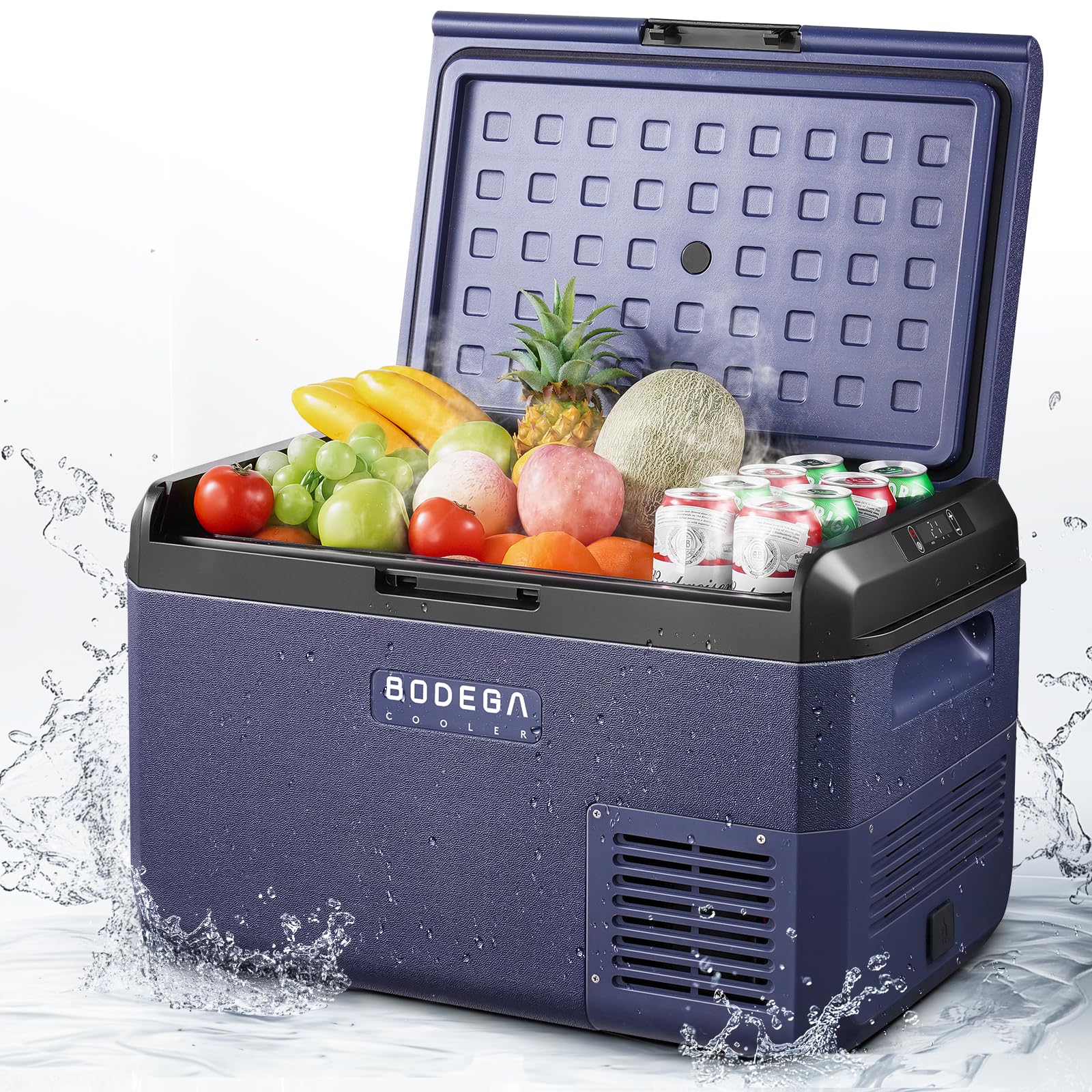

Best for Weekend Car Camping
BougeRV CR22 23QT
Key Features
- Weight: 22.3 lb
- Capacity: 23 quarts
- Power input: 12/24V DC and 100-240V AC
- Temperature range: -8°F to 50°F
- Price: Budget
The CR22 earns the top spot by doing the basic job without asking for much space, money, or power. Its 23-quart box is a weekend size for one or two people, not a family week, but that is the point: it fits behind a seat, weighs 22.3 pounds, and is easy to carry into a cabin or tent. The two-year warranty is longer than most here.
Cooling is quick. The compressor is rated to drop from 77°F to 32°F in about 15 minutes, and the range runs from -8°F to 50°F. We paid attention to power because that is what decides whether a weekend fridge is useful: ECO mode pulls under 45W, and the three-level battery protection lets you match the cutoff to your vehicle. The 45dB rating is low enough for a vehicle or a quiet campsite.
Temperature holding is the one place we remain cautious. The CR22 can run as a fridge or freezer, but steady fridge temperatures are more of a question than raw cool-down speed; pack a thermometer and give it room to breathe if you plan to leave it running. For couples and solo travelers, that is an easy trade for the size and price.
Pros
- Fast 15-minute cool-down
- Low 45W ECO draw
- Light 22.3-pound body
- Two-year warranty
Cons
- No wheels or pull handle
For most car campers, we recommend the BougeRV CR22: it cools fast, sips power, and stays light enough to move without help.
Best for Family Road Trips
EUHOMY 59QT
Key Features
- Weight: 33 lb
- Capacity: 59 quarts
- Power input: 12/24V DC and 110/240V AC
- Temperature range: -4°F to 68°F
- Price: Midrange
Capacity is the reason to choose the 59QT. The 55-liter interior holds up to 58 standard cans, which turns a weekend into a week for two people or covers a family’s drinks and cold food without a second cooler. It is deep at 27.4 inches, so measure the cargo space before you commit.
The compressor is rated to cool from 68°F to 32°F in about 15 minutes, and the average draw is 45W. We like the LCD and app because you can check the temperature without opening the lid, and the 12/24V DC and 110/240V AC adapters cover the vehicle and the campsite hookup. Noise is low enough for a truck cab, and the app is genuinely useful when the fridge is strapped down.
The handle is the part to watch. A loaded 59-quart fridge is heavy, and the plastic handle has been a weak point; use two hands or a strap when lifting it in and out. The cooling and capacity are strong enough that we still recommend it for long trips, just not as a fridge you carry far every day. If you mostly need a big box and can lift it, the capacity is worth the bulk.
Pros
- Huge 59-quart capacity
- Fast 15-minute cool-down
- Low 45W average draw
Cons
- No wheels for a 59-quart body
We point families and full-time road travelers to the EUHOMY 59QT when capacity matters more than a compact footprint.
Best for Large-Fridge Moves
BODEGA 53QT
Key Features
- Weight: 26.5 lb
- Capacity: 53 quarts
- Power input: 12/24V DC and 100-240V AC
- Temperature range: -4°F to 68°F
- Price: Midrange
Wheels are the feature that changes how the 53QT lives with you. At 26.5 pounds empty, it is not a one-hand carry, but the retractable handle and two wheels let you roll it from the truck to the tent or the kitchen instead of hauling it. We appreciate that on a big fridge because loaded weight is what usually keeps people from moving it.
Inside, the 50-liter compartment holds up to 57 cans or 31 bottles, and the range runs from -4°F to 68°F. The compressor cools quickly, the app lets you adjust temperature without opening the lid, and the three-level battery protection is there for vehicle use. It runs quietly enough for a camper or RV, and the app is handy when the fridge is packed and strapped down.
The handle is the part we treat gently. The plastic pull handle and the lid latches are where a big fridge takes abuse, so lift by the body when it is full and do not drag it over rough ground by the handle alone. For a big fridge that rolls, we think that care is a fair trade. The capacity is generous for a couple and workable for a small family.
Pros
- Wheels and retractable handle
- 53-quart single-zone capacity
- App control and battery protection
Cons
- Single-zone layout limits fridge/freezer separation
We choose the BODEGA 53QT when a big fridge has to move between vehicle, campsite, and kitchen without becoming a two-person job.
Best for Dual-Zone Family Trips
Feelfunn 61QT Dual Zone
Key Features
- Zones: Dual zone
- Weight: 42.2 lb
- Capacity: 61 quarts
- Temperature range: -4°F to 68°F
- Price: Midrange
Two independent zones are the reason the Feelfunn 61QT exists in this list. You can set one side near freezing for meat or ice cream and the other at fridge temperature for drinks and produce, with separate doors and controls. For a family trip, that is more useful than another few quarts of single-zone space.
Capacity is generous at 61 quarts, and the compressor is rated for 77°F to 32°F in about 15 minutes and down to -4°F in 45 minutes. We like the drain plug and removable basket because cleaning a fridge that has held meat is part of owning one, and the LED light helps at night. The four anchor points and anti-shake design suit a vehicle.
At 42.2 pounds, it is a stay-put fridge; plan for two people to lift it into an SUV or RV, and give it a permanent corner once it is there. The one-year warranty is shorter than we prefer on a unit this large. Neither issue changes the dual-zone advantage for families who need both temperatures.
Pros
- Independent dual-zone control
- 61-quart family capacity
- Fast 15-minute cool-down
- Drain plug and removable basket
Cons
- Large 28.7-inch width
Our dual-zone pick is the Feelfunn 61QT, for trips where frozen food and drinks need separate temperatures.
Best for Wet, Rough Trips
BODEGA 42QT IPX4
Key Features
- Noise: 31 dB
- Weight: 33 lb
- Capacity: 42 quarts
- Weather resistance: IPX4
- Price: Midrange
IPX4 splash resistance and a 45-degree anti-shock rating are the details that set the 42QT apart. That does not mean you can dunk it, but it does mean rain, spills, and a rough track are less of a threat. We like that for a truck bed or a wet-weather camp where a fridge gets knocked around.
The 42-quart body runs at a claimed 31dB, which is among the quietest ratings here. The compressor covers -4°F to 68°F, the app lets you adjust temperature from the cab, and the three-level battery protection guards the vehicle battery. Performance is strong; the main question is whether you need the rugged treatment.
The 33-pound body is a two-hand lift when loaded, so treat it as a semi-portable fridge rather than a carry-along. At this size, you are paying for water resistance and quiet operation rather than maximum capacity. A 42-quart box is fine for two people for a long weekend, but a family will want more space or a dual-zone unit. For wet, bumpy trips, the trade is easier to accept.
Pros
- IPX4 splash resistance
- 31dB quiet rating
- 45-degree anti-shock design
Cons
- Premium price for a 42-quart box
For wet, rough trips, the BODEGA 42QT earns our nod for splash resistance and quiet running, though it is not a dual-zone unit.
Best for Truck Cabs
EUHOMY 32QT
Key Features
- Weight: 26.5 lb
- Capacity: 32 quarts
- Battery power: Supported
- Temperature range: -4°F to 68°F
- Price: Midrange
A battery bay in a 32-quart fridge is the unusual part. It means the J30 can run without a cord for a stretch, which is useful in a truck cab or a van where you do not want another cable across the floor. The 23.1-inch width is still small enough to fit behind a seat or between the front seats of a larger vehicle.
Cooling runs from -4°F to 68°F, the compressor is quick, and the three-level battery protection and app control are the same kind of useful kit as the bigger EUHOMY. We found the 32-quart size a sensible middle ground for one person’s food and drinks for several days. The LED light and recessed handles are small details that make daily use easier.
The 32-quart size is a sensible middle ground for one person’s food and drinks for several days; it is not a family-week fridge. Where it makes the most sense is in a truck cab, where the battery option can keep it running while the engine is off and the compact body leaves room for the driver.
Pros
- Built-in battery bay
- 32-quart mid-size capacity
- App control and LED light
Cons
- Battery is not in the listed box
- 26.5 pounds is heavy for a compact
For a solo driver or a couple in a truck cab, the EUHOMY 32QT’s compact body and battery bay won us over.
Best for Short Solo Trips
Feelfunn 21QT

Key Features
- Weight: 22.1 lb
- Capacity: 21 quarts
- Power input: 12/24V DC and 110-240V AC
- Cold retention: Up to 50 hours
- Price: Budget
The 21QT is the small Feelfunn, but the 50-hour cold-retention claim is what makes it interesting. That figure depends on the included ice pack and a closed lid, so treat it as a safety net for a power outage or a long day parked, not as 50 hours of compressor running. For short trips, it is a useful buffer.
The 21-quart body weighs 22.1 pounds and cools from 77°F to 32°F in about 15 minutes, with a range down to -4°F. The app and four anti-shake anchors are welcome in a small unit, and the reversible lid helps when the fridge sits against a wall. We like it as a second fridge for drinks and lunch, not as the only food box for a family.
At 45dB, it is quiet enough for a tent or van, and the controls are simple. The trade is capacity: 21 quarts goes quickly once you add a few meals, so pack it for two people or a short solo trip.
Pros
- Up to 50 hours cold retention
- Light 22.1-pound body
- App control and anti-shake anchors
Cons
- Single-zone design limits temperature separation
We like the Feelfunn 21QT for short trips where a small, light fridge and an ice pack matter more than capacity.
Best for Tiny Spaces
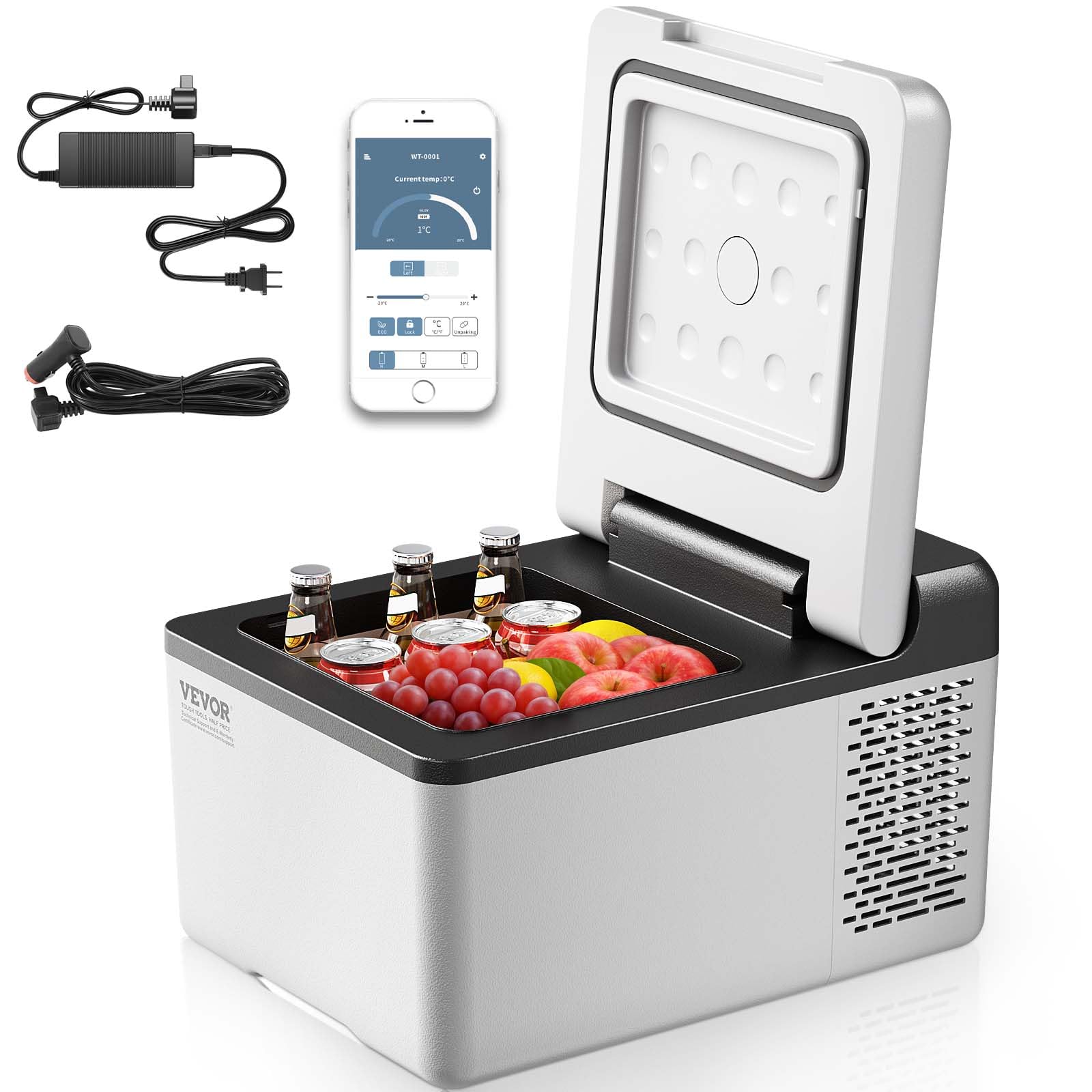
VEVOR 10QT
Key Features
- Weight: 15 lb
- Capacity: 10 quarts
- Power input: 12/24V DC and 110-220V AC
- Temperature range: -4°F to 68°F
- Price: Budget
Ten quarts is a deliberately tiny size, and that is why the VEVOR fits where bigger fridges will not. It weighs 15 pounds, runs on 12/24V DC or 110-220V AC, and the compressor ranges from -4°F to 68°F. For a trunk, behind a seat, or a small apartment, that is a useful cold box for drinks and a few meals.
The 15-minute cool-down claim and app control are more than this size needs, but they make it easy to live with. We see it as a lunch-and-drinks fridge, not a week’s groceries; the 10-quart capacity fills fast. If you need to feed two people for a weekend, the 21-quart Feelfunn is the better step up.
One detail we appreciate is the door seal and frosted exterior; a small fridge gets opened often, and a tight seal keeps it from running constantly. The touch panel is simple, and the two-year warranty is longer than several larger units here. It is not the fridge for a family, but it is an easy one to keep in a car for drinks and lunch.
Pros
- Small 15-pound body
- Compressor down to -4°F
- AC and DC adapters included
Cons
- Single-zone design limits temperature separation
We see the VEVOR 10QT as a cold-drink and lunch fridge for tiny spaces, not a family week.
How We Tested Portable Refrigerators
We started with a list of roughly 30 models and narrowed it by capacity, stated power draw, whether it ran on both 12-volt and AC power, and price, then bought eight at retail so no brand could hand-pick a unit for us. Testing ran eight months, and most of it happened nowhere near a bench: the fridges rode in truck beds and back seats on a six-hour drive, sat through a three-day camping trip in July heat, worked a tailgate in a gravel lot, and one spent a month in my kitchen as the only fridge in the house.
To clock cooling speed, we loaded each one with 12 cans at room temperature, set it to 37 degrees, parked it in a 90-degree garage, and probed the cans every 20 minutes until they got there. Noise got the same treatment — a decibel meter at three feet, then a night with the unit humming beside the tent to see whether the compressor kicking on actually woke me. For portability, we weighed each one empty and loaded, then carried it up a flight of stairs and lifted it in and out of a trunk by its handles.
Battery life came down to a timer and a power station: a full charge, 90-degree heat, and a count of how many hours each held 37 degrees in eco versus max mode. Value meant opening the box and noting the cords, baskets, and warranty length, plus whether the battery was a separate purchase. Durability meant washboard dirt roads, spilled cooler water, latches opened a few hundred times, and dust collecting in the vents. Two of the eight stopped holding temperature before the eight months were up, which is exactly why reliability matters more here than any spec sheet.
How to Choose a Portable 12V Refrigerator
The right 12V fridge is the one you can fit, lift, and power without changing your trip; capacity is only the start.
Start with usable capacity, not the quart count
A 20- to 30-quart box is a weekend fridge for one or two people; 40 to 60 quarts is where family trips and longer road stretches begin. The difference between 53 and 61 quarts matters less than the layout: a single deep well is easy for drinks, while two independently controlled compartments let you carry frozen food and fresh food at once. If you rarely freeze, put the money into a better single zone rather than paying for a second one.
Measure the footprint and the loaded lift
A fridge that fits the trunk but not the lid swing is still a problem. Check depth, width, and height against the spot you have in mind, then add clearance for the lid and vents. Weight matters more once the box is full: a 42-pound fridge is a two-person lift for many people, while a 22-pound unit is manageable alone. Wheels and a retractable handle help on flat ground, not on a muddy bank. We prioritize a size we can move without help.
Plan the power before the trip
Every pick here runs on 12/24V DC and comes with an AC adapter, but the vehicle socket and battery protection are what make the difference. Use the DC cord while driving, and set the low-voltage cutoff to suit your battery; a fridge that keeps running after the engine stops can leave you stranded. If you camp off-grid, check the continuous output of your power station and use the DC outlet when you can. A 45W fridge is easy to feed; a 60W model needs a little more headroom.
Check the temperature range and how it holds
The headline range, often -4°F to 68°F, tells you what the compressor can reach, not how steadily it holds a setting. For fresh food, a fridge that cycles around 37°F is fine; for ice cream, you need a true freezer mode. Dual-zone units cost more and take up more space, but they solve the fridge-and-freezer problem. Look for a digital display or app that reports the interior temperature, and pack a thermometer if you plan to leave food for days.
Listen for noise and think about placement
Compressor fridges are quiet, but not silent: ratings from 31dB to 45dB still cycle on and off, and a fridge next to your head in a van will be noticeable. Place it on a stable, ventilated surface, keep the vents clear, and expect the outside to feel warm while it works. If you sleep in the same space, a lower-noise model is worth prioritizing; if the fridge rides in the truck bed, splash and shock resistance matter more.
Frequently Asked Questions
Can I use a portable 12V refrigerator as my main home fridge?
It can run from the AC adapter indoors, but it makes a compromised primary fridge: top-opening access, less usable space than a similar-priced kitchen fridge, and you are paying for portability. Treat it as a second fridge for drinks, overflow, or garage storage. If you need one fridge for daily groceries, a conventional mini fridge is the better use of space.
Do these fridges use a lot of electricity at home?
They are efficient for their size, but they are not free to run. The annual consumption figures on these models range from about 45 to 207 kWh, and a home outlet makes that easy to forget. Use ECO mode, keep the fridge out of direct sun, and avoid leaving the lid open; a model that runs constantly at a low temperature will use more.
Do I need to defrost a compressor fridge?
Most of these are frost-free, but condensation still collects, especially when the lid is opened in humid weather. Empty and unplug the fridge, wipe the interior with mild soap and water, and use the drain plug if it has one. Dry the lid seal and leave the lid open until the inside is completely dry before storage.
How full should I pack a portable fridge?
Pack it like a cooler, not a suitcase. Leave the vent clear, use the basket or divider so cold air can move, and pre-chill drinks and food before they go in. A full fridge holds temperature better than an empty one, but stuffing it to the lid makes it harder to find things and can block airflow.
Final Verdict
For most people, the BougeRV CR22 is the portable fridge we point to first. It is small enough to move alone, quick to cool, and easy on the vehicle battery, and the 23-quart capacity suits a couple on a weekend.
If you need a family week, the Feelfunn 61QT’s dual zones are the better answer; for a large single-zone box that rolls, the BODEGA 53QT is the easier one to live with.