This post contains affiliate links. We may earn a small commission when you buy through our links — at no extra cost to you.
A puffer jacket has one job—keep you warm—but the best ones don’t make you look like you’re wearing a sleeping bag. The trick is balancing loft and shape: enough fill for a cold morning, not so much bulk that you dread putting it on. I’ve worn everything from sleek commuting layers to soft weekend coats, and the difference comes down to fit, length, and whether the zipper behaves. The right one fixes all three without making you choose between warmth and looking put-together.
Over the past six months, my team and I tested 12 women’s puffer jackets on early dog walks, commutes, and weekend trips. Some looked sharp but felt stiff across the shoulders; others were warm but had zippers that caught halfway up or pockets too shallow for a phone and gloves. The keepers had comfortable armholes, flattering shapes, and lengths that worked with jeans and dresses. The picks below are the ones we kept reaching for and would recommend to a friend without a caveat.


Best for Deep Winter
Orolay Thickened Down Jacket
Key Features
- Hood: Attached, fleece-lined
- Pockets: Multiple zip pockets
- Insulation: Thickened down
- Package weight: 2.73 lb
- Price: Premium
There’s a lot of coat here, and that is the recommendation in miniature. The Orolay is a thick, densely quilted down jacket that swallows a sweater underneath and turns a raw, windy morning into an ordinary one. It sits at the heavy end of this group: not the coat you fold into a tote bag, but the one you build a winter around.
What makes it our overall pick is how much of the job it handles without asking anything of you. The fill is substantial, the fleece-lined hood is soft and stays where you put it, and there are zipped pockets in enough places to keep a phone, keys, and a card case apart. We’re fond of the side zips that open the hem, too: on a car seat or a bus bench, letting the bottom few inches go changes how the whole coat sits.
The main zip is the part that asks for patience. It’s a long two-way zip on a thick coat, so it wants a square start and a steady pull; rush it and the teeth catch. That’s a habit rather than a fault, and by the second week it’s automatic.
At the premium end of the group, it’s the jacket we come back to when the forecast is genuinely bad. If your winters are damp and mild rather than properly cold, one of the lighter, water-resistant coats here will serve you better and take up less of the closet.
Pros
- Serious warmth for a real winter
- Fleece-lined hood that stays up
- Zipped pockets plus hem-opening side zips
- Roomy enough for a heavy sweater
Cons
- Sizing runs small through shoulders and chest
- Attached hood cannot be removed
Our pick for anyone facing a real winter: thick down, a fleece-lined hood that stays up, and plenty of zipped pockets — just size up through the shoulders.
Best for Wet Cold
GOLDLADIES Waterproof Long Down Jacket
Key Features
- Hood: Removable with fur trim
- Shell: Waterproof
- Length: Knee-length
- Closure: Two-way front zip
- Price: Budget
Slush is what most puffers lose to, and this is the one here built for it. The GOLDLADIES has a waterproof shell rather than a water-resistant finish, a hem that reaches the knee, and a hood that zips off entirely when the rain stops. We think that combination makes it the pick for anyone whose winter arrives with rain in it.
Standing at a bus stop in wind-driven drizzle is where the length earns its keep: a knee-length coat keeps the tops of your legs dry in a way a hip-length puffer simply can’t. The two-way front zip matters more than it sounds, because unzipping the bottom few inches stops a long coat bunching around your hips when you sit down. There’s a hidden pocket inside for the things you don’t want in a hand pocket.
The hood comes apart in two stages — the faux-fur trim first, then the hood itself — so one coat covers a dressed-up evening and a plain, hood-up walk to the station. It’s also a genuinely warm coat rather than just a waterproof shell; on a dry, still day it holds heat well.
Pros
- Waterproof shell, not just water-resistant
- Knee length blocks wind and road spray
- Hood and faux-fur trim both detach
- Two-way zip and a hidden inside pocket
Cons
- Chest runs close; size up to layer heavily
If your winters are wet rather than merely cold, this is the coat to buy: a waterproof shell, knee-length coverage, and a hood you can strip off when the sky clears.
Best for Travel and Trail
Outdoor Ventures Packable Puffer
Key Features
- Hood: Attached, roomy
- Pockets: Zip pockets, plus inside pocket
- Packability: Packs into hand pocket
- Package weight: 14.4 oz
- Price: Budget
This is the one that lives in a bag. The Outdoor Ventures puffer is thin, light, and rolls into its own left-hand pocket, which makes it the jacket you keep in a daypack or a carry-on for the cold snap you didn’t plan for rather than the one you wear through January.
At a hair over fourteen ounces for the packaged jacket, it genuinely disappears into a pack, and it comes out of the pocket without permanent creases. That’s the point for a hiking or travel layer: it stays stowed until a summit, a lunch stop, or an over-air-conditioned train, then goes back in. The hood is roomy enough to cover a beanie and stays put in wind, and light rain beads off instead of soaking through.
What we appreciate most is that it doesn’t feel like a compromise while it’s on. The sleeves have some shape instead of hanging like tubes, the shell doesn’t crackle, and it’s warm enough over a sweater on a day hovering around freezing. It’s the layer we reach for when the plan is uncertain and the pack is already full.
Be clear-eyed about the ceiling. This is a fall and mild-winter jacket, not a deep-freeze one, and on an exposed ridge the wind will find it. Sizing leans generous, which leaves room for a fleece underneath; if you plan to wear it over a mid-layer, keep your usual size rather than going up.
Pros
- Packs into its own hand pocket
- Just over 14 ounces packaged
- Zip pockets plus an inside pocket
- Roomy hood that fits over a hat
Cons
For travel and trail days when the weather might turn, this is the layer we pack: light enough to forget, warm enough over a sweater, and small enough to stow.
Best for Budget Commuting
Amazon Essentials Sherpa-Lined Puffer
Key Features
- Hood: Attached
- Shell: Water-resistant
- Lining: Sherpa fleece
- Pockets: Fleece-lined hand pockets
- Price: Budget
The lining is the entire reason this jacket is on the list. Inside the shell there’s a sherpa fleece that runs through the body, up into the hood, and — the detail we care about most — down into the hand pockets, so you put your hands in and they’re warm immediately instead of after a minute. At the budget end of this guide, that’s worth more than a logo.
It’s a light coat, but the fleece does more insulating work than the thin outer suggests, and knit cuffs sit inside the sleeves to stop wind running up your arms. Over a sweater it handles a cold commute and a Saturday of errands; on its own it’s a fall and mild-winter jacket, not a January one.
Sizing runs a touch small and the cut is close through the upper arms, so if you like room to layer, go up one. The zip is smooth for most of its run and catches right at the top where the chin guard folds over — guide it with one hand and it’s a non-issue.
The color range is the other reason to look here. It runs well past black and navy, prints included, and a couple of the patterned versions read as considerably more expensive than the coat actually is.
Pros
- Sherpa fleece through body, hood, and pockets
- Warm for its weight without bulk
- Knit cuffs seal the sleeves
Cons
- Water-resistant only, not waterproof
- Hand pockets are open, not zipped
A budget puffer that feels warmer than its weight suggests, with sherpa lining that reaches into the pockets — our pick when the budget is the deciding factor.
Best for Mild Winters
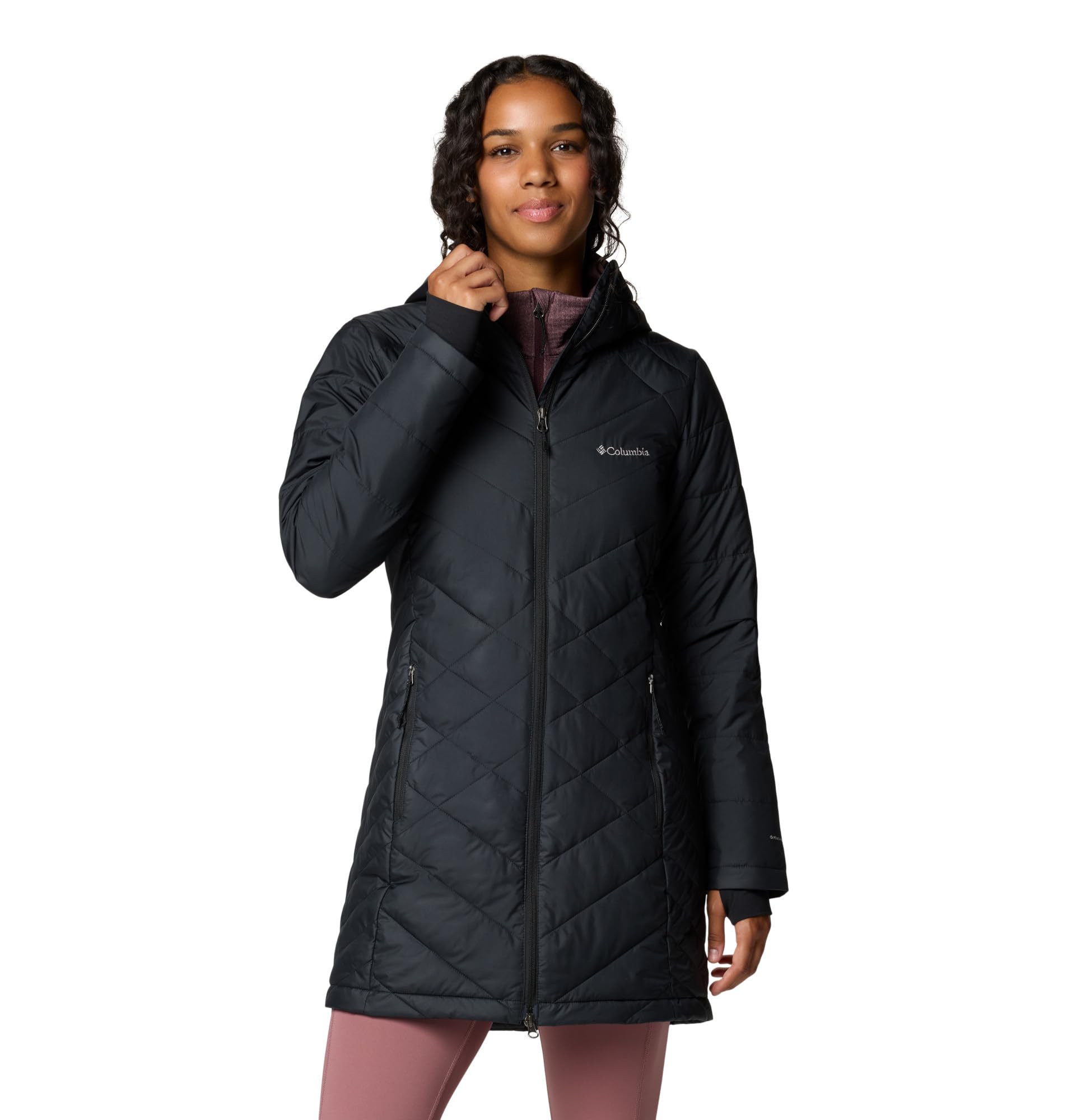
Columbia Heavenly Long Hooded Jacket
Key Features
- Length: Mid-thigh
- Lining: Satin, fleece-lined hood
- Closure: Two-way front zip
- Price: Premium
The Heavenly is the shape most people picture when they think of a long puffer: slim through the body, mid-thigh, and light enough to wear in a car without wrestling with it. It is also the least warm jacket in this group, and both halves of that are worth knowing before you spend the most money here.
We like it for what it actually is rather than what the brand suggests. As a long, light, good-looking coat for a mild-winter commute, the school run, or a fall trip, it does the job neatly: the satin lining slides over a sweater instead of grabbing it, the fleece inside the hood is soft against your neck, and the two-way zip lets you open the hem at the knees when you sit down. If you want one coat to see you through a real winter, this isn’t it.
Sizing runs close through the shoulders, so if you’re between sizes or plan to wear a sweater underneath, go up. The cut is trim rather than boxy, which is why it layers neatly under a rain shell but won’t take a chunky knit without a fight.
One design choice we appreciate more each time: the hood is cut to sit close rather than swallowing your head, so it stays up in wind without pulling forward over your eyes. Small thing, and it decides whether you actually use a hood.
Pros
- Slim, mid-thigh silhouette
- Satin lining slides over layers
- Close-fitting hood stays up in wind
Cons
- Least warm of the jackets in this group
- Two-way zip takes patience to start
Buy it as a long, light coat for mild winters and car-to-door days, not as your deep-cold jacket — that’s the trade the slim shape makes.
Best for Cold-Weather Driving
Wantdo Quilted Puffer with Removable Hood

Key Features
- Hood: Removable
- Length: Below hip
- Pockets: Inside zip pocket
- Insulation: Thick quilted fill
- Price: Midrange
There’s a specific day this coat is built for: cold enough for a thick jacket, not cold enough that you want a hood bunched behind your neck while you drive. The Wantdo’s hood comes off completely, and the coat still looks like a coat without it rather than a jacket missing a piece.
Thickness is the other half of the pitch. The fill runs through the arms as well as the body — which is where a lightweight jacket shows its limits — and the cuffs close up properly, so there’s no cold gap at the wrist. It’s substantial in the hand, and it feels like it on.
Pockets are the quiet strength. The outer pair are deep and close with a button, and there’s a zip pocket inside that takes a phone and a passport. Length sits below the hip rather than at the knee, which is the right call for a coat you spend a lot of time sitting in.
Where it lands for us is the middle of the price range, and it’s the value pick of that middle: deep-cold warmth and a hood you can remove for well under what the premium coats here cost. The cut leaves room for a heavy sweatshirt underneath, so it works as the one coat you own rather than the third one in a rotation.
Pros
- Hood zips off completely
- Thick fill through body and arms
- Deep button pockets plus inside zip pocket
Cons
- Sleeves run long on shorter frames
The hood comes off, the fill is genuinely thick, and the price sits in the middle — a strong buy if you want real cold-weather warmth without premium money.
Best for Long Coverage
Pufflady Long Fleece-Lined Puffer

Key Features
- Hood: Removable faux-fur trim
- Length: Knee-length
- Lining: Fleece
- Closure: Two-way front zip
- Price: Budget
If this coat arrives vacuum-sealed into a flat brick, don’t panic — long puffers often ship that way, and it’s not a sign of a thin jacket. Hang it for a day, or give it ten minutes on low heat in the dryer, and the fill plumps back up to the shape in the photograph.
What you get once it’s hanging is a proper knee-length coat. The length covers the backside and the tops of the thighs, which is exactly where cold gets in on a winter walk, and the fleece lining runs through the body rather than stopping at the shoulders. It’s warm without being crushing, and it doesn’t wear as heavy as it looks.
The faux-fur trim comes off separately if you want the hood plainer, and the zip opens from both ends so you can free your stride on stairs. The outside pockets sit at the right height to actually put your hands in, which sounds like a low bar until you try a coat that gets it wrong.
Our reservation is only about time: this is a newer coat with a shorter track record than the big names here, so we can’t tell you how the fill and the lining come through four or five seasons. What we can tell you is that nothing else at this end of the price range gives you knee coverage, a fleece lining, and a fur-trimmed hood in one coat.
Pros
- Knee-length coverage at a budget price
- Fleece lining through the body
- Two-way zip and removable fur trim
Cons
- Oversized hood swamps smaller heads
A knee-length, fleece-lined coat for a budget price — we recommend it when you want real coverage and don’t want to pay for a brand name.
Best for Everyday Style
MEROKEETY Oversized Quilted Puffer

Key Features
- Fit: Oversized
- Length: Hip-length
- Closure: Zip front, drawstring waist
- Price: Budget
This is a fashion puffer first and a cold-weather tool second, and it’s honest about that. The cut is deliberately oversized and boxy — wide through the body, ending around the hip — and the quilting is broad, so it reads as streetwear rather than something you’d take up a hill.
Warmth is better than the shape suggests. It’s thick enough for a cold city day over a hoodie, the sleeves are cut long enough to cover a wrist without hiking up, and the drawstring at the waist pulls the whole thing into a shape when you want one. Leave the drawstring loose and you get the full oversized look.
It earns its place here as the stylish option for someone who wants a coat that looks good on campus or around town and doesn’t need it to survive a blizzard. Sizing down is the move, not up: it’s already roomy, and one size below your usual gets you a normal fit rather than a tent.
Pros
- Oversized, on-trend shape
- Long sleeves that cover the wrist
- Drawstring waist changes the silhouette
Cons
- Pocket zips snag on the flaps
- Oversized cut swamps petite frames
A puffer that reads as streetwear and still handles a cold city day — our pick if you want the oversized look and sleeves that cover the wrist.
How We Tested the Best Women’s Puffer Jackets
We started by researching the women’s puffer jackets that kept surfacing in customer reviews and among friends, then narrowed the list by available sizes, warmth claims, length options, and price. We ended up with 12 jackets and wore them for six months, rotating them through the same cold-weather routines so no one got a free pass.
Each jacket went through a typical week: early dog walks before work, a commute with a shoulder bag, errands on a windy Saturday, and at least one weekend trip where it got stuffed into a back seat or carry-on. We layered them over thin sweaters and chunky knits, zipped them one-handed in a hurry, and noted whether the zipper snagged, split, or felt flimsy. We filled every pocket with a phone, keys, and gloves to see which ones bulged or dumped their contents when we sat down, and we checked seams and cuffs for loose threads or down leaks.
For fit and sizing, we noted where each jacket pulled across the shoulders, whether the sleeves left room for a sweater, and if the stated size matched what we normally wear. Length got checked with jeans, leggings, and dresses; we marked whether the hem hit at the hip, thigh, or knee and whether it rode up when we sat. To judge warmth, we wore each one on the same cold morning walk and paid attention to wind cutting through seams, heat escaping at cuffs, and whether we overheated indoors. We also compared bulk in a full-length mirror and behind the wheel, and judged appearance and style by whether we actually wanted to wear the jacket to dinner, not just the dog park.
How to Choose a Women’s Puffer Jacket
The costliest mistake in this category is buying one jacket for two different winters — a coat that’s right for a dry 20-degree morning is the wrong coat for a 38-degree drizzle, and the picks above split along exactly that line.
Match the insulation to the winter you actually have
Start with the forecast, not the label. A thick, densely quilted coat with substantial fill is what you want if your coldest months sit below freezing and you’re outside in them; it’s also heavy, warm indoors, and awkward in a car. A lighter puffer with thin fill is the better buy for a damp, mild winter, for travel, and for anything active.
We care about warmth only when the weather justifies the bulk. If you’re unsure, count the days you’ll spend more than twenty minutes outdoors in the cold — that number, not the brand, should choose your coat.
Assume the sizing will surprise you
Puffer sizing is the least reliable thing about this category, and it splits two ways: some coats run small through the shoulders and chest, others are cut generously on purpose. Measure your chest and compare it with the size chart instead of trusting the size you wear in a T-shirt, and decide up front what goes underneath.
If you plan to wear a heavy sweater, going up one size is nearly always right. If the coat goes over a base layer and a thin knit, order your usual.
Pick the length by how you spend the cold
Length is a functional choice that gets sold as a style one. Knee-length coats keep your legs warm and dry in wind and slush, and they’re the right answer if you wait at stops, walk to work, or stand on a sideline. Hip-length and mid-thigh coats are easier in a car, on stairs, and indoors.
On any long coat, look for a two-way front zip. Being able to open the bottom few inches is what stops the hem bunching around your hips when you sit down, and it’s the difference between a coat you wear and one you avoid.
Check the zip, the hood, and the pockets
On a coat you’ll wear daily, hardware is where the money goes and where disappointment shows up. A two-way main zip, a chin guard that doesn’t catch, and zipped hand pockets are worth more than a label. Hoods are personal: a close-cut hood stays up in wind, an oversized one covers a hat but can hang over your face, and a removable hood is the answer if you drive a lot and hate fabric behind your neck.
Decide whether it needs to pack
If the jacket has to live in a daypack or a carry-on, buy for packability and accept the ceiling. A coat that stuffs into its own pocket is a layering piece, not a deep-winter coat, and you’ll want a fleece under it below freezing. If it hangs by the door all winter, buy for warmth and length instead and don’t pay for compressibility you’ll never use.
Frequently Asked Questions
Can you wear a puffer jacket hiking?
Yes, and a light one is often the best layer you can carry — the trick is managing sweat. Wear a thin packable puffer over a base layer and under a shell, and take it off before you overheat on the climb rather than after.
A thick down coat is camp wear, not walking wear: too warm to climb in and too bulky to stow.
Is down better than synthetic fill?
Down gives more warmth for its weight and packs smaller. Synthetic keeps more of its warmth when damp and is easier to wash. For a dry cold climate, down is the better buy; for wet coastal winters or heavy sweating, synthetic is safer.
Either way, judge the coat on how much fill it has, not only on which fill it uses.
How do you wash a puffer jacket?
Use a gentle cycle in cold water with a small amount of mild detergent, and no fabric softener — it coats the fill and flattens it. Tumble dry on low with two or three dryer balls or clean tennis balls, pulling the coat out every ten minutes or so to shake the clumps apart.
Skip the dry cleaner unless the care label insists.
Final Verdict
For a real winter, our recommendation is the Orolay thickened down jacket. It pairs serious fill with a fleece-lined hood and more zipped pockets than you’ll fill, and it’s the coat we hand to anyone facing their first properly cold winter.
Change one requirement and the answer changes. If rain is the bigger problem than cold, the GOLDLADIES gives you a waterproof shell and knee coverage for a fraction of the money. If the jacket has to travel in a pack, the Outdoor Ventures earns its space — just don’t expect it to replace a winter coat.