This post contains affiliate links. We may earn a small commission when you buy through our links — at no extra cost to you.
A survival kit is supposed to sit quietly until the power dies, the car won’t start, or a hike runs long—then work without a second thought. I’ve opened enough kits to know a long item list can hide flimsy pouches, confusing instructions, and a bag that splits the first time you repack it. The right one gives you a clear, usable set for warmth, light, first aid, water, and basic repairs without turning your closet into a gear locker.
Over eight months, my team and I tested 12 emergency survival kits, from compact car kits to larger home kits. We inventoried every item, weighed and carried each packed kit, and used the gear during a power outage, a rainy camping weekend, and the usual car-trunk shuffle. The heaviest kit isn’t always the most complete, and the most complete often isn’t the one you’ll actually carry—so the picks below are built around how you’ll store and use a kit, not the longest packing list.



Best for Family Evacuations
EVERLIT STORM II
Key Features
- Pack weight: 20 lb
- Food and water: 2 food bars (3,600 cal); 24 water pouches (125 mL)
- People and days: 2 people, 3 days
- First aid pieces: 200, including CAT tourniquet
- Price: Premium
Twenty-four water pouches, two 3,600-calorie bars, water purification tablets, and a 200-piece first aid kit with a CAT tourniquet: the contents list is what separates this kit from the pouch-and-gadget crowd. Add a hand-crank radio that also charges a phone, two emergency shelters, two ponchos, and 100 feet of paracord, and a household of two has the awkward parts of a three-day evacuation already handled.
We treat it as the default recommendation here because the three things that actually decide a 72-hour kit — water, calories, and bleeding control — are covered without a trip to the pharmacy. The bag supports that: 1000D polyester, four main compartments, MOLLE webbing, and enough spare pockets that medication, a change of clothes, and documents go in without unpacking anything that’s already there.
Budget the water honestly and the kit still needs a top-up. Twenty-four pouches at 125 mL is three liters for two people, half a liter each per day, which is a fraction of what anyone actually drinks. Put a jug of water per person beside the bag, or lean on the purification tablets and a nearby tap, and the rest of the kit genuinely covers three days on its own.
Pros
- Food, water, and trauma first aid in one bag
- Hand-crank radio doubles as flashlight and phone charger
- Plenty of empty pockets for your own supplies
- Sturdier pack and contents than the budget kits here
Cons
- Twenty pounds is heavy for anything on foot
If your plan is one purchase that covers food, water, trauma first aid, and a radio for two people for three days, this is the kit we point you to.
Best for Budget Car Kit
Ready America 70280
Key Features
- Pack weight: 7.8 lb
- Food and water: 2 food bars (2,400 cal); 12 water pouches (4.225 oz)
- People and days: 2 people, 3 days
- First aid pieces: 33
- Price: Budget
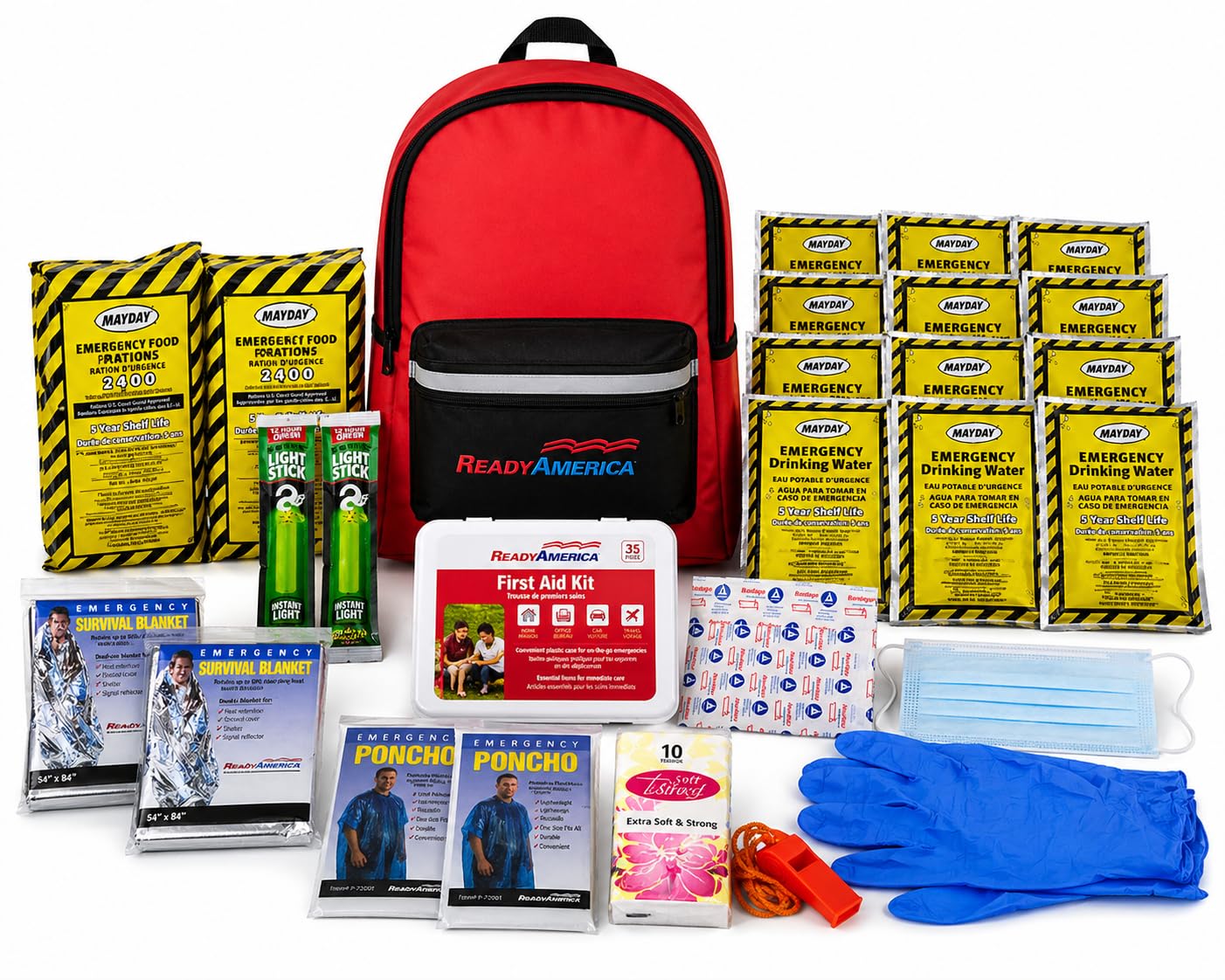
Two people, three days, and a pack you could mistake for a school bag — 9.5 by 6 by 12 inches, 7.8 pounds, small enough to disappear into a car trunk or the back of a closet. Inside are two 2,400-calorie food bars, twelve water pouches, two survival blankets, two ponchos, lightsticks, dust masks, gloves, a whistle, and a 33-piece first aid kit.
Five years of shelf life on the food bars and water pouches is the number that makes a cheap kit worth owning, because the whole bargain is that it sits untouched and still works when you finally unzip it. That’s the argument for buying two rather than spending the same money on a single fancier bag: one by the front door, one in the trunk, and every car in the household is covered.
We like it as the budget pick because nothing important is missing. Food, water, warmth, light, and basic medical care for two people all fit in a bag light enough to hand to anyone in the house, and nothing needs charging or assembling. The food is fuel rather than dinner — two dense bars — so expect it to buy calories, not comfort.
Pros
- Food, water, warmth, and light for two people
- Five-year shelf life on food and water
- Under eight pounds and small enough for a trunk
Cons
- Pack is cut for a child’s frame
- First aid handles scrapes, not trauma
We recommend it as the kit to buy two of — one for the hall closet, one for the trunk — as long as you’re not planning to carry it far.
Best for Sheltering in Place
Redfora Earthquake Bag
Key Features
- Pack weight: 16 lb
- Total pieces: 107
- Food and water: 2 food bars (3,600 cal); 24 water pouches; 20 purification tablets
- People and days: 2 people, 3 days
- Price: Premium
Redfora packs this bag the way a good pharmacist labels a medicine cabinet: color-coded, resealable waterproof pouches, each one marked, backed by a printed contents list and a video walkthrough. Open it in the dark with a flashlight in your teeth and you can still find the water. That organization is why it’s here — nothing else in this group is as easy to inventory or as quick to raid under pressure.
The contents lean toward sheltering rather than fleeing: a sleeping bag, a tube tent, 30 feet of nylon rope, a full hygiene kit, 24 water pouches with 20 purification tablets, two 3,600-calorie food bars, a NOAA hand-crank radio and charger, a multi-tool, and a first aid kit. For an earthquake, a wildfire evacuation to a gym, or three days stuck in a stairwell, that set makes more sense than a pouch full of fishing line.
Against our top pick, the difference is what the money buys. Redfora spends it on labeled packing, a sleeping bag, and hygiene; EVERLIT spends it on a 200-piece medical kit with a tourniquet and a pack built to be carried. If medical depth matters more to you than a sleeping bag, take the EVERLIT.
Pros
- Best-organized bag in this group
- Sleeping bag, tube tent, and hygiene kit included
- 24 water pouches plus 20 purification tablets
Cons
- Sixteen pounds makes it a stay-put bag
We recommend it when the plan is to shelter in place for three days: the labeled packs and the sleeping bag are what you’ll be glad you have.
Best for Glovebox Tool Kit
XKASE 19-in-1
Key Features
- Case: Waterproof, foam-lined
- Case size: 8.2 x 5.1 x 2.7 inches
- Total pieces: 19
- Price: Budget
A waterproof, foam-lined case the size of a paperback — 8.2 by 5.1 by 2.7 inches — with every tool sitting in its own cutout. That’s the appeal in one sentence: it doesn’t rattle, it doesn’t leak, and it doesn’t turn into a bag of loose metal after a year in a trunk.
We keep coming back to it for vehicles because the case is the feature. Inside are 19 pieces: a folding knife, a wire saw, a flint and striker, a five-in-one paracord bracelet with a built-in compass, a spork-knife, and a pocket flashlight, all in a box that doubles as storage. None of it is expedition grade, and for the glovebox job none of it needs to be.
Small is the point and also the limit. Nineteen pieces is a tool layer rather than an emergency plan, and it earns its place as one part of a larger vehicle kit. What we like is that a case this size actually stays in the car — the kits that live in a closet because they’re too big to move are the ones that help nobody.
Pros
- Waterproof foam-lined case keeps tools dry and quiet
- Fits under a seat or in a glovebox
- Cheap enough to put one in every vehicle
Cons
- No food, water, or first aid inside
We recommend it as the hard-shell tool layer of a car kit — add water and a couple of food bars and you have something genuinely useful in the glovebox.
Best for Day Hikes
LUXMOM 142-Piece Kit
Key Features
- Weight: 3.4 lb
- Bag size: 9 x 6 x 5 inches
- Bag material: 600D nylon
- Total pieces: 142
- Price: Budget
Nine inches by six by five and 3.4 pounds, in a 600D nylon pouch with MOLLE straps: it slides into a daypack and you forget it’s there until you need it. For hiking, that’s the whole argument — a kit that stays home because it’s heavy is a kit you don’t have.
The 142 pieces are mostly small: a hatchet, a three-mode flashlight, a multi-tool card, a survival bracelet, a wire saw, fire-starting gear, and a first aid pouch. It’s a starter kit in the honest sense of the word, with enough inside to handle a cut, a cold night, or a fire, and little enough weight that it comes on the hike where you might need it.
We like it for day hikes and campsites because the weight and the price are right and the pouch disappears into a pack. Everything inside is smaller than the product photos suggest, and the knife is the first thing to upgrade — but as a starter kit that lives in a daypack, the trade is fair.
Pros
- Packs into a daypack at 3.4 pounds
- First aid, fire starting, and cutting tools in one pouch
- MOLLE straps let it hang on a bigger pack
Cons
- No food, water, or shelter in the pouch
We like this one for day hikes — 3.4 pounds, first aid, and tools that fit in a daypack — and not as a household kit.
Best for Camp and Vehicle
HIHEGD 250-Piece Kit

Key Features
- Shelter: Emergency tube tent
- Bag size: 8 x 6.5 x 6 inches
- Bag material: 1000D nylon
- Total pieces: 250
- Price: Midrange
A tube tent in a bag measuring 8 by 6.5 by 6 inches is the reason this one earns a place. Shelter is what compact kits skimp on, and something you can actually crawl into matters more on a cold, wet night than another folding gadget. Among the pouch-style kits here, this is the one with a roof.
The rest is the familiar 250-piece spread: first aid in a bright red pouch, a knife, an axe, a wire saw, fire starter, flashlight, compass, fishing kit, and a MOLLE-compatible 1000D nylon bag. It all fits, and it’s all small — the tools are scaled for a pouch rather than for a weekend of real work.
It’s a tool and first aid kit rather than a 72-hour plan, since there’s no food or water inside, so treat it as the gear half of a car or camp kit and add the consumables yourself. That’s how most kits at this size are built, and the tent is what puts this one ahead of the pouch-only options.
Pros
- Tube tent included at a very small packed size
- First aid, cutting tools, fire, and fishing gear together
- MOLLE-compatible 1000D nylon bag
Cons
- Repacking 250 pieces takes patience
We rate it for the tent: a full tool roll in one small bag, as long as you accept that most of it is scaled down.
Best for Truck and Basecamp
RIKOJUXI 262-Piece Kit

Key Features
- Shelter: Emergency tent
- Bag size: 8 x 7.5 x 10.63 inches
- Total pieces: 262
- Headline tools: Axe-hammer and shovel-pick
- Price: Midrange
An axe-hammer and a shovel with a pick are what separate this kit from the pouch crowd. They’re carbon steel, they detach, and they’re the sort of tool you want when a branch is down across a track or a tent site needs clearing — jobs a multi-tool card can’t touch.
The other 260-odd pieces follow the usual pattern: first aid in a bright red pouch, a tent, a fishing kit, fire starter, flashlight, compass, and a multi-tool, all in a bright red crossbody bag with compartments, 8 by 7.5 by 10.63 inches.
Carrying it feels different from a backpack. A crossbody bag with a 10-inch depth sits close to the body and swings less, which is fine from a truck to a campsite and less good for miles. The bright red shell is easy to spot in a truck bed or a closet, and that matters more than it sounds when you’re grabbing in a hurry.
Where it makes sense is the truck bed or the basecamp box, where the axe and shovel earn their space and the rest of the kit backs them up. As a household’s only emergency kit it comes up short, since there’s no food or water inside, so pair it with a 72-hour bag rather than using it as one.
Pros
- Axe-hammer and shovel-pick go beyond pouch tools
- Bright crossbody bag with usable compartments
- Tent and first aid included alongside the tools
Cons
- Axe and shovel are the least reliable parts
Worth it for the axe and shovel: we recommend it as a truck or basecamp kit, not as a household’s only emergency plan.
Best for Rucksack Add-On
ANJIME 294-Piece Kit

Key Features
- Bag size: 11 x 9 x 6 inches
- Attachment: MOLLE-compatible
- Bag material: 1000D nylon
- Total pieces: 294
- Price: Midrange
The first aid supplies come in their own bright red pouch inside the main bag. That sounds like a small thing and isn’t: in a hurry you can pull the medical kit out and leave everything else packed. It’s the most useful design decision in this kit.
The rest is a 294-piece spread in an 11 by 9 by 6-inch 1000D nylon crossbody — knife, axe, shovel, fire starter, compass, wire saw, fishing kit, glow sticks, and first aid consumables. A count that high is mostly small consumables, so read the contents list against what you actually need rather than trusting the number on the box.
The bag is the reason to choose it over a plain pouch. MOLLE webbing and straps let you hang it on a larger pack or a vehicle panel, and the crossbody shape keeps both hands free. It carries close to the body and swings less than a backpack, which suits a truck and suits a long walk less.
Our take: attach it to a bigger pack rather than carrying it alone. That’s a narrower job than a full 72-hour bag, and toward the bottom of the price range it’s a cheap way to put real tools and a first aid kit within reach.
Pros
- Separate bright red first aid pouch
- MOLLE straps attach to a larger pack
- Cheap way to add tools plus first aid to a rucksack
Cons
- Flashlight and zipper faults can turn up
- No food or water inside
Strap it to a bigger pack and it makes sense; we recommend it for that job, with a look at the flashlight and zips on arrival.
How We Chose and Tested Emergency Survival Kits
To build the shortlist, I started with kits sold through outdoor retailers and general home stores, then filtered out anything with a vague contents list, missing expiration dates, or an outer bag that looked too small to repack. That left 12 kits across different sizes and price points, from compact kits meant for a car to larger kits for a hall closet or garage shelf.
For eight months, we kept each kit where it would realistically live and put it through the same handling. We unzipped every kit, laid the contents on a table, and checked each promised item against the packing list, noting missing pieces, flimsy tools, and anything that needed instructions to figure out. We weighed each packed kit, carried it by the handle on a mile-long walk, and tried repacking it in the dark garage during a planned power outage. We also used the same kits on a rainy camping weekend and kept one in a car trunk through a month of errands.
Durability came from repetition: zippers opened and closed, pouches stuffed back in, water containers checked for leaks, and outer bags inspected after each trip. To judge value, we tallied what it would cost to assemble the same contents separately and compared that with how many items we’d trust in a real emergency. Versatility showed up in the gaps—some kits handled a home blackout but were too bulky for the car, while compact kits were easy to carry but thin on first aid and repairs. The final picks are the ones that stayed complete, usable, and easy to store after all that handling.
How to Choose an Emergency Survival Kit
The piece count on the box tells you almost nothing; what matters is how much water and food is actually inside, whether the medical kit handles more than a scrape, and whether anyone in the house can carry the bag.
Count the water, not the pouches
Twelve pouches at 4.225 ounces works out to about a liter and a half. Twenty-four pouches at 125 milliliters is three liters. Neither comes close to a gallon per person per day, and the pouch count on the front of the box won’t tell you that — the total volume will. Check the fluid ounces before you buy, then plan to add water or lean on purification tablets. Kits that include tablets, like the Redfora, at least give you a way to make more.
Bandage box or trauma kit
First aid in this category runs from 33 pieces of adhesive bandages, wipes, and a few pain relievers to 200 pieces that include a tourniquet. Which you need depends on how far you are from help. In a city ten minutes from a hospital, bandages are the realistic need. If your plan involves a wildfire evacuation, an earthquake, or a road closed for a day, bleeding control is the scenario where the kit earns its price. Read the contents list and look for gauze, tape, and a tourniquet rather than a piece count.
Test the small tools on arrival
Every kit here ships with a flashlight, a fire starter, and a compass, and those three are where quality varies most across this group. Before the bag goes in the closet, click the light on, strike the fire starter until it throws a spark, and check the compass against your phone. A compass that reads wrong is worse than no compass. Replace what fails, and confirm that any folding blade locks open before you put a hand anywhere near it.
Weight and the grab-and-go test
A 7.8-pound kit and a 20-pound kit solve different problems. If the bag lives by the door and travels by car, weight barely matters and the fuller kit wins. If your evacuation means stairs, transit, or a walk, weight decides everything. Pick the loaded bag up one-handed and carry it down a flight — that tells you more than the scale does. Past about 20 pounds, split the contents between two packs rather than buying a bigger bag.
Write the expiry date on the bag
A preassembled kit works because sealed food bars and water pouches keep for five years, which means the bag can sit in a closet and still be food. That only holds if you know when it runs out. Write the earliest date from the food and water on the outside of the bag, set a phone reminder a month ahead, and use the yearly check to swap batteries and replace anything you borrowed.
Frequently Asked Questions
What should I add to a preassembled survival kit?
The four things kits leave out: your medications, a copy of ID and insurance cards, cash in small bills, and a phone cable or power bank. Add glasses, a change of clothes and shoes, and anything a pet or a baby in the house needs. Pack them in the bag’s spare pockets the day it arrives, because the version you assemble during an evacuation is the version you forget.
Can I fly with an emergency survival kit?
Not in carry-on if it contains a knife, an axe, or a fire starter — those have to go in checked baggage, and a kit with a hatchet is one to check rather than argue about at the gate. Food bars and sealed water pouches travel fine in a checked bag. Flying to a rental cabin or a hotel, buying a kit at the destination is simpler than shipping one.
Is it cheaper to build a kit or buy one?
At the budget end, buying assembled wins: a pouch, a first aid kit, a flashlight, and fire-starting gear bought separately add up fast and take an afternoon to assemble. At the premium end you’re paying for curation and a bag you can carry. A household that already owns a decent pack, a headlamp, and a first aid kit can build something better for the money, so start from what you own.
Final Verdict
The EVERLIT STORM II is the kit we point most households to. It covers the three things that decide a 72-hour kit — water, calories, and bleeding control — in a bag with room for your own medication and clothes, and it adds a radio that works without batteries. Put water beside it and you’re genuinely prepared for three days.
If the budget is tighter or the bag needs to live in a car, the Ready America 70280 does the same job at a fraction of the weight and price, as long as no one has to carry it far. Choose the Redfora instead if you expect to shelter in place rather than move.