This post contains affiliate links. We may earn a small commission when you buy through our links — at no extra cost to you.
A weather alert at 2 a.m. is not the moment to discover your radio’s battery is dead. A good emergency radio for camping is the gear you hope stays boring: it pulls in the weather band when your phone has no bars, runs through a stormy night, and slides into a pack pocket without adding real weight. The cheap ones often sound like a drive-thru speaker and feel like they’d crack if dropped; the better ones justify the price by being durable, easy to charge, and genuinely useful when the power goes out at home, too.
Over the past six months, my team and I have tested 12 emergency radios on weekend camping trips and through a few home outages, listening for clear sound, timing battery life, and checking how each one charged from a wall outlet, a power bank, and a hand crank. The pattern was clear: the best models get the basics right—solid reception, readable controls, and a battery that holds—without making you pay for features you’ll never use.


Best for Car Camping
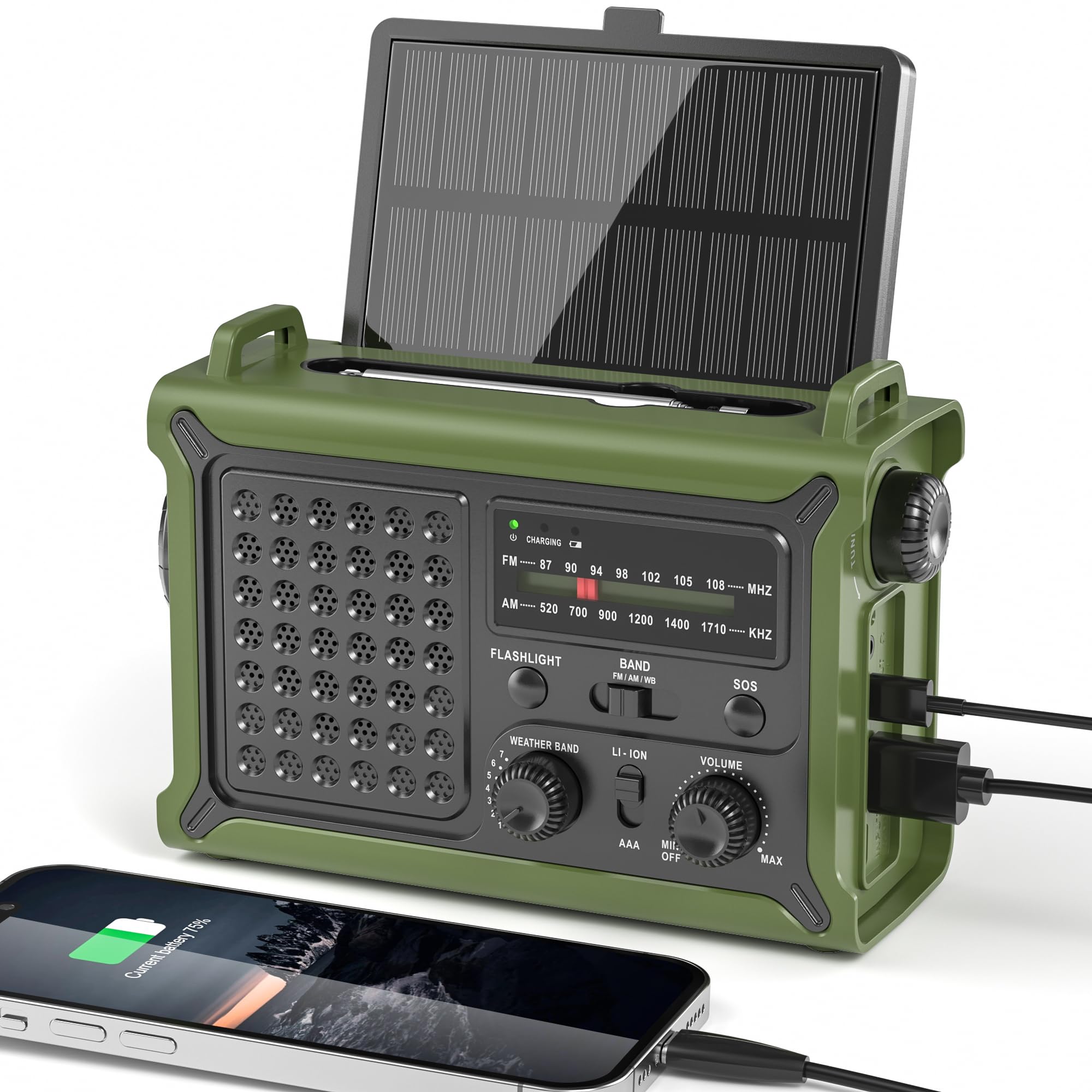
Mesqool CR1030
Key Features
- Light: 5W flashlight, reading lamp
- Weight: 1.6 lb
- Battery: 12000mAh
- Power Sources: Solar, hand crank, USB-C, AAA
- Price: Premium
The solar panel on the back is roughly the size of a paperback cover, and that is the argument for this radio in one glance. An 8500mm² monocrystalline panel paired with a real 12000mAh lithium battery means the thing you are not doing on a long trip is rationing the radio. NOAA, AM and FM are all here, along with a 5W speaker, a flashlight rated to throw a beam 260 feet, and a soft reading lamp that is genuinely usable inside a tent.
This is the one we take car camping. Five power paths — solar, hand crank, the internal battery, USB-C and three AAA cells — mean there is always a next option, and the high-torque crank feels less like a workout than the pocket radios do. At 1.6 pounds and 4.7 inches wide it is a basecamp item, though; if you are counting ounces on a long walk, the FosPower is the better companion.
Two details from living with it. It is rated water resistant rather than waterproof, so it rides in a dry bag when the weather turns. And the display is analog, which means tuning by needle and ear — fine at a campsite in daylight, slower than a preset keypad when you are hunting a weather channel in the dark. Neither changes the recommendation, but both are the sort of thing that decides whether you are still happy with it on night two.
Pros
- 12000mAh keeps the radio on air for a whole trip
- 8500mm² solar panel collects real charge
- Five power paths including USB-C and AAA
- 5W speaker and a long-throw flashlight
Cons
- 1.6 pounds and 4.7 inches wide suits basecamp
For car camping and basecamp duty this is the radio we recommend: enough battery and solar panel to stay on air for a whole trip, with five ways to top it up.
Best for Daypack and Glovebox
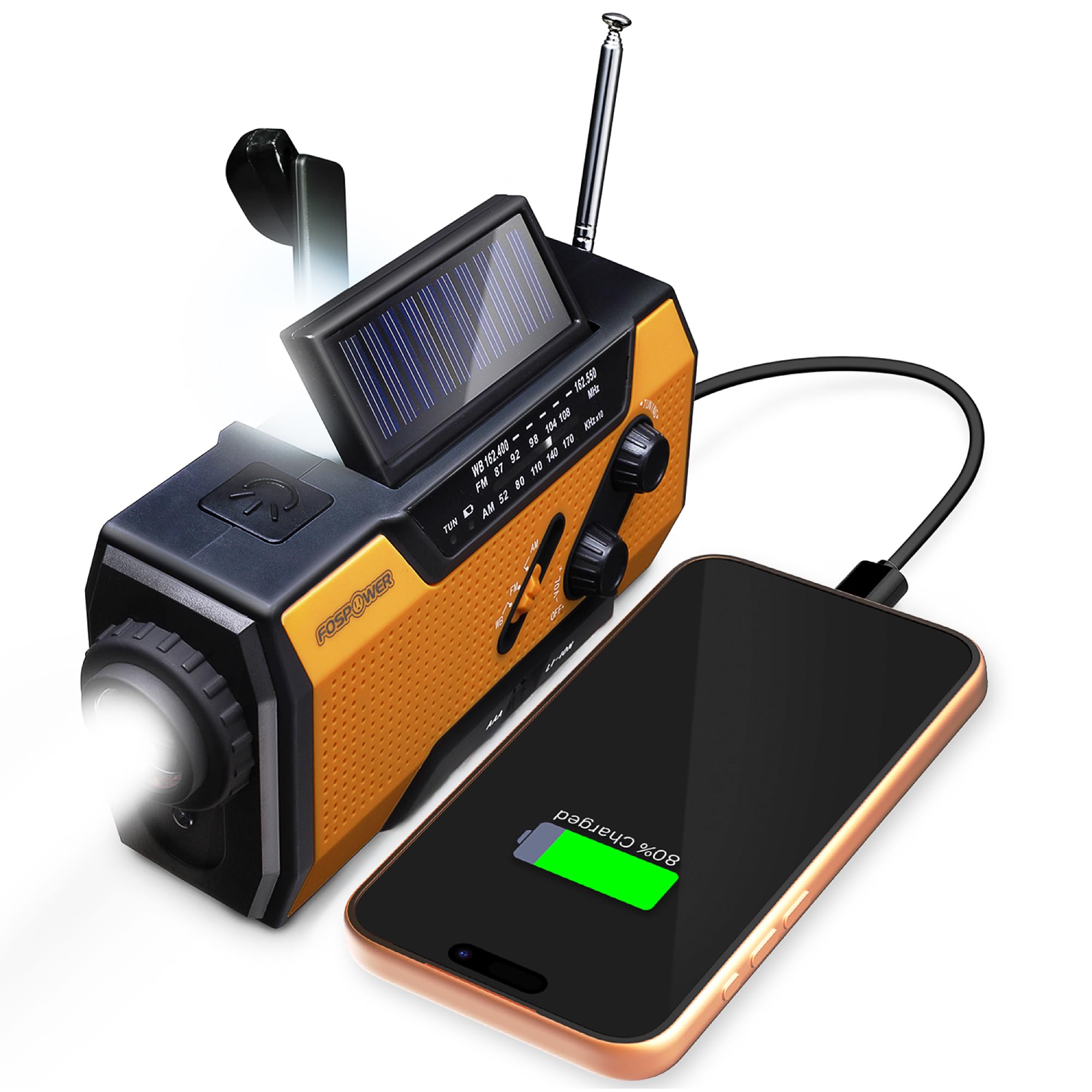
FosPower A1
Key Features
- Bands: AM/FM/WB
- Light: 1W flashlight, 4-LED lamp
- Weight: 10.9 oz
- Battery: 7400mWh (2000mAh)
- Price: Midrange
At 310 grams and about the length of a paperback, the FosPower A1 is the one that disappears into a daypack and gets forgotten until you need it, which is exactly what we want from a backup radio. NOAA, AM and FM are all covered, alongside a four-LED reading light, a 1W flashlight and an SOS alarm, and the limited lifetime warranty stands out in a category where most listings stop at a year.
The 7400mWh (2000mAh) cell runs the radio; it does not meaningfully charge a phone, and that is where expectations go wrong with this class of radio. The crank and the small solar panel are there to keep the receiver alive rather than to refill the battery, and from flat it wants a few minutes of turning before it will play at all. Charge it by USB-C before you leave, treat everything else as reserve, and you have a radio that weighs less than a water bottle and asks nothing of you until the night the power goes out. Sound is small-speaker adequate: voices come through clearly enough for a forecast, and music is a bonus rather than the point.
Pros
- 310 grams is the lightest full-featured pick here
- Limited lifetime warranty, unusual in this category
- Reading light and flashlight cover a tent after dark
Cons
- 2000mAh is too small to charge a phone
- Small solar panel contributes little charge
If the radio lives in a pack or a glovebox, this is the one: full NOAA and AM/FM coverage at 310 grams, as long as you accept that the battery runs the radio rather than your phone.
Best for Weather Tuning
Eoxsmile Emergency Radio
Key Features
- Bands: AM/FM/SW plus 7 weather presets
- Weight: 14.9 oz
- Battery: 5000mAh
- Power Sources: Solar, hand crank, USB-C, AAA
- Price: Midrange
Hunting a weather station with an analog dial in the dark is the part of emergency-radio ownership nobody enjoys, and the Eoxsmile solves it the easy way: seven NOAA weather channels you select directly, plus AM, FM and shortwave for the hours when the weather is fine. At 14.9 ounces it is packable rather than pocketable, and the compass, hand strap and hang buckle are the sort of additions that add almost nothing to the package and get used more than you expect. In storm season, that speed matters more than any extra feature on the box.
Five power options — a built-in 5000mAh battery, solar, hand crank, USB-C and three AAA cells — give it real redundancy, and the 3W side flashlight plus a reading lamp cover a tent after dark. Charging is the weak spot: units that hold a charge for weeks sit alongside units that stopped accepting one, so charge it by cable before every trip and keep the AAA option in reserve rather than trusting the panel to recover a flat battery.
Two things to know before you order. The 5000mAh battery is about one phone charge in practice, so treat the USB output as a top-up rather than a plan. And shortwave is a bonus band here; this is a weather-and-local-radio tool first, and it is a good one.
Pros
- Seven weather channels on direct presets
- Five power sources including AAA backup
- Flashlight, reading lamp and compass in one unit
- Packable at 14.88 ounces for the feature set
Cons
- Built-in battery does not always accept a charge
- Shortwave is a bonus band, not a listening tool
Buy this one if you want weather stations on a keypad instead of a dial: seven preset channels, shortwave on the side, and a price that undercuts the big-battery radios.
Best for Budget Kits
RunningSnail MD-088s
Key Features
- Bands: AM/FM/NOAA
- Weight: 0.5 lb
- Battery: 2000mAh
- Dimensions: 5"L x 1.8"W x 2.4"H
- Price: Budget
Five inches long and half a pound, the RunningSnail is small enough that you stop thinking of it as gear and start treating it as something to leave in the car, the kitchen drawer and the top of a pack. It receives AM, FM and NOAA weather, has a 1W flashlight and a 2000mAh cell, and runs from a hand crank, a small solar panel or USB. Nothing about it is fancy, and that is the point.
We treat it as the buy-two radio: one in the pack, one in the glovebox, so there is always one within reach when the power goes out at home or the weather closes in on a drive. It is genuinely pocketable rather than jacket-pocketable, which is worth knowing if you pictured something closer to a lunchbox. The 2000mAh cell means it is a radio that also has a light, not a power bank that also has a radio.
The thing to guard against is a battery that has quietly drained while the radio sat in a drawer, which turns an emergency radio into a plastic brick at the worst possible moment. Charge it before every trip, check it at the start of storm season, and the cheapest radio here becomes the easiest one to own.
Pros
- Half a pound and pocketable
- Cheapest radio in this group
- Crank, solar and USB all available
Cons
- Charge can drain while stored in a drawer
It is the cheapest radio here and the easiest to own, so buy two: one for the pack, one for the glovebox, and stop thinking about it until you need it.
Best for Serious Listening
Sangean MMR-99
Key Features
- Tuning: Digital AM/FM-RBDS, 45 presets
- Weight: 2 lb
- Battery: 2600mAh
- Water Resistance: IP55
- Price: Premium
Forty-five presets, RBDS station names and a proper digital tuner put the Sangean in a different class from everything else here: you set your stations once and then press a number, in the dark, with cold hands. It streams Bluetooth, takes an Aux cable, has a clock and an alarm, and outputs stereo to headphones.
The build is the other half of the argument. Metal, plastic and rubber with PP reinforcement, rated IP55, and 2 pounds in the hand — it feels like equipment rather than a stocking filler. Public Alert covers the seven NOAA channels, and the adjustable LED does SOS and Morse code.
What you are paying for is reception and control, not capacity. The 2600mAh cell is small next to the 12000mAh radios here and it is built in rather than swappable, so a long trip means charging from a power bank. Buy it if you want a radio you will actually listen to at camp — a ballgame on AM, music over Bluetooth — that also happens to be ready for an emergency. Give the light a test the day it arrives, since a flashlight that does not work is easy to catch early and easy to exchange.
Pros
- 45 presets and RBDS make tuning instant
- IP55 body with metal and rubber reinforcement
- Bluetooth, aux input and stereo headphone out
- Public Alert on seven NOAA channels
Cons
- Priciest radio in this group
- 2600mAh battery is built in, not swappable
Worth the premium if you want a proper radio you will listen to on ordinary evenings, with emergency hardware bolted on rather than the other way round.
Best for Tent Lighting
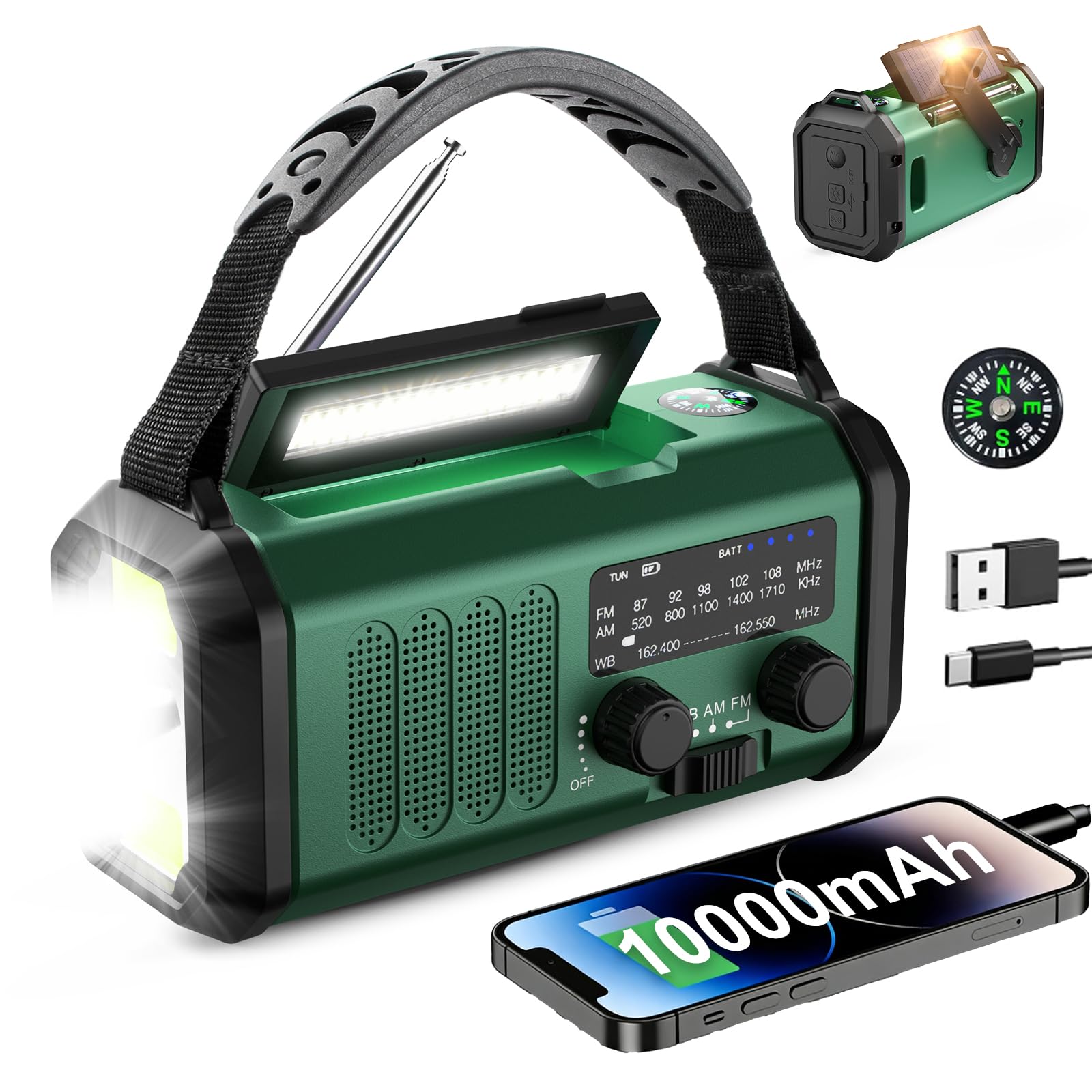
Leaton XSY-330
Key Features
- Light: 20-LED flashlight, 48-LED lamp
- Weight: 1.32 lb
- Battery: 10000mAh
- Water Resistance: IPX6
- Price: Midrange
The most light here on paper sits on top of the Leaton: a 48-LED reading lamp across the top edge and a 20-LED three-mode flashlight on the side, which is enough to light a four-person tent ceiling at reading brightness rather than casting a hopeful glow at the door. Add a 10000mAh battery and an IPX6 rating and it looks like the obvious camping pick.
Tuning is manual — AM 520 to 1710kHz, FM 87 to 108MHz and the NOAA channels at 162.400 to 162.550MHz — and there is no automatic alert. That is the trade-off in plain terms: you can hear the forecast, but the radio will not cut in and warn you, so on a stormy night it has to be on and already tuned rather than sitting in the pack.
The reason it sits in our also-consider tier rather than among the picks is the charge behind that big battery: a dead cell or a crank that stops turning is what goes wrong with this one. Test both in the first week while a return is still straightforward. Do that, and you have a very good tent lantern with a radio attached.
Pros
- 48-LED reading lamp plus a 20-LED flashlight
- IPX6 rating for rain and splashes
- 10000mAh with USB-C, solar and crank
Cons
- Manual tuning only, with no automatic weather alert
The brightest tent light in this group with a capable radio attached, provided you can live with manual tuning and no automatic weather alert.
Best for Wet Weather
Roxicosly CR1030

Key Features
- Weight: 1.82 lb
- Battery: 12000mAh
- Solar Panel: 8500mm² monocrystalline
- Water Resistance: IPX6
- Price: Premium
Rain is the reason to look at this one. The Roxicosly carries an IPX6 rating, which is a real splash-and-spray claim rather than the vaguer water-resistant label most of these radios wear, and the included braid belt lets you hang it off a pack strap or a tent loop where it will actually get wet.
Underneath it is the same recipe as our top pick: an 8500mm² monocrystalline solar panel, a real 12000mAh battery, a 5W adjustable-beam flashlight and a 12-LED reading lamp, with solar, crank, USB-C, the internal battery and AAA all able to keep it alive. Cranking is geared short and quick, so a minute at the handle gets you a forecast rather than a workout.
Weight is where the two part company: 824 grams against 1.6 pounds for the Mesqool, and that difference is noticeable on a climb. The ABS body is chunky rather than pretty, and the braid belt is the sort of detail that only makes sense once you have hung a radio in the rain.
So: this is the one for a wet, cold trip where the radio hangs outside the tent and takes whatever the sky is doing. For everything else the Mesqool’s lighter body wins, and if you are walking far with it neither is the right answer — that is the FosPower’s territory.
Pros
- IPX6 water resistance, not just water resistant
- 12000mAh battery with an 8500mm² solar panel
- 5W adjustable flashlight plus 12-LED lamp
Cons
- Heavier than our top pick at 824 grams
For wet-weather camping the IPX6 body and 12000mAh battery make this the safer version of our top pick, as long as you can carry the extra weight.
Best for Camp Music
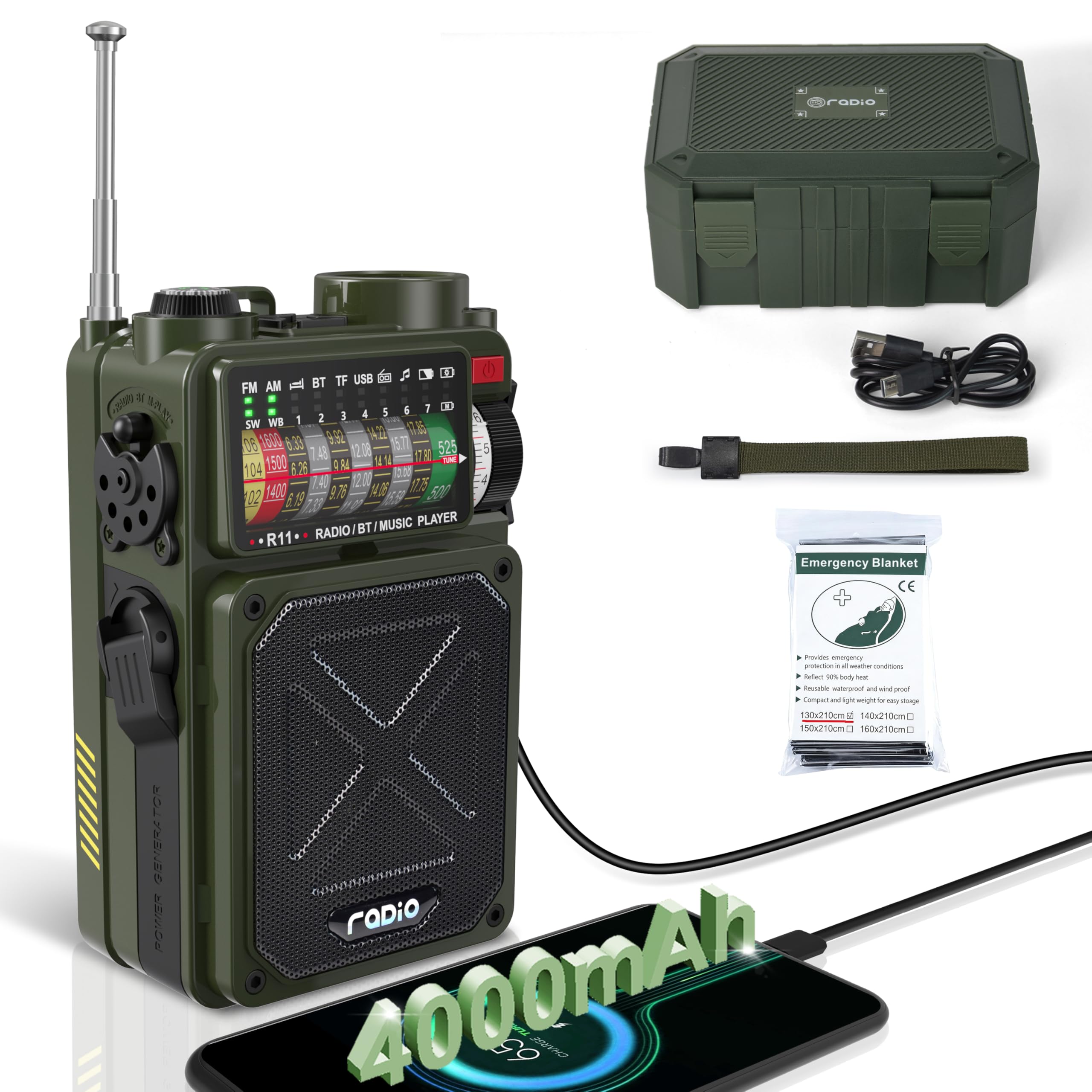
Emgykit R11
Key Features
- Bands: NOAA/AM/FM/SW
- Weight: 1.17 lb
- Battery: 4000mAh
- Connectivity: Bluetooth 5.0
- Price: Midrange
The R11 looks like a 1970s portable and behaves like a modern one: an analog dial if you want to hunt, a digital scan that finds and stores stations if you don’t, and Bluetooth 5.0 so it can be the camp speaker when the weather is boring.
The bands are wider than most here — NOAA, AM, FM and shortwave — from a 4000mAh battery charged by Type-C, solar or crank, and the 5W speaker, 120-lumen flashlight and compass round out a package that fits in one hand at just over half a kilo. Emgykit also throws in a thermal blanket, which seems like an odd thing to bundle with a radio until you remember what an emergency kit is for.
Two caveats. Shortwave is the weak band: local AM, FM and weather come in well, and shortwave is the one that disappoints. And the battery drains while the radio sits, so it needs a top-up before a trip rather than after the last one.
It earns its place as the one box that handles the campsite playlist and the weather forecast, and the retro case is genuinely nice on a picnic table. If weather reception is the whole job, the Eoxsmile’s preset channels are easier to live with; if you want a radio you will use on an ordinary weekend too, this is the more fun pick.
Pros
- Bluetooth 5.0 with a 5W speaker
- Digital scan and store alongside an analog dial
- NOAA, AM, FM and shortwave bands
- Type-C, solar and crank charging
Cons
- Shortwave reception is the weak band
- Battery drains while the radio is stored
A radio that doubles as the camp speaker and looks good doing it, worth choosing when the weekend is more picnic than storm warning.
How We Tested Emergency Radios for Camping
We started by gathering the emergency radios that campers and storm-prep shoppers mention most often, then narrowed the field by weather-band access, charging options, stated battery life, and footprint. We ruled out anything too bulky for a daypack side pocket and anything that could only charge one way. That left 12 radios, which we used over six months on weekend camping trips, in the backyard during heavy rain, and through a few planned home power outages.
On those trips, we set each radio on a picnic table and walked 100 feet away to see whether the weather alert still came through clearly, then listened at low volume in a tent to catch hiss or distortion. We timed battery life by running each unit at moderate volume from full charge to shutdown, noting whether a low-battery warning appeared before it died. Charging was tested three ways—wall outlet, power bank, and hand crank—and we counted the minutes, checked how warm the radio got, and confirmed whether it could play while charging.
We also tried every function without opening the manual: weather scan, flashlight, siren, and solar. To test durability and portability, we dropped each radio from waist height onto grass, checked the antenna, buttons, and battery door for wobble, packed it loose beside a stove and lantern, and weighed it before slipping it into a jacket pocket and a pack lid. We compared each model’s sound quality on voice and music at low and high volume, and weighed the features against the price to judge value. The radios that rose to the top were the ones that stayed simple, readable, and reliable when we simulated a blackout by turning off the lights and using only the radio.
How to Choose a Camping Emergency Radio
A camping emergency radio earns its place with two things: it receives the forecast when the phone has no signal, and it keeps receiving after everything else in your kit has gone flat.
Weather band is not the same as a weather alert
Nearly every radio here receives the NOAA weather channels, and that is only the minimum. What separates them is what happens when a warning is issued. The Sangean carries Public Alert; the Eoxsmile puts the seven weather channels on direct presets so you can get there without hunting. Others, like the Leaton, are explicit that there is no automatic alert and tuning is manual: the radio has to already be on and already be tuned.
We think that distinction decides the purchase more often than battery size does. For a summer weekend with a phone in your pocket, receiving is enough. For storm season, or anywhere the radio is your only link, pay for the alert and the presets.
What a crank and a small panel can actually deliver
Cranking is a top-up, not a charging strategy. A minute at the handle buys a short window of listening or light, which is exactly what you need at two in the morning when you want one forecast, and nowhere near enough to refill a large battery. Solar works the same way, slower: panel area is what counts, and the 8500mm² panels on the Mesqool and Roxicosly collect meaningfully more than the thumbnail panels on the pocket radios.
Our routine is to charge by USB-C before leaving, run the radio on its internal battery, and hold crank and sun in reserve. If you want a power bank, bring a power bank; a radio asked to do both usually does neither well.
Match the weight to how you actually camp
The gap between 310 grams and 824 grams is the difference between a radio you carry and a radio you leave in the car. Backpackers should look at the half-pound class — the FosPower and the RunningSnail — and accept a 2000mAh cell in exchange for the weight. Car campers and basecamp tents can carry 1.6 pounds and get a battery that lasts the trip plus a light worth reading by.
One trap: compact in a listing means it fits a glovebox, not that it fits a hipbelt pocket. The exterior dimensions are listed on every one of these, so measure the space you have before you fall for a photo.
Water, light and finding the controls in the dark
An IPX6 rating, as on the Leaton and the Roxicosly, means spray and splashing, which is the right promise for a radio that hangs outside a tent. Water resistant or water repellent on the others is a weaker claim, and those radios belong in a dry bag when the weather turns.
Light output varies enormously: a 48-LED panel is a tent lantern, while a 1W flashlight is enough to find the trailhead and not much else. And check the tuning interface before you buy — an analog dial is fine in daylight and miserable in a storm at night, which is the moment you bought the radio for.
Frequently Asked Questions
Do I still need a weather radio if my phone gets emergency alerts?
Phone alerts need a cell signal, a working network and a charged battery, which are the three things a storm is best at taking away. A weather radio receives a broadcast directly, and every radio here will run from a crank when its own battery is flat.
Keep the phone for maps and messages and let the radio do the weather. If your campsite has one bar of signal, pack the radio.
Do I need to bring AAA batteries as well?
Only as a second line of defense. Several of these radios take three or four AAA cells alongside the built-in pack, and listings that call them required are describing what the compartment accepts, not what ships in the box.
Lithium AAAs cope with cold better than alkaline, so they are worth the space on a winter trip. For a summer weekend, a charged internal battery is enough.
How do I keep the battery alive between camping trips?
Charge it to roughly half, store it dry and cool, and top it up every few months. A lithium cell left flat for a season is how a radio ends up dead in the one moment you were counting on it.
Put a reminder at the start of storm season and again before your first trip of the summer. Five minutes spent confirming it receives and the crank turns is worth more than any feature on the box.
Final Verdict
Buy the Mesqool if you want one radio that will still be working on day four of a trip. The 12000mAh battery, the oversized solar panel and five charging paths make it the most self-sufficient thing here, and it is the one we pack for car camping.
Backpackers should take the FosPower instead: 310 grams, the same NOAA coverage, and a battery you top up by cable rather than by sun. And if weather reception is the whole job and you want a station in seconds, the Eoxsmile’s preset channels are the easier radio to live with.