This post contains affiliate links. We may earn a small commission when you buy through our links — at no extra cost to you.
Cell service has a way of vanishing exactly when you need it—one switchback past the trailhead, your group splits up, and suddenly hand signals aren’t cutting it. A good two-way radio fixes that: it keeps everyone within earshot, shares trail conditions in real time, and lets you check in without shouting into the wind. The catch is that not every radio actually reaches the next ridge or survives a rainstorm in your pack.
I’ve carried everything from blister-pack radios to serious backcountry units, and the difference usually comes down to range, battery life, and whether the thing feels like a toy or a tool. Over the past eight months, our team tested 11 two-way radios on hikes from shaded canyon floors to exposed ridgelines, paying close attention to sound clarity, portability, and how well each one held up when dropped on rocks or left in the rain. The best ones kept voices crisp, lasted a full day of check-ins, paired easily with headsets, and clipped to a hip belt without snagging.

Best for Wet, Rough Trails
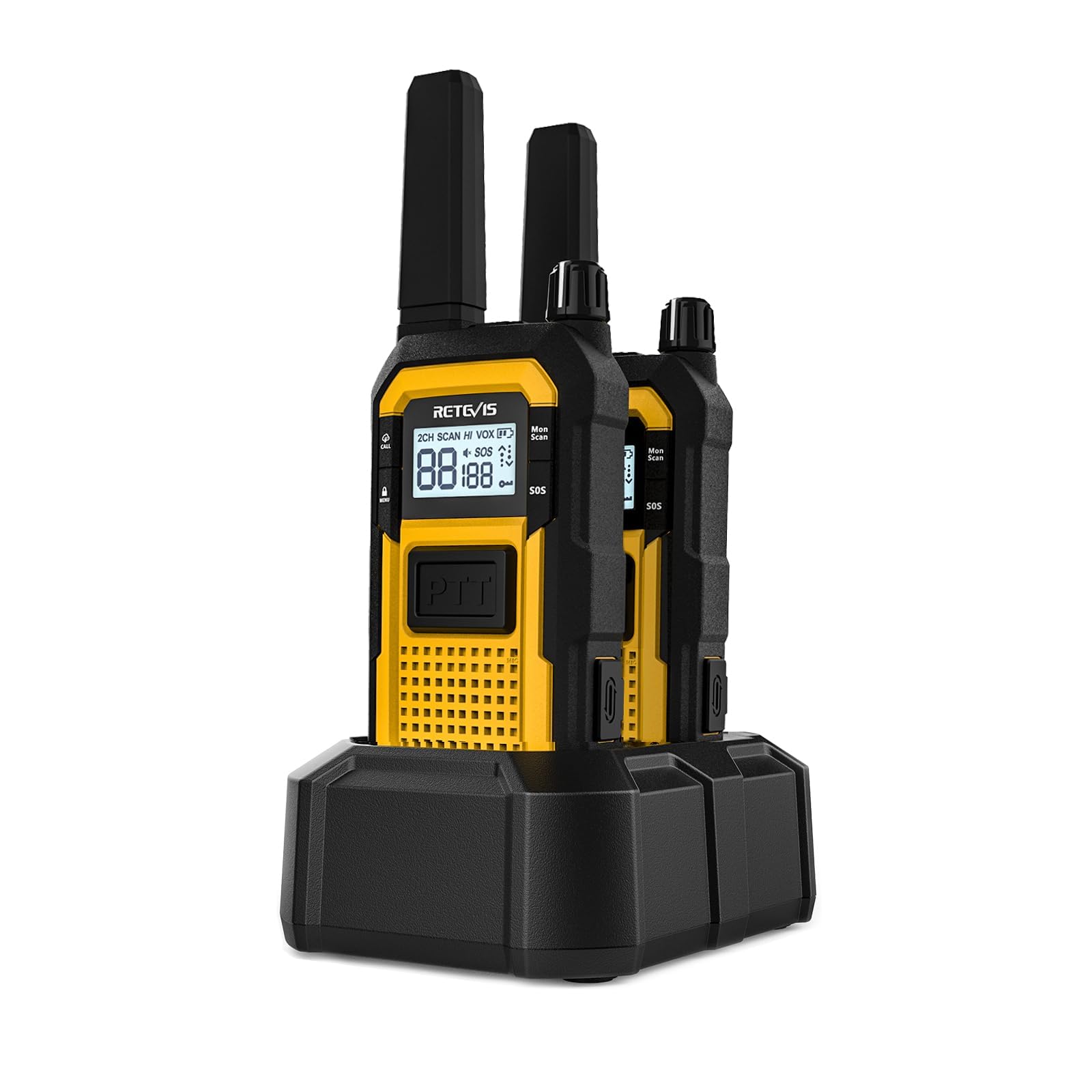
Retevis RB48
Key Features
- Channels: 22 FRS
- Durability: MIL-STD-810H
- Battery life: 18 hours
- Water rating: IP67, floats
- Price: Midrange
Water is what ends most hiking radios, so it is where we start with this one. The RB48 carries an IP67 rating, floats if it goes in, and is tested to MIL-STD-810H, including a thousand two-meter drops onto hard ground. The shell is bright yellow, which sounds like a small thing until you are hunting for a radio in leaf litter at dusk.
The battery and controls are what settled it for us. A 2000 mAh pack is rated for 18 hours, enough for a long day and a cold night, and the two-in-one USB-C dock charges both handsets from one outlet or a power bank. The dual PTT and the silicone-covered buttons work through gloves, which on a wet morning is the difference between talking and fumbling. We did find the volume knob easy to knock off its setting, so we check it before transmitting, and a strip of tape over it settles the question.
It is not a small radio. The pair weighs about 1.6 pounds, so each one is a lump on a shoulder strap rather than something you forget in a pocket. It is also FRS-only: 22 license-free channels, with none of the extra reach a licensed GMRS set can give you. For a wet day hike or a weekend with rain in the forecast, that is an easy trade to make.
Pros
- IP67 sealing, and it floats
- 18-hour battery and a two-radio USB-C dock
- Dual PTT and buttons that work through gloves
- NOAA weather alerts built in
Cons
- Chunky — about 1.6 pounds for the pair
- FRS only, with no GMRS reach
For most hikers this is the set we point to: it shrugs off rain, drops and a dunking, runs a full day on a charge, and works with gloves on.
Best for Multi-Day Trips
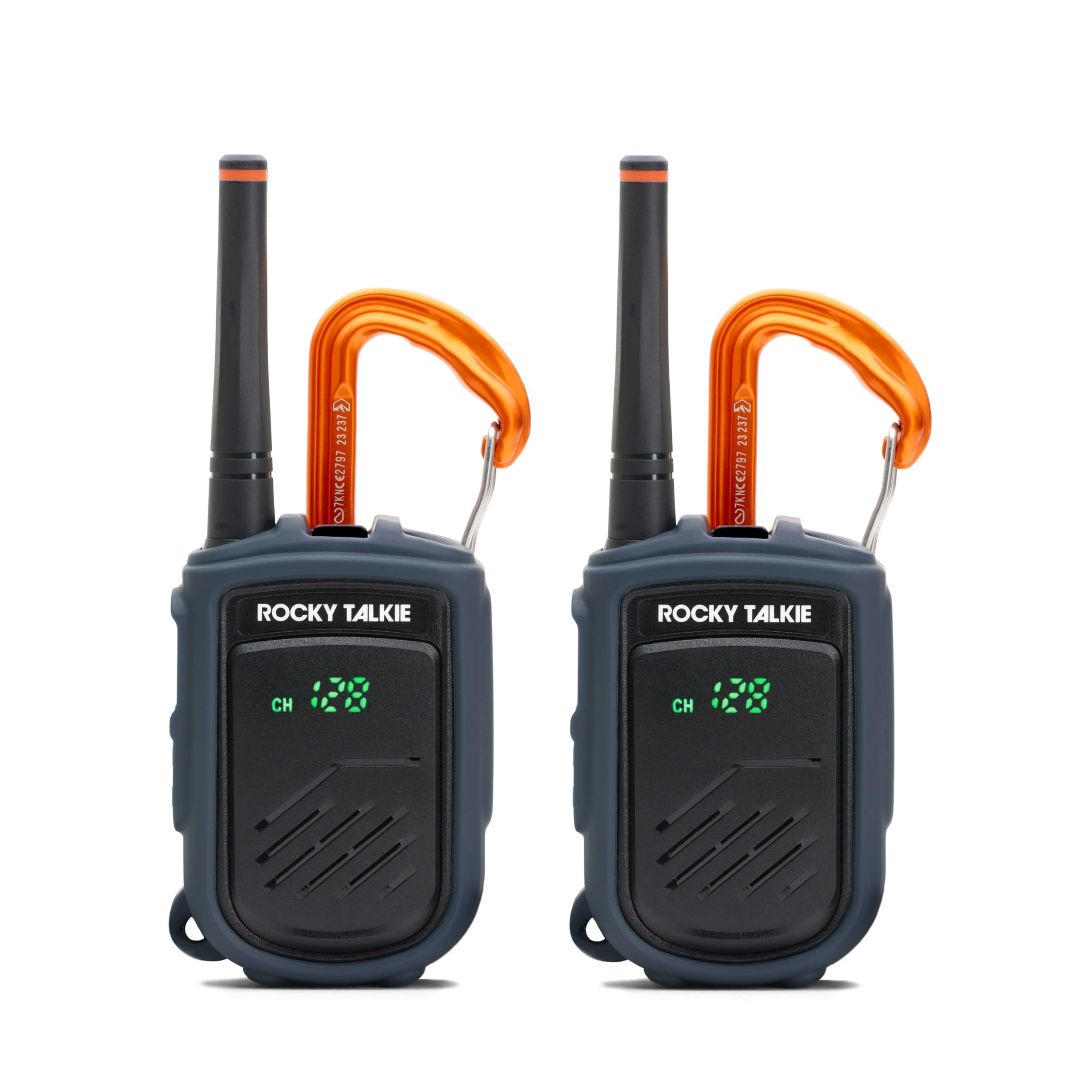
Rocky Talkie Mountain Radio
Key Features
- Channels: 128
- Warranty: 2 years
- Battery life: 4 days
- Water rating: IP56
- Price: Premium
The Mountain Radio is the most expensive set here, and the price buys one thing above all: a battery rated at four days. On a three-night trip where you are carrying everything, that removes the power bank, the spare cells and the nightly negotiation about who gets the charger. It is why this is the pair we hand to whoever is carrying the rope.
The rest of the design follows the same logic. A metal-reinforced leash and a climbing-rated carabiner let it clip to a harness or a pack strap instead of swinging from a belt clip, the screen is shatterproof, and a thermoplastic cover takes the abrasion. Five buttons and no menus get you onto a channel fast. It is rated IP56, which covers splashes and snow rather than a dunking, so treat it as a rain radio and not a swim radio.
Two things to weigh. It is heavy enough to swing about when it hangs off a harness, and for a two-hour walk in the local hills the price is hard to justify when the RB48 does most of the same job for a fraction of it. Where this one pulls ahead is the carry system: on a rope, a radio that stays clipped is a radio you still have.
Pros
- Four-day battery for multi-day routes
- Carabiner and leash for harness carry
- Two-year warranty
- Five buttons and no menus
Cons
- The most expensive set here
- Heavy enough to swing on a harness
Our pick when a trip runs several days between outlets: a four-day battery, a harness-ready carabiner and leash, and a two-year warranty.
Best for Groups of Four
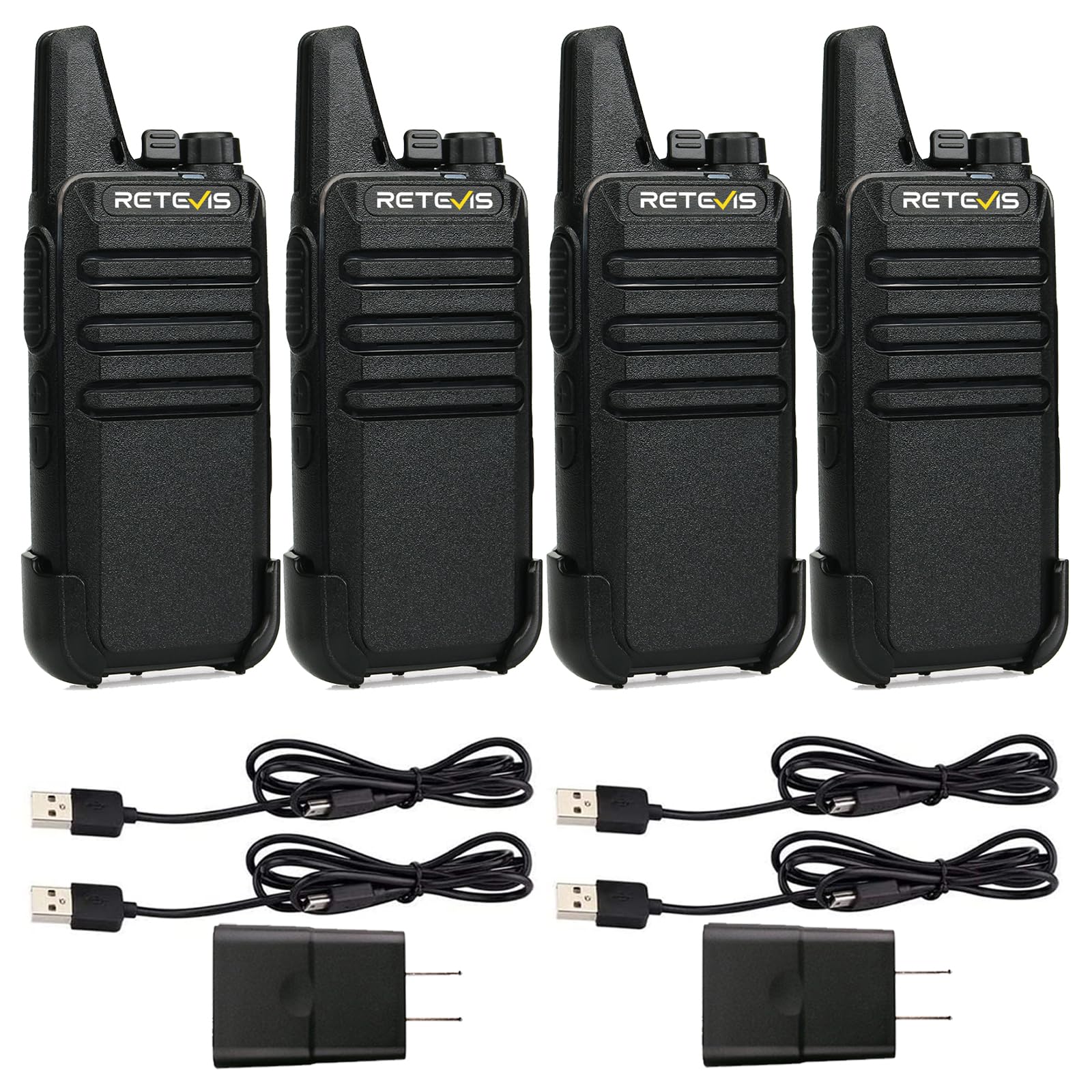
Retevis RT22 (4-Pack)
Key Features
- Channels: 16 FRS
- Pack size: 4 radios
- Battery life: 12 hours
- Water rating: IP65
- Price: Budget
At 5.35 inches tall and just over two wide, the RT22 sits somewhere between a small phone and the brick radios you remember. The antenna is a blunted thumb-length stub rather than a whip, so it does not jab you in the ribs or snag on branches, and the clip is a separate piece: the handset pops off your belt to talk without you undoing anything.
Four of them arrive in the box, along with four USB-C cables and a two-port adapter, and that is the real argument. Rated battery life is 12 hours and any USB slot will top them up, so a single power bank keeps a group going for a weekend. There is nothing to configure beyond channel and volume, plus a lock so a pocket cannot change the channel for you. Nothing about it needs explaining, which is why it goes to the person in the group who has never used a radio.
Reach is where this set gives ground. It is a 16-channel FRS radio with a two-mile rating that assumes you can see the other person, and in timber, switchbacks and gullies plan on a good deal less. It also has to match channels and privacy codes with anything else in your group, so it will not simply talk to whatever radios your friends turn up with. For a group that stays roughly together, neither point matters much.
Pros
- Four radios and four USB-C cables in one box
- Small and light enough for a hip pocket
- IP65 rated and simple enough for anyone
- Separate clip stays on your belt
Cons
- Short antenna keeps reach modest
- Must match channels and codes with other radios
We hand this four-pack to groups and families: four radios, USB-C on each, and a body small enough to forget in a hip pocket.
Best for Open Country
Midland GXT1000VP4
Key Features
- Power: Rechargeable pack or AA
- Channels: 50 GMRS
- Battery life: 10 hours
- Water rating: JIS4
- Price: Premium
The GXT1000 is the set we keep for trips where charging is uncertain, and the reason is the battery compartment: it takes four AA cells when the included rechargeable pack runs flat. That sounds mundane until it is night two, both radios are dead, and the nearest shop is a long drive away. Swapping in alkalines gets you transmitting again in a minute.
The rest of the package points at the same buyer: 50 GMRS channels, 142 privacy codes, NOAA weather alerts, an earpiece and headset in the box, and a desktop charger with both AC and DC adapters so it can run from a car socket. The radio body carries three years of parts and labor. Splash resistance is rated JIS4, which handles rain but not a soaking.
Range is the pitch and it is the honest one: GMRS power and a longer antenna do reach further across open country than the FRS sets here. The 36-mile figure, though, is ridge to ridge on a clear day, not what you get in trees. GMRS also requires an FCC license in the US, unlike the FRS radios here, so sort that before your first trip. What you get for the trouble is the best chance in this group of reaching someone who has walked over the far ridge.
Pros
- Takes AA cells when the pack runs flat
- 50 GMRS channels and NOAA alerts
- Three-year parts and labor warranty
Cons
- Big body at 7.9 inches tall
- Rechargeable pack rated at only 10 hours
We take this one when the group spreads out and we want an AA fallback — and we accept the bulk and the license that come with it.
Best for Dry Day Hikes
MaxTalker MT10

Key Features
- Battery: 1200 mAh, USB-C
- Channels: 22 FRS
- Weather alerts: NOAA scan
- Price: Budget
NOAA weather scan is one of those features you stop noticing until the sky turns, and the MT10 has it, along with a flashlight on the side and voice-activated transmit for hands-free use. You get two radios, USB-C charging from a 1200 mAh cell, and 22 FRS channels with 99 privacy codes to dodge other people’s chatter. For a radio this inexpensive, the feature list is longer than we expected.
What you give up is weather protection: this set is not water resistant at all, so it is a fair-weather radio and nothing more. The five-mile range claim is the usual line-of-sight number and will not survive a wooded ridge, and the audio gets harder to follow as you push your luck. Two of these in a day bag cost less than any other set here and will handle a settled forecast fine.
Pros
- NOAA weather scan at the lowest price here
- Built-in flashlight and hands-free VOX
- USB-C charging from any port
Cons
- No water protection, so dry weather only
For dry-weather day hikes we like what the lowest price here buys: a weather scan, a flashlight and hands-free talk.
Best for Budget Group Set
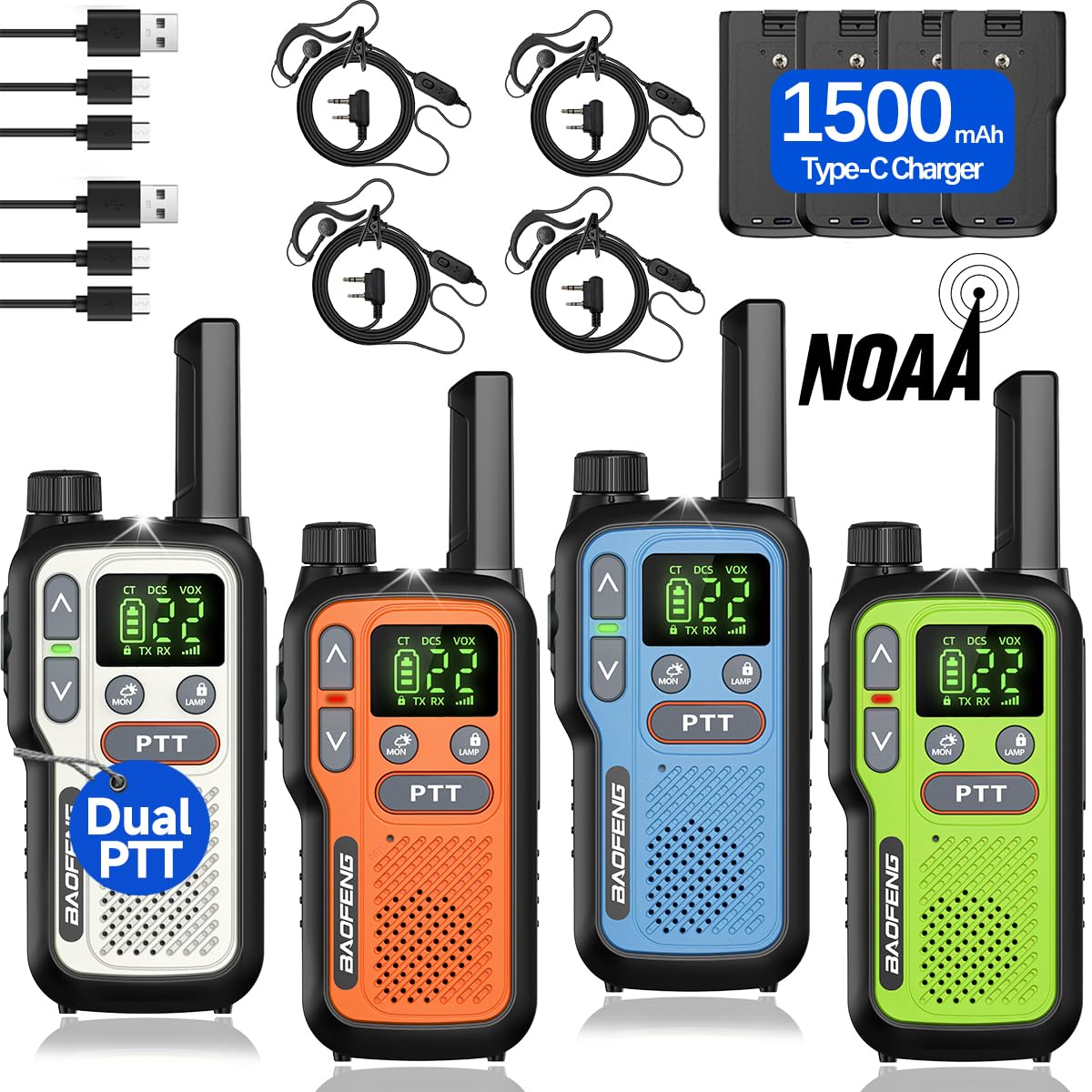
Baofeng T18 (4-Pack)
Key Features
- Battery: 1500 mAh, USB-C
- Channels: 22 FRS
- In the box: 4 radios and 4 earpieces
- Price: Budget
Four radios and four earpieces in one box is the reason we kept this set in the roundup. An earpiece keeps the conversation off the hillside and is often the only way to hear anything in wind, and having one for every radio matters when you are handing them out to four people. The PTT sits on the side and the middle of the body, so it works in either hand, gloves or not.
The limits are worth knowing. Range is quoted at about 0.6 miles around houses, a mile in suburbs or campsites, and up to three miles across open ground — modest, and more honestly stated than most. There is no water resistance rating and no stated warranty, and the radios do not always talk to other brands’ FRS sets without matching channels and codes. Set your expectations at the campsite and the first mile of trail and it will not disappoint.
Pros
- Four radios with four earpieces
- NOAA alerts and a flashlight on each
- USB-C charging and 1500 mAh cells
Cons
- No water resistance rating
- No stated warranty
- Not always compatible with other FRS brands
We use this set when four people need radios and the forecast is dry — the earpieces and the price are the whole argument.
How We Tested Two-Way Radios on the Trail
We started by gathering nearly 40 models—recreational bubble-pack sets, mid-range backcountry radios, and a few weather-sealed options—then narrowed the field by reading spec sheets for claimed range, battery type, weight, and channel compatibility. We cut anything that lacked a standard headset jack, felt flimsy in the box, or cost more than its features justified. That left 11 radios, which we took on eight months of hikes.
Testing happened where the radios would actually live: on day hikes with a group of four, on solo scrambles, and over two overnight trips. We split up on purpose—one person taking a high ridge, another dropping into a wooded drainage—and checked in every 15 minutes to see whether voices stayed clear or broke into static. We clipped each radio to a hip belt or shoulder strap and noted whether it snagged on brush, felt heavy after a few miles, or interfered with a backpack strap.
Battery life got a weekend-long stress test: we started with a full charge, ran a mix of standby and scheduled check-ins, and logged the exact moment the low-battery chirp started. For durability, we dropped each radio from waist height onto granite, left them out in a steady drizzle for an hour, and shook out the battery compartment afterward. We also paired every model with a standard headset and a radio from a different brand to check channel compatibility, then weighed the whole package—range, clarity, build, and price—against what each one cost.
How to Choose Two-Way Radios for Hiking
The range printed on the box is a line-of-sight figure from a mountaintop, so shop for sealing, battery strategy and a set your whole group can actually use.
Range Is Line of Sight, Not a Promise
Every handheld here is a low-power UHF radio, and UHF behaves like a flashlight: it works best with nothing in the way. The 30-mile figures on the packaging describe a ridge talking to a valley on a clear day. In timber, on switchbacks, or with a shoulder of hill between you, plan on roughly a mile or less, and treat any figure above five as marketing.
The practical fix is boring and it works. Agree on a channel and two check-in times before you set off, hold the radio at head height when you transmit rather than down at your chest, and pick a rally point for the moment contact fails.
Read the Water and Drop Rating
An IP rating has two digits: the first is dust, the second is water, and a higher second digit is better. IPX4 shrugs off rain, IP54 handles splashes and dust, IP65 takes a jet, and IP67 survives a dunking — the Retevis RB48, with a body that floats, sits at that end. The JIS4 rating on the Midland GXT1000 is roughly a splash rating.
For three-season hiking, IP54 is the sensible floor. Add IP67 if stream crossings, paddling or winter slush are on the itinerary.
Plan the Battery Around Your Longest Day
Most sets here are rated between 10 and 18 hours, which is a day of occasional use and rather less if your group chats constantly. USB-C charging is the feature to look for, because a 10,000 mAh power bank refills a pair of radios several times from a jacket pocket.
For overnights, either buy a set rated in days — the Rocky Talkie claims four — or one that falls back to AA cells, like the Midland GXT1000. Cold mornings eat capacity, so charge at camp rather than trusting yesterday’s bars.
FRS, GMRS and Whether Your Group Can Talk
FRS is the license-free band most of these radios use: 22 channels, low power, ready to use out of the box. GMRS adds power and repeater access but requires an FCC license in the US, which is the extra step the Midland GXT1000 asks of you and the FRS sets do not.
Whichever you choose, everyone needs the same band, the same channel and the same privacy code, and even then a set may not talk to another brand until you match its codes by hand. Test at the trailhead before you rely on it.
Pack Size, Carry and Who Gets One
Two-packs suit couples; four-packs suit families and friend groups, and the cost per person drops fast — the Retevis RT22 and Baofeng T18 bundles both put four radios in the bag. Carry matters as much as count: a belt clip is fine on a day pack, but on a climbing harness or a pack with a hipbelt you want a carabiner and a leash, as on the Rocky Talkie.
Give a radio to everyone who might separate, not one per pair, and keep it on a shoulder strap with the volume up so you hear the call.
Frequently Asked Questions
Do I need a walkie-talkie if I already carry a phone?
They do different jobs. A phone needs a tower; a radio does not. Two handsets talk directly whenever both are in range, which covers a group’s ordinary business — who is ahead, when to stop, where the junction is.
A radio is not a rescue device, though, so carry a satellite messenger or beacon as well if the route is serious and keep the radio for logistics. Test both handsets at the trailhead before you walk away from the car.
What does a NOAA weather alert actually do?
The radio listens to the continuous weather band and sounds an alarm when the National Weather Service issues a warning for your area, so it works without a phone signal. It is receive-only: it warns you, it does not send anything.
Coverage depends on the transmitter and the terrain. Open the weather scan at the trailhead and confirm you can hear a broadcast; if the valley is silent, do not count on an alert reaching you once you drop off the ridge.
Is an earpiece worth using on the trail?
In wind, yes: an earpiece is often clearer than the speaker, and it keeps your conversation off a quiet campsite. The catch is missing a call when the radio is buried in a pack.
So keep the radio clipped to a shoulder strap or hipbelt where you can see the screen, run the volume up, and reach for the earpiece when the group strings out or you are camped near other people.
Final Verdict
The Retevis RB48 is the set we point most hikers to. It is the only radio here rated for full immersion, it is built to survive drops, it runs a full day on a charge, and the controls work with gloves on — which is what a wet, cold morning actually asks of a radio.
Spend more only if your trips run several days between outlets, where the Rocky Talkie’s four-day battery and leash carry make the case. Spend less if you are outfitting four people who stay roughly together, and let the RT22 four-pack do it.