This post contains affiliate links. We may earn a small commission when you buy through our links — at no extra cost to you.
Every walkie talkie box advertises a range measured from a mountaintop to a valley with nothing in between — 30 miles, sometimes 35. In a canyon or a crowded campground the honest number is closer to one or two, and that gap between the sticker and reality is where good radios separate themselves. What you’re really paying for is a unit that stays intelligible when the trail bends, still has battery at hour nine, and clips to your belt without popping off in the brush.
Something first-time buyers rarely hear: privacy codes don’t make you private. They just filter out everyone who isn’t on your code — anyone on the channel can still hear you. My team has spent the past six months carrying 12 models through ridge-lined hikes, a working farm, hotel service corridors, and a two-car highway drive, and the winners were never the ones with the biggest number on the box. They were the ones that kept working when conditions got ordinary-bad, which is what the picks below were chosen for.



Best for Hiking and Rain
Retevis RB48
Key Features
- Battery: 2000mAh, 18 hours
- Channels: 22
- Waterproof rating: IP67
- Durability standard: MIL-STD-810H
- Price: Midrange
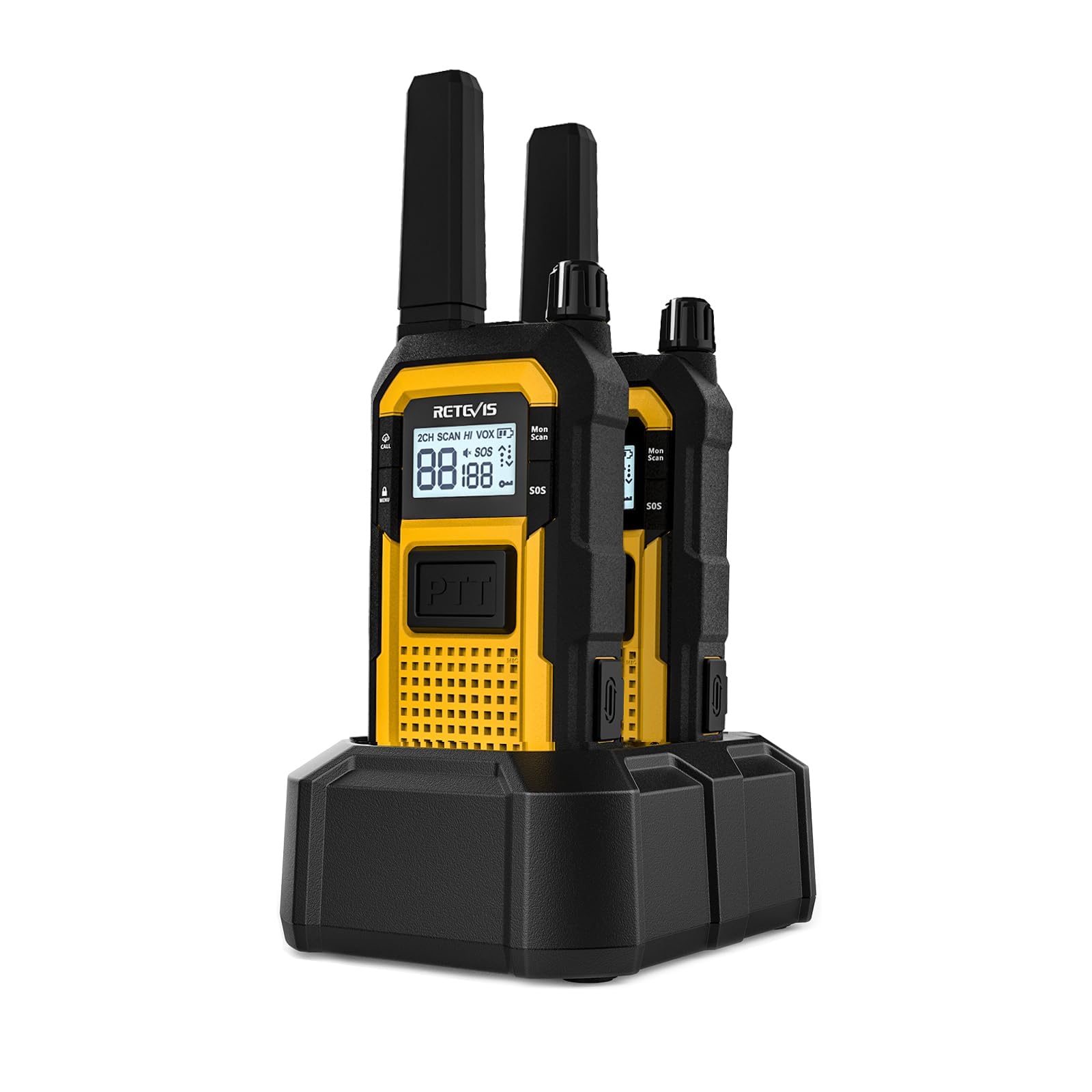
MIL-STD-810H is the kind of specification that means nothing until you are standing in a downpour with a pack on, but on the RB48 it lines up with the things we actually inspect: a sealed antenna, silicone covers over the buttons, and an IP67 rating that covers dust as well as water. Rain, grit and a drop onto rock are what end a handheld’s season, and this one is built for all three. The bright yellow shell seemed like a gimmick until a radio went down on a scree slope and we found it again in seconds.
Battery is where this pair separates from most of the group. The 2000mAh pack is rated at 18 to 20 hours, which covers a full hiking day with margin, and you can refill it from USB-C in a car or drop both radios into the included two-bay dock at camp. The 5-year warranty on the radio body is the longest coverage here outside Midland’s.
Dual PTT buttons sit where a gloved thumb expects them, one per channel, so you can switch between the walking group and basecamp without menu-diving. The roger beep confirms a transmission has finished when reception is patchy, and the vibration alert earns its keep in wind, when a call would otherwise go unnoticed. The 22 channels are license-free FRS, so anyone can join on the same channel and code.
Retevis quotes 300,000 square feet or 25 floors for range, which are building figures. Plan on roughly a mile of clear ground between handsets and less once a ridge or wet canopy gets in the way, which is the honest arithmetic for every radio here. Two radios per box is the one real limit: a group of four needs two sets, and that is the case where a four-pack like the Gaswei makes more sense.
Pros
- IP67 and MIL-STD-810H housing
- 18 to 20 hours per charge
- Dual PTT usable with gloves
- License-free 22-channel FRS
Cons
- Sold as a two-pack only
The pair we reach for first on a wet, long day: IP67 and MIL-STD-810H, 18 to 20 hours per charge, and controls you can work with gloves on.
Best for Big Groups
Midland GXT1000VP4
Key Features
- Battery: 10 hours, 8 AA
- Channels: 50
- Privacy codes: 142
- Water resistance: JIS4
- Price: Midrange
Fifty channels and 142 privacy codes is the biggest channel count in this group, and at a busy trailhead on a summer Saturday that is the difference between a clear line and everyone else’s chatter. The feature we value more is the NOAA weather scan: a radio that interrupts with a severe-weather alert earns its pack space on a high route, especially where a phone has no signal to warn you.
Runtime is the compromise, and it is also the reason this set stays on our shortlist for multi-day trips. Midland rates the included packs at 10 hours, and rechargeable packs are the first thing to soften over a couple of seasons — but the dual-power tray takes 8 AA cells, so a flat battery becomes a two-minute fix from a gas station or a cabin drawer. That fallback is worth more to us than another few hours of rated runtime.
Water resistance is JIS4, which handles rain and splashes; a radio dropped in a creek is a different story. The 36-mile figure is the largest claim on any box here and describes two units with a clean line of sight, so treat it as a ceiling rather than a plan. Three years of parts and labor is the longest warranty in this group, which counts for something on a radio that lives in a truck.
Pros
- 50 channels and 142 codes
- NOAA weather scan and alerts
- AA tray backs up the rechargeable packs
- Three-year parts and labor
Cons
- JIS4 rated, so a dunking is not covered
We recommend this pair for big groups and storm country: 50 channels, NOAA alerts and an AA fallback, with battery life you plan around rather than trust.
Best for Job Sites
DEWALT DXFRS800
Key Features
- Battery: 18 hours
- Channels: 22
- Output power: 2 watts
- Waterproof rating: IP67
- Price: Premium
The DXFRS800 sits at the top of the price range for a pair here and does not buy you more channels — 22 FRS, same as most of the group. What the money buys is a 2-watt radio in an IP67 housing rated for 2-meter drops, a holster in the box, and a call button on the front face you can find by feel with gloves on. On a site, that is the whole argument.
Eighteen hours of rated battery and a dual-port dock that charges both radios from one adapter make it a set you can leave on a bench overnight and grab in the morning. The dock needs the radio seated squarely to make contact, so check the indicator before you walk away. Reception held clear past a mile on flat ground and dropped back to short hops once timber got in the way, which is the same physics as everything else here.
Weight and price are the trade-offs. Two radios, holsters and a charger make a heavier package than a slim business set, and this is the priciest two-radio box here. For hiking, an RB48 does the same job lighter. On a tailgate, in rain, with a glove on, the DEWALT is the one that keeps working.
Pros
- IP67 with a 2-meter drop rating
- 18-hour battery and dual-port dock
- Front call button findable with gloves
Cons
- The priciest two-radio set here
- Dock needs the radio seated squarely
Our pick for a job site or a farm: tough, simple and priced like a tool, though it is more radio than a hiker needs to carry.
Best for Paddling Groups
Gaswei G2pro+
Key Features
- Channels: 22
- Privacy codes: 121
- Weather alerts: NOAA
- Waterproof rating: IP67, floating
- Price: Premium
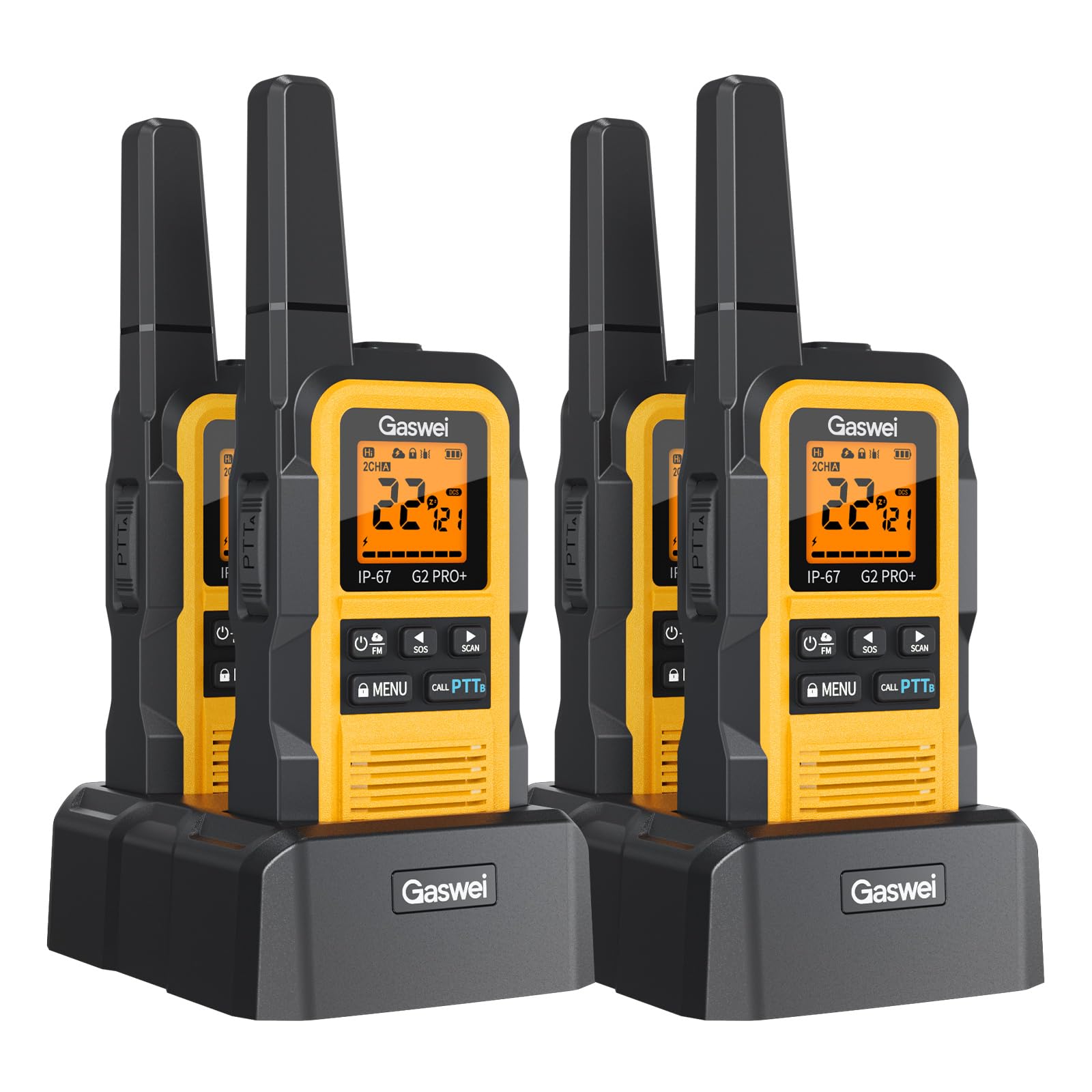
Four radios, one order, and no argument about who pairs with whom. The G2pro+ is rated IP67 and built to float, which is the detail that matters most to us for paddle trips: a radio that goes over the side is something you fish out rather than something you replace. Dual PTT buttons sit on both sides, so left- and right-handed users get a natural press with wet, cold hands.
The feature list is long for the money: 22 FRS channels with 121 privacy codes, NOAA weather channels, VOX for hands-free use, an SOS siren and an FM receiver. NOAA and the floating body are the parts that earn their place on a trail radio.
Two things to weigh. This is the largest single outlay in the group, even though the cost per radio undercuts most of the pairs here, and four radios is two more than a couple needs. Buy it if you are outfitting a group of four — a boat, a campsite, a family — and buy a pair if you are not.
Pros
- IP67 body designed to float
- Four radios with dual PTT
- NOAA weather and SOS built in
- 121 privacy codes on 22 FRS channels
Cons
- Largest single outlay, and only worth it for four
The set we suggest when four people are sharing a boat or a campsite: waterproof, floating, and cheaper per radio than most pairs here.
Best for Large Crews
Retevis RT22 6-Pack
Key Features
- Size: 3.78 x 2.17 x 0.87 in
- Battery: 1000mAh, 10 to 12 hours
- Channels: 16
- Charging: Six-way gang dock
- Price: Midrange
Small enough to vanish into a jacket pocket — 3.78 by 2.17 by 0.87 inches and about 108 grams — with the antenna in a stub that will not snap off inside a pack. The key lock is the detail we appreciate most: someone always brushes a channel button in a crowded truck, and a locked keypad keeps the whole group on the same frequency.
The six-way gang charger is the real argument. One outlet, six radios, all full by morning, which is the difference between a set that gets used and a set that lives in a drawer with three dead units. Rated runtime is 10 to 12 hours on a 1000mAh pack — a full day, not a full weekend away from the dock. The dock is the part that wears out; charging can stop after a few months, so watch the indicator lights and treat it as a consumable.
Sixteen channels and a 2-mile quote make this a campsite, farm or worksite radio rather than a summit one, and it is not rated IP67 like the hiking-first sets here. What it is, is the simplest way to put a radio in six pairs of hands with one thing to plug in.
Pros
- Six radios and a six-way gang charger
- Slim 108 g body with key lock
- 10 to 12 hours per charge
Cons
- Charging dock can stop working after months
- 16 channels, the fewest in this group
Six people, one dock, and the least fuss per person of anything here — this is the set we choose when a whole group needs radios.
Best for Family Camping
BAOFENG T18 4-Pack
Key Features
- Pack: 4 radios
- Battery: 1500mAh, USB-C
- Channels: 22
- Range claim: 3 miles on open ground
- Price: Budget
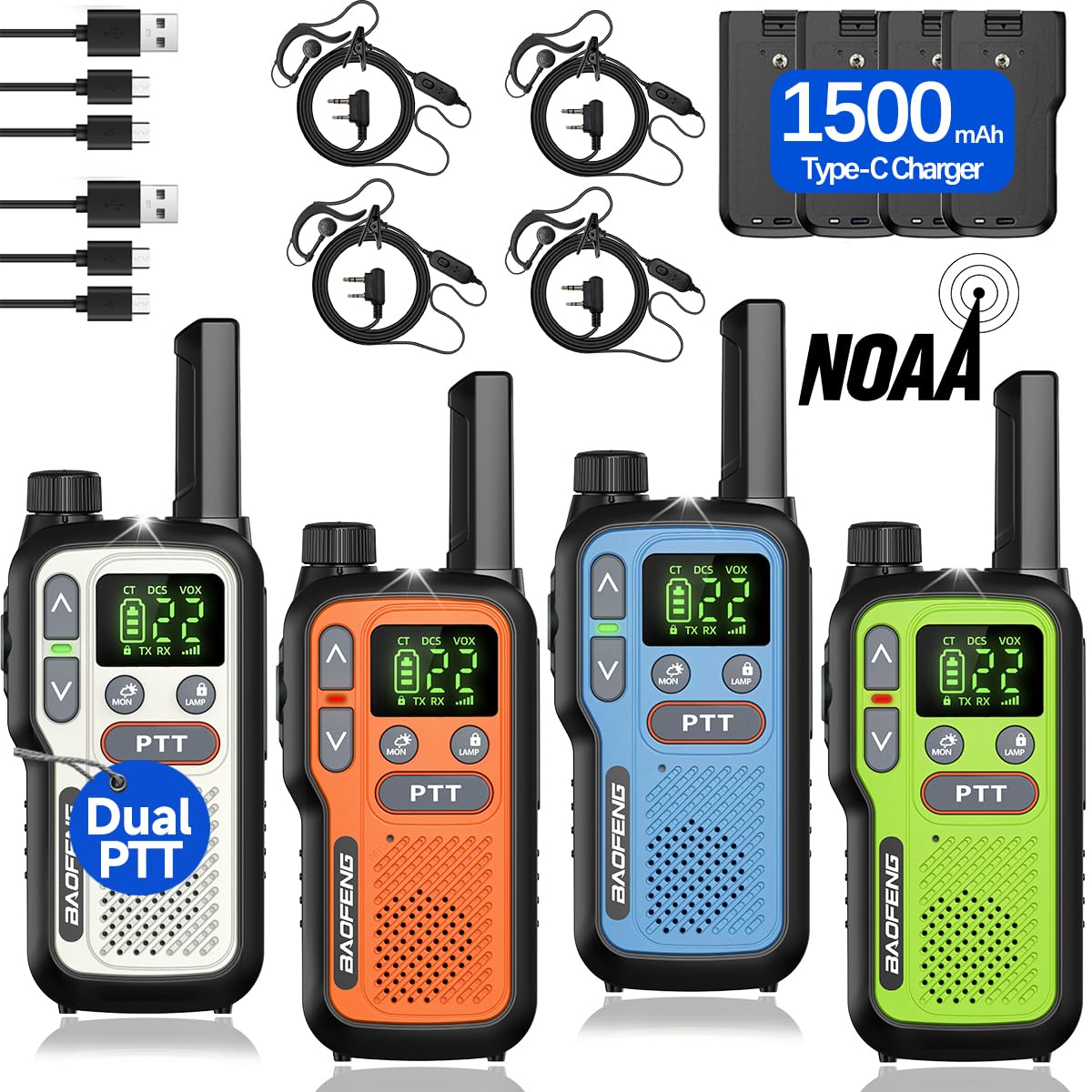
The most useful thing about the T18 is the honesty of its range figures: about 0.6 miles in a neighborhood, a mile in the suburbs or at a campsite, and up to 3 miles on flat open ground. That is a fair description of what a handheld does, and it is the number to keep in your head when another box promises 36.
For the outlay you get four radios, each with its own 1500mAh battery, USB-C charging from a power bank or car socket, NOAA weather reception, dual PTT buttons and a flashlight. USB-C is the practical win: one cable for four radios, and the same cable as your phone. The menu takes a few minutes to learn, and the screen stays readable in daylight.
The limits are real. These are not water resistant, so a wet weekend means dry bags, and the range is a neighborhood tool — right for kids on bikes and a two-car convoy, wrong for a group spread across a mountain. If your trips are the second kind, the RB48 is the honest upgrade.
Pros
- Four radios at the lowest cost per handset
- USB-C charging from a power bank
- NOAA reception, VOX and flashlight
Cons
- Not water resistant
- Range falls to blocks in built-up areas
For a family that wants four radios cheaply, this is the set we hand out — as long as you keep them out of the rain and expect neighborhood range, not ridge-to-ridge.
Best for Neighborhood Use
MaxTalker MT10

Key Features
- Battery: 1200mAh, USB-C
- Channels: 22
- Range claim: 5 km
- Privacy codes: 99
- Price: Budget
Two radios, two USB-C cables, and the smallest outlay here. On paper the feature list matches sets that cost far more: 22 FRS channels, 99 privacy codes, NOAA weather scan, VOX, a flashlight and a 1200mAh battery.
Where the savings show is at the edges. Volume is fine on a quiet street, but at the far end of its range the audio gets harder to follow, and the quoted 5 km shrinks to a block or two among houses. Charging deserves a test in the first month: the battery is sealed in, so a unit that stops accepting a charge retires the radio rather than costing you a pack of cells.
The menu is simple enough that a ten-year-old works it out, and the clip holds a belt. For the neighborhood, a festival, a mall or a second pair for the car, that is plenty. For anything involving weather, take one of the waterproof picks instead.
Pros
- Lowest-priced pair here
- USB-C charging with a 1200mAh battery
- Easy menu a child can work
Cons
- Sealed battery, not user-replaceable
- Range falls off within about a mile
This is the pair we point to when the job is two kids on bikes within a few blocks, not a summit push — cheap, simple and charged by USB-C.
How We Tested Long Range Walkie Talkies
We started by reading spec sheets and owner reviews for two dozen sets, then filtered down to license-free models that don’t require a permit to operate, dropped anything whose accessories cost as much as the radios, and landed on 12 models to test over six months. Both two-packs and singles were included, since most people buy in pairs but plenty of us just need one more.
Range came first, because it’s the claim everyone inflates. We walked pairs apart on a trail with a ridge between us until the audio broke into static, noting whether the signal dropped all at once or degraded gradually, then repeated the walk across an open farm field, through a concrete parking garage, and floor by floor up a hotel stairwell. Battery life got the same treatment: a full charge, then a radio check every 15 minutes through a long workday, followed by timing a recharge on the desktop cradle and again from a USB-C cable in the car.
Durability and portability we tested the unglamorous way. Each unit was dropped from waist height onto pavement, left out through a steady rain shower, and shaken out after a week in a dusty truck console. We weighed them, clipped them to belts and backpack straps, and jogged a lap to see what stayed put. Sound quality was judged in wind and beside a highway with the volume half up, and compatibility by trying to reach other brands’ radios on shared channels. Value came down to what shipped in the box — earpieces, spare batteries, a charging dock — against what the set cost.
How to Choose a Long-Range Walkie Talkie
The range figure on the box is a laboratory number; the radio that keeps your group together is the one with the right band, enough battery and a housing that survives the weather.
Read the range claim as a best case
Handheld range is line of sight, and every obstacle spends it. A ridge, a wet canopy, a stand of pine or the steel body of a car can cut a link that would carry miles over open water. Treat the big number as the best case the maker could produce and plan for a mile or so of clear ground — and expect a few hundred yards once terrain gets involved.
The practical workaround costs nothing: agree a rendezvous point before you split, and use a high point or a clearing when you need to call. Terrain beats wattage every time.
FRS, GMRS and talking to each other
FRS is the license-free service most of these handhelds share, which is why a Retevis can talk to a Midland on the same channel and code. GMRS adds channels and, in the US, requires an FCC license; some sets here list GMRS capability, so confirm which channels you may legally use before a trip.
For a mixed group, pick a channel and a privacy code everyone can reach and write it on a card. Radios that cannot share a channel are two separate groups in the same jackets.
Water, dust and the drop that ends the trip
Look for a real IP rating rather than the words water resistant. IP67 means dust-tight and survives immersion; JIS4 and IP54 handle rain and splashes but not a radio that goes into a creek. A sealed antenna and covered buttons matter as much as the number on the box.
If your trips involve packrafts, kayaks or river crossings, a floating body turns a lost radio into a wet one.
Battery, charging and the dock in your bag
Runtime figures are quoted for light use, so read them as a ceiling. The bigger question is how you refill: USB-C is the most flexible because it shares a cable with your phone and runs from a power bank, while a charging dock is convenient at a cabin and useless on the move. An AA tray is the best insurance on a long trip, since spare cells are sold everywhere.
For a group, a gang charger that fills six radios from one outlet is worth more than an extra hour of rated runtime.
Pack size and how your group splits up
Most sets are sold as pairs, which is right for two people and wrong for four. Count the people who need a radio first, then look at cost per handset: a four-pack often undercuts a pair per radio, and a six-pack with a gang charger is the cheapest route to equipping a club.
The catch is that pack sizes are fixed at the point of sale, so buy the size your biggest trip needs rather than the one your next trip needs.
Frequently Asked Questions
Are walkie talkies worth carrying if everyone has a phone?
Yes, wherever the signal stops. A radio needs no tower, works in a dead zone, and one press reaches everyone on the channel at once instead of one call at a time — which is why they still earn pack space on hikes, hunts and ski days, and keep working when a phone battery is spent.
Agree a channel and a check-in time at the trailhead, and clip the radio outside your pack rather than burying it.
How do I get more range out of the radios I already have?
Get the antenna higher and keep it vertical — a radio held at an angle with a hand wrapped around the antenna loses real distance. Step into a clearing, climb a few feet of slope, or transmit from a window rather than from inside a metal vehicle.
If the group cannot hear you, check that both radios share the same privacy code before blaming range: a mismatched code sounds exactly like no signal.
Do privacy codes make my conversation private?
No. A privacy code filters what you hear; it does not stop anyone else hearing you. Anyone on the same channel can still listen in, and another group using the same code will break through.
Use codes to cut cross-talk at a busy trailhead or campsite, not to protect anything sensitive — and keep names, locations and plans vague if you would rather not broadcast them.
Final Verdict
For most people heading out with two radios, the Retevis RB48 is the pick: an IP67 and MIL-STD-810H housing for weather and drops, a genuine full day per charge, and 22 license-free FRS channels so the rest of your group can join.
If your trips run four people on water, the Gaswei set covers everyone in one box and floats. If you are equipping a crew of six, the RT22 with its gang charger is the practical answer — and if the radios live on a tailgate rather than a trail, the DEWALT is the one that takes the abuse.