This post contains affiliate links. We may earn a small commission when you buy through our links — at no extra cost to you.
Every walkie talkie box promises a range in miles, and every one of those numbers came from a clear day over open water. In a stand of trees or the aisle of a warehouse store, you get a fraction of it. What separates a good pair from a frustrating one is what the spec sheet skips: whether voices stay clear when someone whispers, whether the battery lasts a full day outdoors, and whether a kid can work the buttons without the manual. The right pair closes the gap when cell service drops and lets you talk the second you press the button.
I’ve handed radios to my kids in the backyard, clipped one to a wet hiking pack, and heard more garbled transmissions than I’d like to admit. My team and I spent six months putting 14 models through exactly that kind of use. One thing worth knowing before you buy: channels and privacy codes don’t add range, they mostly just filter out other people on your channel. The picks below are the ones that stayed clear, held a charge, and survived a drop.

Best for Hiking and Family
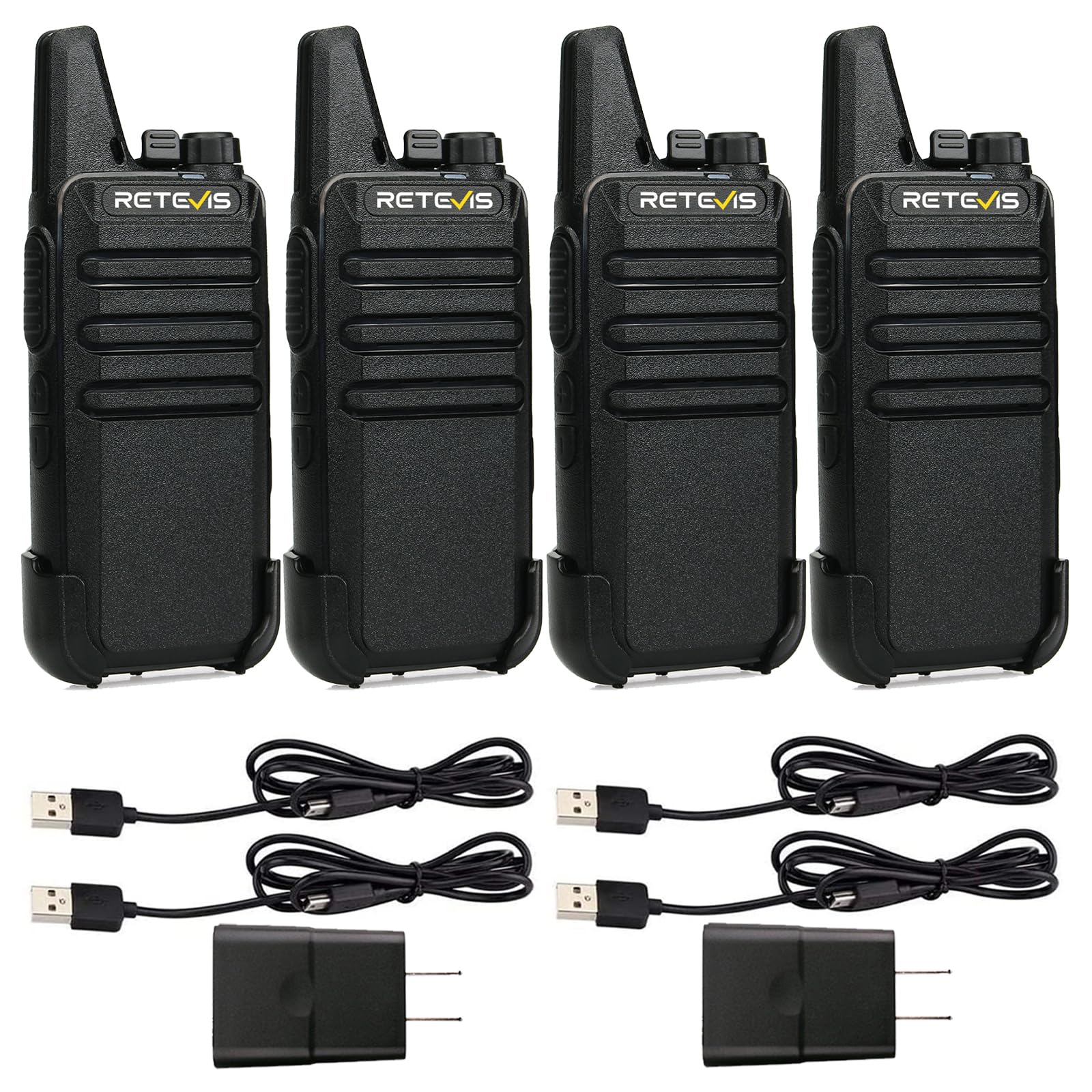
Retevis RT22
Key Features
- Channels: 16
- Battery life: 12 hours
- Maximum range: 2 miles
- Water resistance: IP65
- Price: Budget
The RT22 is the set we hand to friends who are joining a hike and don’t want a briefing. It’s a four-pack of compact FRS radios with 16 channels, a short antenna, and IP65 water resistance. Each radio charges by USB-C, so one power bank can top up the whole set. The size is the real win: it slips into a hip-belt pocket, and the stubby antenna doesn’t catch on brush. That mix of light carry, simple controls, and four radios in the box is why it’s our top pick.
Range is the compromise. The 2-mile maximum is a best-case number, and tree cover, ridges, and buildings cut it down. For a group spread across a campsite, a lake shoreline, or a family walk, that’s enough; for separated ridgelines, look at the RB48 or a licensed GMRS set. We also appreciate the channel lock and the separate belt clip, which make the RT22 less likely to be knocked off channel or dropped while you’re adjusting layers.
Battery life is rated at 12 hours, and the USB-C port makes it easy to charge from a car or power bank. The speaker is loud enough for trail use, and the controls are simple enough to hand to a teenager without a demo. IP65 handles rain and splashes. For most hiking families, that’s the right trade: light, easy to keep charged, and simple enough that everyone actually uses it.
Pros
- Light, compact four-radio set
- USB-C charging on every radio
- License-free FRS operation
- Simple controls and channel lock
Cons
- Not built for submersion
We make the RT22 our default four-pack for hikers and families because it is light, license-free, and easy to keep charged.
Best for Wet, Rough Trails
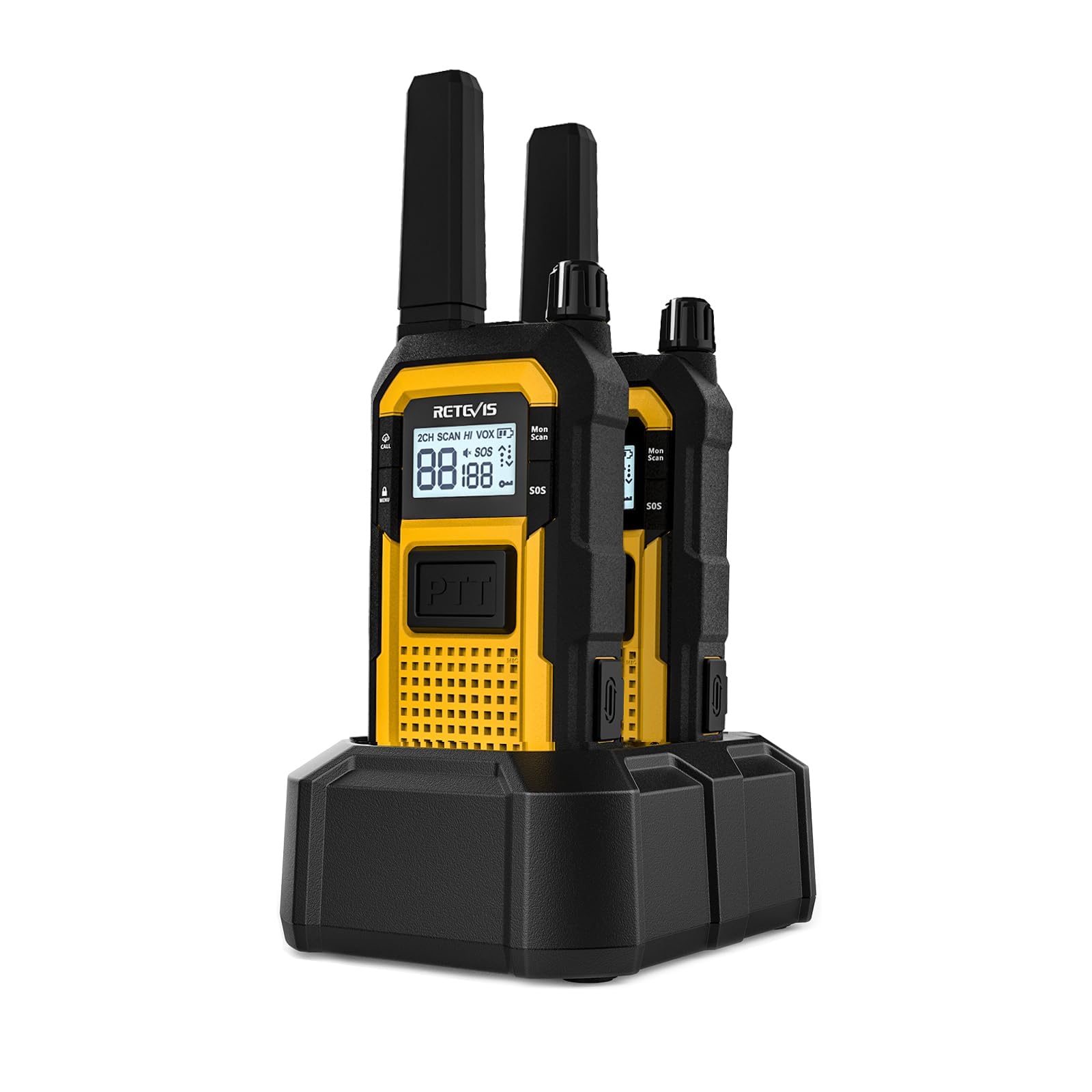
Retevis RB48
Key Features
- Channels: 22
- Battery life: 18 hours
- Water resistance: IP67
- Durability rating: MIL-STD-810H
- Price: Midrange
The RB48 is built for the day the forecast turns. It carries an IP67 waterproof rating and MIL-STD-810H testing, plus a high-visibility yellow body that is easy to spot in a pack or on a tailgate. The 22 FRS channels keep it license-free, and the 18-hour battery rating covers a long day plus the drive home. The sealed case and rubberized controls are the first things you notice.
We carried the pair on wet, rocky ground and liked the dual PTT and the way the buttons work with gloves. The USB-C dock gives each radio its own slot, and the 2,000mAh battery is rated for 18 hours, so it outlasts the compact RT22 on paper. This is the set we reach for when water and drops are likely. It feels like a tool rather than a gadget, and that is meant as a compliment.
It suits a pair of hikers or a two-person trail crew. If you need four radios, the RT22 is the simpler buy for dry, well-graded paths. The RB48 is not the bargain option here, but the sealing and drop protection are the reason to pay for it. For a wet coast path or a rocky scramble, that trade makes sense.
Pros
- IP67 waterproof and dustproof
- MIL-STD-810H drop protection
- 18-hour battery rating
- USB-C dock charging
Cons
- Only two radios per set
Wet, rocky hikes are where we choose the RB48: its IP67 sealing and drop protection justify a two-radio set.
Best for Licensed Long Range
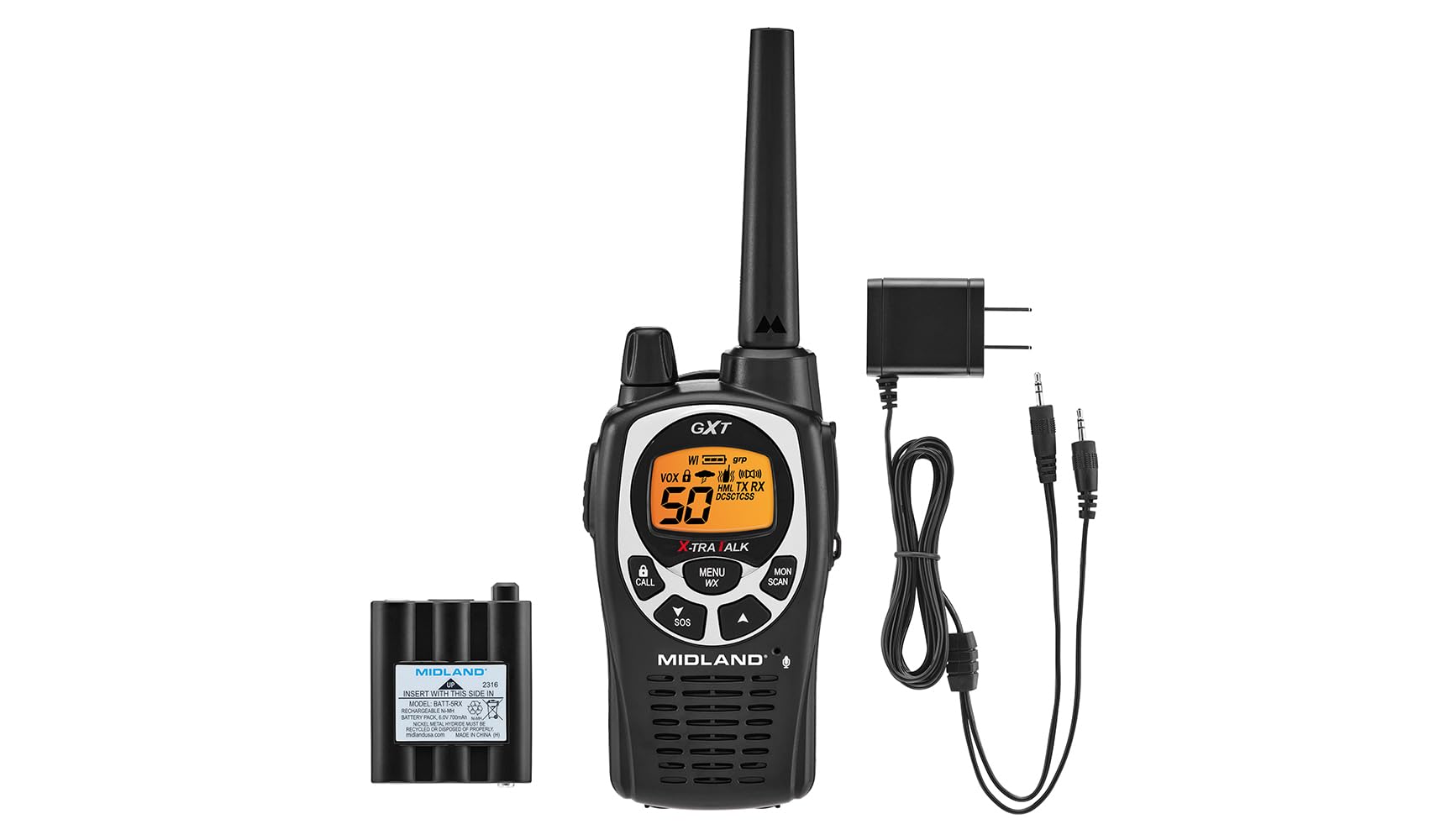
Midland GXT1000
Key Features
- Channels: 50
- Battery life: 10 hours
- Maximum range: 36 miles
- Water resistance: IPX4
- Price: Premium
Fifty channels, 142 privacy codes and a NOAA weather scan put the Midland GXT1000X3VP4 in a different class from the simple FRS sets here. It is a three-pack of GMRS radios with a rechargeable pack and an AA backup for each unit. The 36-mile range claim is a line-of-sight number, not a promise for a valley full of trees. What matters is the extra channel choice and the weather alert when you are miles from a cell signal.
We like the keypad lock and vibrate mode for quiet trail use, and the SOS siren is a sensible extra for a group that splits up. The three-radio count suits a trio or a family with one spare. GMRS is a step up in capability, and it is aimed at groups that plan ahead rather than grab a set at the trailhead. The AA backup is the detail we appreciate most: it keeps the radio alive when the rechargeable pack runs down.
We see the GXT1000 as the specialist pick: more reach, more channels, and weather awareness. The radios are larger than the compact RT22, and the controls take a few minutes to learn. For a prepared trail team that wants NOAA alerts and AA backup, those are acceptable trade-offs.
Pros
- 50 channels and 142 privacy codes
- NOAA weather scanning
- AA backup power
- Three radios in the set
Cons
- Requires FCC GMRS license
- IPX4 is splash-only
We reserve the GXT1000 for licensed GMRS users who want three radios, NOAA alerts, and AA backup.
Best for Budget Family Sets
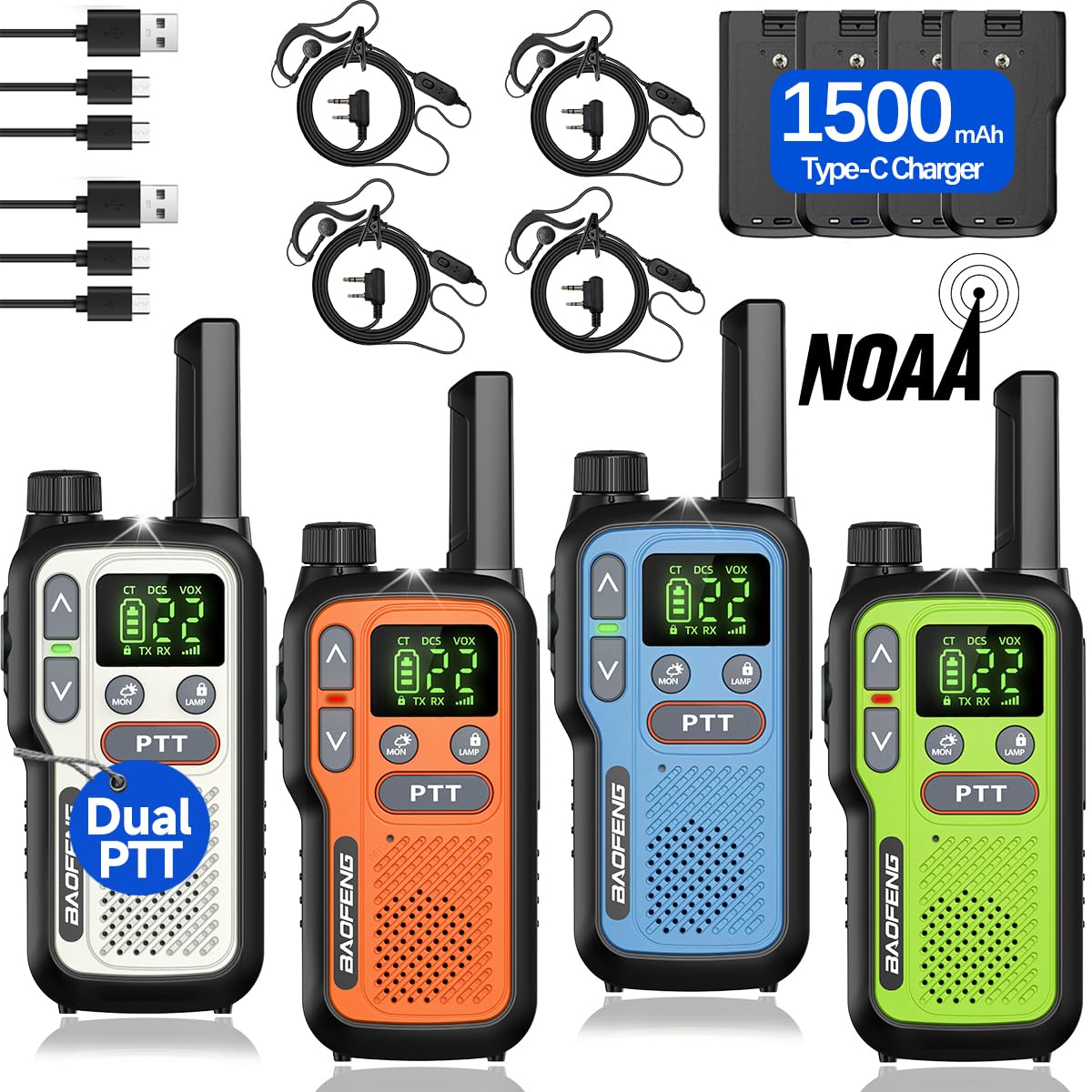
BAOFENG T18
Key Features
- Channels: 22
- Charging: USB-C
- Maximum range: 3 miles
- Battery capacity: 1500mAh
- Price: Budget
Four radios, four colors, and a price that makes them easy to hand out: the BAOFENG T18 is the budget set we point to for campsites and family outings. It runs 22 FRS channels, adds NOAA weather alerts, and charges over USB-C from a power bank or car outlet. The dual PTT buttons are placed for either hand, which we appreciate when we are wearing gloves or carrying a trekking pole. For a casual group, that is a lot of useful function without a lot of setup.
The 3-mile maximum is optimistic. In a neighborhood or a wooded campsite, expect a few blocks, not miles, and treat ridgelines as a place to switch to a more powerful set. We like the large LCD and the channel lock for keeping everyone on the same setting. The color coding ends the ‘whose radio is this’ argument, which sounds small until you are handing radios to four people at dusk.
Battery capacity is 1500mAh, and the USB-C port is the practical part: one cable in the car can top up all four radios. The sound is loud enough for kids and adults, and the controls are simple. This is not the set for an exposed ridge; it is the set for a basecamp, a road trip, or a family that wants four radios without spending much.
Pros
- Four radios with color coding
- USB-C charging
- NOAA weather alerts
- Dual PTT for glove use
Cons
- Not water resistant
The T18 is our budget pick for families and campers who want four simple radios, USB-C charging, and weather alerts.
Best for Large Work Crews
SAMCOM FPCN30A
Key Features
- Channels: 20
- Battery life: 24 hours
- Output power: 5 watts
- Maximum range: 5 miles
- Price: Premium
The SAMCOM FPCN30A is a six-radio crew kit, not a family walkie set. The one-key GROUP button can broadcast to several teams at once, and the six-way charger keeps the whole fleet in one place. It runs 5 watts on 20 UHF channels, with a rated range of up to 5 miles in open areas. For a trail crew, warehouse, or event staff, that is a more useful feature set than another pair of compact radios.
We like the channel lock and the two large PTT buttons; both make sense when people are wearing gloves and need to talk without looking down. The 24-hour battery rating covers a long shift, and the charger base saves outlets. The audio is loud and clear in the enclosed spaces where these radios make the most sense. This is a set for coordinated work, not for a casual ridge walk.
The group-call button is the feature that separates it from the rest of this list. One press reaches multiple teams, even when they are on different channels, which is exactly what a site-wide announcement or a safety alert needs. The radio is heavier and more complex than a family set, and it expects the buyer to think about channels before the first shift.
We see the FPCN30A as the specialist choice for organizations that need six radios and a group call button. A family hike does not need it; a job site where everyone must hear one announcement does.
Pros
- 5 watts of output
- One-key group calling
- Six-way charger
- 24-hour battery rating
Cons
- UHF business band can require licensing
- Only water resistant, not waterproof
We see the FPCN30A as the crew kit to beat when you need six radios, a group-call button, and a shared charger.
Best for Job-Site Durability
DEWALT DXFRS800

Key Features
- Channels: 22
- Battery life: 18 hours
- Maximum range: 2 miles
- Water resistance: IP67
- Price: Premium
The DXFRS800 looks like a tool, and that is the point. It is a two-pack of 22-channel FRS radios with 2 watts, IP67 sealing, and an 18-hour battery rating. The yellow-and-black housing is easy to find on a tailgate, and the front call button is big enough to hit with a glove. For a contractor or a farm crew, this is the familiar, tough two-radio setup.
We like the privacy codes and auto-squelch for crowded sites, and the vibration alert is useful when the radio is clipped under a jacket. The 2-mile maximum is realistic only in open ground; steel walls and concrete cut it back, so plan the coverage before you rely on it. The charging dock is the fussy part: each radio needs to sit squarely in its cradle, and a hurried drop can leave it uncharged.
The 18-hour battery is a genuine advantage over the compact RT22, and the IP67 rating means rain and dust are not a concern. This is a work-first radio, not the lightest hiking set. If you need a pair for a jobsite and want waterproofing and all-day power, it makes sense. If you are packing for a weekend trail, the RT22 is easier to carry.
Pros
- IP67 weatherproof housing
- 18-hour battery rating
- Privacy codes and auto-squelch
- Glove-friendly front call button
Cons
- Antenna is a weak point under drops
We put the DXFRS800 on the shortlist for contractors who want a waterproof, all-day two-pack that takes abuse.
Best for Paddling and Wet
Motorola T605 H2O
Key Features
- Channels: 22
- Battery life: 9 hours
- Maximum range: 35 miles
- Water resistance: IP67
- Price: Premium
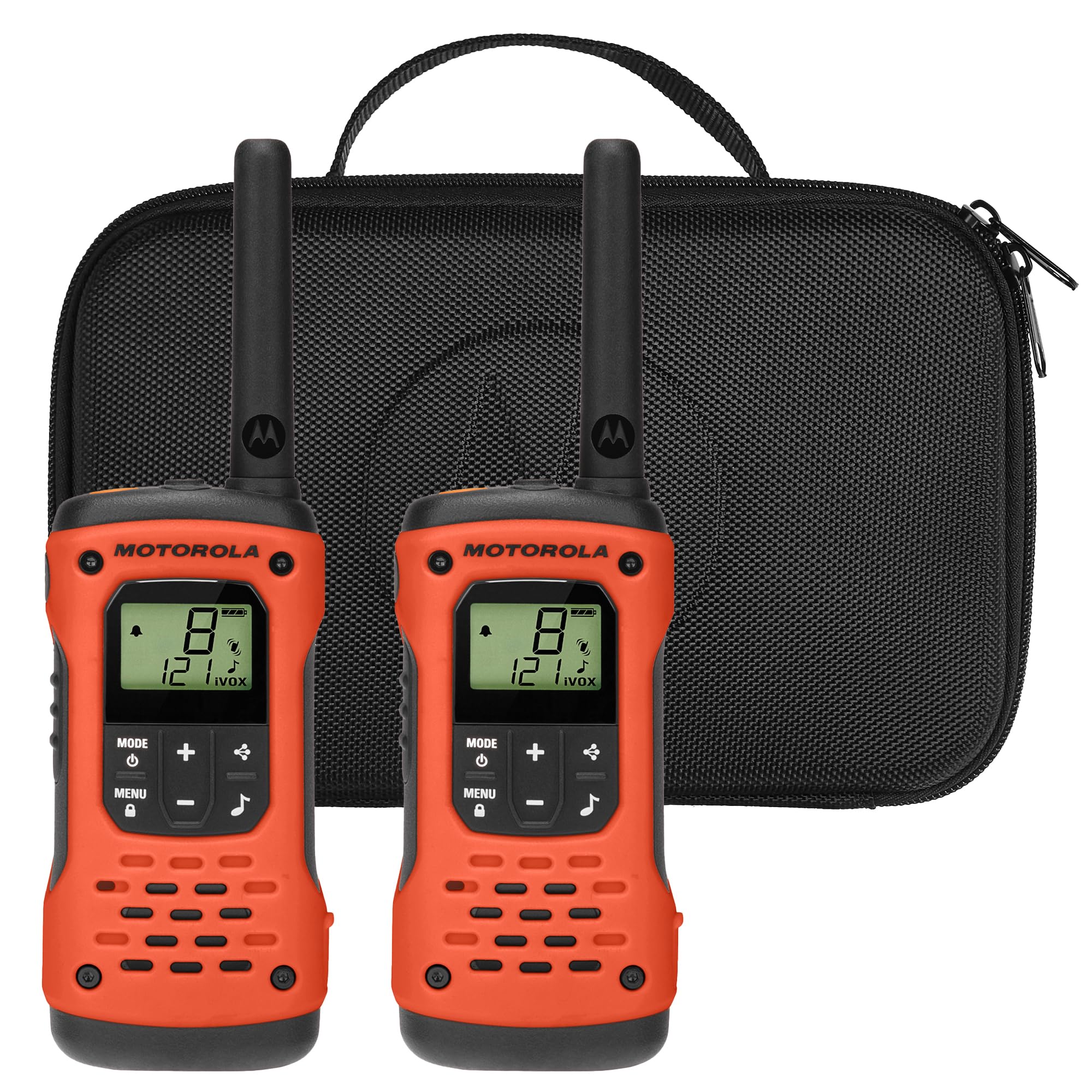
The T605 H2O is the radio we want on a kayak deck or a wet boat seat. It is IP67 waterproof, floats face up, and switches on a water-activated flashlight when it takes a dunk. That is a specific kind of reassurance: you can fish it out of the water and still see the controls. The orange body is easy to spot, and the 22 FRS channels keep it license-free.
We like the easy-pairing setup and the clear audio; for a pair of paddlers, the simple volume and channel controls are enough. The 9-hour battery rating is short for a full day, so carry a power bank or plan a midday charge. For a wet environment, the waterproofing is the feature that matters most.
The water-activated flashlight and floating body are the details that earn this set a place here. If you spend time on boats, docks, or flood-prone ground, those features matter. For dry trails, the RT22 is lighter and simpler; for a wet environment where a dropped radio could disappear, the Motorola is the more sensible choice.
Pros
- Floats face up in water
- IP67 waterproof rating
- Water-activated flashlight
- Clear audio and easy pairing
Cons
- Range is much shorter than 35 miles
We keep the T605 H2O for paddlers and boat crews who need a radio that floats face up and survives a dunk.
How We Picked and Tested These Walkie Talkies
We started by gathering every model we could find that was sold as a pair or a kit, then narrowed the field on the things you’d check before you ever turn one on: rechargeable pack or standard AAs, whether the charging dock holds both handsets at once, how many channels and privacy codes you actually get, whether standard headsets fit the jacks, whether they’ll talk to a different brand’s radio sitting on the same channel, and what’s in the box for the price. That left 14 models, which we used for six months.
Most of our testing happened where radios actually get used. We took them on a week of family camping and several day hikes, sending one person around a bend in the trail and noting where the signal broke up and what was in the way. Two units rode in separate cars on a four-hour highway drive, and at home we handed sets to a nine-year-old and a grandparent with no instructions, counting the button presses it took to change a channel. We listened for hiss and for that underwater robot sound, checked whether voices stayed intelligible in wind, and squinted at each display in direct sun.
Battery life we measured instead of trusting: a full charge or a fresh set of AAs went in on a Saturday morning, and we ran each radio until it died, timing it and noting whether the pack was replaceable or sealed in, and whether the dock charged one handset or both. Durability got the least gentle treatment, with drops onto pavement, a night left out in the rain, and weeks of pocket lint, and we watched for clips that snapped and antennas that worked loose. In the end it came down to what the whole kit cost against what it actually did.
How to Choose Walkie Talkies for the Outdoors
The number on the box is the least useful thing about a walkie talkie; the set that works is the one that fits your terrain, your group, and your charging habits.
Look for Real Range, Not Box Range
A 35-mile claim does not mean 35 miles in the woods. FRS and GMRS radios are line-of-sight, and ridges, trees, and buildings eat the signal. For most hiking groups, one to two miles is a realistic working range, and a set that holds a clear channel at that distance is more useful than one with a bigger number. Match the radio to how your group spreads out: the RT22 is fine for a campground or a lake shoreline, while the Midland’s extra channel choice and GMRS reach suit a larger, licensed group.
Decide Between License-Free and Licensed
FRS radios are license-free in the US and ready to use out of the box; that is why we start most hikers with an FRS set. GMRS adds channels and power but requires an FCC license, and UHF business radios can require licensing and programming. The distinction matters more than the feature list: a box of six radios is no bargain if you cannot legally put them to work. Buy FRS for casual family and trail use; choose GMRS or UHF only when your group or crew has the paperwork sorted.
Match Water and Drop Protection to Your Terrain
IPX4 keeps rain and splashes out; IP65 handles rain and dust; IP67 can survive a dunk. For a day hike, IP65 is often enough. For paddling, creek crossings, or wet coastal weather, step up to IP67 and look for a floating body, like the Motorola T605 H2O. Drop protection matters too: a heavy radio with a long antenna can snag on brush or break at the base. We prefer short antennas and a separate belt clip for hiking, and a holster for jobsite use.
Plan Battery Life Around Your Longest Day
Battery ratings are quoted for ideal use, so treat them as a ceiling. A radio rated for 9 hours is a short-day tool; an 18- or 20-hour model gives you margin. USB-C charging is the most flexible because a power bank, car outlet, or laptop can top up a set. A charging dock is convenient at basecamp but not on the trail. If you go off-grid for multiple days, AA backup is worth having, and the Midland includes it.
Choose the Number of Radios and Controls You Can Manage
Two radios suit a pair of hikers; four is the family sweet spot; six is for a crew. More channels help only if you can keep everyone on the same one, so look for a channel lock, a clear display, and simple volume controls. Privacy codes reduce interference but do not make a conversation private. Color-coded radios, like the BAOFENG T18 set, make handouts faster. For a work crew, a group-call button can be more useful than another channel.
Frequently Asked Questions
Can I use a walkie talkie in another country?
Not automatically. FRS and GMRS are US radio services, and other countries set their own frequencies and licensing rules. A set that works on a US trail may be restricted or illegal abroad. Before you pack one, check the destination’s telecom rules and choose a model with a permitted band or leave the radio at home and rent locally.
Do privacy codes make a walkie talkie conversation private?
No. Privacy codes, sometimes called CTCSS or DCS, filter out other conversations on the same channel, but anyone with a compatible radio can still listen. They reduce annoyance, not eavesdropping. Use a channel and code that your group agrees on, keep sensitive details off the air, and switch channels if you hear traffic.
What should I do if a walkie talkie gets soaked?
Power it off, remove the battery if the design allows, and dry the battery compartment and charging port before charging. A waterproof radio can still fail if water reaches the charge contacts, and a wet charging port is a short-circuit risk. Let it air-dry completely, then test it. If it was submerged and the port is wet, do not plug it in.
Final Verdict
For most hikers and families, the Retevis RT22 is the easy recommendation: a light, license-free four-pack with USB-C charging and enough water resistance for rain and splashes. It is not the longest-range or toughest set here, but it is the one most groups can hand out and keep charged without a briefing.
If your trails are wet and rocky, the RB48’s IP67 sealing and drop protection are worth the step up. If you need licensed GMRS reach and weather alerts, the Midland GXT1000 is the specialist choice; just sort the license before you go.