This post contains affiliate links. We may earn a small commission when you buy through our links — at no extra cost to you.
A walkie talkie should be the simple thing you grab when the trail splits or someone wanders off for firewood, but the distance on the box rarely survives contact with a pine ridge. What matters at camp is less flashy: clear voices through wind and trees, a battery that lasts a weekend, and controls you can work with cold fingers. That is what keeps your group in contact when cell service disappears.
Over the past six months, my team and I have taken 14 walkie talkies on camping trips, clipping them to pack straps and leaving them out in damp morning air. The ones that earned a permanent spot paired quickly with other units, survived a weekend of constant check-ins, and still sounded intelligible when someone whispered from across the loop. A good radio is not the one with the biggest range number; it is the one you don’t think twice about grabbing.


Best for Family Camping Trips
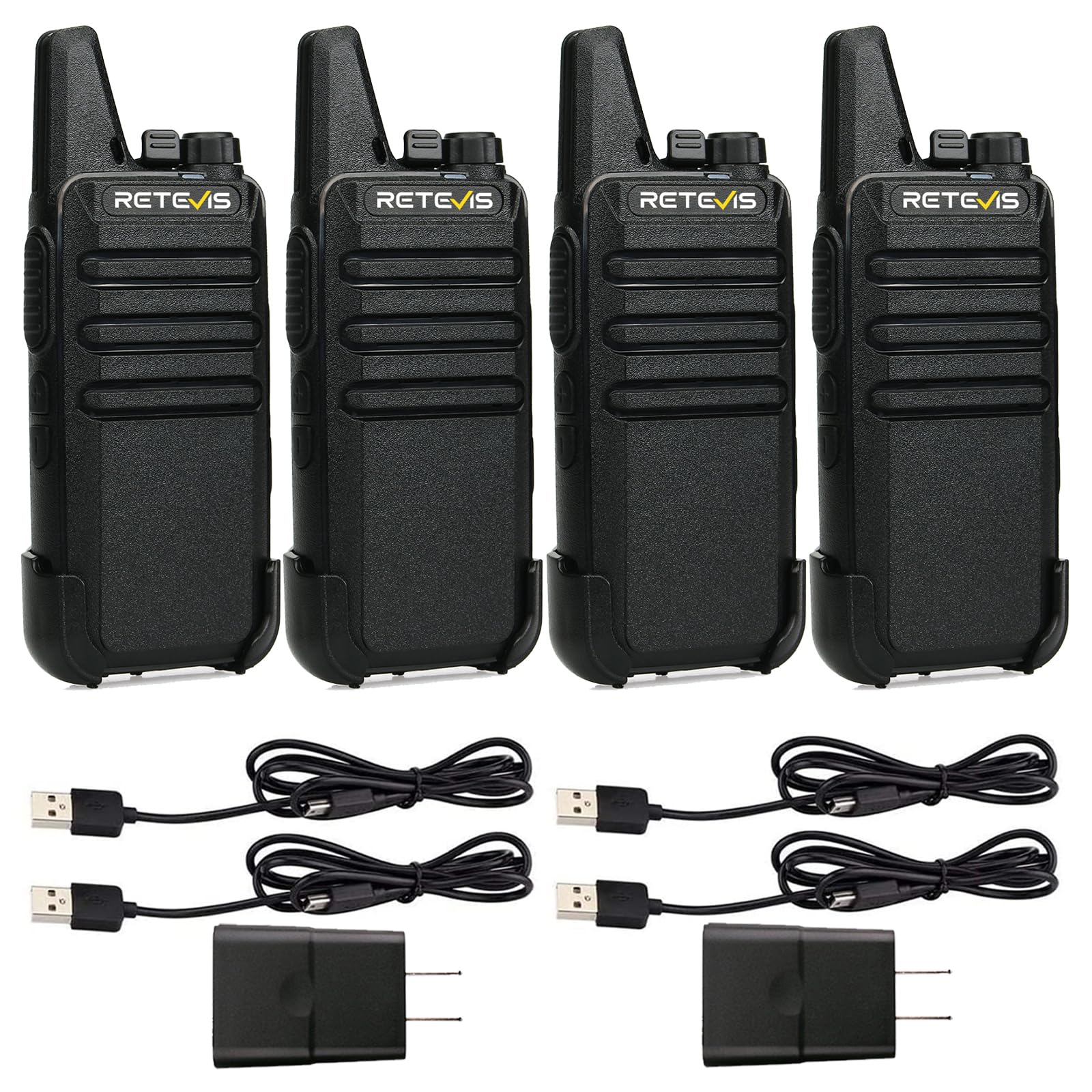
Retevis RT22 4-Pack
Key Features
- Battery: USB-C, 12 hours rated
- Channels: 16 FRS
- Talking range: Up to 2 miles
- Water resistance: IP65
- Price: Midrange
A thumb-length antenna is the first thing we noticed, and it is the reason we reach for this set first. Long whips snag on straps and snap at the base; the RT22’s stub has nothing to catch. Each radio is 0.83 by 2.2 by 5.35 inches, the four-pack weighs 1.6 pounds, and the IP65 shell means a wet evening doesn’t end the trip. The belt clip is a separate piece, so you can leave the clip on your waist and pull the radio off to talk.
The controls finish the argument: one knob for the channel, one for volume, a keypad lock, and nothing else to misconfigure in the dark. Nobody in our group needed a briefing, and that matters more on a camping trip than any feature list. The 300 mW speaker carries across a site, and the FRS channels stay clear at the distances a campground actually covers.
Charging is USB-C, one cable per radio, with two dual-port adapters in the box, so a single power bank and a four-way hub covers the whole set overnight. Retevis rates the battery at 12 hours, which is a full day of on-and-off use with plenty in reserve.
The trade-off is the weather band: there isn’t one, so if you camp where afternoon storms build fast, the MaxTalker pair is the better call. Range deserves the same honesty — two miles is an open-ground ceiling and a ridge drops it to a fraction of that, which is why we set a check-in time rather than trusting the number. Retevis ships these on its own channel list and names only other Retevis handhelds as compatible, so if half your group brings another brand, pair them at home first.
Pros
- Stub antenna won’t snap in a pack
- IP65 rated for rain and dust
- One-knob operation needs no explaining
- USB-C charging for all four radios
Cons
- No weather band or NOAA alerts
If you want one set that handles a season of camping without fuss, we point you to the RT22: four rain-rated radios anyone can pick up and use.
Best for Storm-Prone Campsites
MaxTalker MT10 2-Pack
Key Features
- Battery: 1200mAh, USB-C
- Weather: NOAA scan
- Channels: 22 FRS, 99 privacy codes
- Talking range: Up to 5 km
- Price: Budget
Weather alerts are the feature that makes a walkie talkie worth carrying in storm country, and the MT10 has them: it scans the NOAA channels for your area and sounds an alarm when the service issues a warning. Add 22 FRS channels, 99 privacy codes, a working flashlight, and an LCD you can read at night, and the practical side of a camping trip is covered.
We think this is the pair to buy if the forecast where you camp changes by the hour. The 1200mAh battery is built in and charges over USB-C with a cable for each radio, VOX frees your hands while you’re pitching a tent, and the sealed pack keeps the body small enough to clip to a shoulder strap. The five-kilometer range figure is an open-ground number like everything else here, so expect a fraction of it once trees get involved.
Charging is where these can stumble: if a unit refuses to take a charge, sort it out inside the return window rather than at the trailhead. Otherwise there’s little to fuss over — the clips hold, the menu is short enough to learn in a minute, and the flashlight is bright enough for the walk to the washroom.
Pros
- NOAA weather scan and alert
- 22 FRS channels with 99 privacy codes
- USB-C charging with a cable per radio
- Light enough to clip to a pack strap
Cons
- Not rated for rain
- Sealed battery, no AA fallback
Our pick when storms are part of the itinerary: NOAA alerts, 22 FRS channels, and a light pair that is easy to hand around.
Best for Wet, Rough Days
pxton PX-888S 2-Pack
Less money than our top pick buys a pair of radios with an IP54 rating, a drop-proof shell, and an earpiece for each handset, and that trade deserves a closer look than it usually gets. These are the radios to reach for when the trip involves rain, mud, or a canoe rather than a picnic table.
The PX-888S keeps things simple: 16 preset channels on a rotary knob, VOX for hands-free talk, and a battery rated at 8 to 12 hours of continuous use with a long standby figure behind it. The earpieces matter more than they sound — in wind or at a crowded site, an earpiece is what makes a message intelligible, and two come in the box with belt clips, a charger, and a hand strap.
We like these best for wet, close-quarters work: two people lashing a tarp in the rain, a paddler and a shuttle driver, anyone who needs a hand free. Charging runs through the included dock rather than USB-C, so bring an inverter if the car is your only outlet, and treat the battery packs as the wear item — the pair keeps going on the second pack when the first gives up. The earpieces are what make them feel like work radios rather than toys.
Pros
- IP54 shell handles rain and mud
- Earpieces and clips included for both
- 8 to 12 hours of continuous use
- 16 channels on a simple rotary knob
Cons
- Only 16 preset channels, not the FRS 22
Wet, muddy, hands-full trips are where this pair earns its place: rain-rated shells, earpieces in the box, and clear close-range audio.
Best for Group Camps
MaxTalker MT10 6-Pack
Key Features
- Battery: 1200mAh, USB-C
- Weather: NOAA alerts
- Channels: 22 FRS, 121 sub-channels
- Talking range: Up to 5 miles
- Price: Premium
Six radios answers a specific problem: a camp with more people than pairs. Two families, a scout group, or a site with a kitchen crew and a firewood crew can all run on one plan, and the 121 sub-channels give each conversation somewhere to sit so nobody is talking over anybody. The rest is the same MT10 hardware as the two-pack — 22 FRS channels, NOAA weather alerts, a 1200mAh battery in each radio, USB-C charging, VOX, and a flashlight.
If your group is big enough to need six, buying them in one box is the sane way to do it: everyone gets the same radio, the same channel plan, and the same charger, which is half of where group communication goes wrong anyway. We keep the six cables in one pouch for exactly that reason — a missing one turns a full set into five radios on day two.
Pros
- Six radios keep a whole camp on one plan
- 22 FRS channels plus 121 sub-channels
- NOAA alerts on every handset
- USB-C charging on each radio
Cons
- Not rated for rain
- Sealed battery, no AA fallback
For a camp that splits into crews, this is the set we recommend: the same weather-ready MT10, just enough of them to go around.
Best for Budget Family Set
BAOFENG T18 4-Pack
Key Features
- PTT: Side and front buttons
- Battery: 1500mAh, USB-C
- Weather: NOAA alerts
- Channels: 22 FRS
- Price: Midrange
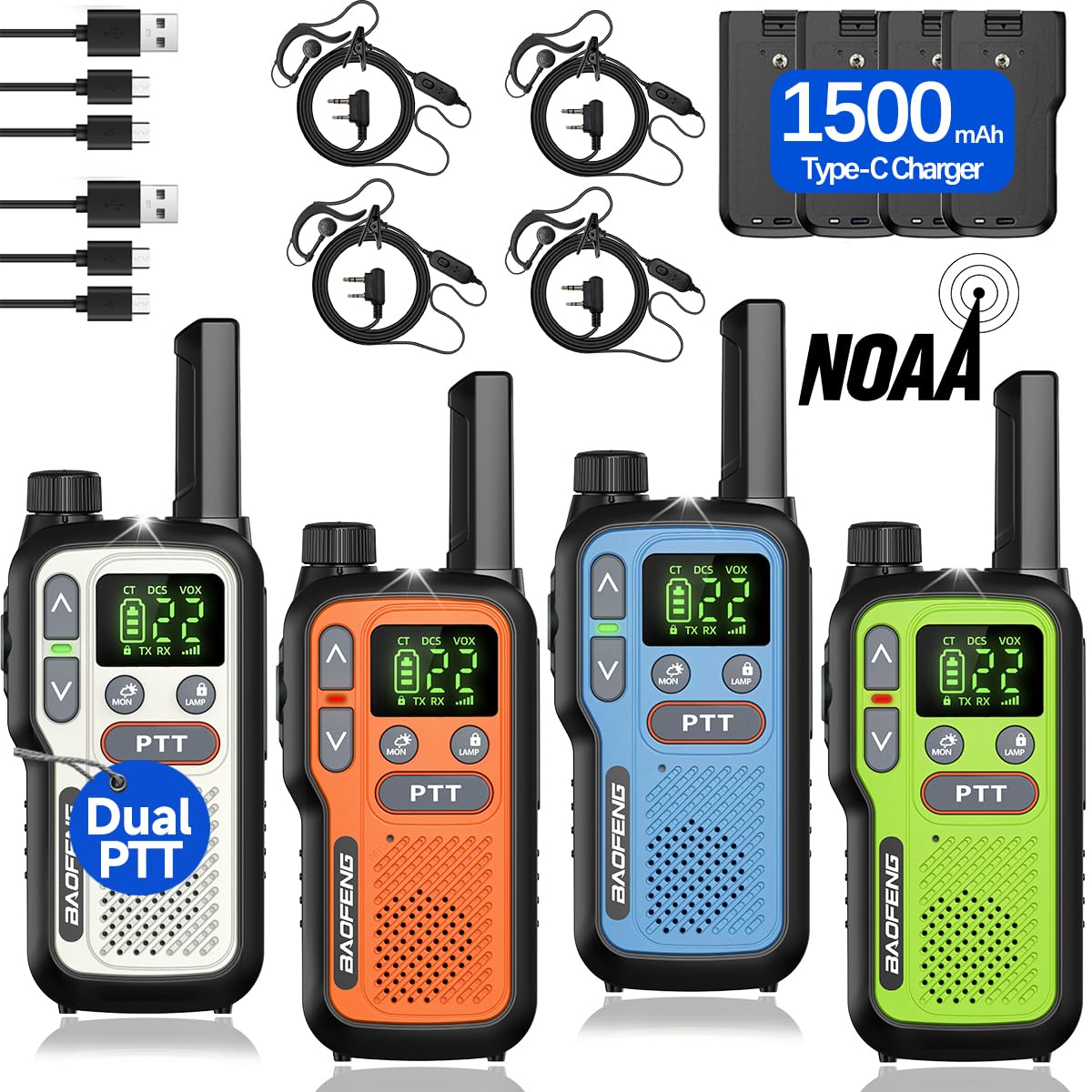
Two push-to-talk buttons — one on the side, one on the front — look like a gimmick until you’re wearing gloves in the cold or holding a mug in the other hand. The T18 puts a button where your thumb already is. It also carries 22 FRS channels, NOAA weather alerts, a flashlight, and an LCD that stays readable at night, in a body small enough for a kid’s jacket pocket.
The 1500mAh battery charges over USB-C, and each of the four radios comes with an earpiece, so a family of four gets a complete kit out of one box. Audio is loud rather than refined — fine for "where are you" and less so for a long conversation. Learn the keypad lock on day one, because the front button is easy to bump inside a pack.
Our take: this is the four-pack for a family that wants weather alerts and gloved-hand controls without overthinking the purchase. The four earpieces and the dual buttons are what push it ahead of the other budget sets here.
Pros
- Second PTT button works through gloves
- NOAA alerts on all four radios
- 1500mAh battery over USB-C
- Earpieces included for each radio
Cons
- No water-resistance rating
- No stated manufacturer warranty
A budget four-pack that gets the camping basics right: NOAA alerts, two PTT buttons, earpieces, and enough radios for a family of four.
Best for Spare-Battery Trips
BAOFENG MP25 2-Pack

Key Features
- Battery: 1500mAh, up to 18 hours
- Weather: 12 NOAA channels
- Channels: 22 FRS, 155 privacy codes
- Backup power: 3 AA cells
- Price: Budget
Three AA cells is the detail that matters on day three, when the lithium pack is flat and the nearest outlet is back at the trailhead. The MP25 runs up to 18 hours on its 1500mAh battery and takes NiMH or alkaline AA cells as a fallback, which is the feature we care about most on a trip measured in days. It also carries 22 FRS channels, 12 NOAA weather channels, 155 privacy codes, dual watch, and a channel monitor, and it ships as a two-pack with a one-year warranty. If you want a weather-equipped pair with a plan B for power, this is the one we point to.
There are things we haven’t lived with long enough to judge — this is a newer model with less of a track record than the Retevis set. The listed five-kilometer maximum is an open-ground figure, so treat it as a camping-trip range rather than a ridge-to-ridge one and plan your check-ins accordingly.
Pros
- AA cells as backup power
- 22 FRS channels with 155 privacy codes
- 12 NOAA weather channels
- Up to 18 hours on the 1500mAh pack
Cons
- No water-resistance rating
A weather-equipped FRS pair with an AA lifeline — our choice for multi-day trips where charging is uncertain.
Best for Alkaline Backup
Midland LXT600VP3

Key Features
- Power: Rechargeable pack or AAA
- Weather: NOAA scan and alert
- Battery life: 6 hours rated
- Privacy codes: 121
- Price: Premium
Thirty miles is the number on the box, and it is the one figure here we ignore. That is a line-of-sight number measured with nothing in the way; put a ridge, a stand of pines, or a tent wall between two radios and the usable distance shrinks to something you could almost shout across. Set expectations there and the LXT600VP3 gets much easier to like.
What it does well is weather and channel management: NOAA weather scan plus alert across the weather channels, and 121 privacy codes spread over the channel list to keep other people’s conversations out of your ear. Sound is crisp, the controls are obvious, and the whole radio is 4.8 ounces and a little over six inches tall.
The reason it stays on our list is power. It runs on the included rechargeable packs or on AAA alkalines when those run dry, and the desktop charger tops both radios at once. A pack of alkalines in the glovebox is effectively a full reset, and on a trip where you’re never far from the car that beats a bigger battery.
It is a calmer setup than chasing USB cables around a tent, and it is why this set stays on the list despite doing nothing clever. Two radios, one dock, a spare set of alkalines — some camps need exactly that and nothing more.
Pros
- NOAA weather scan and alert
- Rechargeable packs or AAA cells
- Charges both radios at once
- Light at under five ounces
Cons
- Six-hour rated runtime
- Desktop charger only, no USB-C
Our pick for a fixed camp with power nearby: NOAA alerts, rechargeable packs with an AAA fallback, and a dock that charges both at once.
How We Tested Camping Walkie Talkies
We began with a broad list of camping-oriented walkie talkies and filtered it by price, size, channel options, and whether the published battery and power specs held up to a reality check. That left 14 units from a mix of brands, which we used over six months on weekend camps and longer trips. We did not rely on a lab bench: the radios rode in car consoles, got clipped to pack straps, and sat on picnic tables while we set up camp.
On the trail, we split the group and sent one person up a ridge while another stayed back at camp, noting exactly where voices broke up among trees and whether a check-in came through clearly or arrived clipped. We logged battery life from first switch-on to the low-battery warning, including overnight standby and a full day of periodic calls. Back at camp, we handed the radios to kids and adults who had never used that model and watched whether they could find the push-to-talk button, change volume, and switch channels without being shown. We also mixed brands around the same fire to see how easily they shared a channel and whether privacy codes caused confusion.
For portability, we checked whether each radio stayed clipped to a pack strap during a scramble and whether it disappeared into a jacket pocket without snagging. We also noted build quality in the hand: whether battery covers stayed shut, clips kept their spring, and buttons still clicked after a weekend of use. Durability got its own rough handling: waist-high drops onto granite, damp grass overnight, dusty picnic tables, and a few accidental dunks in a cooler puddle. Through all of it we tracked reliability with scheduled check-ins every hour, and we judged sound quality by how much wind and background chatter swallowed a normal speaking voice.
How to Choose Camping Walkie Talkies
The radio that works on a camping trip is the one that still transmits in rain, still has a charge on day two, and doesn’t need a manual — range is the last thing to worry about.
Treat Range as a Terrain Question
UHF radios like these want something close to line of sight. Every tree, tent, vehicle, and ridge between two handsets eats signal, which is why a set claiming five miles can lose contact at a quarter of that in a wooded campground. Plan on roughly a mile as a good outcome and set a check-in time and a meeting point before anyone splits up.
If your camp spans a lake or a valley, put a radio on the highest ground you have and accept that the far shore may be out of reach. A five-mile figure on a box is measured with nothing in the way; your campsite is never that.
Weather Alert and Charging Earn Their Keep
NOAA weather scan is the feature that pays for itself. It monitors the weather channels for your area and sounds an alarm when a warning is issued, which is often more notice than a phone gets with one bar of signal. If you camp in the mountains or near water, this is worth more than another mile of claimed range.
Charging is the other decision. USB-C radios draw from the same power bank as everything else in your pack, while dock-charging sets need their cradle and an outlet. Count the cables before you leave: four radios usually means four.
Read the Water Rating, Not the Word Waterproof
An IP number tells you what a radio survives. IPX4 handles splashes, IP54 adds dust protection, and IP65 shrugs off a low-pressure jet. A listing that says water resistant with no number is telling you almost nothing, so assume the worst and pack a dry bag — that is the trap most buyers walk into.
The same logic applies to the hardware. A stub antenna can’t snap off at the base, and a detachable belt clip lets you leave the clip on your pack and pull the radio off to talk.
Match the Radio to the Hands Using It
Pack size is the first arithmetic: one radio per person who wanders off, plus a spare if the group may split. After that, look at the controls. A single channel knob and a volume wheel get used correctly by a cold, tired person at dusk; menus and multi-function keys do not.
A keypad lock matters more than it sounds, since a bumped button inside a pack can hold a channel open and flatten the battery. VOX is worth having if you’ll be talking while both hands are busy with a tent.
Lithium Packs vs an AA Fallback
Sealed lithium packs are lighter and charge over USB-C, and a 1200mAh to 1500mAh pack covers a full day of casual use. The trade-off is that a dead pack stays dead until you find power, and the packs are the part that wears out first.
Sets that accept AA or AAA cells cost a little bulk and give you a reset you can buy at any gas station. For a weekend near the car, the lithium pack wins; for a multi-day backcountry trip, the fallback battery is the feature worth choosing.
Frequently Asked Questions
Do camping walkie talkies need a license?
The 22-channel FRS radios here don’t need one in the US — FRS is the license-free family band, and it’s what most camping sets use. Check the spec list before you buy: a radio described only as 16-channel UHF is a different product, and you should confirm the rules for it before you transmit.
Why do I keep hearing other campers on my channel?
Because everyone shares the same 22 channels, and a crowded campground fills them. Privacy codes — CTCSS or DCS, sometimes sold as sub-channels — don’t scramble your voice; they simply stop your radio from opening its speaker for traffic that doesn’t carry your code.
Agree on a channel and a code before you leave, then move if a neighboring group is camped on yours.
What should I pack with a set of camping radios?
One charging cable per radio and a power bank, even for a weekend — a four-pack means four cables, and a missing one is the usual reason a radio goes out flat. Add the earpieces for windy or crowded sites, a zip-top bag for anything without an IP rating, and spare AA or AAA cells if your set takes them.
Final Verdict
The Retevis RT22 is the set we hand to a family heading out for a weekend: rain-rated, USB-C, four radios, and controls nobody has to be taught. The one thing it lacks is a weather band, so if you camp where storms build fast, the MaxTalker MT10 pair covers that ground for less.
Multi-day trips away from power move the BAOFENG MP25 to the front, thanks to its AA fallback, and wet, hands-busy work favors the pxton pair. Everything else here is a variation on those three decisions.