This post contains affiliate links. We may earn a small commission when you buy through our links — at no extra cost to you.
Trekking socks have to do two opposing jobs at once: cushion every step without turning your boots into a swamp. A pair that’s too thin leaves your soles aching on rocky descents; too thick and your feet overheat on the climb. The right pair fixes both—and quietly solves the blister, cold-toe, and soggy-sock problems that can derail a long day out.
Over the past six months, I’ve worn 14 pairs of trekking socks on day hikes, a three-day backpacking trip, and plenty of weekend walks, and my team has washed each one more times than I’d like to admit. The differences come down to fit, thickness, and how the wool or synthetic blend handles sweat and odor. A few pairs felt soft out of the box but lost their cushioning after a dozen wash cycles; others stayed warm even when damp, and the best ones earned their price by holding shape through repeated wear. I’ve sorted through the standouts below.


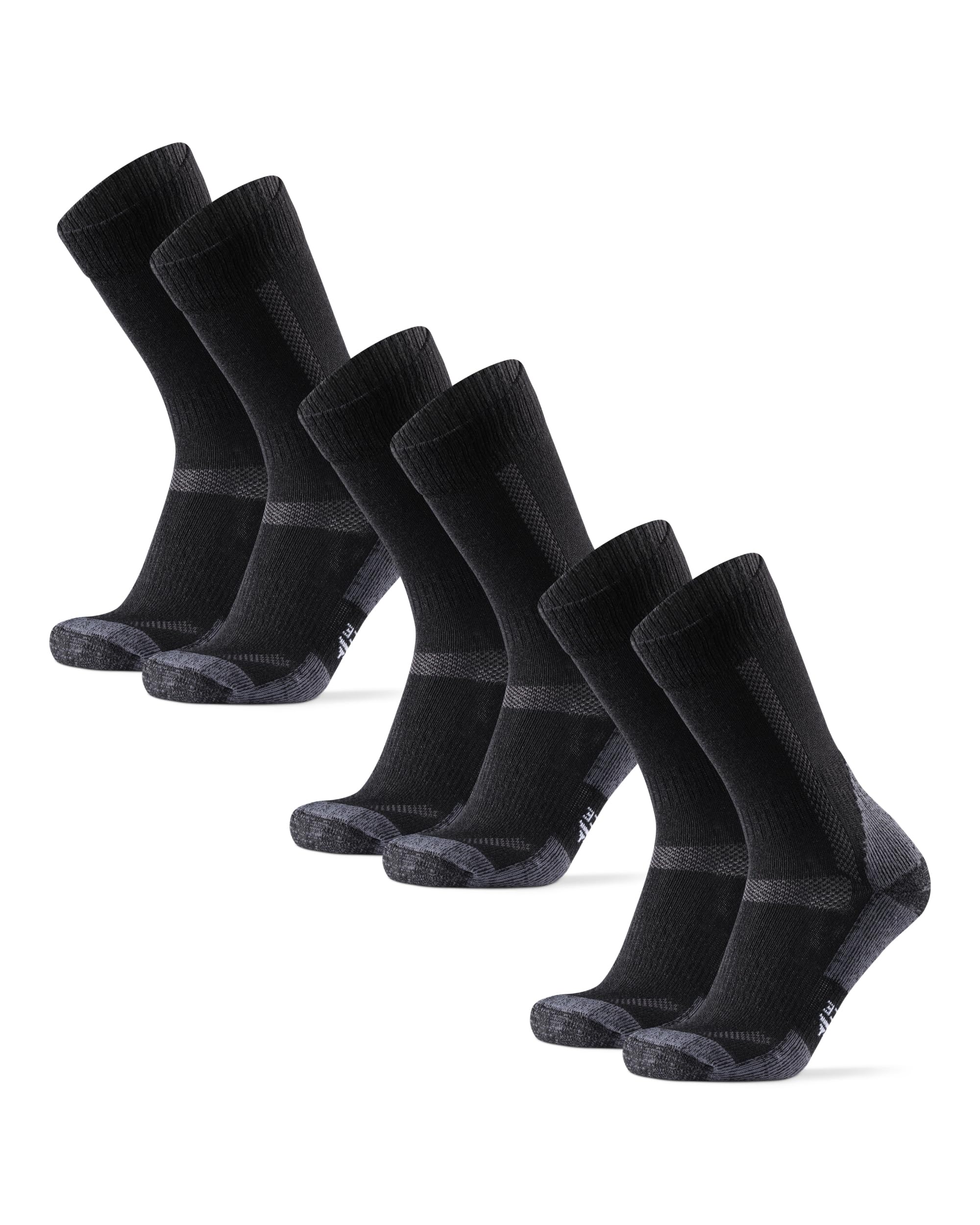
Best for Three-Season Hikes
Darn Tough Hiker Micro Crew
Key Features
- Height: Micro crew
- Weight: Midweight
- Material: Merino wool
- Guarantee: Lifetime
- Price: Premium
The lifetime guarantee is the line that sells this sock, and for once the promise matches the thing in your hand. The Hiker is Darn Tough’s midweight micro crew, which means terry cushioning under the sole and a cuff that stops just above a boot collar — enough coverage to keep a tongue off bare skin, without a tall shaft to bunch behind your calf. It’s the pair we take when a hike involves rock, a loaded pack, or weather we’re not sure about.
What we watched for on descents was whether the sock stayed where we put it, and the heel pocket does its job: the knit hugs the back of the heel and the arch band keeps the sole from rotating underfoot. Width is the thing to sort out before you order. The fit runs narrow through the arch and toe, so if your foot lands between two sizes, take the larger one — that single decision is the difference between snug and tight.
Merino does the rest. Warmth arrives when the weather turns, sweat doesn’t leave your feet clammy, and the sock doesn’t stink after a second day, which is the practical reason wool keeps winning on multi-day trips. Ours have kept their shape at the ankle rather than going slack, and the color has held through repeated washing.
If you want a sock that makes a roomy winter boot feel snugger, this isn’t it — the padding is midweight, not expedition weight. For three-season hiking in boots that fit properly, it’s the pair we buy again without thinking about it, and the guarantee is why we stopped saving them for best.
Pros
- Stays put inside boots on descents
- Lifetime guarantee backs the heel and toe
- Warm without turning clammy
- Holds shape and color over time
Cons
- Less padding than a heavy winter sock
- Premium price for a single pair
Our top pick for most hikers: midweight merino that stays locked in a boot, a lifetime guarantee behind the heel and toe, and warmth for three seasons.
Best for Cold-Weather Hikes
Buttons & Pleats Trail Crew
Key Features
- Height: Crew
- Material: Merino wool
- Cushioning: Plush, thick
- Price: Midrange
The inside of the Buttons & Pleats is what you notice first: a brushed, almost fleecy lining and a loft closer to a winter hat than a hiking sock. Pull one on at a cold trailhead and the difference is immediate — no shock of cold sole, no thin patch under the ball of the foot. If your feet run cold, this is the pair to start with.
Among the thicker socks here, this is the warmest that still fits inside a normal hiking boot, and it’s the one we hand to anyone who feels the chill. The warmth doesn’t come with the clammy, sweaty feel of a cheap acrylic knit, and the cuff sits gently on the calf instead of digging in. There’s more wool in this knit than in most of the blends here, which is why the softness holds up.
Where it earns its keep away from the trail: ski boots, snow shoveling, cold mornings in a tent. Ours have been through normal cool washes and come out soft rather than matted, which we can’t say for every thick wool sock we’ve owned. Just don’t ask it to double as a summer sock — this is a cold-weather tool, and it’s honest about that.
Pros
- Plush, thick loft for cold mornings
- Warm without feeling sweaty
- Softness survives washing
- Strong value for a wool-heavy sock
Cons
- Heels can wear through within a couple of months
The cold-feet pick: a thick, plush merino crew that keeps its softness through the wash and still fits inside a normal hiking boot.
Best for Women Hikers
Anlisim Merino Hiking Socks
Key Features
- Height: Crew
- Material: Merino wool
- Cushioning: Medium
- Department: Women’s
- Price: Midrange
Most women’s hiking socks are a unisex sock sized down, and it shows at the heel and the instep. The Anlisim is cut for a woman’s foot, and the difference lands in the two places that matter: a heel pocket that stays under the heel and an arch that doesn’t press across the top of the foot. The cuff holds without leaving a mark on the calf.
Warmth is the next thing you notice. These feel soft against the skin with none of the prickle people expect from wool, and they’re warm enough for a cold morning without turning into a sweatbox on the climb. The color range is the widest in this group, and the shades have held through repeated washing.
For a women’s-specific pair, this is our default recommendation: a close, stay-put fit and soft merino warmth at the low end of what the good socks here cost. The one adjustment is sizing — these run snug, so if you’re between sizes, or you wear a thin liner, go up.
Thin enough for trail shoes as well as boots, they’ve ended up in the daypack rather than the sock drawer: the pair that’s already there when the weather turns on a short trip or the forecast is wrong.
Pros
- Stays up without a tight band
- Soft merino with no itch
- Warm for its weight
- Colors hold up in the wash
Cons
- Lighter cushioning than the winter pairs here
For women, start here: a foot-shaped fit that stays up without squeezing, with soft merino warmth for three-season hiking.
Best for All-Day Wear
Time May Tell Hiking Crew
Key Features
- Height: Crew
- Cushioning: Cushioned
- Department: Men’s
- Moisture management: Wicking
- Price: Midrange
This is the pair we point to when the Darn Tough feels like more sock than the budget allows. Cushioning sits in the middle — enough under the heel and ball to take the edge off a rocky descent, not so much that a precise-fitting boot turns tight — and the cuff stays up on the shin instead of sliding into the boot. For a mid-priced crew, that combination is harder to find than it should be.
What we noticed over a few trips: the heel stays put, the toe seams sit flat, and the patterns are genuinely cheerful rather than the usual gray and charcoal. They’ve kept their shape through washing. Long-term wear is the open question — the knit still looks new on ours, but we’ve put fewer hard miles into these than into the Darn Tough, and that’s the honest comparison.
Pros
- Cushioned without crowding a boot
- Cuff stays on the shin
- Holds shape through washing
- Bright patterns that stay bright
Cons
- Moderate cushioning rather than plush
The mid-priced all-day pick: moderate cushioning that doesn’t crowd a boot, a cuff that stays on the shin, and a fit that survives washing.
Best for Warm-Weather Hikes
Danish Endurance Hiking Socks
Key Features
- For: Men and women
- Use: Hiking and thermal wear
- Material: Merino wool blend
- Price: Premium
Thin is the whole idea here. Slide a Danish Endurance sock into a precise-fitting boot and there’s no pressure across the instep, no bunching at the flex point — exactly what you want on a hot climb or in footwear that fits like a glove. Warmth is a surprise for the weight: enough to take the chill off a cool morning without turning your feet into a swamp by lunch.
This is our lightweight pick, and moisture handling is why. On a sweaty ascent our feet came out damp rather than soaked, and the sock stayed comfortable through a long day in boots. They’re the pair we pack for summer trips and travel, when a sink wash and a line overnight is the whole laundry plan.
Sizing is the thing to get right. The chart is generous and the ankle knits up close after a warm wash, so measure your foot rather than trusting your shoe size, and expect a snug fit out of the bag rather than a roomy one.
Pros
- Thin profile suits snug boots
- Wicks well on sweaty climbs
- Warm without overheating
- Comfortable year-round
Cons
- Minority-merino blend limits warmth in a cold snap
For hot climbs and snug boots, this is the one: a thin, breathable sock that handles sweat and stays comfortable for three seasons.
Best for Summer Trails
MIRMARU 5-Pair Crew

Key Features
- Care: Hand wash only
- Height: Crew
- Material: 55% combed cotton, 40% polyester, 2% spandex
- Pack size: 5 pairs
- Price: Midrange
Cotton in a hiking sock usually means someone cut a corner. Here it looks like a decision. The MIRMARU crew is a combed-cotton blend with a dense, smooth weave, and in warm, dry conditions that translates into a sock that doesn’t cook your feet the way a thick wool crew does. Under a work boot in July, it’s a real difference.
The fit is relaxed without being sloppy: the cuff stays up on the calf without pinching, there’s elastic through the midfoot to stop it shifting, and the height clears a boot without climbing toward the knee. Five pairs in a pack means one on your feet, one in the wash, and three in the drawer, which is how most people actually use hiking socks.
Our take: this is the pack for summer day hikes, travel, yard work and mild-weather boots. It is not the pack for anything wet or cold — if your trips run into rain or shoulder-season slop, put the money into wool instead.
Pros
- Five pairs in a single pack
- Cool and dry in mild weather
- Cuff stays up without pinching
- Holds up through repeated washing
Cons
- Holds moisture once feet get wet
- Hand wash only
A warm-weather five-pack: cool, smooth cotton-blend crews for dry summer trails and work boots, not for wet or cold days.
Best for Winter Warmth
MOGGEI 5-Pair Women’s Crew

Key Features
- Height: Crew
- Weight: Thick thermal
- Material: Merino wool
- Pack size: 5 pairs
- Price: Budget
Five pairs in one pack is the reason to look at these, and the reason to be a little careful. This is a lot of sock for the money, and the money is the point: what you get is a thick, soft wool-blend crew that lives happily in a boot or around the house.
Warmth is the strength. These are genuinely warm without being bulky, and the cuff is comfortable on a larger calf — a real issue with budget wool socks, which tend to grip. The softness lasts past the first wash too, which surprised us in a pack at this level.
They’re versatile in the way winter socks need to be: under leggings and boots, in bed on a cold night, in a cabin with a wood stove and no insulation. The colors are cheerful and have held up, and the knit isn’t so thick that it fights a tight shoe.
Our take: buy these for camp, the cabin, cold commutes and short winter walks. They are not the pair for a long trip — for that, pay for the Darn Tough. But as a drawer-filler for winter at a price that makes a five-pack an easy yes, they do the job.
Pros
- Five warm pairs in a single pack
- Thick and soft without binding the calf
- Warm without extra bulk
- Good value for winter wear
Cons
- Toe seams and heels can fail early
- Runs short and slides down in roomy shoes
A winter warmth bargain: five soft, thick women’s crews for camp and cold walks — don’t count on them for a long trip.
Best for Day Hikes
RUIXUE Merino Crew 3-Pack

Key Features
- Material: Merino wool
- Pack size: 3 pairs
- Cushioning: Terry cushioned
- Certification: OEKO-TEX and GRS
- Price: Budget
A seam across the toe is the kind of thing you notice at the worst possible moment, usually on a long descent when everything is already sore. This sock doesn’t have one: the toe is knit seamlessly and there’s terry cushioning under the sole. Two details that matter more on a hike than almost anything else on the label.
It’s also the only sock here with third-party certification behind it, OEKO-TEX for the textile and GRS for recycled content, which is worth something if you care where the material comes from. Warmth is solid for a midweight, and three pairs cover a long weekend without a wash.
The fit runs tight. A large foot in the biggest size will feel it, and so will a wide calf — these are not the socks for a broad leg. The blend also reads more synthetic against the skin than the wool-first socks here, a slightly slicker feel some people will like and others won’t.
Our take: a good, certified, cushioned sock at a low per-pair price, best for day hikers with average-width feet who want a spare pair in the pack. Near the top of the size range, order up.
Pros
- Seamless toe reduces rub
- Terry cushioning under the sole
- OEKO-TEX and GRS certified
- Three pairs at a low per-pair cost
Cons
- Tight on large feet and wide calves
- Blend feels more synthetic than wool-first picks
A certified, cushioned three-pack at a low per-pair price, best for day hikers with average-width feet and calves.
How We Tested Trekking Socks
Over six months, we pulled together a shortlist of 14 trekking socks from brands known for merino and synthetic blends, filtering out anything with poor sizing ranges or a price that didn’t match its materials. Each pair went into a rotation that included rocky day hikes, a three-day backpacking trip, and weekend walks around town. I wore them with the same two pairs of boots to keep the fit comparisons honest.
On the trail, I paid attention to pressure points, seam placement, and whether the sock bunched under my arch on steep descents. After each hike, I checked for dampness at the toe and heel, then washed every pair according to the care label and noted pilling, thinning, and lost elasticity. For warmth, I wore them on cold morning starts and exposed ridgelines, and I made a point of testing a few pairs after they’d gotten wet to see if they still held heat. Softness got checked both dry and damp—some wool blends felt scratchy against the ankle bone, while others stayed smooth.
Fit and thickness mattered as much as fabric. I sized each pair to the chart, then noted whether they slipped, twisted, or left marks under the boot cuff. Thickness was judged inside the same boots, not on a lab bench, so I could tell which pairs felt bulky on a fast climb and which were too thin for rocky ground. To assess value, I divided the price by the number of wears each pair survived before showing real wear—and the ones that lasted past 10 wash cycles without losing cushioning clearly earned their keep.
How to Choose Trekking Socks
The most useful thing we can tell you is that thickness, warmth and durability are three separate decisions, and the sock that’s perfect on a July ridge is the wrong one for a February start.
Cushioning Should Match Your Boot, Not the Thermometer
More padding feels better on the shelf and can be worse on the trail. A thick sock in a precise-fitting boot takes up volume, presses the foot against the shell, and gives blisters a head start. If your boots are snug, or you wear them with a thin liner, go lighter — the Danish Endurance and the MIRMARU are the low-volume options here. If there’s room to spare, a plush crew like the Buttons & Pleats fills the gap and softens rock underfoot. Test it at home: lace up with the sock on, tap the toe box, and check that your toes don’t touch the front.
Merino Is a Spectrum, Not a Guarantee
The word merino on a label tells you almost nothing about how much wool is in the sock. Wool-first knits stay warm when damp, resist odor across several days, and feel softer against skin; blends with a minority of wool lean on synthetics for durability and a thinner profile. Neither is wrong — the Danish Endurance is minority-wool and it’s among the coolest socks here — but when warmth and multi-day freshness are the point, look for wool at the front of the ingredient list. And leave cotton out of anything that might get wet; the MIRMARU’s cotton blend is lovely in July and a poor choice in a downpour.
Fit Comes Down to Height, Heel and Half a Size
Three questions decide whether a sock is still comfortable at mile ten: does the cuff sit above the boot without sliding, does the heel pocket stay under your heel, and is there room at the toe. Crew height clears most hiking boots; a micro crew like the Darn Tough sits just above the collar with less fabric to bunch. Size by foot length, not shoe size — brands size differently, and several pairs here run narrow or short. Between sizes, or planning to add a liner, take the larger sock and let a cool wash bring it in slightly.
Durability, Guarantees and What Wears Out First
Heels and toe seams go before anything else. The difference between a sock that lasts two seasons and one that lasts five is mostly knit density and how much nylon sits in those two zones, which is why an all-wool sock isn’t automatically the tougher one. A guarantee changes the arithmetic: Darn Tough backs its socks for life, and that is a large part of why we’re comfortable pointing you at a single premium pair over a cheap five-pack. Treat the heel as the wear gauge — when the knit there thins and goes shiny, the next blister is closer than you think.
Frequently Asked Questions
Do merino hiking socks itch?
Usually not. Merino fibers are far finer than the wool in an old sweater, and the socks here are blended and brushed so they sit smooth against skin. If you’re sensitive, wash them once before the first hike and wear them on a short walk before committing to a long one. A thin synthetic liner is the fallback if a seam still bothers you.
How should I wash merino hiking socks?
Cool water, mild detergent, inside out, air dry. Heat is the enemy: a warm wash and a hot dryer are what shrink a wool crew and flatten the cushioning under the sole. Read the care line before you buy, because the MIRMARU is hand-wash only, and the thicker wool pairs will drop a size if you treat them like gym socks.
Do I need a liner sock underneath?
Most hikers don’t. A cushioned merino crew worn against skin handles sweat well on its own, and a second layer adds volume inside the boot. Liners earn their place on multi-day trips if you blister between the toes — and if you add one, size the outer sock up or loosen the lacing to keep room in the toe box.
How many pairs should I take on a multi-day hike?
Two for a weekend, three for a week. Rotate them daily, rinse the worn pair at camp, and clip it to the outside of the pack to dry; wool keeps working when damp, but a dry pair in the morning is the luxury worth planning for. On long trips, thinner socks that dry faster beat thick ones that hold water.
Final Verdict
The Darn Tough Hiker is the pair we recommend to most people most of the time: midweight merino cushioning that stays where you put it, a lifetime guarantee behind the heel and toe, and enough warmth for three seasons of boots. It is the one place where paying more up front genuinely buys you fewer replacements.
If you feel the cold, the Buttons & Pleats gives you more loft for less money and asks only that you accept faster heel wear. Women shopping for a close fit should start with the Anlisim.