This post contains affiliate links. We may earn a small commission when you buy through our links — at no extra cost to you.
A steep downhill is where trekking poles earn their keep—and where a bad pair gives itself away. If a lock slips mid-step or the poles are heavy enough that you leave them strapped to your pack, they aren’t doing you any favors. The right pair takes pressure off your knees, adds stability on loose rock, and turns a long day into a more enjoyable one. For women, fit is the quiet hero: shorter grips, a strap that doesn’t dig in, and an adjustable range that actually matches your height.
I’ve been hiking with poles for years, but over the past eight months my team and I logged miles with 12 pairs on local trails—muddy climbs, rocky descents, and a few long days where the poles never left our hands. We adjusted them for different heights, collapsed and packed them, and noted which locks held tight and which shafts showed wear. A pole that feels fine in the store can rattle loose on mile six. The picks below are the ones we reached for again and again.


Best for Most Women
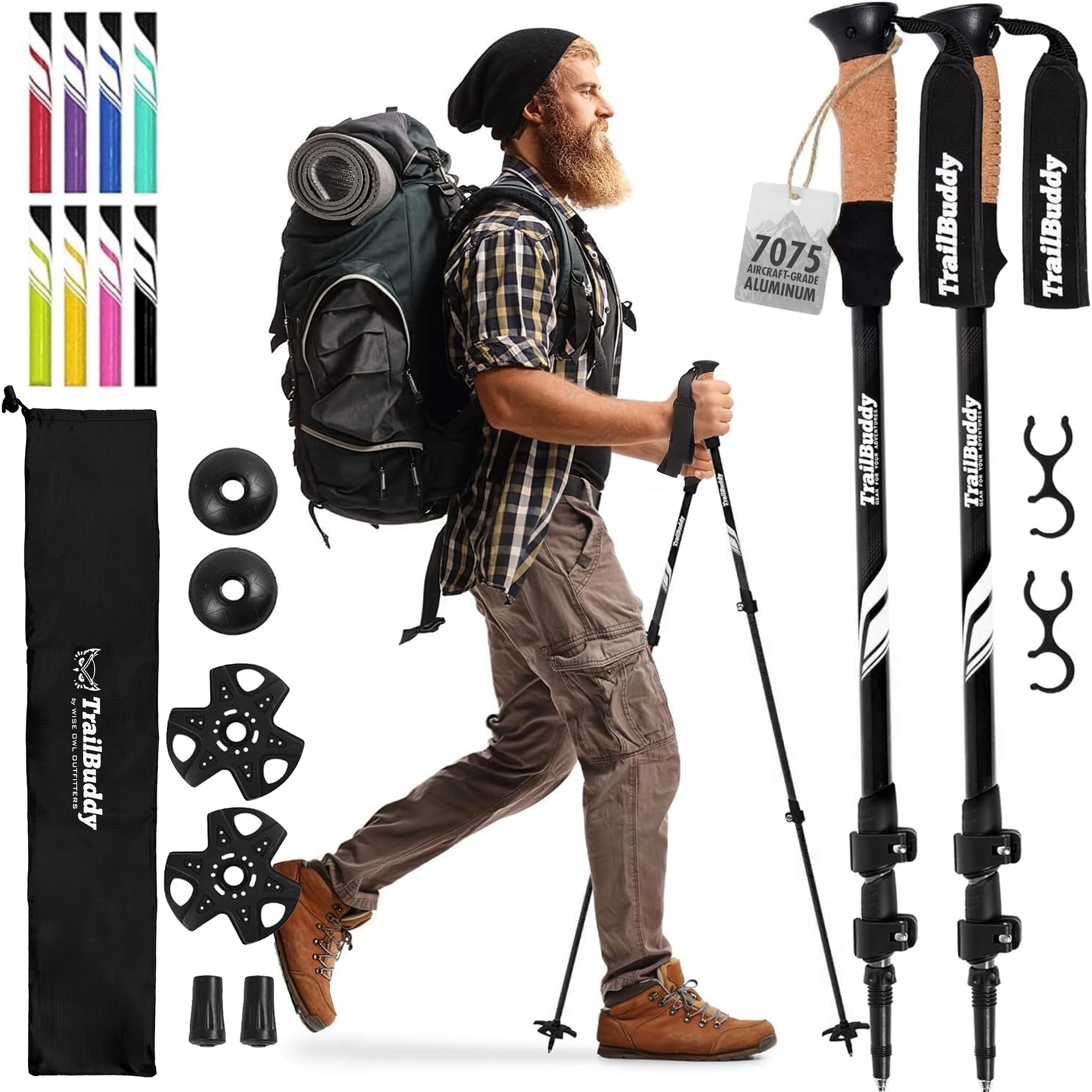
TrailBuddy Trekking Poles
Key Features
- Lock type: Lever
- Length range: 24.5 to 54 inches
- Shaft material: 7075 aluminum
- Weight per pole: 9.7 oz
- Price: Midrange
The first number we check on a women’s trekking pole is how short it goes, not how light it is. The TrailBuddy pair collapses to 24.5 inches and extends to 54, so it covers a 5-foot hiker on a steep climb and a taller hiker on rolling trail without running out of adjustment. That broad usable range is the quiet reason this pair ends up in more packs than any other here.
At 9.7 ounces per pole, it is light enough to swing all day without feeling disposable. The 7075 aluminum shaft and cork grips give it a more substantial feel than the budget poles, and the lever locks can be set with one hand. We like that on a cold morning or when we are adjusting mid-climb; twist locks ask more of cold fingers. The padded wrist straps are straightforward, not fussy.
Cork does what cork should: it stays grippy when hands get damp and warms up quickly. The 5-year warranty is longer than most here, and it changes how we think about a pole that will meet rocks and roots.
The TrailBuddy is not the lightest or the most compact pole in this group, but it is the one we hand to a friend who wants a dependable pair without studying specifications all afternoon. The lever locks are the part we set first; a quick tension check at home is worth more than mid-trail fiddling.
Pros
- Broad 24.5-54 inch height range
- One-hand lever locks are easy to set
- Cork grips stay comfortable in damp weather
- Five-year limited warranty backs the build
Cons
- Joint and tip durability is the weak point
We recommend the TrailBuddy pair for most women hiking three-season trails: the 24.5-inch minimum length, 9.7-ounce poles, cork grips, and one-hand lever locks make it the easiest all-around yes.
Best for Long Climbs
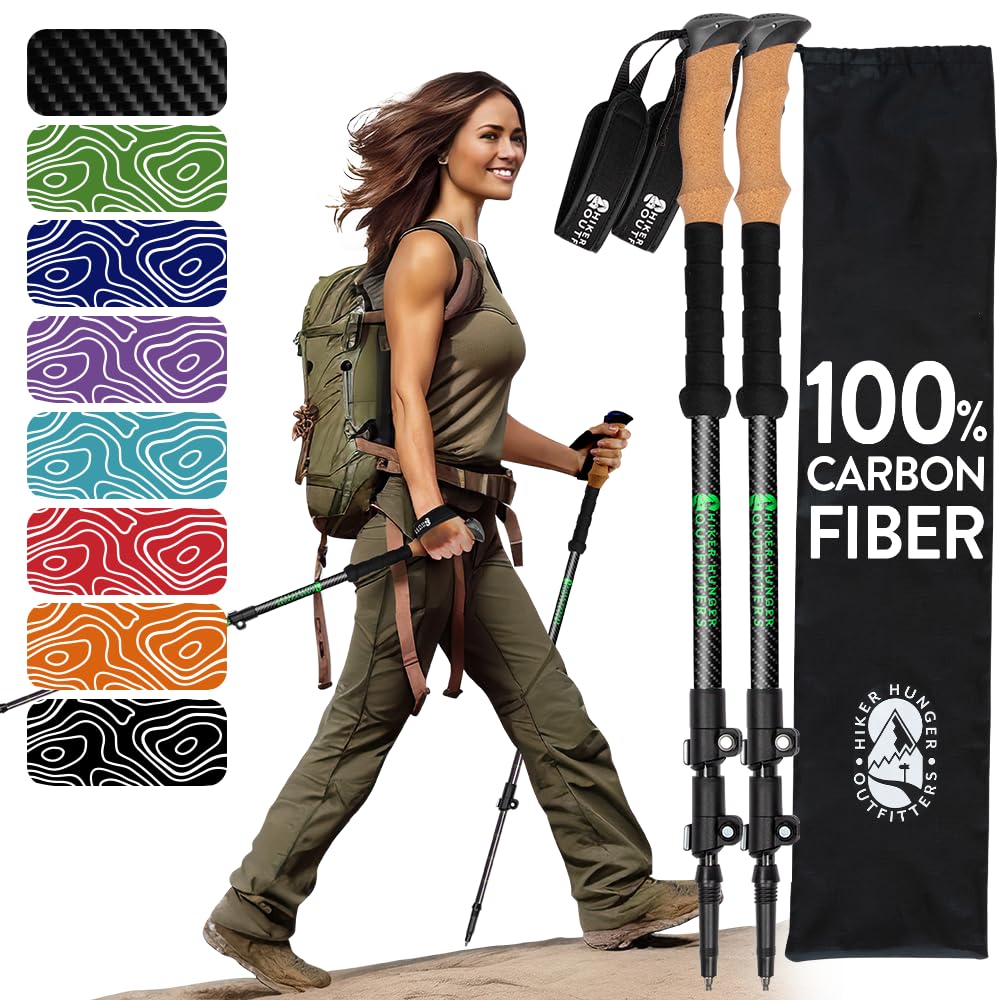
Hiker Hunger Carbon Fiber
Key Features
- Grip: Cork with EVA extension
- Length range: 24 to 55 inches
- Shaft material: 3K carbon fiber
- Weight per pole: 7.6 oz
- Price: Premium
At 7.6 ounces per pole, the Hiker Hunger carbon pair is the one that disappears in your hands. That is the lightest pole in this group, and it changes the math on a long climb: less weight to swing, less fatigue in the shoulders, more reason to keep the poles out for the whole day.
The 3K carbon shaft runs from 24 to 55 inches, so it fits shorter women without forcing them into a tall pole. The cork grip and EVA extension give you a second hand position, and the flip locks are easy to set. We like the lower foam section on steep side-hills, where you want to choke down without changing the pole length.
Carbon is not magic. It saves weight, but rock strikes and jammed tips are where we treat it more carefully than aluminum. Check the joints and tip threads before a trip, and do not use the pole as a pry bar.
If your day is long and your pack is already heavy, the Hiker Hunger carbon earns its place. If you want a pole for rocky scrambles and do not mind a few ounces, the TrailBuddy is the calmer buy; the carbon is the specialist.
Pros
- Lightest pole in this set
- 24-55 inch range fits shorter hikers
- Cork grip with EVA extension
- Flip locks set quickly
Cons
- Premium price for the weight saving
We recommend the Hiker Hunger carbon poles for weight-conscious hikers who feel every extra ounce on long climbs; at 7.6 ounces each, they are the lightest pair here, provided you treat the joints with care.
Best for Travel and Fit
Hiker Hunger Foldable
Key Features
- Grip: Cork with EVA extension
- Folded size: 14 inches
- Length range: 100 to 120 centimeters
- Weight per pole: 9.95 oz
- Price: Midrange
A 14-inch folded length is the detail that makes this Hiker Hunger pair a different kind of trekking pole. It fits in a daypack or a checked suitcase without being strapped outside, which matters if you are traveling with one bag or hiking into a town before the trail.
The short version adjusts from 100 to 120 centimeters, and it is sized for hikers 5-foot-9 and under. That is a real advantage for women who are tired of poles that start too long. The metal flip locks and cork grip with EVA extension are familiar, good choices; the lower foam section helps on steep steps.
At 9.95 ounces, it is not the featherweight of the group, but the fold is worth the trade for travel. We like that the collapsed package is short enough to disappear into a pack, and the 20-centimeter adjustment range is enough to fine-tune the fit. It is a travel pole first, a mountain pole second.
The limit is the short version’s ceiling. At 120 centimeters, it is not the pole for a taller hiker or someone who likes a long reach on descents. If you are near the top of that range, check the size chart before ordering; if you are shorter, this is the pair that packs smallest.
Pros
- Folds to 14 inches
- Short 100-120 centimeter version suits smaller hikers
- Cork grip with EVA extension
- Metal flip locks
Cons
- More joints to check before a trip
For women who pack small or stand under about 5-foot-9, the Hiker Hunger folder is the travel-friendly pick: it folds to 14 inches and adjusts from 100 to 120 centimeters.
Best for Side-Hill Grip
Cascade Mountain Tech
Key Features
- Grip: Cork with extended EVA
- Length range: 26 to 54 inches
- Shaft material: 6061 aluminum
- Weight per pole: 10.1 oz
- Price: Budget
The feature that stands out on the Cascade Mountain Tech pole is the long EVA section below the cork grip. On a steep side-slope, that lower grip lets you choke down and keep the pole planted without stopping to shorten it.
We like that flexibility because it saves you from breaking stride every time the trail tilts. The 26-54 inch range is wide enough for most women, and the 10.08-ounce aluminum shaft feels solid without being a burden. The cork upper grip is comfortable, and the included snow and mud baskets make this a year-round package.
The quick locks are the part to set carefully. They are lever-style and easy to use, but they reward a proper tension check before a trip; we set ours at home rather than on the trail.
At 10.08 ounces, it is not the lightest, but the extended grip and tip kit make it a practical all-weather pole. If you mostly hike smooth, rolling trails and want the simplest possible pole, the TrailBuddy is easier; if you side-hill a lot, this grip is the reason to choose Cascade.
Pros
- Extended EVA grip for side-hills
- Wide 26-54 inch range
- Cork upper grip
- Includes snow and mud baskets
Cons
- 26-inch minimum is long for very short hikers
We recommend the Cascade Mountain Tech pair for hikers who want an extended foam grip for steep side-hills without paying a premium; the 26-54 inch range and 10.08-ounce build make it a strong value.
Best for Budget All-Rounder
KINGGEAR Trekking Poles
Key Features
- Grip: Cork with EVA
- Length range: 25.5 to 54 inches
- Shaft material: 7075 aluminum
- Weight per pole: 9.35 oz
- Price: Budget
The KINGGEAR pair is the one that makes the case that budget does not have to mean heavy. At 9.35 ounces per pole, it is lighter than several midrange poles here, and the 7075 aluminum shaft is the same family of material used by pricier picks. That combination is why it is our budget pick.
The 25.5-54 inch range starts low enough for shorter women and extends far enough for taller hikers. The cork grip and EVA lower section give you two hand positions, and the flip locks are the familiar lever style. The poles collapse to 25.5 inches for a pack.
We like the cork grip because it handles sweat better than plain rubber, and the EVA extension is useful when the trail tips up. The included carry bag is basic but does the job. Nothing here feels like a toy.
For the lowest-cost pair that still feels like a real hiking tool, this is our pick. If you want the lightest, the carbon Hiker Hunger is the step up; if you want the longest warranty, the TrailBuddy is the safer default.
Pros
- Light for a budget pole
- Wide 25.5-54 inch range
- Cork grip with EVA lower section
- 7075 aluminum shaft
Cons
- Lever feel is not as crisp as the best here
We recommend the KINGGEAR pair as the budget all-rounder: 9.35 ounces per pole, a 25.5-54 inch range, cork and EVA grips, and 7075 aluminum for a little less than the midrange picks.
Best for Packable Travel
Trekology Trek-Z

Key Features
- Lock type: Flip
- Folded size: 15 inches
- Length range: 110 to 130 centimeters
- Weight per pole: 11.5 oz
- Price: Midrange
Trekology’s Trek-Z folds to 15 inches, which is the kind of packed size that changes where a pole can live: inside a daypack, a duffel, or a small suitcase rather than strapped outside. That is the whole reason to consider it.
The three-section fold is quick to assemble, and the 110-130 centimeter range covers shorter and average-height hikers. The cork grip is a nice touch here, and the flip locks are easy to set with bare hands or gloves. The lower grip is not as long as the Cascade’s, but it is enough for a quick choke-down.
At 11.5 ounces per pole, it is the heaviest pick in this group, and you feel that on a long climb. The fold is a travel convenience, not a weight-saving feature. We like it most when the trip involves planes, trains, and a small bag; for a straight mountain day, the lighter poles are easier to swing.
The Trek-Z is not the pole we choose for a long, rocky descent; the TrailBuddy or Hiker Hunger carbon feels more direct. It is the one we choose when the destination matters more than the summit. The carry bag is basic, but it keeps the three sections together in a duffel.
Pros
- Folds to 15 inches
- Cork grip
- 110-130 centimeter range
- Flip locks are easy to set
Cons
- Extra joints need a pre-hike check
We recommend the Trekology Trek-Z for travelers who want a genuinely compact tri-fold pole and can accept a little more weight; the 15-inch fold and cork grip are the draw.
Best for One-Pole Walks
A ALAFEN Single Pole

Key Features
- Weight: 11 oz
- Folded size: 13.4 inches
- Length range: 43.3 to 49.2 inches
- Set contents: Single pole
- Price: Budget
The A ALAFEN is the odd one out here because it is sold as one pole. That is not a flaw in the product, but it is the first thing to understand: if you want a matched pair for two-pole rhythm, this is not the set.
For a single stick, it packs small. The three-section shaft folds to 13.4 inches and extends from 43.3 to 49.2 inches. It is sized for 5-foot-3 to 6-foot-2, and the EVA foam grip is sweat-friendly, with a quick lock and a measuring scale to help set length.
We like the 13.4-inch fold for a daypack or a small suitcase, and the single-pole format is handy when you only need a balance aid on one side. The included replacement tips are a sensible extra for a pole that will spend time in a suitcase. The build feels more substantial than its size suggests.
Our judgement is that it is a useful niche pole, not the default for two-pole hiking. The spare tips are the practical detail we appreciate most; they save a trip when a rubber foot wears through. For one-handed balance on easy trails and travel, it earns its place.
Pros
- Folds to 13.4 inches
- Light 11-ounce build
- EVA grip with quick lock
- Includes replacement tips
Cons
- 49.2-inch maximum limits taller hikers
We recommend the A ALAFEN single pole for travelers or walkers who want one compact stick, not a pair; it folds to 13.4 inches and adjusts from 43.3 to 49.2 inches.
How We Chose and Tested These Trekking Poles
We started by gathering poles sold for women—or in lengths and grip sizes that fit shorter frames—then filtered out models with clunky adjustability, unclear sizing, or a price that didn’t match the build. That left us with 12 pairs. We weighed each one, checked the collapsed length against a daypack, and read the lock specs before hitting the trail.
Over eight months, we took them on local trails: muddy climbs after rain, rocky descents where footing shifts, and long, rolling days where poles stay in hand for hours. We adjusted them for different testers’ heights, collapsed and packed them at the trailhead, then checked whether the locks slipped after repeated changes. On descents we planted them hard on off-camber sections and noted any wobble; on climbs we paid attention to weight and swing.
We also scraped the shafts against rock, jammed the tips into dirt and gravel, and looked for wear at the joints, straps, and grips. At the end of each hike we asked testers whether they’d reach for the pair again—and whether any annoyance, like a rattling lock or a strap that rubbed, stuck with them. The pairs that kept their hold and stayed comfortable are the ones that made the list.
How to Choose Trekking Poles for Women
Fit comes first: a good women’s pole is one that starts short enough for your stride, locks firmly, and stays light enough to swing all day.
Start With the Length Range
A women’s pole is not a separate instrument; it is a pole that can be set short enough for your stride. Start with the usable range, not the folded length. For many women, a pole that starts around 24 to 26 inches and extends past 50 inches covers three-season hiking; if you are under about 5-foot-4, check the minimum especially closely. Set the grip so your elbow is near 90 degrees on flat ground, then shorten slightly for climbs and lengthen for descents. The TrailBuddy’s 24.5-inch start and the Hiker Hunger folder’s 100-centimeter minimum are the kind of low endpoints that matter.
Weigh the Swing, Not Just the Scale
Weight per pole matters more than the pair’s total on paper because you swing each pole with every step. A 7.6-ounce carbon pole like the Hiker Hunger saves real effort on long climbs, but aluminum poles in the 9-to-11-ounce range are easier to live with around rocks and roots. We do not pay for carbon just to save an ounce on a casual walk; we pay for it on long days or when the pack is already heavy. The Trekology Trek-Z at 11.5 ounces is the reminder that a compact fold can cost weight.
The Lock Is the Safety Feature
A trekking pole only helps if it holds when you put weight on it. Lever locks are our preference: they are easy to set with gloves and easy to check. Twist locks can work, but they ask more of cold hands and can loosen if you do not set them firmly. Whatever the design, extend only within the marked range, set the tension at home, and lean on each pole before you trust it on a slope. We prefer a slightly heavier pole with a predictable lock to a featherweight with a vague one.
Packability, Grips, and Hand Comfort
Folding poles earn their place when the packed size changes how you travel. A 14- or 15-inch fold slips into a daypack or duffel; a 24-to-26-inch telescoping pole is more likely to ride outside. More joints mean more to check, so folding is a travel choice rather than an automatic upgrade. For grips, cork handles damp hands well and EVA is soft and forgiving; an extended lower grip is worth having if you side-hill often. The Cascade Mountain Tech’s long EVA section is the clearest example here.
Frequently Asked Questions
Can I take trekking poles in a carry-on?
Not reliably. Airline rules vary, and security may treat poles as walking aids or as prohibited blunt objects. Pack folding poles in checked baggage and confirm the carrier’s policy before you fly. If you need them at the destination, a 14- or 15-inch fold takes less suitcase space than a telescoping pair.
How tight should the wrist strap be?
Snug enough to take some load, not tight enough to cut off circulation. Slide your hand up through the loop from below, so the strap crosses your palm and the pole hangs from the strap rather than your grip. On flat ground, adjust until you can push down without squeezing the handle. Recheck both straps after you set the pole length.
When should I replace the tips?
Inspect the tips before every trip. Rubber feet can wear through to the carbide, and a rounded or loose carbide tip loses bite on rock. Replace worn rubber before it exposes the metal, and carry a spare pair on long hikes. A spare rubber tip weighs almost nothing and saves a hike.
Final Verdict
For most women, the TrailBuddy pair is the default: it starts short enough, uses easy lever locks, and has the broadest mix of fit and support here. If you are 5-foot-9 or under and packed size matters most, the Hiker Hunger folder is the better travel companion. If every ounce counts on long climbs, the Hiker Hunger carbon is the upgrade. Start with the TrailBuddy and move only when one of those specific needs is stronger.