This post contains affiliate links. We may earn a small commission when you buy through our links — at no extra cost to you.
Somewhere around mile eight of a rocky descent, your knees start sending invoices. Trekking poles are the simplest way to settle that bill: they take load off the joints, catch you when a loose heel skids, and turn a bad creek crossing into a non-event. The catch is that the category pulls in two directions at once. The lightest poles can feel like wet noodles the moment you put real weight on them, and the burliest ones make themselves known in your pack all day.
There’s also a piece of math most first-time buyers get wrong: you size a pole to your height with the tip on the ground and your hand where your fingertips brush the top of the grip, not your palm. Miss by an inch or two and your shoulders will file a complaint by mid-afternoon. My team and I spent six months hiking with 12 pairs — local day trails, loaded overnight trips, one memorably muddy spring — to find the ones worth carrying. The picks below are poles I’d hand to a friend without a caveat.



Best for All-Round Trail Use
Foxelli Aluminum Trekking Poles
Key Features
- Grip: Cork with EVA extension
- Lock type: Flip lock
- Weight per pole: 9.4 oz
- Adjustable range: 24 to 54 in
- Price: Midrange
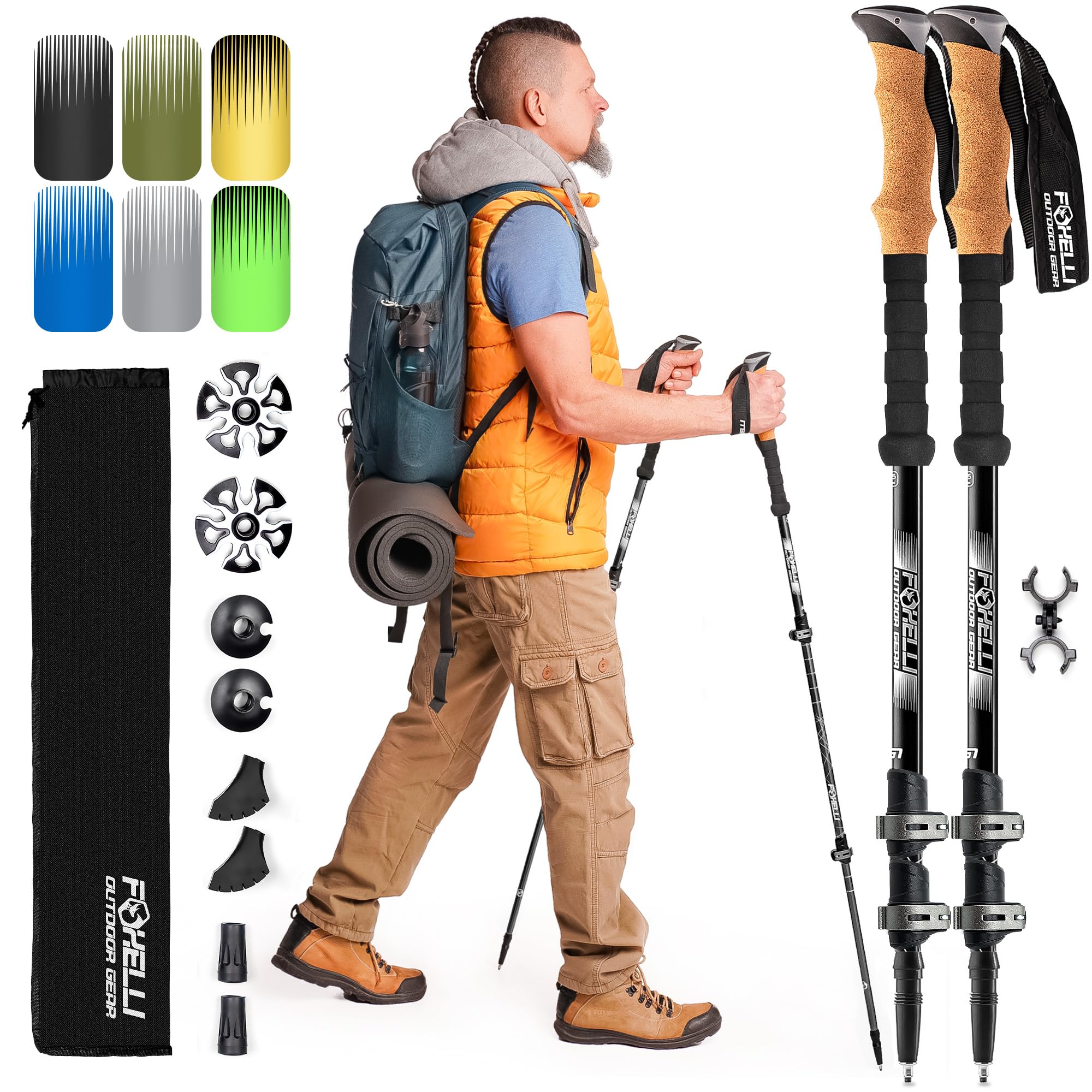
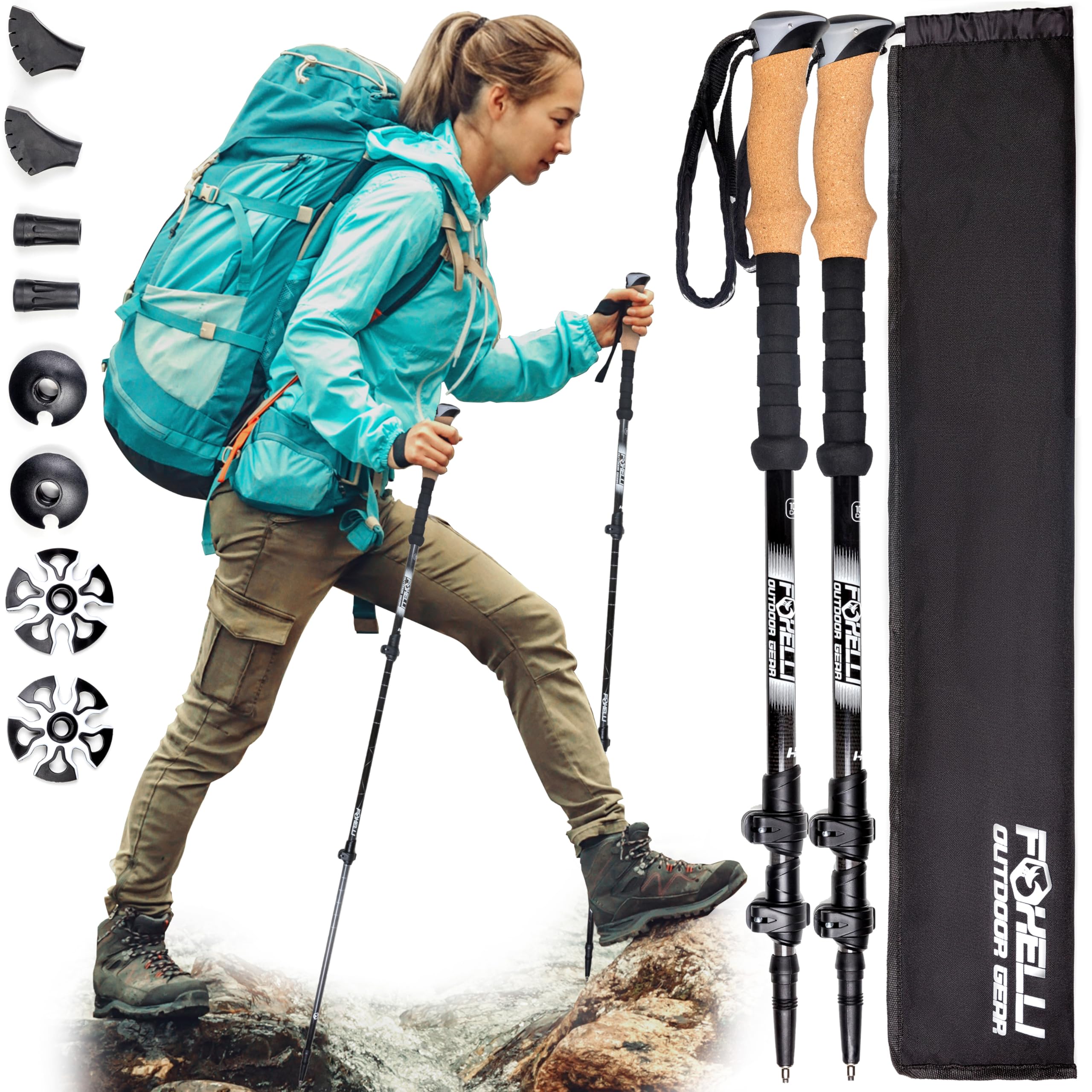
This is the pair we point people to first. Foxelli’s aluminum poles weigh 9.4 ounces each, lock with a flip lever you can work in gloves, and put cork under your palm with a foam extension below it for the steep sections. What earned it the top spot is that there’s nothing to warn you about: the weight, the grip and the clamps all sit at or near the front of this group, and none of the usual weak points turned up while we used them.
Twenty-four to fifty-four inches covers the usual adult span, and the sections pull apart to roughly 21 inches, short enough to disappear into a daypack when you want both hands free for a scramble. The tip kit is more than box-filler: rubber feet, mud baskets and snow baskets press on at the end, and swapping them takes under a minute. We kept the rubber feet on for a week of hard-packed path and the carbide never touched the ground.
The complaints are small ones. The rubber tips can pull off in thick mud, so check the end before you collapse the pole and keep the spares in the bag. There’s no alignment mark on the shafts either, which adds a beat when you’re lining the grip and the tip back up in a hurry.
Where it runs out of room is height. Fifty-four inches is the ceiling, which suits most adults, but anyone at the very top of the range has a better option in the Black Diamond Trail and its 140 cm reach. For everyone else, this is the pair the rest of the list is measured against.
Pros
- Cork grip with a foam extension for climbs
- Flip locks set fast, even in gloves
- Packs down to about 21 inches
- Interchangeable tips and baskets included
Cons
- Rubber tips can pull off in mud
- 54-inch ceiling is tight for very tall hikers
Our pick for hikers who want one dependable pair for day hikes and the occasional big push: light, comfortable under the palm, and free of the slipping-clamp trouble that dogs cheaper poles.
Best for First-Time Pole Buyers
TrailBuddy Trekking Poles
Key Features
- Lock type: Lever lock
- Shaft material: 7075 aluminum
- Weight per pole: 9.7 oz
- Adjustable range: 24.5 to 54 in
- Price: Midrange
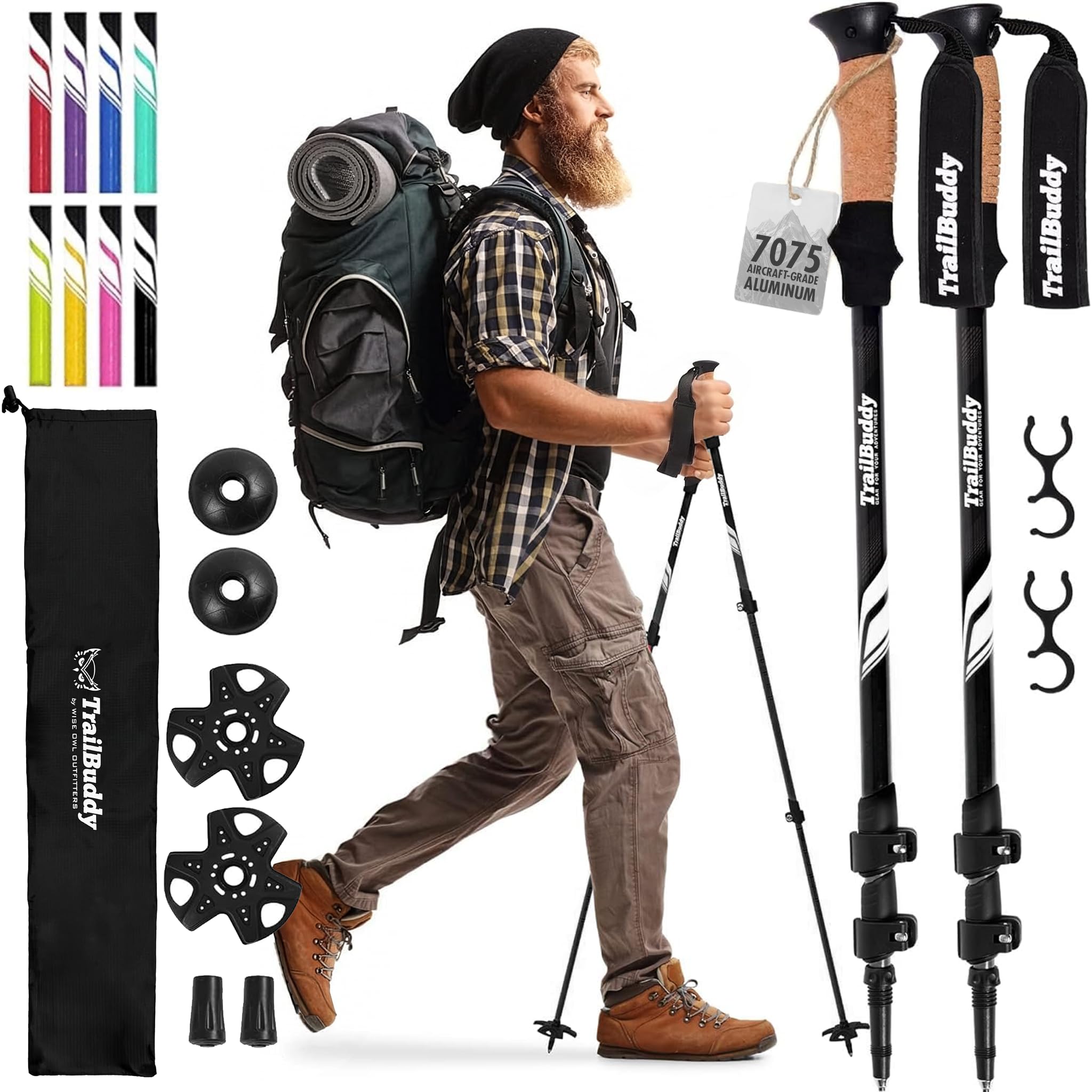
Three aluminum sections, a lever at each joint and cork under the hand: the TrailBuddy is the classic shape, and setup takes a minute the first time and seconds after that. The levers are the easiest thing here to work with gloves on — one thumb, one click, and the section is set — which is not something you can say about the twist locks on cheaper telescoping poles.
We rate it the safest first purchase in this guide. It collapses to 24.5 inches, reaches 54, and carries a five-year limited warranty, the longest any maker here offers — worth more on a pole than on most gear, because the failure you care about happens halfway down a slope. The 7075 aluminum shafts feel stiff in the hand, the cork grips mold to your palm, and the padded straps spread the load across your wrist instead of cutting into it.
Where a pole like this can let you down is a hard sideways load. Jam one between two rocks and lean on it, and the lower section is what gives. That’s true of every aluminum pole in this guide, but it’s worth saying because these are the ones a beginner is most likely to abuse. Use them for support and rhythm rather than as a probe or a pry bar and they do exactly what the design promises. At 9.7 ounces a pole they’re a shade heavier than our top pick, a difference you notice on the pack rather than in your hands.
Pros
- Lever locks work one-handed
- Five-year limited warranty
- Cork grips and padded wrist straps
- Collapses to 24.5 inches
Cons
- Lower section can snap under a sideways load
The safest first purchase in this guide: one-hand lever locks, a five-year warranty and a shape almost anyone can set up in a minute.
Best for Value Carbon Hiking
Cascade Mountain Tech Carbon Fiber
Key Features
- Folded length: 26 in
- Shaft material: Carbon fiber
- Weight per pole: 8 oz
- Adjustable range: 26 to 54 in
- Price: Midrange
Eight ounces a pole is where this pair starts, and it’s the number you feel around the thousandth step of a climb. Against the aluminum poles here the carbon shaft saves about an ounce and a half and, more usefully, swings faster — the pole comes forward with less effort, so you settle into a rhythm instead of hauling it along.
The rest of the package is familiar. Cork grips with an extended EVA section below them, quick flip locks, and the full tip kit: snow baskets, mud baskets, rubber boots and a carry case. Folded, it’s 26 inches, longer than the collapsible poles here that break down small enough for a suitcase, so this is a pair for strapping to the outside of a pack rather than stowing inside one.
What we like most is the arithmetic. This is the cheapest carbon pole in this guide, and for most hikers the gap between it and the premium carbon picks is a couple of ounces, a nicer strap and a longer warranty rather than a different experience on the trail. The clamps are the soft spot: they can work loose over a season and want the tension screw taken up. Check them before a big day and they hold all day.
Pros
- 8-ounce carbon shaft swings fast
- Cork grip with EVA extension
- Full tip kit and carry case
- Least expensive carbon pair here
Cons
- Clamps loosen and need retensioning
- 26-inch folded length is long for packing
Buy this if you want carbon lightness and a cork grip without paying premium money — just plan on tightening the clamps once a season.
Best for Long-Distance Backpacking
Foxelli Carbon Fiber Trekking Poles
Key Features
- Folded length: 24 in
- Shaft material: Carbon fiber
- Weight per pole: 7.6 oz
- Adjustable range: 24 to 55 in
- Price: Midrange
Same brand as our top pick, same cork-and-foam grip, same flip levers — the difference is the shaft. Foxelli’s carbon pair comes in at 7.6 ounces a pole, the lightest thing in this guide and about two ounces under the aluminum version. On a long day that’s the gap between poles you notice and poles you forget.
The 3K carbon shafts are stiff, the tungsten carbide tips bite into rock rather than skating across it, and the poles break down to 21 inches, short enough for a duffel or the bottom of a backpack. The all-terrain tip kit comes with them, and the grip is the same cork-over-foam arrangement as the aluminum pair, so nothing changes in your hand.
Carbon behaves differently when it fails, and that’s the thing to understand before paying for it. Aluminum bends and keeps going; carbon is stiffer and lighter but can crack rather than bend, and a cracked shaft tends to go with little warning. Treat a carbon pole as support, not as a lever for prying a boot out of mud, and give the lower sections a look over after a rocky trip.
For backpacking and big-mile days, we think the extra money buys something real: less weight in your hands and less fatigue in the last mile. If your hiking is mostly short loops with the occasional rocky stretch, the aluminum version is the more forgiving buy and the better use of the difference.
Pros
- 7.6 ounces a pole, the lightest here
- Cork grip with foam extension
- Packs down to 21 inches
- Tungsten carbide tips grip rock
Cons
- Carbon can crack instead of bending
- Costs more than the aluminum version
For long days and heavy packs, this is the pair we hand over: 7.6 ounces a pole, cork under the palm, and a stiffness you feel on the climb.
Best for Alpine and Snow
Black Diamond Trail
Key Features
- Grip: Dual-density foam
- Lock type: FlickLock
- Packed length: 64 cm
- Adjustable range: 100 to 140 cm
- Price: Premium
The reason to buy these is the range: 100 to 140 cm, the tallest ceiling in this guide, from a pair that still packs to about 25 inches. If you’re tall, or you want one pole for snowy approaches and another for summer trails, that span is the whole argument. It’s also the pair we trust most on rock and ice — the FlickLock clamps are the most secure in this group and the carbide Tech Tips bite hard.
The grips are dual-density foam with a long choke-up section, which feels different from the cork on almost everything else here: cooler and tackier when your hands are wet, less molded to your palm over a long day. Some hikers never go back to cork; others miss it within a mile. The extended section earns its keep on steep ground, where you choke down on the grip instead of stopping to shorten the pole.
What you don’t get is the box of bits. Rubber tips are sold separately and the poles arrive as a bare pair, so add them if you walk pavement or want to quiet the tips down. And the premium buys adjustment hardware and range rather than lightness: the listed 486 grams puts these among the heavier options in this guide, not the lightest.
Pros
- 140 cm ceiling suits tall hikers
- FlickLock clamps hold securely
- Dual-density foam with long choke-up
- Packs to about 25 inches
Cons
- Rubber tips sold separately
- Heavier than the carbon picks here
The one to get if you’re tall, ski tour, or walk in snow — the 140 cm ceiling and the FlickLock clamps are what the money buys.
Best for Travel and Packing
Trekology Trek-Z
Key Features
- Grip: Natural cork
- Lock type: Metal flip lock
- Folded length: 15 in
- Adjustable range: 110 to 130 cm
- Price: Midrange
Fifteen inches is the pitch, and it’s a good one: this is the pole that goes inside a daypack, lashes to the outside of a small pack, or slides into a duffel beside your boots. The tri-fold system uses an internal cable with a metal flip lock at the height joint, and assembly takes seconds once you’ve done it twice.
We like it most for mixed trips — a town morning, a trail afternoon, poles in the bag in between. What you trade for the small bundle is rigidity: every folding pole has more joints than a telescoping one, and you can feel the middle section flex when you weight it on a steep descent. The height range is narrower too, 110 to 130 cm, so shorter walkers and anyone much over six feet should measure their usual pole length before ordering.
The cable running through the sections is what makes the fold work, and it’s also the part that can fail. Don’t yank a stuck section apart; straighten the joint and ease it back. Treated that way this is a lot of pole for the money, and the cork grip is the same sort of thing you’ll find on pairs further up this list.
Pros
- Folds to 15 inches
- Cork grip at a mid-range price
- Assembles in seconds
- Fits inside a daypack or duffel
Cons
- Height range stops at 130 cm
- Visible flex at the joints on descents
The travel pole: fifteen inches folded, cork in your hand, and a narrower height range you should check before you commit.
Best for Budget Cork Comfort
Cascade Mountain Tech Aluminum

Key Features
- Grip: Cork with EVA extension
- Shaft material: 6061 aluminum
- Weight per pole: 10.1 oz
- Adjustable range: 26 to 54 in
- Price: Budget
The first thing to know about the cheapest cork-handled pole here is that the locks need setting up before you trust them. The quick clamps have a tension screw, and the difference between a pole that holds your weight all day and one that slides under a hand’s pressure is a quarter turn. We spent our first few minutes with a screwdriver, loading each joint with full body weight before taking them out, and that’s the right way to start with these.
What the money buys is genuinely good. A cork grip with an extended EVA section, a 26-to-54-inch range, tungsten carbide tips, and a kit of baskets, boots and tip covers in a travel bag — the same shape of package as poles well above this one on the price ladder. The extended grip is the part you’ll use most, sliding your palm down on steep ground rather than stopping to shorten the pole.
Our read is that this is a walking and light-hiking pole rather than a mountaineering one. The money has gone into the cork, the extended grip and the tip kit, and that’s the right call for paths, tracks and the kind of trails where you’re using the pole for rhythm as much as for load.
Pros
- Cork grip with extended EVA section
- Full basket and tip kit included
- 26 to 54 inch range covers most adults
- Lowest-priced cork pole here
Cons
- 10-ounce poles swing heavier than the carbon picks
A budget cork pole that rewards five minutes with a screwdriver — good for paths and everyday walking, not for loading hard on a rocky descent.
Best for Occasional Walks
Amazon Basics Trekking Poles
Key Features
- Grip: EVA with extended grip
- Lock type: Quick lock
- Shaft material: 6061 aluminum
- Adjustable range: 25.2 to 53 in
- Price: Budget
There’s a real case for spending as little as possible on a first pair of poles. If you’re not sure you’ll enjoy walking with them, or you want them for a couple of trips a year, the cheapest pair that locks and holds is the rational buy, and this is that pair.
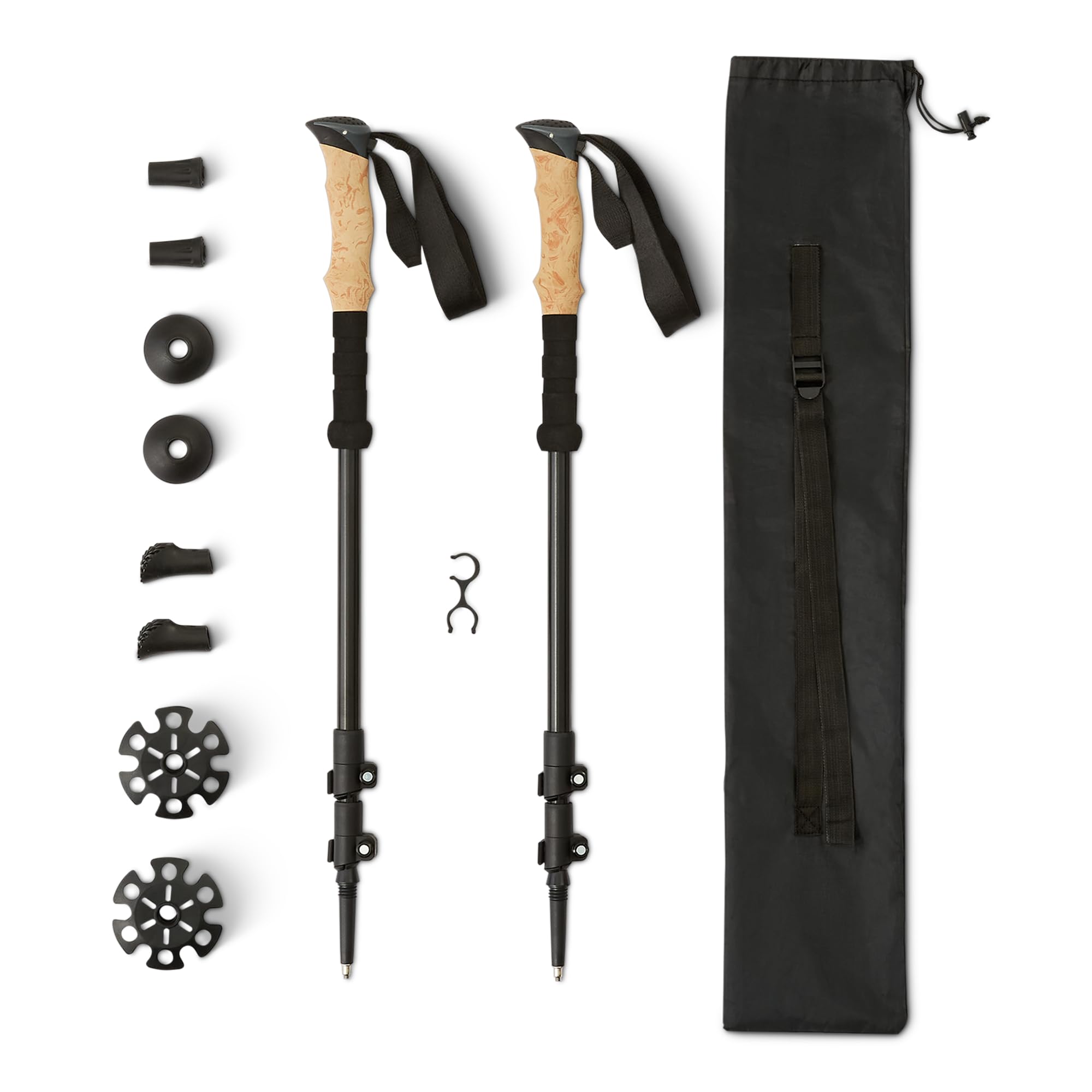
What you get is a 6061 aluminum pole running from 25.2 to 53 inches, with a quick outer lock, EVA handles and an extended grip below them, plus a four-season accessory set: boot tips, mud baskets, snow baskets, rubber tips and a storage bag. We laid the kit out beside poles further up this list and it’s the same shape of package.
Where the budget shows is in the materials and the ceiling. EVA doesn’t mold to your hand the way cork does, and it can feel slick once you’re sweating. The maximum is 135 cm, fine for most adults but tight for anyone tall. And the rubber tips are the first thing to wear through, so check them at the start of each season and swap them before they’re worn down to the carbide.
None of that makes it a bad buy. Our take is that it’s a pole for flat walks, park paths and the occasional trail, and it does that job for less than anything else here. What it won’t give you is the confidence of the proven designs above it, so treat this as the pair you learn on and upgrade once you know what you want.
Pros
- Lowest-priced pair here
- Four-season tip and basket kit
- Quick locks adjust without tools
- Extends to 53 inches
Cons
- 135 cm ceiling limits tall hikers
- EVA handles instead of cork
The low-risk way to find out whether you like walking with poles, as long as you’re not tall and don’t expect cork comfort.
How We Tested Trekking Poles on Trail, Not in a Lab
We started with roughly 40 pairs sold by the outdoor brands you see on any gear wall, then narrowed by price band, packed length, grip material, and lock type so the final list wasn’t the same pole in four colorways. Twelve pairs made the cut, and we hiked with them for six months: neighborhood greenways, steep rocky descents, a couple of loaded overnighters, and one very muddy spring.
Every pair went on a kitchen scale first, since claimed weights tend to be optimistic, and we noted how they swung in hand versus how they felt after four hours of walking. Adjustability got tested the way it actually fails — in cold, wearing gloves — by extending and collapsing both poles and timing how long it took to hit the right length, then checking whether the printed markings were still readable after a season of grit. We cinched and loosened the straps one-handed mid-stride, swapped baskets, and strapped the collapsed poles to packs to see how much length they ate up.
Then the locking mechanisms, which are where hikes end. We leaned hard on a single pole on descents, planted one above a step-up, and jammed tips into mud to see whether the lock crept or slipped; flip locks were also checked for drift after repeated folding. Stability we judged by flex in motion — watching for shimmy and bend under weight on rough ground, especially on the lighter pairs, where swing weight and stiffness are the whole decision.
Durability ran through all of it: granite scrapes, tips wedged between rocks, poles left wet in a trunk overnight. We tracked which grips went smooth and which carbide tips rounded off first, and any pair that developed a wobble at the joint or a lock that stopped holding was cut, no matter how good the first hike felt.
How to Choose Trekking Poles
The lock, not the shaft, decides whether a pair of poles is worth carrying; everything else is a preference you can work around.
Check the Lock Before Anything Else
A pole has one job under load: stay at the length you set. Lever and flip clamps do it with a cam you tension by screw or thumbwheel. Twist locks rely on friction inside the shaft and can let go when you weight a pole on a descent. Whichever you pick, test it before you go — extend each section, put the tip on a hard floor and lean your full weight on the grip. A joint that creeps in the living room will collapse on a slope, so tighten it and try again until it holds.
Aluminum or Carbon Fiber
Aluminum bends, absorbs abuse and usually gives warning before it fails. Carbon is lighter and stiffer but can crack rather than bend, sometimes with little notice. The weight spread in this guide runs from 7.6 to about 10 ounces a pole, and you feel it in the swing far more than on the strap of a pack. Our preference is aluminum for rock, snow and rough handling, and carbon for long days with a light pack. If you walk a handful of times a year, aluminum is the better use of the money.
Match the Length Range to Your Height
Poles are sold by the span they adjust across, and the top of that span is where buyers get caught out. Most telescoping pairs reach 54 inches or 135 to 140 cm, which covers the large majority of adults. Folding designs often stop at 130 cm, short for anyone much over six feet. Check the ceiling before you shop rather than the collapsed length, and aim to run your pole in the middle of its range, where the joints are least stressed.
Grips, Straps and the Extended Section
Cork wicks sweat and molds to your hand over a season. EVA foam is cheaper and lighter but gets slick when you’re working hard, and rubber is the least forgiving of the three. More useful than the material is what sits below the grip: an extended foam or EVA section lets you choke down and keep moving on a steep pitch instead of stopping to shorten the pole. Use the strap as well — pushed up under the heel of your hand it carries the load, which is the entire point of having one.
Packed Length, Folding and Travel
Telescoping poles collapse to roughly 24 to 26 inches, which straps to a pack but won’t vanish into one. Folding poles get down to about 15 inches by adding joints and an internal cable, and you pay for that compactness with a little flex and one more part that can fail. If the poles live inside a daypack or a duffel, folding wins. If they ride on the outside of a pack, telescoping is simpler and sturdier. Compare collapsed lengths, not extended ones.
Frequently Asked Questions
Do trekking poles actually help on a hike?
They give you two extra points of contact on loose ground and take a share of the load off your legs on descents, which is why they show up most on steep, rocky trails and long downhill days. Use both poles, plant them ahead of you rather than beside your feet, and let the wrist strap carry the push instead of gripping hard. One pole used occasionally is mostly a nuisance; a matched pair used consistently is what people notice.
How do I set the right length on the trail?
Stand tall on level ground with the tip on the floor and the grip in your hand; your elbow should be bent to roughly a right angle, which usually puts the grip near hip height. Shorten both poles by 5 to 10 cm for a sustained climb so you can push down without hunching, and lengthen them by the same amount for a long descent. Wrap a strip of tape at your setting so you can find it again in seconds.
Can I take trekking poles in a carry-on?
Plan on checking them. Screeners generally treat a collapsed pole as a potential weapon, and a folding design that fits in a duffel doesn’t change that. Check your airline’s rules before you fly, pack the poles in the hold with the tips covered, and if you need them at the far end, put them in the bag you’re already checking rather than gambling at the security line.
What wears out first, and what does upkeep cost?
Rubber tips, then baskets, then lock tension. The rubber feet are consumables: once the carbide shows through, the tip skates on rock and chews up pavement. Replacement tips and baskets are inexpensive and usually brand-specific, so order a spare set when you order the poles. A minute with a screwdriver on the clamps at the start of each season covers everything else.
Final Verdict
Most hikers should buy the Foxelli aluminum pair. It’s the one pole here that is light, comfortable and steady without asking you to accept a known weakness, and it handles everything from a park path to a full day on rocky trail.
Spend more only for a reason: the carbon version if you’re counting ounces over long days, or the Black Diamond Trail if you’re tall or heading into snow. If you’re still deciding whether poles are for you at all, the Amazon Basics pair is the cheapest honest way to find out.