This post contains affiliate links. We may earn a small commission when you buy through our links — at no extra cost to you.
A hiking pole that slips mid-step is worse than no pole at all — you load your weight, the lower section creeps down, and you catch yourself on the wrong leg. What a good pair actually fixes is the descent: your knees stop taking every rock, and a loaded pack stops steering you off balance. I spent years borrowing a too-long pair from my partner before I understood what a correctly sized pole does for a loose downhill. My team and I just spent eight months with 12 pairs.
The women’s-specific label mostly comes down to grip diameter and packed length, not secret geometry, and both matter more than the marketing lets on — a narrower grip is easier to hold if your hands are smaller, and a shorter collapsed pole disappears into a daypack. None of that helps, though, if the locks creep under weight, the straps chafe on a long climb, or the swing weight tires your arms by mile eight. The picks below earned their place on all of it.



Best for All-Around Hiking
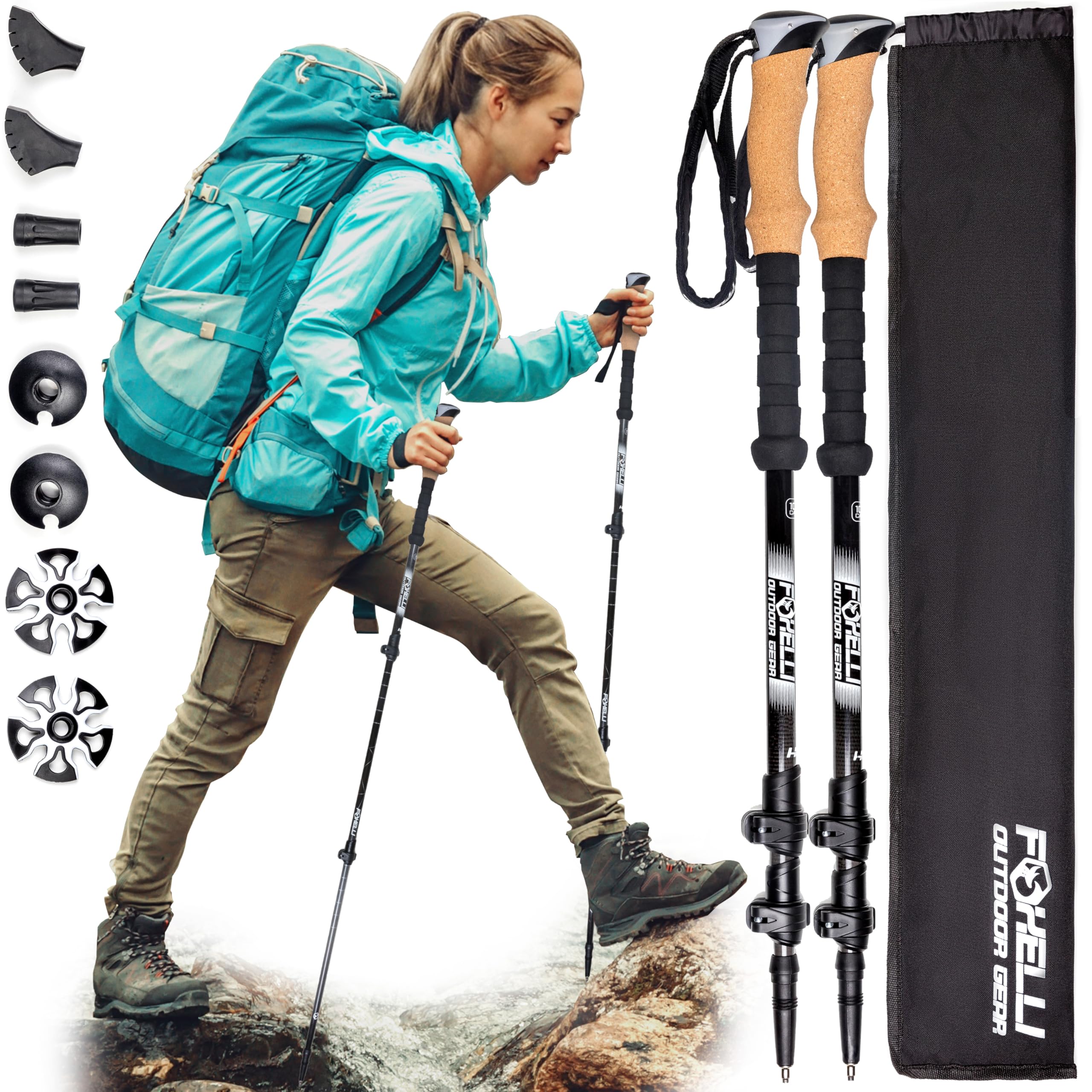
Foxelli Carbon Fiber Trekking Poles
Key Features
- Grip: Cork with foam extension
- Length range: 24–54 in
- Packed length: 24 in
- Weight per pole: 7.6 oz
- Price: Premium
At 7.6 ounces per pole, the Foxelli pair is one of the lightest full-length options here, and that figure is the first thing we notice on a climb. Less weight to swing means less shoulder fatigue on a long day, and the carbon shaft keeps the pair from feeling like a compromise. The 24-to-54-inch range gives most women room to set a natural arm bend without running out of adjustment.
What makes it our top pick is the grip and lock package. The natural cork molds to a damp hand, and the foam extension below it gives you a place to choke up on steep switchbacks. We also like the flip locks: they are easy to set with one hand, and the thumb screws let you snug the clamp if it starts to feel loose. That combination of light shaft, comfortable grip, and reliable lock is what separates the Foxelli from cheaper aluminum pairs.
At 24 inches folded, it packs into a daypack without drama, though it is not the smallest package here. If you are flying with only a carry-on, a tri-fold pole such as the Trekology or Covacure saves more room. The Foxelli is the pair we choose for the trail itself, not for squeezing into the bottom of a suitcase.
Over a full day, the low swing weight and cork grip are the parts that keep us coming back. The locks hold the length we set, and the poles feel composed rather than twitchy when the trail turns rough. We prefer to carry this pair when the route has a bit of everything.
Pros
- 7.6-ounce carbon shafts
- Cork grip with foam extension
- Secure one-hand flip locks
- Broad 24–54 inch height range
Cons
- Premium tier costs more than value picks
Our top pick is the Foxelli carbon pair: one of the lightest full-length options here, with cork comfort and locks that stay set on long climbs and descents.
Best for Value All-Rounder
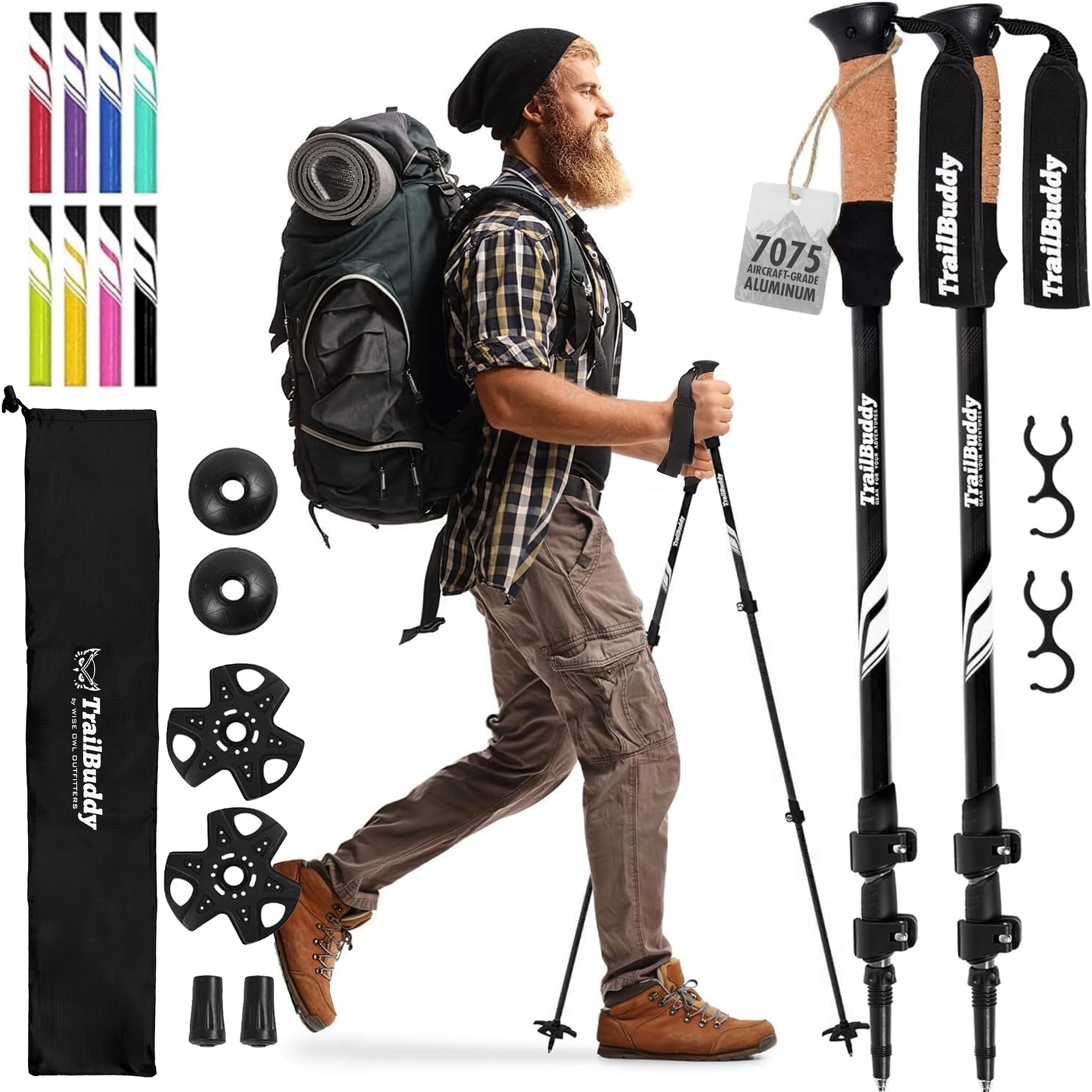
TrailBuddy Trekking Poles
Key Features
- Grip: Cork
- Length range: 24.5–54 in
- Packed length: 24.5 in
- Weight per pole: 9.7 oz
- Price: Midrange
The Foxelli pair is lighter, but the TrailBuddy is the set we hand to a friend who wants one pair for everything. The lever locks are the reason: you can open and close them with one hand, even in gloves, and the tension is easy to adjust. Add cork grips and a five-year limited warranty, and this is the least fussy way into a reliable pair.
At 9.7 ounces per pole, the TrailBuddy keeps swing weight reasonable for day hikes and weekend backpacking. The 24.5-to-54-inch range covers a broad spread of heights, and the poles collapse to 24.5 inches for a pack. The cork handles are shaped to fill the palm, while the lever locks are easier to operate than twist locks when your hands are cold.
The TrailBuddy is the pair that stays in the car for a spontaneous walk, which is the best compliment we can give a value pick. It is not the lightest or the most compact here, but the grams and inches buy a lever lock that works with gloves and a warranty that most rivals here do not match.
Pros
- One-hand lever locks
- Cork grips
- Five-year limited warranty
- Broad 24.5–54 inch range
Cons
- Basic wrist straps
For a do-everything pair that costs less than carbon, we choose the TrailBuddy: one-hand lever locks, cork grips, and a five-year warranty.
Best for Smaller Hikers
Black Diamond Trail Women’s Poles
Key Features
- Grip: Dual-density foam
- Lock: FlickLock
- Size: 100–125 cm
- Shaft: Aluminum
- Price: Premium
The women’s version is sized from 100 to 125 centimeters, and that narrower range is the point. Instead of asking a unisex pole to collapse into a short-enough length, it puts the grip at a natural height for smaller hikers. The foam grip is long enough to choke down on steep ground, and the FlickLock clamps hold the setting once you close them.
We think the Black Diamond feels like the most purpose-built pair here. The dual-density foam is comfortable without cork’s texture, the straps are easy to adjust, and the flip locks are secure. The clamps can be stiff when new, but they loosen with use; after that, the adjustment stays put.
The foam grip is the detail we keep coming back to: it is comfortable for long stretches and easy to choke down on. This is a pair for the hiker who knows her height and wants the fit solved before the trail, not for a household that shares one set. The premium hardware is the reason to pay attention.
Pros
- Women’s-specific 100–125 cm fit
- Comfortable dual-density foam grips
- Secure FlickLock clamps
- Premium build and finish
Cons
- Women’s 100–125 cm range may not suit taller hikers
Shorter women who want a dedicated fit and premium hardware should start with the Black Diamond Trail.
Best for Taller Hikers
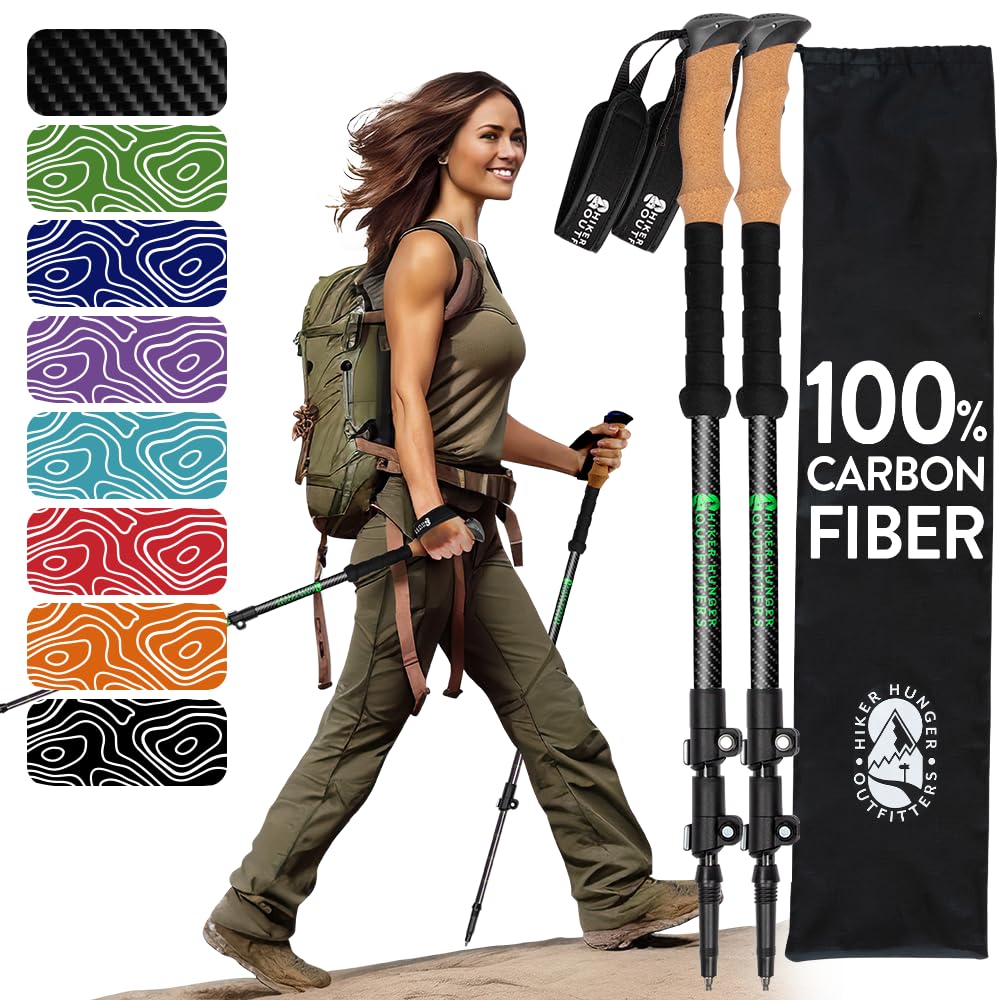
Hiker Hunger Carbon Fiber Poles
Key Features
- Grip: Cork with EVA extension
- Length range: 24–55 in
- Packed length: 24 in
- Weight per pole: 7.6 oz
- Price: Premium
The 55-inch maximum is why the Hiker Hunger pair makes our list. Taller women often end up hunched over a pole that stops an inch or two short, and this is one of the few picks here that reaches that bit farther. The 7.6-ounce carbon shaft keeps the extra length from feeling like extra work.
The grip is a two-part system: cork where your palm sits, foam below for steep sections. We appreciate that combination because it gives you options without asking you to change the strap every time the trail tilts. The flip locks are quick to set, and the poles break down to 24 inches for a pack.
The 24-inch folded length is ordinary for a telescoping pole, so this is not the pair for a small carry-on. What it gives back is a long, light pole that does not make a tall hiker feel folded into the landscape.
Pros
- 7.6-ounce carbon shafts
- 55-inch maximum for taller hikers
- Cork grip with EVA extension
- Quick flip locks
Cons
- One-year warranty only
Taller women finally get a full-length carbon option in the Hiker Hunger: 55 inches of reach, 7.6-ounce shafts, and a cork grip.
Best for Cork-Grip Value
Cascade Mountain Tech Trekking Poles
Key Features
- Grip: Cork with EVA extension
- Length range: 26–54 in
- Packed length: 26 in
- Weight per pole: 10.1 oz
- Price: Budget
The Cascade pair puts a full cork grip in your hand and adds an EVA extension below it, which is the setup we want for long descents where your hand slides down the shaft. The cork is the part that sells it: it feels warmer and grippier than bare foam, and it is shaped to fill the palm rather than just sit under it.
At 10.08 ounces per pole, the aluminum shaft is heavier than the carbon picks, but it also feels less precious on rocky ground. The poles adjust from 26 to 54 inches, collapse to 26 inches, and come with rubber tips, mud baskets, snow baskets, and boots. That kit is the difference between a pair you use all year and one you leave by the door in winter.
Where this pair earns its keep is the completeness: cork, a wide height range, and a tip kit for every season. The 26-inch packed length makes it a daypack pole rather than a travel-first one, so we leave it at home when luggage space is tight. It is the pair we lend out without worrying about the return condition.
Pros
- Full cork grip with EVA extension
- Complete four-season tip kit
- Solid 6061 aluminum shafts
- Budget-friendly for cork
Cons
- Clamp tension needs occasional checking
Cork comfort and a full tip kit are the reasons the Cascade Mountain Tech earns our value nod for women who hike in every season.
Best for Travel and Packing
Trekology Trek-Z Trekking Poles
Key Features
- Grip: Cork
- Length range: 110–130 cm
- Packed length: 15 in
- Weight per pole: 11.5 oz
- Price: Midrange
Fifteen inches folded is the number that gets the Trek-Z into places a telescoping pole cannot go. The tri-fold design breaks into three short sections, so it slides into a daypack, a duffel, or the corner of a suitcase without the usual 24-inch spear sticking out of the top.
Assembly is quick: the sections join with a simple push and the flip lock sets the length. The range is 110 to 130 centimeters, which suits a broad middle band of heights, and the cork grip gives you the same damp-hand security as the pricier cork picks. At 11.5 ounces per pole, it is not the lightest, but it is light enough to carry all day.
The folding hardware is the price you pay for that packed size. The sections need to be seated fully before you lock them, and the joints reward a deliberate setup rather than a hurried one. We treat the Trek-Z as a travel tool, not as a substitute for a fixed-shaft alpine pole.
Where it wins for us is the combination of a 15-inch pack and a cork grip. We reach for it when the trip involves a flight or a small daypack, and we like that it makes a travel day feel less like a packing puzzle.
Pros
- Folds to 15 inches
- Quick tri-fold assembly
- Cork grip
- 110–130 cm height range
Cons
- Joints flex under hard load
The Trekology Trek-Z is the pair we pack when luggage space matters: 15 inches folded, a cork grip, and a quick three-section build.
Best for Budget Buyers
Kinggear 7075 Trekking Poles
Key Features
- Grip: Cork with EVA extension
- Lock: Flip lock
- Length range: 25.5–54 in
- Weight per pole: 9.35 oz
- Price: Budget
A 25.5-to-54-inch range and a 9.35-ounce shaft are not budget numbers on paper, which is why the Kinggear pair caught our attention. It covers the same height band as pairs that cost much more, and it does it with a cork grip and an EVA extension below it.
The flip locks are the familiar lever type, and the poles come with a carry pouch and a bright pink finish that is easy to spot in a gear bin. The cork is natural rather than a foam imitation, and the extended lower grip gives you a place to slide your hand on steep ground.
What sold us is the completeness: full height, cork, EVA extension, and a pair that does not feel like a compromise on the specs that matter. It is the pair we keep for guests and spare layers, because it fits almost anyone and asks little.
Pros
- Full 25.5–54 inch range
- Cork grip with EVA extension
- Light 9.35-ounce shafts
- Bright color options
Cons
- Clamp screws need periodic tightening
Budget buyers should look at the Kinggear pair: it delivers a full 54-inch height range, cork grips, and a light shaft for very little.
Best for Short Hikers
Covacure Tri-Fold Trekking Poles

Key Features
- Grip: EVA foam
- Lock: Flip lock
- Length range: 39.4–47.2 in
- Packed length: 14 in
- Price: Budget
At 14 inches folded, the Covacure is the smallest package in this group. That is the whole reason to look at it: it slips into a small daypack or a carry-on-sized bag in a way the 24-inch telescoping pairs cannot.
The adjustment range is 39.4 to 47.2 inches, and the EVA foam grip is comfortable in the hand. The tri-fold sections join with a simple push and the lever locks the length; the whole pole feels more substantial than its folded size suggests.
The tri-fold sections join with a simple push and the lever locks the length. The EVA grip is comfortable and easy to wipe clean after a muddy day, and the bright color makes the pole easy to find in a pack.
What earns it a place is the folded size: it turns a pair of poles into something you can carry without planning around them. We keep it for city breaks and short trails where a full-size pole is more hassle than help.
Pros
- Folds to 14 inches
- Comfortable EVA grips
- Quick tri-fold assembly
- Bright color options
Cons
- Short 39.4–47.2 inch range
For shorter hikers who need a truly compact pole, the Covacure tri-fold is a smart specialist, as long as its length range fits.
How We Tested the Best Hiking Poles for Women
We started by pulling every women’s-specific and unisex pair we could find with a published weight under a pound and a collapsed length short enough to disappear into a daypack, then narrowed by grip circumference, usable adjustment range, and lock type. That left 12 pairs, which we carried for eight months on local trails — long climbs, rocky descents, muddy spring paths, and one memorable talus field.
Every pole got walked down a steep, loose stretch we repeated on purpose, since that’s where a failing lock shows up first. We taped the sections before each run and checked for creep afterward, and we counted how many times we had to flip a lever or twist a collar mid-climb to keep the pole from collapsing. Adjustment was timed from fully collapsed to full extension, with and without gloves, and we noted whether the height markings stayed readable while we were moving.
Weight came off a kitchen scale rather than the spec sheet, and we judged swing weight by carrying each pair for a full day and paying attention to how our forearms felt on the last mile. Straps got hooked over a wrist and pushed hard to see whether they twisted or dug in. For durability, we scraped tips across rock, checked the lower sections for dents after hard plants, and left wet poles in a hot car overnight to see what rusted. We also collapsed each pair into a 20-liter pack and strapped a set to the outside to confirm nothing rattled loose on the walk in.
How to Choose Hiking Poles for Women
The best pole for most women is the one that lets your arm sit at a natural bend without pushing the grip past its safe adjustment range.
Start With Fit, Not the Folded Size
The first question is whether the pole can put your hand at the right height. Stand tall with the tip on the ground and the grip in your hand; your elbow should sit near a right angle, not a shrug or a stoop. A pole that tops out too low forces you to lean, and one that starts too high leaves no room to shorten it on a climb.
Women’s-specific ranges are useful when they solve that fit rather than just shrink a unisex pole. The Black Diamond Trail uses a 100–125 cm range, while the Hiker Hunger reaches 55 inches for taller users. We treat the listed range as the first filter and the folded size as the second, not the other way around.
Decide How Much Weight You Want to Swing
Carbon poles such as the Foxelli and Hiker Hunger list 7.6 ounces per pole; the aluminum TrailBuddy and Cascade sit around 9.7 to 10 ounces. That difference is small in a backpack but noticeable at the end of a long climb, when every swing counts. For day hikes, either material is fine; for long days and backpacking, the lighter shaft earns its keep.
We do not chase the lowest number at the expense of a lock that slips. A few extra ounces in an aluminum pole can buy a more forgiving shaft around rock and a lower replacement cost. The right trade-off depends on whether you hike mostly on smooth trails or spend your weekends on rough ground.
Treat the Lock and Grip as One System
A flip lock is the easier choice for most women: it can be set with one hand, works with gloves, and shows its tension adjustment. Twist locks are sleeker and less likely to snag, but they take two hands and more patience. Whichever you choose, test it with your weight before you leave the trailhead and tighten the clamp if the pole slides.
Cork grips handle sweat and rain well and mold to the hand; foam grips feel softer and are easier to wipe clean. The grip is also where a women’s-specific pole earns its keep, because a smaller hand can wrap a narrower handle more securely. The Black Diamond’s foam and the Cascade’s cork are both good examples of matching the material to the conditions.
Match Packed Length to the Trip
A standard telescoping pole packs to about 24 to 26 inches; a tri-fold pole such as the Trekology or Covacure packs to 14 or 15 inches. The shorter package is the obvious win for a small daypack or a checked bag, but it is not automatically the better trail pole. Tri-fold joints can add flex and setup steps, and some short folders give up height range to get there.
If you check luggage and hike mostly on trails, a 24-inch telescoping pair is simpler and stiffer. If you fly with a small bag, commute with a daypack, or want poles that disappear into a suitcase, the folded size is worth the compromise. Choose the pack size for the trip you take most often, not the one you take once a year.
Frequently Asked Questions
Do I need two hiking poles or is one enough?
Two poles give you a rhythm, share the load, and keep you balanced when one foot slips. One pole is enough for mild balance support, an injured side, or a hand that needs to stay free. Try a familiar hill with one pole first; if you reach for the missing side on descents, carry the pair.
Can I take trekking poles in a carry-on?
Airline rules vary by carrier and route, and a folding pole does not guarantee cabin clearance. Check your airline’s sports equipment page before you book; if the poles are essential, plan to check them or arrange a loaner at your destination. A 14-to-15-inch tri-fold packs smaller, but the airline still makes the call.
How do I use the wrist straps correctly?
Slide your hand up through the loop from below, then bring the strap across your palm so it sits between your hand and the grip. Tighten it until the pole hangs from your wrist when you open your fingers, but loose enough that you can let go quickly. Push down through the strap on climbs instead of squeezing the grip.
Final Verdict
The Foxelli carbon pair is the one we recommend first. It gives most women the best mix of low swing weight, a comfortable cork grip, and locks that stay where you set them, with a height range that covers short day hikes and longer backpacking days. If you are on a tighter budget, the TrailBuddy is the value alternative; if you are shorter and want a dedicated women’s fit, the Black Diamond Trail is the specialist. Choose the Foxelli unless one of those specific needs changes the decision.