This post contains affiliate links. We may earn a small commission when you buy through our links — at no extra cost to you.
A hiking pole only proves itself when the ground stops cooperating. On loose gravel, wet roots, and the downhill stretch that makes your knees complain, the wrong pole rattles, slips shorter, or feels like carrying an extra chore. The right pair gives you a second set of legs and enough confidence to look at the view instead of your feet. Over the past six months, my team and I have tested 12 pairs on local trails and neighborhood walks, and the differences went beyond specs.
Adjustability had to feel intuitive, not like a puzzle, and locking mechanisms either held firm or quietly lost height under pressure. Weight mattered most on longer climbs, while build quality and durability showed up in scuffs, scratches, and how the tips and locks aged. The best poles were stable enough to lean on, functional enough to adjust without stopping, and light enough to forget—which is really the point: a walk you enjoy rather than endure.


Best for Everyday Trail Walks
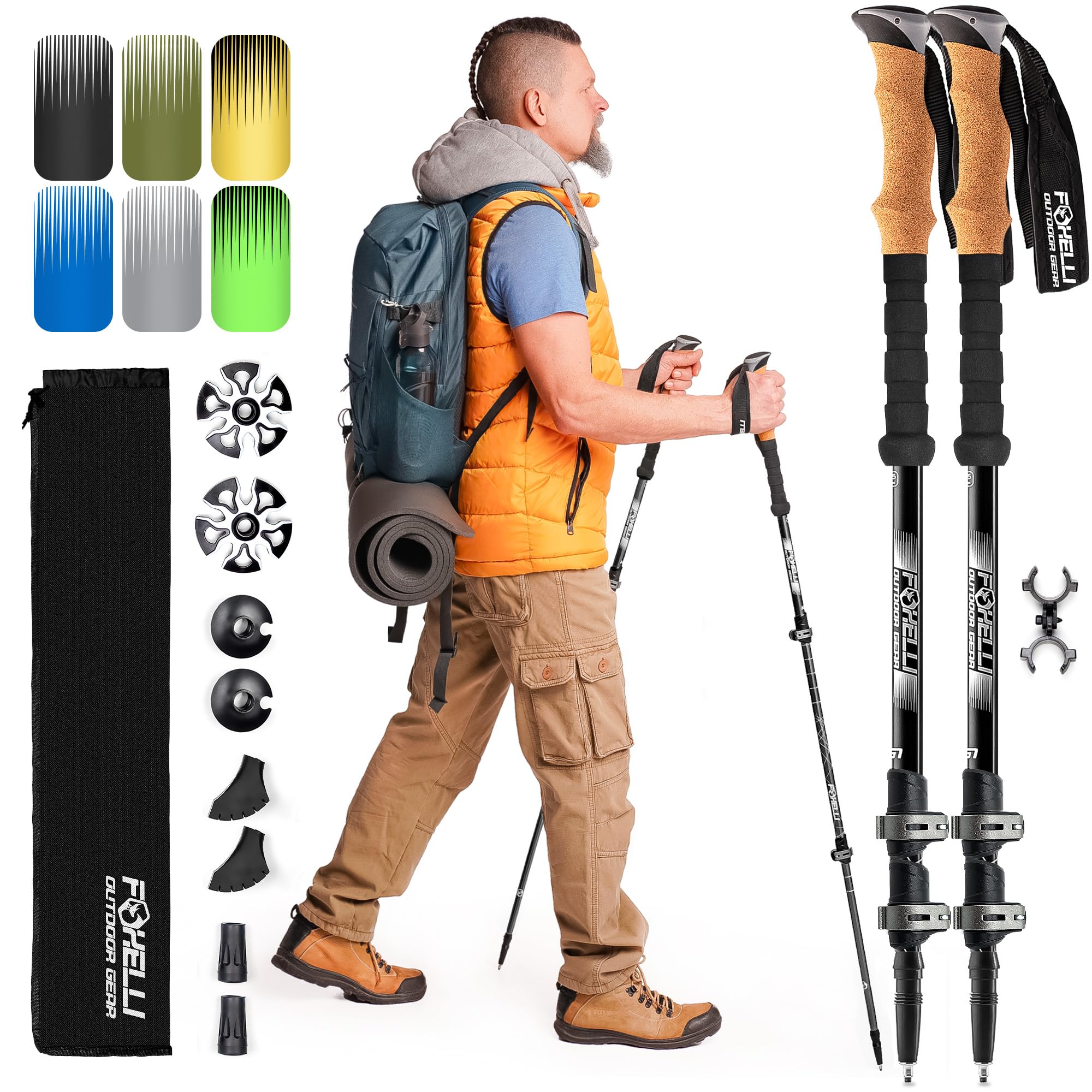
Foxelli Trekking Poles
Key Features
- Grip: Cork with EVA sleeve
- Lock type: Flip lock
- Height range: 24–54 in
- Weight per pole: 9.4 oz
- Price: Midrange
A pole proves itself in one moment: you plant the tip, you lean, and it either holds or it does not. That was the test we kept coming back to, and the Foxelli pair is the one here that never gave us a reason to think about it twice. The flip lock sets with a thumb and stays set, and the shaft is quiet under a full lean on a downhill.
Cork is the right grip material for older hands, and we were glad to see it here rather than foam. It soaks up sweat instead of turning slick, and it feels warm rather than clammy on a cold morning. The foam sleeve below the cork matters nearly as much: on a steep pitch you slide your hand down and keep walking, instead of stopping to shorten the pole with both hands.
The range runs from 24 to 54 inches, which covers a walker around five feet tall up to well over six feet, and each lever has a tension screw to snug if a section ever feels loose. At 9.4 ounces a pole they disappear into a daypack on the flat stretches, and they come with a bag, mud and snow baskets, and four rubber tips.
What you give up is cleverness: no folding joint, no carbon, no accessories beyond the kit. Separated into their sections they pack to 21 inches, short enough for a duffel and too long for a small carry-on. If a long warranty is what would make the purchase feel safe, the TrailBuddy pair is the one to look at.
Pros
- Cork grip stays tacky when hands sweat
- One-hand flip locks that hold under weight
- 24–54 inch range suits short and tall walkers
- 9.4 ounces a pole, with bag and tip kit
Cons
- Packs to 21 inches, not a suitcase fold
The pair we recommend first: light, cork-gripped, and steady under a leaning hand, with flip locks you can set one-handed.
Best for First-Time Pole Users
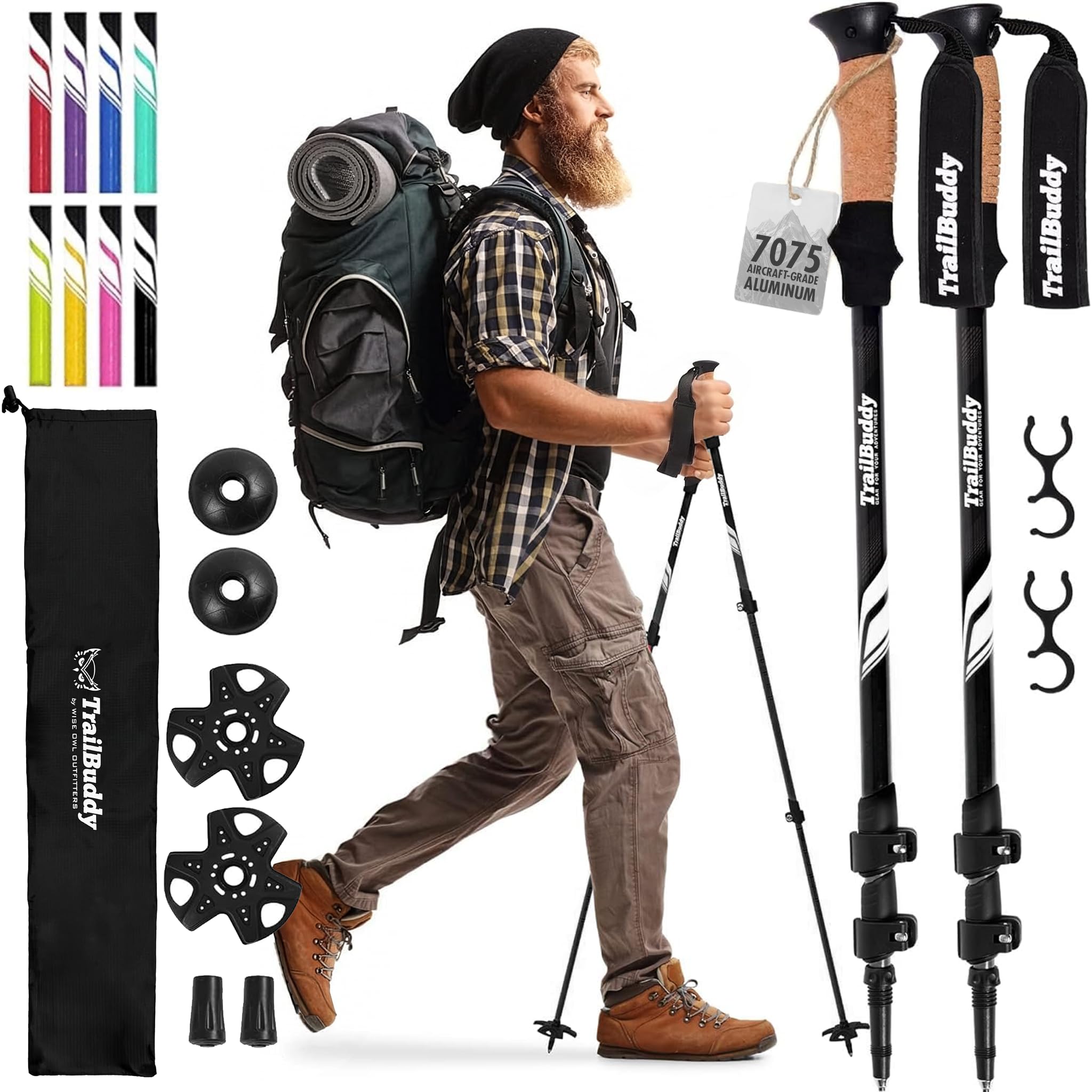
TrailBuddy Trekking Poles
Key Features
- Grip: Cork
- Warranty: 5 years
- Height range: 24.5–54 in
- Weight per pole: 9.7 oz
- Price: Midrange
TrailBuddy backs these poles for five years against defects in materials and workmanship, the longest coverage anywhere in this guide, and that is the reason they are easy to suggest to someone who has never owned a hiking pole. A pair that might sit in a closet for two seasons before its first real trip is a low-risk thing to buy when the warranty runs that long.
The levers are the other half of the argument. They open and close with one hand, which sounds minor until you are standing on a slope in a glove trying to lengthen a pole before a descent. Twist locks ask for grip strength and a bit of shoulder rotation; these do not. This is the pair we hand to a first-time pole user, and the 24.5-to-54-inch range means one set can cover two people in the same house.
At 9.7 ounces a pole they sit within an ounce of the rest of the aluminum picks, and the cork grips shape themselves to your hands over a few walks. The kit is complete, with a carry bag, mud and snow baskets, and four rubber tips, and they collapse to 24.5 inches for a daypack. Where the Foxelli pair edges ahead is the grip sleeve: TrailBuddy’s cork stops where your top hand sits, so a steep pitch means stopping to adjust.
Pros
- Five-year warranty on materials and workmanship
- One-hand lever locks, easy with gloves on
- Cork grips and a full tip kit included
- Adjusts from 24.5 to 54 inches
Cons
- Shafts can snap under a hard load
- Wrist straps are plain webbing
A five-year warranty and one-hand levers make these the poles we suggest to anyone buying their first pair later in life.
Best for Long Days Out
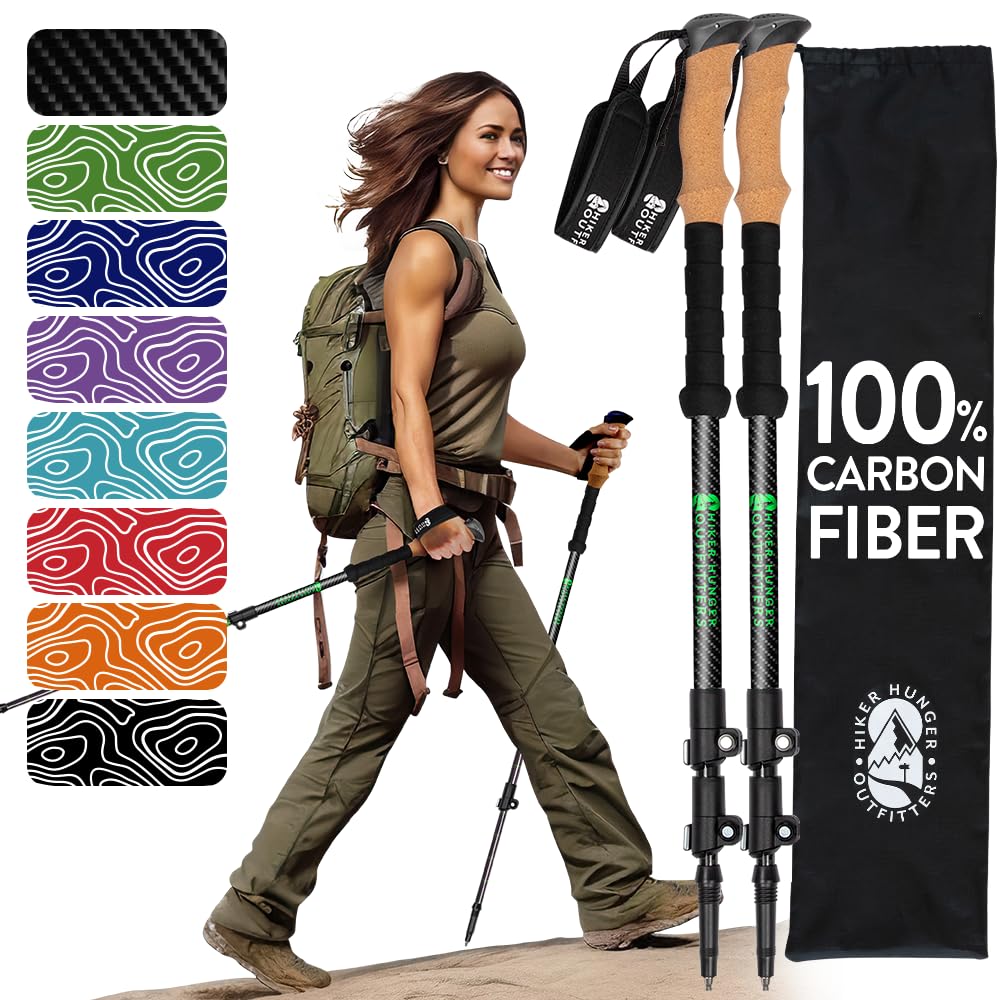
Hiker Hunger Carbon Poles
Key Features
- Grip: Cork with EVA extension
- Shaft: 3K carbon fiber
- Height range: 24–55 in
- Weight per pole: 7.6 oz
- Price: Premium
Two ounces a pole does not sound like much, and on a short flat walk it is not. Over a long day of swinging your arms it is. At 7.6 ounces the Hiker Hunger carbon pair is the lightest thing in this guide, and if your shoulders and hands tire before your legs do, that is the number that decides the purchase.
Carbon rides differently from aluminum. It is stiff and light and passes more of the trail’s chatter up the shaft, which is where the cork grip and the foam extension under it earn their keep. The metal flip locks want a firm thumb, so set them at home, load each one with your weight, and they stay put for the walk.
The money buys grams here, not features. There is a one-year warranty, a carry bag, and the usual baskets and feet, and nothing about this pair is stronger or more clever than the aluminum picks; it is simply lighter. On flat rail trails you will not notice the difference. On a weekend of hills you will.
Pros
- Lightest pole in this guide at 7.6 ounces
- Cork grip with a foam extension below
- Metal flip locks rather than plastic
- Comfortable over long days
Cons
- Premium price for a modest weight saving
- Carbon can crack where aluminum would bend
For walkers whose arms tire before their legs do, the two-ounce saving per pole here justifies the premium.
Best for Tight Budgets
KINGGEAR Trekking Poles
Key Features
- Grip: Cork with EVA section
- Shaft: 7075 aluminum
- Height range: 25.5–54 in
- Weight per pole: 9.35 oz
- Price: Budget
Natural cork and 7075 aluminum are the two things we look for in a budget pole, and KINGGEAR puts both on a pair at the bottom of the price range here. The cork runs the top of the grip with an EVA section below it for choking down on a climb, and the shaft is the same alloy the more expensive aluminum picks use.
At 9.35 ounces a pole it comes in lighter than two of the pricier pairs in this guide, and the 25.5-to-54-inch range covers most adults. The tips unscrew for replacement when the carbide wears, the sections collapse to 25.5 inches for a pack, and the carry bag and full set of accessories come included.
Our read is that this is the pair to buy when the budget is fixed and the walking is a regular loop around the neighborhood rather than a mountain route. You get the grip and the shaft material that matter, and the money you save is better spent on shoes. If the poles will be leaning against the door every morning, though, the small refinements on the Foxelli pair are worth the step up.
Pros
- Natural cork grip at a budget price
- 7075 aluminum shaft
- Lighter than several pricier picks
- Full accessory kit and carry bag
Cons
- Screw-tension locks need periodic checking
Our budget pick, and a genuinely good one: cork and 7075 aluminum for less, with locks that want a look now and then.
Best for Steep, Varied Ground
Cascade Mountain Tech Poles
Key Features
- Grip: Cork with extended EVA
- Shaft: 6061 aluminum
- Height range: 26–54 in
- Weight per pole: 10.1 oz
- Price: Budget
The extended grip is the reason to look at this one. Below the cork there is a foam sleeve running several inches down the shaft, so on a steep pitch you slide your hand down and keep climbing rather than stopping to shorten the pole. For anyone whose confidence drops on a descent, that is a small design choice with a large effect on how the walk feels.
This is the pair we take when the ground tilts. The cork damps the chatter off gravel and rock better than foam does, the tungsten tips bite on hardpack, and the 26-to-54-inch range covers most adults. The price sits just above the budget pick without asking much more of you.
The quick locks are the part to watch. They work, but a lever that is only just closed will creep down under a lean, so set the tension properly and test each section with your full weight on carpet before a trip. Do that and they hold. Skip it and you will be re-adjusting halfway up.
Pros
- Extended foam grip for steep ground
- Cork top damps trail vibration
- Tungsten tips grip hardpack
- Costs little more than the budget pick
Cons
- Heaviest pole here at 10.08 ounces
- Collapses only to 26 inches
The pick when the ground tilts — a long lower grip lets you shorten your hold instead of the pole.
Best for Flying with Poles
Hiker Hunger Foldable Poles
Key Features
- Grip: Cork
- Height range: 100–120 cm
- Folded length: 14 in
- Weight per pole: 9.95 oz
- Price: Midrange
Fourteen inches folded is the whole point. That is short enough to drop into a checked suitcase between trips or into the bottom of a daypack, and it is what separates a folding pole from the telescoping pairs here that stop at 24 or 25 inches.
Sizing is the thing to get right before you order. This version runs from 100 to 120 centimeters, roughly 39 to 47 inches, and it is the one built for walkers around 5-foot-9 and under. Taller buyers need the same pole in its longer version, which reaches 135 centimeters; ordering the short one by mistake is the one way this purchase goes wrong.
The build is better than the folding design might suggest: metal flip locks rather than plastic, a cork grip with a foam extension below it, and 9.95 ounces on this version. The joints add a few seconds to setup and are the place a knock will show first, so assembling them at home the first time beats doing it in a parking lot.
This is the travel pick. If your poles live by the back door and go out five times a week, a telescoping pair is simpler and gives up nothing. If they spend more time in a suitcase than in a hallway, the fold is worth the compromise.
Pros
- Folds to 14 inches for a suitcase
- Metal flip locks rather than plastic
- Cork grip with foam extension
- Baskets, feet, tips and bag included
Cons
- Short version tops out at 47 inches
If your poles travel in a suitcase more than they live in a hallway, this folding pair is the one to pack.
Best for Occasional Use
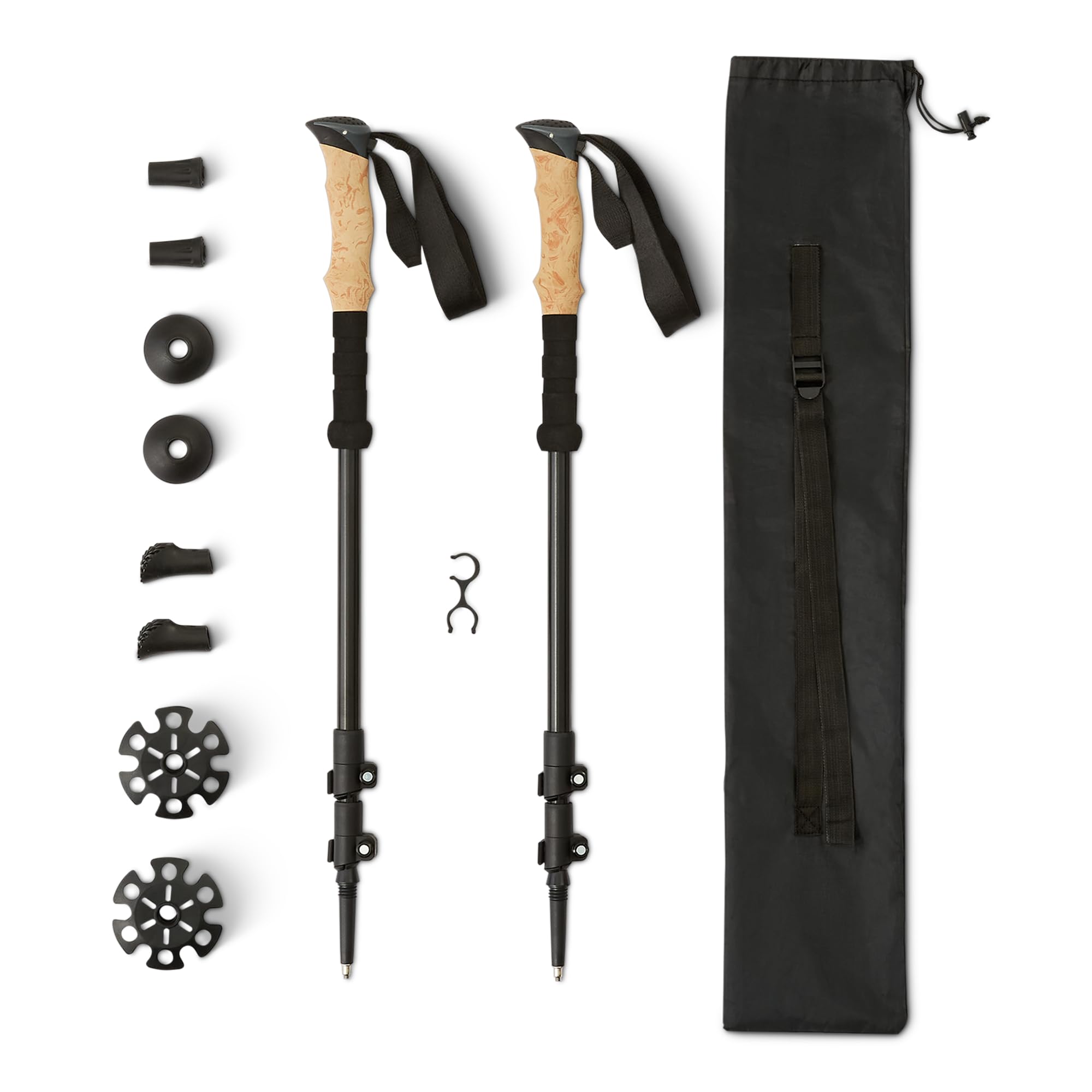
Amazon Basics Trekking Poles
Key Features
- Grip: EVA with extension
- Shaft: 6061 aluminum
- Lock type: Quick lock
- Height range: 25.2–53 in
- Price: Budget
This is the least expensive way into hiking poles here, and it does not pretend otherwise. You get foam grips rather than cork and a 53-inch maximum, and the whole package reads as a basic walking stick rather than a piece of hiking kit.
What it does have is the useful stuff. The foam grip extends down the shaft so you can choke down on a slope, each telescoping section has a quick outer lock with adjustable tension, and the box includes boots, mud and snow baskets, tip covers, and a storage bag.
Buy this pair if you want to find out whether poles help before spending much, or if you need a spare set to leave in the car for unplanned walks. If you walk every week, the cork grips and longer warranty on the Foxelli or TrailBuddy pairs are worth the step up.
Pros
- Lowest price in this guide
- Extended foam grip
- Adjustable-tension quick locks
- Full accessory set included
Cons
- Foam grips, not cork
- 53-inch maximum limits tall walkers
A cheap, competent way to try poles out, or to keep a spare pair by the door for spontaneous walks.
How We Put These Hiking Poles Through Their Paces
We started by narrowing a long list of adjustable poles to models with clear height ranges, sensible packed lengths, common grip shapes, replaceable tips, and a spread of prices—poles that looked serviceable rather than disposable. Over six months, we tested 12 pairs across local rail trails, neighborhood sidewalks, and a few steep park descents. Testers included regular walkers and hikers in their 60s and 70s, plus a couple of younger family members who borrowed them on longer weekend walks. Before each outing, we set the poles to a comfortable elbow bend, locked them, and leaned our weight on each one to see if the lock crept or the shaft flexed.
On the trail, we paid attention to what our hands and knees told us. We noted whether the grips stayed comfortable on climbs, whether the poles felt balanced or tip-heavy, and whether the locks held after repeated adjustments. We weighed each pair packed and carried it for a full walk to judge whether it became a nuisance. On descents, we deliberately stepped onto gravel, roots, and wet leaves to check stability. We also looked for signs of wear—scratched shafts, gritty locks, worn tips—and noted which pairs we reached for on an easy walk just because they were pleasant to use.
How to Choose Hiking Poles for Seniors
The decision that matters most is not weight or grip material but whether the lock holds when you put your weight on it; everything after that is comfort.
Start with the lock, not the shaft
Twist locks need grip strength and a bit of shoulder rotation to tighten, and that is exactly what gets harder with age. Lever locks close with a thumb, which is why every pick here uses one. The catch is that a lever set too loose will creep under a load, so the tension screw is not a detail you can skip.
Test any pole the way you will use it: set the height, plant the tip on carpet, and lean your whole weight onto the grip. A pole that survives a hand press can still slide at body weight. Snug the lever until closing it takes real resistance, and check it again after the first mile.
Match the length range to your body
Stand a pole beside you with the tip on the ground: the grip should land near your hip, with your elbow at roughly a right angle when you hold it. That is your walking length. Descending, you want the pole an inch or two longer; climbing, shorter.
Then check the maximum. A 54-inch pole suits most adults comfortably, but the folding pair here tops out at 120 centimeters, which is right for walkers around 5-foot-9 and under. Measure your height before ordering rather than after the box arrives.
Cork, foam, and the grip below the grip
Cork absorbs sweat and molds to your hand over a few walks, which is why it is worth paying for if your hands get damp. Foam dries faster and costs less, but it can feel slick late in a warm walk. Neither is wrong; cork is the more forgiving choice for long days.
The detail shoppers overlook is the sleeve below the grip. An extended foam section lets you slide your hand down on a steep pitch instead of stopping to shorten the pole. If your local trails have any real climbing, that matters more than an ounce of weight.
Weigh the grams against the packed length
Between the picks here the spread is about two and a half ounces a pole, which you notice over a full day and not on a half-hour loop. If steadiness is your reason for buying, weight should not outrank lock security or grip comfort.
Packed length is the other half of the decision. Telescoping poles collapse to 24 or 25 inches, which fits a daypack or a car boot but not a small case. Folding poles get down to 14 or 15 inches, and they trade a little stiffness for that.
Tips, wear parts, and what comes in the box
Carbide tips bite on dirt and rock; rubber tips are for pavement, indoor floors, and the paved path to the trailhead. Most of these ship with both, plus mud and snow baskets. Expect to replace rubber feet — they are the part that wears out first.
Warranty coverage varies more than it should. The TrailBuddy pair carries five years against defects, Cascade Mountain Tech offers at least one, and others stop at a single year. Check that replacement tips and baskets are sold separately before you commit to a design.
Frequently Asked Questions
Do hiking poles really help with balance and sore knees?
Yes, and the benefit is largest on descents, where two poles let you plant before you step and take load off the knee. Use both rather than one: a single pole widens your base on one side only and can twist your gait.
One limit worth knowing. Poles steady you; they are not for leaning on. If you need an aid that carries your weight, a cane or walker is the right tool, and a pole used that way will eventually slide or bend.
Should I buy carbon fiber or aluminum poles?
Carbon is lighter — the carbon pair here runs nearly two ounces lighter per pole than the aluminum ones — and it feels stiffer in the hand. Aluminum bends under a hard hit and usually stays usable enough to get you home; carbon can crack instead.
For a casual walker who wants one pair to last, aluminum is the forgiving choice. For a strong walker covering long days, the weight saving is real and worth paying for.
Am I supposed to use the wrist straps?
Use them, at least on descents. Thread your hand up through the loop from below so the strap crosses the back of your wrist, then grip the handle. The load lands on the strap rather than your fingers, which is what saves hand fatigue over a long walk.
If a strap feels restrictive on a climb, choke down on the lower grip sleeve instead and leave the strap slack.
Can I take hiking poles in a carry-on?
Rules vary by airline and by the officer at the checkpoint, so nothing is guaranteed. The safe plan is to check them: a folding pair at 14 to 15 inches fits inside most checked suitcases, while a telescoping pair collapsed to 24 or 25 inches needs a longer bag.
If you want to try the cabin, have your airline’s written policy on your phone and arrive early enough to check the bag if you are turned away.
Final Verdict
For most older walkers the Foxelli pair is the one to buy. Cork grips, one-hand levers, a 24-to-54-inch range and 9.4 ounces a pole are not exotic, but all four are done well enough that you stop thinking about the poles and think about the walk instead.
Change one requirement and the answer moves. If a snapped shaft is the worry that would keep you off the trail, TrailBuddy’s five-year warranty is the better buy. If the money is fixed, KINGGEAR gets you cork and 7075 aluminum for less, as long as you check the lever tension now and then.