This post contains affiliate links. We may earn a small commission when you buy through our links — at no extra cost to you.
The first sign that a trekking pole is wrong for backpacking usually shows up on a descent: the lock slips under a loaded pack, the tip skitters on wet rock, or the grip starts rubbing a hot spot into your palm. A good pair should disappear into the rhythm of a long day, adding stability on loose ground and taking the pounding off your knees without feeling like dead weight in your hands. They also need to adjust quickly for different hikers and stay light enough that you don’t resent carrying them on the flats.
Over the past eight months, we tested 14 pairs on local training hikes and three overnight backpacking trips. We loaded packs, lent poles to hikers from 5’2" to 6’4", and used them to pitch shelters and cross muddy creeks. What separated the good from the bad wasn’t just weight—it was whether the locking mechanisms held under load, whether the poles felt stable on descents, and whether the tips and joints survived being packed away wet. The picks below earned a spot by the door.


Best for Loaded Backpacking
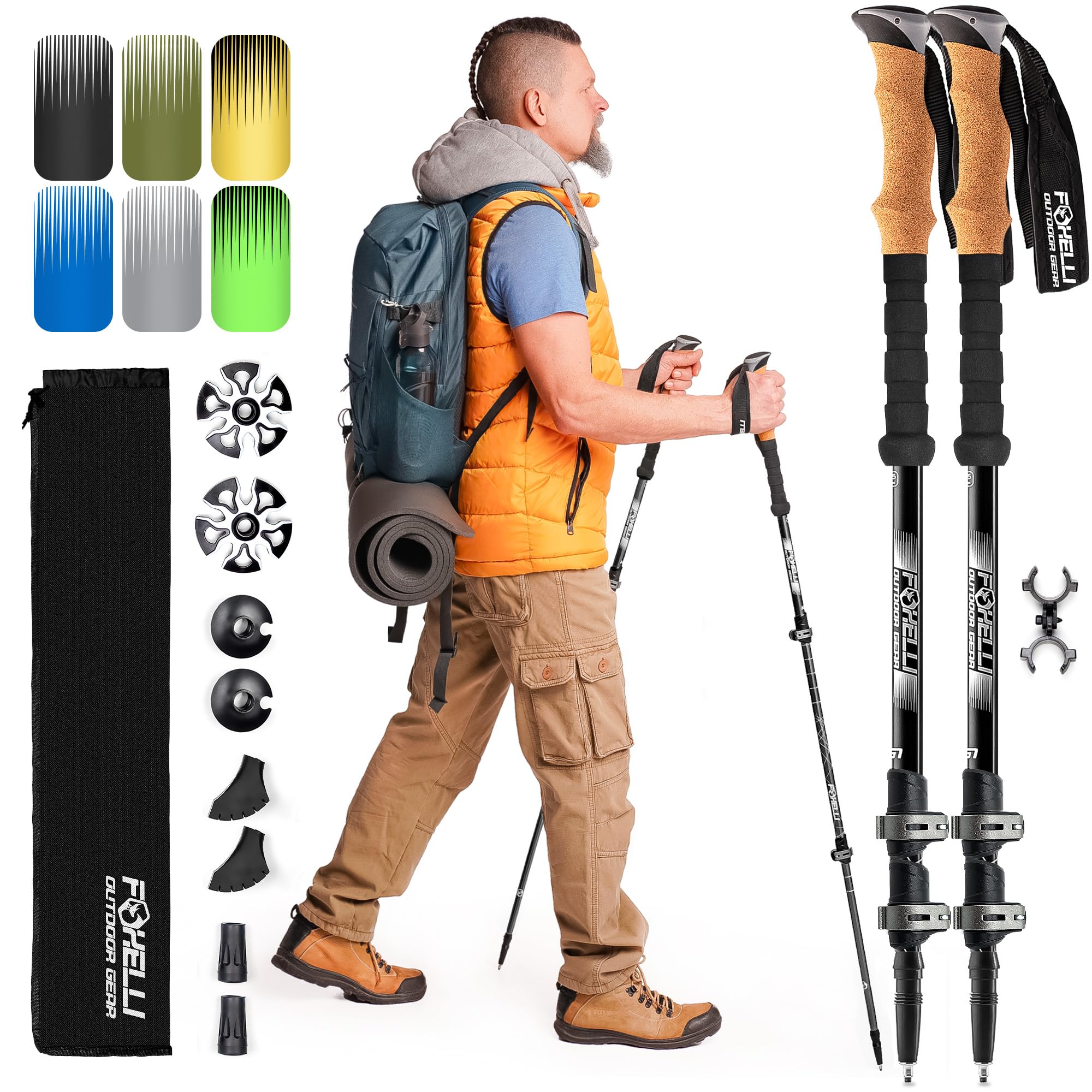
Foxelli Aluminum Trekking Poles
Key Features
- Grip: Cork with EVA extension
- Length range: 24 to 54 in
- Packed length: 24 in
- Weight per pole: 9.4 oz
- Price: Midrange
9.4 ounces a pole is a good figure for an aluminum trekking pole, but it is not the reason this pair sits at the top. It is that nothing about them asks for forgiveness. The flip locks hold the length you set, the shaft stays rigid when you drop your weight onto it on a descent, the cork grip does not turn in your hand on a wet climb, and the whole thing behaves like gear built by someone who has carried a pack up a hill.
The grip setup is what we appreciated most on longer days. Natural cork molds to your hand and stays drier than foam, and there is a soft EVA section below it, so when a climb gets steep enough that you want to palm the top of the pole, your hand has somewhere to go that is not bare shaft. The wrist straps adjust without a fight, which is the sort of thing you notice only when it is wrong.
The one structural compromise is packed length. These collapse to 24 inches, normal for a telescoping pole and still long enough that they will not disappear into a small overnight pack, so they ride strapped to the outside. That is fine until you are bushwhacking through scrub or handing a bag to an airline counter. If storage inside the pack matters more than grams, a folding pole is the answer.
What keeps us coming back is how little upkeep the pair asks for. Wipe the shafts, check the lock tension at the start of a season, and they do the same thing trip after trip. For a first pair, or a replacement for the set that finally died on a scree slope, that steadiness is worth more than shaving another ounce.
Pros
- Holds its length under a loaded step
- 9.4 oz per pole with cork grips
- Adjusts 24 to 54 inches with flip locks
- Ships with baskets, tips, and a carry bag
Cons
- 24-inch packed length rides outside a small pack
We point most backpackers here: light enough to carry all day, rigid under a loaded step, and simple enough that nothing on it needs babysitting.
Best for Counting Grams
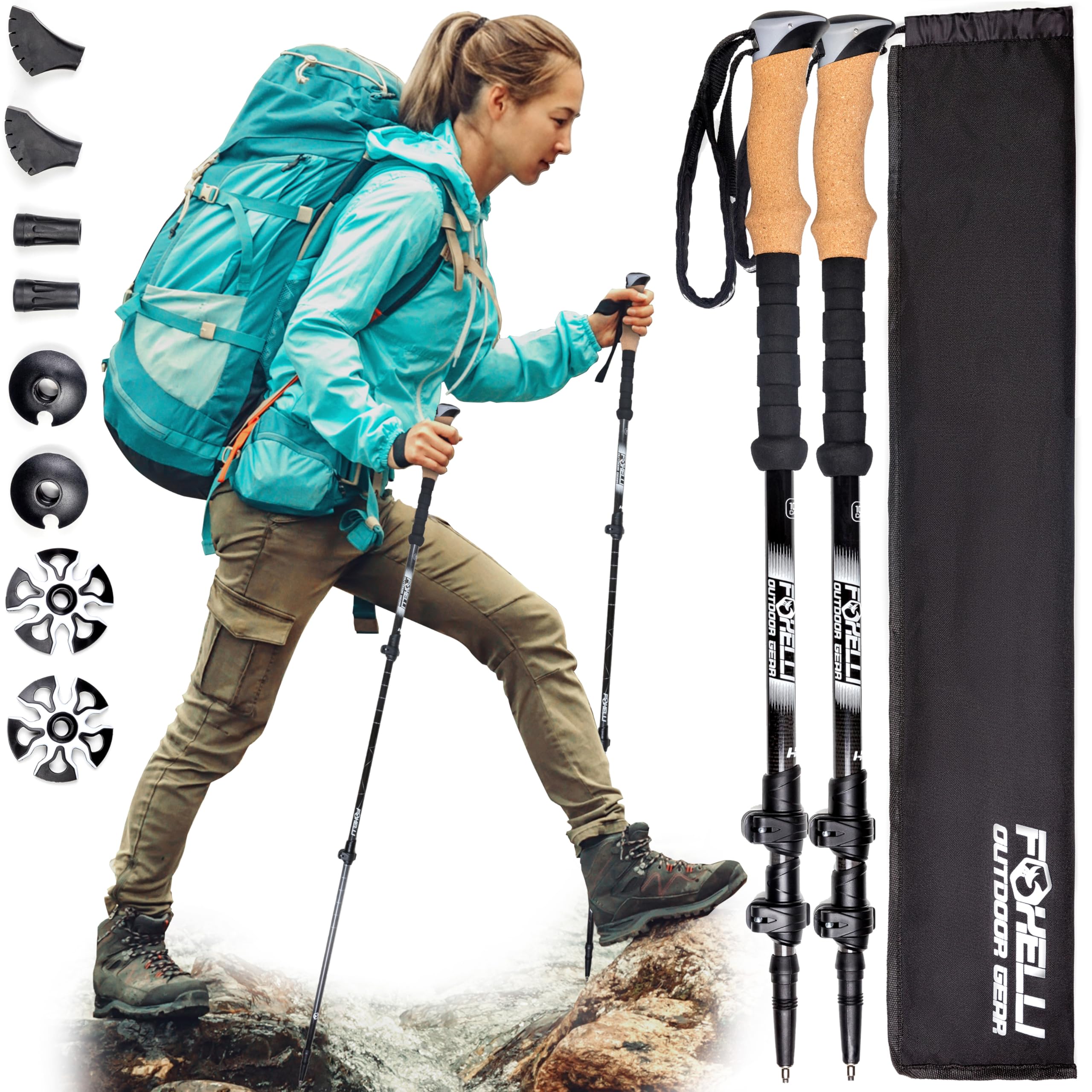
Foxelli Carbon Fiber Trekking Poles
Key Features
- Shaft: 3K carbon fiber
- Length range: 24 to 55 in
- Packed length: 24 in
- Weight per pole: 7.6 oz
- Price: Premium
Nearly two ounces lighter per pole than our top pick, and the difference is legible on a climb. You swing a light pole instead of hauling it, and by the fourth hour of uphill that is the number deciding how fresh your shoulders feel at the top. The shaft is 3K carbon fiber, and the grip setup copies the aluminum pair: natural cork over an EVA extension, with flip locks and a 24-inch collapsed length.
Our view is that the weight is the smaller half of the decision. Carbon is lighter and stiffer, and it fails differently from aluminum. A bent aluminum shaft can often be straightened enough to finish the trip; a cracked carbon one can let go under load with no warning. That is the trade you accept, and it is why the aluminum pair stays first for remote routes and heavy packs. Of the carbon poles we covered, though, this is the one we trust most with our weight on a descent.
The rest is familiar: a 24-to-55-inch range that reaches an inch higher than the aluminum version, which helps at the tall end, plus a full set of baskets and rubber tips for mud, snow, and rock. It is the pair for a trip where you are counting grams and the route is mostly trail rather than talus, and where a snapped shaft would be an inconvenience rather than an evacuation.
Pros
- 7.6 oz per pole, the lightest here
- Stiff carbon shaft with cork and EVA grips
- Reaches 55 inches, the tallest here
Cons
- Carbon can crack where aluminum bends
- Single year of warranty coverage
The ultralight choice: 7.6 ounces a pole, stiff under load, and the carbon shaft we trust most in this group, worth it if pack weight is your priority.
Best for Tight Budgets
KINGGEAR 7075 Trekking Poles
Key Features
- Shaft: 7075 aluminum
- Length range: 25.5 to 54 in
- Packed length: 25.5 in
- Weight per pole: 9.35 oz
- Price: Budget
A budget pole has one job: prove it is not a false economy. KINGGEAR makes a reasonable case for itself. The shaft is 7075 aluminum, the stronger of the two alloys used in this guide, and at 9.35 ounces a pole it is within a whisker of our top pick’s weight. The natural cork grip carries an EVA section below it for steep ground, and the length runs from 25.5 to 54 inches, which covers most adults.
The locks are where the money went missing. They are flip levers and they hold, but the tension screws work loose and want a periodic turn; when one backs off, the pole shortens under your weight, which is the worst possible moment to find out. Set them with a screwdriver before a trip and check again at the trailhead and the problem mostly disappears. We think of this as the pair to buy when the budget is fixed and the trips are ordinary: three-season backpacking with a normal load, where a scuff on granite should not cost you a season. The lifetime guarantee helps that arithmetic too, since it is more coverage than several pricier pairs here offer.
Pros
- 9.35 oz per pole, close to the top pick
- Cork grip with an EVA lower section
- Lifetime guarantee coverage
Cons
- 25.5-inch packed length will not fit a small pack
The best value here: 7075 aluminum at 9.35 ounces a pole, cork grips, and a lifetime guarantee, provided you are willing to keep an eye on lock tension.
Best for Shared Use
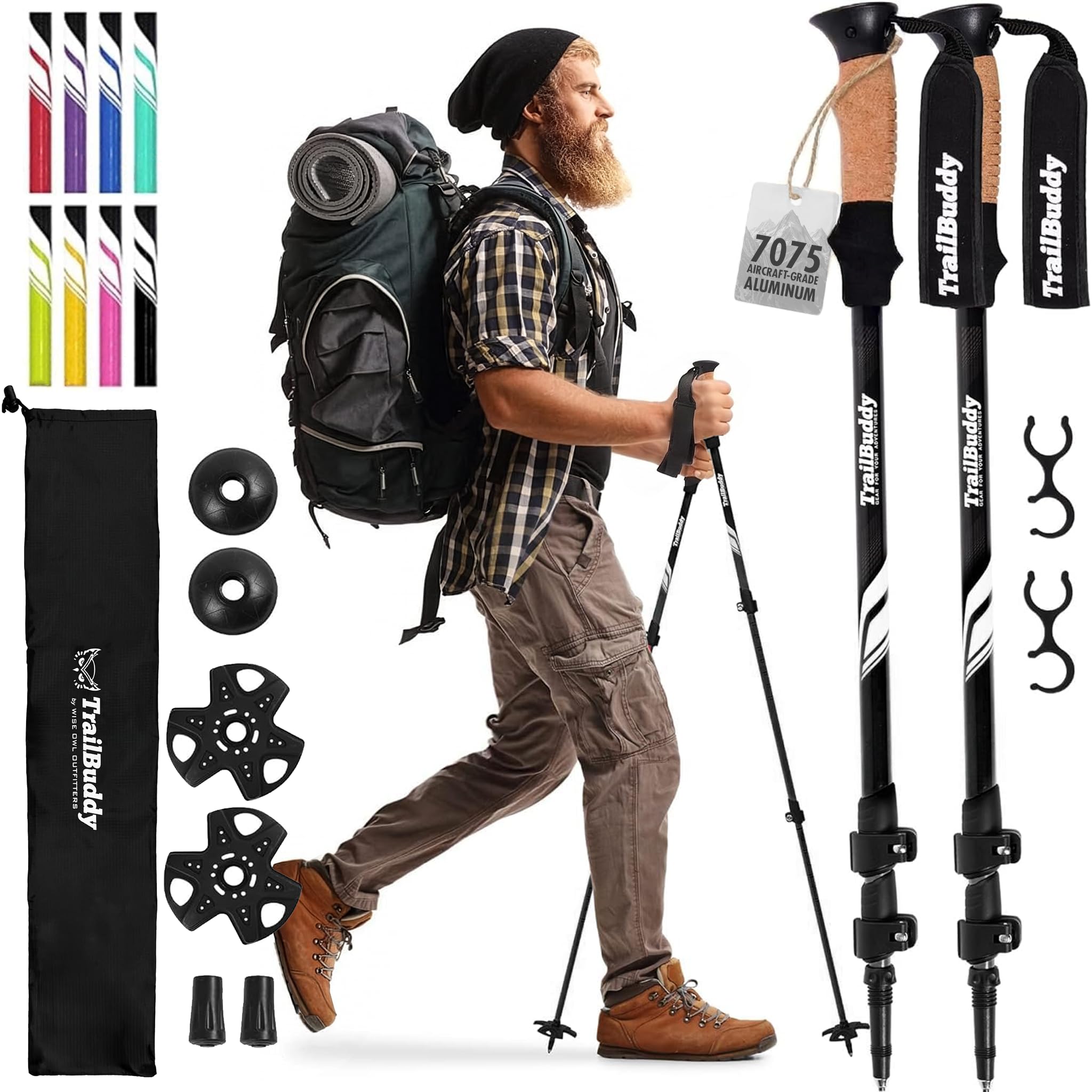
TrailBuddy Trekking Poles
Key Features
- Lock type: Lever
- Length range: 24.5 to 54 in
- Packed length: 24.5 in
- Weight per pole: 9.7 oz
- Price: Midrange
Collapsed to 24.5 inches and stretched to 54, this pair covers more people than anything else in the guide. The low end is short enough to work as a kid’s pole on a family trip, and the top of the range handles a tall adult without maxing out. They run on lever locks you can pop with a thumb, which matters more than it sounds when you are wearing gloves and the wind is up.
At 9.7 ounces a pole they sit within a whisker of the top pick, on the same 7075 aluminum. Portability is the other quiet strength: they break down small enough for a suitcase, and the carry bag keeps trail mud off the rest of your kit. The cork handles are shaped to mold to your hand, and the padded straps sit flat against the wrist instead of biting into it.
What we keep noticing is how well the pair handles being handed around. One set, run short for a teenager and long for an adult, covers a household’s whole season. That is the sort of flexibility that keeps a pair out of the gear closet, and it is why we keep one of these in the loaner pile.
Pros
- Range covers 24.5 to 54 inches
- One-handed lever locks
- Five-year warranty, the longest here
- 9.7 oz per pole with cork grips
Cons
- Shafts can snap under a hard load
The most adaptable pair here: 24.5 to 54 inches, thumb-friendly lever locks, and five years of coverage at a weight that will not bother you on the climb.
Best for Small Packs
Hiker Hunger Foldable Trekking Poles
Key Features
- Grip: Cork with EVA extension
- Length range: 100 to 120 cm
- Packed length: 14 in
- Weight per pole: 9.95 oz
- Price: Midrange
Fourteen inches folded is the whole argument. A telescoping pole collapses to 24 or 25 inches and then rides outside your pack; this one drops into a daypack, a duffel, or the lid of an overnight pack and disappears. On a trip where the poles come out for the steep parts and go away for the scrambly ones, that is worth more than an ounce or two.
It is built the way folding poles are built. Aluminum sections join on an internal cord, metal flip locks set the length, the joints where sections meet are reinforced, and the cork grip has an EVA extension below it for steep ground. At 9.95 ounces a pole it is not the lightest thing here, but for an aluminum folder it is respectable, and the collapsed package is what you are buying.
Sizing is the part to read carefully. The version here runs 100 to 120 centimeters, which suits hikers around 5 feet 9 and under. A longer version covers taller users, and if you are near the top of that range you want the long one. Treat the 120-centimeter ceiling as a real limit rather than a suggestion.
We reach for this pair when the route mixes hiking with hands-on scrambling or travel, and when the pack is already full. The costs are a few extra seconds at the trailhead while you seat the sections, and joints that give a little more than a straight telescoping shaft. Neither has been enough to leave it behind, and on a trip with a tight pack neither will be for you either.
Pros
- Folds to 14 inches for inside-pack storage
- Metal flip locks and reinforced joints
- Two frame sizes, short and long
- Cork grip with EVA extension
Cons
- Sections need assembling at the trailhead
The one to pack when space matters more than grams: folds to 14 inches, locks with metal levers, and comes in two frame sizes so shorter hikers get a proper fit.
Best for First-Time Buyers
Cascade Mountain Tech Trekking Poles

Key Features
- Grip: Cork with extended EVA
- Length range: 26 to 54 in
- Packed length: 26 in
- Weight per pole: 10.1 oz
- Price: Budget
The long EVA section under the cork grip is what sells this pair. Traversing a slope, you choke down on the lower grip instead of stopping to shorten the pole, which is the same trick the expensive sets use on the cheapest pair we recommend. Add a cork upper that stays dry in the heat and the handle end of these poles is genuinely well thought out.
The kit is the most complete here: tungsten carbide tips, rubber tips over them, boots, snow and mud baskets, tip covers, and a travel bag. That is a set you can take from a summer trail to a snowy approach without buying anything else. The shaft is 6061 aluminum at 10.08 ounces a pole, adjustable from 26 to 54 inches and collapsing to 26.
The clamps are where it comes apart. Cascade’s quick locks hold when they are tensioned properly and slip when they are not, and a pole that shortens under your weight on a descent is worse than no pole at all. Set the screws at home, lean your full weight on each pole to test, and check them again before a long trip. Do that and this is a lot of pole for the money; skip it and you will spend the day fighting them.
Pros
- Extended EVA grip below the cork
- Complete tip and basket kit included
- 26 to 54 inches of adjustment
Cons
- 26-inch packed length is the longest here
A well-equipped first pair with a genuinely useful extended grip, as long as you set the lock tension properly and check it before every trip.
Best for Travel Trips
Trekology Trek-Z Trekking Poles

Key Features
- Grip: Cork
- Length range: 110 to 130 cm
- Packed length: 15 in
- Weight per pole: 11.5 oz
- Price: Midrange
The case for a folding pole turns up on the days when hiking is not the whole plan: a scramble where both hands are needed, a bus, a packed suitcase. The Trek-Z breaks into three sections and stows at 15 inches, short enough to go inside a pack rather than ride on it, and it goes back together in seconds once you have the sequence down.
Cork grips absorb sweat on a hot climb, and the extension below the grip gives your hand a lower place to sit when the trail pitches up. The flip lock sets the length and, once tensioned, holds it. The whole thing runs on a tensioned internal cord that pulls the sections apart for storage and back together for use.
Where the design shows its seams is under load. Three sections and a couple of joints mean the pole gives when you lean on it, and the cork grip is built to rotate slightly rather than torque your wrist, which is sensible on a maintained trail and less reassuring on a loose descent. We think of these as travel poles that hike: excellent company on a trip where walking is part of the itinerary rather than the whole of it, and a compromise that will show up on a multi-day route with a heavy pack.
Pros
- Folds to 15 inches in three sections
- Cork grip with a lower EVA extension
- Adjusts from 110 to 130 cm with a flip lock
Cons
- 11.5 oz per pole, heaviest here
- 130 cm maximum is short for tall hikers
A compact travel-first pole: 15 inches folded, cork grips, and a tri-fold design that stows inside a pack, best for trips where hiking shares the itinerary.
How We Tested Backpacking Trekking Poles
We started by gathering trekking poles built for backpacking rather than running or casual walking, filtering out fixed-length models, ones with lower sections that looked easy to bend, and weight claims that didn’t match the specs. That left 14 pairs, which we used over eight months on local training hikes and three overnight trips. We weighed every pair, adjusted them for hikers from 5’2" to 6’4", and packed them into daypacks and checked luggage to see how small and how heavy they really were.
On the trail, we loaded 30- to 35-pound packs and paid attention to steep descents, loose scree, wet roots, and muddy creek crossings. We noted whether the locking mechanisms slipped under weight, how much sideways flex the shafts showed when we leaned on them, and whether the grips stayed comfortable with and without gloves. We also used the poles to pitch shelters, probe unclear trail edges, and check stream depth, then collapsed them and packed them away wet to see how the joints and straps held up.
Durability and overall build quality got their own round of abuse: rock strikes, jammed tips, and weeks of grit working into the locks. We checked whether the adjustment sections still moved freely after each trip, whether the locks engaged at the same point every time, and whether the straps showed fraying. We also handed poles to different testers mid-hike to see how quickly and safely they could reset the length with gloves on and a pack still on their back.
How to Choose Trekking Poles for Backpacking
Two numbers decide most of your comfort on the trail, weight per pole and packed length, and both are routinely misread on a listing.
Read the weight and length figures carefully
A listing will say a pole weighs nine ounces, and it may mean one pole or the pair. The difference is most of a pound in your hands all day, so work out which figure you are reading before you compare anything. Packed length gets less attention and matters nearly as much: a telescoping pole collapses to somewhere between 24 and 26 inches, which is short enough for a suitcase but not for a daypack, so it rides on the outside of your pack.
A folding pole gets down to 14 or 15 inches and goes inside. Decide which of those two lives you lead before you look at anything else.
Aluminum or carbon: pick your failure mode
Carbon is lighter and stiffer, and it earns its price on long trail miles where you are counting grams. The trade is how the shaft gives out. Aluminum bends; a bent pole can often be straightened enough to get you off the mountain. Carbon cracks, and a cracked shaft can let go under a load without much warning, which is a poor outcome two days from a trailhead.
For remote routes with a heavy pack, we take aluminum and accept the extra ounces. For fast trips on maintained trails, carbon’s saving is real and worth having.
Locks: set them before you need them
Flip levers beat twist locks on a backpacking pole, because you can open and close them with a thumb instead of two hands and a lot of swearing in the rain. The lever is only half the system. There is a tension screw inside it, and it works loose over a season.
Set each lock with the pole fully extended, lean your weight onto it, and tighten until the section stops creeping. Do that at home and again at the trailhead and you have removed the most common reason a pole lets you down mid-descent.
Fit, grip, and the details you feel by hour six
A pole that is too short makes you stoop and one that is too long makes you reach; most adults land somewhere between 110 and 130 centimeters, so the range a pole offers matters more than its maximum. The extended grip below the handle is worth paying for if you traverse slopes, since it lets you choke down for a few steps instead of stopping to adjust.
Take the baskets, too. Wide ones for soft snow, small ones for rock, and rubber tips for pavement and scrambles where carbide scars the surface.
Frequently Asked Questions
How do I set trekking poles to the right length?
Stand on flat ground with the tips planted just in front of you and your hand on the grip. The top of the grip should sit around hip height with your elbow bent to roughly a right angle. Shorten both poles a few centimeters for a long climb, where you will be reaching up, and lengthen them for a descent where you want to plant them further ahead.
Do I need two poles, or is one enough?
For a loaded backpack, two. The second pole keeps your rhythm symmetrical, shares the load across both knees, and turns a stumble on a rough descent into a catch. One pole still earns its place if you need a hand free for a camera, a map, or a dog, and a folding design makes it easy to stow when the trail turns into a scramble.
Can I use trekking poles as tent poles or ski poles?
Not without losing your warranty. At least one maker here excludes both uses explicitly, and the logic applies across the category: a shaft bent past its intended load is not a manufacturing defect. If you are saving weight by pitching a shelter on your poles, check the maker’s terms first and use a shelter designed for it rather than improvising with a clamped pole.
Final Verdict
Buy the Foxelli aluminum pair. It is the one set here where weight, lock security, grip, and build all land on the right side of the line at once, and it asks nothing of you beyond an occasional check of the lock tension.
If the climb is long and the pack is light, the Foxelli carbon shaves nearly two ounces per pole and holds up better than the rest of the carbon field. If the budget is fixed, KINGGEAR gets you 7075 aluminum and cork for the least money here, with a lock you will want to keep an eye on.