This post contains affiliate links. We may earn a small commission when you buy through our links — at no extra cost to you.
A budget trekking pole has one job: stay rigid when you lean on it, then shrink down small enough to forget about. The trouble is that inexpensive pairs often cut corners in the locking mechanism, and a pole that telescopes under your weight mid-descent is worse than no pole at all. The right pair takes pressure off your knees, keeps you steady on loose ground, and is light enough that you stop noticing it on your pack.
The catch is that budget poles can feel like a gamble: some wobble, some straps chafe, and some tips wear down to nubs in a season. I’ve hiked with a rotating cast of cheap poles for years, and my team recently spent five months with 14 pairs on local trails, testing how easily they adjusted, how much they weighed, and whether the locks, straps, and tips held up. The best ones made the walk more enjoyable, not more fussy. A few stood out as genuinely stable underfoot; those are the ones worth carrying.


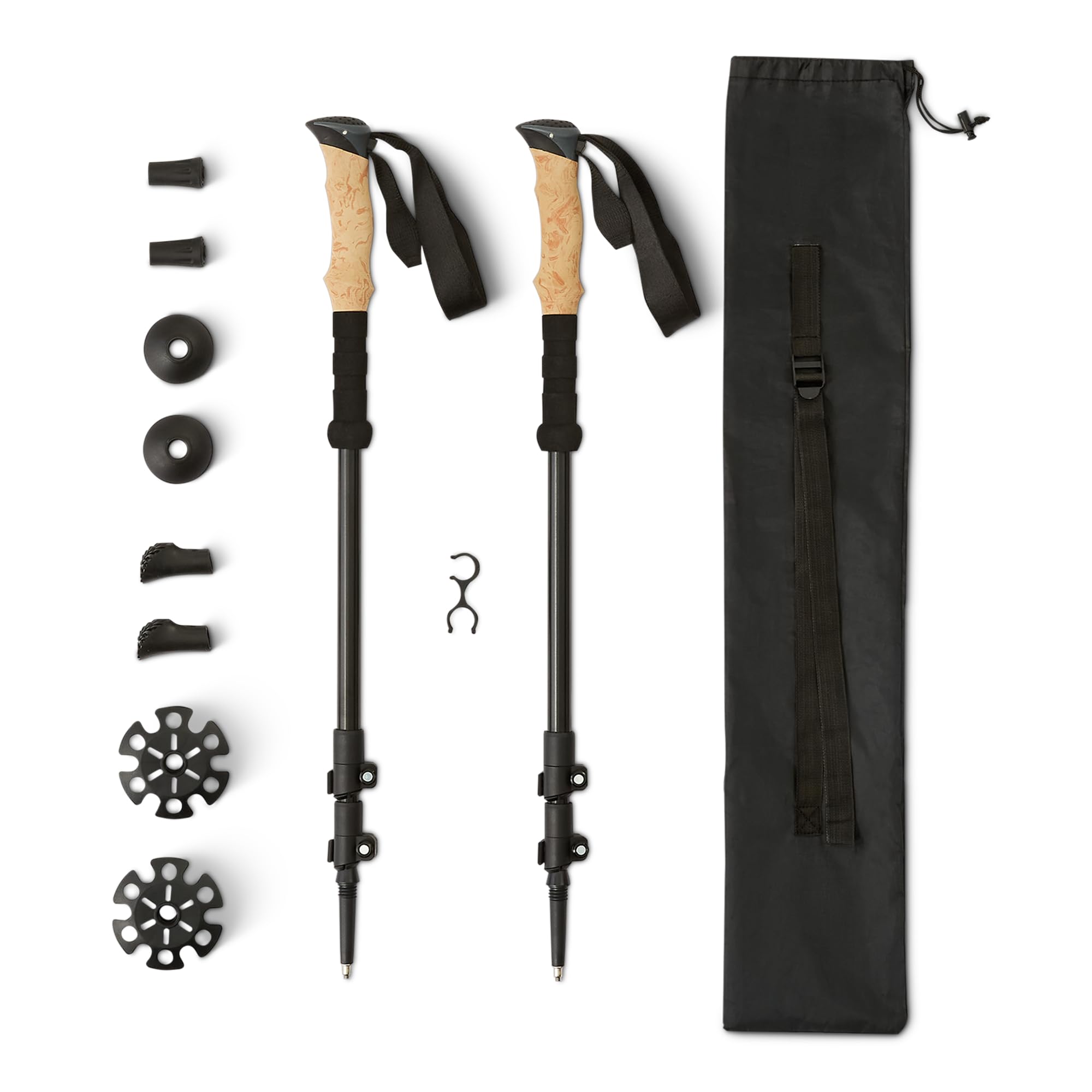
Best for All-Round Hiking
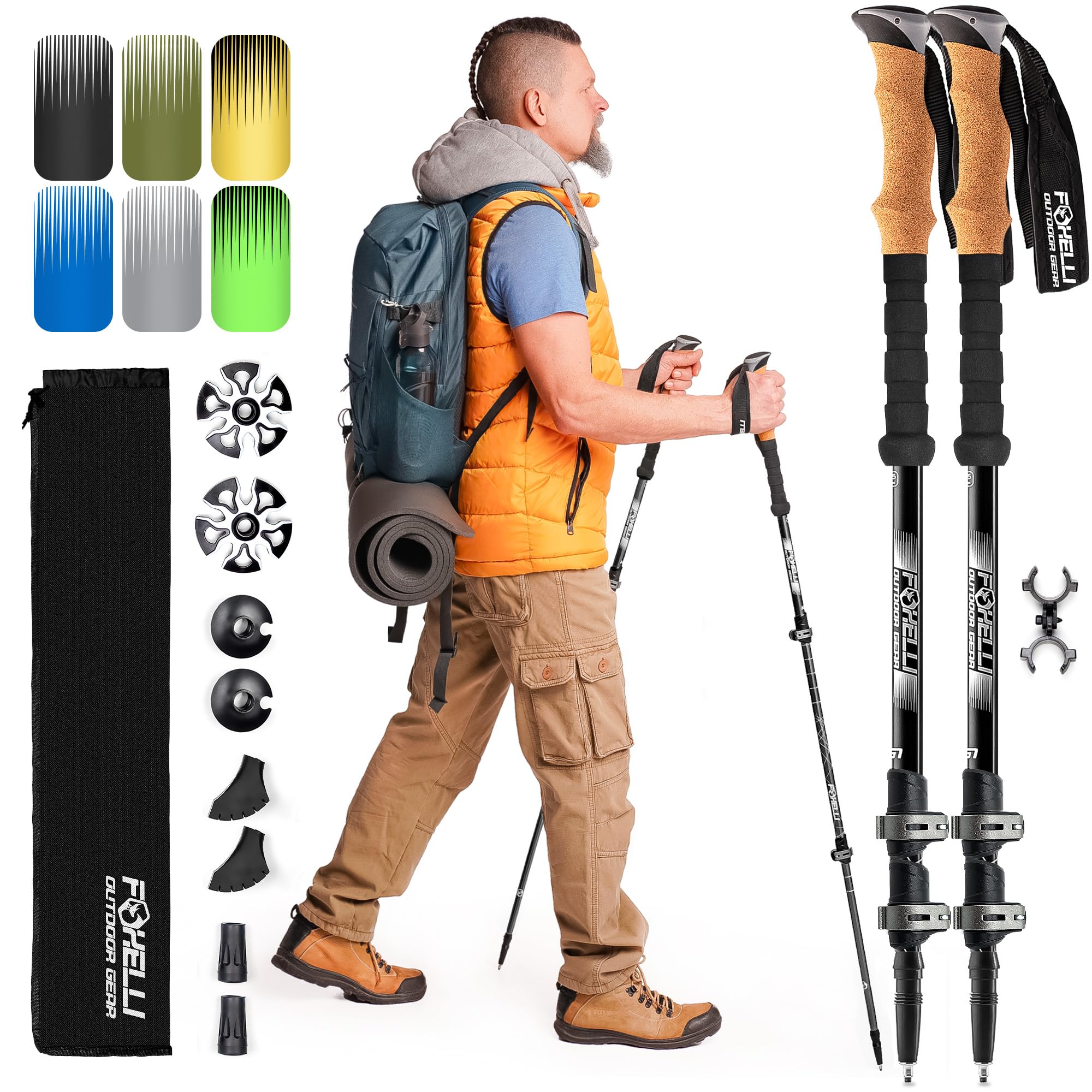
Foxelli Trekking Poles
Key Features
- Grip: Cork with EVA extension
- Lock type: Flip lever
- Length range: 24 to 54 in
- Weight per pole: 9.4 oz
- Price: Midrange
Twenty-four to fifty-four inches covers the whole span most adults need, and the Foxellis get there with a lever lock you can flip with a thumb while your other hand holds a map. At 9.4 ounces a pole they swing without dragging, and the cork grip runs down into a soft EVA extension, so a steep sidehill does not force you to let go and re-grip.
Adjustability and a shaft that still feels solid at full extension are the two things budget poles most often get wrong, and this is the pair in this group with the fewest qualifiers on either. Setting height is a two-second job, the clamp bites where you put it, and nothing creaks when you lean your weight through the downhill pole. That is why they are our default rather than a cheaper pair.
The tips are what wear first, since rubber boots give up on pavement and rock long before the shafts do, and the box includes four rubber tips plus mud and snow baskets, so you have a spare set before you need one. Cork handles are the slower reward: they mould to your hand over a season instead of getting slick, which is more than we can say for the foam grips on the cheapest pairs here.
Pros
- Full 24-to-54-inch range suits almost any adult
- Cork grip with EVA lower extension
- One-handed lever locks that hold set length
- Four spare rubber tips and both basket types included
Cons
- Packs to 24 inches, so not a carry-on folder
We recommend them to almost every hiker here: the full 24-to-54-inch range fits tall and short users, the cork grips hold when wet, and the flip locks work one-handed.
Best for Long-Term Reliability
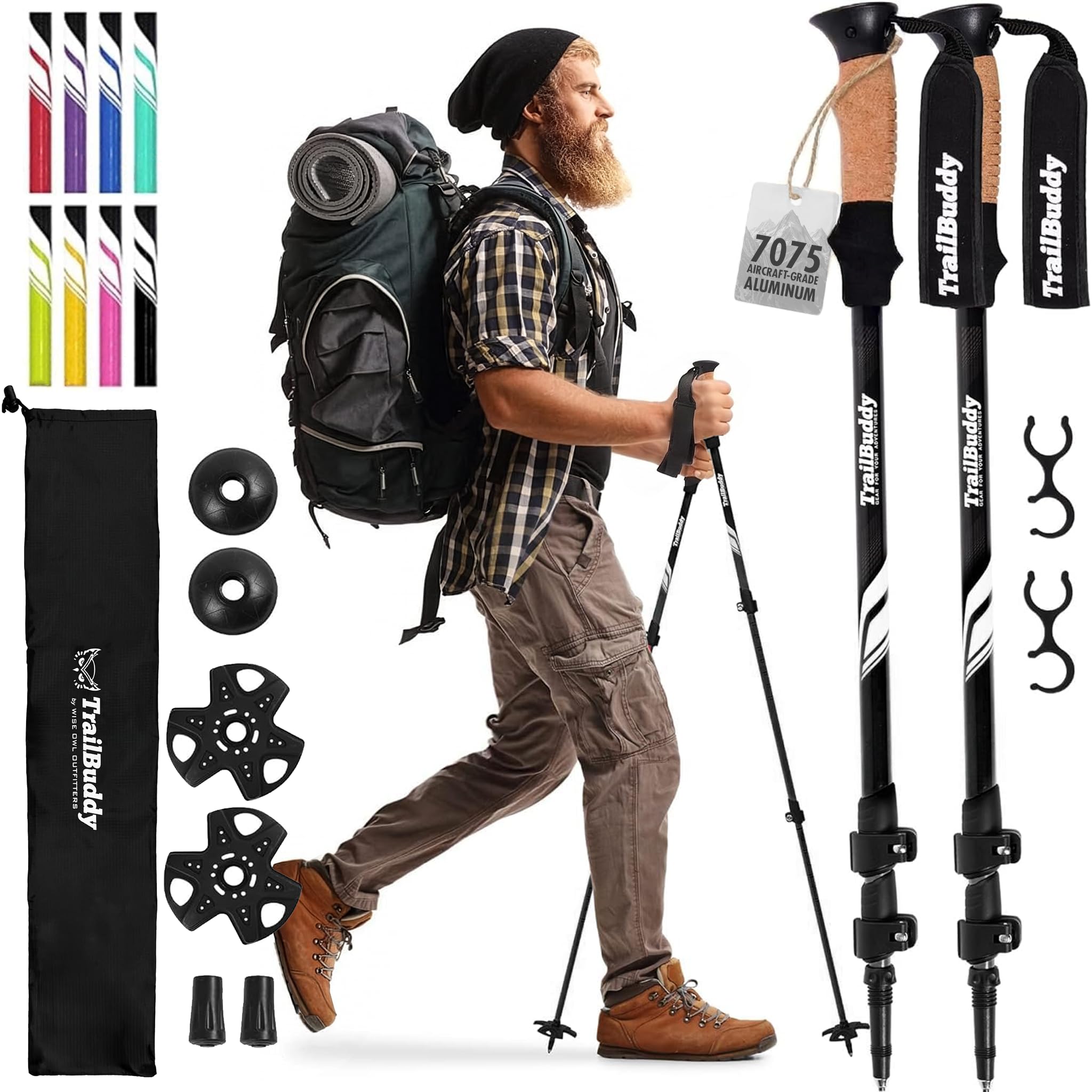
TrailBuddy Trekking Poles
Key Features
- Warranty: 5 years
- Lock type: Lever
- Length range: 24.5 to 54 in
- Weight per pole: 9.7 oz
- Price: Midrange
A five-year warranty on a pair of poles that cost this little is the detail that keeps us coming back to the TrailBuddys. It is the longest coverage in this group by a wide margin, and it says something about how much faith the maker has in the joints, which is where a cheap pole usually gives up first.
The rest of the package is standard budget-pole good: a 7075 aluminum shaft at 9.7 ounces a pole, lever locks you open and close with one hand, cork handles with padded straps, and a span from 54 inches down to 24.5, short enough that a child can use one on the flat walk back to the car. The threaded tips are a small thing we appreciate, since you can see at a glance whether the rubber boot is screwed on all the way.
The lower joint is where these differ from our top pick. A snapped or seized section is the failure to watch for, usually at a join rather than at the grip or the lever. Keep the sections clean, dry them after a wet hike, and resist over-tightening a lock to kill a rattle; a clamp cranked down hard is what puts a crease in thin aluminum.
Pros
- Five-year limited warranty, the longest here
- Lever locks work with one hand
- Folds to 24.5 inches for packs and kids
- Threaded tips show when they are seated
Cons
- Wrist straps feel thin next to the grips
The five-year warranty is the longest in this group and the sensible reason to buy these; we think the 24.5-inch fold makes them an easy second pair.
Best for Lightweight Value
KINGGEAR Trekking Poles
Key Features
- Shaft: 7075 aluminum
- Lock type: Flip
- Length range: 25.5 to 54 in
- Weight per pole: 9.35 oz
- Price: Budget
Nine point three five ounces a pole is the lightest thing in this group, and the KINGGEARs get there with 7075 aluminum rather than the 6061 most budget poles use. The practical effect is that the pole swings without you noticing it, a small thing on a two-mile walk and a real one on a thousand feet of climbing.
Length runs 25.5 to 54 inches on a flip lock, and the cork grip tapers into an EVA lower section so your hand can slide down for a steep step without breaking stride. For a pole this light it also feels planted when you load the downhill side, which is not something we expected at the low end of the price range.
The thing to stay on top of is clamp tension. The flip locks have a tension screw that works loose over a season, and a pole that shortens under your weight mid-step is the worst outcome a budget pole can deliver, so set the tension before your first hike and check it every few outings.
Pros
- Lightest pole in this group at 9.35 oz
- 7075 aluminum at a low price
- Cork grip with EVA lower section
- Full 25.5-to-54-inch adjustment range
Cons
- Packs to 25.5 inches, far from a folder’s 14
Our value pick: a 7075 shaft at 9.35 ounces a pole, a full-height range, and a price near the bottom of this group.
Best for Travel and Packing
covacure Trekking Poles
Key Features
- Grip: EVA foam
- Lock type: Flip
- Length range: 39.4 to 47.2 in
- Packed length: 13.7 in
- Price: Budget
13.7 inches folded is the number that makes the covacures interesting. A tri-fold breaks into four short sections rather than telescoping into one long one, so the pair lies flat in a carry-on, a daypack lid, or the bottom of a pannier.
This is the pair we hand someone whose poles travel more than they hike: the city break with one hill in it, the flight where the checked bag is already full, the partner who wants a stick for the downhill and nothing else. Assembly is quick, the flip lock is easy to work, and the EVA grips are comfortable for a couple of hours at a time.
The shape has more joints than a telescoping pole, and every joint is a place to check: seat each section fully and give the pole a tug before you lean on it. Grips are the other difference. Cork it is not, and foam gets slick once your hands are wet, which is fine for a stroll and less so on a long climb.
Pros
- Folds to 13.7 inches for a carry-on
- Tri-fold assembles in seconds
- Very light and packable for travel
- Flip lock is simple to operate
Cons
- Tops out at 47.2 inches, too short above about 5 foot 9
- EVA grips get slick with wet hands
Buy these if the poles need to fit in a carry-on, at 13.7 inches folded, and skip them if you are taller than about 5 foot 9.
Best for First Pair
Amazon Basics Trekking Poles
Key Features
- Grip: EVA with down grip
- Lock type: Quick lock
- Length range: 25.2 to 53 in
- Weight per pole: 9.3-10 oz
- Price: Budget
This is the pair we suggest to someone who wants to try trekking poles without committing to the hobby. It is one of the cheapest in this group, and nothing about it feels like a shortcut on a local trail: a 6061 aluminum shaft at 9.3 to 10 ounces a pole, a quick lock with adjustable tension, and a span from 25.2 up to 53 inches.
The kit is fuller than the price suggests, with snow baskets, mud baskets, boot tips, TPE tips and a storage bag, so you are not buying a winter basket separately the first time you hit snow. The extended foam section below the handle is a nice touch at this end of the market: it gives you somewhere to put a hand on a steep pitch without stopping.
What the savings buy you is foam rather than cork. EVA is comfortable and cheap to make, but it does not wick the way cork does, and on a hot climb with sweaty hands you will feel the difference. Worth knowing, too, that 53 inches is an inch under the tallest poles here: fine for most, marginal if you sit at the very top of the height chart.
Pros
- One of the cheapest pairs in this group
- Full seasonal kit including baskets and TPE tips
- Extended foam down grip below the handle
- Adjustable quick lock with a 25.2-to-53-inch span
Cons
- EVA foam grips rather than cork
The pair we hand a first-time buyer: one of the cheapest here, with a full seasonal tip kit and a range that covers most adults.
Best for Steep Terrain
Cascade Mountain Tech Trekking Poles

Key Features
- Grip: Cork with EVA down grip
- Tips: Tungsten carbide
- Length range: 26 to 54 in
- Weight per pole: 10.1 oz
- Price: Midrange
The extended EVA section below the cork grip is the reason to look at these. On a long sidehill or a steep step down you can slide your hand down the shaft instead of letting go and re-gripping the cork, and that is the kind of detail that only matters on real terrain, where it matters a lot.
The package is generous: tungsten carbide tips for year-round use, plus rubber boots, snow baskets, mud baskets and a carry case, and the poles run 26 to 54 inches on a quick lock. At 10.08 ounces a pole they are a touch heavier than the lightest here, which you feel more on a long climb than on a day walk.
The clamp is the part to respect. A quick lock that is not tensioned right will let the pole shorten under your weight mid-step, which is worse than having no pole at all. Set the tension at home, walk a mile, and check it again before you trust it on anything exposed.
We keep them on the list for the grip and the tip kit rather than the lock. If you hike steep ground often and want carbide under you in winter, the extended grip and the accessory set are worth more than the ounce you give up; if your walking is mostly flat paths, the simpler poles above suit you better.
Pros
- Extended EVA down grip for steep ground
- Tungsten carbide tips plus rubber boots and baskets
- Full 26-to-54-inch quick-lock range
Cons
- Quick clamps need careful tensioning
- Heavier than the lightest here at 10.08 oz
Worth the money if you hike steep ground often, because that extended lower grip is the most useful thing on the pole.
Best for Shorter Hikers
Hiker Hunger Trekking Poles

Key Features
- Lock type: Metal flip
- Length range: 100 to 120 cm
- Packed length: 14 in
- Weight per pole: 9.95 oz
- Price: Midrange
The version we looked at stops at 120 centimeters, about 47 inches, and that number decides whether these are for you. Hiker Hunger builds a longer version that reaches 135 centimeters for hikers over roughly 5 foot 9; this one is for the shorter half of the market, and it says so plainly.
For that buyer it is a clever pole. It folds to about 14 inches into four sections, the smallest package here after the covacures, and at 9.95 ounces it disappears into a daypack. The metal flip locks and reinforced joints feel more substantial than the money suggests, and you get a choice of cork or EVA grips plus the usual basket set.
Two practicalities. More joints means more places to check: seat each section fully and give the pole a tug before you start. And the warranty runs a year rather than the five you get from TrailBuddy, which is worth weighing if you are hard on gear.
Pros
- Folds to about 14 inches for a daypack
- Metal flip locks and reinforced joints
- Choice of cork or EVA grips
- Light at 9.95 ounces in the short version
Cons
- 120 cm ceiling in this version
- One-year warranty only
A smart buy for shorter hikers who want a pole that folds into a daypack, provided 47 inches of length is enough.
Best for Taller Walkers
Croosseoutdoors Trekking Poles

Key Features
- Lock type: Twist and flip
- Packed length: 23 in
- Maximum length: 53 in
- Weight per pole: 9.7 oz
- Price: Budget
Two external flip locks and an internal twist lock, on a four-section shaft: the Croosseoutdoors use a combination most budget poles skip, and the point is that you can set the top sections one-handed with the pole planted.
The claimed range covers 4 foot 11 to 6 foot 5, with a 23-inch fold, and each pole weighs 9.7 ounces. For a tall hiker on a tight budget that reach is the reason to look here, since most of the cheap folders in this group top out well under six feet.
The trade-off is thin walls. Aluminum this light at this price is not built for a hard fall onto rock, and a kinked section ends the pole; treat them as trail poles rather than mountaineering tools and they are good value. The four-way tip kit, with two rubber tips, two boot tips, and snow and mud baskets, helps the wearing parts last, though the rubber goes first whatever you do.
Where we come out: a sensible buy for a tall walker who wants reach without spending much, provided you set the twist lock and check it before each trip. That internal joint is the one these hang on.
Pros
- Reach to about 6 foot 5 of body height
- Packs to 23 inches for a pack or case
- Light at 9.7 ounces a pole
- Four tip types included
Cons
- Thin-walled shafts can kink in a fall
- Internal twist lock needs regular checking
The budget pick for taller walkers: reach to 6 foot 5 and a 23-inch fold, as long as you are willing to mind the twist lock.
How We Tested Budget Trekking Poles
We started by pulling together every budget pair we could find under the usual entry-level ceiling, then narrowed the shortlist by reading specs for packed length, stated weight, adjustment range, and warranty. We ruled out anything with plastic collars that felt brittle in hand or straps that looked stitched to fail, and we ended up with 14 pairs. For five months, those poles went on weekend day hikes, after-work walks, and one loaded overnight trip, with testers of different heights switching them mid-trail.
On the trail, we set each pole to our height, marked the shaft with tape, and then leaned our full weight onto it on descents to see whether the lock slipped. We adjusted them while wearing gloves, collapsed and redeployed them at water breaks, and noted whether the mechanism caught or needed two hands. We weighed every pair on a kitchen scale before the first hike and checked packed length against a daypack, then carried them all day to judge balance and swing weight.
To test attachment, we tugged hard on the wrist straps, twisted the baskets, and checked the tips after muddy sections and rocky scrambles. Durability got the least gentle treatment: we jammed tips between roots, dragged them over grit, and watched for wobble at the joints. By the end, we knew which poles stayed planted when we needed them, which straps stayed comfortable, and which pairs made a long walk more fun rather than a chore.
How to Choose Budget Trekking Poles
On a cheap trekking pole the money comes out of the lock and the tip long before it comes out of the shaft, which is exactly where we spend our attention.
Start With the Lock, Not the Alloy
The clamp is what turns two aluminum tubes into something you can lean on, and it is the part budget makers economize on. We care more about a lever lock with a tension screw you can adjust yourself than about the alloy in the shaft: you can feel a good clamp bite, and you can re-tighten it when it loosens. Twist locks are tidier, with nothing to snag on brush, but they are harder to set with gloves on and harder to judge by feel.
Whichever you choose, set the tension at home, walk a mile, and check it again. The Cascade Mountain Tech clamps are the ones in this group that most reward that habit.
Match the Length to Your Height, Then Add for Descents
Every pole here adjusts, so the ceiling is what decides. On flat ground the grip should sit at hip height with your elbow at about 90 degrees, which works out to roughly 68 percent of your height; going downhill you want a few inches more. Someone 6 foot 2 needs about 50 inches on the flat, which rules out the 47-inch folders before you look at anything else.
If you are over about 5 foot 9, check the maximum length first and treat every other feature as secondary.
Telescoping or Folding
Telescoping poles collapse to 24 to 26 inches: short enough for a pack’s side pocket or a checked bag, long enough that they will not vanish into a small daypack. Folding poles break into four sections and pack to 13 to 17 inches, which is what you want if the pole has to live in a carry-on or a summit pack.
Folding costs you joints. A folder has three or four places to seat and check, and its shorter maximum length rules out taller hikers. If you fly with poles once a year and hike every weekend, telescoping is the better buy.
Grips, Tips, and the Parts You Will Replace
Cork moulds to your hand and stays grippy when damp; EVA foam is comfortable, cheaper to make, and slicker once you are sweating. An extended lower grip, the padded section below the handle, is worth having if you hike steep or sideways ground, because it lets you choke down on the shaft instead of letting go and re-gripping.
Tips are consumables. Rubber boots wear through on rock and pavement while carbide lasts and bites ice, so check that the box includes spares and both basket types. Buying tips later costs more than the small upgrade would have.
How Much the Ounces Matter
Every aluminum pole here lands between about 9.3 and 10 ounces, and that spread is not worth paying much for. You feel an ounce in your hand at the end of a long day, not on a two-hour walk, and a lighter pole with a slipping lock is worse than a heavier one that holds.
Spend the difference on a lock that stays put and a length that fits. Weight is the last thing to optimize in this price bracket, not the first.
Frequently Asked Questions
Are carbon fiber poles worth the extra over aluminum?
For most people shopping this bracket, no. Carbon saves a couple of ounces and costs a good deal more, and it fails differently: aluminum bends or takes a set, where carbon can crack without warning. Buy aluminum for a first pair or a pair that gets thrown in and out of a pack, and look at carbon when weight becomes the thing you care about most.
Can I take trekking poles in a carry-on?
Rules vary by airline and by country, and they change. Some carriers treat poles as walking aids, others class them as hiking equipment and stop them at the gate. Ask your airline before you fly, and if the answer is not definite, check them: a folding pair packs small enough for a suitcase.
Do I need one pole or two?
Two, for anything steep or uneven. One pole helps your balance, but a pair shares the load on a descent and gives you two extra contact points on wet roots and loose scree. If you are buying because a knee is complaining, buy the pair rather than one.
Can I use my trekking poles as tent poles?
The warranty on the Cascade Mountain Tech poles explicitly excludes using them as tent poles or for skiing, and that is a fair line for any pair here. A pole that has taken a bend as a shelter support may fold under you on a descent. Use an adapter set or purpose-made peg instead and keep the poles for walking.
Final Verdict
We recommend the Foxellis. They cover the full height range most adults need, the lock works with gloves on, the cork grip gets better with use, and nothing about them reads as a budget compromise. If money is tighter, the KINGGEARs are the lightest pair here and give up little except packability. If the poles will live in a carry-on, the covacures fold to 13.7 inches and expect a shorter hiker.
Start with the lock, buy the length that fits, and the rest sorts itself out.