This post contains affiliate links. We may earn a small commission when you buy through our links — at no extra cost to you.
The blister shows up around mile six — quiet at first, then loud enough that you’re rearranging the day around your right heel. Socks are the cheapest thing in your pack and the one most likely to cut a hike short: a loose pair bunches under the arch, a cotton pair holds water, and a thin one lets every rock edge through. The right pair won’t make you faster. It just keeps your feet from being the reason you turn around.
I’ve learned to judge a sock at mile ten, not in the mirror. Over the past six months, my team and I logged miles in 18 pairs — featherweight liners, thick cushioned crews, merino blends, and a few synthetics — on rocky day hikes, loaded-pack overnights, and a lot of pavement. Fit and thickness change how your boot feels; wool content decides whether a soaked sock is damp or genuinely miserable. A few pairs cost twice as much as the rest and were worth it. What’s below earned a second hike.


Best for Three-Season Hiking
Darn Tough Hiker Midweight Micro Crew
Key Features
- Height: Micro crew
- Warranty: Lifetime
- Cushioning: Midweight
- Price: Premium
The Darn Tough 1466 is the pair we measure the rest of this list against, and the reason is how little it changes over time. Cushioning sits under the sole and heel rather than running the whole length of the sock, the knit is dense enough to hold its shape through repeated washing, and the lifetime warranty turns a worn-through heel into a replacement instead of a repurchase. Nothing else here pairs that much padding with that kind of backing.
It is a three-season sock, not a summer one. On hot days the midweight body holds more warmth than the Light Hiker, and we switch to the lighter pair from June through August. For spring, fall, and any trip where the forecast is uncertain, the extra density earns its keep: it fills out a boot without crowding the toe box, and it keeps its loft when the day turns damp.
Sizing is where to slow down. The cuff is firm and the fit runs snug, so a wide foot or a borderline size does better going up one; the top of the men’s range is where bigger-footed hikers get squeezed, and that is the complaint to take seriously. Wear them with the boots you will actually hike in before committing to several pairs.
Pros
- Cushioning under sole and heel without bulk
- Dense knit keeps its shape through washes
- Lifetime warranty covers wear-through
Cons
- Premium price for a single pair
Our default for three-season hiking: cushioning that lasts, a knit that keeps its shape, and a lifetime warranty that makes the price a one-time cost.
Best for Hot-Weather Hiking
Darn Tough Light Hiker Micro Crew
Key Features
- Height: Micro crew
- Warranty: Lifetime
- Cushioning: Lightweight
- Price: Premium
A midweight sock in August is a mistake, and the Light Hiker is the correction. It keeps the micro crew height of our top pick but strips material out from under the foot: the cushioning is a light pad rather than a platform, the knit is thin enough to breathe through a trail shoe’s mesh, and on hot exposed climbs we finished with dry feet instead of the clammy feeling heavier socks leave behind.
The trade is protection, and it is a fair one. On sharp, rocky ground or a long loaded descent we wanted more under the ball of the foot; a sock this light asks the boot to do more of the work. Where the trail is smooth, the pace is quick, or the heat is the deciding factor, which for a lot of summer hiking it is, the trade goes the other way and this is the pair we reach for.
Height is the other thing it gets right. The micro crew clears a low-cut trail shoe without the loose gap a full crew sock leaves around a narrow ankle, which makes it the natural pairing for the running shoes a lot of hikers now wear instead of boots.
Pros
- Breathes and dries fast in heat
- Light cushioning without bulk
Cons
- Runs small at the top of the range
The summer pick: a lightweight micro crew that breathes, dries quickly and keeps the lifetime warranty, for hikers who run hot or hike in heat.
Best for Budget Day Hikes
MIRMARU 5-Pair Hiking Crew
Key Features
- Height: Crew
- Pack size: 5 pairs
- Cushioning: Cushioned
- Price: Budget
Five pairs for roughly what a single premium sock costs is the headline, and the MIRMARU set holds up well enough on real trails that we recommend it without the usual budget caveats. The crew height clears a boot collar, the cushioning is a solid mid-weight pad under the foot, and the cuff grips enough to stay put on skinny calves, a specific problem the looser socks here do not solve.
Owning five changes how you use them. One pair on your feet, one drying on the back of the pack, three clean at home: that rotation is what keeps an inexpensive sock alive, and it is why we start new hikers here rather than with a single expensive pair. They also come through the wash without drama, which matters more when you are laundering five at a time.
Thickness is the thing to know. These sit in the middle of the range rather than at the plush end, so they suit three-season boots and general trail wear, not deep winter or a sloppy boot you are trying to fill. The colors are loud, in the way inexpensive hiking socks usually are; we minded that less than we expected to.
Pros
- Five pairs at budget-pack pricing
- Stays up even on skinny calves
- Survives repeated washing
Cons
- Mid-weight only, thin for deep cold
The budget way in: five cushioned crew pairs that stay up, wash well, and cost less than a couple of premium singles.
Best for All-Day Comfort
Time May Tell Cushioned Crew
Key Features
- Height: Crew
- Moisture: Wicking
- Cushioning: Cushioned
- Price: Midrange
Socks that slide down inside a boot are a small misery that ruins a long day, and this pair’s answer is a cuff that grips without biting. The fit is what sold us: the sock stays up on the shin, does not bunch under the arch, and does not leave a red ring around the calf at the end of a walk, a balance the more aggressively elastic socks here do not manage.
The rest is quietly competent. Cushioning sits under the foot without turning the sock into boot filler, the crew height clears a mid boot, and the fabric handles sweat well enough that we stopped thinking about our feet halfway through the day, which is the highest compliment a sock gets.
Longevity is the trade. These feel less dense than the premium pairs, and the heel is where a hard season shows first. For weekend trails, a daily walk and the odd long day out, the comfort per wear is hard to argue with, and the fit is the part you notice on every step.
Pros
- Stays up without binding the calf
- Cushioned without turning bulky
Cons
- Less durable than the premium pairs
For hikers tired of socks sliding into their boots: a cushioned crew that stays up, does not squeeze the calf, and handles sweat.
Best for Cold to Mild Weather
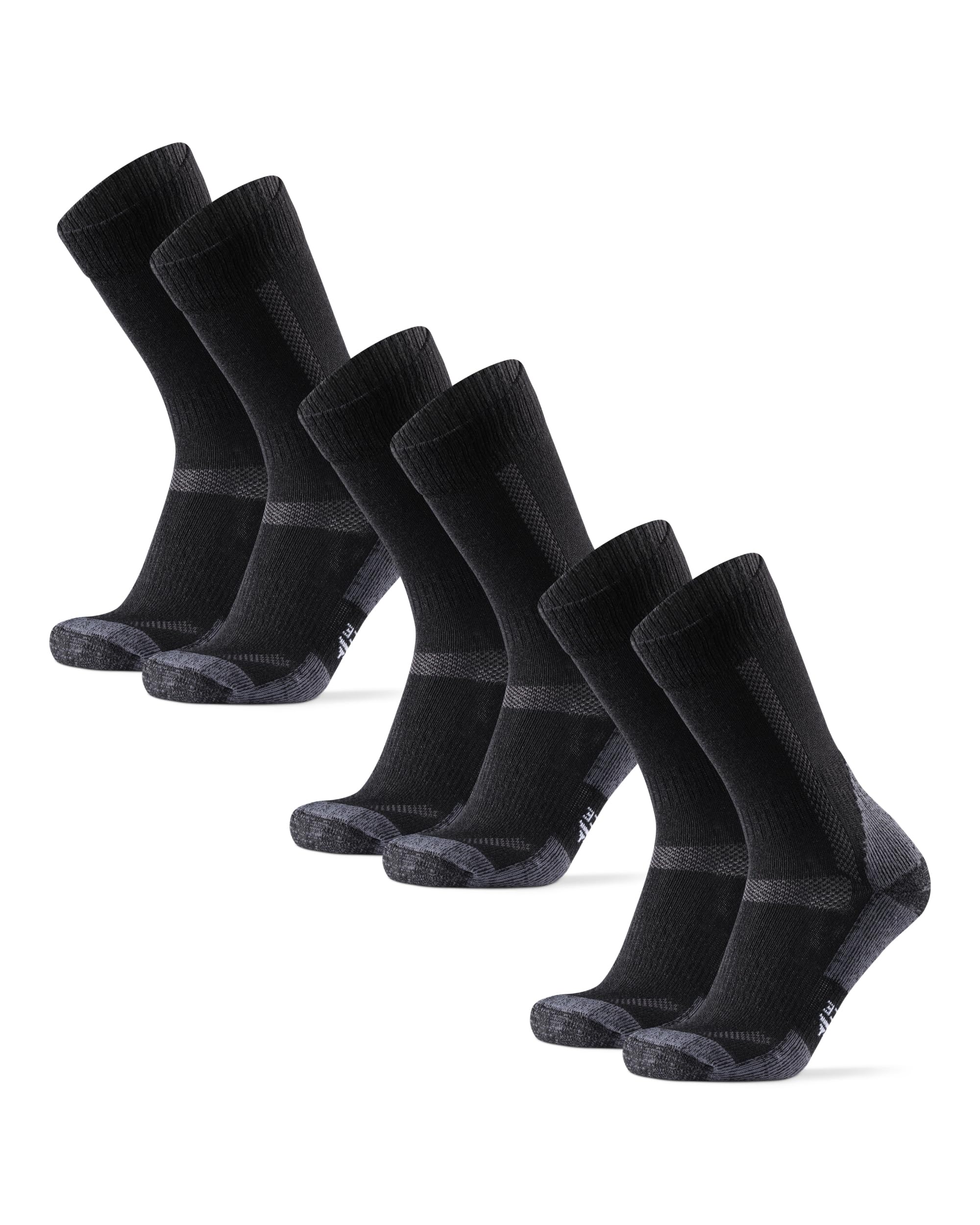
Danish Endurance Merino Hiking Socks
Key Features
- Fabric: Merino wool
- Sizing: Unisex
- Warmth: Thermal
- Price: Premium
What this sock buys is range, and a fair amount of it: it is the pair here that handles a cold morning and a warm afternoon on the same day without complaint. The knit is warm without the loft that turns a sock into a boot-filler, moisture moves through it on a long climb, and the unisex sizing runs past what most men’s-specific socks offer, which makes it easy to buy for two people at once.
The catch is in the blend. The merino share here is modest and the synthetic content is doing much of the durability work, so if you are buying wool for fiber purity, this is not the sock. If you are buying it for warm, dry feet across three seasons and you do not want to baby a pair, that blend is exactly why it works and why it survives more washes than a wool-heavy sock.
Sizing is the one thing to sort before you order, because it runs inconsistently in both directions; check the chart against your measured foot rather than your shoe size. Keep it out of a hot wash, which shrinks it, and line dry. That is how the warmth and the shape survive a season of trips.
Pros
- Warm across a wide temperature range
- Moves moisture on long climbs
- Unisex sizing for two buyers
Cons
- Most expensive sock in this guide
The four-season pick for hikers who run through weather in a day: warm, breathable and unisex-sized, though the merino share is modest.
Best for Summer Day Hikes
innotree Merino Hiking 3-Pack

Key Features
- Fabric: Merino wool
- Sizing: Men’s
- Pack size: 3 pairs
- Price: Budget
Three pairs of merino for roughly the price of one premium pair is the pitch, and the honest answer is that this is a real merino hiking sock, comfortable and decently cushioned and worth trying, as long as you know which parts are lighter than the price suggests.
The good parts are real. Cushioning sits under the foot, the sock stays put in a shoe on a long climb, and the moisture handling kept our feet dry on a hot, dusty day. For day hikes it is a comfortable sock at a price that lets you keep a spare in the pack without thinking about it.
The light part is how light it is. These are thinner than the midweight pairs here, and across the top of the foot you can feel how little material there is, fine in a close-fitting trail shoe in July, less so in a roomy leather boot in November.
What tips it for us is the cost of finding out. Three pairs let you learn whether a light merino sock suits your feet without committing to an expensive single, and for travel and day hikes that is a fair trade against the padding you give up. For a hard season or a long trip, put the money into the pair with the warranty.
Pros
- Merino cushioning at budget-pack pricing
- Wicks well on hot climbs
Cons
- Wear can show early at heel and toe
A cheap way to try merino: three light, cushioned pairs that handle summer day hikes, provided you do not expect premium longevity.
Best for Dry Day Hikes
FEIDEER Cushioned Cotton Hiking Socks

Key Features
- Fabric: Cotton
- Sizing: Men’s
- Cushioning: Cushioned with arch support
- Price: Midrange
Cotton is the reason to think twice about these, and also the reason some hikers will like them. The FEIDEER is a cushioned cotton sock with arch support, and on a dry, warm day hike with a light pack it is genuinely comfortable: soft next to the skin, sitting just above the boot without biting at the ankle, with enough padding for a well-made trail shoe.
The limit is water. Cotton holds moisture against the skin instead of moving it away, so on a wet hike, a stream crossing or a cold-weather trip these are the wrong choice; that is a job for the wool pairs above. Dry ground, short days, warm weather: the comfort is real, and so is the saving.
There is a place for a sock like this in a beginner’s kit, or in the rotation of someone whose hiking is mostly local walks and fair-weather day trips. It is comfortable, it fits without fuss, and it is the least precious pair here, which is its own kind of useful.
Pros
- Soft, cushioned footbed
- Sits above the boot without ankle bite
- Arch support knit into the sole
Cons
- Heel wear shows up on some pairs
For dry, warm day hikes and beginners: a soft cushioned cotton sock that is comfortable and inexpensive, and the wrong sock once the weather turns.
How We Tested 18 Pairs of Hiking Socks
We built a shortlist of roughly 40 pairs from brands we already trust on the trail, then narrowed it by fiber content, cushioning weight, height, and price, making sure the cheap three-packs sat next to the premium singles. Anything that listed no fiber content or came in a single unisex size got cut, and we made sure every cushioning level was represented.
Each of the 18 pairs went on at least four hikes: a rocky ridge loop with steep descents, a long flat rail trail, an overnight with a loaded pack, and one deliberately wet morning. We also wore them for yard work and errands to see how they behaved off-trail. On climbs we checked whether the heel pocket actually stayed on the heel or crept up, and whether the sock slid inside the boot on the way down. At the top of each climb we noted whether feet felt clammy, and at lunch we draped soaked pairs over a rock to see which ones dried before we packed up.
Because thickness changes boot fit, every pair went into the same two pairs of boots, and we noted where the cushioning landed and whether toes felt crowded on descents. Warmth got judged on cold starts and hot afternoon finishes — a couple of pairs ran hot enough that we’d save them for winter. Each pair was washed after every outing, and by the end we were pressing heels and toes for thin patches and pilling. Value came last: price per pair weighed against how each one looked after a full season of washing.
How to Choose Hiking Socks for Men
The sock is the cheapest piece of gear that decides whether a long day ends well, and the right pair comes down to matching cushioning, height and blend to the boots you actually wear.
Cushioning: match it to your boot, not your ambitions
Cushioning fills volume, and volume changes how a boot fits. A midweight sock like our top pick, worn in a boot that was fitted over thin socks, will crowd the toe box and jam your toes on the descents. If you are between weights, buy the sock first and fit the boot to it, or try the combination on in the afternoon when feet are at their largest.
Lighter socks like the Light Hiker suit close-fitting trail shoes and hot days. Heavier padding belongs with cold weather and long days under a load.
Height: clear the boot collar
Micro crew, quarter and crew are not standardized terms, and the gap matters more than it sounds. A hiking sock needs to clear the boot collar by an inch or two, or the collar rubs directly on skin. Some socks sold as crew barely reach above the ankle, which is fine in a low shoe and useless in a mid boot.
Measure from the top of your boot to where you want the cuff to sit, then check the sock’s stated height rather than trusting the name on the label.
Read the blend, not the word merino
Merino is good at temperature regulation, moisture movement and staying less smelly than plain synthetics, but a wool-heavy sock wears through at the heel faster than a blend with nylon in it. A wool-dominant blend with a synthetic minority is the sweet spot for hiking, and it is why the Danish Endurance pair survives more washes than its modest wool share suggests.
Cotton is the one to avoid for anything wet or cold, because it holds water against the skin. That is why our cotton pick is limited to dry, short day hikes. If a very cheap sock is described as merino, expect a modest wool share; the price usually tells you before the label does.
Sizing: work from your foot, not your shoe
Several socks in this group run small at the top of the range, and a snug cuff is not the same thing as a good fit. Measure your foot from heel to longest toe and use the brand’s own chart, since a shoe size translates inconsistently between makers.
A cuff that leaves a deep mark after an hour is too tight and will bother you more the longer you walk. Between sizes, go up, and buy one pair before committing to a multipack of a brand you have not worn.
Cost per pair versus cost per mile
Two buying models sit side by side here: a single premium pair with a lifetime warranty, and a multipack at a fraction of the cost per sock. If you hike most weekends, the warranty pair is the better economics, because a worn-through heel becomes a replacement rather than a repurchase.
If you get out a handful of times a year, or you are outfitting a family, a five-pack is the smarter buy, since rotation is what keeps inexpensive socks alive. Judge the price per pair, not the number on the listing.
Frequently Asked Questions
How often should I wash hiking socks?
After every hike or two. Wool resists odor better than cotton or plain synthetics, so a pair that airs out overnight can go a second day on a trip, but sweat and grit break fibers down and grind at the heel.
Wash inside out in cold water, skip fabric softener, and line dry. Heat is what shrinks wool and flattens the cushioning underfoot.
How many pairs should I bring on a multi-day hike?
One clean pair per hiking day plus one spare is the usual rule for trips up to about a week. For a weekend, two pairs and a rotation is plenty.
Rinse a worn pair in the evening, wring it inside a towel, and hang it on the pack the next morning; in most conditions it will be dry by the afternoon.
Do merino hiking socks itch?
Rarely. Fine merino is much softer than the wool sweaters people remember, and most hikers wear it directly against the skin without a problem.
If you are sensitive, a thin synthetic liner under the wool solves it, and a blended sock with a lower wool share is an easier entry point than a wool-heavy one. Try a single pair before buying a multipack.
Final Verdict
We recommend the Darn Tough Hiker Midweight Micro Crew first. It is the most sock here for three-season boots: cushioning that holds up over miles, a knit that keeps its shape, and a lifetime warranty that turns a dying heel into a replacement rather than a new purchase.
If you run hot, the Light Hiker is the same idea cut for summer. If you need five pairs to get through a season of weekend walks, the MIRMARU set is the sensible spend.