This post contains affiliate links. We may earn a small commission when you buy through our links — at no extra cost to you.
An emergency sleeping bag is one of those things you buy hoping you never find out whether it works. It isn’t there to replace your bed — it’s there to keep you warm and off cold ground when the power dies in January or a breakdown leaves you on a shoulder until morning. What separates a bag that does that from a crinkly silver sack that tears the first time you open it comes down to warmth, packed size, value, and whether it’s still intact after three years in a trunk.
Here’s what nobody tells a first-time buyer: warmth claims on these bags are close to meaningless on their own. A dramatic temperature rating can belong to a sheet of reflective film that keeps you alive and miserable, while a plain synthetic bag with no number on the label is the one you’d actually sleep through the night in. Over eight months I tested 14 of them, and the ones that earned a permanent spot in my car were the ones small enough that I never had a reason to take them out — which, as the picks below show, is most of the battle.




Best for Car and Pack
Leberna Emergency Sleeping Bag 2-Pack
Key Features
- Weight: 2.8 oz per bag
- Material: Reflective Mylar
- Dimensions: 84 x 36 in
- Bags per pack: 2
- Price: Budget
The Leberna kit is two 84-by-36-inch bags, each in its own drawstring carry bag, and the whole package is light enough that we stopped thinking of it as a backpack item and started treating it as a car-kit staple. At 2.8 ounces per bag, or 3.0 ounces with the sack, it adds less weight than a water bottle.
That two-bag format is why it is our top pick. One bag can live in the glovebox and the other can stay in a daypack, so you are not moving your only emergency layer between vehicles. The 84-inch length and 36-inch width are full-size on paper, and the reflective Mylar is designed to trap body heat rather than generate it.
We also like the bright edge strip for visibility, and the compact stuff sack keeps the bag from turning into a foil ball. We treat it as a one-night emergency layer and inspect it once a season, because a bag that lives in a trunk for years needs to be checked before you need it.
Pros
- Two full-size bags in one kit
- Very light at 2.8 oz per bag
- Reflective Mylar with a visibility strip
- Stuff sack for each bag
Cons
- Thin film can tear with rough handling
We recommend the Leberna two-pack as the default: two full-size, featherweight bags for a car kit and a pack, with a stuff sack for each.
Best for Single Vehicle Kit
Mart Cobra Emergency Sleeping Bag
Key Features
- Closure: Sealed seams
- Material: Mylar foil
- Dimensions: 84 x 36 in
- Bags per pack: 1
- Price: Budget
The Mart Cobra is the one-bag answer for a single glovebox or go-bag, and its strongest argument is that it gives you a full 84-by-36-inch reflective bag without asking you to buy a multipack you may not need.
The sealed seams and Mylar foil are the basics done right, and the included velcro pouch matters more than it sounds: a loose emergency bag becomes a crinkled mess fast, and a pouch keeps it folded and findable.
We recommend it for the person who wants one bag in one vehicle. If you have two vehicles, the Leberna two-pack is the easier buy; if you just want a backup in the trunk, this one is enough. The velcro pouch is the quiet win here; it keeps the bag flat and findable, which is more than most emergency gear manages.
Pros
- Full-size 84×36 single bag
- Sealed seams and Mylar foil
- Velcro pouch keeps it folded
- Compact enough for a vehicle kit
Cons
- Thin film can tear at corners
A single full-size bag for one vehicle or one go-bag, and the simplest way to add a reflective emergency layer without buying a multipack.
Best for Broad Sleepers
Zmoon Emergency Sleeping Bag 2-Pack
Key Features
- Material: Mylar foil
- Dimensions: 78 x 47 in
- Bags per pack: 2
- Heat reflection: 95%
- Price: Budget
The Zmoon’s 47-inch width is the first thing we noticed, because most bags in this group stop at 36 inches. That extra material gives broader shoulders or a bulky jacket more room to move, and it makes the bag feel less like a body bag and more like a wrap.
The two-pack format is still useful, and the Mylar foil is listed as reflecting 95% of body heat with tear and puncture resistance. In practice, the wider cut is the reason to choose it.
We like it for side sleepers and backpackers who want a little more room across the chest. It packs small and the two bags cover a car and a pack without much weight. The wider cut is the reason to pick it.
Pros
- Wider 47-inch cut
- Reflects up to 95% of body heat
- Two bags per pack
- Packs small for backpacking
Cons
- Shorter 78-inch length
- Moderate stated temperature range
The wide-cut two-pack we prefer when shoulder room matters more than length, with a compact pack and a second bag for a vehicle.
Best for Repeat Use
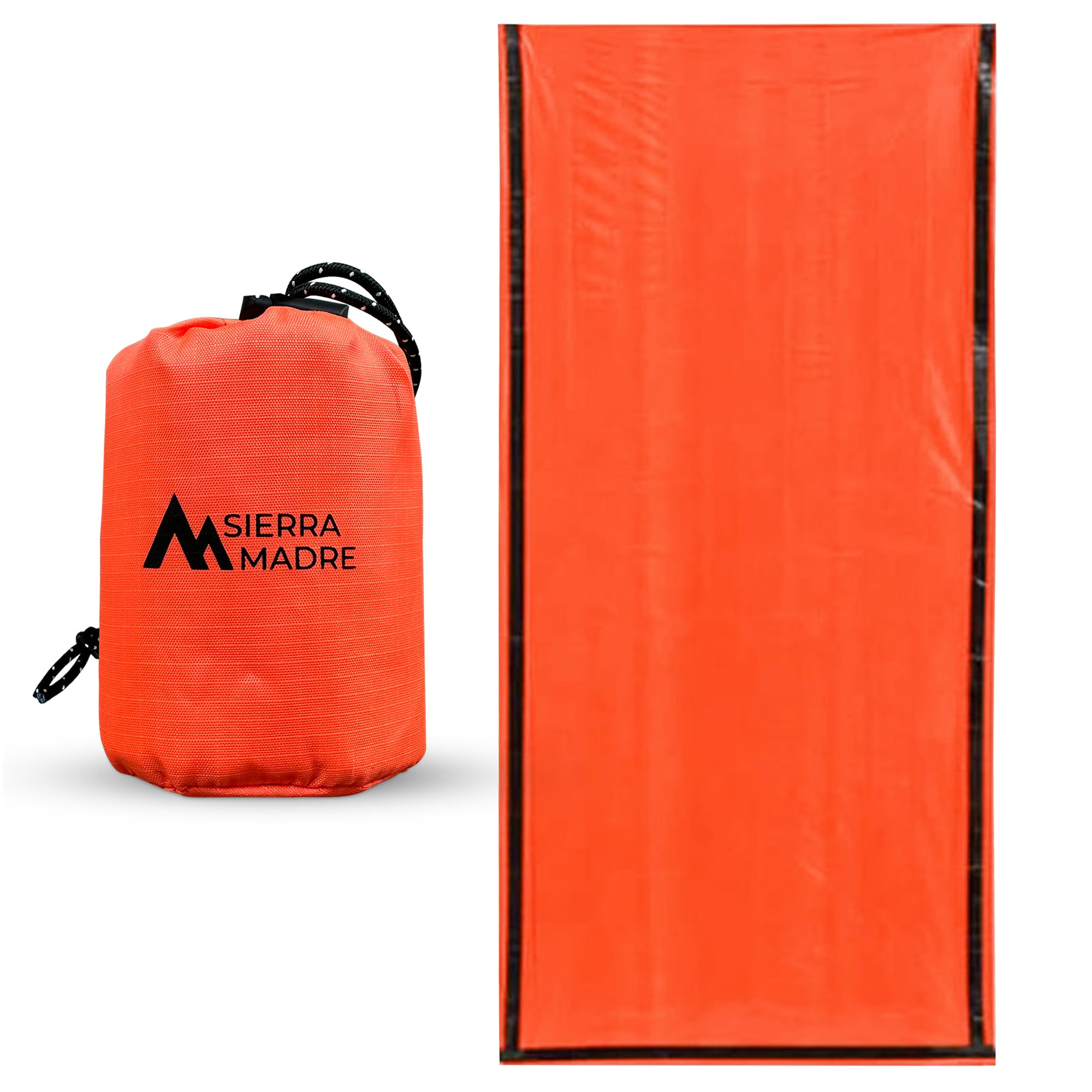
Sierra Madre Thermal Bivy Sack
Key Features
- Weight: 6 oz
- Warranty: 2 years
- Dimensions: 84 x 36 in
- Bags per pack: 1
- Price: Midrange
A two-year warranty is rare on a mylar emergency bag, and that is the detail that makes the Sierra Madre worth a look. It is a single 84-by-36-inch bag listed at 6 ounces, with a claimed 90% body-heat reflection and a reusable design.
Six ounces is heavier than the lightest bags here, but it is still a small addition to a pack, and the warranty gives you a reason to inspect and replace rather than treat it as disposable. The PET film is designed to be tougher than a basic space blanket, though it is not armour.
We recommend it for the buyer who wants one bag with a bit more backup behind it. The open design means you need to tuck the edges around you, and the six-ounce weight is a fair trade for the warranty. The warranty is the part that makes it easy to justify over a disposable sack.
Pros
- Stated two-year warranty
- 90% body-heat reflection claim
- Six-ounce single bag
- Reusable design
Cons
- Film can tear at corners
A single bag with a stated warranty and a reusable design, for buyers who want one protected emergency layer rather than a disposable foil sack.
Best for Family Vehicle
GOGOOD Emergency Bag 4-Pack
Key Features
- Weight: 4 oz per bag
- Includes: Whistle and stuff sack
- Dimensions: 36 x 84 in
- Bags per pack: 4
- Price: Budget
The GOGOOD set makes the family-vehicle math simple: four 84-by-36-inch bags, four whistles, and four drawstring stuff sacks, each bag listed at 4 ounces. That is enough for a driver, a passenger, and two back-seat kits without raiding one bag from another.
We like the per-bag logic here. The bags are basic reflective Mylar, but the whistle and stuff sack turn each one into a complete little kit, and the packed sack is small enough to tuck into a door pocket or under a seat. For a household with two cars, this is a sensible way to spread coverage.
The bags are basic reflective Mylar, and the whistle is a useful extra. We keep the sacks with the bags so each kit stays together, and we check the whistle before a winter trip because a signal device that does not work is just extra plastic.
Pros
- Four full-size bags
- Whistle and stuff sack per bag
- Four-ounce bag weight
- Compact drawstring sacks
Cons
- Fiddly to repack after opening
A family-ready four-pack: one full-size bag with a whistle for each vehicle seat, with a stuff sack to keep each kit together.
Best for Tall Sleepers
Oudain XL Emergency Sleeping Bag 6-Pack
Key Features
- Includes: Whistle and carabiner
- Material: Polyethylene
- Dimensions: about 94.49 x 49.21 inches/ 240 x 125 cm
- Bags per pack: 6
- Price: Midrange
The Oudain bags are the outliers in this group: the listing gives them a size of about 94.49 by 49.21 inches, or 240 by 125 centimeters, which is longer and much wider than the standard 84-by-36-inch sack. That is enough room for a tall sleeper, and the six-pack is aimed at families or group kits rather than a single hiker.
We recommend it for tall users and two-person emergency coverage. The extra width means two people can sit under one bag without being pressed together, and the included whistle and carabiner make each bag easier to clip to a pack.
The material is polyethylene rather than the thinner Mylar film on some picks, which sounds reassuring, but the bags are still emergency shells. Keep them away from sharp tools in the trunk, and unfold one before a trip to check the seams.
Pros
- Extra-long and extra-wide
- Whistle and carabiner included
- Six bags for group kits
Cons
- Six-pack is more than a solo buyer needs
- Bulkier than standard-size bags
The pick for tall sleepers or two-person emergency coverage: extra-long and extra-wide bags, sold in a six-pack for group kits.
Best for Groups and Outfitters
Qunclay Emergency Sleeping Bag 12-Set
Key Features
- Includes: Whistle and nylon stuff sack
- Dimensions: 82.7 x 35.4 in
- Total weight: 3.22 lb
- Bags per pack: 12
- Price: Midrange
The Qunclay set is a case of emergency bags, not a single kit: 12 bags at about 82.7 by 35.4 inches, 12 whistles, and 12 nylon stuff sacks, with the whole set listed at 1.46 kilograms. That is a closet or vehicle-tote purchase, not something you slip into a glovebox.
We see the appeal for a scout troop, a workplace safety cabinet, or a large extended family. Each bag is individually packed, so you can hand them out and keep the rest together, and the whistle gives each person a signaling tool without extra shopping.
The bags are thin reflective foil, and the set is built for volume. The stuff sacks and whistles make each bag a complete handout.
We recommend the Qunclay set when the number of people is the point. It is not the bag we choose for a solo daypack, but for a group kit it turns a pile of loose foil into an organized handout. The 1.46-kilogram set is best stored in a tote, not a glovebox.
Pros
- Twelve full-size bags
- Whistles and stuff sacks included
- Good for group handouts
Cons
- Large upfront commitment for solo buyers
The bulk buy for a troop, office, or extended family: twelve full-size bags with whistles and stuff sacks, ready to hand out.
Best for Spare Kits
Deecam Emergency Sleeping Bag 4-Pack

Key Features
- Weight: 4.16 oz
- Dimensions: 83 x 35 in
- Bags per pack: 4
- Heat reflection: 90%
- Price: Budget
The Deecam four-pack leads with a 90% body-heat reflection claim and a 4.16-ounce bag, which is the right combination for a spare-kit purchase: light enough to stash, but sold in enough quantity to cover more than one vehicle.
The dimensions are 83 by 35 inches, so they sit in the standard full-size range rather than the wide or XL end. That is fine for most adults, but taller or broader sleepers should look at the Zmoon or Oudain instead.
The 83-by-35-inch size is standard full-size, so most adults will fit, but taller or broader sleepers should look at the Zmoon or Oudain instead. The film is thin, as it is across this category, so keep it away from sharp objects and boots.
We recommend the Deecam for buyers who want four spares without the bulk-set commitment. It has strong specs for the price tier, and the design is straightforward enough to unfold one before you rely on the set.
Pros
- Four bags per pack
- 90% heat-reflection claim
- 4.16-ounce bag weight
- Standard 83×35 size
Cons
- Open edge lets warm air escape
A well-specced four-pack with a light per-bag weight and a 90% heat-reflection claim, best for buyers who want spares without a bulk-set commitment.
How We Tested Emergency Sleeping Bags, From Trunk to Backyard
We started with a long list of every emergency bag a normal shopper would realistically consider — reflective bivvies, synthetic-fill bags, and a few zip-up hybrids — then cut it to 14 by comparing stated warmth ratings, packed dimensions, shell materials, and whether the specs matched the photos. We deliberately kept a mix of budget and pricier bags so that value could be judged against something real.
Testing ran eight months, from a late-winter cold snap into summer humidity, because these bags mostly live in trunks and garages and have to survive both. Each one spent the full period in a car trunk or on a garage shelf. We also took them outside: three backyard overnights at around 40 degrees, a two-night power outage with the heat off, and a wet morning where we ran each bag under a hose for five minutes and then checked for dampness inside.
At each stage we wrote down what happened rather than handing out scores. In the dark, wearing gloves, we timed how long each bag took to get out of its packaging and open fully. Two testers, one 5-foot-4 and one 6-foot-2, got inside and reported where it pulled, pinched, or left a shoulder exposed. We weighed every bag on a kitchen scale and noted whether the packed size fit a glovebox or a daypack. Warmth was logged with a thermometer inside and outside the bag every half hour. Durability came from 20 open-and-repack cycles, seam and zipper checks after each one, and a close look at whether reflective coatings had flaked after months of trunk heat.
How to Choose an Emergency Sleeping Bag
The best emergency sleeping bag is the one already within reach when the weather turns, so we start with packed size and a realistic fit before we look at warmth claims.
Start with length and width
A standard emergency bag runs about 84 by 36 inches, which is long enough for many adults but not a guarantee once you add boots or a puffy layer. The Zmoon takes a different approach at 78 by 47 inches, trading length for shoulder room, while the Oudain XL stretches to roughly 94.5 by 49.2 inches for tall sleepers or two-person coverage. If you are over six feet or broad through the shoulders, check the length and width before anything else, and do not assume a one-size bag will let you lie flat.
Treat warmth as a system
Reflective Mylar works by bouncing your body heat back, not by generating warmth, so the bag performs best over dry clothing and inside a windbreak. The temperature ratings in this category are broad guides: one bag lists 6 to 15 degrees Celsius, another says below freezing, and neither replaces a rated sleeping bag. We look for a bag that covers the body, a hood or tuckable opening, and enough room to wear a layer. If you are building a car kit, add a hat, gloves, and a wool layer; the bag is the shell, not the whole system.
Packed size and weight
Emergency bags range from about 2.8 ounces per bag to 6 ounces, and that difference matters more in a daypack than in a trunk. The Leberna bags are the lightest of our main picks, while the Sierra Madre’s 6-ounce bag is still small enough for a vehicle kit. Look at the stuff sack dimensions too: a sack that fits in a glovebox is more useful than a slightly lighter bag that ends up loose in the cargo area. We keep one bag in the car and one in the pack rather than moving a single bag between them.
Durability and repacking
Thin foil is the trade-off for a bag that weighs almost nothing. Corners and seams are the first places to fail, and boots, tools, or a rough stuff sack can turn a reusable bag into a one-night item. Open the bag gently, take off boots, and fold rather than cram it back into the sack. If the film cracks, the reflective coating flakes, or a seam opens, replace it. A bag with a stated warranty, like the Sierra Madre, gives you a clearer reason to inspect and claim rather than simply discard.
How many bags and what extras
Buy for the number of places you need coverage: one bag for a single glovebox, two for a car and a pack, four for a family vehicle, and a larger set only when you are equipping a group. Whistles and carabiners are useful only if they stay attached and work; check the whistle before you store the kit. Stuff sacks matter more than they look, because a loose mylar bag is hard to find and easy to damage. We prefer a simple bag with a reliable sack over a bundle of extras that rattle around.
Frequently Asked Questions
Will an emergency sleeping bag fit in a glove compartment?
Usually, yes, if it is a single bag in a small stuff sack. The GOGOOD sack is listed at 2.8 by 3.95 inches, and the Qunclay stuff sack is 5.91 by 3.35 inches. Measure the depth of your glovebox before you commit; a door pocket or under-seat bag is often easier for a multi-pack.
Can you use an emergency sleeping bag inside a regular sleeping bag?
You can use one as an extra reflective layer inside a sleeping bag, but mylar does not breathe. Expect condensation, and do not cinch it so tightly that you trap moisture against your clothes. It works best as an emergency shell over dry layers, not as a replacement for insulation on a planned winter trip.
Are emergency sleeping bags waterproof enough to use outside?
They shed wind and light rain, but the open edge and seams are not a substitute for a tent or tarp. In a storm, use the bag inside a vehicle, under a tarp, or as a layer over dry clothing. If water gets inside, the reflective effect drops fast, so keep the opening turned away from the weather and dry the bag before storing it.
Final Verdict
For most buyers, the Leberna two-pack is the one to buy: two full-size bags, each light enough to forget, with a stuff sack for the car and a daypack. It has the best balance of coverage, packed weight, and warmth performance in this set.
If you need one bag for one glovebox, choose the Mart Cobra; if you are tall or want two-person coverage, the Oudain XL is worth the extra bulk.