This post contains affiliate links. We may earn a small commission when you buy through our links — at no extra cost to you.
Every sleeping bag is a negotiation between warmth, weight, and price, and you only get to pick two. Go cheap and you get a bag that keeps you warm but eats half your trunk; go light and you will pay dearly for the privilege. What a good bag actually buys you is a night of sleep — cold seeps in through the seams, the draft collar, and the inch of dead air around your feet, and a bag that gets those details right is the difference between waking up rested and waking up at 4 a.m. doing squats by the fire.
I’ve spent eight months in 12 of them — weeknights in the backyard, a damp weekend on the coast, a high-desert trip that dropped into the low 30s — stuffing each into its sack and zipping and unzipping until the pulls snagged or didn’t. What I learned: the number on the tag is not the temperature you sleep at. Fit, a hood that seals, and a draft collar matter more. The picks below are the ones we’d pack again.



Best for Three-Season Camping
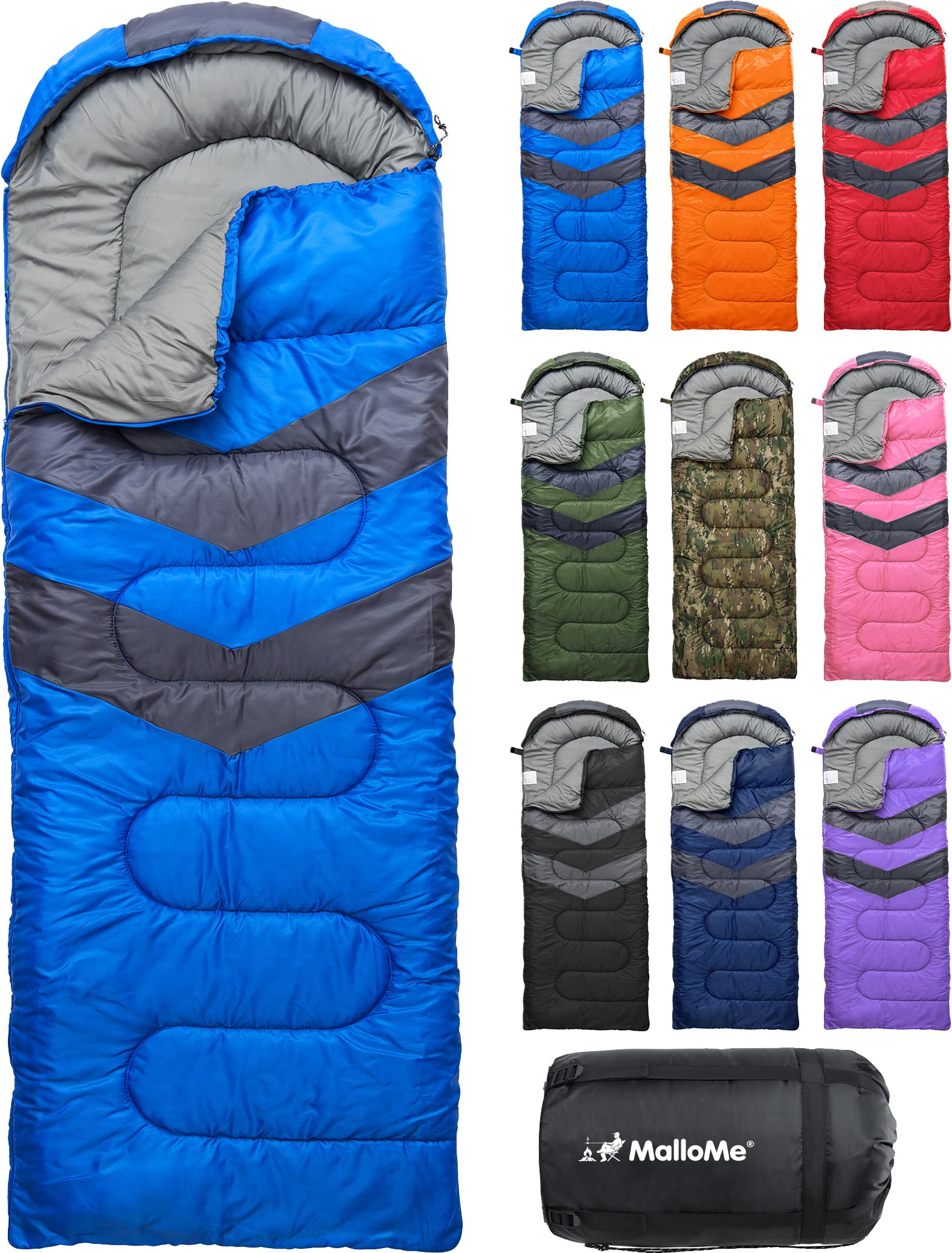
MalloMe Sleeping Bag
Key Features
- Shape: Rectangular
- Weight: 3 lb (1.3 kg)
- Dimensions: 86.6 x 31.5 in
- Temperature rating: 50-80°F
- Price: Budget
Fifty to eighty degrees is the honest description of this bag’s working range, and that covers most of the camping people actually do: late spring, summer, early fall, a tent, a pad underneath. At around three pounds it disappears into a pack, and it rolls down small enough that we stopped thinking about it on the walk in. That combination is why it is the first bag we reach for when the forecast is undecided.
What earns it the top spot is how little it asks in return. The 86.6-inch length lets a six-foot camper stretch out flat, and the rectangular cut leaves room to turn over. Packing up is where budget bags usually sour people, and here the sack is sized generously enough that the roll-up takes a minute rather than a wrestling match. Against the Sportneer it gives up the venting foot zip and a little warmth at the edges; it wins on length and on that sack.
The cold end of the range is a real boundary. This is not the bag for a hard frost, and the Coleman Heritage is the pick once the forecast turns. Above that, including a lot of damp fifty-degree nights, it does the job without costing you pack weight or much money. Ours has been borrowed for sleepovers, stuffed into a duffel for a festival, and hauled up a hill, which is about as varied a life as a three-season bag can expect.
Pros
- Around three pounds in the pack
- Rolls back into its sack easily
- 86.6-inch length suits tall campers
- Costs little for a three-season bag
Cons
- Zipper is the bag’s weak point
- 31.5-inch width is snug across the shoulders
For most campers this is the bag we point to: light enough to carry in, long enough for a six-footer, and warm from late spring through early fall.
Best for Backpacking Trips
Sportneer Sleeping Bag
Key Features
- Sack: Compression sack included
- Weight: 3.3 lb (1.5 kg)
- Foot zip: Two-way, separating
- Dimensions: 87 x 31.5 in
- Price: Budget
The two-way zip at the foot is the detail we ended up using most. On a mild night you open the bottom and let your feet breathe while your shoulders stay covered, and because the zip separates at the end, the whole bag opens flat like a quilt when it is too warm for anything else. For three-season camping that flexibility is worth more than a few extra ounces of fill.
At 3.3 pounds with a compression sack it packs smaller than the MalloMe and rides well on a weekend pack. The shell is 190T polyester taffeta over a pongee lining, the smooth and slightly cool feel most synthetic bags have at first touch. The hood cinches down with a drawstring, which is the part that matters on a night that turns colder than the forecast promised.
The cut is where it narrows, in both senses. Thirty-one and a half inches across is standard, but the bag tapers toward the shoulders and the length is tight for anyone much past six foot. Average builds will be comfortable. We keep it for trips where the weather is likely to swing — that foot zip earns its place the moment the sun comes out at seven in the morning and you want out of the bag without getting cold first.
Pros
- Foot zip vents without uncovering your shoulders
- Opens flat and works as a quilt
- Compression sack packs it small
- Hood cinches down for cold snaps
Cons
- Tight through the shoulders for larger frames
Our backpacking pick — the foot zip vents a warm night, the compression sack shrinks it down, and it holds up through three seasons.
Best for Cold Car Camping
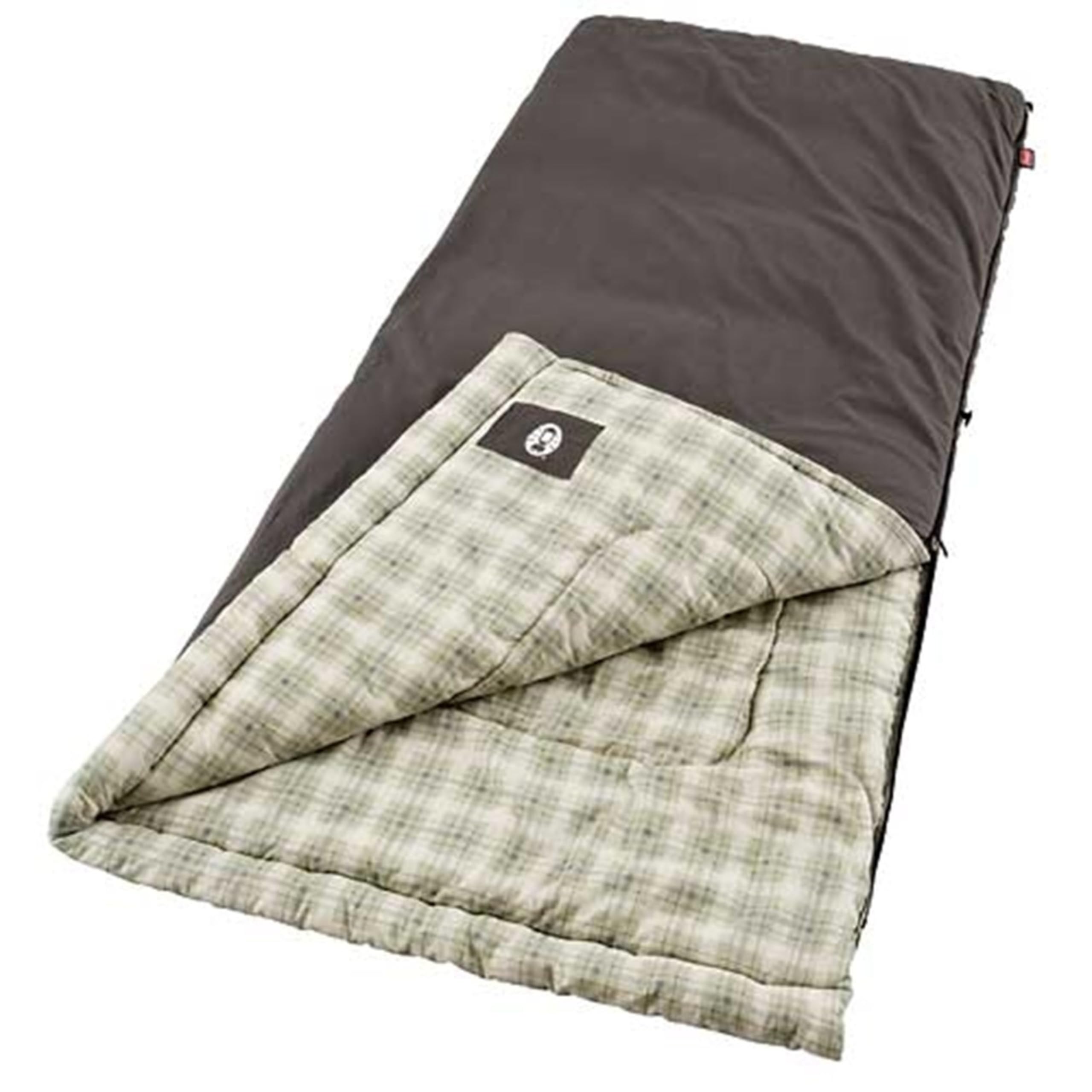
Coleman Heritage Big & Tall
Key Features
- Weight: 8.9 lb
- Dimensions: 40 x 84 in
- Insulation: 5 lb Holofill 808
- Temperature rating: 10°F
- Price: Premium
Eight point nine pounds is the number that decides this bag’s job. You carry it from the trunk to the tent, not from a trailhead to a ridge, and in exchange you get five pounds of Holofill 808 insulation and a 10°F rating — the warmest bag in this group by a wide margin. The FiberLock construction is meant to keep that fill from migrating into one corner, which is what turns a heavy bag into a cold one after a few seasons.
The other half of the appeal is the shape. Forty inches across and 84 long, with a cotton cover and a flannel liner, it feels closer to bedding than to camping gear. The flannel is the detail that sells it: no cold nylon shock at two in the morning, and enough width to pull a knee up. The patented no-snag zipper is the kind of boring engineering that matters over years rather than one trip, and the machine-washable build means a muddy weekend is not a life sentence.
We rate it the best cold-weather car-camping bag here, and the Wrap ‘N’ Roll straps make the roll-up less of a chore than a bag this size deserves, though it still stores like a small duffel. The five-year limited warranty is the longest of any pick here. Backpackers should walk past without a second look; the weight settles that argument on its own.
Pros
- 10°F rating is the warmest here
- 40-inch width leaves room to move
- Cotton flannel liner feels like bedding
- No-snag zipper and five-year warranty
Cons
- 8.9 pounds rules out backpacking
Buy it when the car does the carrying: ten-degree rated, flannel lined, and built for sleepers the standard bags ignore.
Best for Big and Tall
HiZYNICE XXL Sleeping Bag
Key Features
- Lining: 100% cotton flannel
- Weight: 7 lb
- Dimensions: 90 x 39 in
- Temperature ratings: 30°F comfort, 15°F limit, 0°F extreme
- Price: Premium
Ninety inches long and 39 wide — roughly a foot wider than a standard camping bag — and that changes what sleep feels like. You can bend a knee, roll onto your side, and keep your shoulders inside the bag instead of pressed against a seam. The listing says it still fits a camper of six foot seven, which is a claim almost nothing else here makes.
Warmth is the other reason it earns a place. The comfort rating is 30°F, with a 15°F limit and a 0°F extreme, and the comfort number is the one that describes a night you would sleep through; the other two are about getting through it. A draft tube runs behind the zip, and the cotton flannel lining is genuinely soft, the plush kind rather than the utility flannel on the REDCAMP.
At seven pounds this is a car-camping bag: cabin, RV, hunting camp, anywhere it travels in a vehicle. The thing to know before you order is that the seams and the compression sack are the weak points. The shell and lining hold up fine; it is the stitching at the stress points and the sack’s construction that give trouble. Set it up once at home and check both before a trip.
Pros
- 39-inch width fits big and tall sleepers
- 30°F comfort rating for real cold
- Cotton flannel lining is soft and warm
Cons
- Seams and stuff sack are weak points
- Seven pounds means car camping only
The one we hand to big, tall, or restless sleepers: 39 inches wide, flannel lined, and rated for genuinely cold nights.
Best for Couples Camping
REDCAMP Flannel Sleeping Bag
Key Features
- Fill: 2 lb cotton
- Zippers: Two-way, reverse for joining
- Dimensions: 75 x 33 in
- Temperature range: 50-77°F
- Price: Midrange
Two of these zip into one double. The zippers are two-way and reversible, so a left-hand and a right-hand bag meet down the middle, and you get a shared quilt rather than two singles pushed together. For couples, or for anyone who has spent a night with a cold strip of air between two bags, that is the whole argument.
The flannel lining is the second reason to pick it. It is a utility flannel — closer to a sturdy sheet than to a plush blanket — and for people who dislike the slick feel of a synthetic liner, that is precisely the point. The shell is a 210T ripstop polyester with a water-resistant finish, which handles dew and a damp tent floor without much fuss.
Watch which fill you order. This is the 2 lb version, in the 50-77°F range with comfort around 59°F: a summer and festival bag rather than a shoulder-season one. The same shell comes in heavier fills if you want to push into spring and fall. Check the length too — 75 inches is the shortest bag in this group, and a six-foot sleeper will feel the end of it at their toes.
We rate it the best of these for couples and for anyone who wants a blanket feel in a tent. It is also the one most likely to get used indoors, on a sofa, a guest bed, or the back of a van, because the flannel and the shape both work without a tent around them. Bring a pad if the ground is cold; flannel is cozy, not insulating.
Pros
- Two bags zip into one double
- Cotton flannel liner feels like bedding
- Comes in heavier fills for colder trips
Cons
- 75-inch length is short for tall campers
The couples’ pick, because two of these zip into one double — and the flannel lining makes it feel like bedding rather than gear.
Best for Car Camping
SOULOUT 3-4 Season Sleeping Bag

Key Features
- Weight: 4.5 lb
- Dimensions: 86.6 x 32.7 in
- Packed size: 9.1 x 13.8 in
- Temperature rating: 32-77°F
- Price: Midrange
The packed bundle is 9.1 by 13.8 inches, which is honest about what this is: a four-and-a-half pound bag that lives in a trunk or a van rather than at the bottom of a backpack. What the weight buys is space — 86.6 inches long and 32.7 wide, with zips at the top and the bottom so you can vent your feet or your shoulders independently.
The temperature claim spans 32 to 77°F, and the bottom of that is optimistic. Plan on it for nights in the forties and above, with a liner and a warm hat if the forecast wobbles. Treated as a summer and early-fall bag it is comfortable, and the water-resistant shell shrugs off condensation on the inside of a tent, which is most of what a three-season night asks.
It stays on this list because it is the roomiest bag here that still packs into a sensible bundle, and the two-way opening makes it the easiest of these to climb into in the dark without waking everyone. If your camping is a tent beside the car and your nights are mild, the space is worth more than the warmth you give up against the MalloMe or the Sportneer.
Pros
- 32.7-inch width gives room to turn
- Top and bottom zips vent separately
- Water-resistant shell handles tent condensation
Cons
- Buckles on the stuff sack are brittle
- 4.5 pounds is heavy for backpacking
A roomy car-camping bag with independent top and bottom venting; its 32°F claim is optimistic, so keep it to mild nights.
Best for Kids and Summer
TANSTRIDER Sleeping Bag

Key Features
- Weight: 3 lb
- Included: Compression sack, draft collar
- Dimensions: 87 x 31 in
- Temperature range: 55-60°F comfort, 40°F limit
- Price: Budget
A nine-year-old on a scout trip and a grown adult on a July weekend want roughly the same thing from a sleeping bag: light, forgiving of being dragged around, and warm enough for a night in the fifties. This is that bag. It runs 87 inches long and 31 wide, so a child has room to grow into it and a six-foot adult still fits, and at three pounds it is not a burden in a duffel.
We rate it the best value here for summer and early-fall camping with kids. The draft collar behind the neck and the cinching hood are features that usually vanish at this end of the market, and the foot zip lets a hot sleeper stick their feet out without unzipping the whole bag. A compression sack is included, and it is a real one.
The 55-60°F comfort range is the honest limit. The 40°F figure alongside it should be read as the point where you would be uncomfortable rather than the point where the bag keeps you warm. It is a summer bag — festival, backyard, warm-weather backpacking — and it should stay home from October onward.
Pros
- Three pounds is easy for a child to carry
- Draft collar and cinching hood included
- Foot zip vents without a full unzip
- 87-inch length fits adults and growing kids
Cons
- Comfort range covers mild nights only
What we hand a kid or a fair-weather camper: light, roomy enough to grow into, and rated for the mild nights those trips happen in.
Best for Summer Backpacking
Wind Tour 3 Season Sleeping Bag

Key Features
- Weight: 2.2 lb (1 kg)
- Quilt mode: 72.8 x 63 in
- Sleep mode: 84.6 x 31.5 in
- Temperature range: 43-59°F
- Price: Budget
Open it flat and it becomes a 72.8 by 63-inch quilt; zip the hood extension on and it is an 84.6-inch sleeping bag. That dual mode is why we kept it on the list. As a bag it handles a mild night; as a quilt it goes over a pad in a shelter, over a sleeping child, or on the grass at lunch, and few bags here do two jobs at all.
At 2.2 pounds it is the lightest of the group and packs down accordingly. The fill is thin — enough to hold warmth and break a breeze, nowhere near enough to cushion you from the ground. The 11.8-inch hood extension only counts toward the length in sleep mode, which is the sort of detail that catches people out when they compare sizes on a listing.
In use it behaves like a warm-weather quilt with a hood: fine on a summer night with a pad underneath and the hood cinched, less convincing once the temperature drops and wind gets under the open edge. The shell wipes clean easily, which matters for a bag that will spend half its life on the ground outside a tent.
We reach for it on settled summer trips where pack weight matters, and for cabin weekends where a full bag is overkill. Less loft is the price of two pounds, and that price is worth paying in July in a way it never is in October.
Pros
- 2.2 pounds is the lightest here
- Opens into a 63-inch-wide quilt
- Hood extension zips on for cooler nights
Cons
- Thin fill gives almost no ground cushioning
- 43-59°F range limits it to summer
The lightest bag here and the only one that opens into a quilt, which makes it the summer backpacker’s choice.
How We Tested 12 Sleeping Bags in Real Camping Conditions
We began with research rather than a shopping cart: we pulled every three-season bag we could find, sorted by temperature rating, fill type, shape, packed size, and price band, then narrowed to 12 that covered the real spread — budget workhorses, mid-priced standouts, and a few investment pieces. Bags with vague or missing temperature ratings, or with shells that felt thin in the hand, did not make the cut.
For eight months, three testers between 5-foot-2 and 6-foot-4 slept in them on back porches, on a damp weekend near the coast, and on a high-desert trip that bottomed out in the low 30s. We weighed every bag on a kitchen scale, stuffed it into its sack and set it beside a 10-liter stuff sack for comparison, and measured shoulder and hip girth against our own bodies, since a bag that is too wide is dead air you have to heat.
On cold nights we kept a thermometer by the tent and wrote down the hour we first felt chilled, which told us more about warmth than the tag did. Zippers got run from the inside in the dark and with gloves on, and we counted every snag. Durability meant 20 stuff-and-roll cycles, then a look at whether the loft came back, whether seams strained, and whether fill leaked at the baffles. We also noted the small things — whether the bag twisted on pad straps, vented on a mild night, or opened flat as a quilt — and weighed all of it against what each bag cost.
How to Choose a Sleeping Bag for Camping
The most useful thing you can do before ordering is ignore the number printed largest on the bag and match it to the coldest night you will actually sleep through.
Read the rating as three different numbers
Most bags quote a comfort figure and a limit figure, and some add an extreme. Only the comfort figure describes a night you would sleep through; the limit is where a cold sleeper starts shivering, and the extreme is about getting through, not sleeping. That is why the HiZYNICE’s 30°F comfort figure is a colder bag than the SOULOUT’s 32°F headline — the second is the bottom of a range, not a comfort point.
Pick for the coldest night you expect in the season you actually camp, then add a margin for a bad forecast. A 50-80°F bag like the MalloMe is a summer-to-early-fall bag; a 30°F comfort bag is the shoulder-season one.
Weight decides which kind of camping you are doing
Around three pounds with a compression sack is the practical backpacking end of this group. Seven to nine pounds is car camping, full stop. The Wind Tour at 2.2 pounds and the MalloMe at about three are bags you carry without noticing; the HiZYNICE at seven and the Coleman Heritage at nearly nine are bags you carry from the trunk to the tent.
Be honest about which trip you take more often. A heavy bag on a short walk is fine, a light bag on a cold night is not, and those two trade against each other directly.
Fit is length and width together
Eighty-six inches is the standard length here and fits most adults to about six foot with room at the head. Seventy-five inches, which is what the REDCAMP offers, is a short bag — fine for a five-foot-six sleeper, tight for anyone taller. Width matters just as much: 31.5 inches is standard, and broad shoulders or side sleeping want 33 inches or more.
A bag can be long enough and still pinch. If you turn over a lot, the HiZYNICE’s 39-inch cut or the SOULOUT’s 32.7 inches are the ones to look at.
The zipper is the part that fails first
A coil zipper is the cheapest component on a sleeping bag and the one that ends its life. When the slider catches the lining, the teeth separate and the bag stops being a bag. A draft tube or a fabric guard behind the zip prevents most of that, and a two-way zip with a separate foot opening is worth having for venting alone — the Sportneer and the SOULOUT both do it.
Run the zip all the way around before your first trip and again before you leave. It is a thirty-second check that saves a night.
Lining and fill decide how it feels at two in the morning
Flannel and cotton feel like bedding and weigh more; polyester pongee feels slick and dries faster. The Coleman Heritage and the HiZYNICE use cotton flannel, which is why they are heavy and why people love sleeping in them. Synthetic hollow-fiber fill lofts back after packing and tolerates damp better than cotton, which takes longer to dry and does not recover the same way.
For a bag that lives in a car, take the flannel. For one that lives in a pack, take the synthetic and accept the cooler first touch.
Frequently Asked Questions
Can I wash a sleeping bag in a washing machine?
Yes, if it is a synthetic bag and you use a front-loading machine on a gentle cycle with a little non-detergent soap. The Coleman Heritage is listed as machine washable; for the others, a bathtub and a warm room do the same job with less risk to the seams.
Dry it thoroughly before it goes back into storage. A bag put away damp loses loft and smells, and high heat is the one thing that will wreck the fill.
Can two sleeping bags be zipped together?
Only when one bag is a left-hand zip and the other is a right-hand zip with a matching coil. The REDCAMP is built for it — its two-way reverse zippers join two bags into one double — and the HiZYNICE comes in left and right versions for the same trick.
Order both at once and check the zipper pitch matches before you leave.
Why am I still cold in a bag rated for the temperature?
Because the ground pulls more heat out of you than the air does. A bag’s fill compresses flat underneath, so an insulated pad — closed-cell foam or an insulated inflatable — does as much work as the bag itself.
Then close the hood, wear a dry hat, and eat something before bed. On a marginal night that combination buys several degrees for very little.
How do I get the bag back into its sack?
Fold it in half lengthwise, then roll from the foot, pressing the air out with your knees as you go. Synthetic fill also tolerates being stuffed hand over hand, which is faster and easier on the seams.
At home, store it loose — hanging or in a cotton sack — rather than compressed, so it keeps its loft between trips.
Final Verdict
Most people should buy the MalloMe and stop shopping. It lives in the temperature range where most camping happens, it weighs about three pounds, it fits a tall sleeper, and it packs without a fight — that combination is why it holds the top spot.
Two requirements move the answer. If you run warm and want to vent your feet on a mild night, the Sportneer is the better bag. If your trips are cold and the car is parked twenty feet away, the Coleman Heritage is worth the weight.