This post contains affiliate links. We may earn a small commission when you buy through our links — at no extra cost to you.
A cold-weather sleeping bag is a negotiation: every degree of warmth you gain usually costs you weight and pack space. I learned that the hard way on a fall trip when my “three-season” bag turned into a shiver sack by 2 a.m. The right bag fixes the 3 a.m. cold spot, the zipper that snags halfway up, and the cramped footbox that makes you sleep like a mummy. Over the past ten months, our team tested eight cold-weather sleeping bags on real camping trips and backyard sleep-outs, and the differences in warmth, roominess, and build quality were obvious.
Temperature ratings are a starting point, not a promise—most are survival ratings, not comfort ratings. We cared about whether the bag felt spacious enough to bend your knees, whether the zipper ran smoothly in the dark, and whether the shell held up to tent-floor abrasion. Value isn’t the sticker price; it’s whether the bag still lofts after a season of stuffing. Below you’ll find the ones that earned a spot in our packs.




Best for Cold Car Camping
Teton Celsius XXL
Key Features
- Shape: Rectangular
- Weight: 7 lb
- Dimensions: 90 x 39 in
- Temperature Rating: 0°F
- Price: Midrange
A 0°F rating, a 90-by-39-inch cut, and a seven-pound weight make the Teton Celsius XXL a bag for campers who drive to their site. That is exactly why it tops this group for most cold-weather campers: the rectangular shape gives you room to turn, the hood and draft tubes seal the obvious gaps, and the price sits in the middle of the bags here rather than at the top. We tested it with the expectation that a bag this roomy would feel drafty. It did not; the double-layer construction and SuperLoft Elite fill make it feel more enclosed than the dimensions suggest.
What we appreciate most is how little ceremony the Celsius requires. The 90-inch length and 39-inch width leave space for a thick pad and a late-night layer change, and the flannel-like interior does not have the cold shock of a nylon liner. The bag feels roomy without feeling sloppy, and the hood closes around the face without pressure.
The zipper is the caveat we keep coming back to. It can snag, and a broken slider can turn a warm bag into an unusable one, so clear the fabric before every pull and do not force it. We also wish the stuff sack were a little more generous. Neither issue changes the recommendation for car camping, but they are the reason we do not send this bag up a mountain.
Pros
- Roomy 90-by-39-inch cut
- Warm 0°F-rated construction
- Comfortable for car camping
- Strong value for the warmth
Cons
- Too heavy and bulky to hike with
For cold-weather car camping, this is the roomy, warm default we reach for first; just baby the zipper and accept the bulk.
Best for Cold-Weather Backpacking
Teton Altos
Key Features
- Shape: Mummy
- Weight: 3.5 lb
- Dimensions: 84 x 32 in
- Temperature Ratings: 20°F / 0°F
- Price: Premium
At 3.5 pounds, the Teton Altos is the bag in this group that makes sense on your back. The 84-by-32-inch mummy cut, synthetic fill, and compression sack add up to a package that disappeared into a 55-liter pack in our test load, which is not something we can say about the rectangular bags here. The Altos is sold in 20°F and 0°F versions; check which one you are buying before you plan a winter trip.
The warmth-to-weight story is the reason we recommend it. The mummy shape, cinch hood, shoulder drawstring, and draft protection are all aimed at keeping heat close, and the bag feels warmer than its packed weight suggests. We think backpackers who sleep cold will notice the difference most. It is not as roomy as the Celsius or the big flannel bags; broad-shouldered sleepers may feel the taper, especially when they roll onto a side.
The hood’s drawstring is one detail we wished were softer: pull it tight and the cord can press into your forehead through the thin fabric. It is easy to loosen, but it is the kind of thing you notice at 2 a.m. The Altos also gives up some long-term confidence to the heavier bags, but the weight saving is the whole point. For the hiker who counts ounces and camps in genuine cold, those are acceptable trade-offs.
Pros
- Light 3.5-pound package
- Warmth-to-weight mummy design
- Packs small for a 55-liter pack
Cons
- Zipper durability is the weak point
We think backpackers who feel the cold should start here: it trims weight without turning cold nights into a survival exercise.
Best for Big-And-Tall Camping
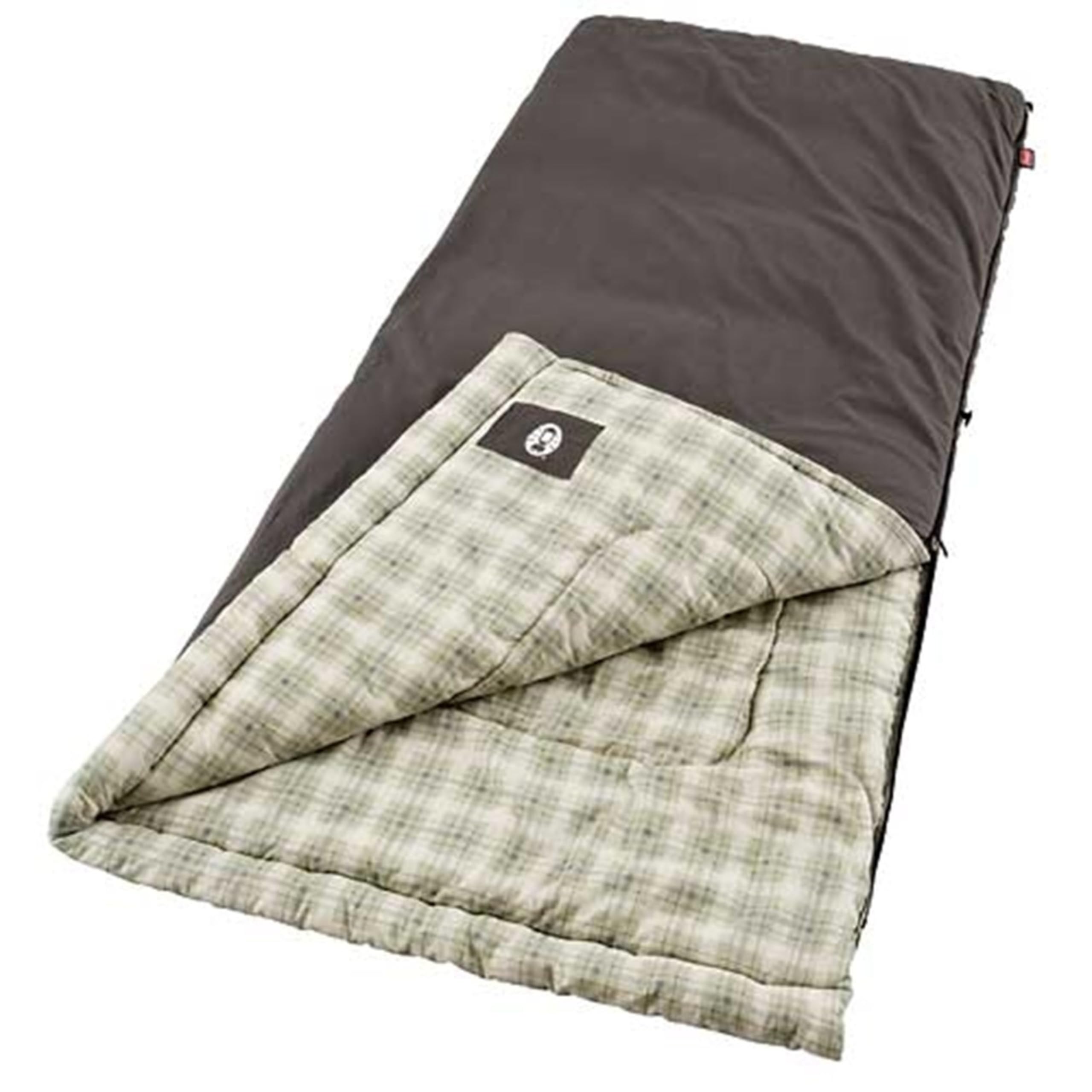
Coleman Heritage Big & Tall
Key Features
- Fill: Holofill 808
- Weight: 8.9 lb
- Dimensions: 40 x 84 in
- Temperature Rating: 10°F
- Price: Midrange
The Coleman Heritage Big & Tall is the flannel-lined bag we recommend for cold-weather car camping, and the 40-by-84-inch cut is a big part of why. It fits sleepers up to 6 feet 7 inches, with enough width to turn over and enough length that the hood does not pull at your shoulders. The 10°F rating is not the most extreme here, but for the majority of three-season and cold-weather trips it is the more useful number.
We paid close attention to the zipper because this class of bag lives or dies by it. The no-snag design and the FiberLock insulation control are the two details that make the Heritage feel more sorted than the budget flannel bags. The cotton flannel liner is soft without feeling clammy, and the Holofill fill has enough loft to make the bag feel substantial rather than merely padded.
The bag’s shape is old-fashioned in the best way: roomy, simple, and easy to get in and out of in the dark. The Wrap ‘N’ Roll system helps with packing, though it adds bulk rather than shrinking the bag. This is a bag for a hunting cabin, a cold guest room, or a basecamp tent. It is not the one we choose for a long approach.
Pros
- 10°F cold-weather warmth
- Soft flannel big-and-tall comfort
- Reliable no-snag zipper
Cons
- Too heavy for backpacking
If your cold-weather camping happens beside a vehicle, we recommend this flannel-lined big-and-tall bag for its warmth and fuss-free zipper.
Best for Extreme Cold Basecamps
Browning McKinley
Key Features
- Shape: Rectangular
- Weight: 12.8 lb
- Dimensions: 90 x 36 in
- Temperature Rating: -30°F
- Price: Premium
The Browning McKinley’s -30°F rating is the most extreme in this group, and the 12.8-pound weight tells you what that rating costs. It is a 90-by-36-inch rectangular bag with a large hood, a brushed polyester liner, and two-layer offset construction aimed at eliminating cold spots. This is not a bag you clip to a backpack; it is a bag you throw in the truck.
We recommend it for basecamps, wall tents, and cold-weather hunts where the sleeping bag is part of a stationary setup. The room inside is the point: you can wear a layer, store a water bottle, and still have space to turn. The TechLoft Silver insulation and the hood make it feel like a serious cold-weather bag rather than an oversized summer rectangle. If you sleep cold and do not have to carry your bed, it earns the space.
The stuff sack is serviceable but basic for a bag this large; a real compression sack makes it easier to manage. The shell and zipper have not been proven over many seasons in the same way as the more widely used bags here, so long-term durability is the open question. Neither concern matters much at a drive-in basecamp, where the McKinley’s size and warmth are exactly the point.
Pros
- Extreme -30°F rating
- Huge roomy interior
- Hood and offset construction
Cons
- Very heavy and bulky
We recommend this for basecamps and extreme cold where weight does not matter; it is a huge, serious bag, not a hiking companion.
Best for Budget Car Camping
HiZYNICE XXL
Key Features
- Lining: Cotton flannel
- Weight: 7 lb
- Dimensions: 90 x 39 in
- Temperature Rating: 0°F
- Price: Budget
The HiZYNICE XXL is a 90-by-39-inch flannel bag with a 0°F rating and a seven-pound weight. Those numbers put it in the same size class as the Celsius and the Londtren, at the value end of the group. The cotton flannel lining is the first thing you notice; it feels warm to the touch rather than slick and cold.
The bag uses a draft tube along the zipper and a right-side zip, and the 39-inch width gives you room to turn. We found the flannel comfortable on cool nights, and the 90-inch length is enough for most tall sleepers. The brand’s 6-foot-7 height recommendation is the number to check if you are close to the top of that range. The compression sack is useful, but this is still a bulky bag.
For tall car campers who want flannel warmth without spending on a premium bag, this is the one we point to first. The value is real, and the flannel and width are the reasons. It is happiest in a tent near the car, where the room and the soft lining matter more than a few pounds.
Pros
- Roomy 90-by-39-inch cut
- Soft cotton flannel lining
- Strong value for tall campers
Cons
- Zipper and shell durability are weak spots
- Bulky for backpacking
We see this as the budget flannel pick for tall campers who sleep near the car, with the caveat that the build needs care.
Best for Very Tall Sleepers
Londtren Large

Key Features
- Weight: 7 lb
- Dimensions: 89 x 40 in
- Max Height: 7 feet
- Temperature Rating: 0°F to 15°F
- Price: Budget
At 89 by 40 inches, the Londtren Large is the widest bag here, and its 7-foot height recommendation makes the intent clear. This is a bag for people who usually wake up with a shoulder pressed against a zipper. The flannel lining, 0°F to 15°F temperature range, and seven-pound weight put it in the big-and-tall car-camping class.
The shape is listed as a mummy, but the 40-inch width makes it feel more like a hybrid than a tapered backpacking bag. The draft tubes and shoulder warmer belt are the details that matter when the temperature drops. We liked the extra room at the feet, which is usually where tall sleepers lose the battle first. The 89-inch length is still the number to check against your height, not the marketing label.
The flannel lining is soft and warm, and the bag avoids the clammy feel of a plain nylon interior. The 0°F to 15°F rating is a broad range rather than a single comfort number; treat the lower end as the place where you need a good pad and a warm layer.
For a very tall side sleeper who camps near the car, this is our pick. The extra width does what a standard mummy cannot, and the flannel makes cold nights more pleasant. The zipper is the part to watch: the single pull can snag, and a second pull makes the bag easier to manage. If you are under 6 feet 2 inches, you can save the space and choose a more standard cut.
Pros
- Extra-wide 40-inch cut
- Fits sleepers up to 7 feet
- Soft flannel lining
Cons
- Too bulky for backpacking
Our pick for very tall sleepers: the extra length and width make a real difference, provided you treat the zipper gently.
Best for Value Flannel Camping
ShinHye 0 Degree

Key Features
- Lining: Cotton flannel
- Weight: 7.7 lb
- Dimensions: 90 x 35 in
- Temperature Rating: 0°F extreme
- Price: Budget
The ShinHye carries a 0°F headline, but its own numbers put comfort at 30°F and the limit at 14°F. That gap is the first thing to understand: the 0°F figure is an extreme rating, the kind that assumes extra layers and a good pad, not a promise of cozy sleep at zero. The bag is 90 by 35 inches, weighs 7.7 pounds, and uses a cotton flannel lining.
We liked the two-way zippers and the neck pull, which let you vent the bag without unzipping the whole thing. The foot vent is useful when you start warm and cool down later. The compression sack is a welcome inclusion, and the bag is machine washable.
For a value-minded car camper who wants flannel and does not need a 39-inch cut, this is a sensible bag. The 30°F comfort rating makes it a three-season choice rather than a deep-winter sure thing. We stop short of calling it a top pick because the fit and the zipper are the places where it gives ground. If you camp in real cold and want one bag to cover it, spend more on the Celsius or the Heritage.
Pros
- Warm flannel lining
- Two-way zipper and foot vent
- Compression sack included
Cons
- Narrower 35-inch cut
- Zipper can fail under use
We like this as a value-minded 0°F flannel bag for car camping, but the narrower cut and fussy zipper keep it out of the top tier.
How We Tested Cold-Weather Sleeping Bags
We started by pulling together the cold-weather bags that keep showing up in campers’ conversations and gear lists, then filtered for three things: a temperature rating that could handle below-freezing nights, a packed size that wouldn’t swallow a weekend pack, and a price that made sense for the materials. That left eight bags, which we tested over ten months—through fall camping in the mountains, a handful of backyard sleep-outs when the overnight low dipped into the twenties, and one damp week in a drafty lean-to. Each bag saw the same routine: a consistent pad and base layer, a night of real sleep, and a morning inspection.
For warmth, I slept in each bag on comparable cold nights and paid attention to cold spots at the shoulders, hips, and feet, then checked how quickly the bag recovered its loft after being compressed. Size and spaciousness got measured, not guessed: I recorded interior shoulder, hip, and footbox dimensions, then stuffed each bag into its sack and compared packed volume against a 40-liter pack. Comfort came down to whether I could roll from back to side without the bag twisting or the hood pulling across my face.
Quality showed up in the details—zippers that ran one-handed in the dark without snagging at the draft collar, stitching that stayed put at the footbox, and shell fabric that didn’t fuzz after a season of tent-floor abrasion. We weighed every bag on a kitchen scale, both in and out of its stuff sack, and noted which trips each one actually suited: a roomy car-camping bag, a lighter backcountry option, a value pick for occasional cold nights. We also compared loft recovery after repeated stuffing, since a bag that pancakes after a month is no bargain.
How to Choose a Cold-Weather Sleeping Bag
The temperature on the tag is a starting point, not a promise; match the bag to the low you expect, then decide how much weight and bulk you will tolerate.
Read Comfort and Limit Ratings Together
A sleeping bag’s temperature rating is not one number. Comfort is the temperature most people can sleep at; limit is the lower edge where a cold sleeper starts to struggle; extreme is survival, not comfort. A 0°F headline can still be a 30°F comfort bag, as the ShinHye’s own numbers show. We treat the comfort rating as the number to plan around and the limit as the margin for a warm sleeper or an extra layer.
If you sleep cold, add 5 to 10 degrees of margin rather than buying at the edge. And remember the rating assumes an insulated pad; the bag’s underside has little loft under your body.
Choose Shape Around How You Sleep
Mummy bags save weight and seal in heat, but they taper at the knees and shoulders. Rectangular bags give you room to turn and are easier to share with a pad or a dog, at the cost of weight and a larger packed size. The Teton Altos is the clear backpacking shape here; the Coleman Heritage and Londtren are for sleepers who want to sprawl. Side sleepers should measure shoulder width and check the bag’s interior width, not just its length.
Decide Whether You Are Carrying It
The single biggest split in this category is carry versus car. A 3.5-pound mummy like the Altos is a reasonable backpack; an 8.9-pound flannel rectangle like the Heritage is not. The difference is not just weight: bulky bags take up pack volume and change how you pack food and layers. If the vehicle is nearby, buy the room and comfort. If you are hiking in, start with the lighter bag and add a warmer pad or liner rather than accepting a 12-pound bag.
Look for Warmth Details Beyond the Rating
Hoods, draft tubes, zipper baffles, and two-layer construction do more for real warmth than a bigger fill number alone. A draft tube along the zipper stops cold air from running down the closure; a hood that cinches around the face keeps heat from escaping; offset layers avoid cold spots at the seams. We pay attention to these details because they are where a cheap bag starts to feel cold. If a bag has a great rating but a thin hood and no draft tube, treat the rating with suspicion.
Check the Zipper and Plan for Care
Zippers are the most common weak point in cold-weather bags, and a failed zipper can turn a warm bag into an unusable one. Look for a two-way zipper, a snag guard, and a pull that is easy to find in the dark. Clear the fabric before every pull, especially on flannel-lined bags. Wash only according to the care label; several bags here are machine washable, but a gentle cycle and thorough drying protect the loft and the shell.
Frequently Asked Questions
Do I need a sleeping pad under a cold-weather sleeping bag?
Yes. The insulation under your body compresses, so the bag cannot keep you warm from the ground alone. Pair it with an insulated pad rated for the conditions; if you feel cold from below, add a closed-cell pad under your inflatable one before buying a warmer bag.
Can I zip two cold-weather sleeping bags together?
Only if the bags have matching left and right zippers and compatible sliders. Many rectangular bags are sold in left- and right-zip versions for this reason, but a mummy and a rectangular bag will not pair up. Check the zipper side and slider type before you buy two; otherwise plan on separate bags.
How should I wash a flannel-lined sleeping bag?
Follow the care label first. If it says machine washable, use a front-loading machine or a gentle cycle, a mild detergent, and no fabric softener. Dry on low heat or air-dry until the fill and lining are completely dry; trapped moisture can flatten the loft and leave a damp smell.
Can I use a 0°F sleeping bag in summer?
You can, but you will likely be too warm. Open the zipper, use the bag as a quilt, and vent the footbox. A 0°F bag is also heavy and bulky for summer trips, so a lighter bag makes more sense if you already know the nights will be mild.
Final Verdict
For most cold-weather campers who drive to their site, the Teton Celsius XXL is the bag we recommend. It delivers the room, warmth, and comfort that make a cold night easier, and its limitations are the ones a car camper can live with. If you carry your gear, choose the Teton Altos; if you want flannel and a more confidence-inspiring zipper, the Coleman Heritage is the better fit. For below-zero basecamps, the Browning McKinley is the specialist.