This post contains affiliate links. We may earn a small commission when you buy through our links — at no extra cost to you.
The fire’s lit, the stars are out, and then the lantern flickers and dies, or the stove won’t light, or someone’s phone is at 4 percent with no charger for miles. Camping is mostly wonderful, but it runs on a chain of small dependencies — light, heat, food, dry clothes — and each one leans on gear that has to work the first time, in the dark, with cold hands. The right kit doesn’t make the trip; it quietly removes the failures that can sink it.
I once had a cheap headlamp die on a night walk to the bathrooms, and the lesson stuck: the gear that ruins a trip is rarely the gear you researched, it’s whatever you grabbed at the gas station on the way out. Over the past eight months, my team and I have taken 15 essentials on four trips, weighing everything, timing burn and battery life, and handing it to first-time campers to see what confused them. Size and sturdiness pulled against each other constantly, and price rarely predicted the winner. The picks below earned a permanent spot in my bin.



Best for Backcountry Water
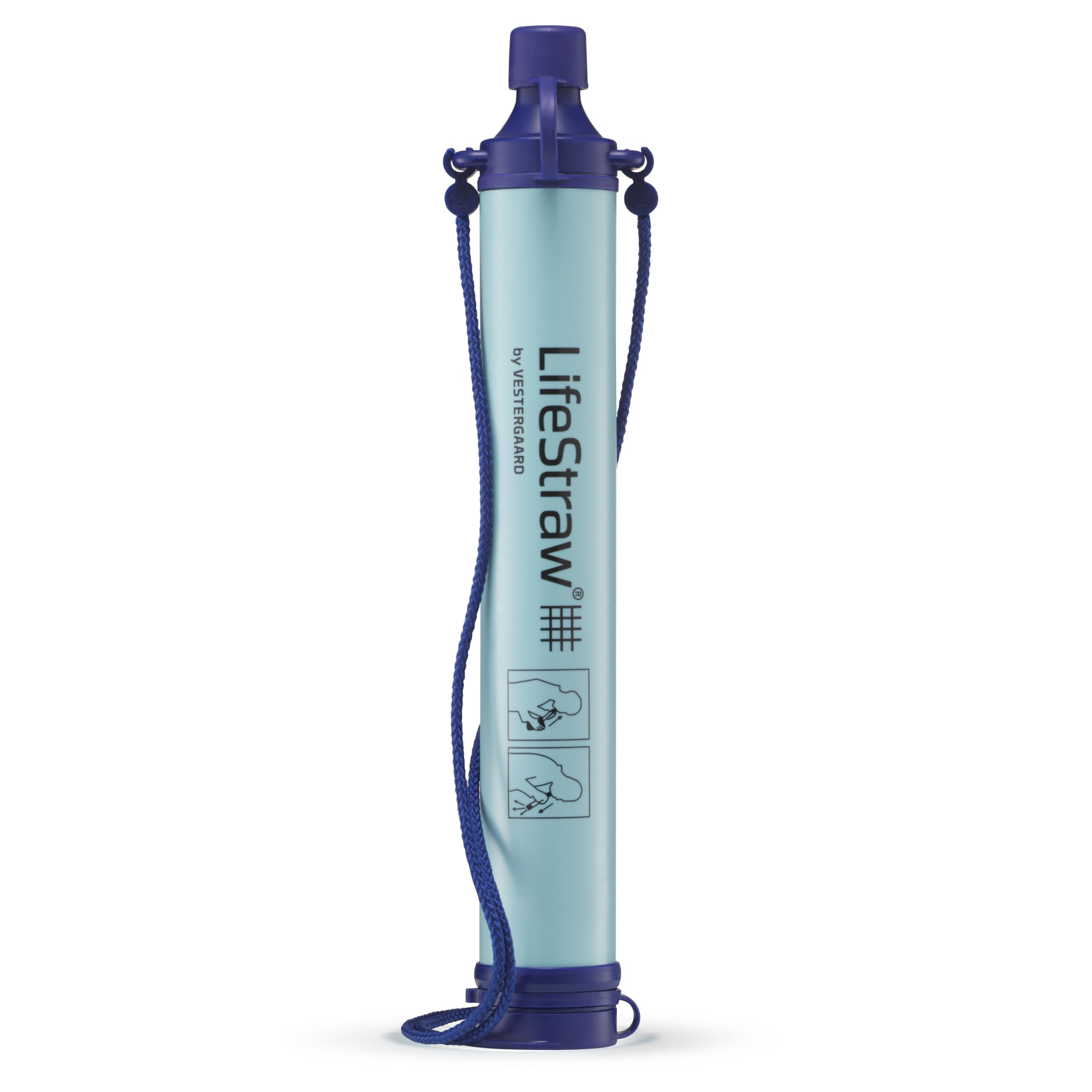
LifeStraw Personal Water Filter
Key Features
- Weight: 1.59 oz
- Dimensions: 3.75"D x 1.39"W x 12"H
- Certification: NSF
- Filter Capacity: 4,000 Liters (1,000 Gallons)
- Price: Midrange
Four thousand liters of drinking water from something that weighs 45 grams and hangs around your neck. That ratio is why the LifeStraw sits at the top of this list: water is the one need you can’t improvise at a campsite, and this is the least fuss we’ve found for meeting it — no pumping, no batteries, no waiting for a pot to boil and then cool.
Inside the plastic tube is a hollow-fiber membrane rated for 99.999999% of waterborne bacteria and 99.999% of parasites, plus microplastics down to one micron and turbidity down to 0.2 microns. Those claims are verified to EPA, NSF, and ASTM protocols, which is the part we actually check on a filter this cheap. You put one end in a lake, a river, or a bottle you’ve filled and drink through it, so a liter costs a few minutes of sipping rather than a fuel canister.
Two habits make it work better. Run a liter through before your first trip so the opening mouthful doesn’t taste of the factory, and keep it in a hip-belt pocket rather than buried at the bottom of the pack, because the moment you want it is the moment you’re thirsty and far from the car. The 4,000-liter rating is a long runway — for weekend camping this is a buy-once item, and the one piece of gear here that we notice immediately when it’s missing.
Pros
- Turns lake or river water into drinking water
- 45 g and 12 inches, so it disappears in a pack
- 4,000-liter filter life with no fuel or batteries
- Verified to EPA, NSF, and ASTM protocols
Cons
- No storage — you drink at the source, so bring a bottle
It’s the first thing we pack and the only item here that turns a river into drinking water — 4,000 liters of it from a 45-gram straw.
Best for Minor Injuries
Coleman All Purpose Mini First Aid Kit
Key Features
- Case: Crush-proof metal tin
- Pieces: 27
- Footprint: 0.88 x 2.5 x 3.88 in
- Price: Budget
Twenty-seven pieces inside a tin that measures under four inches long and less than an inch deep. That’s the whole argument: a first-aid kit only helps if it’s with you, and this one drops into a pack lid, a glovebox, or a bike saddlebag without a second thought. The tin is the reason we rate it above softer pouches — crush-proof metal with an embossed logo you can find by feel in the dark.
The contents are the sensible basics: latex-free bandages, antibiotic ointment, antiseptic wipes, sting relief wipes, butterfly, spot, and knuckle bandages, and safety pins. We treat it as a boo-boo kit rather than a trauma kit — it handles the cut, the blister, and the wasp sting, which is what a weekend actually produces, and it isn’t built for anything serious. If you’re heading somewhere remote, add a bigger kit alongside it rather than expecting this one to scale.
At this size, one for the car and one for the pack is not overkill. The tin keeps everything dry and organized, refilling is a matter of dropping in a fresh box of bandages, and it survives being sat on in a full trunk. Ours lives where we can reach it without unpacking anything, which is the only place a first-aid kit is worth keeping.
Pros
- 27 pieces in a crush-proof metal tin
- Fits a glovebox, pack lid, or saddlebag
- Covers cuts, blisters, and stings
Cons
- 27 pieces go quickly when you’re patching up a group
We recommend it without hesitation: 27 basics in a crush-proof tin the size of a deck of cards.
Best for Car Camping
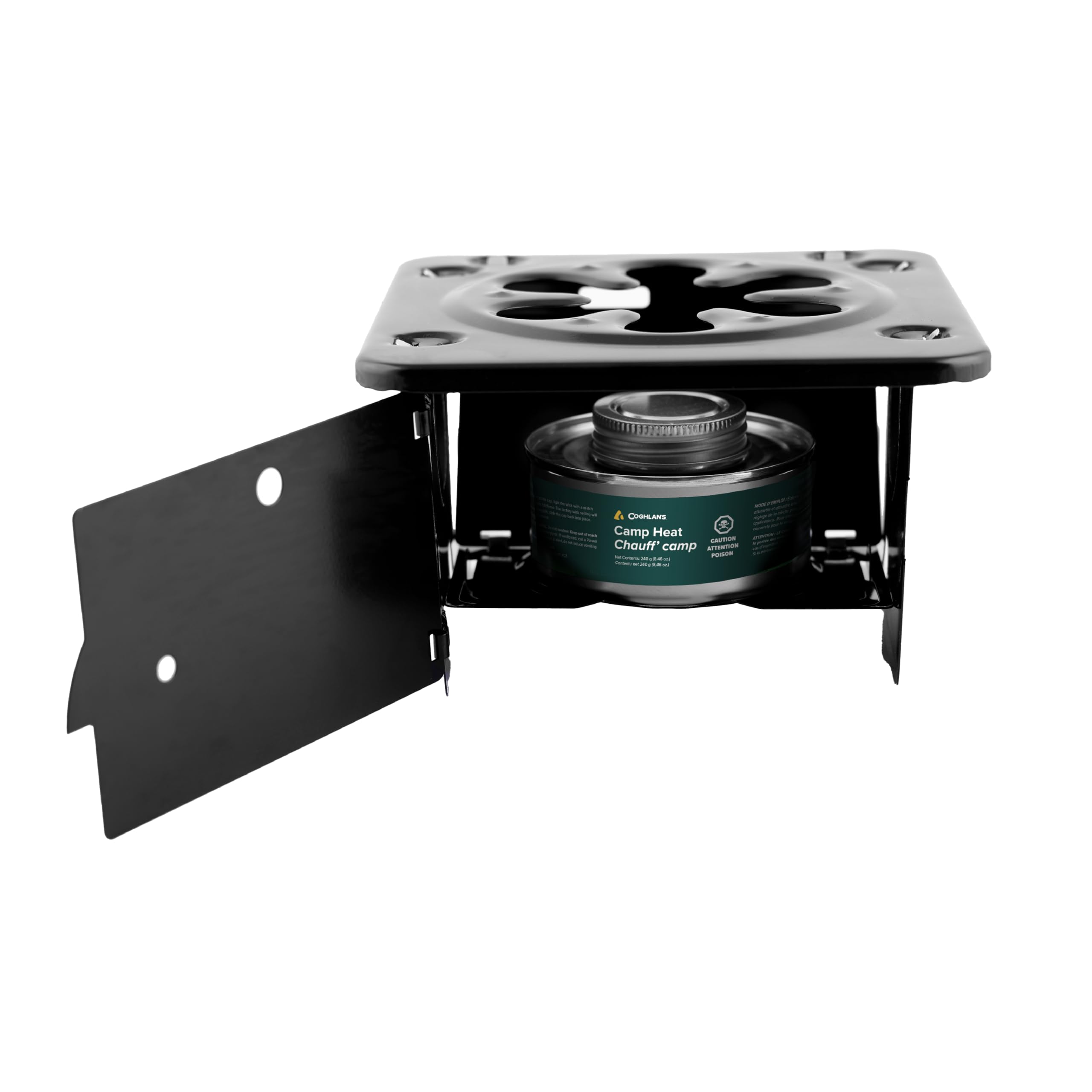
Coghlan’s Portable Folding Camp Stove
Key Features
- Fuel: Solid fuel tablets or canned heat
- Weight: 16 oz (1 lb)
- Cooking Surface: 6.5 x 6.5 in
- Price: Midrange
The stove arrives without fuel, and that’s the first thing to plan for. It burns Coghlan’s Camp Heat, fuel cubes, or solidified alcohol, all sold separately, so order tablets with it or you’ll be improvising on the first evening. What does arrive is a coated-steel frame that folds flat, a 6.5-by-6.5-inch cooking surface, and five inches of working height under a small pot.
Our use for it is the night the campfire dies — a fire ban, a downpour, a wet woodpile — when a hot meal otherwise turns into a cold sandwich. Set a pot on the grid, light a tablet underneath, and water is boiling in a few minutes with no canister, no pump, and no priming. For car camping, tailgates, and power outages, we haven’t used a simpler backup.
Two handling notes. The frame locates on notches, so lift the pot off rather than dragging the whole stove if you need to move it mid-cook. And 16 ounces is car-camping weight, not backpacking weight: in a trunk it’s nothing, on a long climb it’s a conversation. Keep it level — a tilted frame under a full pot is the only way this one bites.
Pros
- Folds flat for a car kit or bug-out bag
- Runs on canned heat or fuel tablets
- 6.5-inch surface takes a small pot
Cons
- Fuel sold separately
Our pick for the night the fire won’t light: a flat-folding stove that turns a fuel tablet into a hot meal.
Best for Emergency Kits
Mart Cobra Emergency Mylar Blankets
Key Features
- Material: Aluminized Mylar
- Thickness: 0.01 mm
- Pack Count: 4
- Blanket Size: 82" x 52"
- Price: Budget
Four blankets, each 82 by 52 inches unfolded, made from 0.01-millimeter aluminized Mylar and folded into a bundle you can hold in one hand. Those numbers are the product: big enough to wrap an adult, thin enough to live in a glovebox for years without being noticed, and light enough that there’s no excuse for leaving them at home.
The job is the night that goes wrong — a soaked sleeping bag, a cold passenger on a long drive, someone who has stopped shivering. Reflective film like this traps body heat and blocks wind, and it doubles as ground cover or a windbreak in a pinch. Four is the right count for a family: one in each pack, one in the car, one in the emergency box.
We treat them as single-use insurance rather than reusable kit. The film is thin, and ‘tear-resistant’ survives folding and unfolding far better than it survives being dragged over gravel — at a hundredth of a millimeter, that’s simply the trade for the size. As a shelter or a sleeping layer they’re poor, because a sheet of Mylar has no insulation of its own, but as the thing at the bottom of the pack that takes the edge off a bad night, a four-pack is some of the best value in this guide.
Pros
- Four blankets, each big enough for an adult
- Folds to a palm-sized bundle
- Reflects heat as a wrap, groundsheet, or windbreak
Cons
- Tears if dragged over rough ground
Cheap insurance we hope never leaves the bottom of the pack: four reflective blankets in the space of a wallet.
Best for Inside the Tent
FLY2SKY Clip-On Tent Lights
Key Features
- Battery: 3 AAA per light (not included)
- Brightness: 150 lumens
- Pack Count: 4
- Water Resistance: IPX8
- Price: Budget
Four lights, each about the size of a small phone at 5.7 by 2.1 inches, running three AAA batteries and putting out 150 lumens through three LEDs. The clip is the part that earns them a place: it opens wide enough for a tent loop, a guy line, a pack strap, or a child’s belt loop.
Light where you need it beats one lantern in the middle of the site. We hang one from the tent ceiling loop for reading, clip another to a pack for the walk to the washroom, and hand the spares to kids who want their own. There are three modes — high, low, and strobe — and the IPX8 rating means a wet night doesn’t worry us.
The batteries are the catch: three AAAs each, twelve for the set, none in the box, and how long they last depends entirely on the cells you feed them, so pack spares or a charger. Low mode is still bright enough that it doesn’t buy much dimming, and the strobe is a toy more than a tool. Neither point changes what these are for.
Pros
- 150 lumens from a palm-sized light
- Clips to tent loops, guy lines, and pack straps
- IPX8 water resistance for wet nights
- Four lights in one pack
Cons
- Three AAA batteries each, none included
The lights we hand the kids when they want their own: bright, clipped where you need them, and four to a pack.
Best for Campfire Treats
MalloMe S’mores Sticks
Key Features
- Length: 32 in
- Storage: Zipper pouch
- Material: 18/8 stainless steel
- Pack Count: 5
- Price: Budget
Thirty-two inches is the number that matters: it’s how far the fork holds a marshmallow from the coals, and roughly how far a child’s hand stays from the flames while they roast. The set is five forks, each with two prongs, wooden handles, telescoping shafts, and color-coded handle tips so everyone knows whose is whose.
They collapse into the zipper pouch, which is the difference between a roasting fork that goes camping and one that stays in a kitchen drawer. Cleaning follows the packet: fifteen minutes soaking in warm water, then a sponge, before the sugar sets like glue.
Stiffness at full extension is the compromise. With the shaft all the way out and something heavier than a marshmallow on the end, the fork flexes, so keep hot dogs closer in and don’t lever it against the fire. Used inside their reach, ours have taken everything we’ve put on them.
The reach is why they stay in the kit. Five forks also ends the argument about whose turn it is, and the colored tips mean a four-year-old can find their own in the dark. As campfire kit rather than cookware, that’s a trade worth making.
Pros
- 32 inches keeps hands back from the flames
- Five color-coded telescoping forks
- Zipper pouch keeps soot out of the car
Cons
- Flexes when fully extended and loaded
We give kids these instead of a sharpened stick — 32 inches of reach, five forks, and one pouch for the lot.
Best for Drying Wet Gear
HONGYUTAI Retractable Clothesline

Key Features
- Clips: 12
- Line Length: 12 ft
- Packed Size: 6.26 x 6.34 x 1.46 in
- Price: Budget
Twelve feet of line, a dozen clips that slide along a bead track, and hooks at each end that go over a branch, a shower rod, or a tent pole. It retracts into a case roughly the size of a fist — 6.26 by 6.34 by 1.46 inches — so it wedges into a corner of a duffel and gets forgotten until the towels come out wet.
Camping is where it earns its keep: towels, swimsuits, socks, dishcloths, the pile that would otherwise sit in a damp heap in the trunk for three days. The bead stops are more useful than they sound — space the clips out for a towel, bunch them for socks — and the hooks hold between two fixed points without the line sagging into the middle.
The trade is weight and hardware. This is not a gram-counter’s clothesline: a strict backpacker will leave it at home and a car camper will use it every trip. The hook tips are bare metal with no rubber caps, so hang them over fabric or a branch rather than a painted rail. For base camps and family trips, it’s the most quietly useful thing in this guide.
Pros
- 12 feet of line with 12 attached clips
- Hooks go over branches, rods, or poles
- Packs into a fist-sized case
Cons
- Bare metal hook tips can scuff surfaces
The line we throw in for car trips: 12 feet, a dozen attached clips, and a case that fits in the glovebox.
Best for Campfire Nights
MEKER Fire Color Packets

Key Features
- Use: Fire pits, campfires, fireplaces
- Weight: 11.2 oz
- Packets: 12
- Price: Budget
No unwrapping, no touching powder: you throw a sealed packet into the fire and the flames start shifting to blue, green, and purple within a couple of minutes. Twelve packets come in the box, each self-contained, which is the reason we’re comfortable handing one to a child to toss in.
Time is the honest variable. One packet gives a few vivid minutes before it fades; two or three at once give a stronger, slightly longer show, and a packet dropped into a deep bed of coals reads differently from one in a small fire pit. Expect minutes, not hours. The color runs out well before the fire does.
Where it lands best is a family fire with children who have already seen a hundred ordinary campfires. The first packet gets a shout; the second gets a request for more. Twelve disappear fast when everyone wants a turn, so we dole them out a night at a time instead of emptying the box on the first evening.
Judged as gear it’s frivolous; judged as the thing that makes a trip memorable, it’s the best value here. We keep the box in the fire kit and bring it out on the last night, when sitting around a fire has started to feel routine.
Pros
- Turns flames blue, green, and purple
- Sealed packets — no chemical handling
- Works in fire pits, campfires, and fireplaces
Cons
- Color fades within minutes
The small extra we never skip on a family trip: a sealed packet that turns one campfire green, blue, and purple.
How We Tested the Camping Gear
To build the shortlist, I started with roughly 60 pieces of gear — standby brands our readers keep recommending plus newer options that kept surfacing in reviews — and cut anything too heavy for a pack, too bulky for a car trunk, or priced well past what the job actually requires. That left 15 essentials, tested over eight months on four trips: a rainy weekend at a drive-in site, a two-night backpacking loop, a cold snap with overnight temps near freezing, and a backyard campout with two kids who had never pitched anything.
Every item was weighed on a kitchen scale, then packed into a 40-liter bag to see what it displaced. We timed setup with a stopwatch, then handed the gear to a first-time camper with no instructions to see whether it still made sense. Headlamps and lanterns ran on high until they dimmed; stoves were timed boiling a liter of water in a breeze; stuff sacks spent a night in a cooler of water. Everything got dropped, kicked across a site, and sat on at least once.
Back home, it all went into a bin and kept getting used — the lanterns through a two-day power outage, the power bank on a dead car battery, the first aid kit on a kitchen burn — which is where emergency readiness and battery retention really showed up. After eight months we could divide price by trips taken and see which pieces earned their keep. The ones that didn’t got handed off, and we’re still using the rest.
How to Choose Camping Gear That Earns Its Space
The camping kit that saves a trip is short: water you can drink, warmth you didn’t plan for, light after dark, and a way to cook when the fire won’t cooperate.
Start with the four problems you can’t improvise
You can forget a folding table and still have a good weekend. You can’t forget drinking water, warmth, light, or a way to deal with a cut. Those four get the first of the budget: a filter that turns a stream into a refill, a reflective blanket that lives in the pack even in July, lights that work when the phone dies, and a kit small enough that you actually carry it.
Everything else on a packing list is comfort. Worth having, certainly, but not worth planning a trip around, and not worth buying before the four above are sorted.
Match the weight to how you camp
Car camping has a trunk; backpacking has a limit. A 16-ounce folding stove is nothing in a tote and a real argument on a long climb, and a 12-foot clothesline that earns its place at a base camp is dead weight above the treeline. Decide which trip you take more often, then buy for that one rather than for the trip you imagine.
The trap is the word compact. In a listing it usually means the item fits a car trunk, not that it belongs on your back. Read the ounces and the packed dimensions, not the adjective.
Count what runs out
Consumables decide how gear feels on the second trip. Three AAA batteries per light becomes twelve for a four-pack, fuel tablets for a folding stove are sold separately from the stove, and a small first-aid tin needs restocking after somebody raids it for a plaster. Budget for the refills as part of the purchase.
Rechargeables pay for themselves over a season of camping; a spare set of alkalines in the glovebox costs you nothing and rescues an evening. The gear that disappoints is usually the gear that needed something else to work on the night it was used.
Buy for the people around the fire
Gear for a group is different gear. A five-pack of 32-inch roasting forks keeps four kids clear of the flames and ends the queue, four clip-on lights mean everyone has their own, and a four-pack of blankets covers a family rather than one sleeping bag.
If you camp with children, the deciding question is reach and independence: can they use it themselves, safely, from fifty feet away while you’re doing something else? Gear that needs an adult standing next to it is gear you’ll stop bringing.
Frequently Asked Questions
Do you need a water filter if you boil your water anyway?
They solve different problems. Boiling kills what makes you sick, but it needs fuel, a pot, and time to cool, and it does nothing about silt or grit. A filter gives you drinking water on the move with no fuel at all.
Carry both if you’re cooking with river water. If you’ll only take one, take the filter — it’s the one that works without a fire.
Can you cook inside a tent with a fuel-tablet stove?
No. Fuel tablets, canned heat, and any other combustion source give off carbon monoxide, and a tent or a zipped vestibule concentrates it fast. Cook outside, on bare ground or a flat rock, with the stove out of the wind and clear of guy lines.
If the weather is too bad to cook outdoors, eat cold food. A hot meal isn’t worth the risk.
What should go in a camping first-aid kit that a basic tin doesn’t cover?
Bandages, wipes, and sting relief are already in a kit like the Coleman. What catches people out is everything personal and everything bigger: antihistamine, prescription medication, tweezers for splinters and ticks, blister dressings, and one large dressing for a proper cut.
Restock after every trip and check dates each spring — a kit missing the one thing you need is the same as an empty one.
Final Verdict
If you buy one thing from this guide, buy the filter. Water is the only need on the list you can’t substitute with something you already own, and the LifeStraw covers it for 4,000 liters at 45 grams. After that, our order is a first-aid tin, a folding stove with fuel bought alongside it, a couple of reflective blankets, and lights you can hang.
The exception is the car camper with a water tap and a fire ring: for that trip the Coghlan’s stove and the roasting forks will change more evenings than a filter will, and the fire-color packets will be the part the kids talk about on the drive home.