This post contains affiliate links. We may earn a small commission when you buy through our links — at no extra cost to you.
The lightest stove in the world is worthless if it won’t light. Ultralight backpacking stoves are a three-way compromise — ounces, packed size, and the ability to actually boil water when the wind picks up — and most models lean hard into one at the expense of the other two. A burner that shaves an ounce often wobbles under a full two-liter pot, and a stove that feels rock-solid tends to swallow half your cook kit. What you’re really buying is a hot meal and a cup of coffee at the end of a long day without paying for it in pack weight, which is why how a stove behaves in bad conditions matters far more than the gram count printed on the box.

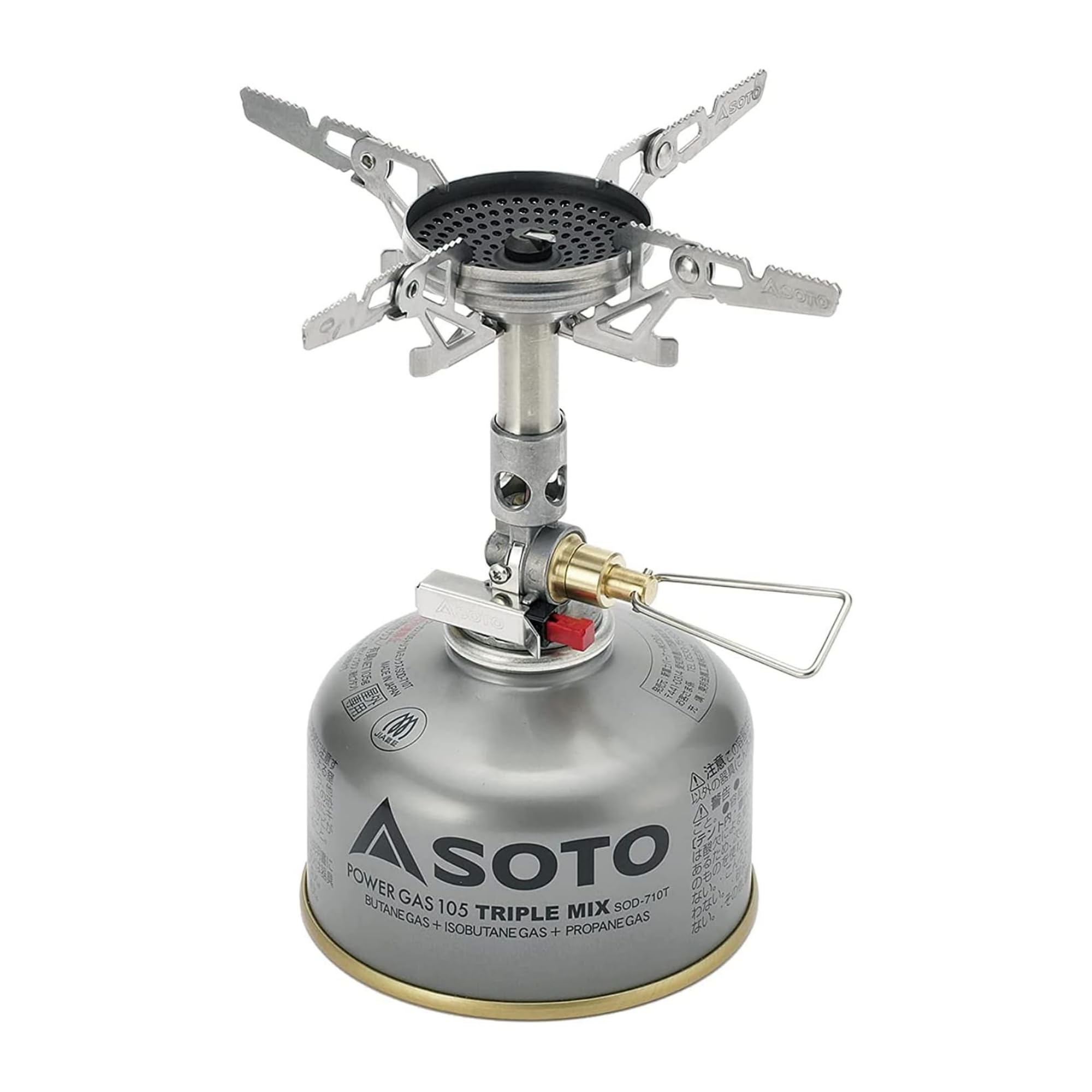


Best for Three-Season Backpacking
MSR PocketRocket 2
Key Features
- Fuel: Isobutane canister
- Boil time: 1 L in 3.5 min
- Packed size: 2 x 2 x 3 in
- Stove weight: 2.6 oz (4.2 oz with case)
- Price: Midrange
Every stove in this guide gets measured against the PocketRocket 2, and most of them lose on the things that decide an ordinary evening: weight, price, and how little thought it takes. It is 2.6 ounces, folds to roughly two inches square, and disappears into a 750 ml pot. There is no priming, no pumping, no ritual — screw it onto the canister, open the valve, light it.
The performance is why it stays the default. MSR rates it at 3.5 minutes for a liter, and the valve turns down far enough to hold a simmer rather than just scorch the bottom of the pot, which is more than the cheapest stoves here manage. The serrated pot supports take a range of pot sizes, from a solo mug up to something you would cook a real meal in.
Wind is where it shows its age. The burner sits exposed, and a gusty camp stretches that three-and-a-half-minute liter into a much longer wait while the fuel goes with it. Shelter it behind a rock, a pack, or a folded sit pad and it is fine; if you habitually camp above treeline, the regulated SOTO or Deluxe is the better spend. The hard case adds 1.6 ounces if you carry it, and it is the first thing we leave behind.
Pros
- 2.6 ounces, and it nests in a small pot
- 3.5-minute liter with a usable simmer
- Nothing to prime, pump, or preheat
- Hard case keeps the valve clean in a pack
Cons
- No built-in igniter — pack a lighter
Buy this one unless wind or cold is a regular feature of your trips — it is the lightest, simplest way to a fast liter of water at a fair price.
Best for Windy Exposed Camps
SOTO WindMaster 4Flex
Key Features
- Output: 3260 W
- Igniter: Built-in, protected in burner post
- Pot support: 4Flex for larger pots
- Stove weight: 3.07 oz
- Price: Premium
Wind is the condition that separates canister stoves, and the WindMaster is built around it. The burner head is concave and sits close to the pot, a shape SOTO describes as a built-in windscreen, and the regulator holds output steady in gusts and cold rather than fading as the canister chills. On an exposed camp that is the difference between a hot dinner and a lukewarm one.
At 87 grams it is the heaviest of the stoves we call front-runners here, and we still reach for it when the forecast is ugly. The 4Flex support is the other half of the argument: it widens the platform so a larger pot sits flat instead of perching, which turns a boiling machine into a stove you can cook a real meal on. The igniter is buried in the burner post rather than hanging off a wire, protected from the knocks that kill the exposed ones.
The rest is money and conditions. It costs more than the PocketRocket 2 and the LiteMax, and in sheltered woodland those dollars buy very little — the lighter stove boils just as fast. Where the WindMaster earns the premium is the trip where the weather turns and you are cooking in it anyway.
Pros
- Holds output in wind and cold
- 4Flex support takes wide, heavy pots
- Igniter protected inside the burner post
Cons
- Heaviest of the front-runners at 87 g
- Not rated for 100% propane
The stove to buy if your camps are exposed or your pot is wide — it holds its output when the weather does not, and the 4Flex earns its keep.
Best for Cold-Weather Trips
MSR PocketRocket Deluxe
Key Features
- Burner: Pressure-regulated, broad head
- Igniter: Built-in push-start
- Boil time: 1 L in 3.5 min
- Stove weight: 2.9 oz
- Price: Premium
The Deluxe answers one question: what does the extra money buy over the stove we recommend to everyone? A regulator, a piezo, and a broader burner — and the first of those is the one that matters.
As a canister empties and cools, a plain stove loses pressure and the boil stretches out. The Deluxe holds its rated 3.5-minute liter even with low fuel and in colder weather, which is the difference between a fast brew on a frosty morning and standing around waiting for one. The wider burner head spreads the flame for simmering and handles wind better than the base model, and the igniter sits inside the burner instead of hanging on a wire where it gets bent.
Our read after using both: if you cook in the cold, or you are the sort who runs a canister to the last gasp rather than swapping early, the Deluxe earns its premium. If your trips are summer weekends with a fresh canister, the base PocketRocket does the same job for less. The 0.3-ounce difference is nothing; the push-button light with numb hands is not.
Pros
- Regulated output holds as fuel runs low
- Protected piezo lights on the first press
- Broad burner improves wind and simmering
- Only 0.3 oz more than the base model
Cons
- Costs a lot more than the base model
Worth the upgrade if you cook in the cold or run canisters to the last drop — the regulator and the protected piezo are the reasons.
Best for Ounce Counting
Snow Peak LiteMax Titanium
Key Features
- Material: Titanium
- Packed size: 3 x 2.7 x 1.3 in
- Pot support: Foldable arms double as windscreen
- Stove weight: 1.92 oz
- Price: Midrange
Two ounces is the headline, and Snow Peak’s figure is honest: 1.92 ounces, the lightest canister stove here that we trust with a one-liter pot. Titanium is how it gets there, in the body and in the arms, and there is nothing on it that looks likely to snap.
The arms fold in over the burner and, according to Snow Peak, double as a windscreen. What they really do is put a little metal between the flame and the breeze while keeping the folded package flat enough to slide into a pot. It is not a real windshield, and a gusty camp still wants a rock or a pack for shelter, but it is more protection than the bare burners give.
Flame control runs from a low simmer up to a fast boil, and the pot supports are broad by ultralight standards, so a 750 ml pot sits on them properly instead of balancing. It screws straight onto an isobutane canister with no pump or prime, and it folds into its own carry bag, which is small enough to lose in a pack.
Where it lands: this is the stove for someone who has weighed everything else and has a few grams left to spend. It is a little lighter and a little cheaper than the PocketRocket 2, and it has fewer parts that can fail. If your trips are three-season and your scale is the boss, this is the pick; for identical behaviour in a cold snap, pay for a regulator.
Pros
- 1.92 oz in a titanium body
- Folding arms double as a windscreen
- Broad supports hold a 750 ml pot
Cons
For the backpacker who weighs everything: the lightest canister stove here we trust with a one-liter pot, with no parts to go wrong.
Best for First Stove
Fire-Maple Greenpeak 1
Key Features
- Fuel: Isobutane canister, EN417 valve
- Igniter: Built-in piezo
- Folded size: 2.1 x 2.8 in
- Stove weight: 85 g (3 oz)
- Price: Budget
Budget stoves are usually a gamble: you save money and pay for it with a wobbly pot and a dead igniter. The Greenpeak 1 is the budget stove here we trust on a real trip without a backup plan. It is 85 grams, built from stainless steel, ceramic and aluminum rather than stamped sheet, folds to roughly two by three inches, and has a piezo igniter that is part of the design rather than a wire glued on.
The heat fins under the burner are the detail we appreciated most. They spread the flame across the base of the pot instead of concentrating it in one hot spot, so oatmeal and rice do not scorch in the middle while the edges stay cold. The pot supports are wide enough for a proper pot, and the stove sits with less rocking than the cheapest models here — which is most of what you are paying for over them.
What it gives up is speed and grams. It is slower to the boil than the PocketRocket or the WindMaster, and it weighs about three times what the BRS does. Neither matters much for a weekend of dehydrated meals and coffee; both matter if you are counting ounces across a long thru-hike. As a first stove, a second stove, or the one that lives in the car, it is the easiest recommendation on this page.
Pros
- Piezo igniter at a budget price
- Steel build sits steadier than the clones
- Heat fins spread the flame evenly
Cons
- Slower to the boil than the top picks
- Heavier than the titanium stoves here
The budget stove we trust on a real trip: piezo ignition, a planted platform, and heat fins that stop dinner scorching in the middle.
Best for Solo Gram Saving
BRS-3000T

Key Features
- Output: 1940 W
- Material: Titanium
- Packed size: 1.18 x 1.18 x 1.97 in
- Stove weight: 0.92 oz
- Price: Budget
Set a one-liter pot on the BRS and the first thing you notice is how little of it is supported. The arms are short and the span is narrow, so a wide pot perches rather than sits, and a mug or a 750 ml pot is the natural pairing. That is the trade you make for 26 grams, and it is better to know it before you buy than after.
As an object, though, it is remarkable: 26 grams of titanium, 1940 watts, and a boil that beats stoves costing several times as much. It screws onto a standard canister, the valve gives usable flame control, and it packs into a space you would otherwise fill with a stuff sack. For solo trips with a small pot on flat ground, it is the cheapest real weight saving in this guide.
It is not a stove to lean on. The thin arms can bend under a heavy pot, and we keep it to one person and one pot rather than a group kit; ask it to hold a big shared dinner and you are outside what it is built for. There is no igniter, so a lighter lives in the pot. Treat it as a specialist and it earns its place; treat it as your only stove and you may be shopping again by midsummer.
Pros
- 26 grams — the lightest stove here
- 1940 W gives quick boils
- Cheapest real weight saving here
Cons
- Thin arms can bend under a heavy pot
- No igniter — bring a lighter
The cheapest way to drop real weight, as long as you accept it as a solo mug stove and not a group kitchen.
Best for Car and Backup
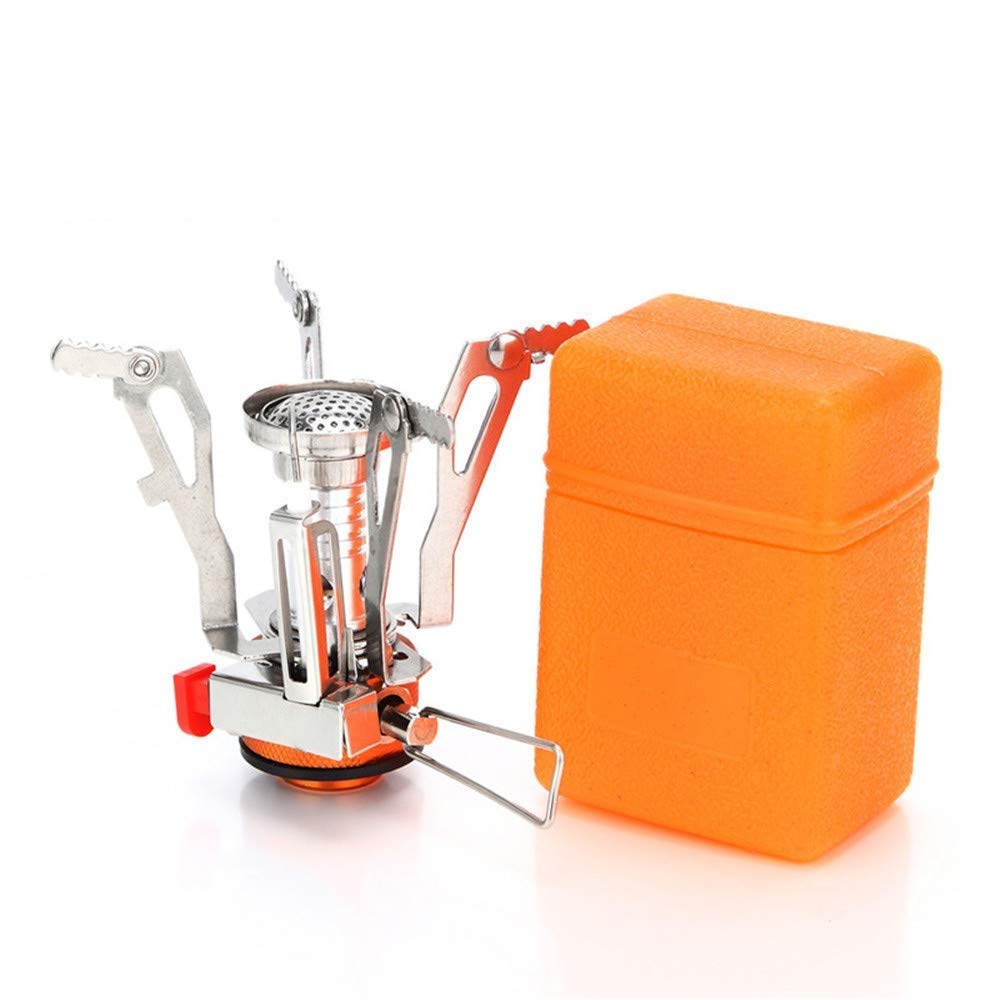
AOTU Portable Camping Stove
Key Features
- Fuel: 7/16-thread butane or butane-propane canister
- Output: 3000 W
- Igniter: Built-in piezo
- Stove weight: 3.84 oz
- Price: Budget
Three thousand watts from a stove that folds into a plastic box the size of a deck of cards: the pitch is real, and water goes fast. The piezo is there and works, and the whole thing stows inside a mess kit with room left for a lighter. Nothing about it feels refined, and nothing about it feels like it will fall apart in a weekend.
The money you save shows up in the details. The valve covers a lot of ground between off and full, but the useful part of it is narrow and coarse, so anything you would call simmering is guesswork — treat it as a boiler and you will be happy. The fuel fitting takes standard 7/16-thread canisters, so whatever the outfitter has on the shelf will fit.
Our recommendation: it is the stove to keep in the car, in the bug-out bag, or in the daypack for a quick brew at a viewpoint, and a fine first stove if your cooking is coffee and rehydrated meals in a small pot on flat ground. It is the one here we hand to a Scout or a friend who is not ready to spend much. It is also the one we replace first if we start cooking properly.
Pros
- 3000 W for fast boils
- Piezo igniter and a carry box
- Folds small enough for a mess kit
Cons
- Wide pots rock on the short arms
- Igniter can need a few presses
A cheap, punchy boiler for the car kit or a first stove — as long as your pot is small and the ground is flat.
Best for Canister-Free Trips
Vargo Titanium Triad

Key Features
- Fuel: Alcohol
- Material: Titanium
- Stove weight: 1.6 oz
- Price: Midrange
No canister, no gas, no pressure: the Triad burns alcohol, which is either the whole point or a dealbreaker depending on how you camp. It is solid titanium, 1.6 ounces, and has no moving parts to break and no seals to perish. For a long walk where you resupply fuel in towns, that is an attractive set of facts.
Using it is a different ritual from a canister stove. You pour alcohol into the central cup, light it, and wait for the stove to bloom — the jets to pressurize and the flame to settle into a ring. How long that takes varies with temperature, fuel and how much you poured, and there is a learning curve before you can predict it. Once it is going, expect a slow boil; this is a stove for a leisurely camp.
Like every alcohol stove, it needs a windscreen, so a foil shield belongs in the kit rather than in the accessory drawer. Filling it is easy: the wide central cup takes fuel from a bottle without a funnel, and whatever is left can go back in the bottle once the stove cools, which is more than you can say for a half-empty canister.
So who is it for? Long-distance walkers who buy fuel as they go, anyone who wants a stove with nothing to fail, and people who value a silent camp over a fast one. It asks for patience in return for simplicity and no canister waste. If you want a three-minute liter and a real simmer, buy a canister stove; this one is for the trip, not the schedule.
Pros
- 1.6 oz with no moving parts
- No canisters to carry out or dispose of
- Alcohol is easy to resupply on long routes
Cons
- No flame control — simmering is guesswork
- Pot supports sit wide for narrow mugs
For canister-free trips and quiet camps: a 1.6-ounce titanium alcohol stove that asks for patience in exchange for simplicity.
How We Tested These Stoves, From First Light to Full Bloom
We started by pulling together every canister stove we could find that weighed under about four ounces with a burner head wide enough to hold a real pot, then cut the list by price, fuel compatibility, and whether the thing actually nests inside a typical 750-milliliter or one-liter mug with a canister. That left 14 stoves, which my team and I have been cooking on for the past six months — on weekend overnights, on a weeklong section hike, and on more than a few mornings in a windy trailhead parking lot when I wanted coffee before dawn and didn’t care who saw me hunched over a titanium pot.
How to Choose an Ultralight Backpacking Stove
The stove weighs almost nothing and decides almost everything about an evening in camp, so choose it by how you boil water, not by the smallest number on the box.
Weight Is a System, Not a Stove
An ultralight stove saves you an ounce or two; a badly chosen one costs more than that in fuel and patience. Weigh the whole kit — stove, canister, pot, and anything you need to keep the pot steady. A 26-gram stove that forces you to carry a canister stand or a wider pot is not saving much, and a regulated burner that stretches a canister over an extra day can end up lighter across a week. Start with the pot you already own, then pick the stove that sits on it properly.
Wind and Cold Beat Weight on Real Trips
Published boil times are measured in still air with a full canister. In a gusty camp a bare burner loses heat sideways, and the same liter takes far longer while the fuel goes with it; in the cold, an unregulated stove fades as canister pressure drops. If you camp above treeline, in exposed sites, or outside summer, pay for a regulated burner — the SOTO WindMaster and the PocketRocket Deluxe are the two here built for it — or budget for a windscreen and extra fuel.
Match the Supports to the Pot
Ultralight stoves are usually designed around the small pot the same brand sells, and the supports follow. A narrow three-arm burner is fine under a 750 ml mug and unnerving under a two-liter pot; the SOTO’s 4Flex, the Snow Peak’s broad arms and the Fire-Maple’s wide platform are the ones here that hold a bigger pot with confidence. Measure the base of your widest pot and compare it with the stove’s support span before ordering — a pot that overhangs the arms is a spill waiting to happen.
Treat the Igniter as a Convenience
A push-button piezo is lovely when your hands are cold and the wind is up, and it is the first thing to give trouble on any stove. Some of the cheapest models here have igniters that take several presses, and none of them should be your only way to make fire. A mini lighter weighs almost nothing and lives in the pot with the stove. Buy the igniter for convenience by all means, but pack as though it is not there.
Pick the Fuel to Suit the Trip
Canister gas is fast, controllable, and the easiest thing to live with on a weekend, but canisters are awkward to dispose of and hard to source on some routes. Alcohol is slower and quieter, needs priming and a windscreen, and is available almost anywhere in the world. Tablet stoves are the lightest backup and the least controllable. Match the fuel to how you resupply: a three-day trip is a canister; a month-long walk through small towns may not be.
Frequently Asked Questions
Can I use a backpacking stove inside my tent?
No. Every stove here — canister, alcohol, or tablet — produces carbon monoxide, and a closed tent or zipped vestibule traps it. Cook outside. If the weather forces you under cover, use a vestibule with the door wide open, keep the stove clear of fabric, and never leave it burning while you sleep. Cold mornings are exactly when people get this wrong, so settle the rule before the trip rather than at dawn.
Is a stove worth carrying if I only boil water?
For dehydrated meals and a hot drink at the end of a wet day, yes. The stoves here weigh less than a filled water bottle, which makes a hot dinner the cheapest comfort in your pack. Cold-soaking works in summer and saves the stove and fuel entirely, but it takes hours and gives you nothing warm. Where campfires are banned or the wood is picked over, a stove is the only hot food you are getting.
Can I fly with a backpacking stove?
The stove, yes; the fuel, no. Canisters are not accepted on passenger flights, so plan to buy fuel where you start or ship it ahead to a resupply point. Empty and air the stove, then pack it in checked baggage rather than carry-on. Rules vary by airline and country, so confirm before you check in — and leave time for an outfitter stop at the far end.
Final Verdict
If one stove has to do everything, make it the PocketRocket 2. It is light enough to forget, it boils a liter in about the time it takes to pitch a shelter, it costs less than the regulated stoves here, and nothing about it needs explaining on a dark, wet evening.
Spend more only when a condition demands it: the SOTO WindMaster for exposed camps and wide pots, the PocketRocket Deluxe for cold mornings and canisters run to the last gasp. If your trips are three-season and sheltered, the cheaper stove is the better buy.