This post contains affiliate links. We may earn a small commission when you buy through our links — at no extra cost to you.
A backpacking stove has two jobs, and they pull in opposite directions: boil water fast, and don’t tip over. Chasing ounces gets you a burner the size of a deck of cards, which is a neat magic trick until you set a full two-liter pot on it in a breeze. That’s the tradeoff every shopper runs into — light in the pack, steady on uneven ground, compact when it’s time to break camp, and worth the money you handed over.
We cooked on 14 stoves over eight months — tiny canister-top burners, remote-canister models, integrated systems with their own pots — on weekend trips and quick after-work overnights. Some patterns held: real weight includes the fuel, the smallest packed footprint isn’t always the easiest to live with, and budget models differ far more in their threads and pot supports than their spec sheets admit. The picks below are the ones I’d carry again.



Best for Three-Season Backpacking
MSR PocketRocket 2
Key Features
- Fuel: Isobutane-propane canister
- Boil time: 1 L in 3.5 min
- Packed size: 2 x 2 x 3 in
- Packed weight: 2.6 oz (4.2 oz with case)
- Price: Midrange
Two and a half ounces is easy to say and hard to beat. The PocketRocket 2 screws onto any standard threaded canister, drops inside a small pot with a lighter for company, and MSR’s numbers put a liter of water at a rolling boil in three and a half minutes. Of everything we tested for this guide, it’s the stove that asks the least of the rest of your kit, which is why it’s the one we recommend first.
The valve earns its keep below boiling too. It walks down from a hard rolling boil to a simmer you can hold without the flame guttering, and the serrated pot supports take a wider range of pot sizes than the burner’s own footprint suggests. There’s no igniter — you bring a lighter or a match — and we stopped missing one quickly, partly because a lighter never quits in the cold the way a piezo can.
The hard-shell case adds an ounce and a half but keeps the arms from snagging on everything in your pack, so we bring it. Against the alternatives here, the SOTO holds a flame better in a gust and the PocketRocket Deluxe adds a regulator for cold mornings, and neither closes the gap in weight and price this stove opens. Ours lives in the pot with a lighter and a folded bandana, and that’s the entire accessory list.
Pros
- 2.6 oz, or 4.2 oz in its hard case
- A liter boils in 3.5 minutes
- Valve simmers as readily as it boils
- Serrated supports take a wide range of pots
Cons
- Costs more than budget burners that boil nearly as fast
- No regulator, so output tapers as the canister chills
Our default for three-season backpacking: 2.6 ounces, a fast liter, and a valve that holds a simmer, with no igniter to break.
Best for Windy Campsites
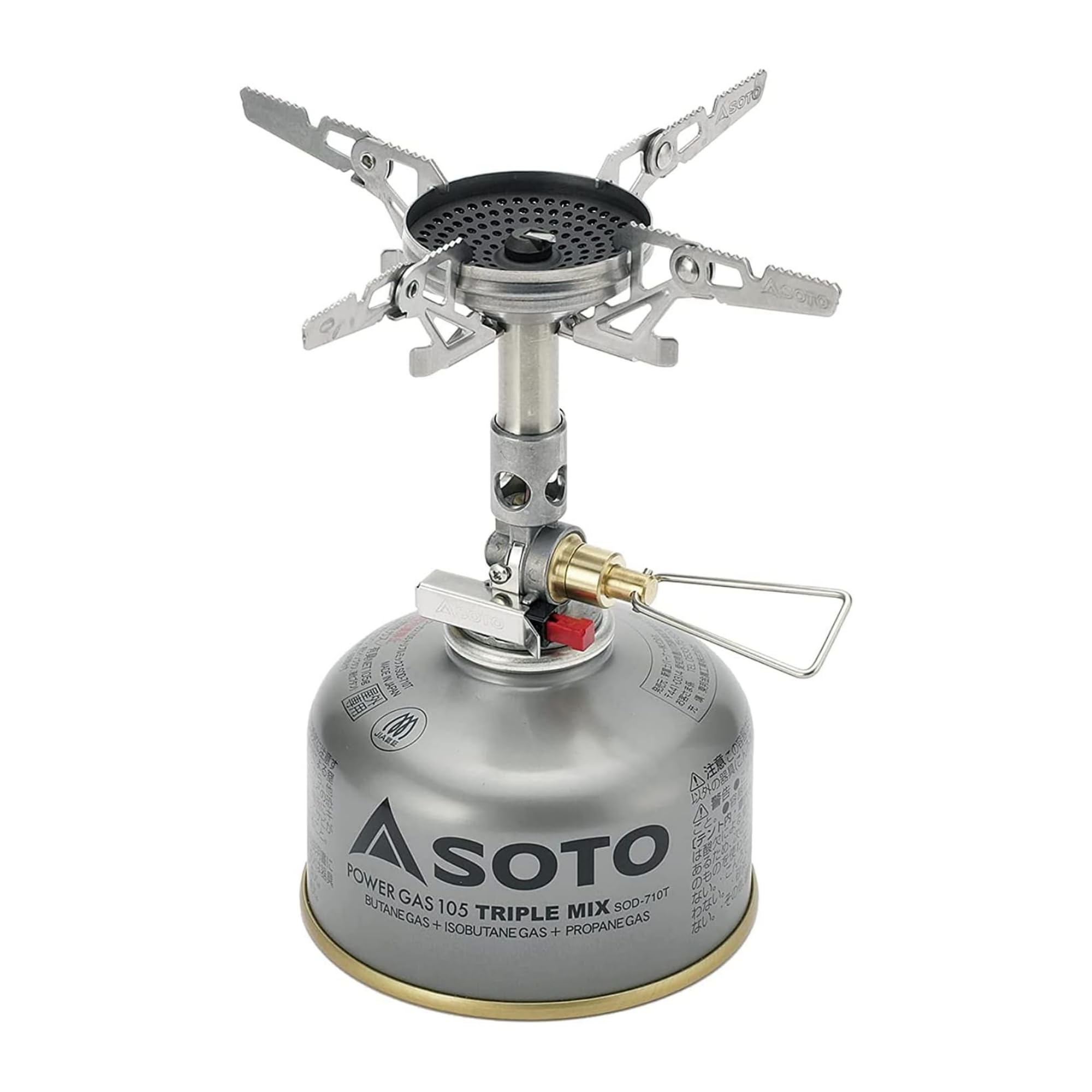
SOTO WindMaster
Key Features
- Fuel: Butane/isobutane/propane mix
- Output: 3260 W
- Weight: 3.07 oz
- Pot support: 4Flex, wider pots
- Price: Premium
The burner head on the WindMaster is concave, and the shape is the whole argument: the pot sits down into the flame rather than on top of it, and the raised rim shields the flame from the side. SOTO pairs that with a regulator in the valve so the flame holds where you set it as canister pressure drops. On an exposed pitch, the difference between this and a flat-headed burner is the difference between cooking and babysitting.
That’s why this is the stove we pack when the forecast has wind in it. At 87 grams it’s a little heavier than our top pick and it costs more, and on a still evening those are the only two differences you’d notice. Add the four-prong 4Flex support and it takes a wider pot than most canister stoves, which matters when two people are sharing one burner.
The igniter sits inside the burner post rather than out on a wire, where it’s protected from the knocks that kill piezo units, and it lit on the first press more often than not. One restriction is worth knowing before you order: SOTO rates the regulator for butane, isobutane and propane mixes, and 100% propane is prohibited, so read the canister label instead of grabbing whatever the shop has.
Pros
- Holds a steady flame in gusty weather
- Regulator keeps output up as pressure drops
- 4Flex support steadies larger pots
- Igniter sheltered inside the burner post
Cons
- Will not run on 100% propane
The stove we pack when the forecast has wind in it: a shielded burner, steady output, and a protected igniter, at a premium price.
Best for Fast Hot Meals
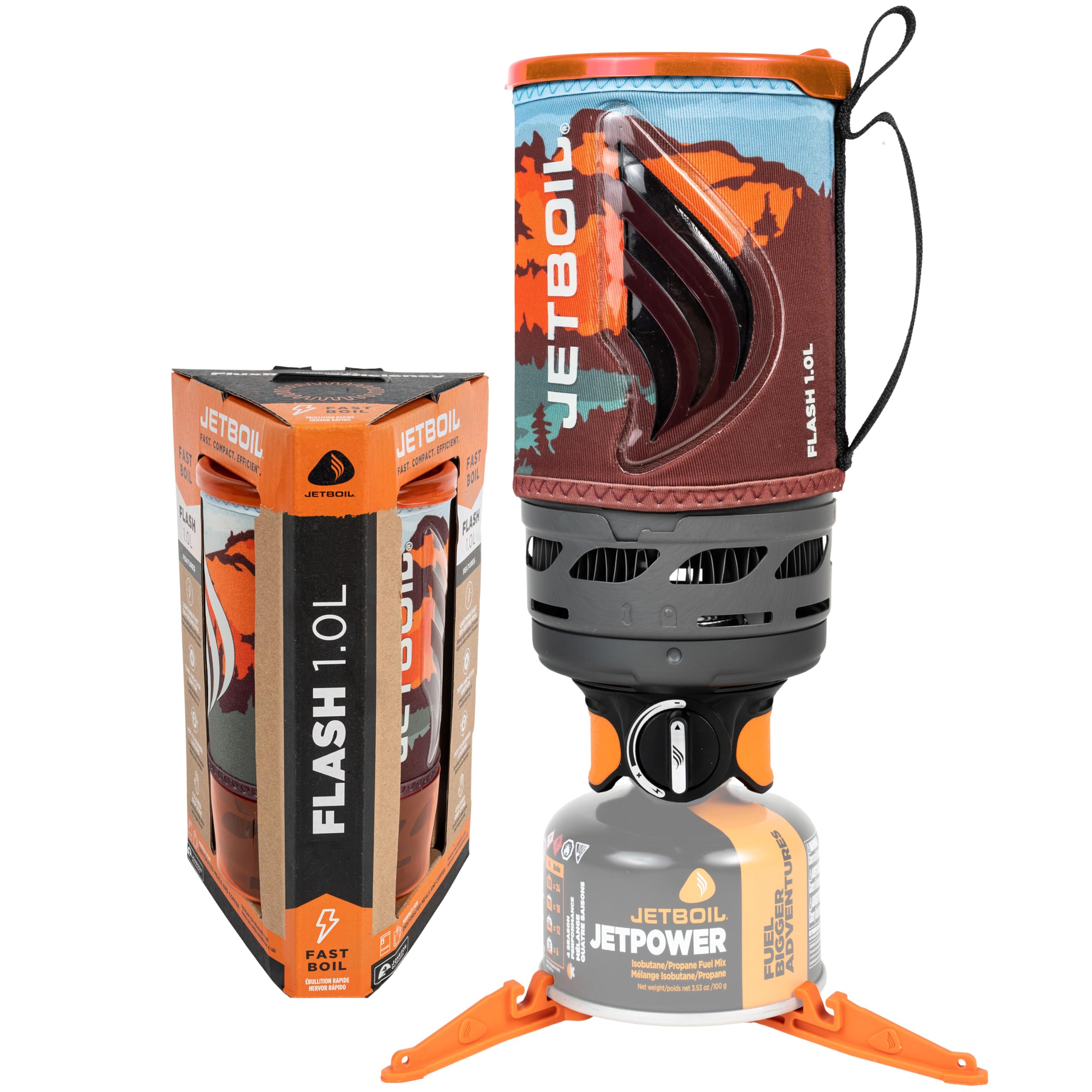
Jetboil Flash 1.0L
Key Features
- Fuel: Isobutane/propane, sold separately
- Cookpot: 1.0 L
- Boil time: 16 oz in 2 min
- System weight: 13.1 oz
- Price: Premium
You’re not buying a burner with the Flash; you’re buying the pot it lives under. The 1.0 L cookpot, its insulated cozy, the lid, the bottom cup and the canister stabilizer all nest into one cylinder that goes into your pack as a single object, and the burner clips to the pot instead of rolling loose in your food bag.
In use it’s the quickest thing here: Jetboil’s number is 16 ounces of water in two minutes, and the turn-and-click knob works like a home gas ring rather than a valve you coax. The color-coded rubber zone stays cool enough to grab, the three locking points keep the pot from rotating while you stir, and the cozy holds heat in a rehydrating meal while it sits.
We recommend it to the person who wants hot food at the end of a wet day and doesn’t want a procedure for it — the system removes almost every decision except how much water. What it won’t do is cook: the pot is the only vessel, so this is boiling, rehydrating and coffee rather than a pan of onions. At 13 ounces packed it’s also the heaviest stove in this guide by a wide margin, and that’s the real cost of the convenience.
Pros
- Everything nests into the 1.0 L pot
- 16 oz boils in about two minutes
- Ignition works like a stove at home
- Insulated cozy keeps meals hot
Cons
- Costliest kit here, with the canister sold separately
For fast, fuss-free hot meals the Flash is the system we hand people, as long as boiling is the cooking you plan to do.
Best for Cold-Weather Trips
MSR PocketRocket Deluxe
Key Features
- Weight: 2.9 oz
- Warranty: 3-year limited
- Boil time: 1 L in 3.5 min
- Regulator: Built-in pressure regulator
- Price: Premium
A canister cools as it empties, and as it cools the pressure inside falls. On an unregulated stove that shows up as a flame that fades through the trip. The PocketRocket Deluxe puts a pressure regulator between canister and burner, and the job it does is hold the output you asked for as that pressure drops.
MSR’s figure is a liter in three and a half minutes even in colder weather and with low fuel, and the half of that claim which matters more to us is the second: the last third of a canister stops behaving like a canister that’s nearly out. For a November trip, or for a stove used three times a year on the same half-empty canister, that’s worth real money.
The rest is refinement rather than reinvention. The piezo sits inside the burner housing where it’s shielded from the pot and from packing, the burner head is broad enough to spread heat for a simmer instead of leaving a hot spot in the middle of the pan, and the whole thing folds into a stuff sack at 2.9 ounces.
Our recommendation: choose the Deluxe if you cook in the cold, run canisters to the end, or genuinely simmer. Skip it if you only boil water in summer, where the standard PocketRocket 2 does the same job. It also carries a three-year limited warranty, the longest coverage on any stove in this guide.
Pros
- Regulator holds output as the canister chills
- Ignition button protected inside the burner
- Broad burner head simmers without hot spots
- Folds into its own stuff sack at 2.9 oz
Cons
- Costs noticeably more than the PocketRocket 2
Pay for the Deluxe if you cook in the cold, drain canisters to the end, or actually simmer; summer boilers can save the difference.
Best for Budget Weekends
Fire-Maple Greenpeak 1
Key Features
- Fuel: Isobutane, EN417 valve
- Weight: 3 oz
- Ignition: Built-in piezo
- Folded size: 2.1 x 2.8 in
- Price: Budget
Folded, the Greenpeak 1 measures 2.1 by 2.8 inches and weighs 85 grams, which is small enough to vanish into a 600 ml pot alongside a small canister and a lighter. At a budget price, with an igniter built in, that’s the package that earns it a place here.
The stove folds open into three legs around a burner that pushes out more flame than 85 grams suggests, and the valve gives a usable range from a fast boil down toward a simmer. The piezo has been the pleasant surprise — it’s exactly the part budget stoves get wrong, and this one lights on the press without any coaxing.
Where it sits in the lineup is the interesting part. It does most of what the premium burners do for a fraction of what they cost, and the ground it gives — no regulator in the valve, so wind and a cold canister cost you output — is ground you don’t miss on a summer weekend. It ships without a stuff sack, so wrap it in something.
Pros
- 85 g and folds to 2.1 x 2.8 in
- Piezo ignition at a budget price
- Standard EN417 threaded valve
Cons
- Ships without a stuff sack
The budget stove we point people to first: 85 grams, a folded size that disappears, and a piezo that works.
Best for Value-Focused Backpacking
CAMPINGMOON XD-2F
Key Features
- Output: 3.3 kW
- Weight: 3.53 oz
- Regulator: Built-in pressure regulator
- Pot support: Detachable 4-prong
- Price: Budget
Three pot arms mean you spend the first minute of every boil hunting for the spot where the pot doesn’t wobble. The XD-2F uses four detachable arms on a flat platform, and a pot sits on it the way it sits on a table — which is the sort of thing you notice most when the ground is uneven and dinner is already late.
Under that platform there’s more than the price suggests: a pressure regulator in the valve, a piezo igniter, and 3.3 kW of output in a stainless body that packs into a 750 ml pot with a small canister. At 100 grams it sits in the same weight class as stoves that cost far more.
It’s the stove we point at anyone who wants the wind and simmer behaviour of a premium burner without committing to the premium price, and on value it’s the strongest of this group. The catch is the pot support itself: two arms come off for packing, which shrinks the bundle and gives you two small parts to lose in the dark.
Pros
- Four flat arms steady a full pot
- Regulator and piezo at a mid price
- Packs into a 750 ml pot
Cons
- Two-piece pot support can be mislaid
A budget burner with premium habits: four steady arms, a regulator, and an igniter, for well under the premium stoves.
Best for Ultralight Solo Trips
BRS-3000T

Key Features
- Output: 2700 W
- Weight: 0.88 oz
- Material: Titanium, copper, stainless steel
- Boil time: 1 L in 2 min 58 sec
- Price: Budget
The pot arms on the BRS-3000T are short and close in, so a 550 ml titanium cup sits fine while anything wider is balanced on a small ledge and rocks the moment the ground isn’t level. That’s the first thing to weigh before buying: this stove is happiest under a mug, not a two-liter pot.
Twenty-five grams is the entire argument, and it’s a good one. BRS rates it at 2700 W and a liter boiled in just under three minutes, and the whole thing disappears into a cup with a mini lighter and a small canister. On a long trip where every item is weighed against its job, this is the burner that survives the cut.
The trade is durability. A 25-gram frame is thin titanium and thin is the point, so the arms and the valve are the parts to be careful with; it rewards being threaded onto the canister squarely and packed in something soft rather than loose beside a titanium pot. Check the connection before you light it, because a canister that isn’t fully seated will vent gas as the stove goes on.
Pros
- 25 g, the lightest stove in this guide
- A liter in just under three minutes
- Packs inside a 550 ml cup
Cons
- Short arms let wider pots rock
- Thin titanium rewards careful packing
For gram counters only: 25 grams and a genuinely fast boil, in exchange for small pot arms and a delicate build.
Best for Wood-Fired Trips
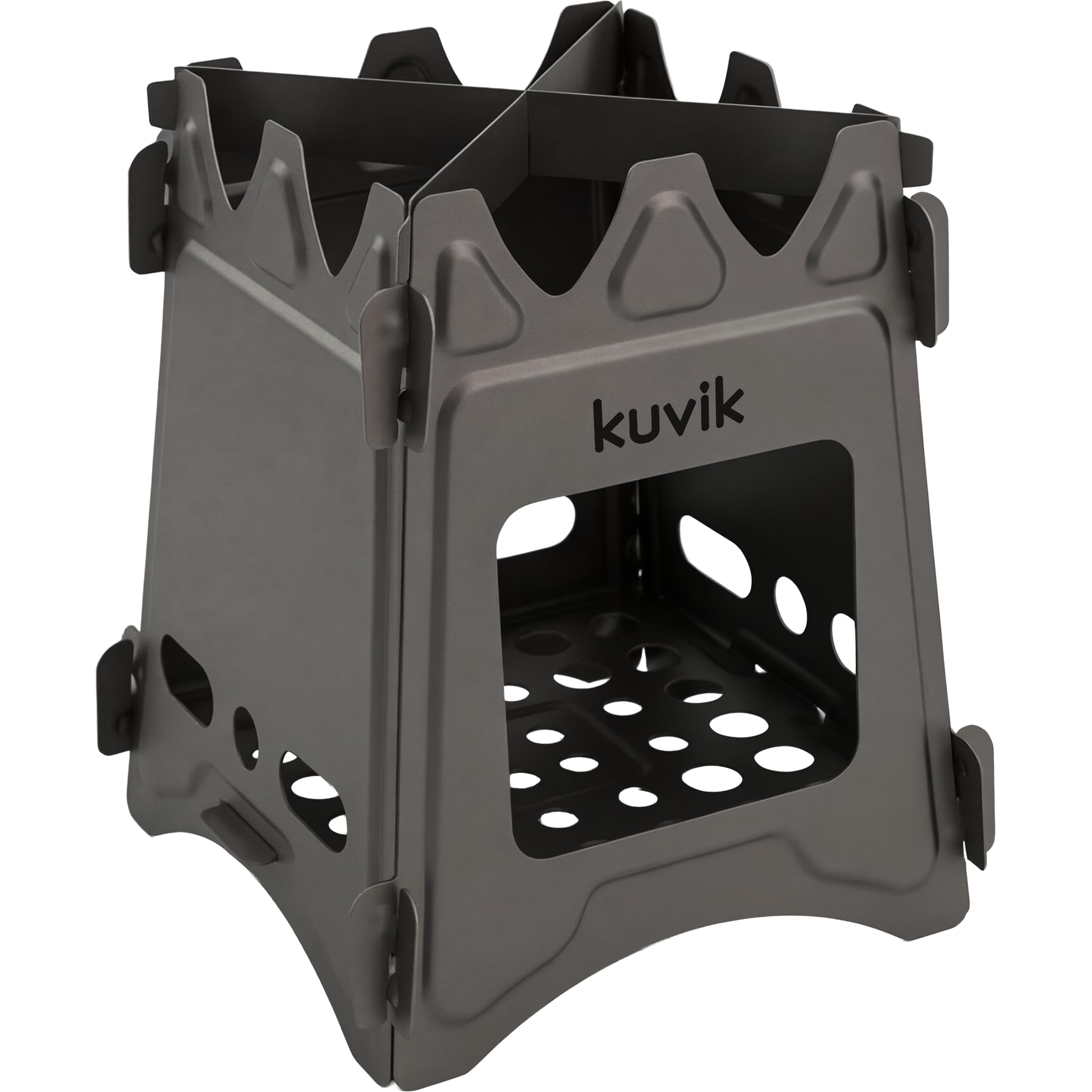
Kuvik Titanium Wood Stove
Key Features
- Fuel: Wood and twigs
- Weight: 6.88 oz
- Footprint: 6.25 x 5 x 5 in
- Packed thickness: 0.2 in
- Price: Midrange
Above the treeline, inside a fire closure, or on the fourth day of rain, the Kuvik is dead weight: it burns twigs, and there aren’t any. That isn’t a flaw in the build, it’s the boundary of the design — and inside that boundary it’s the most satisfying stove here, because dinner smells like a campfire instead of a gas jet.
What you get for 6.88 ounces is a set of flat grade-1 titanium panels that slot together into a freestanding box, with a footprint of about 6.25 by 5 inches that will hold a small kettle or a 32-ounce pot. Collapsed, it’s a 0.2-inch stack in a pouch — thinner than the canister you aren’t carrying.
Burning wood changes the rhythm of a trip. There’s no valve to turn down, so heat comes from how much you feed it, and a pot of water is a few minutes of pushing twigs into a slot rather than a two-minute wait. The fuel is free and unlimited, which is a real pleasure on a long walk, and the pot comes away sooty, which is the price of it.
Our take: this is the stove for the backpacker who’d rather carry six ounces of titanium than a canister, and for trips where a fire is part of the evening anyway. Treat it as a second stove rather than an only one — a canister burner is what you want for a quick brew in a hurry. Packed flat, it also takes less room than the canister it replaces, and that space goes to food.
Pros
- 6.88 oz and packs to 0.2 in thick
- No fuel canisters to buy or carry
- Grade-1 titanium slots together without tools
- Holds a 32 oz pot
Cons
- Needs dry wood and a legal fire site
- Sooty pots and constant feeding
The fuel-free option: six ounces of titanium that burns twigs well, on trips where dead wood is legal, dry, and close at hand.
How We Tested Backpacking Stoves
Every stove here started as a candidate on a list: burner weight, packed size, fuel type, price, and whether the manufacturer publishes an actual boil time. We cut anything that just duplicated a lighter or heavier option at the same price, then bought 14 units outright so no brand could send a cherry-picked sample.
All 14 went out over eight months, from late-season overnights to summer weekends, and each one made at least four trips. Mornings meant coffee and oatmeal; evenings meant a one-liter boil for dinner, sometimes two in a row. On a kitchen scale we weighed each stove with its case, then again with a full canister, because the number on the box rarely matches the number in your pack. We packed each one into a 750-milliliter pot alongside a lighter and a small cloth to see whether compact actually meant compact.
At camp we timed a one-liter boil with the lid on, noted wind and air temperature, then repeated it in a sheltered spot to see how much the stove cared about weather. Stability got tested honestly: a full pot on a sloped slab, a nudge with a boot toe, a stir with a spoon to see if the legs walked. We also ran every burner at its lowest flame for ten minutes to check simmer control. For durability, we watched the threads and o-rings each time a canister went on and off, folded and unfolded the pot supports every trip, and looked for corrosion after wet weekends.
Two stoves lost their spot on the list after a season of that. The rest still live in the gear bin and will keep getting used.
How to Choose a Backpacking Stove
The burner is the easy part of the decision; the fuel you can actually buy, the pot you already own, and the wind at your campsite settle more of your trip than any spec does.
Fuel first: canisters, valves, and mixes
Almost every stove here runs on a threaded isobutane-propane canister, and none of them include one. The thread is the EN417 Lindal valve, which most of the world sells, but the mix inside varies and a stove with a regulator is fussier about it — SOTO prohibits 100% propane outright. Buy the canister at the shop nearest the trailhead rather than assuming your local mix will be on the shelf there.
A wood stove sidesteps all of this and ties you to dry dead wood instead, which is a fair trade only on trips where you’d be having a fire anyway.
Match the stove to the pot, not the other way round
The bare burners here — PocketRocket 2, Greenpeak 1, BRS-3000T — assume you already own a pot and, in wind, a screen. That’s the lightest way to travel if the pot is one you like. An integrated system like the Jetboil Flash supplies the pot, lid and cozy in a single object and then locks you to it.
Our preference is a bare burner plus a pot with a wide, flat base. Check that base against the spread of the stove’s arms before you commit: a wide pot on short supports is where tipping starts, and a liter of boiling water is not the thing to test it with.
Weight: count the fuel and the pot, not just the burner
The BRS-3000T is 25 grams and the Jetboil Flash is 13 ounces, and neither number is the whole story — the bare burner still needs a pot, and the system carries its own. What we weigh in practice is the whole cooking kit: stove, pot, lid, canister, lighter.
An extra ounce spent on four flat pot arms or a regulator buys more comfort at dinner than an ounce shaved off and spent balancing a full pot on three short ones.
Wind decides more boils than the rating does
Wind is where canister stoves fall over, and no output figure tells you how a burner behaves in a gust. Three things help, in order: a sheltered pitch behind a rock or a tarp, a concave or shielded burner head like the SOTO’s, and a screen or a pot that sits close to the flame.
A regulator is the fourth and most expensive fix, holding output as canister pressure falls in the cold or with little fuel left. If you camp above the trees or late into the year, it’s the upgrade worth paying for.
The igniter is a convenience, not a guarantee
Piezo igniters are the first thing to fail on a stove, and units mounted inside the burner post — the SOTO and the PocketRocket Deluxe both do this — survive longer than the exposed-wire type. None of that changes the basic rule: carry a lighter.
A stove with no igniter at all isn’t a downgrade if you already carry one, so don’t pay extra for a piezo you don’t need.
Frequently Asked Questions
Can I fly with a backpacking stove?
Take the stove, leave the fuel. Canister fuel is prohibited in both carry-on and checked baggage, and an empty canister is still a canister, so it stays home. The stove itself travels fine in either bag once it’s clean of fuel residue.
Plan to buy a canister at your destination — 100 g and 230 g are the sizes most outdoor shops stock — and check that your stove takes the standard threaded valve before you go.
How much fuel do I need for a weekend?
Less than you think. The BRS-3000T lists roughly 140 grams of gas per hour and a liter boiled in about three minutes, which works out near seven grams a liter — so a 100 g canister is a dozen or more liters of boiled water.
Two hot drinks and a dehydrated dinner a day for one person fits comfortably in a 100 g canister for a weekend. Two people should carry a 230 g one, and cold weather or melting snow earns a bigger margin.
Can you actually cook on one of these, or only boil water?
Both, with the right pan. A broad burner head and a fine valve — the PocketRocket Deluxe is the most controllable here — will hold a low flame under a frying pan, and the limit is technique as much as hardware: keep the flame small, use a lid, and move the pan rather than turning the gas up.
Thin, wide pans heat more evenly than heavy cast iron on a canister stove. If you plan to cook rather than rehydrate, buy a bare burner and a pan you’ve chosen.
Final Verdict
For a normal three-season trip, the MSR PocketRocket 2 is the stove we hand over: the lightest thing here that never makes you think about it, and fast enough that a liter boils while you’re still getting the food out.
Two exceptions earn their money. In exposed campsites the SOTO WindMaster holds a flame in a gust better than anything else in this guide, and the CAMPINGMOON XD-2F buys you a regulator and four steady arms on a budget. The rest are specializations — pick one only if it names your trip.