This post contains affiliate links. We may earn a small commission when you buy through our links — at no extra cost to you.
A tarp is the lightest shelter you can carry—and the least forgiving if a seam or tie-out is wrong. The appeal is a dry night without a tent’s bulk, but a reliable pitch comes down to construction. I’ve spent enough mornings wringing out a sagging shelter to care less about spec-sheet claims and more about how fabric, seams, and coverage behave when the wind shifts. A good backpacking tarp fixes the trade-off between weight, weather protection, and cost: it keeps you and your pack dry without acting like a brick, and it lasts more than a season.
We pitched 12 tarps over eight months, from lunch-stop setups to wet, windy overnights, and the best earned their keep with clean stitching, reinforced tie-outs, and fabric that didn’t sag into a bathtub. Size matters as much as grams—too small saves weight until rain blows sideways—and value is the model whose seams and coating survive repeated pitching, not the cheapest one. The picks below are the ones I’d trust when the forecast turns.


Best for Three-Season All-Rounder
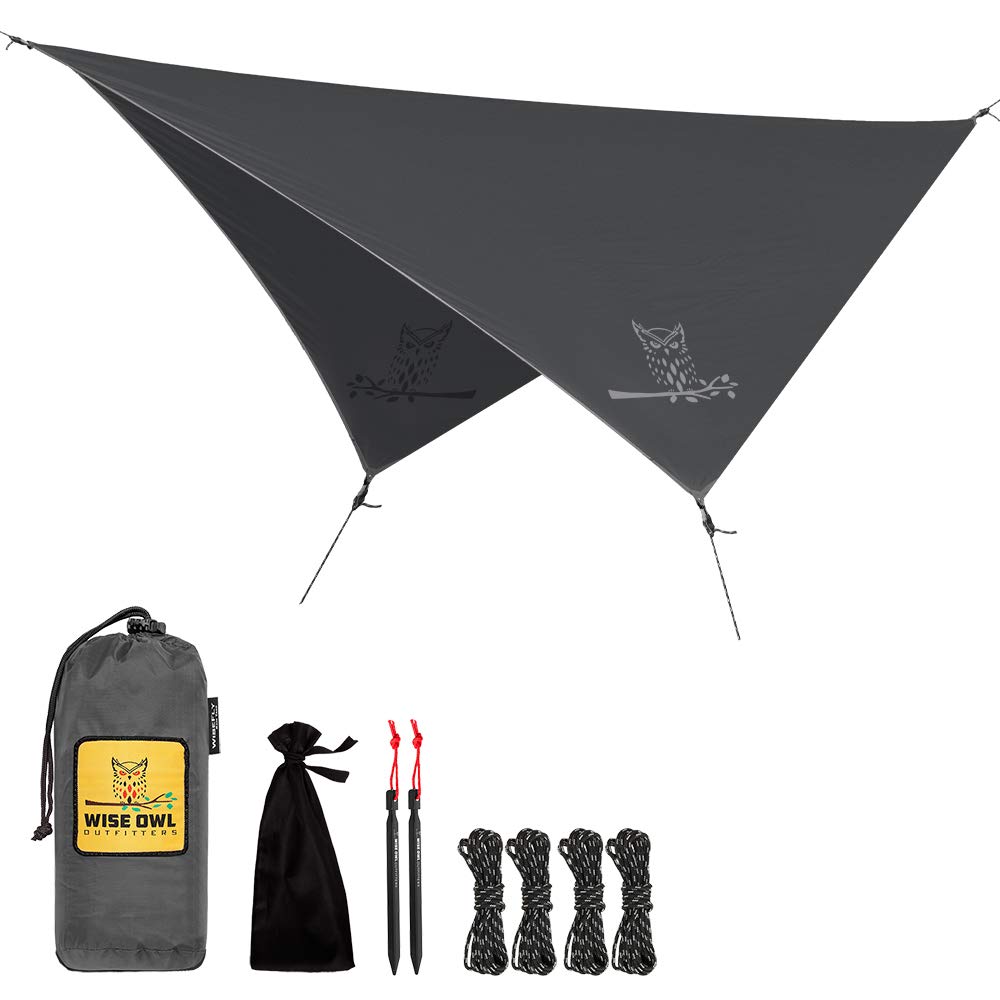
Wise Owl Lite Rain Fly
Key Features
- Footprint: 11 x 9 ft
- Kit includes: 4 stakes, 6 guy lines
- Packed weight: 18.9 oz
- Waterproof rating: 3,000 mm
- Price: Midrange
Nineteen ounces for 11 by 9 feet is the ratio that keeps this tarp at the top of our list. That’s enough fabric to shelter a hammock properly or to build a roomy A-frame for one, in a bundle that disappears into a pack’s side pocket. The kit is genuinely complete, too: six 10-foot guy lines, four aluminum stakes, a stake bag and a waterproof sack, so a first pitch never stalls while you hunt through a gear bin for hardware.
The 3,000 mm coating and taped seams sit in the middle of this group — the AquaQuest Guide and the Gold Armour are both rated higher — but for three-season rain that’s a comfortable margin, and the seams arrive sealed rather than left for you to do.
Eleven by nine sounds generous, and pitched as a diagonal over a hammock it is. Drop the same panel into a low A-frame to shed wind and the usable floor shrinks faster than the number suggests: in bad weather this is a one-person shelter, in mild weather a two-person one. The stuff sack is cut close as well, and a wet tarp with the stakes still inside takes a second attempt — keep the stakes in their own bag and the problem mostly evaporates.
The guy lines are 10 feet each, which sounds like overkill until you’re tying off to two trees further apart than you planned for. Add a one-year warranty against defects and a footprint that covers a hammock’s full length, and you have a tarp that behaves like a much more expensive one.
Pros
- 18.9 oz for a full 11 x 9 ft panel
- Six guy lines and four stakes included
- Taped seams with a 3,000 mm coating
Cons
- 3,000 mm coating trails the 5,000 mm tarps here
- Low A-frame pitches eat the usable floor
We recommend the Wise Owl Lite to almost any backpacker: 18.9 ounces, a full 11 by 9 feet, and a complete line-and-stake kit, with waterproofing that handles three-season rain.
Best for Ultralight Solo Trips
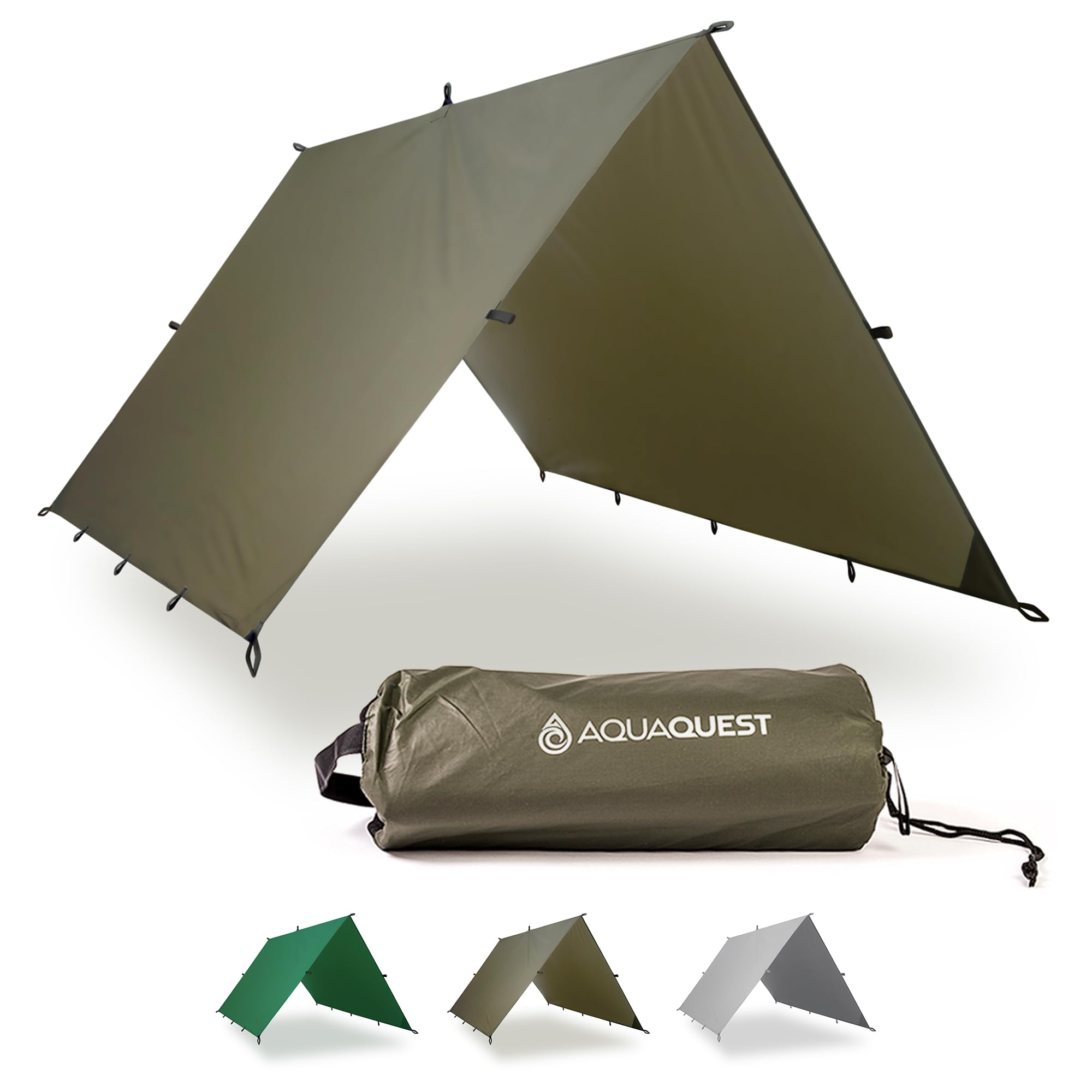
AquaQuest Guide Tarp
Key Features
- Footprint: 9’7" x 6’7"
- Packed weight: 14.4 oz
- Tie-out points: 13
- Waterproof rating: 5,000 mm
- Price: Premium
Nothing else here asks as much for as little fabric. The Guide is 0.9 pounds for a finished 9 foot 7 by 6 foot 7 panel — 64 square feet of 40D ripstop nylon with a 5,000 mm coating, taped seams and 13 tie-outs. In the bag: the tarp and a stuff sack. Stakes and lines are yours to supply.
We keep coming back to it for solo trips with an ugly forecast. Five thousand millimeters and heat-taped seams are the most protection on offer in this group, and the light fabric packs down to something you stuff into a lid pocket without thinking about it. The lifetime warranty matters here in a way it doesn’t on a budget tarp — this is a shelter you expect to pitch hundreds of times.
The catch is coverage, and it’s a real one. Nine foot seven by six foot seven is a one-person shelter: generous in a lean-to or a low diamond, cramped the moment a second person or a wet pack wants in. If you camp with someone else, a 12-foot panel — the onewind, the NoCry or the Gold Armour — adds a dry partner for roughly a pound and a half.
Pros
- 0.9 lb with a 5,000 mm coating
- 13 reinforced tie-outs on a small panel
- Lifetime warranty against defects
Cons
- Ships without stakes or guylines
- 64 sq ft is a solo shelter, not a shared one
Buy the Guide if you hike alone and the forecast is ugly: 0.9 pounds, 5,000 mm and a lifetime warranty, in a panel that shelters one person and no more.
Best for Budget First Tarp
Kalinco 10×10 Tarp
Key Features
- Footprint: 10 x 10 ft
- Packed weight: 1.8 lb
- Tie-out loops: 19
- Waterproof rating: 3,000 mm
- Price: Budget
Nineteen reinforced loops on a tarp in the budget bracket is the detail that made us look twice. Three sit on the ridgeline and the rest run the perimeter, so a 10 by 10 square becomes an A-frame, a lean-to, a diamond over a hammock or a windbreak with a raised wall.
At 1.8 pounds it gives away about ten ounces to our top pick for effectively the same footprint, on a 210T polyester with a 3,000 mm coating and a taped centre seam. The square shape is the trade in the other direction: more pitching options than a rectangle, slightly less ridgeline than an 11-foot panel gives an 11-foot hammock. Six aluminum stakes and six ropes with tensioners come in the bag, which is more hardware than the position on price suggests.
We point people here when they’re building a first shelter kit or adding a second tarp for a kid’s setup. It isn’t what we carry on a long day — those ten ounces are noticeable at mile twelve — but nothing else here covers this many pitching options for so little of the budget.
Pros
- 19 tie-out loops including ridgeline points
- Six stakes and six tensioner ropes included
- Square panel pitches more shapes
Cons
- 1.8 lb, about ten ounces above the top pick
For a first tarp or a second shelter on a tight budget, the Kalinco’s 19 tie-outs and complete stake-and-line kit make it the easy call.
Best for Cold-Weather Hammocking
onewind 12×10 Tarp with Doors
Key Features
- Fabric: 1.1 oz 20D ripstop silnylon
- Footprint: 12 x 10 ft
- Packed weight: 2.2 lb
- Waterproof rating: 4,000 mm
- Price: Premium
If your hammock season runs into frost, doors are the difference between a tarp and a shelter. This onewind closes both ends, uses a 1.1 ounce 20D ripstop silnylon with a 4,000 mm coating, and still comes in at 2.2 pounds — the only fully enclosed pitch in this group.
Silnylon is why it packs small and why it costs what it does. The double-ended stuff sack, four aluminum stakes, six 10-foot reflective guylines, four adjusters and four carabiners with the door cordage already attached make it a better-equipped package than most at this size. The one niggle is the sack: a 12-foot silnylon panel is a lot of fabric to compress, and after a wet night it takes patience. A slightly larger sack fixes it for almost no weight.
Against the ultralight pick this is 2.2 pounds instead of 0.9, at the top of the price range here — a lot of tarp for someone who camps three seasons and never sees frost. For shoulder-season trips, exposed sites and sideways rain, the doors earn every ounce back.
Pros
- Doors close both ends against wind and frost
- 4,000 mm silnylon at 2.2 lb
- Stakes, lines and carabiners in the bag
Cons
- Premium price tier for a shelter this size
- 2.2 lb, more than double the ultralight pick
Our pick for hammock camping in shoulder season: the doors seal a 12-foot silnylon panel down to 2.2 pounds, and you feel the difference on a frosty morning.
Best for Group and Basecamp
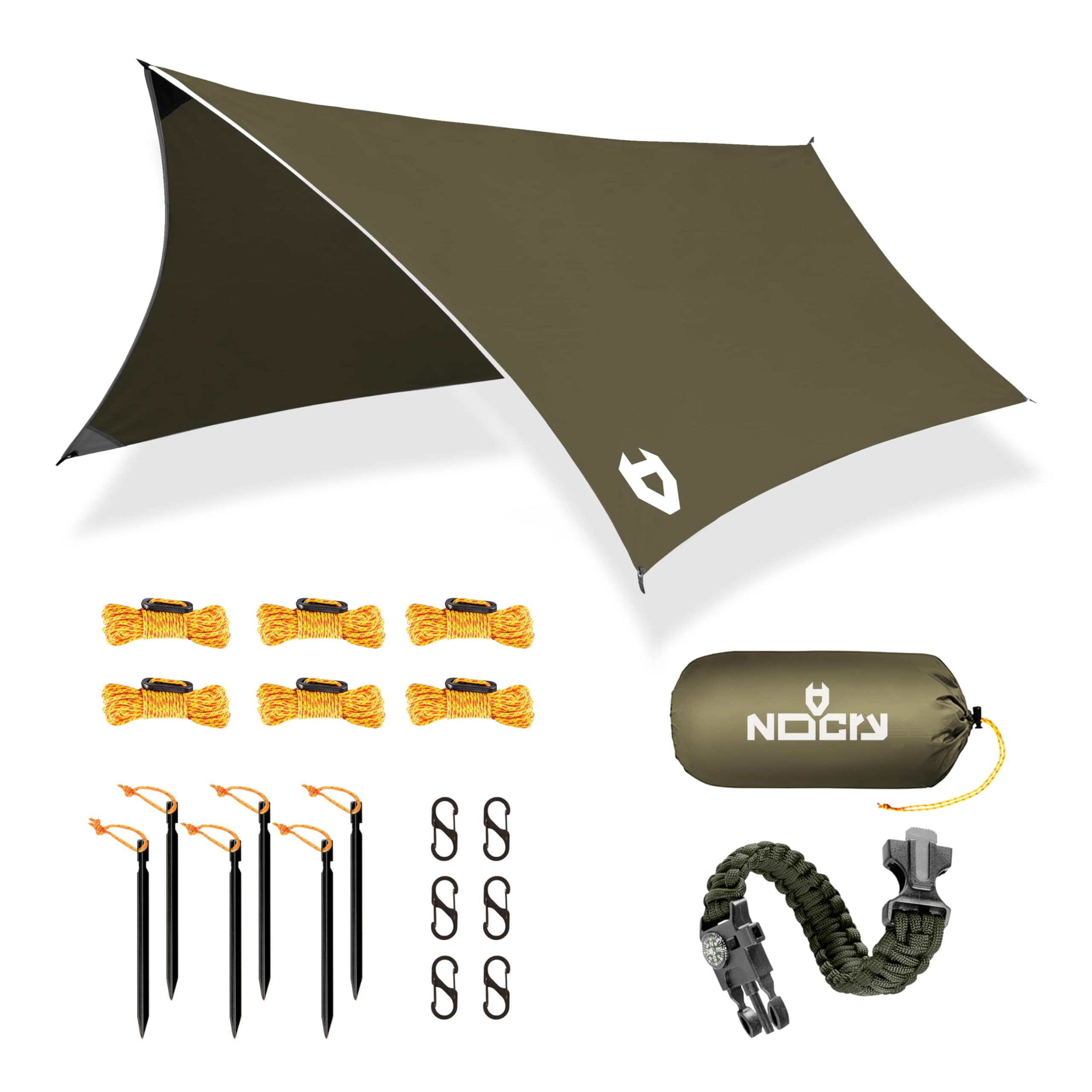
NoCry 12×10 Rain Fly
Key Features
- Fabric: 210T polyester, TPU coated
- Footprint: 12 x 10 ft
- Fly weight: 1.65 lb
- Kit weight: 2.1 lb
- Price: Midrange
Six aluminum stakes, six carabiners, seven adjustable ropes, a sack for the lines, a carry pouch and a survival bracelet: the NoCry turns up as a kit rather than a panel, which is exactly what you want when you’re outfitting a first shelter or a group’s shared gear.
The tarp itself is 12 by 10 feet — 120 square feet of 210T polyester with a TPU coating — matching the biggest footprints here. That covers two hammocks hung close together, a picnic table with the chairs pulled in, or a cooking area you can crouch in without your shoulders brushing the fabric.
Weight is the honest trade. The fly alone is 1.65 pounds and the whole kit runs a little over two, so you’re carrying roughly a pound more than our top pick for twenty extra square feet. At basecamp that’s a bargain; on a fast solo push it’s the wrong tarp.
Check the stitching and grommets when it arrives — construction is the inconsistent note in this design, and reinforced corners either read as solid or as the place a thread lets go. Buy it for coverage and a full hardware kit at a midrange price, and accept that it’s a shelter you share rather than carry far.
Pros
- 120 sq ft, among the largest here
- Full hardware kit included
- Limited lifetime warranty
Cons
- Fly 1.65 lb, over 2 lb with hardware
- Stitching and grommets need a check on arrival
The one to buy when you’re sheltering more than yourself: 120 square feet, a full hardware kit and a lifetime warranty for a midrange outlay.
Best for Maximum Pitch Options
Gold Armour Rainfly 12×10

Key Features
- Footprint: 12 x 10 ft
- Tie-down loops: 33
- Waterproof rating: 5,000 mm
- Price: Midrange
Gold Armour doesn’t publish a packed weight for this 12 by 10, and for a backpacking purchase that’s the first figure we look for. What it does publish is 33 tie-down loops — more than anything else here — plus two centre lines and a 5,000 mm coating.
The loop count changes what the tarp can do: a full enclosure, a lean-to with a raised porch, a windbreak with wings, a hammock pitch with the corners pulled out square. Twelve by ten feet is the same footprint as the NoCry and the onewind, so the decision between them comes down to fabric, hardware and that unpublished weight.
Reinforcement at the tie-outs is where this one asks for care. Corners and edge loops take the load in a gust, and that’s the spot to inspect before you commit it to exposed ground. Buy it for the pitch options at a midrange price; if you want to pitch once in a blow and stop thinking about it, the onewind or the AquaQuest is the safer company.
Pros
- 33 tie-down loops, the most in this group
- 5,000 mm coating at a midrange price
Cons
- Tie-out reinforcement is the weak point under load
Worth it if you pitch a dozen shapes and want the most tie-outs here; look elsewhere if you want to load it up in real wind and stop thinking about it.
Best for Stealth and Shade
OneTigris Bulwark Tarp

Key Features
- Tie-outs: 19
- Footprint: 12.8 x 9.5 ft
- Packed weight: 2.4 lb
- Waterproof rating: 2,000 mm
- Price: Midrange
Coyote brown is the reason a lot of people find this tarp: pitched low in scrub or against dark timber, it sits quietly where a bright shelter waves at the ridge line.
Twelve point eight by nine point five feet is the largest panel in this group, with 19 reinforced attachment points, three of them on the ridgeline, plus six 13-foot guylines with tensioners, hex pegs and a stuff sack. Those 13-foot lines are longer than most here, which matters when the only anchors are two trees at an awkward distance.
At 2.4 pounds it’s also the heaviest tarp here, and its 2,000 mm coating is the lowest rating in the group. Neither is fatal — 2,000 mm handles steady three-season rain — but together they place this at the camp-comfort end of the category rather than the thru-hiking end.
What a big flat panel buys you is shade over a whole site, a dry place to sit out an afternoon of weather, and enough length to box in a hammock and gear against wind chill. It’s a tarp you’re glad to have set up and happy to leave behind when the trip is long.
Pros
- Largest panel here at 12.8 x 9.5 ft
- Six 13-ft guylines with tensioners
- Coyote brown pitches discreetly
Cons
- 2.4 lb, the heaviest tarp in this set
- 2,000 mm is the lowest rating here
A big, discreet panel for camp comfort rather than light packing: 12.8 by 9.5 feet of coyote brown at 2.4 pounds.
Best for Emergency Pack Cover
TRIWONDER 7.5×4.6 Tarp

Key Features
- Weight: 10.6 oz
- Footprint: 7.5 x 4.6 ft
- Tie-out loops: 4
- Price: Budget
Seven and a half by four and a half feet is 34 square feet, and that figure should settle the purchase before anything else does. This is a panel about the size of a poncho: four tie-out loops at the corners, 300 grams, and a stuff sack. No stakes, no lines, no poles.
As a sleeping shelter it doesn’t work. As the thing at the bottom of a daypack it earns its keep — a sudden shower, a windbreak while you eat, a cover for packs left at a trail junction, a sunshade rigged off two poles. At a budget price and 300 grams, that’s cheap insurance you stop noticing you’re carrying.
The silver-coated inner surface is there to reflect heat and cut glare, which is more use over a cold lunch stop than over a sleeping bag. Four loops is also the practical limit: add a couple of guy lines and two stakes and it makes a serviceable gear cover, but it will never be more than that.
Pros
- 300 g and packs to pocket size
- Budget price for a backup panel
Cons
- 34 sq ft is not a sleeping shelter
- No stakes, lines or poles included
Buy it as a 300-gram emergency panel for day trips, not as the shelter you sleep under.
How We Tested Backpacking Tarps
We began with a shortlist of tarps sold for backpacking, then narrowed it by reading fabric descriptions, seam-sealing details, dimensions, hardware, and price. We ruled out shelters with vague coverage specs or no clear guidance on sealing seams, and we made sure the final dozen spanned solo and two-person sizes. Over eight months, those 12 tarps went on weekend trips, backyard pitches, and a few deliberately miserable rainy nights.
We pitched every tarp solo and timed how long it took from stuff sack to taut shelter, then re-pitched in wind and rain to see whether guylines held and whether the fabric flapped or sagged. We weighed each tarp, stakes, and stuff sack on a kitchen scale, then packed it against a 40-liter pack to judge bulk. For water resistance, we ran a hose over each canopy for five minutes and checked for misting, pooling, and drips at the tie-outs; in real storms, we watched whether water tracked along seams or beaded and rolled off.
Seam quality and construction got their own inspection: we tugged reinforced tie-outs, looked for loose threads or skipped stitches, and checked how taped or coated seams held after repeated setups. We also pitched on rough ground and left shelters up through a full weekend of sun and rain to watch for abrasion, stretching, and coating wear. Value came down to what came in the bag—stakes, guylines, stuff sack—and whether the tarp’s weight, coverage, and durability justified its price against the others.
How to Choose a Backpacking Tarp
Your tarp is decided by three things — how much weight you’ll carry, how much weather you expect, and whether you’re hanging or sleeping on the ground — and almost everything else is detail.
Weigh the Kit, Not the Fly
Manufacturers quote the fly weight, but you carry the stakes, lines and sack as well. The NoCry is listed at 1.65 pounds for the tarp and a little over two for the complete kit, and that half-pound gap is typical rather than unusual.
So add six lines and four to six stakes to whatever number is printed, then compare that total against the shelter you’re replacing. A tarp that saves eight ounces on paper and spends them back on hardware hasn’t saved you anything.
Square Feet and Shape
A 10 by 10 square pitches more shapes than a 12 by 10 rectangle, because any side can become the ridgeline. A rectangle wins for hammock camping: the long side runs along your suspension and leaves a porch to cook under.
Match the ridgeline to your hammock. An 11-foot hammock under a 10-foot tarp leaves both ends of the bug net exposed in blowing rain, and the extra two feet of a 12-foot panel is the difference between a dry night and a damp one.
Waterproof Ratings and Seams
Ratings in this group run from 2,000 mm to 5,000 mm. Anything at 3,000 mm and above handles sustained three-season rain; the higher numbers buy margin for snow and for wind-driven spray that sits on the fabric instead of running off.
The number is only half the story. A taped ridgeline seam prevents more leaks than an extra 1,000 mm of coating, because the ridge is where water collects and where the panel is under constant tension. If the seams aren’t taped from the factory, plan on sealing them yourself before the first trip.
Count Tie-Outs, Then Count What They Cost You
Tie-outs are what make a tarp versatile: three on the ridgeline let you pull the panel properly taut, and edge loops let you close an end or lift a side for airflow. A 13 to 19 point panel is the sweet spot for a solo hammock camper.
More isn’t free. Thirty-three loops mean thirty-three potential snag points and a slower setup in wind, and a four-loop panel goes up fastest of all while pitching almost nothing. Decide which pitch you actually use before chasing the biggest number.
What’s Actually in the Bag
Two tarps here arrive as a panel and a stuff sack, with lines and stakes left to you. That’s reasonable for an ultralight shelter where you already own titanium stakes and annoying if this is your first.
Budget for six guy lines of 10 feet or more, four to six stakes, and a sack with room to take the tarp wet. That last point matters more than it sounds: a sack you have to fight is the reason people start leaving shelters at home.
Frequently Asked Questions
Is a tarp really lighter than a tent?
For a solo shelter, usually yes. The tarps here run from 0.9 to 2.4 pounds, and lines and stakes add a few ounces on top, which undercuts most one-person double-wall tents.
But you’re comparing different things: a tarp has no floor and no bug protection. Add a groundsheet and a net and the gap narrows fast, so weigh the whole system against the tent before you switch.
Can you pitch a tarp without trees?
Yes. Two trekking poles set a little below shoulder height, handles up, make a solid A-frame, and the same trick works with a bike held upright or two paddles lashed into an X.
Splay the poles wider than the tarp is tall so wind can’t roll it. In open country a low lean-to anchored to one pole and two stakes sheds far more weather than a tall, proud A-frame.
What do you do with a wet tarp?
Shake it out, roll it loosely, and carry it outside your pack — strapped to the lid or in a mesh pocket — rather than in with your quilt. Wet fabric doesn’t dry in a stuff sack, and a night pressed against a damp bundle is how sleeping bags get soaked.
Hang it in the sun at lunch or at home afterward. Both silnylon and coated polyester dry quickly once they have air moving across them.
How do you keep condensation off the inside?
Pitch high enough to leave a gap between the tarp edge and the ground, and site it where air moves — a ridge or a clearing rather than a hollow where cold air pools.
In still, cold conditions some condensation is unavoidable in any single-wall shelter. Wipe the inside with a bandana before packing up and keep your bag off the fabric; a pitched-with-doors shelter traps more moisture than an open one.
Final Verdict
Our pick for most backpackers is the Wise Owl Lite: 18.9 ounces, a full 11 by 9 feet, and a complete line-and-stake kit that saves a separate shopping trip. It covers a hammock, a ground pitch and a rainy lunch stop without asking you to choose between them.
Spend the extra on the AquaQuest Guide if you hike alone and count every ounce — 0.9 pounds, a 5,000 mm coating and a lifetime warranty — and accept that it shelters one person, not two.