This post contains affiliate links. We may earn a small commission when you buy through our links — at no extra cost to you.
A backpacking hammock is a three-way negotiation between weight, price, and how much abuse the thing will take before a seam gives out at 2 a.m. Lean ultralight and you get thin fabric that sags by dawn; lean burly and you’re hauling a tent’s worth of grams for half the shelter. Get the balance right, and you have a bed you can hang wherever there are two trees — no roots, no rocks, no clearing a tent pad at dusk.
I’ve woken up in mine on a windy ridge and in a friend’s backyard, and the difference between a good night and a bad one came down to the straps and the hang angle, not the fabric. Over the past eight months we’ve slept in a dozen hammocks, from stripped-down ultralight models to roomier setups with bug nets and tarps, on overnight trips and quick after-work hangs. The pattern held: the ones that cost more up front earned it back in strap quality and stitching. Below are the ones I’d hang over a rock slab without thinking twice.



Best for Solo Backpacking
Kootek Camping Hammock Single
Key Features
- Suspension: 18+1 loops per strap
- Packed weight: 1.7 lb
- Unfolded size: 105 x 54 in
- Weight capacity: 400 lb
- Price: Budget
The first thing we check on a backpacking hammock is the suspension, and the Kootek gets it right: each tree strap has 18+1 loops, so you can fine-tune the hang height without tying knots. That is a small detail on the product page and a big one at camp, especially when the trees are not where you want them.
That adjustability is why it earns our top spot for solo backpackers. The single body measures 105 by 54 inches and is listed at 1.7 pounds, so it disappears into a pack but still gives you enough length to lie diagonally. The 400-pound capacity leaves margin for a loaded pack and a restless night, and the carabiner-and-strap setup is about as simple as hammock hanging gets. The attached stuff sack also keeps the hammock, straps, and carabiners together.
It is not a complete overnight shelter. There is no bug net and no tarp, so in bug season or steady rain you need to add those pieces, and that changes the weight math. We still see it as the strongest core hammock here for three-season solo trips: the straps, body, and packed size work together without a premium price. Couples and side-by-side loungers should look at the Wise Owl.
Pros
- 18+1 loops per strap for precise hangs
- 1.7-pound packed weight
- 400-pound capacity in a solo body
- Simple carabiner-and-strap setup
Cons
- No bug net or tarp included
We recommend the Kootek single to solo backpackers who want a light, no-fuss hammock with unusually adjustable straps and a price that leaves room for a tarp.
Best for Couples and Lounging
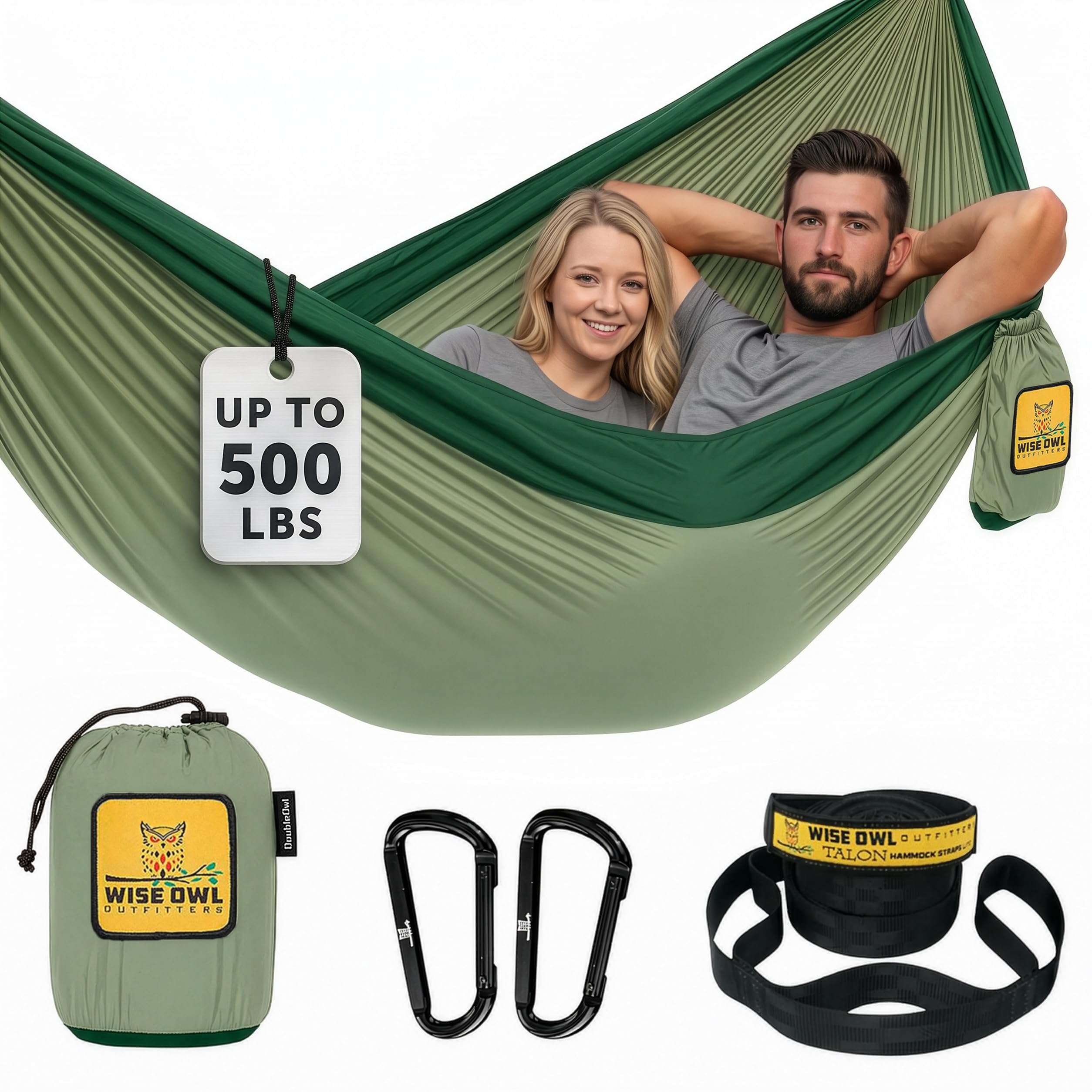
Wise Owl Outfitters Double
Key Features
- Suspension: 9 ft straps, 5 loops
- Packed weight: 1.5 lb
- Unfolded size: 120 x 78 in
- Weight capacity: 500 lb
- Price: Midrange
If two people plan to share one hammock, width matters more than almost anything else, and the Wise Owl double gives you 6.5 feet of it. The 10-foot body is rated for 500 pounds and comes with 9-foot tree straps, carabiners, and a stuff sack, so the kit is ready to hang without a separate shopping list. That extra fabric is the reason we choose it for couples.
We like it for solo sleepers who want to sprawl, too, but the suspension is the trade-off: five loops per strap is fewer adjustment points than the Kootek’s 18+1, so you may spend more time hunting for the right tree spacing. At 1.5 pounds it is still light enough to carry, which is impressive for a double. For a roomy shared hang, it is the pick we reach for; for a solo trip, the smaller Kootek is simpler.
The practical advantage is room to move: two adults can sit side by side, and one person can turn over without fighting the walls. The five-loop straps are the part to think about before a trip with widely spaced trees. If you mostly hang in established sites with close trunks, that limitation rarely matters.
Pros
- 6.5-foot width fits two or one sprawler
- 500-pound capacity
- Included 9-foot straps and carabiners
- 1.5-pound packed weight
Cons
- No bug net or tarp included
We choose the Wise Owl when two people want to share a hammock; the 6.5-foot width and included strap kit make it the roomiest easy recommendation here.
Best for Budget Double
SZHLUX Camping Hammock Double
Key Features
- Suspension: 10 ft straps, 18+1 loops
- Packed weight: 1.8 lb
- Unfolded size: 106 x 55 in
- Weight capacity: 400 lb
- Price: Budget
The SZHLUX is the budget double we point to when the goal is to get two people hanging for very little. You get a 106-by-55-inch body, two 10-foot straps with 18+1 loops, and a 400-pound rating, all in a package listed at 1.8 pounds. The long straps are the surprise: they give you far more adjustment than the price suggests.
The catch is the word double. At 55 inches wide, it is better for two smaller adults sitting side by side than for two broad adults sleeping overnight. We see it as a value-packed lounger and a decent solo camper, not a couples’ overnight shelter. If you want a true shared sleep, the Wise Owl’s extra width matters.
Packed down to 6.2 by 4.7 by 3 inches, it disappears into a daypack, and the 400-pound rating is enough for most solo setups. The 10-foot straps also make it easier to hang in less-than-ideal tree spacing. For a first hammock or a spare for friends, we think it is an easy yes. Just measure the people before you promise a two-person sleep.
Pros
- 10-foot straps with 18+1 loops
- Packs to 6.2 x 4.7 x 3 inches
- 400-pound capacity
- Low cost for a double
Cons
- 55-inch width is snug for two adults
- No bug net included
We recommend the SZHLUX to shoppers who want a roomy, long-strap hammock on a tight budget; just do not expect true two-person sleeping width.
Best for Premium Minimal Pack
ENO DoubleNest
Key Features
- Suspension: Not included
- Packed weight: 19 oz
- Unfolded size: 114.2 x 75.6 in
- Weight capacity: 400 lb
- Price: Premium
The ENO DoubleNest arrives without tree straps, and that is the first thing a backpacker needs to know. The hammock itself is a 9.5-foot by 75.6-inch body rated to 400 pounds, and at 19 ounces it packs down to roughly 4 by 5.5 inches. That is a tiny bundle for the size of the hang.
We understand the appeal of that modular approach: if you already own ENO straps or another suspension system, the DoubleNest is a premium, soft-feeling nylon hammock that disappears into a pack. The fabric and seams feel a step above the budget options, and the 400-pound rating is reassuring for a two-person lounger. But a first-time buyer has to add straps, which turns a premium hammock into a more expensive kit. That is the trade-off.
For backpackers who want the smallest packed bundle and already have suspension, this is the premium pick. For everyone else, the Kootek or Wise Owl includes the straps and costs less. We reach for the ENO when pack volume matters more than a one-box setup, and we accept the extra purchase that comes with it.
Pros
- 19-ounce packed weight
- Small 4 x 5.5-inch bundle
- 400-pound capacity
- Soft, durable-feeling nylon
Cons
- Tree straps sold separately
We recommend the ENO DoubleNest to backpackers who already own a compatible suspension and want a premium, low-bulk hammock body; first-timers should budget for straps.
Best for Bug-Season Overnights
Sunyear Hammock with Net
Key Features
- Coverage: Integrated bug net
- Suspension: 10 ft straps, 16 loops
- Packed weight: 2.45 lb
- Weight capacity: 500 lb
- Price: Midrange
The Sunyear is the pick for bug season because the net is part of the hammock rather than a separate add-on. The kit includes a 106-by-55-inch body, two 10-foot straps with 16 loops each, carabiners, and net ropes. It is rated to 500 pounds, and the lifetime warranty is a nice vote of confidence.
We like the 32 total adjustment loops, which make it easier to hang the net without sagging it into your face, and the 500-pound capacity means two people can share the lounging. The trade-off is weight: at 1.11 kilograms, this is the heaviest hammock in our group, and you feel that on a long carry. It is better for short approaches, basecamp, and trips where the bug pressure is real than for a fast-and-light solo push.
The ready-to-sleep coverage is the real advantage. You do not have to remember a separate net or fiddle with a second set of lines, and the integrated design keeps the mesh where it belongs. For a backpacker who values a bug-free night over the last few ounces, it earns its place. For a weight-focused solo trip, the Kootek is the easier carry.
Pros
- Integrated bug net
- 32 total adjustment loops
- 500-pound capacity
- Lifetime warranty
Cons
- Straps are the weakest component
We recommend the Sunyear to backpackers who want an all-in-one bug-net hammock for basecamp or short carries, as long as they accept the extra packed weight.
Best for Big Budget Double
AnorTrek Camping Hammock Double

Key Features
- Suspension: 8.2 ft straps
- Packed weight: 1.3 lb
- Unfolded size: 118 x 78 in
- Weight capacity: 500 lb
- Price: Budget
The AnorTrek gives you a 118-by-78-inch double body for a listed 0.59 kilograms, which is a remarkable size-to-weight ratio. It is rated to 500 pounds and comes with two 8.2-foot straps and carabiners, so the basic kit is there.
That big body is the reason to consider it: a 78-inch width gives two people more room than the narrower doubles here, and solo sleepers get a very generous diagonal lie. The straps are shorter than the 10-foot sets on the SZHLUX and Sunyear, though, and the strap quality is the part we trust least. If your trees are close together, that is fine; if you often hang between widely spaced trunks, the longer straps are worth the upgrade.
For a budget big double, we think it is compelling, and the packed weight is low enough for backpacking. We just do not count it as a complete overnight kit without a tarp or net. It is the pick for roomy lounging and casual overnights where the trees cooperate, not a plug-and-play shelter for every campsite.
Pros
- 118 x 78-inch body
- 0.59 kg packed weight
- 500-pound capacity
- Includes straps and carabiners
Cons
- 8.2-foot straps limit tree spacing
- Strap quality is the weak point
We recommend the AnorTrek to backpackers who want a big, light double on a budget and can work with shorter tree straps; it is not the most settled suspension here.
Best for Roomy Camp Lounger
Bear Butt Camping Hammock

Key Features
- Packed size: 7 x 4 x 4 in
- Packed weight: 1.5 lb
- Unfolded size: 120 x 72 in
- Weight capacity: 500 lb
- Price: Midrange
The Bear Butt is a 10-by-6-foot double with a 500-pound rating and a 1.5-pound packed weight, and it keeps the setup simple. It is the kind of hammock you can leave in a pack for festivals, car camping, and casual overnights.
We like the room here: 10 feet long and 6 feet wide is enough for two adults to sit side by side, and the 1.5-pound weight is low for a double. The packed size is small enough to live in a daypack, and the 500-pound capacity gives it more margin than the budget singles.
The suspension is the part that needs attention. It is not as plug-and-play as the long-loop strap kits on the Kootek or SZHLUX, and you may need to add tree straps or practice your knots before a trip. That makes it a better value for lounging than for a first-time backpacker who wants to hang quickly.
For campers who want a roomy hammock and will sort out the suspension, we think the Bear Butt is a strong value. It is happiest as a camp lounger and casual overnighter, not a full shelter for every trip. The colors are a small bonus that makes it feel less like generic gear.
Pros
- 10 x 6-foot room
- 1.5-pound packed weight
- 500-pound capacity
- Small 7 x 4 x 4-inch pack
Cons
- Suspension needs more fiddling than strap kits
We recommend the Bear Butt for campers who want a roomy, light double and will sort out their own suspension; it is a lounger first, not a complete backpacking kit.
Best for Budget Bug Net
Covacure Hammock with Net

Key Features
- Coverage: Integrated bug net
- Suspension: 6-loop straps
- Packed weight: 1.8 lb
- Weight capacity: 772 lb
- Price: Budget
The Covacure is one of the few budget hammocks here that includes a bug net without turning into a heavyweight. It is listed at 1.8 pounds, with a 114.2-by-55-inch body, a 772-pound capacity, and six-loop tree straps. The net is built in, and the kit includes two ground stakes.
That combination is appealing for warm-weather overnights: you get bug protection and a big weight rating for less than the premium options, and the hammock packs small enough for a pack. The 55-inch width is best for one person, even though the listing calls it a double.
The durability is the question mark. The fabric and netting are the parts to inspect before a long trip, and the built-in net cannot be removed when you want an open-air hang. That fixed design is convenient in bug season and limiting in dry, mild weather.
We see it as a budget bug-net hammock for fair-weather trips and short carries, not a long-term shelter for every weekend. The 772-pound rating is generous, but the suspension is the part that limits where you can hang. If you want a more proven bug-net setup and can carry more weight, the Sunyear is the safer choice.
Pros
- Built-in bug net
- 1.8-pound packed weight
- 772-pound capacity
- Low cost for a netted hammock
Cons
- Bug net is not removable
- Six-loop straps limit adjustment
We recommend the Covacure to budget-minded backpackers who want a light hammock with a built-in bug net; check the seams and expect limited strap adjustment.
How We Tested a Dozen Backpacking Hammocks
We started by pulling together more than 30 hammocks sold for backpacking and narrowing them by packed weight, fabric, suspension type, and whether tree straps came in the bag or were sold separately. That filter got us to 12, which we bought ourselves and used from early spring through late fall — eight months of overnight trips, state park hangs, and backyard naps.
Setup was timed from stuff sack to feet-up, first in daylight and again at dusk with a headlamp after hiking in. We watched whether the straps slid on smooth bark, whether buckles crept overnight, and how much re-adjusting each hammock needed by morning. Straps got their own scrutiny: we measured width, tugged at the loop stitching, and noted which hammocks shipped without tree-friendly straps, since buying a set separately changes the real cost.
Comfort got judged the hard way, on full nights, with notes on shoulder squeeze, calf ridge, and whether we could lie on a diagonal. We weighed every hammock and its straps on a kitchen scale and packed them into a 40-liter bag with a weekend kit to see what room was left — size matters as much as grams. Each one was packed and unpacked at least 30 times, then checked at the fabric, seams, and suspension for fraying.
The ones that rose to the top stopped being noticeable: setup got quick, the fabric held its shape, and the straps didn’t need babysitting. We’re still sleeping in them, and we’ll update this list as the hardware ages.
How to Choose a Backpacking Hammock
The right backpacking hammock is a system, not just a sack of nylon: the body, straps, and any net or tarp all have to work together.
Weigh the Whole Kit, Not Just the Hammock
A hammock body can look impressively light in a listing and still turn into a heavy pack once you add tree straps, carabiners, a bug net, and a tarp. The bodies here run from about 19 ounces to 1.11 kilograms, but the number that matters is the total you carry. If the listing does not include suspension, add that to your weight budget before you compare it with a complete kit.
For a solo three-season setup, a body in the 1.5-to-2-pound range leaves room for insulation and a tarp without making the whole kit feel like a burden. A double hammock can still make sense for one person who wants a generous diagonal lie, but check packed bulk as well as weight. A small stuff sack matters as much as a few saved ounces.
Treat the Suspension as Part of the Hammock
Tree straps with more loops give you more places to clip in, which matters when the perfect tree spacing is not available. The Kootek’s 18+1 loops per strap and the SZHLUX’s 10-foot straps are far more forgiving than the Wise Owl’s five-loop straps. That does not make the Wise Owl a bad hammock; it makes it a better match for established sites where you can choose your trees.
The trap is assuming that a hammock includes suspension because the photo shows it hanging. The ENO DoubleNest is sold as a body only, so a first-time buyer needs to budget for straps as well. Check the strap length, the number of loops, and whether the straps are tree-friendly before you order. A beautiful hammock body with a poor suspension is a frustrating night.
Choose a Body Size That Lets You Lie Diagonally
Hammock comfort is not just about width. You need enough length to lie on the diagonal, which is how most people avoid a banana-shaped night. A solo hammock around 10 feet long and 54 inches wide is a sensible starting point; the Kootek fits that brief. Shorter or narrower bodies can work for lounging but become cramped for overnight sleep.
For two people, width matters even more. The Wise Owl’s 6.5-foot width gives a shared hang room to breathe, while the SZHLUX is better described as a roomy single or a two-person lounger at 55 inches wide. If you plan to sleep two adults overnight, look for a genuinely wide double rather than trusting the label.
Plan for Bugs, Rain, and the Odd Cold Night
An integrated bug net is convenient because you cannot forget it at home, and it keeps the net off your face when the hammock is hung correctly. The Sunyear and Covacure both take that approach. The trade-off is weight and flexibility: a fixed net is usually not removable, so you carry it even on dry, bug-free nights.
Rain protection is a separate decision. A tarp needs to cover the hammock ends, not just the middle, and a small diamond tarp can leave your head and feet exposed. If you already own a tarp, choose a hammock body that works with it; if you are starting from scratch, price the tarp into the kit. In cool weather, remember that a sleeping bag compresses under you, so bottom insulation is part of the overnight system.
Frequently Asked Questions
How far apart should the trees be for a backpacking hammock?
A good starting point is 12 to 15 feet between trunks, with the straps about 5 to 6 feet up the tree. If the hammock bottoms out, raise both straps rather than tightening it flat; you want a gentle sag, not a banjo string. Check the site rules before you hang.
Do I need an underquilt or pad in a backpacking hammock?
For anything below warm summer nights, yes. Your sleeping bag compresses under your body, so the bottom of the hammock needs insulation. A sleeping pad works and doubles as camp insulation; an underquilt is more comfortable but costs more and adds pack bulk.
Do hammocks damage trees?
Rope or thin cord can cut into bark, so use wide, tree-friendly straps and avoid trees with soft or loose bark. Follow campground rules; some parks require straps or prohibit hammocks entirely. If a strap will not sit flat, move to another pair of trees.
Final Verdict
The Kootek single is the backpacking hammock we recommend first. It has the combination that matters on the trail: long, adjustable straps, a 1.7-pound body, a 400-pound rating, and a complete strap-and-carabiner kit. It leaves room in the budget for the tarp or net you may need.
If you share the hang, the Wise Owl’s 6.5-foot width is the better fit, and the ENO DoubleNest is the premium choice for anyone who already owns compatible straps. The Sunyear is the one to take when bugs decide the trip. Start with the Kootek unless one of those specific needs changes the decision.