This post contains affiliate links. We may earn a small commission when you buy through our links — at no extra cost to you.
The best part of a hammock is the twenty minutes after sundown — the lake going quiet, the fire catching — before the whining starts and you’re back inside swatting your ankles. A hammock with a built-in mosquito net fixes that, turning a fair-weather nap spot into somewhere you can actually sleep, so long as the mesh stays off your face and setup doesn’t eat your whole evening.
I’ve hung hammocks that sagged until the netting rested on my shoulder — where the bites happen — and others so fiddly I quit before the fire died. My team and I spent seven months hanging 12 of them in backyard trees and at campsites, timing setup solo, weighing each in its stuff sack, and staying in them until the mosquitoes showed up. Bug protection is the easy part to admire and the easiest thing to get wrong: a net only works if it’s held off your skin, which comes down to the hammock’s cut and the tree straps, not the mesh itself. The picks below run from roomy two-person rigs to packable solo options.




Best for Solo Camping Default
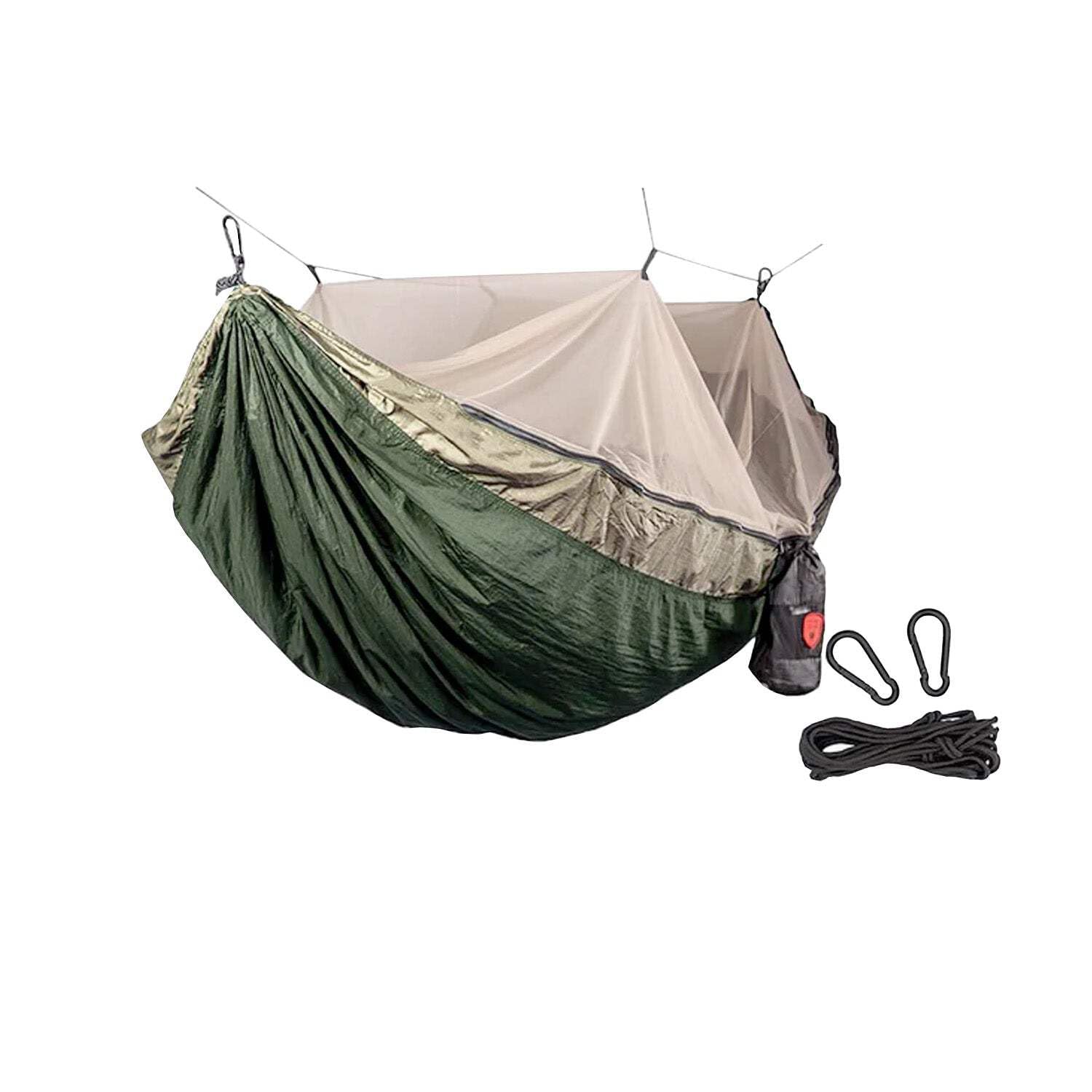
Sunyear Single Hammock
Key Features
- Load capacity: 500 lb
- Packed weight: 2.45 lb
- Unfolded size: 106 x 55 in
- Included suspension: Two 10 ft straps, 16 loops each
- Price: Budget
Sixteen loops on each tree strap is the detail that makes this Sunyear the easiest pick to recommend. The extra adjustment lets you hang the 106 x 55 inch bed at a comfortable height without hunting for the one usable knot position, and the 500-pound capacity gives tall or broad sleepers some margin. At 2.45 pounds, it still disappears into a daypack.
The net is attached and reversible, which we appreciated more than expected: flip it under the hammock and you have an open lounger; bring it back over and the mesh stays overhead. The ridgeline holds the net clear once it is tensioned, and the two net ropes give you a way to fine-tune the shape. We also like that the kit includes the carabiners and a stuff sack, so there is no first-trip shopping list.
What seals the recommendation is the balance: enough capacity for a big solo sleeper, enough adjustment for awkward trees, and a packed size that leaves room for a sleeping bag. The stuff sack is roomy enough that we never fought to get the hammock back in at dusk, which is a small thing until you are tired. For one person who wants a complete net hammock, this is the one we start with.
Pros
- Complete kit with two 16-loop straps
- Reversible net flips out of the way
- 500-pound capacity at 2.45 pounds
- Packs small enough for a daypack
Cons
- Net ridgeline needs deliberate tensioning
- Single variant is a solo bed
Our best all-round pick for solo campers here: a complete net-and-strap kit with generous adjustment and a 500-pound capacity.
Best for Rain-Ready Camping
Sunyear Hammock Bundle
Key Features
- Load capacity: 500 lb
- Packed weight: 2.3 lb
- Unfolded size: 106 x 55 in
- Included shelter: Rainfly, 32 ft ridgeline, four stakes
- Price: Midrange
The rainfly is what separates this Sunyear kit from the simpler hammock we recommend for fair weather. You get the same 106 x 55 inch bed, attached net, and 500-pound capacity, plus a 32-foot ridgeline, a fly, six nylon ropes, and four stakes. That turns the hammock into a shelter rather than a fair-weather bed.
We think it is the right package for campers who want one bag and no separate tarp shopping. The ridgeline gives the net and fly a common spine, and the stakes let you lift the fly’s edges for airflow. The hammock still hangs as a solo bed; the shelter is the upgrade, not extra sleeping room. At 2.3 pounds, the bundle stays reasonable for a short carry, though it is bulkier than the net-only kit.
The net is attached, so you cannot leave it at home, but it can be moved out of the way when the bugs are gone. We did find the fly’s extra cords add a few minutes of fiddling on the first pitch, and the package is overkill for a dry summer overnight. For wet weekends and shoulder-season camps, that trade is worth it. The high-pitch option is what we use on muggy nights; it keeps air moving while the mesh stays shut.
Pros
- Rainfly, ridgeline, ropes, and stakes included
- Same 500-pound net hammock as the basic kit
- Stakes let you open the fly for airflow
- One bag for a weather-ready camp
Cons
- Solo bed only, not for two
- Net can be fiddly to tie back
The rain-ready Sunyear: a complete hammock, net, fly, ridgeline, and stakes for solo campers who expect weather.
Best for Roomy Solo Sleep
Grand Trunk Skeeter Beeter Pro
Key Features
- Bug net: No-See-Um, flip-away
- Load capacity: 400 lb
- Packed weight: 1.8 lb
- Unfolded size: 126 x 60 in
- Price: Premium
At 126 by 60 inches, the Skeeter Beeter Pro gives a solo sleeper something the shorter picks cannot: room to lie diagonally without feeling wedged between the ends. We noticed the extra length most when the hammock was pitched with a little sag, where a 102- or 106-inch bed starts to curl around your shoulders. It carries 400 pounds and weighs 1.8 pounds, so the size does not come with a huge pack penalty.
The No-See-Um net hangs from above rather than resting on your face, and the double-sided zipper lets you get in and out from either side. We appreciate that the net flips under the hammock when you want a plain lounger; it makes the hammock useful in the backyard as well as at camp. Two interior pockets keep a phone and headlamp off the floor.
As a roomy solo bed with a genuinely livable net, it is the most comfortable pick here for tall sleepers. The 400-pound limit is lower than some, but still generous for one. The flip-under net is the detail that makes it a two-mode hammock, not just a camping tool, and the double zipper means you can enter from the side that suits your pitch.
Pros
- Long 126-inch bed for diagonal comfort
- No-See-Um net with double-sided zipper
- Flips into an open hammock
- Light 1.8-pound carry
Cons
- Ships with rope kit, not wide tree straps
- Net can sag without a taut ridgeline
The roomiest solo bed here, with a flip-away no-see-um net for campers who value sleep comfort over a fully sorted kit.
Best for Two-Person Hangs
Easthills Jungle Explorer
Key Features
- Bug net: Removable, full-length zipper
- Load capacity: 600 lb
- Packed weight: 4 lb
- Unfolded size: 118 x 79 in
- Price: Premium
Seventy-nine inches of width is what makes the Jungle Explorer a real two-person hammock rather than a capacity rating with delusions of grandeur. We found the width gives two adults room to lie head-to-foot without the shoulder squeeze that comes from a 55-inch bed, and the 600-pound limit supports the claim. At 118 inches long, it also gives taller sleepers a diagonal.
The net unzips completely, which we like for bug-free afternoons, and the full-length zippers on both sides mean neither sleeper is trapped. Four internal loops and two gear pockets are small conveniences that keep the bed livable. The two 10-foot straps with 16 loops make it easier to level the hammock between uneven trees.
Four pounds is the price of that width, and it is why this is a car-camping or short-walk hammock rather than a long-trail one. For couples and families who want room and a removable net, it earns the space. The two internal pockets are a small thing we missed when we went back to simpler hammocks.
Pros
- 118 x 79 inch bed fits two
- Removable full-length net
- 600-pound capacity
- 16-loop straps and gear pockets
Cons
- Stitching can wear under two-person loads
For two people sharing a hang, this is the roomiest pick, with a removable net and a 600-pound limit.
Best for Cold-Weather Camping
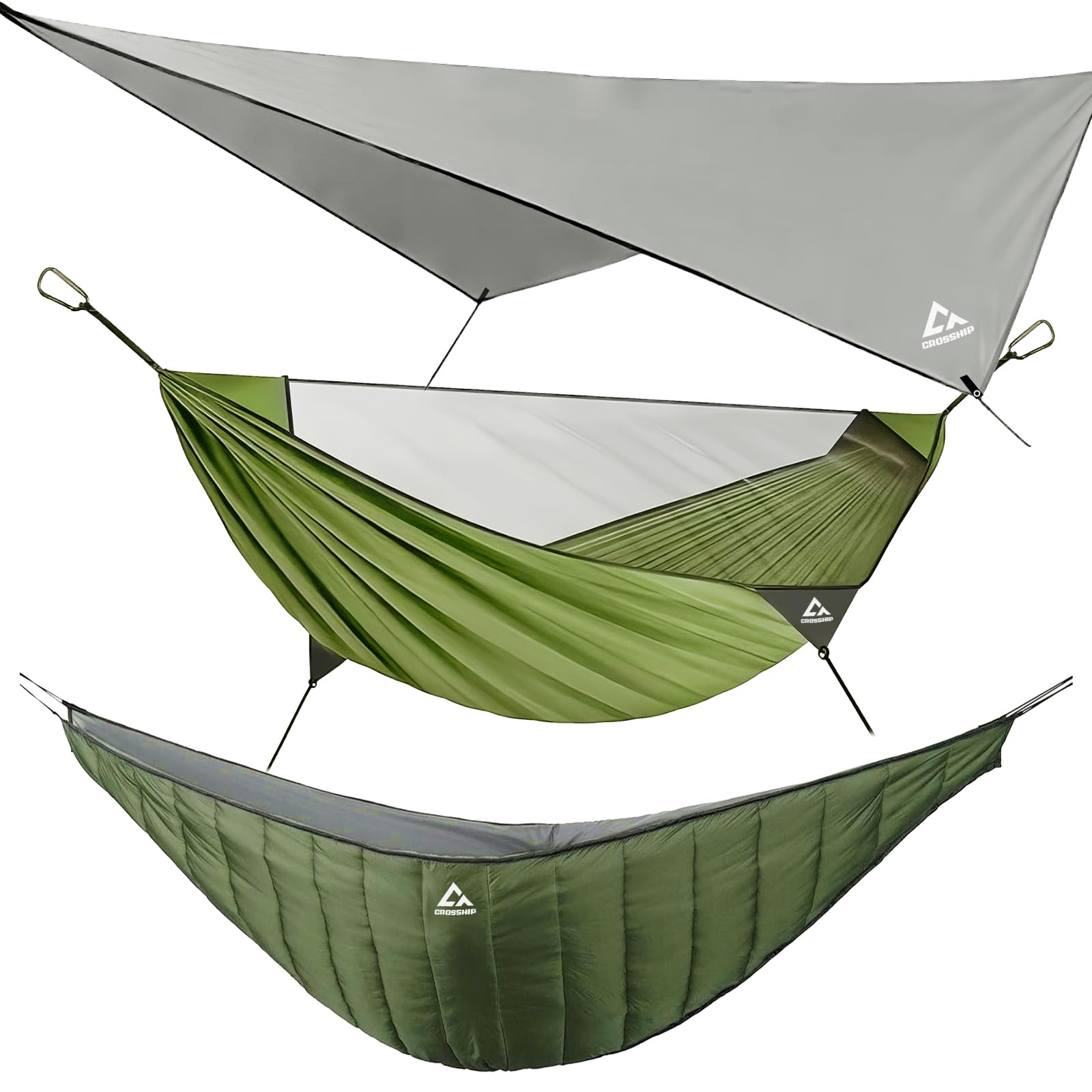
CROSSHIP Hammock Kit
Key Features
- Load capacity: 500 lb
- Packed weight: 4.7 lb
- Unfolded size: 114.17 x 55.11 in
- Included shelter: Underquilt, rainfly, guylines, stakes
- Price: Premium
The underquilt is the reason to look at the CROSSHIP. Instead of relying on a sleeping pad inside the hammock, it wraps a layer of 700-gram polyester fill beneath you, with a 20D ripstop shell and a soft lining. That is the right idea for cold nights, when the fabric under your back pulls warmth away. The kit also includes a triangular rainfly, guylines, stakes, and a B3 mesh net.
We think it is the most complete cold-weather system in this set. The 114 x 55 inch bed and 500-pound capacity keep it a solo setup, while the fly and net turn it into a shelter you can pitch in one go. Setup is straightforward for a kit this involved; the guylines and stakes do the work of keeping the fly off your face.
The trade is specialization: you carry a full sleep system rather than a bare hammock, and the underquilt still needs a top quilt or bag over you. For cold-weather weekends where you drive to the site, that is a fair exchange. The warmth under your back is the part we remember, especially compared with a bare hammock on a damp night.
Pros
- Underquilt, rainfly, and net in one kit
- 700 g fill for cold-night insulation
- 500-pound capacity
- Guylines and stakes included
Cons
- 4.7-pound kit is heavy for long hikes
The cold-night specialist: a full underquilt, rainfly, and net package for campers who want warmth and weather protection in one bag.
Best for Light High Capacity
HGYI Camping Hammock
Key Features
- Mesh density: 380 holes per square inch
- Load capacity: 600 lb
- Packed weight: 2.2 lb
- Unfolded size: 114 x 57 in
- Price: Budget
Six hundred pounds of capacity in a 2.2-pound hammock is the kind of pairing that makes us check the spec twice. The HGYI gets there with a 114 x 57 inch bed and a fine 380 holes per square inch mesh net, and it still packs into a small bag. We were struck by how little it asks you to carry for the load rating.
The net is attached, and the package includes two tree straps, carabiners, and the hammock itself. We found the carabiners a pleasant surprise at this level: they feel solid and are easy to clip one-handed. The 57-inch width is best for one adult, and the 114-inch length gives average-height sleepers enough room to settle in.
We think it is the best light-capacity pick here for warm-weather camping. The load rating gives bigger sleepers margin, and the fine mesh is the kind of detail that matters in black-fly season. It is a straightforward, comfortable place to sleep when the forecast is dry.
Pros
- 600-pound capacity at 2.2 pounds
- Fine 380-hole mesh
- Solid carabiners and included straps
- Compact 114 x 57 bed
Cons
- No rainfly or underquilt included
- 57-inch bed is a solo width
A light, high-capacity solo hammock for warm, buggy nights when you want the load rating without the pack weight.
Best for Reversible Budget Lounging
Qevooon Camping Hammock

Key Features
- Load capacity: 500 lb
- Packed weight: 2.5 lb
- Unfolded size: 114 x 57 in
- Included suspension: Two straps, 18 loops total
- Price: Budget
The 180-degree reversible net is the feature we come back to on the Qevooon. Flip it under the hammock and you have a plain lounger; bring it over and the mesh covers the bed without a separate ridgeline. That flexibility is more useful than a single-purpose camping hammock for backyard afternoons and casual trips.
The kit includes two tree straps with 18 adjustment loops in total, two carabiners, elastic cords, and sand pegs. We appreciated the pegs more than we expected: they give you a way to tension the net away from your face when the trees are close together. The whole thing packs down to about 9 x 5 inches.
At 114 x 57 inches and 2.5 pounds, it is a solo bed with a little room for a child or gear, not a true two-person hang. The 500-pound capacity is generous for one, and the material feels light in the hand. The net is the part to handle carefully when zipping; the fabric is not the burliest here.
We think it is a strong warm-weather choice for lounging and simple camping, especially if you like the flip-over design. The sand pegs and reversible net are the two details that make it feel more flexible than a basic net hammock. The 18 loops are fewer than the Sunyear’s 32, so awkward tree spacing takes more patience.
Pros
- Reversible net flips fully away
- Two straps with 18 loops total
- Sand pegs hold net clear
- Packs to 9 x 5 inches
Cons
- Fabric and net durability is the weak point
The flip-over net makes this an easy warm-weather lounger, and the included pegs help keep the mesh off your face.
Best for Ultralight Solo Trips
AnorTrek Camping Hammock

Key Features
- Load capacity: 500 lb
- Packed weight: 1.74 lb
- Unfolded size: 102 x 55 in
- Included suspension: Two 8.2 ft straps, 5+1 loops
- Price: Budget
At 1.74 pounds and 102 by 55 inches, the AnorTrek is the smallest solo kit here. That makes it the one we reach for when the plan is a short hike, a bike camp, or a pack that is already full. The 500-pound capacity means the light build is not a light-duty build on paper.
The net is attached and uses elastic cords with hooks to hold it clear, and the package includes two steel carabiners and two 8.2-foot tree straps. We liked the dense mesh: it kept the net’s profile low without feeling like a face covering. The 8.2-foot straps are best for close trees; add longer straps for bigger trunks.
A 102-inch bed is compact. We found it comfortable for a solo sleeper of average height, but taller campers will notice the difference against the 118- and 126-inch picks. The 55-inch width is a solo width, not a snug two-person bed.
For the lowest-weight solo kit here, we think that is a fair trade. The AnorTrek is a simple, honest hammock: no fly, no underquilt, no extra bulk. It leaves room in the pack for the shelter you bring.
Pros
- 1.74-pound packed weight
- Dense attached bug net
- 500-pound capacity
- Simple two-strap setup
Cons
- 102-inch bed is short for tall sleepers
A light, compact solo hammock for short trips and smaller sleepers, with a fine net and a bare-bones kit.
How We Tested the Hammocks With Mosquito Nets
We built the shortlist from hammocks that keep surfacing in camping forums and in customer reviews, then dropped anything that shipped without tree straps or with a net cut so close to the body that it couldn’t be pitched away from your face. That left 12, from budget backyard loungers to backpacking setups, and we hung every one for seven months: between two oaks in my backyard, on weekend trips, and on one long river trip where the bugs were genuinely bad.
Setup was timed with a stopwatch — first hang and fifth hang, working alone — because the third attempt is usually where a design either clicks or falls apart. We noted whether straps came in the box, how much tree-to-tree distance each hammock needed versus the trees we actually had, whether the webbing slipped or bit into bark, and how stitching and buckles held up after repeated cinching. Every model went back into its sack onto a kitchen scale, and we compared packed size against how much room it left inside a daypack.
Bug protection got evaluated at dusk, not in daylight: I’d lie in each one with a headlamp and watch where the mesh touched me, whether zippers caught on the way in and out, and whether there was space to roll onto a side without pressing a shoulder through the netting. Climbing in and out told us about stability — a hammock that swings out from under you at 2 a.m. is a wasted night — and we measured usable lying length rather than trusting the listed dimensions. The cords, seams, and netting stayed outdoors in sun and rain between trips to see what frayed or faded first.
Value came last, and it had little to do with the lowest price tag. We tallied what actually arrived in the box — straps, carabiners, a ridgeline, a stuff sack — and weighed that against the cost, since a hammock that needs extra hardware isn’t the bargain it looks like.
How to Choose a Hammock with a Mosquito Net
The net is the reason you are shopping, but the bed, suspension, and shelter decide whether you actually sleep.
Start With the Net and How It Hangs
An attached net saves you from rigging a separate screen, but attached is not the same as well supported. Look for a ridgeline, spreader, or elastic system that holds the mesh above your face; a net that lies on your cheek will wake you every time you turn. Removable and reversible nets add flexibility: the Easthills net unzips completely, while the Qevooon flips under the hammock. Check the zipper from inside and out, and consider whether the net needs stakes or ground cords where you camp.
Match Bed Size to Sleepers, Not Weight Rating
Capacity tells you what the fabric is built to hold; it does not make a narrow bed roomy. A 55-inch-wide hammock is a solo bed even when the listing says two. For one adult, 106 to 114 inches long and 55 to 60 inches wide is a useful range; for two, look at 78 to 79 inches wide and 118 inches long, as on the Easthills. The 500- or 600-pound limits on these picks are margin, not an invitation to squeeze in. Tall sleepers should favor length first.
Decide Whether You Are Carrying Shelter or Just the Net
A net-only hammock is the lighter choice for warm, dry trips: the AnorTrek is under two pounds, and the Sunyear basic kit is not much more. Once rain or cold enters the plan, the calculus changes. A rainfly and ridgeline turn the hammock into a shelter; an underquilt adds warmth underneath, which a sleeping pad can also do with more fuss. The trade is bulk: the CROSSHIP full cold-weather kit is 4.7 pounds. We pick shelter based on the forecast, not the feature list.
Check the Suspension Before You Leave the Trailhead
The straps are where a complete kit earns or loses its keep. Ten-foot straps with 16 loops give you more height and distance options than 8.2-foot straps with five; on sloping ground or thick trunks, that difference matters. Two wide, tree-friendly straps and solid carabiners are the minimum. If a hammock ships with a starter rope kit, as the Grand Trunk does, budget for proper straps before an overnight. We count loops and check strap width before anything else.
Frequently Asked Questions
How do I stop mosquitoes biting through the hammock?
A bug net covers the top and sides, but a single-layer hammock can still let bites come through from below. Put a sleeping pad or underquilt between you and the fabric; the CROSSHIP kit includes an underquilt for exactly this reason. A light blanket works in a pinch, but it shifts more overnight.
Can one person set up a net hammock?
Yes. Clip one end at about chest height, run the net ridgeline before you tension the foot end, then adjust the hang so the hammock has a slight sag. A daisy-chain strap is easier solo than a rope-and-knot system. If you are also pitching a rainfly, set the fly last so you can center it over the net.
Do hammock straps damage trees?
Thin ropes and narrow cords can cut into bark; wide webbing spreads the load. Use the widest tree straps your kit accepts, wrap them around a sound trunk rather than a sapling, and check local park rules before you hang. The two 10-foot straps on the Sunyear kits are a better default than a bare rope, but even those should be checked for abrasion.
Final Verdict
Start with the Sunyear single if you want the best all-round net hammock here: it has the complete kit, the most useful strap adjustment, and enough capacity for most solo sleepers. When rain is part of the plan, the Sunyear bundle is the cleaner answer than adding a tarp later.
Two sleepers should go straight to the Easthills, and cold-weather campers to the CROSSHIP. Those are different jobs, not upgrades.