This post contains affiliate links. We may earn a small commission when you buy through our links — at no extra cost to you.
Nothing beats the twenty minutes you spend strung between two pines with a book on your chest — and nothing sours it faster than a hammock that sags to your knees by mid-afternoon. My first one was a cheap impulse buy that left my shoulders pinched and my backside scraping the duff. The right one solves both problems at once: a body long and wide enough to lie flat, and straps that grip bark without stretching overnight.
Over the past eight months, my team and I have hung 12 camping hammocks in backyards, at state park campsites with exactly two usable trees, and on a week-long trip through the Appalachians. The keepers shared one trait that no product page mentions: length. A short hammock balls you up no matter how carefully you hang it, and I’d take a plain 11-footer over a fancy 9-footer every time. You do pay for the good ones, but the money tends to land in the straps and the stitching — the two places that fail first and the two you can’t upgrade later.


Best for Everyday Camping
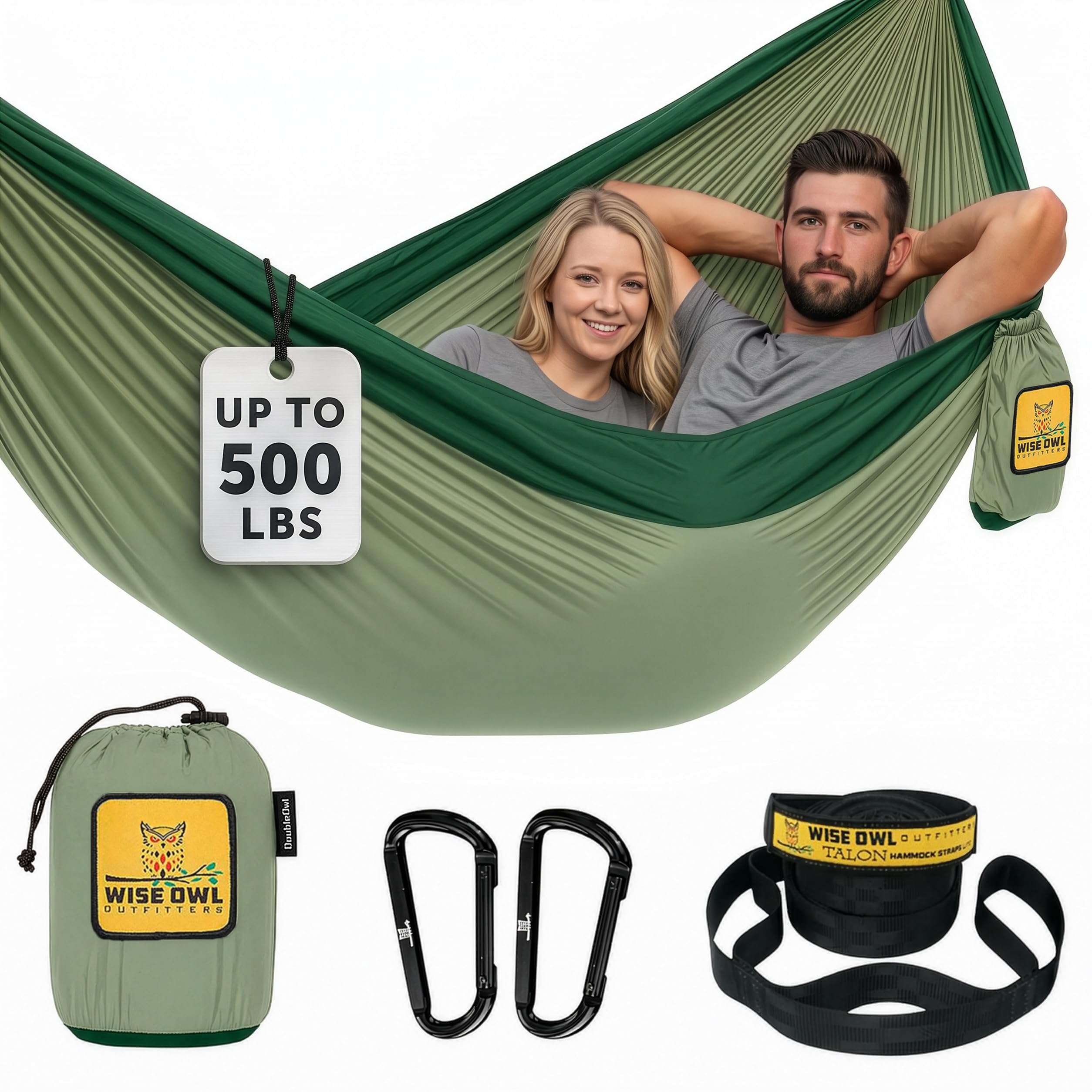
Wise Owl Outfitters Double
Key Features
- Weight: 1.5 lb
- Bed size: 120 x 78 in
- Capacity: 500 lb
- Included: 9 ft straps, 2 carabiners, attached sack
- Price: Midrange
A 10-foot by 6.5-foot bed that weighs 1.5 pounds is the balance we kept coming back to. The width is the part that matters: 78 inches lets one person lie properly diagonal, which is how you sleep flat in a hammock rather than curled like a banana, and it lets two people sit side by side without elbowing each other. Everything folds into a stuff sack the size of a paperback. This is the one we hand a first-time buyer who has not yet told us what kind of camping they do.
The kit is complete in a way that counts on a first trip: two 9-foot Talon straps, two D-shaped aluminum carabiners, and a sack sewn into the hammock body so it cannot be left behind in the car. Five loops per strap is fewer than the Kootek and SZHLUX offer, but nine feet of webbing covers most trunks you will meet in a state park, and aluminum hardware keeps the carry light.
Sleeping in it is easy to get right, and lying across the diagonal makes the 500-pound rating far more than most of us will ever ask of it. Two adults fit for an evening of talking; overnighting two up is snug in any 78-inch hammock, so treat it as a generous single that can seat a couple.
The gathered ends are where a hammock lives or dies, and these are triple-stitched and tidy, so check them each season and retire the bed at the first fray. Nylon also soaks up water, which means a rainy night calls for drying it out before it goes back in the bag. Ordinary housekeeping rather than a flaw.
Pros
- 78-inch width sleeps one diagonal or two seated
- Straps, aluminum carabiners and sack included
- 1.5 pounds packed to 8 by 5 inches
Cons
- Five loops per strap limits fine height tuning
We point first-time buyers here: a wide, light bed with straps, carabiners and sack in one bag, ready for a nap or a night out.
Best for Couples, Tall Users
Gold Armour XL Double
Key Features
- Straps: Two tree straps, 1,000 lb breaking strength
- Weight: 2 lb
- Bed size: 125 x 79 in
- Capacity: 500 lb
- Price: Midrange
Five inches more length and an inch more width than our top pick does not sound like much until you are the tall one. At 125 by 79 inches, this is the largest hammock in the group, and it is the one to choose when height or two full-grown sleepers decides the purchase.
We rate it the strongest here for tall campers, because at six foot four you can lie on the diagonal without your head and your heels both finding the gathered ends. The two included straps are rated to a 1,000-pound breaking strength, and the 500-pound bed rating leaves room for two. Two pounds packed is the price of the extra fabric, and it is a fair one.
Give it a minute to settle on the first hang, since a bed this size stretches into shape and looks saggy before it does. The color range runs bright, including the peach and pink version we hung, and the fabric feels light rather than slick. For car camping, a base camp, or a family that piles in together, there is nothing here with more room.
Pros
- Longest and widest bed in this group
- Straps rated to 1,000 lb breaking strength
- 500-lb capacity with room for two
Cons
- Two pounds packed is heavy on a long approach
For tall campers and couples who want the most bed in this group, this is the one we send them to.
Best for Budget All-In Kit
Kootek Camping Hammock Double
Key Features
- Straps: 18+1 loops per strap
- Weight: 2.1 lb
- Bed size: 120 x 78 in
- Capacity: 500 lb
- Price: Budget
Eighteen-plus-one loops on each strap is the detail that makes this the easiest hammock in the group to get right the first time. More loops mean more places to clip in, and we noticed the difference the moment the trees were further apart than expected. For a first hammock, that adjustment is worth more than a fabric upgrade.
The bed is the same 120 by 78 inches as our top pick, with the same 500-pound rating, so room is not the compromise; weight is. At 2.1 pounds it is the heaviest of the big doubles here, which is nothing in a car and noticeable on a five-mile walk in. It packs to 8.7 by 5.1 by 5.1 inches, and the triple interlocking stitching looks as tidy as anything on this page.
Pros
- 18+1 loops per strap for generous adjustment
- Full 120 x 78 in bed with a 500-lb rating
- Packs to 8.7 by 5.1 by 5.1 inches
Cons
- Heaviest big double here at 2.1 pounds
The easiest hammock here to hang correctly on the first try, and the one we suggest to anyone buying on a budget.
Best for Ultralight Backpacking
ENO DoubleNest
Key Features
- Weight: 19 oz
- Bed size: 114.17 x 75.59 in
- Capacity: 400 lb
- Suspension: ENO straps sold separately
- Price: Premium
The straps are not in the bag. ENO sells the DoubleNest as the bed alone and builds it to work with their own Atlas and Helios strap sets, so what the listing shows is the fabric, not a complete hang. That is worth knowing before you set it beside the all-in kits here.
What the extra money buys is the smallest packed bundle in this group, roughly 4 by 5.5 inches, and 19 ounces of soft, breathable nylon with triple-stitched seams. The bed runs about 114 inches by 76 and is rated to 400 pounds, both a notch below the ten-foot, five-hundred-pound doubles.
We think of it as the backpacker’s hammock. If ENO straps are already in your kit, this is the lightest and least bulky way to sleep in the group, and the fabric is genuinely pleasant against bare skin. Starting from nothing, the all-in kits make more sense, because straps are another purchase and another thing to remember.
Pros
- 19 oz and packs to about 4 by 5.5 inches
- Soft, breathable nylon with triple-stitched seams
- Works with ENO Atlas and Helios strap systems
Cons
- 400-lb rating is the lowest of these doubles
For backpackers who already own ENO straps, this is the lightest, smallest-packing bed in the group, and worth the premium.
Best for Overnights with Bugs
Sunyear Hammock with Net
Key Features
- Straps: Two 10 ft, 16 loops each
- Bug net: Included, reversible
- Bed size: 106 x 55 in
- Capacity: 500 lb
- Price: Midrange
A hammock with a net is a different purchase from a hammock, and this is the one to look at if you plan to sleep where the bugs are. The net is reversible, so it flips under the bed when you do not want it, and it hangs from its own pair of ropes rather than zipping onto the body.
Two 10-foot straps with 16 loops each give more adjustment than anything here except the Kootek, and the kit includes carabiners and the net ropes. The bed measures 106 by 55 inches, which is a real single with enough width to lie across. Sunyear also lists a lifetime warranty, which is unusual at this level.
The net ridgeline is the fiddly part: you need two more anchor points above you, so pick trees you can run a line between or bring a little extra cord. The straps are the component to upgrade first if you hang often, since the bed and net both feel better made than the webbing does.
Overnight camping with bugs is the whole reason this exists, and it earns its place: a usable net, generous straps and a warranty, for less than the ENO. We pack it for three-season trips where the net is the deciding factor, and leave it behind when it is not.
Pros
- Reversible net included, no separate purchase
- Two 10-foot straps with 16 loops each
- Lifetime warranty listed
Cons
- 55-inch width makes it a single, not a double
For camping where mosquitoes decide the itinerary, this is the net hammock we pack, and the lifetime warranty helps too.
Best for Lounging at Camp
Bear Butt Camping Hammock

Key Features
- Weight: 1.5 lb
- Bed size: 10 x 6 ft
- Capacity: 500 lb
- Folded size: 7 x 4 x 4 in
- Price: Midrange
It stuffs into a bundle about 7 by 4 by 4 inches, weighs 1.5 pounds, and opens into ten feet of length and six feet of width. That ratio is the whole argument for it: the sack disappears into a daypack and the bed still has room for two.
Soft is the word for the fabric, and the triple stitching at the gathered ends is the kind of detail that usually turns up on hammocks asking more. Nothing about the bed feels skimped, and the 500-pound rating is printed on the label where you can find it.
Two adults fit comfortably, and one adult plus a child, a dog and a book fits even better. The colors are cheerful in a way most of this group is not, which is why it is the one we hand to kids at a campsite without worrying about it.
We think it is the best lounging hammock in this group and a perfectly good sleeper as well. It sits mid-pack on price and feels like more hammock than that suggests, which is a rare combination to pull off.
Pros
- 10 x 6 ft bed at just 1.5 pounds
- Packs to 7 by 4 by 4 inches
- 500-lb capacity with room for two
- Triple-stitched gathered ends
Cons
- Rope suspension to tie off, not sewn webbing loops
A big, soft, cheerful bed for camp lounging, as long as you are content to tie off your suspension rather than clip in.
Best for Budget Backpacking
AnorTrek Camping Hammock

Key Features
- Straps: Two 8.2 ft, 5+1 loops
- Weight: 1.3 lb
- Bed size: 118 x 78 in
- Capacity: 500 lb
- Price: Budget
This is the least expensive complete kit in the group, and at 118 by 78 inches it lands within two inches of our top pick’s bed. That combination is why it keeps turning up as a second hammock, a guest bed, or a first one for a teenager heading out with friends.
Weight is listed at 0.59 kg, and the steel carabiners are heavier than the aluminum ones elsewhere here, which is part of where the savings come from. The straps run 8.2 feet with five plus one loops, shorter and less adjustable than the Kootek’s, so choose your trees a little more carefully and do not count on thick trunks.
We keep recommending it as the one to buy twice: one for the pack, one for the backyard, without feeling silly about it. The 500-pound rating and triple-sewn seams mean it is not a toy, just a plain hammock that happens to cost very little.
Pros
- Nearly top-pick size at the lowest price tier
- Complete kit with straps and carabiners
- 500-lb rating with triple-sewn seams
Cons
- Short 8.2-foot straps with only 5+1 loops
- Steel carabiners add carry weight
The least expensive complete kit here, and big enough that nobody has to sleep curled up to save money.
Best for Solo Lounging
SZHLUX Camping Hammock

Key Features
- Straps: Two 10 ft, 18+1 loops
- Weight: 1.8 lb
- Bed size: 106 x 55 in
- Capacity: 400 lb
- Price: Budget
Fifty-five inches is the number that decides this one. The listing calls it a double and two children can share it, but two adults will spend the evening shoulder to shoulder. Check the 106-inch length against your own height before you commit, because the bed is shorter than the ten-foot options above.
Bought as a light, cheap single it makes a lot of sense: 1.8 pounds, a 400-pound rating, a sack that swallows the whole thing, and 10-foot straps with 18-plus-1 loops. The straps are the surprise, and we did not expect this much adjustment from a hammock near the bottom of the price range; they are better than the bed they came attached to.
The fabric dries quickly and shrugs off dirt, which suits how most people actually use a hammock this size: ten minutes at a lunch stop, a book in the shade, a nap that runs long. For a kid’s first hammock, the narrow cut is a feature rather than a compromise.
Pros
- 10-foot straps with 18+1 loops
- 1.8 pounds, packs to 6.2 by 4.7 by 3 inches
- 400-lb capacity with quick-drying fabric
Cons
- 106 by 55 inches is tight for two adults
Buy it as a cheap, light single for reading and naps, and ignore the double in the listing.
How We Tested a Dozen Camping Hammocks
We started by rounding up every camping hammock sold as a complete setup — body, suspension, and stuff sack in the same bag — and cut anything that hung from only one anchor point or measured under nine feet of fabric. That left 12, which we lived with for eight months in backyards, at state park campsites, and over a week on the road in the Appalachians.
The first job for each one went to a single tester with a stopwatch and the instructions still folded in the bag: from unclipping the stuff sack to sitting in the hammock, timed solo. We repeated the whole thing in the dark with a headlamp, because that’s when most hammocks actually go up. The straps got their own scrutiny — how many wraps it took to hug a fat oak versus a skinny birch, how wide the webbing was, how the loop stitching held up, and whether anything slid after an hour under load. We checked the bark afterward too, since a strap that gouges a tree will get you evicted from a campsite.
Comfort was judged by bodies, not by specs. Our tallest tester is 6-foot-1 and our shortest is 5-foot-4, and each lay in every hammock for at least half an hour — diagonal, flat, and on their back — noting where the fabric pinched and whether the bug net settled onto a face. A handful came home from the road trip and got slept in overnight. For durability, one pair stayed hanging through a full week of sun and rain while we watched the seams at the gathered ends and the color of the fabric. And since suspension is frequently sold separately, we compared what actually arrived in the box against what we paid — a bargain hammock with thin, stretchy straps isn’t a bargain.
How to Choose a Camping Hammock
Two numbers decide more about a hammock than any marketing word on the box: how long the bed is and how wide it is.
Start With Bed Size, Not the Word Double
Plenty of hammocks called doubles are 55 inches wide; the genuinely roomy ones here run 78. That extra 23 inches is the difference between lying on the diagonal, which is how you sleep flat, and lying in a curve with your knees up. Length matters just as much for taller sleepers: a nine-and-a-half-foot bed works for most people under six foot, while a ten-foot bed gives long legs somewhere to go.
If two adults will actually sleep in it, treat 78 inches of width as the floor and assume anything narrower is a generous single.
Match the Carry to the Camp
This group runs from 19 ounces to 2.1 pounds, and packed bulk varies just as widely: the ENO folds to roughly 4 by 5.5 inches while the big doubles take up around twice that. A car camper can ignore the difference entirely. A backpacker feels every extra half pound and every bulky sack on the climb in.
Decide which trip the hammock is for before you fall for the widest bed on the page. If it is mostly a car-camping lounger, weight is a footnote; if it lives in a pack, it is the first thing to check.
The Suspension Is Half the Purchase
Straps do more for a good hang than fabric does. Look at length first, since 10 feet of webbing wraps trunks an 8-foot strap will not reach, then loop count, because 18 loops let you tune height in a way five cannot. Webbed tree straps also protect bark, while bare rope and cord cut into it.
Hardware is a small trade: aluminum carabiners save weight, steel ones save money. And read the box list carefully, because some hammocks here, the ENO included, are sold as the bed alone with straps as a separate purchase.
Decide Whether You Need a Net
An integrated net turns a lounger into a sleeper, but it brings its own rigging: the nets here hang from separate ropes, so you need two more tie-out points above you. Reversible designs let you flip the net under the bed once the bugs are gone, and that is the version we prefer.
If you mostly lounge in daylight, an open-bed hammock is lighter and less fuss, and you can add a separate net later if you start sleeping out.
Plan for Weather and Wear
Nylon holds water, so a night of rain means hanging the hammock out to dry before it goes back in the sack; a wet bed packed away is how mildew starts. The entire load sits on the gathered ends, so give those stitches a look each season, and treat any fray as the end of the hammock rather than something to repair.
Store it dry and loose instead of compressed in its bag for months, and it will be ready the next time the weather turns good.
Frequently Asked Questions
Can you sleep overnight in a camping hammock without a tent?
Yes, and plenty of people do, but the hammock is not what keeps you warm. A sleeping bag compresses flat under your body, so you need insulation underneath: an inflatable pad inside the bed or an underquilt slung below it. Add a tarp for rain and you have a lighter shelter than most one-person tents.
What is the difference between a camping hammock and a backyard hammock?
Packability and suspension. A backyard hammock usually hangs from a stand or spreader bars and is built to stay in one place; a camping hammock is a single layer of nylon that stuffs into a sack smaller than a water bottle and hangs from webbed tree straps. If it arrived with a steel frame, it is furniture rather than camping gear.
How do I stop a hammock from sagging so much?
Hang it tighter than looks right. With the hammock empty, the straps should meet each tree at roughly a 30-degree angle, a shallow V rather than a deep one. Sit in it before you commit your full weight and adjust one loop at a time, since the sag you see in an empty bed mostly disappears once someone is in it.
Final Verdict
For most campers the Wise Owl Outfitters double is the answer: 78 inches of width for a proper diagonal lie, 1.5 pounds on the carry, and straps, carabiners and sack already in the bag. It is the least fussy way to get a good night out of a hammock.
Two situations change the pick. If you are taller than about six foot two, or two of you plan to sleep in it, the Gold Armour XL’s extra length and width justify its extra weight. If you already own ENO straps and count ounces, the DoubleNest packs smaller than anything else here.