This post contains affiliate links. We may earn a small commission when you buy through our links — at no extra cost to you.
The worst camping trips start with gear that quits early—a lantern that dims before dinner, a sleeping pad that goes flat by midnight, a tent seam that weeps at the first drizzle. Good camping gear is the stuff you stop thinking about: it sets up without a fight, packs small, and holds up through a season of weekends. The right gear fixes the small failures that turn a fun night outside into a long one.
Over the past eight months, my team and I have taken 12 pieces of camping gear—tents, sleeping pads, lanterns, stoves, and chairs—on weekend car-camping trips, a rainy three-day outing, and a week-long road trip. We paid attention to how bright a lantern really is at dusk, whether a pad’s thickness survives a night of tossing, how much a chair or stove weighs packed, and whether the construction matches the description. The best gear isn’t the most feature-packed—it’s the gear that works the same on trip ten as it did on trip one. Below are the picks that earned a permanent spot in my trunk.


Best for Stream Water Anywhere
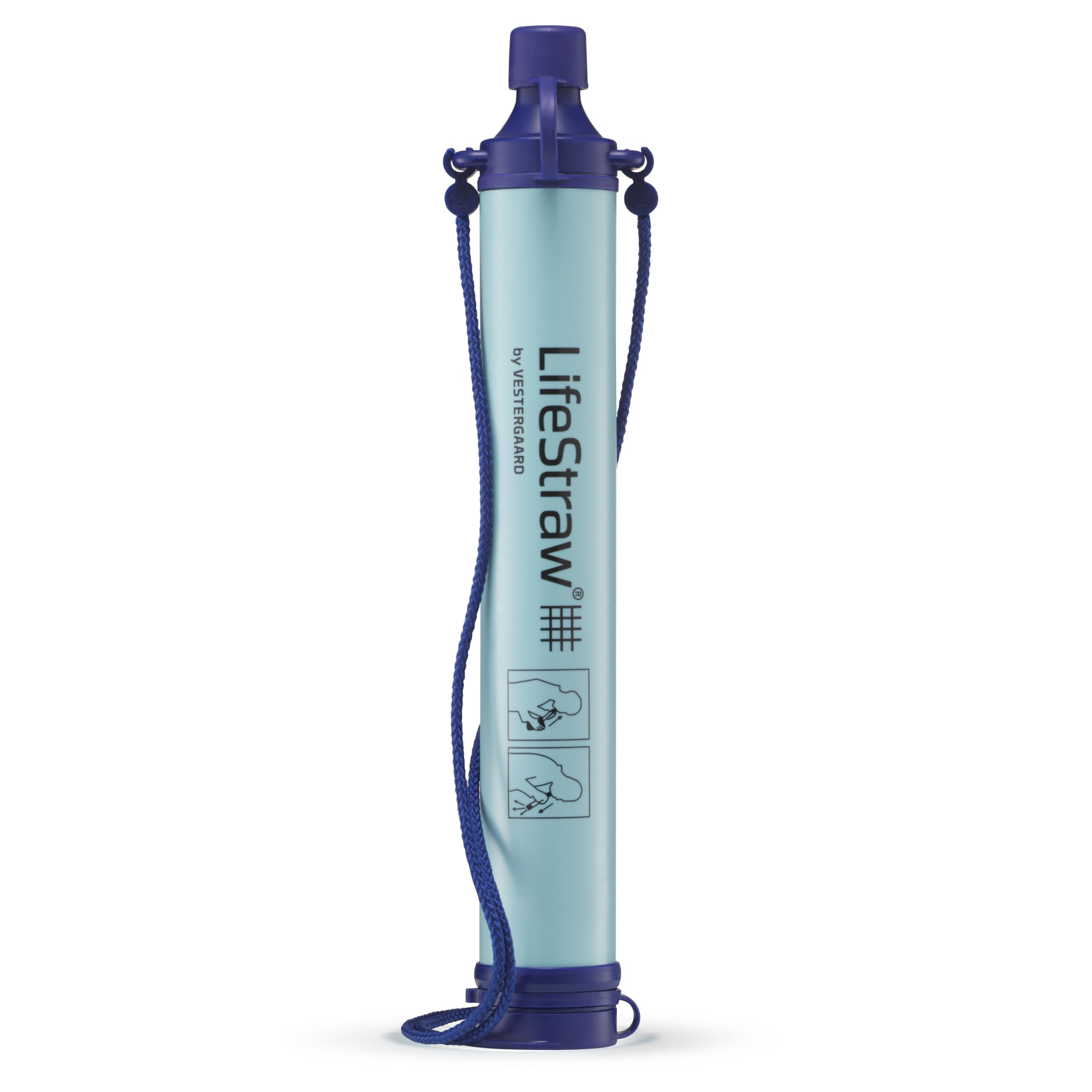
LifeStraw Personal Water Filter
Key Features
- Weight: 1.59 oz
- Power source: No electricity or batteries
- Filter capacity: 1,000 liters
- Bacteria removed: 99.999999%
- Price: Budget
A water filter that weighs 45 grams and asks for no batteries, no pumping, and no moving parts is the easiest piece of gear on this page to justify. You unscrew the cap, drop the end into a stream, and drink through it — the hollow-fiber membrane inside stops bacteria and parasites, and the filter is rated for 1,000 liters before it is spent.
What that changes is how you plan a day. You stop carrying water for the return leg, and you stop turning back early because the bottles are empty. Nothing else here alters a route the way a working filter does, and it does it at a weight you forget is clipped to a shoulder strap.
Two limits are worth knowing before you rely on it. It is a straw, not a treatment system: you drink at the source, and filling a pot for cooking or a bottle for the tent is not what it is for — carry a hard bottle and drink at the water. And it is rated for water between 1 °C and 60 °C, so in freezing weather keep it in a jacket pocket rather than letting it sit in a pack overnight. It is a biological barrier, not a chemical one, and the stated ceiling is a TDS of 1,000 ppm.
Pros
- No batteries, pumping, or spare parts
- 45 g, rated for 1,000 liters
- Blocks bacteria, parasites, and microplastics
Cons
- Straw only — cannot fill a bottle or pot
- Freezing damages it; rated from 1 °C
This is the first thing we pack: a pocket-sized filter that makes stream water drinkable without a battery, a pump, or a spare part.
Best for Family Tent Lighting
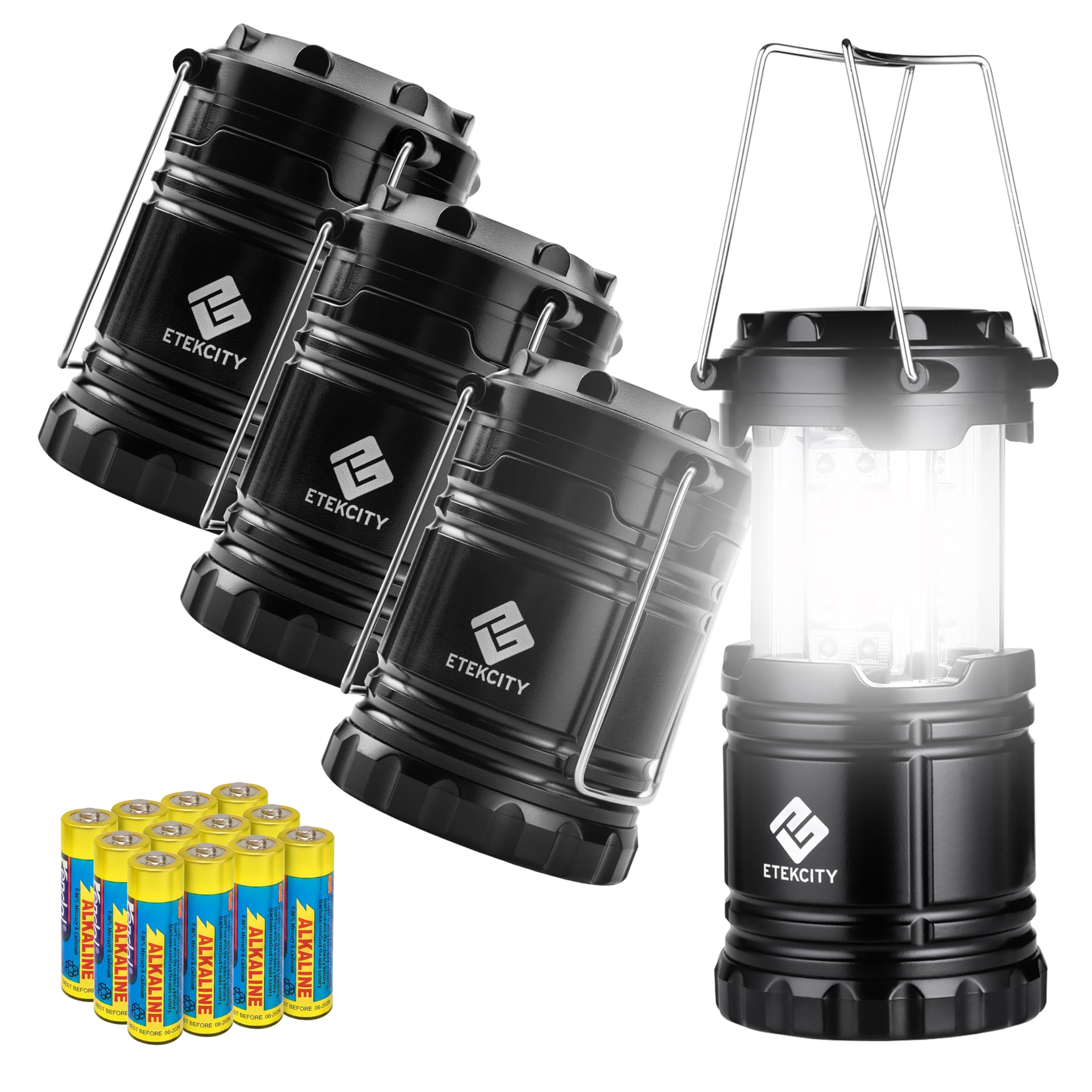
Etekcity LED Camping Lanterns, 4 Pack
Key Features
- Runtime: Up to 50 hours
- Batteries: 3 AA each (12 included)
- Pack contents: 4 lanterns
- Maximum output: 154 lumens
- Price: Midrange
The dimmer on these lanterns is not a dial. You pull the body open to raise the light and push it down to dim or shut it off, so one hand can do it in the dark without hunting for a switch. Of all the small design decisions in this four-pack, that is the one that kept earning its keep.
Four lanterns change how a campsite works. One hangs from the tent loop, one sits on the table, one goes in the wash kit, and one lives in the car. Each throws a 360-degree spread the whole tent can read by, and 154 lumens is a tent-and-table number rather than a floodlight for the entire site — which is the right amount when you are not trying to blind the people in the next pitch. The 50-hour figure belongs to the low end, and the twelve AA batteries come in the box so the lanterns work the evening you get them.
The batteries are the running cost, and they are also why this pack suits car camping: a dead lantern is a swap, not a wait for a charger. Water resistant here means a damp evening on the table, not a night left out in the rain.
Pros
- Four lanterns in one pack
- Slide-to-dim works with one hand
- Twelve AA batteries included
- Up to 50 hours on low
Cons
- 154 lumens is modest for a whole site
- AA batteries are a recurring cost
Four lanterns, batteries in the box, and a one-handed dimmer — for family camping we take this pack over one fancy light.
Best for Kindling and Firewood
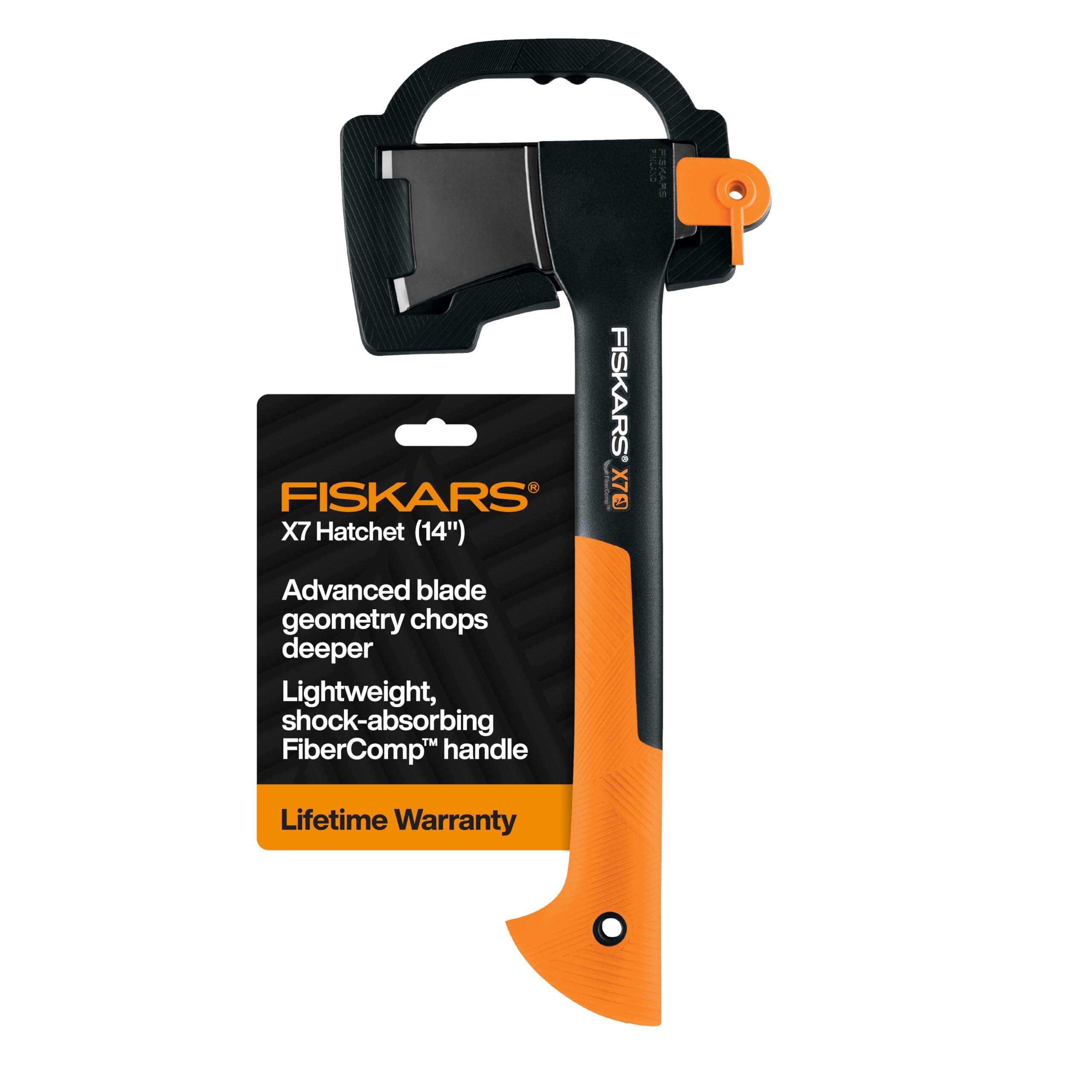
Fiskars X7 Hatchet, 14 in
Key Features
- Warranty: Lifetime limited
- Blade length: 5.12 inches
- Handle length: 14 inches
- Head construction: Insert-molded forged steel
- Price: Midrange
A 14-inch handle does not sound like much until you swing it. The X7’s forged head and 5.12-inch blade put the weight where the swing wants it, so kindling that a camp knife struggles with splits cleanly, and the whole thing is light enough to strap to a pack without thinking about it.
The head is insert-molded into the handle rather than wedged onto it, so there is no loosening and re-seating to do, and the FiberComp handle takes the shock out of a miss. The low-friction blade coating helps a sticky piece of green wood let go, and the sheath clips to a belt or a pack strap.
Understand what it is before you buy it. This splits small to medium kindling and limbs; logs and rounds want a saw, and a hatchet swung at a big piece is how people hurt themselves. The edge dulls with honest use and comes back with a few passes of a file, which is the normal rhythm of owning an axe rather than a fault.
Pros
- Splits kindling with a short swing
- Insert-molded head will not loosen
- Shock-absorbing handle spares the wrist
- Sheath included, lifetime warranty
Cons
- No substitute for a saw on bigger logs
We reach for the X7 every time we build a fire: a short, light hatchet that splits kindling in a swing and arrives with a sheath.
Best for Camp Cooking
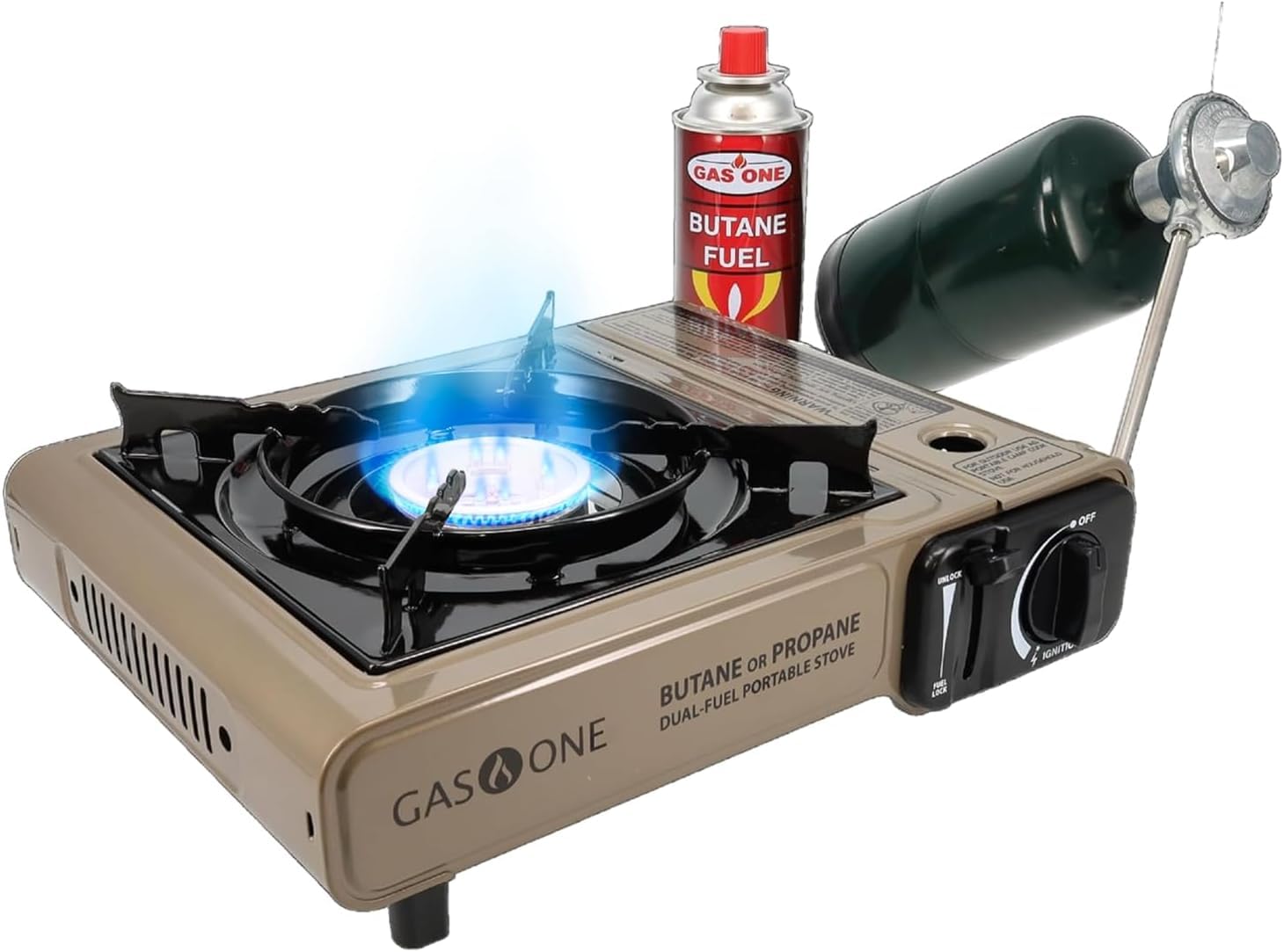
Gas One GS-3400P Stove
Key Features
- Fuel: Butane 8 oz or propane 16.4 oz
- Weight: 3.1 lb
- Ignition: Piezo electric
- Carrying case: Included
- Price: Midrange
Two fuel types on one burner is the whole argument. The GS-3400P takes an 8 oz butane cartridge or a 16.4 oz propane cylinder, and butane canisters are small enough that the stove packs around them — which is why this one lives in the bottom of a camp box instead of on a shelf at home.
The piezo ignition means no matches, though we still carry a lighter, because an igniter is a part that can fail. On butane, a built-in pressure sensor ejects the cartridge and cuts the gas if it detects irregular pressure, which is the sort of feature you want on a stove that rides in the back of a car with everything else.
It weighs 3.1 pounds and packs into its own case, so this is car-camping kit rather than backpacking kit. Heat is quick and adjustable enough to go from a rolling pot down to a simmer, and the case keeps soot off the rest of your gear. We check the gas connection every time we switch between butane and propane — that joint is where a stove like this gets abused, and it is the part worth watching over a season.
Pros
- Runs on butane or propane
- Piezo ignition, no lighter needed
- Pressure sensor ejects and cuts gas
Cons
- Fuel canisters sold separately
- 3.1 pounds is car-camping weight
If you cook at a table rather than over flames, this is the stove we point people to — it burns whichever canister you can find.
Best for Emergency Essentials
Vriexsd 150-Piece First Aid Kit
Key Features
- Shell: Waterproof EVA hard case
- Weight: 0.73 lb
- Contents: 150+ pieces
- Case size: 6.4 x 4.9 x 2.7 in
- Price: Budget
The case is the product. A 6.4 by 4.9 by 2.7 inch EVA shell weighing 0.73 pounds holds its shape when a pack gets thrown on top of it, and it opens flat into separated compartments so you are not tipping 150 pieces onto a picnic table looking for a bandage.
The contents cover the ordinary disasters of a weekend: bandages in several sizes, gloves, povidone-iodine, and scissors and tweezers that are full-size rather than toy-sized. The carabiners let you clip it to the outside of a pack, and it slides under a car seat without a fight, which is where ours spends most of its life between trips.
The thing to plan for is repacking. The compartments are cut for exactly what is in them, so once you have used a few items and added the personal things you actually want — your own medication, a tick remover — it gets tight in there. We keep a small zip bag of extras beside the kit rather than cramming it inside.
Pros
- Hard shell holds its shape in a pack
- 150 pieces in labeled compartments
- 0.73 pounds with carabiners
Cons
- Cramped to repack once opened
Everyone should own one of these; we keep it in the car and take it camping because the hard case survives being thrown in a pack.
Best for Tent Footprint
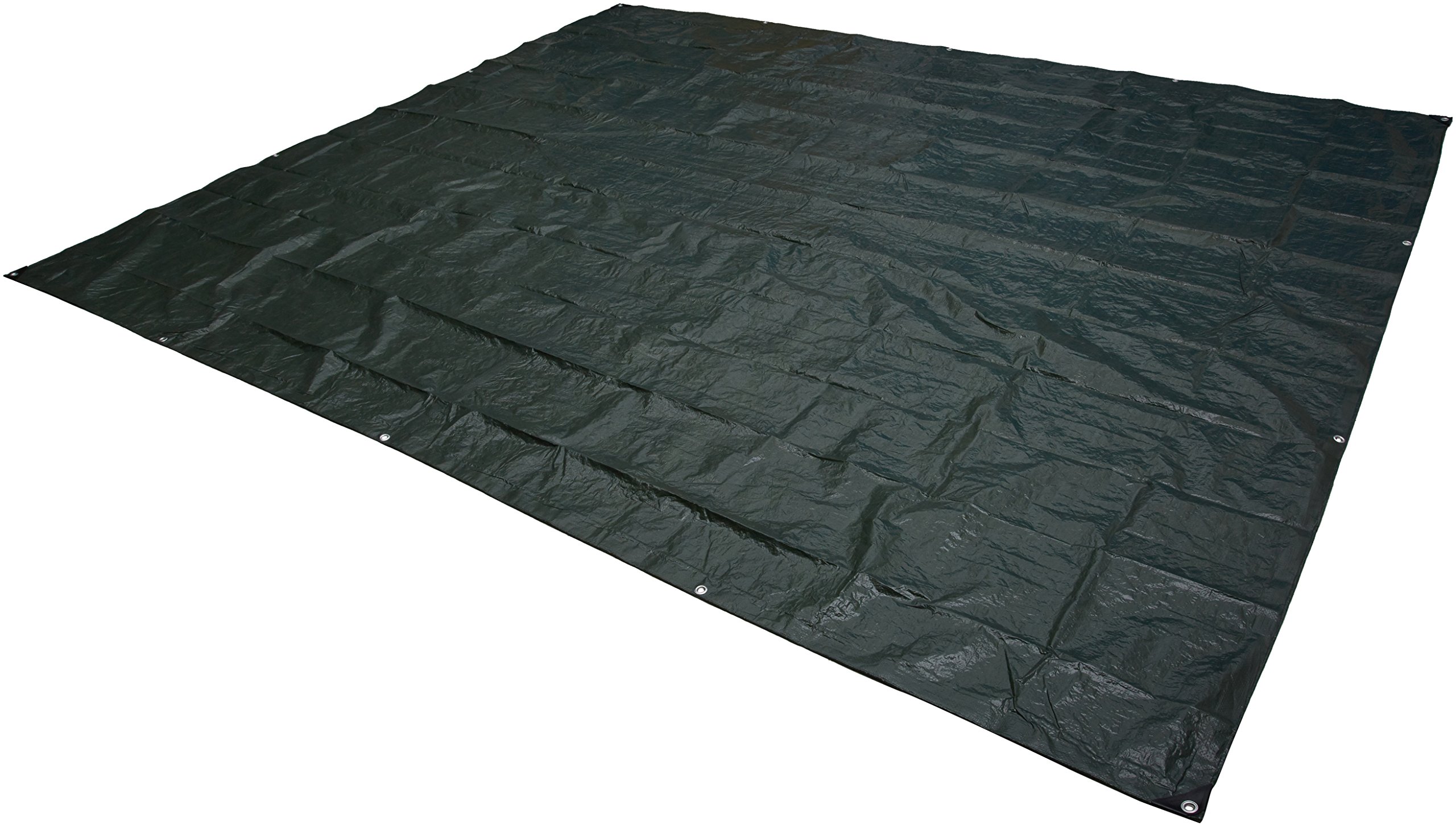
Amazon Basics Camping Tarp, 9.5 x 11.3 ft
Key Features
- Size: 9.5 x 11.3 feet
- Edges: Reinforced corners and grommets
- Weight: 2.2 lb
- Material: Polyethylene, rip-stop
- Price: Budget
Most people buy the tarp too big. A groundsheet wants to be slightly smaller than the tent floor, because anything overhanging the edge collects rain and channels it back underneath — the opposite of the job you bought it for.
This one is 9.5 by 11.3 feet of polyethylene, laminated on both sides, with a rip-stop weave that stops a tear from running and grommets at reinforced corners. Under a tent it stays dry and stays put; over a firewood stack it keeps a week of rain off the logs; staked out from a ridge line it makes a serviceable emergency shelter. At 2.2 pounds it is an easy thing to throw in the car and a heavier thing to carry on your back.
What it is not is a lightweight backpacking shelter. Polyethylene at this thickness is tough, cheap, and bulky, and if you are carrying your accommodation you want nylon instead. For everything else — under the tent, over the wood, across a truck bed — this is the sheet we keep buying.
Pros
- Waterproof on both faces
- Reinforced corners and grommets
- Doubles as a woodpile and gear cover
Cons
- Bulky compared with a nylon shelter
A groundsheet we are glad to own: heavy enough to stay put under a tent, cheap enough to use over a woodpile afterwards.
Best for Pack-Friendly Drying
Rainleaf Microfiber Towel, 48 x 24 in
Key Features
- Size: 48 x 24 inches
- Packing: Snap loop and vented bag
- Absorbency: 5x its own weight
- Fabric weight: 200 gsm
- Price: Budget
You do not rub yourself dry with a microfiber towel, you blot, and nobody mentions that before the first trip. Press it against your arm and let it take the water, and a 48 by 24 inch towel handles a full shower; scrub at yourself the way you do with terry and it just pushes water around.
It soaks up around five times its own weight, then dries in the time it takes to eat breakfast if you hang it from the snap loop. It rolls into its own ventilated bag and takes less room than a paperback, which is why it lives in the pack and the cotton towel stays home. At 200 gsm with a brushed face, it feels closer to suede than to the shiny fabric you might expect from a travel towel.
It is machine washable, sand shakes off, and the 48 by 24 size wraps around an adult without drama. The honest note: it will never feel like a cotton towel, so treat it as a piece of kit rather than a linen cupboard upgrade.
Pros
- Absorbs five times its own weight
- Dries fast on the snap loop
- Rolls into a vented carry bag
Cons
- Needs blotting, not rubbing
Take one of these instead of a cotton towel whenever you are carrying your bag — it dries on the outside of a pack in minutes.
Best for Cold-Weather Warmth
HotHands Hand Warmers, 40 Pairs

Key Features
- Pairs: 40
- Duration: Up to 10 hours
- Activation: Air-activated
- Maximum temperature: 135 °F
- Price: Midrange
Forty pairs is a logistics choice rather than a personal one. A box this size is what you buy when you are the person who brings the warmers for everyone — one pair per person per day, plus spares, covers a long weekend for a group without anyone rationing.
Each pair is air-activated, rated for up to 10 hours, and reaches about 135 °F, so it goes from sealed to useful in the time it takes to walk from the car to the fire. In a glove or a jacket pocket they are still working at the end of a long day, and they are odorless, which matters more than it sounds inside a small tent.
The thing to understand is what a dead pair means. A warmer that never heats at all has usually been exposed before you opened it — a pinhole in the inner wrapper and the chemistry has already run. Check the outer wrapper for tears or puffiness before a trip, keep the box sealed until you need it, and expect the odd failure in a bulk box rather than being surprised by one.
Pros
- Up to 10 hours of heat per pair
- Air-activated, no preparation
- 40 pairs to share with a group
Cons
- Single use, disposable
- The odd pair arrives already spent
Buy the bulk box before a cold trip; a ten-hour warmer you can hand out to the group beats one rechargeable gadget.
Best for Wet-Weather Fire Backup
bayite Ferro Rod Fire Starter
Key Features
- Lanyard: 5 ft paracord
- Striker: Tool-grade HSS steel
- Rod size: 4 in x 3/8 in
- Spark temperature: 5,500 °F
- Price: Budget
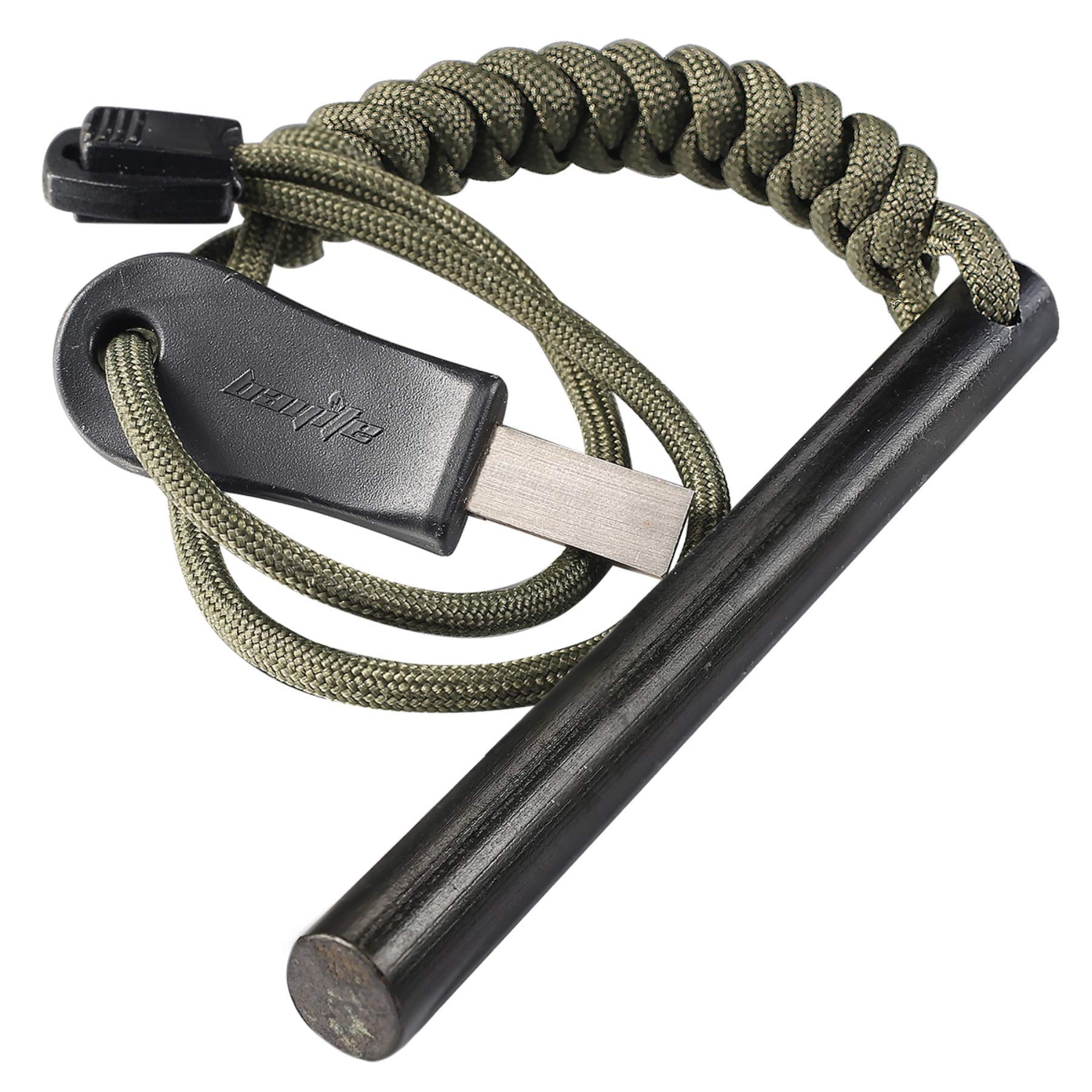
A ferro rod is not a lighter, and it is not a replacement for one. It throws sparks at 5,500 °F onto whatever tinder you have prepared, and if that tinder is wet it does not matter how good the rod is.
What it does well: the 4-inch rod with its 3/8-inch diameter gives you a lot of material to strike, the tool-grade steel striker has six edges, and the whole thing weighs 2.46 ounces with 5 feet of paracord wrapped around the handle for grip. It works wet, cold, and at altitude, which is more than can be said for a disposable lighter that has been in a pack since spring.
Two practical notes from using it. The rod ships with a coating that has to be scraped off before it throws properly, so do that at home rather than in the rain. And the technique is to hold the striker still and pull the rod back, keeping the sparks landing in one spot on your tinder pile. Practice until the first fire you build with it is not the one that matters.
Pros
- Works wet, cold, and at altitude
- 2.46 oz with a paracord grip
- Striker attached, nothing to lose
Cons
- Needs dry tinder to work
Keep one in the pack and practice at home — a fire starter that works when everything is wet, for less weight than a spare pair of socks.
Best for Camp Kitchen Kit
Quatish Travel Utensils, 5 Piece

Key Features
- Pieces: 5
- Cleaning: Dishwasher safe
- Material: 18/8 stainless steel
- Case size: 9.0 x 2.1 in
- Price: Budget
The elastic band is the detail that makes this set worth carrying. It holds the fork, spoon, knife, and chopsticks flat against the case so nothing rattles around in a pack at two in the morning, and the waterproof lining means yesterday’s spoon does not grease the inside of your bag.
Five pieces of 18/8 stainless in a 9.0 by 2.1 inch case, adult-sized rather than the doll’s-house cutlery some travel sets turn out to be. They are dishwasher safe, they do not bend under a firm scoop of chili, and the chopsticks carry laser-etched bands for grip.
The knife is a table knife — it will cut a tomato and spread peanut butter and not much else. That is fine, because you are carrying this to eat with; the folding knife in your pocket does the other job.
Pros
- Five pieces in a slim 9-inch case
- Elastic band stops the rattle
- 18/8 stainless, dishwasher safe
Cons
- The knife is a table knife
A tidy little kit for the camp kitchen: real stainless utensils and a slim case that keeps the rattle out of your bag.
Best for Pocket Carry
Smith & Wesson SWA24S Folding Knife
Key Features
- Lock: Liner lock
- Weight: 3.5 oz
- Blade length: 3.1 inches
- Overall length: 7.1 inches
- Price: Budget
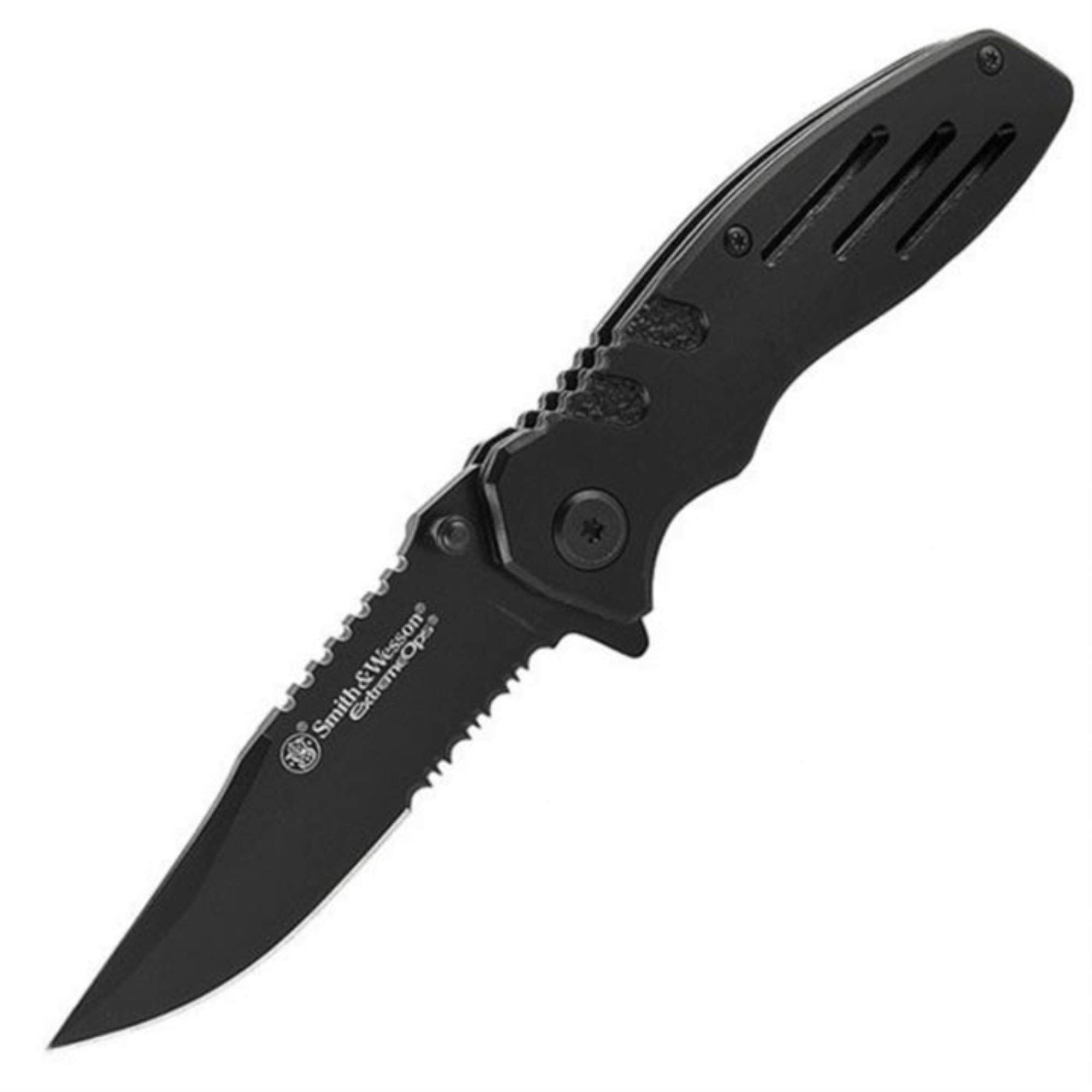
Ours arrived stiff. The thumb knob and finger flipper are both there, but out of the box the pivot wanted a few days of opening and closing before it would flick one-handed, and until then it is a two-hand knife. That is a break-in rather than a fault — but if you need something smooth on day one, this is not it.
Once it settles, there is a lot of knife at 3.5 ounces: a 3.1-inch serrated clip point in 7Cr17MoV, an aluminum handle, a liner lock that holds the blade open with a solid click, and a pocket clip that keeps it at the top of a pocket. Seven inches overall means it disappears in a cargo pocket and still leaves real handle for your hand.
The part to watch is the hardware. Handle screws work loose with use, and on a knife that lives in a damp pack that is worth a look every few trips — a dab of threadlocker and a snug screwdriver keep it together. The serrated edge cuts rope and straps quickly and takes more work to sharpen than a plain edge, which is the trade you accept for it. The limited lifetime warranty covers you if something does let go.
Pros
- 3.5 oz with a pocket clip
- Liner lock holds the blade open
- Serrated edge cuts rope and straps
- Limited lifetime warranty
Cons
- Serrated edge is slower to sharpen
A light, sharp pocket knife that does what a camp knife needs to, as long as you check the screws and do not expect a smooth one-thumb flick.
How We Tested Camping Gear
We started by scanning customer reviews and spec sheets for dozens of tents, sleeping pads, lanterns, stoves, and chairs, then narrowed to 12 that covered a range of prices and designs. We looked for gear that claimed to be portable, durable, and easy to use, but we didn’t take those claims at face value.
Testing ran from early spring through late fall—about eight months. We set up each tent in the dark with a headlamp, timed how long it took one person to pitch it, and then checked the seams after a rainy night. We inflated sleeping pads and measured their thickness before and after a full night’s sleep, noting whether they bottomed out. Lanterns were judged at dusk and in a fully dark tent—we compared brightness across models and noted how quickly they dimmed.
Stoves and chairs were packed and unpacked repeatedly; we weighed them on a kitchen scale and carried them on short hikes to see how they felt. After every trip, we inspected zippers, seams, poles, and fabrics for wear, and we compared what arrived to the product description—did the packed size match the claim? Did the lantern’s brightness match the listed lumens? We also weighed value: a piece of gear earned points for doing its job without extras you’d never use. The gear that scored highest was the gear that stayed out of the way.
How to Choose Camping Gear That Earns Its Space
The best camping gear is the gear that does a job nothing else in your bag already does — and the trip you take most often decides which jobs those are.
Buy for the Trip You Actually Take
If you drive to a site and pitch beside the car, weight is a footnote and volume is what matters: a three-pound stove and a four-pack of lanterns are bargains at that distance. If the tent is a mile up a trail, every item has to justify itself in ounces, and one heavy convenience costs you a whole other item you wanted to bring.
A rule of thumb we use: on foot, anything over about two pounds needs to replace something you would otherwise carry. In the car, pack the thing that makes the evening better and stop apologizing for it.
Lighting: One Per Person, One Per Tent
The figure to distrust on any light is the maximum output. A lantern rated at 154 lumens spends most of its life well below that, and the 50-hour claim printed beside it belongs to the lowest setting, not the bright one. For a tent and a table, low hundreds of lumens is plenty; what you want is a wide spread of light rather than a hot spot pointed at one person.
Then decide between disposable batteries and a rechargeable light, based on how long you are out. A rechargeable headlamp is wonderful for two nights and useless on night four without a power bank, while a pack of AA-powered lanterns is a swap rather than a wait.
Water, Fire, and Warmth
These three are what end trips early, and they are the places to spend a little more attention than the price tag suggests. A hollow-fiber filter needs no power, weighs almost nothing, and handles cloudy water — but it is a biological barrier, not a purifier, so chemical contamination stays out of scope.
Fire: a ferro rod works wet and cold, though it needs dry tinder you prepared before the rain arrived. Warmth: air-activated hand warmers begin working the moment the wrapper opens, so one spare pair in a pocket is worth more than a bigger box left in the car.
Fuel You Can Buy Where You’re Going
Butane and propane are not interchangeable once the temperature drops toward freezing. Butane loses pressure as it gets cold and can sulk through a frosty breakfast; propane keeps going. A dual-fuel stove lets you use the cheap, packable cartridge in summer and switch to a propane cylinder when the season turns.
Fuel is the recurring cost of camp cooking, and it is the awkward thing to transport. Buy canisters in the town near the campsite and let the stove stay in the car.
Ground Sheets: Size Down, Not Up
A tarp under the tent should be slightly smaller than the tent floor, not larger. Anything overhanging the edge collects rain and channels it back underneath — the exact opposite of the job you bought the sheet for. Measure the floor first, then pick the size.
Polyethylene sheets are cheap, fully waterproof, and heavier than nylon. That is the right trade for car camping, firewood covers, and truck beds, and the wrong one for anything you are carrying on your back.
Frequently Asked Questions
Can I use a straw filter on muddy or silty water?
Within reason. The membrane reduces turbidity down to 0.2 microns, so cloudy water still comes through, but silt is what clogs a hollow-fiber filter fastest. Let the water settle in a bottle and pour it through a bandana first.
Keep it for water that is clear-ish. It is a biological barrier rather than a chemical one, and the stated limit is a TDS of 1,000 ppm — skip anything that smells of fuel or comes from runoff beside a road.
Do I need both a hatchet and a knife?
They split the work rather than duplicate it. The hatchet handles kindling, small limbs, and shaving a split piece down to tinder, while a folding knife takes rope, packaging, food, and repairs you would never attempt with an axe.
On foot, carry the knife; the hatchet earns its weight only if you plan fires built from gathered wood. If the firewood is thicker than your wrist, neither is the answer — pack a folding saw.
Does the Gas One stove come with fuel?
No. It ships as the stove and its carrying case, and it takes an 8 oz butane cartridge or a 16.4 oz propane cylinder, so plan for fuel as a recurring cost rather than a one-off purchase.
The practical move is to buy canisters near where you are camping. They are the awkward thing to store and travel with, and every outdoor town sells them.
Why did one of my hand warmers never heat up?
An air-activated warmer needs its inner packet intact until the moment you open it. A pair that stays cold after several minutes in open air has almost certainly been exposed to moisture or a pinhole in the wrapping, and it will not recover.
Check the outer wrapper for tears or puffiness before a trip, keep the box sealed until you need it, and carry one more pair per person than you think you need.
Final Verdict
If you buy one thing from this list, make it the LifeStraw. It disappears into a pocket, weighs almost nothing, and turns a stream into a water supply — the difference between a route and a loop.
Camp with family and the four-pack of lanterns is the next thing we add, because light is what makes an evening at a site work. If your evenings revolve around a fire instead, the X7 hatchet earns its place first. Water, light, warmth: those three cover most of what a weekend asks for, and everything else here is a refinement of them.