This post contains affiliate links. We may earn a small commission when you buy through our links — at no extra cost to you.
The best part of waking up in a tent is the quiet fifteen minutes before anyone else stirs—provided there’s coffee at the end of it. A French press gets you there simply: coarse grounds, hot water, press, pour. The trouble is that the one on your kitchen counter was never built to ride in a duffel beside a stove and wet boots; glass cracks, thin handles loosen, and the second cup goes cold while you’re still lacing up.
Over the past six months, my team and I have brewed with 13 of them—car-camping weekends, one very cold canoe overnight, plenty of backyard fire-pit mornings. What separated them was wall thickness, a filter stack that kept grit out of the last sip, and a handle you could grab with a gloved hand without feeling it flex. Nobody tells first-time buyers this: preheat the carafe with a splash of near-boiling water, and even a middling press holds heat through a second cup. Here’s what survived the duffel.



Best for All-Round Camp Pick
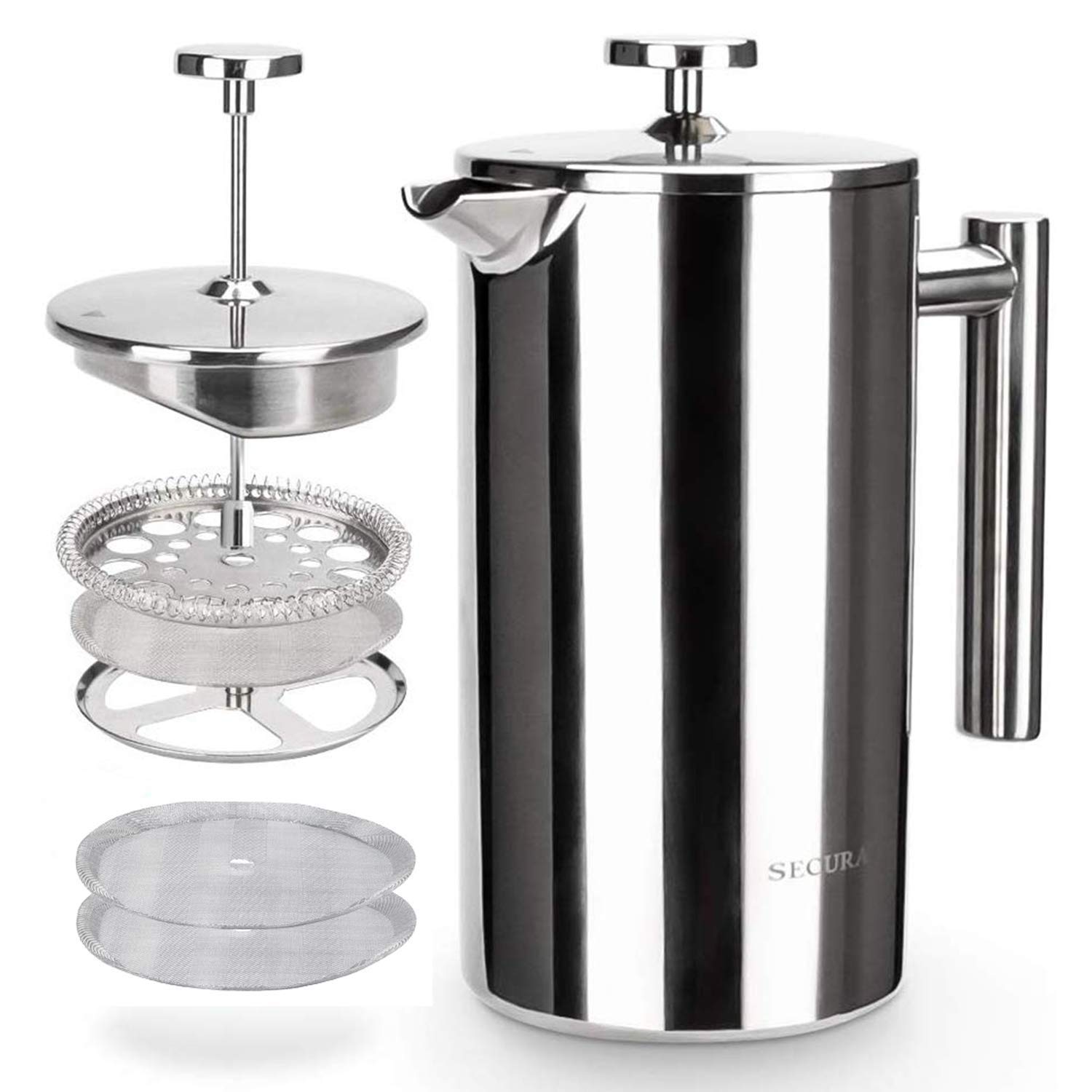
Secura Stainless 34 oz
Key Features
- Filter: Three-layer stainless
- Weight: 2.4 lb
- Capacity: 34 oz (1 L)
- Material: 18/8 (304) stainless steel
- Price: Midrange
The Secura is the press we hand to anyone who has already lost a glass carafe to a campsite picnic table. Both the inside and the outside are 18/8 stainless steel, so a tumble off the bench is a non-event, and the insulated body holds heat well enough that the second cup is still worth drinking. That pairing — nothing to break plus warmth that hangs around — is exactly what we want from camp coffee gear, and it’s why this one earns the recommendation.
The brewing side is well sorted rather than merely adequate. A three-layer stainless filter traps the fine grounds that turn a cup muddy, and Secura includes two spare screens so you can stack extra filtration if you like a cleaner pour. Everything comes apart by hand and every part is dishwasher safe — which matters more at home than at camp, where you’re rinsing in hot water and shaking it dry, a routine this press takes without complaint.
Where it gives something up is weight. At 2.4 pounds it’s the heaviest press in this group, and that’s the direct cost of the insulated wall and the steel that lets it survive. For car camping, a canoe trip or a cabin weekend, 2.4 pounds is irrelevant. For a multi-day backpack, it’s the reason the Bestargot exists.
The details we noticed most in use were the cool-touch handle and knob: you can lift the whole pot mid-brew without hunting for a towel. A 34-ounce batch fills two large mugs with a little left over, which is the right size for most camp mornings, and the two-year warranty is longer than most of its rivals offer.
Pros
- Shatterproof 18/8 stainless inside and out
- Three-layer filter plus two spare screens
- Every part is dishwasher safe
- Two-year warranty backs the build
Cons
- Heaviest steel press in this group
The one we point most campers to: shatterproof 18/8 steel, a clean-pouring three-layer filter and enough capacity for two, at a midrange price.
Best for Slow Camp Mornings
Coffee Gator 34 oz
Key Features
- Filter: Spring-loaded double screen
- Weight: 2.3 lb
- Capacity: 34 oz
- Insulation: Vacuum-layered double wall
- Price: Midrange
A vacuum layer is the difference between coffee that’s still hot when the tent is finally pitched and coffee you drink lukewarm because reheating is more effort than it’s worth. The Coffee Gator is built around that idea: a vacuum-layered double wall, a cool-touch handle, and a lid you can grip bare-handed while you pour. On paper it’s the most insulating design in this group, and insulation is what you’re paying for.
We rate it as the pick for long, slow mornings. The spring-loaded double screen presses against the carafe wall as it travels, which is why fine grit stays out of the cup rather than drifting up around the edge of a flat disc. The whole assembly unscrews for cleaning with no hidden crevices, and the 34-ounce body pours three decent mugs. If your camp routine involves a pot that sits out for an hour while people drift back for refills, this is the one that keeps up.
What it costs is money and pack space. It’s the priciest of the midrange presses here, and the tall, narrow shape is less forgiving to stow than a squat pot. For cold-weather trips where the coffee has to survive the morning, that trade is an easy one to make.
Pros
- Vacuum-layered wall holds heat well
- Cool-touch handle and lid for pouring
- Spring-loaded double screen keeps grounds back
Cons
- Tall 11.9-inch body stows awkwardly
The pick when heat matters most: a vacuum-layered body and cool-touch handle that keep a long camp morning’s coffee drinkable.
Best for Plastic-Free Brewing
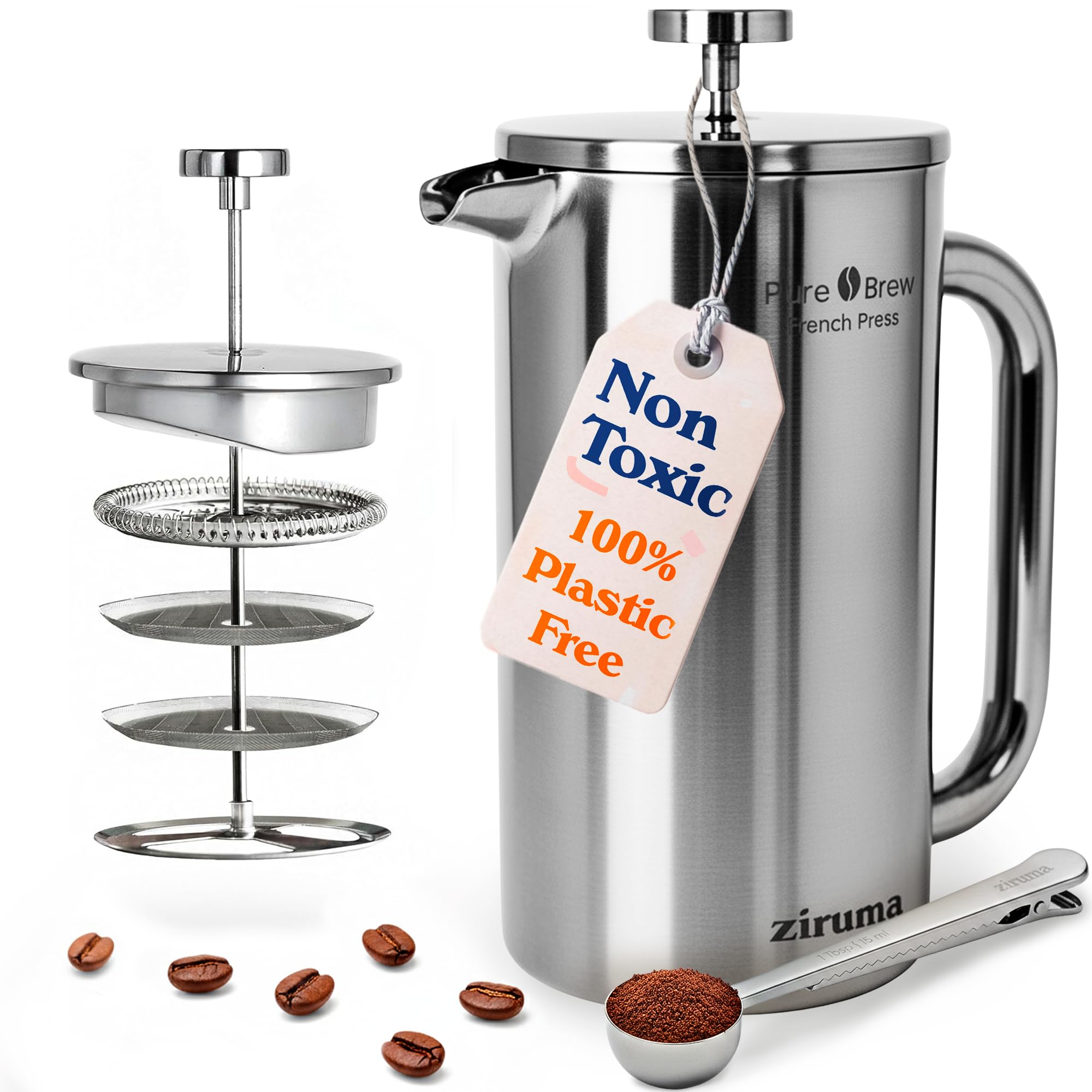
Ziruma 316 Stainless 34 oz
Key Features
- Filter: Four-layer
- Capacity: 34 oz (1,000 ml)
- Material: 316 stainless steel
- Insulation: Double wall
- Price: Premium
Most stainless presses here are made from 304 steel. The Ziruma uses 316 — the surgical grade — and it’s built to keep plastic out of the brew path entirely, down to a steel lid rather than a plastic cap. If the reason you went looking for metal in the first place was wanting nothing to hold odor or shed into hot water, this is the press designed around that concern instead of around a price point.
The rest of the specification is what we want on a camp table: double walls, a four-layer filter, and measuring marks built into the body so you can fill it from a kettle without a separate cup to guess with. A measuring spoon comes in the box, the components are dishwasher safe, and the measuring marks are the detail we ended up using more often than we expected.
It’s the most expensive of the full-size steel presses here, and the premium buys material grade rather than capacity. The one figure we can’t give you is weight — Ziruma doesn’t publish one, and at 8.5 inches tall it’s compact enough that the number matters the moment it goes into a pack. Chase that down before you commit it to a long carry.
Pros
- 316-grade steel, fully plastic-free build
- Double wall holds heat between cups
- Measuring marks built into the body
- Components are dishwasher safe
Cons
- Priciest full-size steel press here
The plastic-free choice: 316-grade steel, a four-layer filter and measuring marks inside the body, at the top of the steel-press price range.
Best for Groups and Families
Belwares 50 oz
Key Features
- Filter: Four-level stainless
- Weight: 2 lb
- Capacity: 50 oz (1.5 L)
- Material: 304 stainless steel
- Price: Premium
Fifty ounces is the number that decides this one. That’s 1.5 liters, three big mugs filled at once, and it’s the only press in this group that handles a family or a full campsite without a second round. The body is double-walled 304 steel, the filter stack runs four levels deep, and Belwares includes two spare screens — useful, because the fine mesh is the part that eventually clogs.
We take this one on group trips and leave the liter presses at home. It’s a basecamp tool rather than a pack item: two pounds and a wide body mean it rides in the truck, not on your back, and the reward for the bulk is the most generous pour here and a pot that’s still warm when the last person wanders over. Two heavy coffee drinkers will finish it; four moderate ones will too. Just know that the matte black finish is the part that ages first, so treat the outside as well as you treat the inside.
Pros
- 50-ounce batch fills three big mugs
- Four-level filter plus two spare screens
- Double-wall body keeps the pot warm
- Comfortable handle and drip-free spout
Cons
- Matte finish chips with use
For four people around a camp table, nothing here brews more at once — and the double wall keeps the second round warm.
Best for Backpacking and Solo
Bestargot Titanium 750 ml
Key Features
- Weight: 7.68 oz (220 g)
- Capacity: 750 ml
- Material: Titanium
- Heat sources: Gas, alcohol, campfire
- Price: Midrange
Backpacking coffee usually means a sachet of instant, and the Bestargot is the one product here that changes that equation. It weighs 220 grams — roughly two pounds less than the stainless presses in this group — because it’s a titanium pot first and a French press second. It heats your dinner water, holds the coffee kit, and brews in the morning, all from the same 750 ml vessel.
The press element is a filter assembly that drops into the pot, and the pot itself is rated for gas stoves, alcohol burners and campfires. That means you heat the water in the vessel you brew in and leave the kettle at home. We were also impressed by the fact that titanium takes on no flavor, which counts for a lot when the same pot held chili the night before. Every part is dishwasher safe once you’re back.
What it isn’t is a carafe. The 750 ml figure is the pot’s capacity, and with the plunger and grounds in place you’re brewing for one — treat it as a generous solo mug rather than a two-person press. The filter stack is lighter-duty than the machined assemblies on the steel models too, so it rewards a little care. Solo trips where weight decides everything are exactly the trips this one is built for.
Pros
- 220 grams, roughly two pounds under steel
- Brews, boils and stores in one pot
- Rated for gas, alcohol burners and campfires
Cons
- One-person brewing capacity
- Filter stack is lighter-duty than the steel presses
The only genuinely packable press here: a 220-gram titanium pot that boils, brews and stores, for solo trips where every ounce counts.
Best for Budget Car Camping
Utopia Kitchen 34 oz
Key Features
- Filter: Four-layer
- Weight: 2 lb
- Capacity: 34 oz (946 ml)
- Material: 304 stainless steel
- Price: Budget
The Utopia is the least expensive stainless press in this group, and nothing about picking it up suggests that. The body is double-walled 304 steel, the filter stack runs four layers, and at two pounds it carries like the pricier models. If you want the stainless experience without stretching the budget, this is where the value sits.
It does the job without fuss. Coffee stays hot through a second cup, the four-layer filter keeps the grit out, and the whole press comes apart by hand for washing. The one spot to keep an eye on is the base, where a seam can show rust spotting if the press is put away wet — dry it properly after washing and it stays clean.
Against the Secura it loses on refinement rather than function: the brushed finish is plainer and the handle is a simple loop with no shaping to it. For the money, though, it’s hard to argue with. This is the press we point to for a first camp setup, a spare that lives in the car, or anyone who wants steel and heat retention without paying for the polish.
Pros
- Cheapest stainless press in this group
- Double-walled 304 steel body
- Four-layer filter traps fine grounds
Cons
- Lid has no pour-spout marker
The budget pick that behaves like a full-price press: double-walled 304 steel, four-layer filtration and coffee that stays hot.
Best for Lightweight Full-Size Press
AgcKuzt 34 oz

Key Features
- Filter: Multi-layer mesh
- Weight: 1.3 lb
- Capacity: 34 oz (1,000 ml)
- Material: Stainless steel
- Price: Budget
If the Secura’s 2.4 pounds has been the sticking point, the AgcKuzt answers it directly: the same 34-ounce capacity and a double wall, at 1.3 pounds. That’s a pound saved on a full-size press, and it was the first thing we noticed lifting it out of the box.
Nothing obvious was cut to get there. The body is brushed stainless with a proper pour spout, the filter is a multi-layer mesh stack, and two spare screens come in the box. The components are dishwasher safe and the whole press comes apart by hand for a rinse at the tap, which is all a camp cleanup really needs.
What we can’t yet tell you is how the lighter gauge holds up across several seasons. There’s less history behind this one than behind the older names in the group, and nothing about it feels flimsy in the hand — but we can’t point to a long record the way we can for the Secura.
For a camper who carries the kit any distance and still wants a full liter at the end of it, that’s a good trade. Think of it as the light-duty version of our top pick: same shape, same capacity, less metal in the wall.
Pros
- 1.3 pounds, lightest full-size press here
- Double-wall steel holds heat
- Two spare filter screens included
- Components are dishwasher safe
Cons
- Shortest track record of the steel presses here
The lighter route to a full-size steel press: 1.3 pounds, a liter of coffee and dishwasher-safe parts, from the newest name here.
Best for Good-Looking Camp Brew
Poliviar Wood Handle 34 oz

Key Features
- Filter: Dual-screen
- Weight: 2.1 lb
- Capacity: 34 oz (1,004.5 ml)
- Material: 18/8 stainless steel, wood handle
- Price: Premium
Most camp coffee gear looks like it belongs in a toolbox. The Poliviar doesn’t: a green retro body, a wood handle, and a shape that looks right sitting on a camp table rather than being hidden in a crate. That’s a genuine part of what you’re buying here, and we won’t pretend the appearance is beside the point.
The brewing side holds up. It’s 18/8 stainless with double walls, a dual-screen filter that keeps the cup clean, and a 34-ounce body that pours three mugs. At 2.1 pounds it sits mid-pack for weight, and the parts come apart for washing without tools.
The handle is the part to watch: the wood is joined to the body, so check the fit when yours arrives and deal with a loose one before the first brew rather than after it. The filter stack also takes a couple of tries to rethread once you’ve had it apart, which is the sort of thing you stop noticing after a week and curse in the dark on day one.
If you want the prettiest press on the table and you’ll treat it accordingly, it earns its place. If you want something you can throw in a tote and forget about until morning, the Secura is the better-tempered choice.
Pros
- Wood handle and retro finish stand out
- Double-wall steel keeps coffee warm
- Dual-screen filter keeps the cup clean
Cons
- Wood handle is the part to watch
- Filter stack is fiddly to rethread
The best-looking press here and a solid brewer, provided you accept a wood handle that rewards a little care.
How We Tested Camping French Presses, From Picnic Table to Pack
We started with roughly 40 presses sold as camping or travel models and narrowed the field by material (double-walled stainless, Tritan, glass with a protective sleeve), capacity between 12 and 32 ounces, whether the plunger locked down for transport, and whether replacement filters were sold separately. That cut the list to 13, which we bought at retail and lived with for six months.
Each press came on at least two trips: a car-camping weekend where it sat on a picnic table, a colder overnight where it waited outside at 35 degrees between cups, and a run of backyard mornings. On every trip we brewed two rounds, took the water temperature at the pour and again 20 minutes later, and noted whether the second cup was still worth drinking. We packed them in duffels with boots and a stove, dropped them from cooler height onto gravel and pavement, gripped each handle bare-handed and in a wool glove to see if it flexed or got hot, and counted whether plunging took one hand or two.
Coffee quality we judged by cupping the same coarse grind side by side, then pouring the final ounce into a white mug to look for grit—a few presses poured clean at first and muddy by the fourth cup. Cleaning got its own Saturday at the sink: we washed each one in cold water, counted how many pieces came apart, and checked whether grounds packed under the filter plates. Six months in, we set all 13 side by side again to look at scuffs, dulled finishes, and loose fittings.
How to Choose a Camping French Press
A camp press has one job the kitchen version doesn’t: it has to survive being packed, and most of the other decisions follow from that.
Start with what the body is made of
Glass is the first thing to rule out if the press will travel. A borosilicate beaker sitting inside a steel frame is still glass, and a carafe that cracks around its plastic collar ends a trip faster than any other failure in this category.
Stainless is the sensible default: 304 or 316 steel takes a knock, holds heat and doesn’t mind a rinse in cold river water. Titanium buys you a big weight saving and the ability to sit directly on a flame, at the cost of capacity and filter refinement. Pick steel for basecamp and vehicle trips, titanium for the pack.
Insulation and the handle that stays cool
A double wall is the biggest comfort upgrade you can buy for camp coffee. Single-wall steel radiates heat quickly; a double-walled or vacuum-layered body keeps the pot drinkable through a second cup, which on a cold morning is the difference between brewing once and brewing twice.
Two practical notes. None of these is a thermos, so preheat with a splash of hot water while the kettle boils. And check that the handle and lid are cool-touch — pouring from a hot pot without a towel is otherwise a two-hand job with a bad failure mode.
Capacity, cups and the weight you carry
Work backwards from mugs, not ounces. The liter presses that dominate this group pour about three 10-ounce mugs, which suits two people. A 50-ounce press fills three large mugs at once and handles four or more around a table.
Weight splits along the same line. Full-size steel runs around two pounds; a 220-gram titanium pot is a solo brewer. If the press rides in a vehicle, take the capacity. If it rides on your back, take the weight and accept a smaller brew.
Filters, grounds and washing up without a sink
Layer count is a rough guide to how clean the cup is: three or four stacked screens hold back more fine grit than a single mesh disc, and spare screens are worth having because the fine mesh is the part that eventually clogs.
At camp the routine is the same for all of them — tip the grounds into a bag, rinse with the last of the hot water, shake dry before packing. Dishwasher-safe claims matter at home, not at a campsite. One detail worth checking before you buy: a lid with a pour-spout marker saves you lining up the spout by eye in the dark.
Frequently Asked Questions
Can you use a French press on a camp stove?
Only if the body itself is built for direct heat, which in this group means the titanium pot and not the insulated stainless carafes — a vacuum wall and a flame don’t mix. For everything else, boil water in a kettle or pot, then let it sit for about 30 seconds off the boil before pouring. That pause also protects a cold carafe from a thermal shock.
How much coffee goes into a camping French press?
Use a coarse grind, roughly the texture of sea salt, and about two level tablespoons per 6 ounces of water. For a liter press that’s six to seven scoops, which gives you a cup strong enough to take a splash of milk. Add the water, stir once, steep four minutes, then press slowly. A finer grind clogs the filter and puts grit in the cup.
Does a metal French press make coffee taste metallic?
No. The 304 and 316 stainless used here is non-reactive, and the cups we brewed in these presses tasted of coffee rather than steel. What does affect flavor is old oil trapped in the mesh: rinse the filter stack in hot water after every use, and give it a soapy brush at the end of a trip.
Can you make cold brew in a camping French press?
Yes, and the bigger pots are good at it. Use a coarse grind at roughly one part coffee to five parts cold water, stir, and leave it 12 to 16 hours — overnight in a cool box or a cool car — then press slowly and pour over ice. A 50-ounce press makes enough for a crowd; keep it in the shade rather than chasing fridge space.
Final Verdict
For one press that covers most camping trips, buy the Secura. It’s shatterproof, it holds heat long enough for a second cup, its three-layer filter keeps the grit out, and it sits in the middle of the price range rather than at the top. Nothing else here balances those four things as well.
Weight is the one reason to look elsewhere. Backpackers should take the Bestargot titanium pot, which gives up capacity and some filter refinement to shed roughly two pounds. Anyone who wants nothing but steel in the brew path should look at the Ziruma.