This post contains affiliate links. We may earn a small commission when you buy through our links — at no extra cost to you.
The picture in your head is perfect: two trees, a breeze, a book, and nothing on the schedule until dinner. Then you try to hang it and find the straps are six inches short for those trunks, the ends sag toward the dirt, and the whole thing shifts every time you roll over. A good camping hammock solves all of that at once — it goes up in a few minutes without a knot-tying degree, holds you level all night, and packs small enough that you stop debating whether it’s worth bringing at all.
I’ve spent enough nights in one to be picky, and over the past seven months my team and I hung 12 different hammocks between backyard oaks and the scruffy pines of a state park, from quick lunch-break hangs to full overnights. The lesson that surprised me most is that what comes in the box matters as much as the fabric. Straps that are too short or too narrow will rule out half the trees at your site, and no amount of comfort makes up for a suspension system that won’t fit. The ones worth carrying are below.
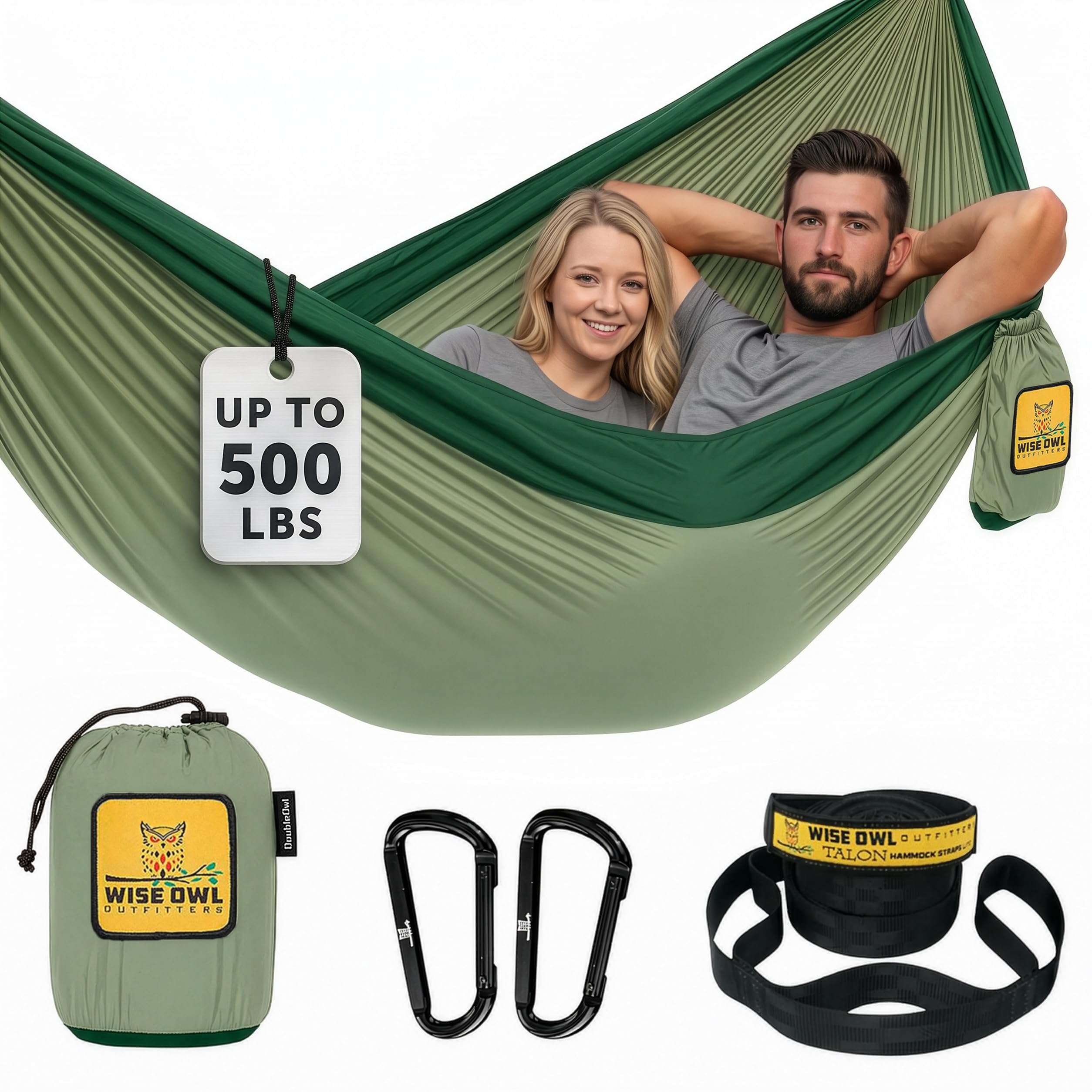


Best for All-Round Camping
Wise Owl Outfitters Double
Key Features
- Tree straps: 9 ft, 5 loops
- Packed weight: 1.5 lb
- Unfolded size: 120 x 78 in
- Weight capacity: 500 lb
- Price: Midrange
Everything that matters about the Wise Owl comes down to one design decision: the stuff sack is sewn into the hammock, so the body, the two 9-foot straps and the carabiners stay one object. Ours has never been folded neatly and it has never lost a strap. At 1.5 pounds, 120 by 78 inches and a 500-pound rating, the double has room for two adults sitting side by side and enough length for a six-footer to lie diagonally instead of curling up.
That balance is why this is the one we point a friend toward. It’s light enough to justify carrying on a day hike where a tent would stay in the car, roomy enough to sleep in, and rated for two, and the triple-stitched seams are the first thing we check on anything that will hold a person’s weight. Hanging it is a two-minute job: wrap a strap, clip a carabiner through a loop, repeat at the other trunk.
The honest limits sit at the edges. On trunks that are far apart, the 9-foot straps run out before the hammock does, so bring a longer set if your sites are open woodland rather than tight groves. And a solo sleeper gets more fabric than they need: the width that makes it a real double makes it floppy to climb into alone. Neither has stopped us keeping it in the car all summer.
Pros
- Complete kit packs into one attached sack
- 500 lb capacity with room for two
- 1.5 lb is light enough for a daypack
- Triple-stitched seams
Cons
- 9 ft straps limit how far apart trees can be
We recommend the Wise Owl double to almost anyone: a complete 500-pound kit that packs into its own sack at 1.5 pounds, with room to sleep two or sprawl one.
Best for Tall Sleepers, Couples
Gold Armour XL Double
Key Features
- Tree straps: Included, 1,000 lb breaking strength
- Packed weight: 2 lb
- Unfolded size: 125 x 79 in
- Weight capacity: 500 lb
- Price: Midrange
Five inches doesn’t sound like much until you’re the tall one. The Gold Armour’s body is 125 by 79 inches against the 120 by 78 of our top pick, and that extra length is why we hand this one to anyone over six feet: you can stretch out on the diagonal without your head and feet both pressed into fabric.
The rest of the kit is complete and unremarkable in the right way: a 500-pound rating, two steel carabiners, two tree straps that Gold Armour rates at 1,000 pounds breaking strength, which is more headroom than the capacity needs, and triple interlocking stitching along the body. At 2 pounds it asks more of your pack than the top pick does.
That weight is the trade. On a car-camping weekend or at a festival you’ll never notice it, and the extra width is worth every ounce when two people are sharing; on a long approach you will notice, and the 1.5-pound doubles start to look better. What we didn’t expect to care about is the colour: the peach and pink fade is loud enough to pick out from across a busy campground, which turns out to be genuinely useful at dusk.
Pros
- Most room of any pick at 125 x 79 in
- 500 lb rating on a 1,000 lb strap design
- Complete kit with carabiners and straps
- Easy to spot across a campground
Cons
- Two pounds is heavy for backpacking
Our pick for tall sleepers and couples: the extra length and width here are worth carrying two pounds for anyone who shares a hammock.
Best for Premium Long-Term Use
ENO DoubleNest
Key Features
- Packed size: 4 x 5.5 in
- Packed weight: 1.19 lb
- Unfolded size: 114.2 x 75.6 in
- Weight capacity: 400 lb
- Price: Premium
The DoubleNest arrives as fabric and little else. ENO sells the straps as a separate accessory, so the first thing to budget for is a suspension set. The hammock itself is 114.2 by 75.6 inches of nylon with a triple-stitched seam, rated to 400 pounds.
What the money buys shows in the hand. The nylon feels softer and more tightly woven than the parachute fabric on the budget doubles, and at 538 grams it folds to roughly 4 by 5.5 inches, which is smaller than most of the kits here once their straps are added. We also like that it’s built to work with the rest of ENO’s line, so a replacement strap or an add-on net is an easy purchase rather than a hunt.
The judgement is simple: this is the hammock for someone who wants one they’ll still be hanging in five summers and doesn’t mind buying the suspension themselves. The ceiling is lower too: 400 pounds against the 500-pound doubles here, so two large adults will feel closer to the limit than they would in the Wise Owl or the Gold Armour. One person plus a pack, or two averaged-sized people, sits comfortably inside it.
Pros
- Best fabric and stitching in this group
- Packs to 4 x 5.5 in at 538 g
- Works with ENO’s strap and accessory line
Cons
- Tree straps sold separately
Buy the DoubleNest for the best fabric and stitching in this group, and accept that you’re buying the straps separately.
Best for Buggy Overnight Trips
Sunyear Hammock with Net
Key Features
- Bug net: Integrated, reversible
- Tree straps: 10 ft, 16 loops each
- Unfolded size: 106 x 55 in
- Weight capacity: 500 lb
- Price: Midrange
The net is the reason to look here, and it’s a good one: reversible, hung clear of your face rather than draped across it, and roomy enough that you aren’t sleeping with mesh against your nose. For overnight trips in bug season it’s the strongest pick in this group.
The kit is complete: a 500-pound rating, 210T ripstop nylon with reinforced stitching, two 10-foot straps with 16 loops each, carabiners and net ropes, plus a lifetime warranty, which is the only long-term promise stated on any pick here. It’s also the heaviest of these at 1.11 kg, because the net, the extra line and the longer straps all add up.
The net is the fiddly part as well. Two tie-outs hold the mesh up, and getting it taut without hauling the hammock out of shape took us a couple of goes the first evening; by the second night it was a minute’s work. The body is 106 inches long, so if you’re much over six feet, plan on sleeping on the diagonal or look at the 10-foot doubles. What surprised us is how much the net changes the character of the thing: it stops being a seat and becomes a room.
Pros
- Integrated reversible bug net for overnight sleeping
- 10 ft straps with 16 loops each
- Lifetime warranty
- 500 lb capacity
Cons
- Net rigging takes extra line and patience
- Heaviest pick here at 1.11 kg
If you plan to sleep out in bug season, this is the one: an integrated net that hangs clear of your face, backed by a 500-pound rating and a lifetime warranty.
Best for Solo on a Budget
Kootek Single
Key Features
- Tree straps: 18+1 loops each
- Packed weight: 1.7 lb
- Unfolded size: 105 x 54 in
- Weight capacity: 400 lb
- Price: Budget
The Kootek is the least expensive way into a complete kit in this group, and complete is the word that matters: straps, carabiners and an attached stuff sack are all in the box, so there’s nothing else to buy before your first hang. It’s a single, 105 by 54 inches, rated to 400 pounds, and 1.7 pounds in the bag.
What surprised us is the suspension. Each strap carries 18+1 loops, far more adjustment than we expect at this price, and it means you can set the sit height in small steps on two trees that don’t want to cooperate instead of walking the ridge looking for a perfect pair. The 210T nylon and triple interlocking stitching are the standard parachute-hammock recipe, and ours has held its shape.
The trade is size, and it’s honest: 54 inches wide is a single in the real sense. A broad-shouldered sleeper will feel the fabric close, and there’s no room for a second person or a dog. As a first hammock, a lunch-stop lounger, or the one that lives in the car without anyone worrying about it, it’s hard to beat.
Pros
- Cheapest complete kit here
- 18+1 loops per strap for fine height adjustment
- 1.7 lb packed with an attached sack
- 400 lb rating for one adult
Cons
- Single width only, with no room for two
For a solo hiker on a tight budget, the Kootek is the easiest yes here: a complete 1.7-pound kit with straps you can actually adjust.
Best for Budget Two-Person Hangs
SZHLUX Double
Key Features
- Tree straps: 10 ft, 18+1 loops
- Packed weight: 1.8 lb
- Unfolded size: 106 x 55 in
- Weight capacity: 400 lb
- Price: Budget
SZHLUX calls this a double, and at 400 pounds it will hold two adults, but 106 by 55 inches is a snug double rather than a generous one. Two people sit side by side easily enough; two people sleeping means one of you is on the diagonal and the other is negotiating.
Where it punches above its price is the suspension. Two 10-foot straps with 18+1 loops each give more reach and finer height adjustment than the top pick does, which matters on open ground where the trunks are further apart than is convenient. It packs to 6.2 by 4.7 by 3 inches at 1.8 pounds, and comes with carabiners, ropes and a storage bag.
As a second hammock, a family spare or a car-camping lounger, this is the value pick of the group: the sort of thing you hand to a kid or a guest without wincing. For two people sleeping overnight, though, spend more on a 79-inch-wide 500-pound double, because the extra width is exactly what stops two sleepers rolling into each other, and this one doesn’t have it.
Pros
- 10 ft straps with 18+1 loops each
- Packs small at 1.8 lb
- Complete kit at a budget price
- 400 lb rating for two seated adults
Cons
- 55-inch width is snug for two adults
The value pick for a second hammock: long, adjustable straps and a two-person rating for very little, as long as nobody expects a wide bed.
Best for Roomy Car Camping
Bear Butt Double

Key Features
- Packed size: 7 x 4 x 4 in
- Packed weight: 1.5 lb
- Unfolded size: 10 x 6 ft
- Weight capacity: 500 lb
- Price: Midrange
The turquoise-into-coral fade is the most distinctive fabric in this group, and the feel matches the look: soft nylon, triple stitching, a finish you notice when you climb in rather than one you inspect.
The dimensions are straightforward: 10 feet long by 6 feet wide, a 500-pound rating, 1.5 pounds, and a pack that folds to 7 by 4 by 4 inches. That’s the same length as the top pick and six inches narrower at the same weight, which puts it in the middle of the group on everything except looks.
Setup is where it diverges. Bear Butt’s suspension runs on ropes you tie off rather than the looped webbing straps the others use, so hanging takes longer than clipping a carabiner through a loop and it’s less forgiving in the dark. If you already own a strap set this is a non-issue; if you don’t, add one to the order and treat the ropes as spare line.
What’s left is a roomy, good-looking hammock that’s easy to like for camp and yard duty. It doesn’t beat the Wise Owl on kit completeness or the Gold Armour on room, but it’s a pleasant, spacious hang, and the three-tone fabric makes it easy to spot from the trailhead.
Pros
- Roomy 10 x 6 ft body
- 1.5 lb packed for a large hammock
- Distinctive three-tone colourway
Cons
A roomy, good-looking 10-foot hammock for camp and yard duty; add a strap set and it’s a happy purchase.
Best for Daypack Lounging
MalloMe Camping Hammock

Key Features
- Packed weight: 1.43 lb
- Unfolded size: 112 x 55 in
- Weight capacity: 661.4 lb
- Price: Budget
At 0.65 kg the MalloMe is the sort of thing you stop noticing in a pack: it goes into a side pocket and comes out at lunch. Unfolded it measures 112 by 55 inches in the size we looked at, which is long and narrow, fine for stretching out alone and tight for two.
MalloMe’s product page covers single and double versions under one title, and this variant’s own details read as a one-person hammock with a 300 kg capacity. Read the size line rather than the photographs before you order, because it’s the difference between a lounger and something you can share.
There are no tree straps in the box, and MalloMe sells a set separately, so add that before comparing it with the complete kits here. Do the sum and most of the price advantage over the Kootek or the SZHLUX disappears.
None of that makes it a bad hammock. The nylon is comfortable for an afternoon, the body is long enough for a tall lounger, and its real strength is being the one you stuff into a bag without thinking twice. What it isn’t is a sleeper’s hammock, which is a job for a 10-foot double with a net or a thicker strap set.
Pros
- 0.65 kg packs into a side pocket
- Long 112-inch body for the money
- Comfortable nylon for day use
Cons
- No tree straps included
Buy it as a light, cheap lounger for day trips and back gardens, with the cost of straps priced in before you commit.
How We Tested the Best Camping Hammocks
We started with the hammocks that keep surfacing in thru-hiker threads and campground reviews, then narrowed by specs we could check on paper: packed weight and packed size, listed capacity, whether the suspension hardware came included or was sold as an add-on, and price spread over a realistic number of nights. That left 12 models, running from stripped-down backpacking setups to roomier ones with built-in bug nets.
Over seven months, those 12 hammocks lived in the backyard, came along on weekend trips, and hung in a state park’s pine stand for full overnights. We timed every setup from the moment the bag opened to the moment we sat in it — first in daylight, then again after dark with a headlamp, which is when bad hardware shows itself. We measured strap length and wrapped each set around trunks from skinny saplings to a two-footer to see which trees a given hammock ruled out.
Comfort got judged the hard way, on overnight hangs, with notes on shoulder squeeze, pressure under the knees, and whether the fabric turned clammy by 3 a.m. We weighed each one packed, checked how much room it ate in a 40-liter pack, and left the hammocks hanging through sun and rain between trips to watch seams, strap stitching, and buckles for fraying or slip. Before naming a winner, we tallied what came in the box against the price, since a cheap hammock that needs $40 of straps isn’t cheap.
How to Choose a Camping Hammock
The hammock body is the cheap part; length, suspension and a net are what decide whether you sleep or just sit.
Length and width come first
Length is what lets you lie on the diagonal, and the diagonal is how you sleep flat instead of banana-shaped. Around 10 feet gives most adults that option, which is why the 10-foot bodies keep turning up among our picks, and the 125-inch Gold Armour is the one for anyone over six feet. Width works the same way sideways: 55 inches is a generous single and only a sitting double, while 78 or 79 inches is where two adults can genuinely share. Buy for the body that will actually be in it, and treat double as a description of fabric rather than of comfort.
The suspension is half the purchase
Straps decide where you can hang as much as the hammock does. Wide webbing spreads the load and protects bark, which is why parks and campsites increasingly require it over rope. Strap length sets how far apart the trunks can be, and loop count decides how finely you can set your sit height: the 18+1 loops on the Kootek and SZHLUX give small steps, where five loops force coarse ones. Then check what’s in the box, because several hammocks here, the ENO included, are sold without suspension at all.
Weight and packed size
Carrying it more than a mile changes the priorities. The lightest kits here are 1.5 pounds, and the ones with nets and longer straps run heavier; the Sunyear is the heaviest of the group at 1.11 kg. Packed volume varies more than the scales suggest, since some kits fold to a fist and others to a melon, and that difference decides whether the hammock goes in the pack or stays in the car. If yours lives in a car, ignore all of this and buy the roomiest one you like.
Do you need a bug net?
A net turns a lounger into a bed for the warmer half of the year, and it works far better than improvising with a separate net you have to rig from scratch. It costs weight and a couple of extra tie-outs, and a permanently attached net is one more thing to keep off your face while you’re reading. Hang in the afternoon only and you can skip it. Plan to sleep out from spring through autumn and buy the net.
Capacity, stitching and the seams that matter
Treat stated capacity as a ceiling rather than a target: 400 pounds covers one large adult or two averaged-sized people, and 500 gives margin for gear and a dog. The more useful check is construction. Look for triple stitching at the gathered ends and along the body, carabiners smooth enough not to fray the strap, and a stuff sack sewn in rather than loose. Anything that arrives with rough hardware or a wandering seam goes straight back, because those are the parts that fail under load.
Frequently Asked Questions
What else do I need to buy with a camping hammock?
Three things, usually: suspension if the hammock doesn’t include it, a tarp for rain, and insulation underneath you. Air moving under a hammock pulls heat away fast, so a pad or an underquilt matters more than a warmer sleeping bag. Sort the straps first, then a tarp long enough to cover the hammock end to end, which means roughly the hammock’s own length plus about a foot at each end.
How far apart should the trees be?
Do the arithmetic before you leave: hammock length plus both straps, minus about a foot at each end for wrapping the trunk. A 10-foot hammock with two 10-foot straps covers a gap in the high teens comfortably; anything wider needs longer straps, and under about 10 feet the hammock ends up on the ground. Pace the gap out at the trailhead rather than at dusk.
Will tree straps damage the trees?
Wide webbing spreads the load and is what most public campsites and parks require; rope and thin cord can cut into bark and are often banned outright. Pick trunks at least a hand’s width across, avoid anything with dead branches overhead, and check the site’s rules before you hang, since some hammock-specific sites specify a minimum strap width.
Final Verdict
The one we pack for an ordinary camping season is the Wise Owl double: 1.5 pounds, room for two, a kit that stays in one piece, and enough length to sleep on the diagonal. It isn’t the cheapest hammock here, and it isn’t the biggest.
Go to the Gold Armour if you’re tall or always hang with a partner. Take the Sunyear if you’ll be sleeping out in bug season, and the Kootek if you hike alone and want to spend as little as possible.