This post contains affiliate links. We may earn a small commission when you buy through our links — at no extra cost to you.
A tarp is a rectangle of fabric with grommets punched around the edge, which makes it sound like the least complicated piece of gear you own. Then the wind shifts at two in the morning, the rain starts coming in sideways, and you find out very quickly whether the coating holds, the tie-outs stay put, and the ounces you carried were worth it. I’ve pitched tarps over picnic tables, over tent platforms, and once, memorably, over a friend’s hammock at an angle that should not have worked.
The gap between a good tarp and a cheap one comes down to details you can’t see online: how thick the coating actually is, how far apart the grommets sit, whether the edges are reinforced, and what the fabric weighs once it’s wet. My team and I have spent the past six months pitching, tensioning, soaking, and folding up 14 of them, from ultralight silnylon to hardware-store polyethylene, and the differences showed up fast. One thing first-time buyers rarely realize: the listed size is measured flat, so once you pitch it as a shelter, you lose a foot or two of usable coverage to the ridgeline and stakes. The picks below are the ones that gave most of that coverage back.



Best for All-Around Camping
KALINCO Camping Tarp
Key Features
- Size: 10 x 10 ft
- Weight: 1.8 lb
- Tie-outs: 19 reinforced loops
- Waterproofing: 3000 mm PU, taped seam
- Price: Midrange
The first thing we noticed about the KALINCO is how little you have to add: six aluminum stakes, six guy lines with tensioners, and a stuff sack come in the box. That completeness is why it is our top pick for most campers. The 10-foot square is big enough for two sleepers or a hammock plus gear, and the 1.8-pound packed weight is reasonable for a shelter that does not need to be babied.
The fabric is 210T polyester with a 3000 mm PU coating and a taped central seam, and the tie-outs are reinforced webbing rather than bare grommets. We paid attention to the 19 attachment points because they let you pitch a flat overhead, an A-frame, or a windbreak without adding hardware. In a steady rain, the taped seam is the detail that matters most; it keeps the ridge line from becoming the weak point.
There is no pole in the kit, so an overhead pitch needs trees, trekking poles, or a paddle. We also treat the square shape as a fair-weather friend: it is versatile, but a rectangular tarp gives longer ridgeline coverage in a narrow site. Those are boundaries, not deal-breakers. For a first camping tarp, that head start is worth more than a few ounces saved.
Pros
- Complete kit includes six stakes and six lines
- 19 reinforced tie-outs for flexible pitches
- 3000 mm PU coating with taped central seam
- Packs to 1.8 lb with stuff sack
Cons
Our top pick for most campers: a complete 10-foot-square shelter kit with taped seams, 19 reinforced tie-outs, and a packable 1.8-pound build.
Best for Hammock Backpacking
Wise Owl Rain Fly
Key Features
- Size: 11 x 9 ft
- Weight: 18.9 oz
- Included: 4 stakes, 6 guy lines
- Waterproofing: 3000 mm PU, taped seams
- Price: Midrange
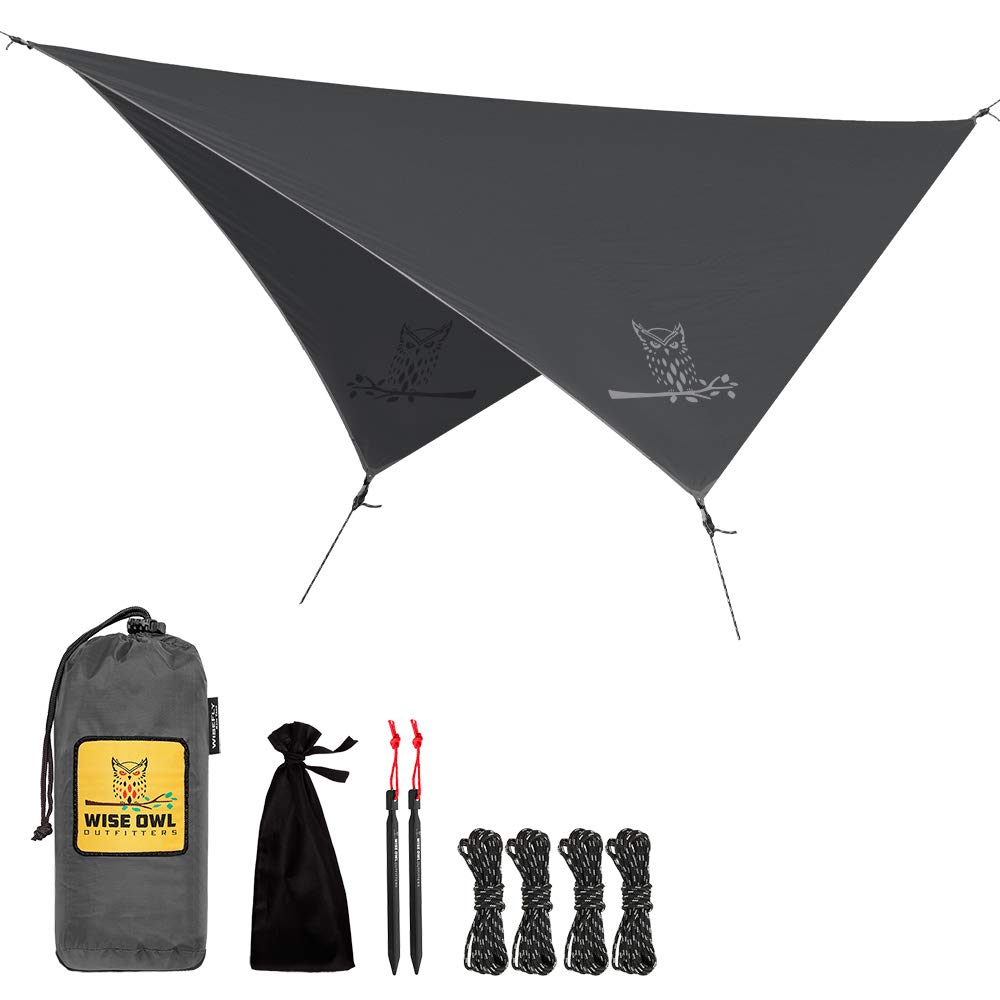
At 18.9 ounces, the Wise Owl rain fly is the one we carry when the walk in is long. The 11 x 9-foot cut covers a hammock with enough side overlap to angle the edges down, and the ripstop nylon is PU-coated to 3000 mm with taped seams. The kit includes six 10-foot guy lines, four aluminum stakes, a stake bag, and a waterproof carry bag, so there is no scramble for cord at camp.
We think it is the best backpacking pick here because the weight saving is real without turning the shelter into a fragile emergency blanket. The taped seams and coating are the same class of protection as the heavier KALINCO, and the six lines give you more pitching options than the four-stake count suggests. In a hammock setup, the extra length is what lets you pull the fly low on one side and still see out.
The 9-foot span is best for one hammock rather than a group, and the fly is not a ground sheet. Those are role boundaries, not flaws. If you want a light rain fly that goes up quickly and packs small, this is the one we recommend; if you need a footprint, choose a polyethylene tarp.
Pros
- 18.9-ounce packed weight for backpacking
- PU 3000 coating with taped seams
- 11 x 9-ft coverage for hammocks
- Includes four stakes and six guy lines
Cons
- Stuff sack is tight when repacking
For backpackers and hammock campers, we recommend this 18.9-ounce rain fly for its taped PU 3000 seams and complete stake-and-line kit.
Best for Hammock and A-Frame
FREE SOLDIER Camping Tarp
Key Features
- Size: 118 x 126 in
- Weight: 2.2 lb
- Included: 4 guy lines, stuff sack
- Waterproofing: 2500 mm PU, heat-sealed seams
- Price: Midrange
The FREE SOLDIER is the tarp we choose when we want options: its 118 x 126-inch rectangle and dense tie-out layout let you pitch an A-frame, a lean-to, or a hammock cover. The 210T ripstop polyester has a 2500 mm PU coating and heat-sealed seams, and the reinforcement at the loops is designed for tension rather than decoration.
That shape is what separates it from a square tarp. The extra width gives you more room to pull the sides down in wind, and the tie-outs sit where you want them for a hammock ridgeline. The kit includes four nylon guy lines with tensioners and a stuff sack.
We recommend it for hammock campers and anyone who likes to experiment with pitch shapes. At 2.2 pounds it is not the lightest shelter here. The trade is a larger, more adjustable canopy that handles a range of campsites. The extra width is the reason this one stays in the pack for hammock weekends, while the ultralight fly comes out for long carries.
Pros
- Roomy 118 x 126-inch rectangular canopy
- Dense reinforced tie-out layout
- 2500 mm PU coating and heat-sealed seams
- Works for hammock and A-frame pitches
Cons
- Four guy lines are sparse for exposed pitches
We recommend the FREE SOLDIER when you want a roomy, adaptable shelter for hammock or A-frame pitches; bring your own stakes.
Best for Tent Footprints
Amazon Basics Camping Tarp
Key Features
- Size: 9.5 x 11.3 ft
- Weight: 2.2 lb
- Material: Polyethylene (PE)
- Water Resistance: Waterproof
- Price: Budget
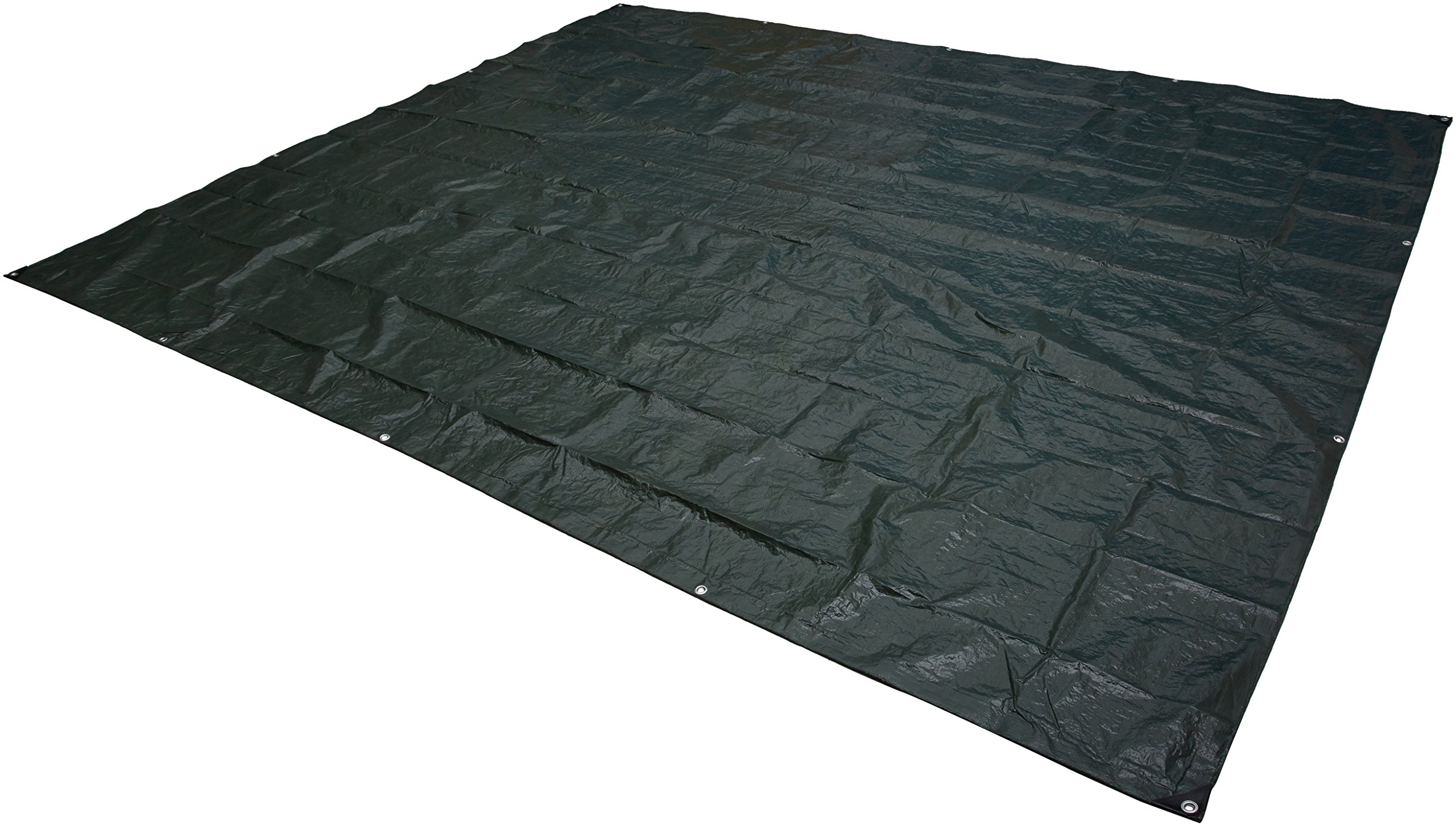
The 9.5 x 11.3-foot cut is why we like this Amazon Basics tarp as a budget ground cover. It is big enough to fold under a two- or three-person tent floor, leave a porch patch at the entrance, or drape over gear in the back of the car. The polyethylene is laminated on both sides and the corners are reinforced, so it takes scuffs from roots and gravel without asking for much care.
We use it on the ground and over equipment, not as a primary overhead shelter. The payoff is a waterproof, UV-protected sheet that shrugs off dirty jobs. If you want a tarp for a tent footprint or a quick gear cover, this is the one we keep in the car-camping bin.
The reinforced corners and edge grommets are the details that make it last through a season of tent floors and gravel. We fold the edges under when it sits beneath a tent so the tarp does not stick out and collect rain. That small habit keeps the ground sheet doing its job.
Pros
- Large 9.5 x 11.3-ft ground coverage
- Waterproof polyethylene with reinforced corners
- UV protection for gear cover
- Affordable footprint and utility tarp
Cons
- Heavy and bulky for backpacking
We keep this large polyethylene tarp in the car-camping kit as an affordable, waterproof footprint and gear cover.
Best for Family Basecamps
CARTMAN 2-Pack Tarp
Key Features
- Size: 10 x 12 ft
- Weight: 5 lb (2-pack)
- Thickness: 8 mil
- Pack Count: 2 tarps
- Price: Midrange
Two 10 x 12-foot tarps in one pack solve a different problem than a single backpacking fly: one can go under the tent while the other covers the picnic table, firewood, or a stack of gear. The 8-mil polyethylene has a 10 x 10 weave and UV protection, and the corners are reinforced for tie-downs.
We recommend this pack for family basecamps because the size is generous and the second tarp is genuinely useful, not a spare that stays in the garage. The 36-inch grommet spacing is the compromise: it is fine for draping and staking a cover, but it gives you fewer tension points than a shelter tarp with loops every couple of feet. For car camping, we accept that trade.
The pair weighs 5 pounds total, which is a car-camping commitment rather than a backpacking load. That is the right trade for a basecamp where the car carries the kit.
Pros
- Two 10 x 12-ft tarps in one pack
- 8-mil polyethylene with UV protection
- Reinforced corners and grommets
- Good basecamp value for families
Cons
- Durability varies in sustained sun and wind
For family basecamps, we recommend this two-pack of 10 x 12-foot, 8-mil tarps because one can go under the tent and one over the gear.
Best for Compact Utility
TICONN Heavy Duty Tarp

Key Features
- Size: 6 x 8 ft
- Weight: 1.2 lb
- Thickness: 5.5 mil
- Grommet Spacing: 18 in
- Price: Budget
Six by eight feet is small for a shelter and just right for a lot of camp jobs: a ground sheet under a small tent, a cover for a cooler and camp chairs, or a windbreak tied between two trees. The TICONN packs to 1.2 pounds, uses 5.5-mil polyethylene, and has grommets every 18 inches.
The 18-inch spacing is the detail that makes it more useful than a plain hardware-store tarp. You get more tie-down options along the edges, and the corners are reinforced. The silver coating reflects UV, which helps when the tarp is covering gear in the sun.
We recommend it as a compact utility tarp rather than a primary shelter. The 6 x 8-foot size is the point: it fits in a daypack and handles small jobs. For a full sleeping area, choose a 10-foot tarp. For the small jobs that come up around camp, though, it is the one we keep folded in the pack.
Pros
- Compact 6 x 8-ft utility size
- Grommets every 18 inches
- UV-resistant polyethylene
- Packs to 1.2 lb
Cons
- 5.5-mil film is thin for rough ground
We recommend this compact 6 x 8-foot tarp for quick camp utility—ground cover, gear cover, or a small windbreak—rather than a full shelter.
Best for Sun and Rain
JAICOM Camping Tarp

Key Features
- Size: 10 x 10 ft
- Weight: 2.1 lb
- Included: 6 stakes, guy lines
- UV Protection: UPF50+
- Price: Midrange
The JAICOM is the tarp we look at when shade matters as much as rain. It carries a UPF50+ rating, which is unusual among the camping tarps here, and the 10 x 10-foot polyester canopy has sealed seams and 11 webbing straps for tie-outs.
The kit is complete enough for a first tarp setup: six stakes, guy lines, and a stuff sack are included, and the 11 straps give you more attachment points than a bare-grommet tarp.
We like the webbing straps because they spread the load better than a metal grommet pulled tight against the fabric. The sealed seams and PU coating are the right call for rain, while the UV rating makes it useful over a picnic table or a sunny hammock hang.
We recommend it for hot-weather campers who want one tarp for sun and rain, and for anyone who values a full kit over the absolute lowest weight. It is heavier than the Wise Owl, so backpackers should weigh the shade benefit against the extra bulk. The UPF50+ canopy is the feature that separates it from the other 10-foot tarps here.
Pros
- UPF50+ sun protection
- 11 webbing straps for tie-outs
- Sealed seams and waterproof fabric
- Complete kit with six stakes
Cons
- 10-ft square is snug for groups
We recommend the JAICOM for hot-weather campers who want a complete 10-foot tarp kit with UPF50+ shade and sealed seams.
Best for Large Gear Cover
Vandham Poly Tarp

Key Features
- Size: 10 x 12 ft
- Weight: 2.65 lb
- Thickness: 8 mil
- Grommet Spacing: Every 1 m
- Price: Budget
At 10 x 12 feet, the Vandham covers a lot of ground for a simple polyethylene tarp. It is the size we reach for when a tent footprint needs a dry staging area, or when a woodpile, bike, or stack of camp chairs needs a quick cover.
The 8-mil HDPE is more flexible than a stiff hardware-store tarp, and the corners and edges are reinforced. The green-silver finish is a practical choice for shade and privacy, though it is not a subtle woodland color.
The grommets sit about one meter apart, which is sparser than we like for a taut overhead pitch. Fewer attachment points mean more sag between ties, so this is a cover and ground tarp first, not a wind-cheating shelter. Add guy lines to the reinforced corners and keep the pitch low if the weather turns.
We recommend it when you need a large, affordable cover and do not need a precision shelter. It is not as packable as a coated nylon fly, but the 10 x 12 footprint is the reason to choose it. Think of it as a draped cover first, and the grommet layout will make sense.
Pros
- Large 10 x 12-ft covered area
- 8-mil HDPE with reinforced edges
- Flexible material for draping
- Good value for large covers
Cons
- Durability varies in sustained sun and wind
We recommend this 10 x 12-foot HDPE tarp when you need a large, affordable cover for gear or a tent footprint, not a taut storm shelter.
How We Tested the Best Camping Tarps
We started with a list of more than 40 tarps sold by outdoor brands and general retailers, then narrowed it by coating type, grommet spacing and count, listed dimensions, and price per square foot of coverage. That left 14 tarps, deliberately spanning the range from budget polyethylene to silicone-treated nylon, so we could speak to what the extra money does and doesn’t buy.
Each tarp was weighed on a kitchen scale with its stuff sack, then carried in a daypack on a four-mile walk to see how the packed shape sat against my back. We measured the flat dimensions with a tape against the advertised numbers, then pitched an A-frame and measured the dry ground underneath it, because those two figures are rarely the same. Thickness went under calipers at three points per tarp, and we folded the same corner back and forth until the coating started to whiten or crack.
For water resistance, we pitched each tarp taut over a frame and ran a hose on it for ten minutes, watching whether water beaded and ran or soaked in and misted the underside, with paper towels underneath as a check. We then set them up three ways — A-frame, lean-to, and flat overhead — timing how long a solo pitch took and noting grommet pull-out, sag along the ridge, and wear at the corners after a night of gusty wind. Value got settled last, at the price per square foot of coverage that actually kept the rain off.
How to Choose a Camping Tarp
Start by deciding whether the tarp is your roof, your floor, or both; that single choice narrows fabric, weight, and tie-out layout faster than any specification.
Overhead Shelter or Ground Sheet?
A tarp that goes over your head has to shed rain and wind; a tarp under the tent has to resist abrasion and keep groundwater out. Coated polyester or nylon with taped seams is the right starting point for a fly, which is why we point backpackers to the Wise Owl and KALINCO. Polyethylene is tougher against scuffs and roots but heavier and bulkier, so we treat the Amazon Basics and CARTMAN as ground-cover and utility picks. Using one tarp for both jobs is possible, but choose the shelter first and fold a footprint slightly smaller than the tent floor.
Waterproofing Is More Than a Label
Hydrostatic ratings and seam treatment tell you more than the word waterproof on its own. For an exposed camp pitch, we look for a 2,500 mm or 3,000 mm PU coating and taped or sealed seams; the KALINCO and Wise Owl list those details. A polyethylene tarp does not need a hydrostatic number, but it does need intact lamination and reinforced corners where the grommets pull. Check the ridge seam and the tie-out stitching before you leave, and re-seal a peeling seam rather than assuming the factory finish will last forever.
Weight and Packed Size
An 18.9-ounce fly and a 2.2-pound polyethylene tarp feel very different after five miles. We count the whole kit, not just the fabric: guy lines, stakes, and stuff sack add up, and a tight sack is a daily annoyance in wet weather. For backpacking, start with the Wise Owl and size up only if you need a two-person shelter; for car camping, the extra bulk of the CARTMAN or Amazon Basics buys coverage and abrasion resistance. The mistake is buying a lightweight tarp for a basecamp where weight does not matter, then giving up coverage you could have had.
Tie-Outs and Pitching Hardware
Tie-out count is not a spec-sheet contest; it tells you how many ways you can change the pitch when wind shifts. We prefer reinforced webbing loops over bare grommets for overhead shelters, and we want at least six guy lines on an exposed pitch. The KALINCO’s 19 loops and the FREE SOLDIER’s dense tie-out layout give more adjustment than the CARTMAN’s 36-inch grommet spacing. Check what comes in the box, too: stakes and lines are easy to forget, and a tarp with four guy lines may need extras before a windy night.
Read the Finished Size
Advertised size and usable size are not always the same. A tarp listed as 8 x 10 may finish smaller, and grommets eat a few inches at each corner. For a ground sheet, we choose a footprint a few inches smaller than the tent floor so rain does not pool on the edges; for an overhead shelter, we want enough span to cover sleepers plus gear, with room to angle the sides down. The 10 x 10 KALINCO and 10 x 12 CARTMAN show how much difference two feet makes. Measure your tent floor or hammock span before ordering.
Frequently Asked Questions
Can I pitch a camping tarp without trees?
Yes. Use two trekking poles, paddles, or sturdy sticks set to the same height, stake the corners, and run a taut ridgeline between the supports. If you use trees, tie around the trunk with a rope or strap rather than driving anything into the bark. Keep the windward edge low and stake every available loop.
How do I keep a tarp from flapping in wind?
Pitch the low edge into the wind, keep the ridgeline tight, and add mid-point guy lines before the wind picks up. Tensioners or short bungee loops let the fabric move without pulling the stakes. If a corner keeps slapping, lower that side and re-stake it at a wider angle; a taut tarp is quieter and sheds rain better.
Will a tarp keep me warm?
No. A tarp blocks rain and wind, but it adds almost no insulation. Warmth comes from your sleeping pad and bag, so put your effort into a dry site and a pad with enough R-value. In cold weather, pitch the tarp low and seal the windward side, but leave ventilation so condensation can escape.
How do I pack a wet tarp?
Shake off loose water, roll or fold it away from your sleeping bag, and put it in a separate stuff sack or the outside pocket of your pack. Dry it completely at home before storage; a tarp packed damp can grow mildew and lose its coating. If the stuff sack is tight, a slightly larger bag makes wet repacking much easier.
Final Verdict
For most campers, the KALINCO is the tarp we recommend: it arrives with stakes and lines, has taped seams and 19 reinforced tie-outs, and packs to 1.8 pounds, so it works as a first shelter or a versatile second tarp. If you backpack or hammock camp and count ounces, choose the Wise Owl rain fly instead; its 18.9-ounce kit is easier to carry. For a car-camping footprint, the Amazon Basics tarp keeps the job simple.