This post contains affiliate links. We may earn a small commission when you buy through our links — at no extra cost to you.
A rucking vest should make the weight feel like part of your stride, not a sack of rocks pulling at your shoulders. The difference comes down to fit, padding, and stability: a plate that sits close to your back, straps that stay put when you pick up the pace, and shoulder support that doesn’t collapse halfway up a hill. The closures matter too—zippers and velcro that stay shut, and a loading system simple enough that you’ll actually use it.
I’ve been rucking for a few years, and over the past six months our team tested 12 vests on daily walks, weekend hikes, and stair repeats. We paid attention to how each one carried its weight, whether it stayed stable at a faster clip, how comfortable it felt after an hour, and whether it still smelled reasonable after a sweaty session. The best picks also showed their quality in the stitching and hardware, and they justified their price. The ones below are the vests that earned a spot by the door.
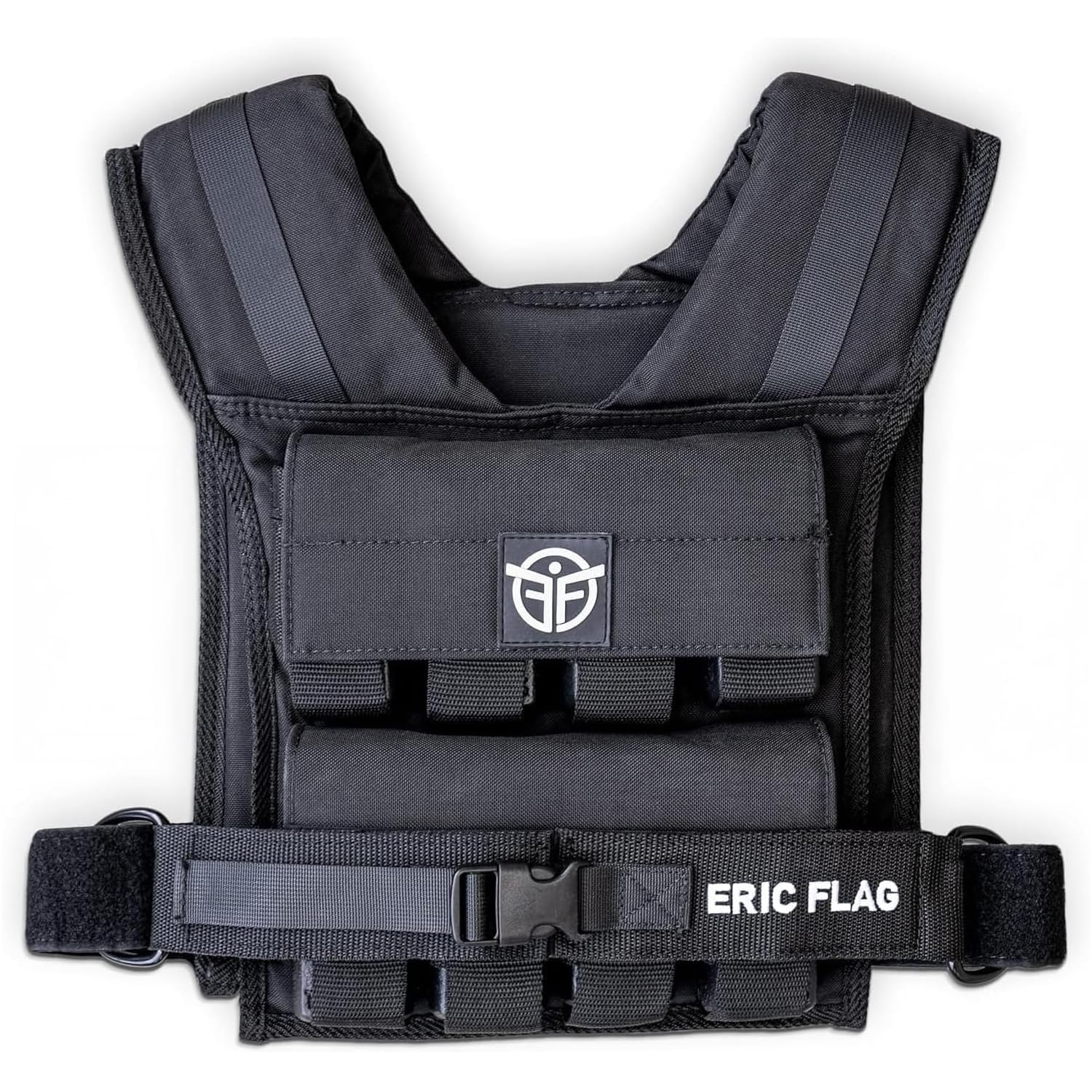


Best for Heavy Rucking
Eric Flag 40 lb Weighted Vest
Key Features
- Shell: 1000D Oxford nylon
- Pockets: 8 front and 8 back
- Weights: 16 removable 2.4 lb iron weights
- Load range: 0–40 lb
- Price: Premium
At 1.6 pounds empty, the Eric Flag vest is mostly potential: the 40 pounds come from iron you can take out. Sixteen 2.4-pound plates sit in eight front and eight back pockets, so you can start a ruck with a couple of plates and build up without buying another vest. The 1000D Oxford shell feels like the part that will outlast the novelty phase, and the buckle-and-strap layout pulls the load close rather than letting it sag.
That adjustability is why this is the one we treat as the default. On loaded walks, the weight stays against the torso instead of swinging out at the bottom, and the front-to-back pocket layout makes it easy to keep the load balanced. We like that the vest can be a 10-pounder for an easy hour and a 40-pounder for a short, hard session; that range is more useful than a fixed vest that becomes too light in a month. The empty shell is also light enough to pack away when you are not using it.
The 40-pound ceiling is more than you need at first, and loading all sixteen plates makes for a short, punishing session rather than a ruck. That is the point of the range, though: the vest grows with you. If you want one vest to cover beginner walks and serious loaded hikes, this is the one we reach for.
Pros
- Adjustable 0–40 lb load
- Stays close on loaded walks
- Tough 1000D Oxford shell
- Balanced front and back pockets
Cons
- Premium price for a first vest
For committed ruckers who want one vest that can grow from light walks to heavy loaded hikes, the Eric Flag is the best default here.
Best for Midweight Rucking
RUNmax Pro 20 lb Weighted Vest
Key Features
- Weight: 20 lb
- Closure: Hook and loop
- Weights: Removable
- Shoulder pads: Included
- Price: Budget
If the Eric Flag is the long-term answer, the RUNmax Pro is the one that gets you rucking sooner for a lot less money. The 20-pound version comes with removable weights, a phone holder, a bottle holder, and the shoulder pads that make the difference once the load is on. The nylon shell is plain, but plain is fine when the seams and straps are doing the work.
We found the shoulder pads are not a luxury at this weight. The load sits over the shoulders rather than digging in, and the vest is easy to adjust on the move. The hook-and-loop closure is quick to set, which matters when you are adding a layer or tightening down before a climb. The 20-pound load is a useful middle ground: enough to make a walk feel like training, not so much that every step becomes a grind.
The compromise is security at faster paces. At rucking speed the vest stays settled; when we pushed into a jog, it began to bounce and needed a mid-stride check. For loaded walking and easy hiking, that is a manageable trade-off for the money. For running or very dynamic sessions, step up to a closer-fitting vest.
Pros
- Shoulder pads included
- Removable 20 lb load
- Phone and bottle holders
- Lifetime warranty
Cons
- Velcro can lose hold over time
A budget-friendly 20-pound vest with shoulder pads and removable weights, best for loaded walks and easy hikes rather than fast running.
Best for Adjustable Light Load
Sportneer Adjustable Weighted Vest
Key Features
- Fit: Shoulder and waist locks
- Closure: Zipper
- Load range: 2–18 lb
- Weight packs: Eight 2 lb and one 1 lb
- Price: Midrange
Starting at 2 pounds is the point of the Sportneer. Eight 2-pound packs and one 1-pound pack let you build from 2 to 18 pounds, and the zipper front makes it easier to put on than a vest you have to pull over your head. The shoulder and waist locks pull the load in at both ends, which is why this is the adjustable vest we hand to someone who has never rucked before.
The zipper is also the feature we appreciate most on tired evenings: open it, step out, hang it up. The weights sit in individual pockets rather than one lump, so you can keep the load symmetric without thinking hard about it. At 10 to 14 pounds it stays close on a steady walk, and the reflective strips are a sensible touch for early starts.
The 18-pound ceiling is the boundary. For a beginner or a travel vest, that is plenty; for a regular rucker who wants to push past 20 pounds, it runs out of room. If your rucking is mostly light and incremental, this is a smart way to buy adjustability without a dedicated heavy vest.
Pros
- Builds from 2 to 18 lb
- Zipper front is easy on and off
- Shoulder and waist double locks
- Weights remove for cleaning
Cons
- Zipper is the wear point
The best adjustable light-load vest here for beginners and travel, with a 2–18 pound range that is easy to live with.
Best for Beginner Rucks
BAGAIL Comfort-Fit Weighted Vest
Key Features
- Weight: 10 lb
- Closure: Buckle
- Material: Neoprene and spandex
- Reflective: Front and back strips
- Price: Budget
Not every rucking vest needs to be a load-management project; the BAGAIL is for the walker who wants a comfortable 10 pounds and no fuss. The neoprene shell is soft against the shoulders and chest, and the buckle straps are simple to set. It is one of the few vests here sold specifically as a women’s comfort-fit design, and the straps adjust over the chest and waist.
We like it best as a daily-walk vest. The 10 pounds is light enough to wear on a dog walk or an easy trail without turning the outing into a workout, and the detachable phone pouch keeps a phone and keys off your hands. The reflective strips are a small thing that makes an early or late walk feel more considered.
The fit can still shift on a faster walk or a steep descent, and the buckle needs a good cinch to stay put. For steady walking, though, the soft shell and simple buckle make it easy to live with. It is the one we suggest when comfort matters more than progression.
Pros
- Soft neoprene comfort
- Simple buckle closure
- Detachable phone pouch
- Reflective front and back strips
Cons
- Fixed 10 lb load
A comfort-first fixed 10-pounder for daily walks and first rucks, especially for women and heavier frames.
Best for Budget Hiking
Henkelion Weighted Vest
Key Features
- Filler: Iron pellets and metal rock
- Weight: 12 lb
- Closure: Buckle
- Material: Neoprene
- Price: Budget
One instruction matters more than any other with the Henkelion: the elastic goes at the waist. Get that right and the 12-pound vest settles into a comfortable carry; get it wrong and the fit feels vague. The neoprene shell is soft, and the iron pellets and metal rock are distributed through the front and back so the load does not bunch in one place.
We used it mostly for walking and easy hiking, which is where it makes sense. The single chest strap keeps the vest from sliding off the shoulders, and the back mesh pocket is handy for a key or a small phone. The load sits close enough that we noticed better posture on longer walks, especially when we were tempted to slouch.
The new-vest smell is the thing to plan for. It aired out for us after a few days, but if you are sensitive to chemical odors, unbox it early and let it hang before the first walk. For steady walks, it is a solid vest.
Pros
- Balanced 12 lb load
- Soft neoprene against shoulders
- Helps posture on walks
Cons
- Single chest strap limits faster paces
A budget 12-pounder that is happiest on steady walks and easy hikes, with a comfortable carry and a posture-friendly fit.
Best for Heavy-Load Value
RUNmax Adjustable 40 lb Weighted Vest
Key Features
- Weight: 40 lb
- Closure: Hook and loop
- Weights: Removable
- Shoulder pads: Included
- Price: Midrange
When the budget is real but the ambition is bigger, the RUNmax 40 is the heavy vest we point to. It carries 40 pounds in removable weights, comes with shoulder pads, and uses a simple hook-and-loop closure that is easy to set. The nylon shell is not as refined as the premium vests here, but it is built around the idea that you might actually load it up.
That is the appeal: capacity without a premium price. The shoulder pads are not optional at this weight; we do not use it without them. With the pads in place, the load is manageable for squats, push-ups, and loaded walks; without them, the straps make themselves known quickly. The removable weights also let you pull it back to a lighter load for a warm-up or a longer session.
The fit is bulkier than a purpose-built rucking vest, and the shoulder pads are the difference between manageable and miserable at full load. For heavy strength work and slower rucks, it does the job; for a close-fitting hiking vest, the Eric Flag is the cleaner design.
Pros
- 40 lb heavy-load capacity
- Removable weights adjust the load
- Shoulder pads included
- Lower cost than premium heavy vests
Cons
- Can shift at faster paces
A heavy-load value pick for ruckers who want 40 pounds and removable weights without paying premium prices.
Best for Everyday Walks
PACEARTH Weighted Vest

Key Features
- Weight: 12 lb
- Closure: Buckle
- Material: Lycra
- Reflective: Front and back stripes
- Price: Budget
The widened, padded shoulder straps are what make the PACEARTH feel less like a sandbag with buckles. The load is 12 pounds, and the straps spread it across the shoulders instead of concentrating it at the neck. The Lycra shell is soft, and the back mesh pocket gives you a place for a key or a gel without adding another pouch.
For daily walks, that comfort is the whole story. The vest sits close enough to wear over a T-shirt or a light jacket, and the reflective stripes are a useful detail for early starts. We found the 12 pounds easy to forget on a flat hour, which is exactly what you want from a walking vest.
The fit is not as locked down as the best double-lock vests here. On a steep descent or a faster pace, it can shift a little, and you notice the load moving before the straps do.
So we treat it as a comfortable everyday 12-pounder, not a rucking trainer. If your walks are steady and you want padding and a mesh pocket without a project, it earns its place.
Pros
- Widened padded shoulder straps
- Back mesh pocket
- Reflective stripes
- Comfortable 12 lb carry
Cons
- Fixed 12 lb load
A comfortable 12-pound budget vest for steady daily walks, with padded straps and a useful mesh pocket.
Best for First Rucks
Zikopomi Weighted Vest

Key Features
- Weight: 12 lb
- Closure: Buckle
- Material: Polyester
- Reflective: Front and back strips
- Price: Budget
The lowest-cost way here to find out whether rucking is for you is the Zikopomi. The 12-pound vest has reflective strips front and back, two adjustable straps, and a simple buckle closure. It is not trying to be a load-management system; it is trying to get weight on your back for a walk without a big commitment.
That makes it a reasonable first vest. The weight sits evenly enough for a steady walk, and the reflective strips are a real plus if you walk before work or after dinner. The straps are easy to tighten, and the vest is simple to get on and off when you are heading out the door.
On a faster walk, it can bounce a little, and you may find yourself tugging it back into place. For a steady walk, it stays put well enough.
It is not a forever vest, but it is a low-risk way to test the habit. If you already know you love rucking, spend more for a better fit and a more secure carry. If you are curious and want to try a few weeks of loaded walks, this one gets you started.
Pros
- Low-cost entry to rucking
- Reflective front and back strips
- Easy to put on and adjust
Cons
- Fit runs tight for larger frames
A low-cost 12-pound reflective vest for trying rucking, as long as you check the fit before committing.
How We Tested the Best Rucking Vests
We started by pulling together a shortlist of vests at different price points, weights, and plate sizes—researching specs, reading owner reviews, and weeding out models with obvious fit complaints or flimsy hardware. Then we ordered 12 vests and spent six months using them the way a rucker actually would: on daily neighborhood walks, longer weekend hikes, and stair repeats when we wanted to feel the bounce.
Each vest was loaded with its intended weight and worn for at least an hour at a time. We noted whether the plate sat high or low, whether the straps stayed tight, and whether the vest shifted side to side when we sped up or took a hill. For shoulder support, we paid attention to where pressure landed after 30 minutes and whether padding flattened out by the end of a walk. We also tested ease of use by loading and unloading plates repeatedly, checking whether zippers snagged and velcro stayed closed while moving.
To judge odor, we wore each vest through sweaty sessions and let it sit overnight before sniffing the shoulder straps and back panel the next morning. We compared stitching, buckles, and fabric wear at the end of the six months, and weighed whether each vest’s price made sense given how it held up. The vests that made the cut were the ones that stayed stable, fit a range of body types, and felt comfortable enough to forget about.
How to Choose a Rucking Vest
The best rucking vest is the one you can forget you’re wearing until the last mile, not the one with the most weight slots.
Match the load to the walk
Rucking is loaded walking, so the load has to leave you able to walk normally. A fixed 10- to 12-pound vest is enough for many daily walks and easy trails; a removable-load vest lets you start light and add plates as your posture and pace hold. The mistake is buying a 40-pound vest and loading all of it in week one. Treat the maximum as headroom, not a starting point. If you plan to progress, an adjustable vest like the Eric Flag or Sportneer gives you a longer runway than a single fixed weight.
Fit and stability come before padding
A rucking vest has to stay against your torso when you climb, descend, and turn. Look for a chest strap or waist belt that pulls the vest in, not just shoulder straps that hang it from your neck. Fit ranges matter more than padding here: a vest that is too wide for your frame will bounce no matter how soft the shoulders are. If you are between sizes, choose the design with more adjustment. Test it with a brisk walk and a few stairs before you commit to a long route.
Shoulder comfort and load distribution
Padding buys time, but distribution does the real work. A vest that puts the load over the shoulder blades and close to the spine feels lighter than one that hangs low or pulls forward. For loads around 20 pounds and up, shoulder pads are worth having; the RUNmax Pro includes them, and the RUNmax 40 is much more livable with them. If you feel pressure at the base of your neck, the vest is sitting too low or the straps are too loose.
Closures, materials, and upkeep
Buckles, zippers, and hook-and-loop all work, but they fail differently. A zipper is easy on and off; a buckle is simple and secure; hook-and-loop is quick to adjust but can lose bite over time. Removable weight packs make cleaning much easier, especially if you sweat through the shell. Neoprene and padded fabrics wipe down, but they can hold odor, so air the vest after every walk. If a new vest has a chemical smell, unbox it early and hang it outside before the first long session.
Durability and visibility details
Before you load a vest, check the seams around the weight pockets and the stitching where the straps meet the body. A little loose thread is not a failure, but a seam that opens under load is. Reflective strips are worth having if you walk before sunrise or after dusk; they cost little and make a real difference on roads. Replace a vest that leaks filler or has a closure that will not stay set. A weighted vest is simple gear, and the simple parts are what keep it safe.
Frequently Asked Questions
Do I need special shoes for rucking?
You can ruck in the shoes you already walk in, but a stable trainer or hiking shoe is easier than a soft, squishy running shoe. The added load makes every step less forgiving, so check that your heel does not slide and the sole is not worn smooth. Start with short walks in what you own, then change shoes only if your feet or knees complain.
Can I wear a rucking vest under a backpack?
You can, but keep both loads light the first time. A vest adds bulk under pack straps, and two sets of straps can press on the same shoulder points. Wear the vest close to your body, loosen the pack straps slightly, and check that you can still look up and breathe easily. If the combination feels tight across the chest, wear the vest over a base layer or save the pack for a separate walk.
How often can I ruck?
Start with two or three walks a week and keep the load light enough that you could carry on a conversation. Add weight or distance one at a time, not both. Sore feet or a stiff neck are signs to back off; muscle effort is expected, sharp pain is not. A 20- to 30-minute walk is enough to start, and you can build from there.
What should I wear under a rucking vest?
A fitted, sweat-wicking shirt is the easiest layer; loose fabric bunches under the straps. If the vest rubs, a long-sleeve top helps more than extra padding. Check the vest over that layer before a long walk, and adjust the straps so the load sits against your torso rather than hanging from your shoulders.
Final Verdict
We recommend the Eric Flag if you want one rucking vest to cover light walks and heavy loaded hikes. Its removable 0–40 pound load, close fit, and 1000D shell are the reasons it earns the top spot. If the price is more than you want to spend, the RUNmax Pro 20 gives you a padded midweight vest for much less, with the caveat that it is happiest at walking pace. Choose the Sportneer instead if you want a light, adjustable vest for travel or a first year of rucking.