This post contains affiliate links. We may earn a small commission when you buy through our links — at no extra cost to you.
Ask anyone who runs with a weighted vest and you’ll hear the same complaint: the ones that fit snugly enough to stay put are the ones you want off after two miles. Add 10 pounds to your shoulders and every design flaw announces itself — straps that bite, plates that shift when you turn, a back panel that turns into a swamp by mile three. That tradeoff is why two vests that look identical online can feel completely different on the road. The right one spreads the load across your torso instead of hanging it off your shoulders, so you can add weight without changing your stride.
I’ve spent the past six months running in 12 different vests, and the ones that stuck around all had one thing in common: they stayed quiet. Hitting the listed weight is the easy part. Fit, comfort over distance, and how a vest smells after a week of sweaty miles are what separate a keeper from closet clutter. The picks below are the ones I kept reaching for, each for a different reason.




Best for Everyday Weighted Running
RUNmax 20 lb Weighted Vest
Key Features
- Load: 20 lb, removable weights
- Shell: 1000D nylon
- Closure: Quick-release buckles
- Chest fit: 28–48 in
- Price: Midrange
The RUNmax 20 LB won us over with its chest range before we even loaded it: 28 to 48 inches is the broadest fit here, and that matters more for running than another inch of padding. The 20-pound version uses removable weights, so you can start lighter and add load as your easy runs settle down. The 1000D nylon shell and quick-release buckles give it a more serious training feel than the budget vests in this guide.
This is the no-shoulder-pad version, and we like the low-bulk shape for running. The trade is obvious: if you want a plusher shoulder feel, the pad-equipped version or the PACEARTH is the better call. We also appreciate the waist strap because a 20-pound load needs a second anchor; cinch it first, then set the chest buckle. At faster paces, check the lower strap again before you add speed.
Durability is where the RUNmax earns its place near the top of this set. The reinforced nylon and lifetime warranty are reassuring, and the removable weights make it easier to inspect the pockets than a sealed sand vest. It is not the cheapest pick, and it is not the lightest, but it is the one we recommend as the default running vest because it can be a lighter starter or a full 20-pound training tool without changing vests.
Pros
- Broad 28–48 in chest fit
- Removable 20 lb load
- 1000D nylon shell
- Quick-release buckles
Cons
- Can bounce if the waist strap is loose
We recommend the RUNmax first because its broad chest fit, removable load, and tough shell make it the most adaptable running vest here.
Best for First Weighted Runs
PACEARTH 12 lb Weighted Vest
Key Features
- Load: 12 lb fixed
- Straps: Two adjustable straps
- Shoulders: Padded shoulder straps
- Visibility: Reflective stripes
- Price: Budget
The PACEARTH is the vest we hand to a runner who wants to try weighted running without committing to a modular system. The 12-pound load is fixed, the two straps are adjustable, and the shoulder straps are widened and padded enough that the vest does not feel like a sandbag with buckles. For a first weighted vest, that simplicity is the point: there are no little weights to lose and no loading chart to learn.
We recommend it most for steady easy runs and walk-run days, where the fixed 12 pounds is enough resistance and the reflective stripes and back mesh pocket add useful practicality. The fixed load is the real limit: this is a first vest, not a progression tool. Air it out before the first outing, because the new-vest smell is the other thing to check. The two-strap fit is the part that needs attention at faster paces.
Pros
- Padded, widened shoulder straps
- Reflective stripes for low light
- Back mesh pocket
- Simple buckle-and-strap design
Cons
- Can slide up at faster paces
We recommend the PACEARTH as the simple fixed-weight first vest for steady easy runs, as long as you set the straps snugly.
Best for Progressive Heavy Training
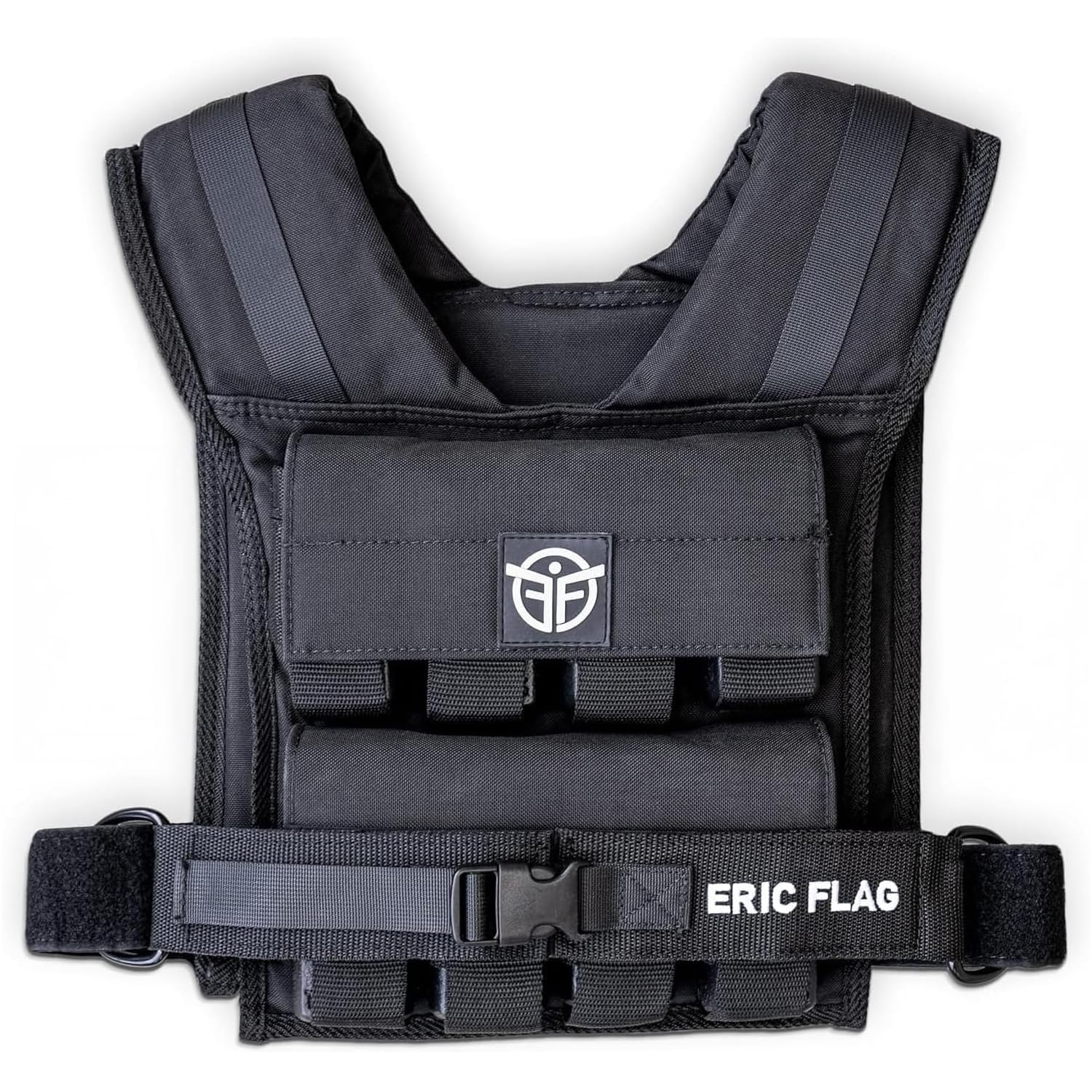
Eric Flag 40 lb Weighted Vest
Key Features
- Fit: Adjustable strap
- Load: 40 lb max
- Shell: 1000D Oxford nylon
- Weights: Sixteen 2.4 lb iron weights
- Price: Premium
Forty pounds is too much for most running, and that is exactly why the Eric Flag belongs here as a specialist rather than the default. The vest ships with sixteen 2.4-pound iron weights and a 1000D Oxford shell that feels built for calisthenics, rucking, and heavy strength phases. We do not start a new runner here. The point is progression: load it light for a jog, then add weights for hill repeats or strength days.
What we like most is how the weight is held: eight pockets front and eight back, each with a removable 2.4-pound iron weight, so the load can be balanced instead of dumped into one compartment. The empty vest weighs 1.6 pounds, which keeps the shell honest when you strip it down. The single adjustable strap is the part to check; a 40-pound load magnifies any looseness, so get the fit right before you add weight.
This is a premium vest, and it earns that place for a narrow buyer: someone who wants one vest to cover weighted pull-ups, rucking, and heavy run-walk sessions. For everyday easy runs, the RUNmax or PACEARTH is easier to live with. The Eric Flag is the one we choose when the session is the point, not the scenery.
Pros
- Sixteen removable 2.4 lb weights
- Tough 1000D Oxford shell
- Balanced eight front and eight back pockets
- Light 1.6 lb empty shell
Cons
- Single adjustment strap limits fine-tuning
- Overkill for everyday running
We recommend the Eric Flag for progressive heavy training, not everyday running, because its removable 40-pound load is a specialist tool.
Best for Women Runners
BAGAIL 10 lb Weighted Vest
Key Features
- Load: 10 lb fixed
- Pouch: Detachable phone pouch
- Shell: Neoprene and spandex
- Visibility: Front and back reflective strips
- Price: Budget
The BAGAIL is cut and marketed for women, and that is the first reason we kept it in the roundup. The 10-pound load is light enough for walk-run sessions, and the neoprene shell with front and back reflective strips looks more like a fitness layer than a tactical vest. The detachable phone pouch is the detail we appreciate most: you can move it to the front, reach your phone, and get it out of the way again.
Fit is where this one earns its keep or loses it. The straps adjust over the chest and waist, and the shape is more accommodating than a unisex box, but it is not a universal plus-size solution. Check that the chest and waist straps still overlap with room to tighten; if they do not, the RUNmax’s broader chest range is the safer pick. The fixed 10-pound load is the other boundary to accept before ordering.
We recommend the BAGAIL for a woman who wants a lighter vest for walking, easy jogging, and gym circuits, especially if the detachable pouch appeals. It is comfortable enough to wear over a normal workout top, and the reflective details make early or late sessions feel less exposed. For pure running at pace, the RUNmax is the more secure shape.
Pros
- Women’s-specific cut
- Detachable phone pouch
- Front and back reflective strips
- Comfortable neoprene shell
Cons
- Fixed 10-pound load
- Can shift at faster paces
We recommend the BAGAIL for women who want a lighter fixed vest and a reachable phone pouch, provided the straps close with room to tighten.
Best for Lightweight Runs
Zeerun 10 lb Weighted Vest
Key Features
- Load: 10 lb fixed
- Straps: Adjustable buckle strap
- Shoulders: Thickened shoulder pads
- Visibility: Reflective stripes
- Price: Budget
The Zeerun 10 LB is the narrow-fit option in this group. The thickened shoulder pads and elastic band make it feel cushioned rather than boxy, and the 10-pound load is light enough for short jogs and daily walks. We noticed the buckle and strap arrangement is simple to adjust, which matters when you are changing layers in cold weather.
The catch is sizing. The vest runs small, especially across the chest, so it suits narrower frames and smaller chests better than broad shoulders. If you are near the top of the fit range, check the strap overlap before you commit; the same close cut that keeps it from bouncing can become restrictive. The reflective stripes are a useful bonus for early starts.
We recommend the Zeerun for a smaller runner who wants a light, padded vest for easy sessions and does not need to add weight. It is not the one for a broad chest or a heavy progression; the RUNmax covers that ground. For the right frame, it is a comfortable and simple way to add a little resistance without a lot of fuss.
Pros
- Thickened shoulder pads
- Light 10-pound load
- Adjustable buckle and elastic band
- Reflective stripes
Cons
- Runs small across the chest
We recommend the Zeerun for smaller-framed runners who want a padded light load, but the narrow sizing is the first thing to check.
Best for Low-Light Routes
ZELUS 12 lb Weighted Vest

Key Features
- Load: 12 lb fixed
- Extras: Phone armband pouch
- Chest fit: 31.5–45 in
- Visibility: Reflective stripes
- Price: Budget
The ZELUS is the low-light pick. The reflective strips are the first thing you notice, and the 12-pound load is fixed and simple. The chest range is 31.5 to 45 inches, which covers a lot of runners without the bulk of a modular vest. We like the armband pouch for a phone and the rear mesh pocket for keys; they keep the small stuff off your hands without turning the vest into a pack.
We recommend it for early-morning or evening walk-runs where visibility matters as much as the load, and for anyone who wants a straightforward 12-pound vest without a progression system. The fixed weight is the limit: once 12 pounds feels easy, there is no next step here. The chest range is also a hard stop; measure before ordering rather than assuming the buckles will take up the slack.
The ZELUS is not the most refined vest here, but it is one of the easiest to recommend on a tight budget. The reflective detailing and phone pouch give it a practical edge for dark starts, and the fixed load keeps the price and the fuss low. If you need to add weight or fit a chest outside the stated range, the RUNmax is the better answer.
Pros
- Reflective stripes
- Phone armband pouch
- Rear mesh pocket
- Fits 31.5–45 in chest
Cons
- Strong new-vest odor can linger
We recommend the ZELUS as a budget low-light vest for walk-runs, provided you can air out the new-vest smell before regular use.
Best for Short Easy Runs
Zikopomi 12 lb Weighted Vest

Key Features
- Load: 12 lb fixed
- Shell: Polyester and iron sand
- Straps: Two elastic straps
- Visibility: Front and back reflective strips
- Price: Budget
The Zikopomi is the easiest vest here to get on and off. Two elastic straps and a buckle do the work, and the 12-pound load is balanced enough for a short run or a brisk walk. The reflective strips on the front and back are a sensible touch for evening sessions, and the price is low enough to treat it as a second vest or a starter.
The fit is the limiting factor. The elastic straps have a finite range, and the vest can run loose on smaller frames or feel too snug on broader chests. Check the strap overlap before you run; if the vest shifts when you jog in place, it will only get worse at pace. The balanced iron-sand fill is a plus, but it does not fix a shell that is the wrong shape for you.
We also noted that the simple design has no removable weights, so the 12-pound load is the load you get. That makes it a poor choice for progression, but a reasonable one for someone who wants one vest for short, easy sessions and does not want to fiddle with pockets.
We recommend the Zikopomi as a low-cost backup or a first weighted vest for short runs, not as the main training vest for a serious runner. The RUNmax costs more but gives you a broader fit and removable weights; the Zikopomi’s advantage is that it is simple, light, and easy to live with. If the straps close with room to spare, it is a lot of vest for the money.
Pros
- Easy on/off with two elastic straps
- Balanced 12-pound load
- Front and back reflective strips
- Budget-friendly starter vest
Cons
- Limited strap adjustment for smaller frames
We recommend the Zikopomi as a low-cost short-run starter for buyers whose frame matches its limited strap adjustment.
How We Tested Weighted Vests for Running
We built the shortlist from roughly 40 vests sold by established fitness brands, filtering on weight ranges, closure style, and whether the load was adjustable. From that group we ordered 12 — plate-loaded, sandbag, and hybrid designs, in both fixed and adjustable fits. Anything that came in a single one-size-fits-all cut got cut early, since chest circumference matters far more than height when you’re trying to keep a vest from bouncing.
Each vest went through the same rotation: a 5K treadmill run, a hill interval session, a 45-minute steady effort, two outdoor runs in heat, and one long slow weekend run, all loaded to roughly 10 percent of body weight. Between runs we weighed every vest on a kitchen scale, empty and loaded, to see whether the stated weight matched reality and where that load actually sat on the torso. We logged whether the vest crept up on downhills, swung out on turns, or stayed put through a sprint finish.
Comfort was judged over distance rather than in the mirror. We noted chafing at the shoulders and ribs, how hot the back panel ran, and whether we could loosen or remove the vest mid-run without wrestling with it. Quality got the laundry test: three wash cycles per vest, plus a sniff check after two back-to-back sweaty runs to see which fabrics held odor and which aired out overnight, along with a look at stitching, buckles, and whether the weight pockets stayed shut.
We judged versatility and value last. A vest that only worked for running, with no way to change the load, had to be considerably cheaper to justify a spot. We also wore each one for walks, rucking, and bodyweight circuits to see how far it stretched past the run.
How to Choose a Weighted Vest for Running
The best running vest is the one that stays close enough to forget about between strides, so we start with fit and load, not with the longest feature list.
Start With the Load You Can Run With
A weighted vest is not a barbell; the load has to leave your stride alone. Fixed vests are simpler and usually cheaper, but they lock you into one weight. Removable-weight vests cost more and take longer to set up, yet they let you start light and add plates as your easy runs adapt. For most runners, a 10- to 20-pound vest covers training; the Eric Flag’s 40-pound ceiling is a specialist tool for strength phases, while the RUNmax’s 20-pound removable load is the more useful everyday starting point.
Fit Is the Real Bounce Control
Bounce is rarely solved by a thicker strap alone; it comes from a vest that can be cinched around your torso, not just hung from your shoulders. Look for a stated chest range, two adjustment points where possible, and a lower strap that sits on your ribs rather than your waist. A women’s cut can make a real difference, but it is not a plus-size guarantee: check that the chest and waist straps still overlap with room to tighten. The BAGAIL is our women’s-cut pick for that reason, and the RUNmax’s 28- to 48-inch chest range is the broadest here.
Comfort and Odor Matter More Than Padding Alone
Padding helps on long efforts, but heat and smell decide whether you keep reaching for the vest. Neoprene and closed shells trap sweat, and a new chemical odor can linger for days. Air out a new vest before the first run, wipe it after sessions, and choose a removable-weight design if you want to inspect or dry the pockets. The Zeerun’s thick shoulder pads and the PACEARTH’s widened straps are the comfort details we notice most in this set; both still need a proper airing.
Check the Seams, Fill, and Visibility
The weight is only useful if it stays inside the vest. Look for double stitching, reinforced stress points, and pockets that close securely over the filler; a vest that leaks sand or iron shot is finished. If you run at dawn or after work, reflective strips are worth prioritising, and a phone pouch you can reach without stopping is more useful than a deep rear pocket. Empty removable weights before cleaning, and spot-clean fixed-fill vests rather than putting them through a machine.
Frequently Asked Questions
Can I use a weighted vest for speed workouts?
Not for interval or tempo paces. A weighted vest is best for easy runs, hills, and strength-endurance blocks; wearing one for speed work changes your stride and makes it harder to hold form. Keep the fast sessions unweighted and use the vest when the goal is effort rather than pace.
Is a weighted vest better than a weighted backpack for running?
For running, a vest is the better shape. It wraps the load around your torso and leaves your arms free, while a backpack sits behind you and pulls on the shoulders. A pack can work for hiking if the load is low and the hip belt carries it, but for jogging choose a vest with a chest strap and a lower adjustment.
Can I wear a weighted vest under a jacket?
You can, as long as the jacket does not stop you cinching the chest and waist straps. Set the vest fit over a base layer first, then add a loose shell; a tight jacket can turn a good fit into a restrictive one. If you need to adjust mid-run, wear the vest outside the shell instead.
Final Verdict
The RUNmax 20 LB is the weighted vest we point runners to first. Its 28- to 48-inch chest range is the broadest here, the removable weights let you start lighter than the full load, and the 1000D nylon shell gives it a training-tool feel that the budget vests do not match. Choose the PACEARTH if you want a simple fixed 12-pound vest, the Eric Flag if your training is ready for 40 pounds, or the BAGAIL if you want a women’s cut and a lighter load. The right pick is the one you can cinch close and forget about between strides.