This post contains affiliate links. We may earn a small commission when you buy through our links — at no extra cost to you.
The first time I tried to haul a boned-out deer in a discount backpack, a shoulder strap ripped free before I’d gone a quarter mile. A hunting pack has to do more than carry gear—it has to stay quiet, keep weight off your hips, and survive brush, blood, and weather. The wrong one turns a good hunt into a long, miserable walk out. The right one disappears on your back until you need it.
Over the past nine months, my team and I have carried 12 different packs—from compact daypacks to multi-day frames—through scouting trips, preseason range sessions, and two big-game seasons. We loaded them with everything from day-hunt essentials to 80-pound mock hauls, and the differences in capacity, zipper quality, strap comfort, and how each pack handled rain were stark. One thing I’ve learned: a pack that feels fine in the store can turn into a chafing, noisy mess after five miles. The picks below are the ones that earned their place on our backs—and justified their price tags.


Best for All-Round Day Hunts
TIDEWE Hunting Backpack
Key Features
- Pockets: 7
- Capacity: 2200 cu in
- Pack weight: 3.7 lb
- Water resistance: Waterproof
- Price: Midrange
The pack is listed at 2,200 cubic inches, which is the size most hunters actually need: room for a jacket, calls, water, snacks and a kill kit, without the bulk of an overnight pack. Seven pockets and five compartments keep that gear from becoming one heap at the bottom, and the waist and side compartments put a call and a rangefinder where your hand expects them. Among the packs here, this is the one we hand to almost everyone.
The fabric is the part we appreciate most. It is a soft, matte polyester that does not rustle or catch the light, and the Next Camo G2 print is subdued enough for timber without looking like a costume. The channeled back panel and padded shoulder straps handled a loaded walk in well, and the waist belt genuinely takes weight off your shoulders when climbing sticks go on the outside. At 3.7 pounds it is not the lightest pack here, but you are carrying padding and structure rather than dead weight.
Zippers are the part we keep an eye on. The pulls work and the teeth have held, but they are not silent, and that is the one moving part worth checking before a season starts. Otherwise it is ready to hunt out of the box, and it costs less than the premium packs here, which leaves money for glass.
Pros
- Quiet matte fabric that does not rustle
- Seven pockets keep a day’s gear separated
- Waist belt takes weight off the shoulders
- Subdued Next Camo G2 pattern
Cons
- Zipper pulls are not silent in the field
For most hunters this is the pack to buy: quiet camo fabric, seven well-placed pockets and a harness that stays comfortable on a loaded walk in.
Best for Bow and Rifle
ALPS OutdoorZ Pursuit Pack
Key Features
- Pockets: 5
- Capacity: 44 L
- Rain cover: Blaze orange, included
- Water resistance: Water resistant
- Price: Premium
The drop-down pocket is the reason to look at the Pursuit. Fold the front panel down and your bow or rifle sits in a cradle against the pack instead of swinging from two straps, leaving both hands free for a climb or a drag. Quiver holders on either side keep arrows where you can count them, webbing loops take the rest of your kit, and a blaze orange rain cover lives in a zippered pocket at the base — exactly where you want it when the sky turns and you are already committed.
At 44 liters it is the largest pack here that still counts as a day pack, and that is the sweet spot for late-season hunts where a puffy, a thermos and spare layers come along. An aluminum stay and a removable padded waist belt let it carry real weight properly, and the integrated shelf keeps the bottom of the pack organized rather than a sack of loose gear. We think it justifies its premium price for anyone who hunts with a weapon strapped to the pack.
The hardware is the caveat. Chest straps and waist buckles are the parts that let go on this design, and a buckle that releases under load is worth testing at home rather than on a ridge in the dark. The shell itself shrugs off brush and thorns, and a limited lifetime warranty covers the pack if a seam does fail. For a short walk to a blind it is more pack than you need; for bow seasons and Western rifle trips it does the most of anything here.
Pros
- Drop-down pocket cradles a bow or rifle
- Quiver holders and lashing webbing on both sides
- Blaze orange rain cover stowed at the base
- Aluminum stay and padded waist belt carry heavy loads
Cons
- Chest strap and waist buckle can fail
If you climb or hike with a bow or rifle on your back, this is the pack we point you to: a secure drop-down weapon pocket, quiver holders and a rain cover, with the harness to match.
Best for Quiet Rifle Stalks
YVLEEN Hunting Backpack 30L
Key Features
- Pockets: 10
- Capacity: 30 L
- Weapon carry: Rifle holder
- Water resistance: Waterproof
- Price: Midrange
Rifle hunters who stalk rather than sit get the most out of this one. The fabric is the soft, soundless sort that does not announce every step to the next ridge, and the Forest Shadow Green camo sits dark against timber instead of glowing like a safety vest. Ten pockets on a 30-liter body is a lot, and it is the reason the pack punches above its size: there is a place for calls, a place for gloves, and a place for the things you would otherwise be digging for with cold hands.
The rifle holder is the other half of the pitch. It seats the gun across the pack firmly enough that you are not re-strapping it every half mile, and the waist belt and chest strap keep the load from shifting when you move through cover. We also liked the zipper pulls, which are long enough to work with gloves on — a small detail that stops being small in November. One quirk: tuck the stock into the side pocket and that pocket will not zip closed, so strap the gun and leave it empty.
Thirty liters is a day’s gear, not a week’s, and the pack is honest about that. Shell, layer, lunch, water and a kill kit fit with room to spare; a treestand and a quartered deer do not. Set against the ALPS it gives up volume and dedicated weapon hardware and gains quiet fabric, a tighter carry and a lower price. That is the trade most rifle hunters here should be making.
Pros
- Soundless fabric that stays quiet in brush
- Dedicated rifle holder keeps your hands free
- Ten pockets in a 30-liter body
- Waterproof shell with a snug waist belt
Cons
- Chest strap runs short over winter layers
Our pick for rifle hunters who move: soundless fabric, ten well-placed pockets and a rifle holder that keeps both hands free.
Best for Light Treestand Days
Fieldline Pro Treeline Daypack
Key Features
- Pockets: 5
- Hydration: Bladder sleeve
- Pack weight: 1.7 lb
- Water resistance: Not water resistant
- Price: Midrange
At 1.7 pounds, this is the pack that disappears on your back. It is a plain camo daypack — five pockets, a hydration bladder sleeve, MOLLE webbing if you want to hang a pouch or two — and that is the whole story. No frame, no weapon pocket, no rain cover. We kept reaching for it for short sits and scouting trips where a bigger pack is just something else to carry to the truck and back.
The trade is structure and weather. Fieldline makes no water-resistance claim here, so a dry bag for your phone and a spare layer is sensible, and the volume is honest day-pack territory rather than cold-weather expedition. What it does well is take abuse without you caring much: it stuffs under a seat, hangs on a hook and comes back for more, and the Plain + Simple lifetime guarantee covers the seams that do let go. If your season is a short walk and a long sit, this is all the pack you need.
Pros
- 1.7 pounds, barely there on the walk in
- MOLLE webbing for extra pouches
- Lifetime manufacturer’s guarantee
Cons
- One-inch waist belt carries very little weight
A 1.7-pound camo daypack with a lifetime guarantee — the pack we hand someone whose hunt is a short walk and a long sit.
Best for Thick Cover
BLISSWILL Hunting Backpack 23L

Key Features
- Pockets: 4
- Capacity: 23 L
- Pack weight: 3 lb
- Water resistance: Waterproof
- Price: Midrange
There is a compass patch sewn into the pack and a survival whistle on the buckles, plus a removable blaze orange flag tucked in the bottom pocket. Some of that is gimmick, some is not: the flag earns its place when you are quartering in timber where another hunter needs to see you, and a whistle costs nothing to carry. The compass we would still back up with a real one.
Where the pack earns its keep is weapon carry. External straps and a boot hold a rifle or a compound bow against the front of the pack, and the compression straps on the front and sides cinch a bulky load so it does not sway on the walk in. The nylon is soft and quiet, the stitching is tidy, and 23 liters holds a compact day setup: calls, water, lunch, a layer and a knife kit.
It is not a load hauler. Twenty-three liters fills fast once cold-weather layers come out, and the hardware — buckles, carry handle, strap anchors — is where this pack is most likely to wear out over several seasons. For a treestand hunter in thick cover who wants quiet and compact and does not ask the pack to carry the stand, that is a reasonable bet for the money.
Pros
- External straps hold a rifle or bow
- Removable blaze flag in the base
- Quiet soft nylon shell
Cons
- Buckles and carry handle wear out first
A quiet, compact 23-liter pack with real rifle and bow straps and a blaze flag built in — a good match for thick cover and light loads.
Best for Budget Waterfowl Days
AUSCAMOTEK Camo Daypack
Key Features
- Pockets: 12
- Capacity: 25 L
- Pack weight: 1.1 lb
- Water resistance: Water resistant
- Price: Budget
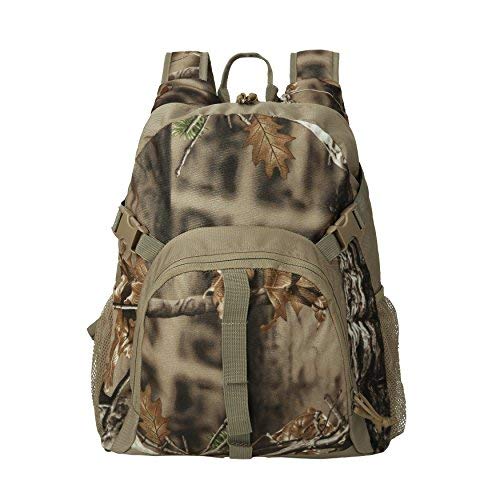
This is the least expensive pack in this guide, and it is honest about what it is: a light camo daypack with twelve pockets, a chest belt and enough room for a rain shell, shells, gloves and a dog leash. At 1.1 pounds it barely registers on your shoulders, and for waterfowl, turkey and short deer sits it does the job without complaint.
Organization is better than the price suggests. The woodland camo print reads well against hardwoods, the side pockets take a bottle, and the chest belt stops the pack bouncing when you are moving quickly. The fabric is the compromise: it is stiffer and noisier than the soft shells on our other picks, which matters in a treestand and hardly at all in a duck blind.
Where it stops is heavy or wet work. The shell sheds a shower but soaks through in sustained rain, so a dry bag for your phone and calls is worth the few ounces, and the seams and strap anchors are not built for hauling decoys or a stand every weekend. Used as a light daypack a season at a time it earns its keep, and it is the one here we would hand a kid heading out on a first hunt.
Pros
- Lightest full pack here at 1.1 pounds
- Twelve pockets for the money
- Chest belt keeps it steady
Cons
- Shell soaks through in sustained rain
- Seams and strap anchors can fail under load
The cheapest way into a camo hunting pack that still works: light, roomy enough for a day, and fine for duck season or a first hunt.
Best for First Pack
AIRTTUZ Hunting Daypack

Key Features
- Pockets: 4
- Rain cover: Included
- Pack weight: 1.9 lb
- Water resistance: Waterproof
- Price: Budget
The rain cover is the detail that makes this pack worth a look at its price. A waterproof shell plus a cover means you are not choosing between hunting in the rain and leaving your gear in the truck. The 600D nylon body is reassuringly substantial for a pack this light, and at 1.9 pounds it carries like a daypack should.
Bow and rifle carry comes from an expandable pocket and a pull-down panel, the same idea the ALPS uses with simpler hardware. Inside there is a large main compartment, a zippered front pocket and mesh side pockets for a bottle. It is a spot-and-stalk shape: narrow, close to the back, easy to move in.
What we cannot tell you is how the seams will look after four or five seasons; that is the open question with a pack this inexpensive, and the harness is simpler than the ones on our top picks.
For a first pack, a backup, or a saddle rig where the pack itself is secondary, that is plenty. It is not the pack to carry a treestand or a quartered deer, but as a light, dry daypack it does the job for less than nearly everything else here.
Pros
- Rain cover included
- Tough 600D nylon shell
- 1.9 pounds with bow and rifle straps
Cons
- Harness is simpler than our top picks
A light, inexpensive camo daypack with a rain cover and straps for a rifle or bow — a sensible first pack or a spare for the truck.
Best for Sit-And-Wait Hunts
ALLBLESSED Hunting Backpack

Key Features
- Pockets: 7
- Capacity: 30 L
- Tree strap: Adjustable
- Water resistance: Water resistant
- Price: Midrange
The first thing you notice is where it sits: high and close against your back, with the chest and waist straps doing the work. That is the right shape for a treestand hunter who climbs with the pack on, and it stops the load swinging when you turn to look behind you.
Seven pockets across a 30-liter body is generous, and the layout keeps calls, gloves and a rangefinder separated instead of heaped in the main compartment. There is also an adjustable strap for hanging the pack on the tree once you are up — a small thing that saves you digging around your boots in the dark.
The fabric is a quiet, tear-resistant camo, and it is water resistant rather than waterproof: a shower is fine, a three-hour soaker is not. Zippers close completely, though they are not silent, which is part of the trade at this price.
Add it up and this is a solid second-tier pick: not as refined as the TIDEWE, not as feature-rich as the ALPS, but it carries a day’s gear quietly and stays where you put it. If your season is mostly sitting and the walk in is short, it is more pack than you need to spend much on.
Pros
- Rides high and close on the back
- Seven pockets in a 30-liter body
- Strap for hanging it at the stand
- Quiet, tear-resistant camo fabric
Cons
- Zippers are audible in still air
- Water resistant, not waterproof
A quiet 30-liter pack that rides high and tight, with seven pockets and a strap for hanging it on the tree — good value for a sit-and-wait hunter.
How We Tested Hunting Backpacks
We started by pulling together a shortlist of 12 hunting backpacks from brands we trust and reader recommendations, filtering by price, frame type, and carrying capacity—everything from 1,800-cubic-inch daypacks to 4,000-cubic-inch expedition haulers. Each pack was assigned to a hunter on our team and used through nine months of scouting trips, preseason range sessions, and two big-game seasons, including archery and rifle hunts.
To test capacity and size, we packed the same loadout into every bag—base layers, rain gear, food, two liters of water, a kill kit, and a first-aid pouch—and noted what fit, what didn’t, and how easy it was to organize. We also wore each pack on a five-mile scouting loop and compared its listed volume to how it actually carried; some packs felt smaller than their specs suggested.
To see how each pack held up, we dragged them loaded through oak brush, set them down on rock, and loaded and unloaded them repeatedly. After every trip we checked seams, webbing, and buckles for fraying or loosening. We opened and closed every zipper at least 50 times—with and without gloves—to see which ones snagged or split. For water resistance, we sprayed each pack with a hose for two minutes and then checked whether the contents stayed dry.
Strap length and comfort got their own scrutiny: we adjusted shoulder and waist straps for hunters ranging from 5-foot-6 to 6-foot-4, noting which packs ran out of webbing or pinched at the hip. We rated suitability for hunting by listening for fabric swish and buckle rattle on still mornings, and by seeing how easily we could reach a bow or rifle. Finally, we compared price against materials, warranty, and how each pack held up, so we could tell which ones were genuinely worth the money.
How to Choose a Hunting Backpack
How you hunt decides the pack long before capacity does — a treestand sitter, a spot-and-stalk bowhunter and a duck-blind regular need three different bags.
Start With How You Hunt
Think about the walk in before you think about liters. If you climb with the pack on and hang it beside you, a compact body that sits high and close beats a big one — that is why the ALLBLESSED suits sitting and the Fieldline suits short walks. If you cover ground and glass, you want something narrower with a waist belt that actually transfers load, closer to the YVLEEN. If your hunt is a half mile to a blind with decoys and layers, capacity wins over trim.
Capacity: Liters, Pockets and the Number That Misleads
Liters usually describe the main body and ignore exterior pockets, so a 25-liter pack with twelve pockets can carry more useful gear than a 30-liter sack with three. Rough guide: 20 to 25 liters covers a warm-weather day, 30 to 40 liters takes cold-weather layers, and 44 liters is about the ceiling for a day pack you carry far. If packing out meat is on the plan, none of these is the right tool — that is frame-pack work.
Quiet Fabric and the Noise You Actually Make
The shell matters less than what hangs off it. Soft, matte fabrics like the ones on the TIDEWE and YVLEEN stay quiet against brush; stiffer nylons rustle, which is fine in a duck blind and not fine in timber. Zipper pulls are the loudest thing on most packs — metal tapping a buckle carries further than any fabric. Test a pack by shaking it, then by opening every pocket slowly with the pack on your back.
Weapon Carry: Drop-Down Panel or External Straps
Two systems cover it. A drop-down panel, as on the ALPS Pursuit, folds out into a cradle with the butt supported; it is the most secure and the bulkiest. External straps and a boot, as on the BLISSWILL and YVLEEN, are lighter and cheaper but depend on you tensioning them properly. Whichever you choose, check that the stock pocket or boot does not stop a nearby pocket zipping closed, because that is the detail that turns a good carry system into a daily annoyance.
Straps, Buckles and the Hardware That Fails First
Shells outlast hardware. Across the packs here, the parts that let go first are chest straps, waist buckles and zipper sliders, not the fabric. Look for a waist belt wide enough to transfer load — a one-inch strap is a stabilizer, not a load bearer — and buckles with some substance to them. Before a season starts, load the pack and hang it from the haul loop; anything that slips in the driveway will slip worse on a ridge.
Frequently Asked Questions
Can I use a regular hiking backpack for hunting?
You can, and plenty of hunters do. What you give up is a quiet shell — hiking packs are often crinkly ripstop — and a hands-free way to carry a weapon. If you go that route, replace metal zipper pulls with cord, cinch every compression strap so nothing swings, and add a blaze orange vest or panel if your state requires orange, since a camo pack will not satisfy that rule.
How do I strap a rifle or bow to a pack with no weapon pocket?
Run two compression straps across the front, with the butt stock down into a side pocket or behind the waist belt and the muzzle angled up clear of branches. Cinch until the gun cannot rotate, shoulder the pack, then swing an arm forward to check the stock does not catch you. Practice the release with the pack on before the season, not in the dark.
Do I need a rain cover if the pack says waterproof?
Usually, yes. A waterproof shell protects the fabric, but seams, zippers and the gap around the lid are where water gets in during a long, steady soak, and soaked fabric gets heavy. A cover also keeps the pack from loading up with water. Even with one, put your phone, calls and tag in a small dry bag.
What else should I buy with a hunting backpack?
A dry bag for electronics and paper, an orange panel or vest if your state requires one, and a hydration bladder if the pack has a sleeve for it — otherwise a bottle in a side pocket does the same job. Keep a spare set of zipper pulls and a buckle in your kit; those are the parts that fail, and they cost almost nothing.
Final Verdict
For most hunters, buy the TIDEWE. It gets out of the way: quiet camo fabric, a pocket layout that keeps a day’s gear findable, and a harness that is still comfortable with a coat on. If you climb or hike with a bow or rifle strapped to your back, the ALPS Pursuit earns its premium, because the drop-down pocket is the difference between carrying a weapon and managing one.
And if your season is a short walk and a long sit, the 1.7-pound Fieldline is all the pack you need — just add a dry bag, because it makes no water-resistance claim at all.