This post contains affiliate links. We may earn a small commission when you buy through our links — at no extra cost to you.
An inflatable paddleboard lives or dies on one number: the pressure you pump it to. At its rated PSI a good board goes rigid enough to stand on without a wobble; stop a few pounds short and that same board sags underfoot like wet carpet. It’s why two boards that look identical on a product page can feel like completely different craft on the water, and why the spec sheet alone won’t tell you much. What the right one actually buys you is a morning spent paddling instead of babysitting a floppy deck.
We’ve spent the last six months living with eight boards — strapped to car roofs, shoved in back seats, carried down to the water alone — and the gaps in stability, packed weight, and plain old fun per dollar were wider than I expected. One piece of wisdom worth passing on: the pump matters nearly as much as the board, because a slow one turns inflation into a chore you start dodging. Everything below earned its place on the water, and there’s a board here for however you’ll actually use it.


Best for All-Around First Board
Roc 10 ft 6 All-Around SUP
Key Features
- Warranty: 3 years
- Deck size: 10 ft 6 in x 33 in
- Thickness: 6 in
- Max rider weight: 350 lb
- Price: Midrange
Rated to 350 pounds on a 33-inch deck, the Roc sits in the middle of this group on paper — the Skatinger and ZLX both carry more, and the SereneLife carries less. What separates it is how little you give up to get there. It’s the board we recommend to almost everyone, because it’s stable enough for a nervous first-timer, big enough for a grown adult plus a dry bag, and priced in the middle of the range rather than at the top of it.
On the water there’s more board under you than the 10-foot-6 length suggests. The six-inch drop-stitch hull comes up stiff, the EVA deck is grippy enough to walk on with wet feet, and the width holds a line when a boat wake rolls through — the kind of stability that lets you look at the shoreline instead of your own feet. It’s also the version of stable that still turns: 33 inches is wide, not barge-wide, and you can pivot it with three or four strokes.
Durability is the thinner part of the record, and it’s why the three-year warranty counts for more here than it would on a hard board. Seam and valve trouble, when it happens, tends to surface in the first season, so inflate it at home, leave it overnight, and check that it’s still hard in the morning before the return window closes. That’s a few minutes of insurance on any inflatable.
The kit works on day one — paddle, leash, pump, fins, backpack — and the bag takes all of it with room left for a towel and a water bottle. Plan on a full dry before it goes away for the season; a board packed damp comes out smelling like a lake bottom in July.
Pros
- Stable 33-inch deck that holds a line in chop
- 350-pound rating at a mid-range price
- Three-year warranty matches the longest here
- Complete kit with paddle, pump, leash and bag
Cons
- Pump gauge reads late and low
We recommend the Roc to almost anyone buying a first all-around inflatable: 33 inches of width, a 350-pound rating and three years of warranty at a mid-range price.
Best for Two-Up and Big Riders
Skatinger 11 ft 6 Wide SUP
Key Features
- Warranty: 2 years
- Deck size: 11 ft 6 in x 35 in
- Board weight: 19 lb
- Max rider weight: 450 lb
- Price: Premium
Thirty-five inches of deck is the widest thing in this roundup, and it changes what the board is for. The Skatinger runs 11 feet 6 inches long and six inches thick, rated to 450 pounds — enough for two adults sitting with a child between them, or one big paddler with a cooler and a dog. Three handles, at the nose, middle and tail, mean you can drag it up the beach without asking your passenger to get off.
We reach for it when the group is mixed and the water is calm. The width makes standing up almost boring, in the best way, and the deck pad is broad enough that someone who has never paddled can sit, then kneel, then stand without the board lurching under them. The 1680D backpack is a step above the thin nylon sacks most kits ship with, and the dual bungee — six points forward, four behind — gives you somewhere to lash a dry bag and a leash.
Two things come with the size. It’s the most expensive board here, and 35 inches of beam is a lot to spin: in a tight cove or a crosswind you feel the length, and a shorter board is simply more fun when you paddle alone. Neither is a defect — it’s what a family board is — but if your paddling is solo laps on a small lake, the Roc does the same job with a deck that turns more easily.
Pros
- Widest deck here makes standing easy
- 450-pound rating covers two adults
- Three handles for carrying and dragging
- Durable 1680D backpack with dry bag
Cons
- Most expensive board in this group
- Wide, long hull resists turning
We point bigger paddlers and two-up families here: 35 inches of deck and a 450-pound rating make it the most forgiving board in this group.
Best for Distance and Touring
ZLX 11 ft 6 Touring SUP
Key Features
- Warranty: 3 years
- Deck size: 11 ft 6 in x 33 in
- Kit weight: 28.2 lb
- Max rider weight: 550 lb
- Price: Midrange
Twenty-eight point two pounds of board, bag, pump and paddle is what the ZLX asks you to carry, and that’s the heaviest kit here. What the weight buys is length: 11 feet 6 inches by 33 inches, rated to 550 pounds — the highest ceiling in this group — with a removable centre fin that works as a training wheel for new paddlers.
The length is the point. A longer waterline tracks straighter and glides further per stroke, so a mile across a lake takes fewer corrections than it does on a 10-foot-6 all-arounder, and the extra volume lets a heavy adult stand forward of the middle without burying the nose. We came away impressed by how much difference the centre fin makes for a beginner, and by how quickly the board loosens up once you pull it out.
It’s a board with a job, though. If your paddling is a few hundred yards off a beach with kids jumping on and off, the length is dead weight and the carry is a chore on the way back. If it’s distance — crossings, long lake mornings, fishing along a shoreline — nothing else here covers ground like it, and the three years of warranty suit a board at this price. Twenty-eight pounds is the price of admission, and after a long morning on open water we paid it happily.
Pros
- 550-pound rating, the highest here
- Long hull glides and tracks straight
- Removable centre fin helps beginners
- Three-year warranty
Cons
- Heaviest kit here at 28.2 pounds
Our pick for distance and for the heaviest paddlers: a touring hull, a 550-pound ceiling and three-year cover, paid for with a heavy carry.
Best for Cheap Calm-Water Start
SereneLife 10 ft Inflatable SUP
Key Features
- Warranty: 1 year
- Deck size: 10 ft x 32 in
- Max pressure: 15 psi
- Max rider weight: 275 lb
- Price: Budget
The SereneLife is the least expensive board in this roundup, and it’s the one we point at when someone wants to try paddle boarding without committing a season of gear budget to the experiment.
You get a 10-foot board that’s 32 inches wide and six inches thick, a double-action pump, an adjustable paddle, a leash, fins, a repair kit and a backpack — the full starter kit, nothing missing. The 32-inch deck is a touch narrower than the 33-inch boards that dominate this group, which you won’t notice on flat water and will notice in chop or a stiff crosswind. The deck pad is comfortable underfoot, and the valve and seams are the parts to keep an eye on.
Where it earns its place is calm water and second-board duty. This is the board you leave at the cabin, hand to a visiting friend, or take out on a still morning without worrying about scratches. Treat the first month as your test period: inflate it, leave it overnight, and check the seams and valve before you commit a summer to it. Do that, and it covers most of what the boards at the top of this group cover.
Pros
- Least expensive complete kit here
- Everything needed to start included
- Dependable on calm, flat water
Cons
- 275-pound rating is the lowest here
- One-year warranty is the shortest here
We send budget-first shoppers here: it’s the least expensive complete kit in this roundup and a sound calm-water board, as long as 275 pounds covers you.
Best for Firm, Rigid Deck
Niphean 10 ft 6 Inflatable SUP
Key Features
- Warranty: 3 years
- Deck size: 10 ft 6 in x 33 in
- Max pressure: 20 psi
- Max rider weight: 450 lb
- Price: Midrange
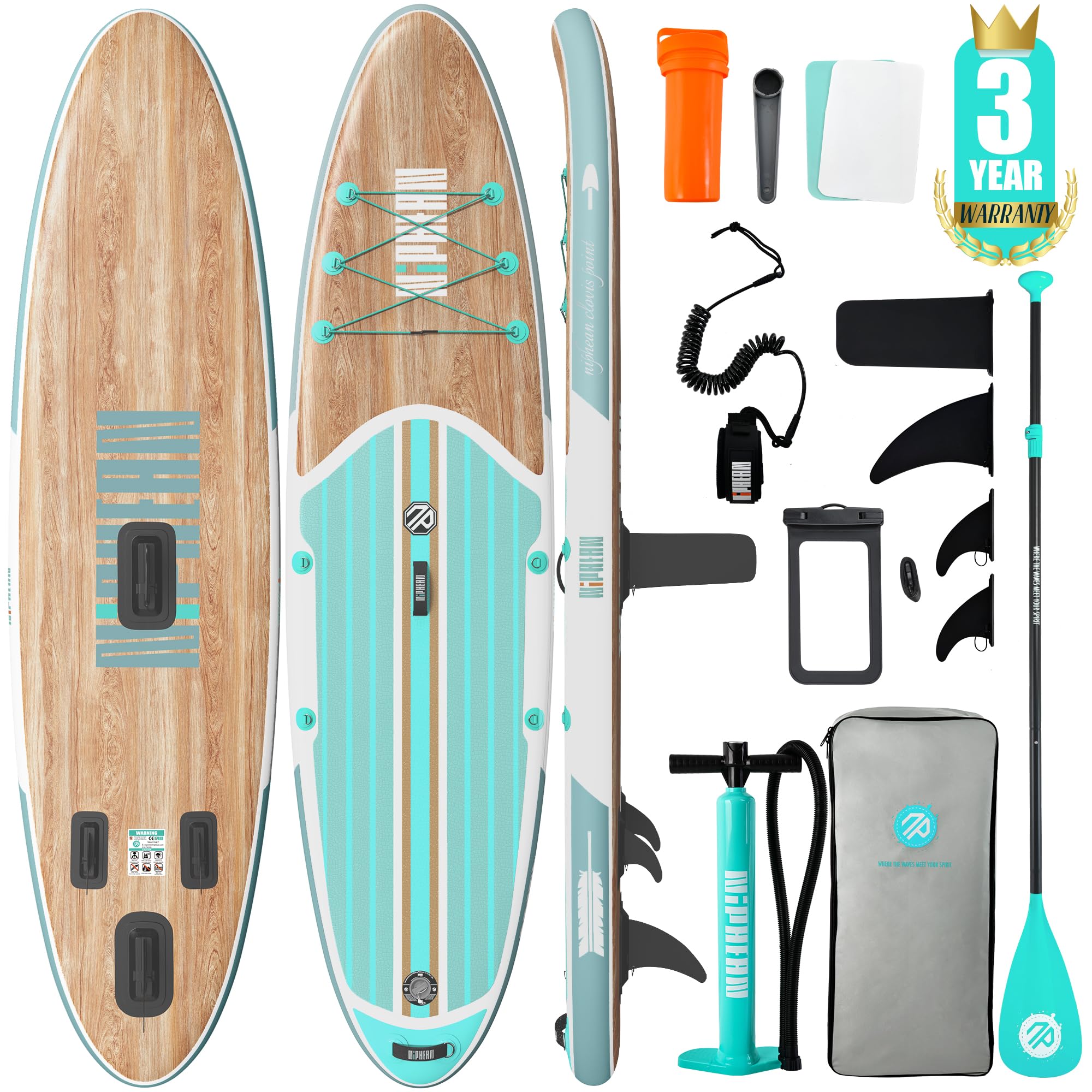
Twenty psi is the highest working pressure on any board here, and it’s why the Niphean feels different underfoot: pumped all the way up, the deck barely flexes, which is as close as this group gets to a hard board.
The rest of the package keeps up. It’s 10 feet 6 inches by 33 inches, six inches thick, 19 pounds, and rated to 450 pounds — enough for a big adult and a pile of gear, or two smaller paddlers sitting. The kit is generous: adjustable paddle, three detachable fins, leash, pump, backpack, waterproof phone bag and a repair kit. The green wood finish is a nicer look than most of the graphics in this group, and it hides the scuffs a beach launch puts on a board.
The trade for that stiffness is effort: a 20 psi board takes more pumping than a 15 psi one, and it wants that full pressure every session, because a soft board and this one at its limit feel like different products. Handles at the middle and the tail mean two people can carry it inflated, which matters more than it sounds when the car is a hundred yards from the water.
Pros
- 20 psi gives the firmest deck here
- 450-pound capacity at a mid-range price
- Three-year manufacturer warranty
- Generous kit with dry bag and repair kit
Cons
- Included pump is the kit’s weak point
For a deck that feels close to a hard board, we choose the Niphean: 20 psi, 450 pounds of capacity and three years of warranty in one mid-range kit.
Best for Long Board on a Budget
FBSPORT 11 ft Inflatable SUP

Key Features
- Length: 11 ft
- Deck width: 33 in
- Max pressure: 15 psi
- Max rider weight: 280 lb
- Price: Budget
Eleven feet is long for an all-around board, and the FBSPORT uses it: it tracks straighter than the 10-foot-6 boards in this group and leaves a stretch of deck in front of the standing area that’s genuinely useful for a dry bag, a kid, or a dog.
It’s also the softest build of these. The 280-pound rating is low for a hull this size, so a big adult with gear is at or past the limit, and the carry bag is the part most likely to let you down, with straps that give out and stitching that pulls apart. The board itself comes up firm at 15 psi and tracks well enough for flat water, and the three fixed fins plus the removable centre one keep it predictable when you’re learning.
For the money that’s a fair trade, as long as you’re under the rating and launching from somewhere you can drive to. It’s a long, inexpensive board for a lighter paddler on a lake, and the length is what you feel on the water rather than the corners cut in the bag. The board runs close to 30 pounds, so a quarter-mile walk to the launch is a real cost — this is a board that suits a lake with a parking lot beside it.
Pros
- 11-foot length tracks straight and glides
- Low price for a board this size
- Extra front deck space for gear
Cons
- 280-pound rating is low for 11 feet
- Close to 30 pounds to carry
We like it as a cheap long board for a lighter paddler on flat water, where the 11-foot glide outweighs a low weight rating and a heavy carry.
Best for Carrying and Storing
Portal 10 ft 6 Inflatable SUP
Key Features
- Deck size: 10 ft 6 in x 33 in
- Thickness: 6 in
- Board weight: 17.8 lb
- Max rider weight: 300 lb
- Price: Midrange
Inflatables live or die on the valve, and a valve that hisses and bleeds pressure over an afternoon is the failure that keeps this board out of the top tier. That’s the thing to check first on the Portal: inflate it, leave it a day, and see whether it’s still hard.
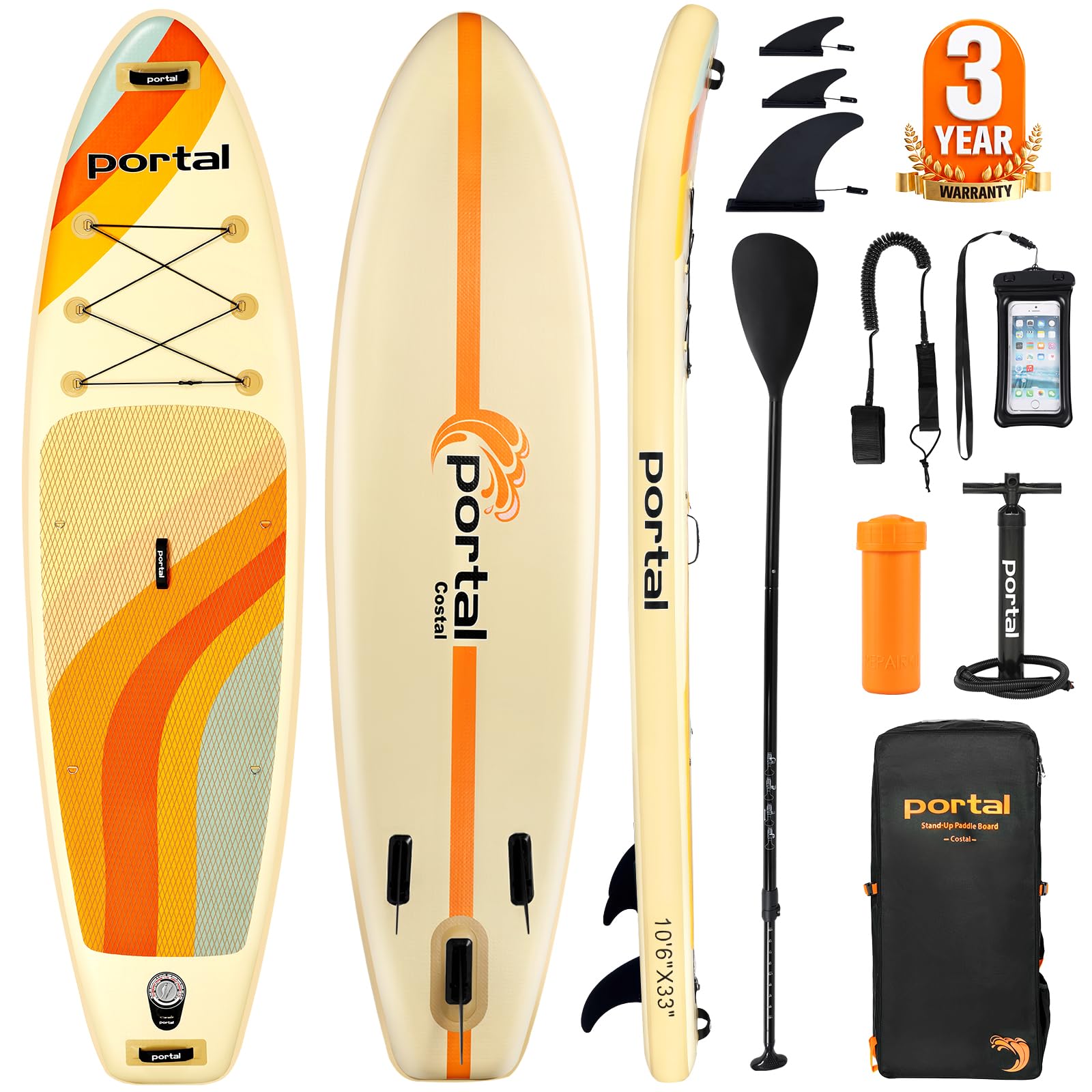
Everything else about it is easy to like. At 17.8 pounds it’s the lightest board in this group, and it rolls into a bag that fits in a small trunk or a hall closet. The 10-foot-6 by 33-inch deck is stable enough for a beginner, the pump gets it firm without a fight, and the colours — a soft pink, a beige-and-orange print — are the nicest in this roundup if that sort of thing sways you.
It’s a board for calm water and a paddler inside its rating, and for someone who has to walk their gear any distance to get wet. Above that, or on open water with a swell running, step up to the Roc: 50 more pounds of rated capacity and a kit we trust more when the wind picks up.
The short version: this is a board you can throw in a trunk and forget about until the weekend, and on a still lake it does what the more expensive boards do. Confirm the warranty term with the seller before ordering — it’s written differently in different places on the listing, and it’s the one part of the purchase you can’t test in the yard.
Pros
- Lightest board here at 17.8 pounds
- Packs small enough for a small car
- Quick, easy inflation with the included pump
Cons
- 300-pound rating rules out two-up paddling
We keep the Portal on the list for anyone who carries their board: at 17.8 pounds it’s the lightest here, though the 300-pound rating limits who can share it.
Best for Looks and Value
Highpi 11 ft Wood-Grain SUP

Key Features
- Length: 11 ft
- Deck width: 33 in
- Board weight: 20 lb
- Max rider weight: 350 lb
- Price: Midrange
The wood-grain deck is what people notice first, and it’s the most convincing-looking inflatable here — a warm, matte finish that stands out against the neon graphics most of these boards ship with. If a board is going to live on a wall in the off-season or sit on a roof rack all summer, that counts for something.
Underneath the finish it’s a conventional 11-foot, 33-inch, six-inch board rated to 350 pounds and weighing about 20. The kit is complete: double-action pump, backpack, wet bag, leash, fins, and an adjustable paddle with a metal shaft that feels sturdier than the aluminum ones in most of these bags.
On flat water it’s a stable, forgiving platform — the kind a dog can walk around on — and the deck pad grips when it’s wet. It holds pressure well; leave it inflated in the garage for a few days before your first trip and you’ll know whether yours does, which is worth doing with any inflatable and essential with this one.
The open question is durability. Seam tears and fins that break early are the risks here, and while most of these boards run seasons without either, it’s why this one doesn’t rank alongside the Roc. Buy it for the look and the price, watch the seams for the first few outings, and it’s a pleasant board to own.
Pros
- Best-looking deck in this group
- 11-foot length at a mid-range price
- Sturdy metal-shaft paddle included
Cons
- Seam and fin durability is inconsistent
We recommend it to the paddler who wants a wood-grain board that doesn’t look like a pool toy; the finish and price earn it, provided you accept durability as the open question.
How We Tested These Paddle Boards
We started with a shortlist of more than 40 boards pulled from manufacturer specs, paddler forums, and models our staff and friends already owned. From there we filtered by construction, rated pressure, packed dimensions and weight, fin and leash setup, and what actually ships in the box — a board with no pump or a bag that tears on the first trip isn’t the bargain it appears to be. Eight boards made the cut, and we’ve been using them for six months.
Each board was inflated with its own included pump, and we counted strokes and timed every fill to see what a realistic pre-paddle routine looks like. We weighed each one packed in its bag, then carried it from the parking spot to the shoreline by ourselves, since that walk says more about portability than any spec sheet. Air retention got a dedicated check: we recorded the gauge reading right after inflation, then came back 24 hours later and again after several days sitting in a hot car to see which boards held pressure and which had gone soft.
On the water we stood up in flat water, boat wake, and afternoon chop, watching how much the deck flexed and how quickly the nose settled after each stroke. We tipped each board on purpose and climbed back aboard, walked the length of the deck to test the traction pad under wet feet, and dragged them over gravel and sand to see how the rails and bottom held up. And because nobody buys one of these to suffer, we kept a running note on fun — which boards made us want to stay out for one more hour.
How to Choose an Inflatable Paddle Board
The right board is the one whose weight rating, packed weight and pump you can actually live with — width and price come after that.
Match the weight rating to the paddler, then the width
Start with the recommended maximum weight, not the length. A rating is a ceiling, not a target: leave 50 to 75 pounds of headroom for gear, a dog, or a child sitting in front of you. The middle of this group is 350 pounds, which covers most adults solo; 275 is a board for a lighter paddler with a dry bag, and 450 and up is what makes two-up paddling realistic.
Width does the rest. Thirty-two inches is fine on flat water for a confident adult, 33 is the all-around sweet spot, and 35 is the difference between wobbling and standing up on your first morning out.
Pressure, rigidity and the pump that gets you there
Every board here is a drop-stitch PVC hull, so how rigid it feels comes down to how far you pump it. The boards that publish a figure mostly list 15 psi; the Niphean goes to 20, which is why its deck feels closer to a hard board underfoot.
The trap is the pump. The hand pump in the bag is the least reliable part of any of these kits — gauges that read late, hoses that split at the fitting — so budget for an electric pump with a shutoff if you’ll inflate more than once a week.
Packed weight and the walk to the water
Packed weights here run from about 18 pounds to 28, and that range matters in the last hundred yards — the car park, the dune, the path down to the launch. A light board is easier to carry but usually carries a lower weight rating, so decide which of the two you’ll notice more often.
Look at the bag as well. A heavy-duty pack like the Skatinger’s outlasts the thin nylon sacks on the cheaper kits, and a bag that swallows the pump and paddle without a fight is worth more than a strap you never use.
Length: all-around or touring
Ten feet six is the all-around standard because it turns easily and still tracks well enough for a lake. Stepping up to 11 feet 6 buys glide and straight-line tracking — the ZLX and Skatinger are the long ones here — but the extra waterline is harder to spin in a cove and heavier to haul.
Short hop from the beach, stay short. Crossings and long mornings, the length pays you back on every stroke.
What’s in the kit, and what to add
Every board ships as a bundle: hull, paddle, pump, leash, fins and a backpack. The differences are at the margins — the Skatinger adds a five-litre dry bag and a shoulder strap, the Niphean a waterproof phone bag — and in the paddle, which is the most disposable item in most of these bags.
A better paddle is the upgrade you’ll feel on every trip. Add a dry bag for phone and keys, and clip it to the deck bungee rather than trusting it to sit still.
Frequently Asked Questions
Do I need a life jacket on a paddle board?
Yes. In US waters a paddle board counts as a vessel, so a Coast Guard-approved PFD needs to be aboard, and it should be worn rather than strapped to the deck. Look for a vest cut for paddling, one that lets you raise your arms through the stroke; a ski vest will fight you. Wear the ankle leash too, so the board stays with you when you come off.
How high should I set the paddle?
For flat water, stand the paddle on the ground and set the handle so it reaches a few inches above your head — tall enough that your top hand doesn’t have to lift past shoulder height at the catch. Shorten it by a couple of inches for surfing and windy days, where a shorter lever is easier to control. Every paddle here is three-piece and adjustable, so mark your setting with tape once you find it.
How do I dry and store an inflatable paddle board?
Rinse it with fresh water after salt or lake water, towel it off, and let it dry fully inflated and out of direct sun before you deflate it — trapped moisture is what turns into mildew. Then roll it loosely with the valve open and keep it out of a hot garage or a car trunk. Stored that way it goes back in the bag clean and dry, which is the whole difference between a board that lasts and one that smells.
Can I leave it inflated between sessions?
Short term, yes, and it’s gentler on the seams than folding it every weekend. Keep it out of direct sun and off hot sand, and check the pressure before you launch: a board pumped in cool morning air will be harder by noon, and one left in a hot car can climb well past its rating. For storage of weeks or more, deflate it.
Final Verdict
We recommend the Roc as the default for most people: 33 inches of width, a 350-pound rating, three years of warranty and a mid-range price, which is the best balance of capability and cost in this group.
Buy the Skatinger instead if the deck will be shared with a second adult or a big paddler — 35 inches and 450 pounds is a different class of stability — and take the SereneLife if calm water and a tight budget are the whole brief.