This post contains affiliate links. We may earn a small commission when you buy through our links — at no extra cost to you.
Inflatable kayaks have a reputation problem: the word still makes people picture a pool toy drifting toward the middle of the lake. The good ones are nothing like that — a drop-stitch floor holds air hard enough to feel like a paddleboard underfoot, and two or three separate chambers mean a puncture slows your day down instead of ending it. What an inflatable really fixes is everything around the paddle: no roof rack, no garage ceiling, no friend with a truck. It lives in a trunk, unrolls at the launch, and ten minutes later you’re on the water.
I kept a hardshell leaned against the garage for two years and paddled it four times; the inflatable in my trunk goes out on a random Tuesday. Over the past six months we’ve paddled eight of them on a flat local lake, a shallow river, and one gusty bay. Floor stiffness and chamber count mattered more than how many paddlers a boat claims to seat, and the priciest boats weren’t the ones we reached for. The picks below are the ones that earned a permanent spot in the trunk.



Best for All-Around Recreational Paddling
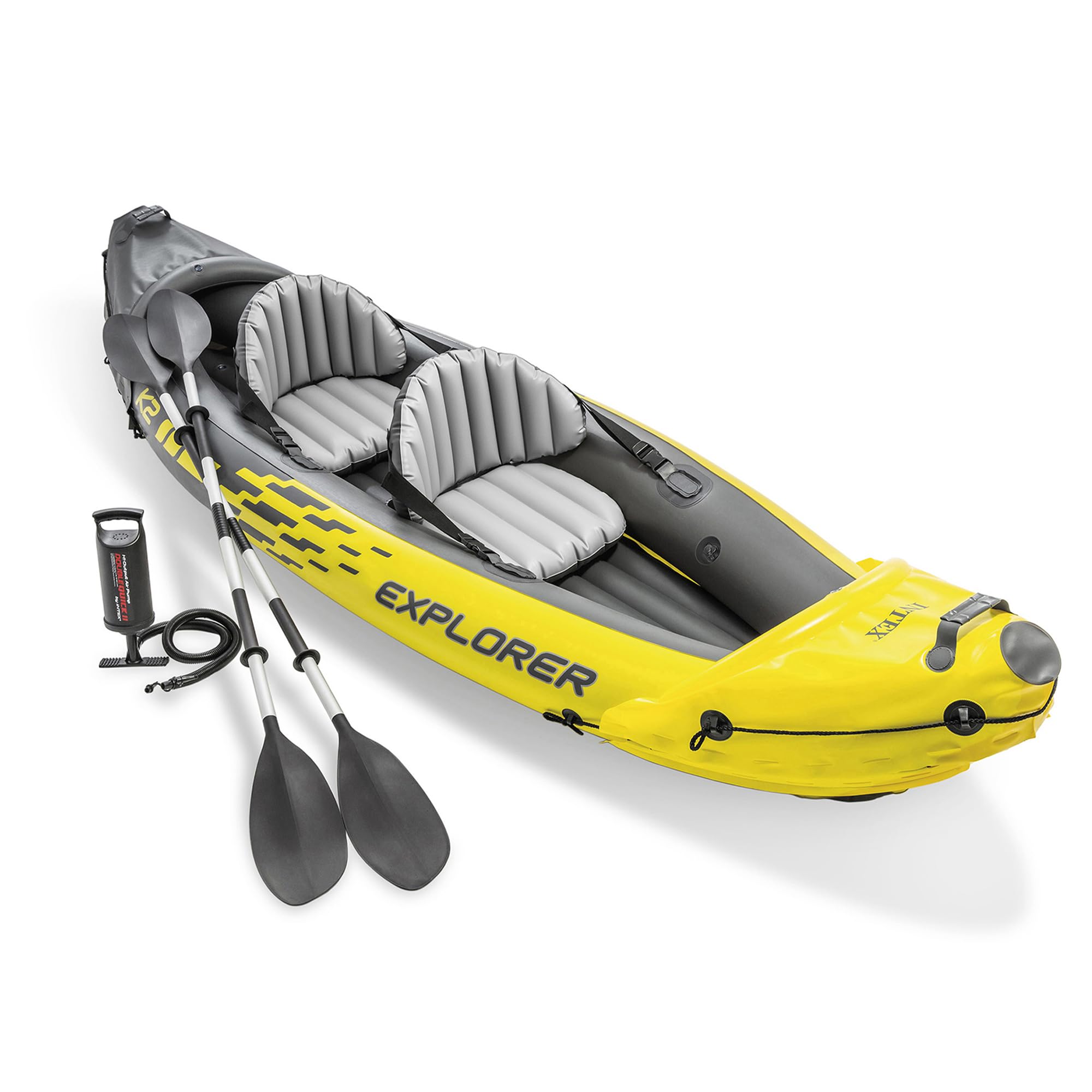
Intex Explorer K2
Key Features
- Inflated size: 10.3 ft x 3 ft x 1.8 ft
- Hull and floor: Vinyl, I-beam floor
- Weight capacity: 400 lb
- Seating capacity: 2
- Price: Budget
What makes the Explorer K2 our top pick is not one standout specification but the complete two-person kit you get for a budget price: a 10.3-foot hull, a 400-pound capacity, two seats, two paddles, and a pump, all in a boat that breaks down into one car-friendly bag. For a first kayak, that completeness matters more than a fancy valve or a race-ready shape. We like that it gets two people on the water without turning the purchase into a project.
On flat water, the three-foot beam and inflatable I-beam floor make a stable, forgiving platform. The low-profile deck and high-buoyancy side chambers give you a sensible amount of freeboard, and the Boston valves are simple to work with. We found the 35-pound package manageable for one person to move around, though it is not the sort of boat you tuck under an arm for a mile.
The Explorer is a recreational boat; treat rough water and long exposed crossings as outside its brief. It is happiest on lakes, slow rivers, and protected bays, where its width and stability do more for a relaxed afternoon than a sharper hull would.
The bow and stern storage and D-rings are useful for a dry bag and a small cooler, and the included repair patch is the kind of small extra that earns its place after a scrape on a gravel launch.
Pros
- Complete two-person kit at a budget price
- Stable three-foot beam for lakes and slow rivers
- Packs into one bag for car transport
Cons
- Seats have modest back support
- Seams and floor are the wear points
We recommend the Explorer K2 to casual paddlers who want a stable, complete two-person kayak for lakes and easy rivers without spending much.
Best for Solo Lake Paddling
Intex Challenger K1
Key Features
- Hull material: PVC
- Inflated size: 9 ft x 2.5 ft x 1.1 ft
- Weight capacity: 220 lb
- Seating capacity: 1
- Price: Budget
The Challenger K1 is the boat we hand to someone who has to carry the kayak from a parking lot alone. At 26 pounds, it is light enough to manage without help, and the 10-foot hull fits into a small trunk or closet. The included paddle and pump complete the package, so the first trip does not begin with a parts order.
We like the low-profile cockpit for easy paddling, and the removable seat gives you a bit of back support. The 220-pound capacity is the limit that matters most: this is a boat for one adult and a small dry bag, not for a full camping load. A 30-inch beam makes it quicker to turn than the wider tandems, but it also feels less planted for a nervous beginner.
The Challenger tracks reasonably well for a short inflatable, especially with the skeg in place, and it is easy to get in and out of at a beach. We noticed the seat back is more of a suggestion than a support, so a pad helps on longer afternoons. The paddle breaks down, the bag swallows the boat, and the whole thing disappears into a closet between trips.
Pros
- Light 26-pound solo package
- Quick setup with included pump and paddle
- Low-profile hull is easy to paddle
Cons
- Seams and floor can develop leaks
We recommend the Challenger K1 to solo paddlers who want a light, inexpensive kayak for calm lakes and short river runs.
Best for Whitewater and Gear
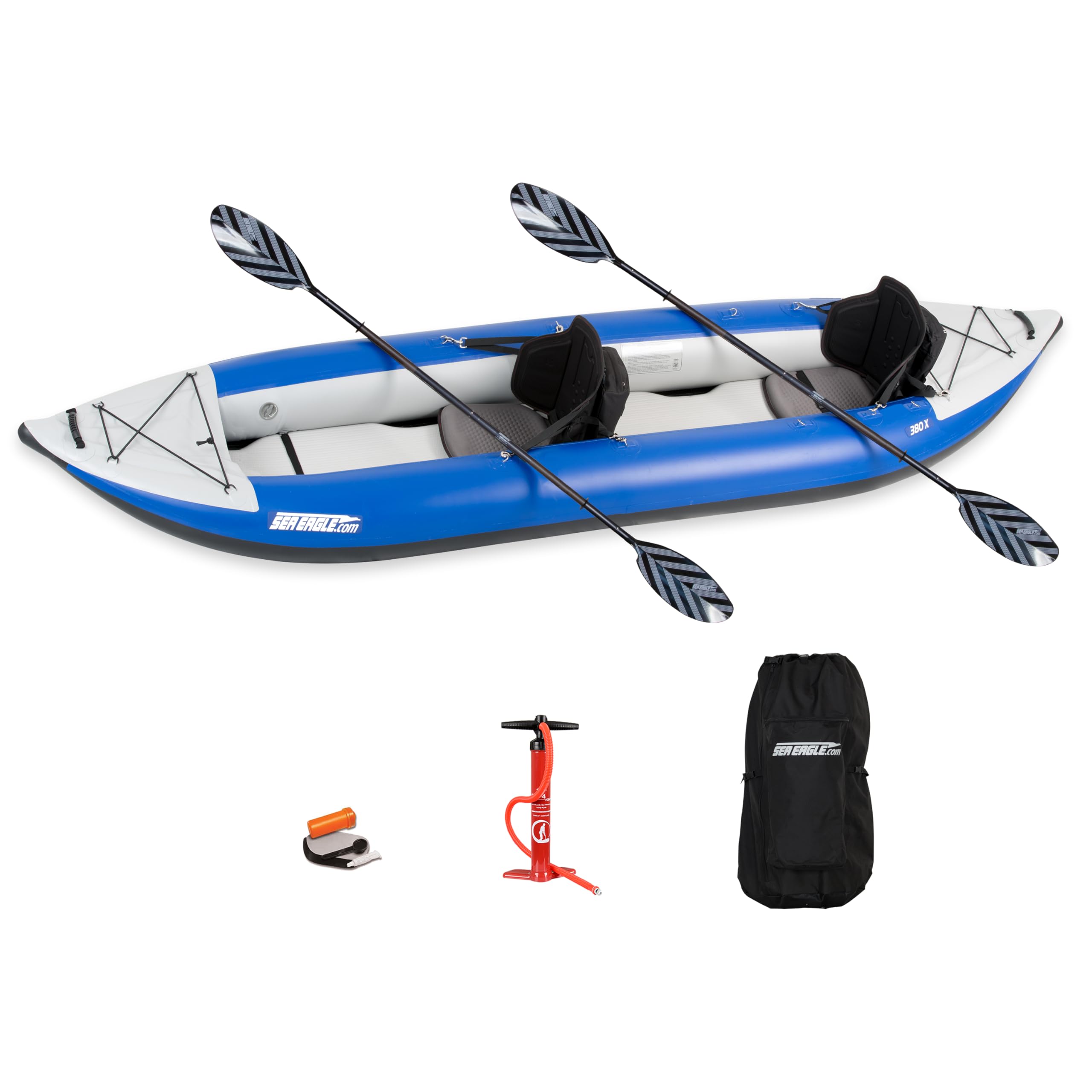
Sea Eagle 380x Explorer
Key Features
- Water rating: Class IV whitewater
- Hull and floor: 1000D PVC, drop-stitch floor
- Weight capacity: 750 lb
- Seating capacity: 2-3
- Price: Premium
The 380x is the only kayak in this set rated for Class IV whitewater, and that changes what the boat can do. Sixteen self-bailing drain valves let water out fast when a wave comes over the side, while the high-pressure drop-stitch floor gives the hull a rigid platform under your feet. You are buying capability here, not just a shape.
The 1000-denier PVC and quadruple-overlapped glued seams are built for rocks and logs, and the 750-pound capacity is generous enough for two large adults plus gear. We appreciated the Pro package’s tall-back seats and the all-purpose backpack, because a boat this capable still has to get from the car to the put-in.
On flat water, the 380x is stable and reasonably efficient, but it is a full-size adventure boat rather than a nimble play boat. We kept coming back to it for rough water and loaded trips, not for quick solo spins. The included high-output pump and backpack make the routine easier, though this is still a boat that rewards a planned launch.
Pros
- Class IV whitewater rating with 16 drain valves
- Drop-stitch floor adds rigid, stable footing
- 750-pound capacity carries two adults and gear
- 1000D PVC and overlapped seams resist abrasion
Cons
- Premium price
- 40-pound hull is a two-person lift
We recommend the Sea Eagle 380x to paddlers who run rivers with real current and need whitewater capability, huge capacity, and a tough hull.
Best for Sit-In Touring
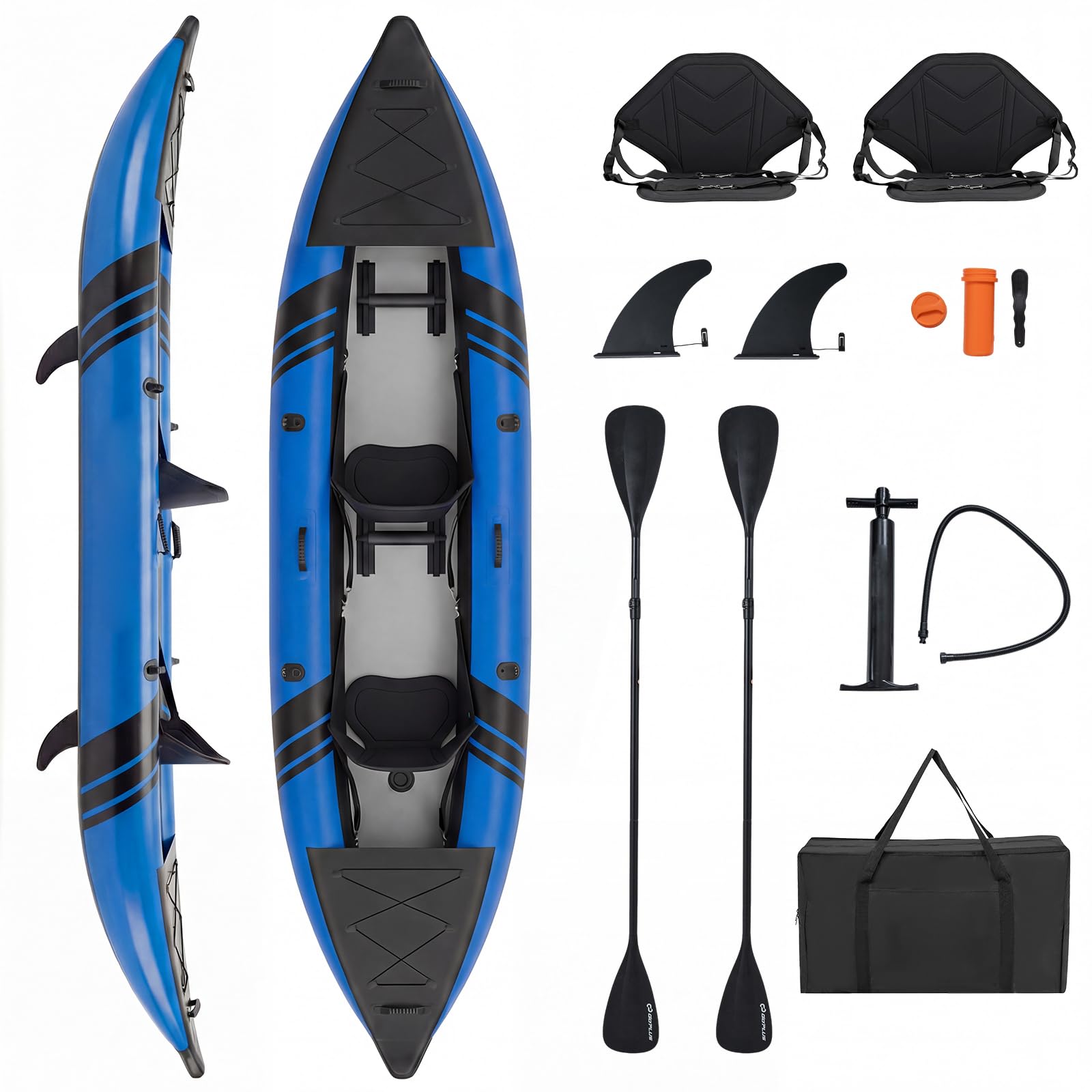
OceanBroad V420
Key Features
- Inflated size: 13.7 ft x 2.95 ft
- Hull and floor: PVC, drop-stitch floor
- Weight capacity: 500 lb
- Seating capacity: 2
- Price: Premium
The V420 is the most touring-minded tandem here: a 13.7-foot sit-in hull, a drop-stitch floor, and a shape that wants to go somewhere rather than just bob around. We noticed the difference in how it carries speed and tracks, especially with the removable fin fitted. This is the one we pick when the plan is a longer lake loop or a slow river with a picnic stop.
The drop-stitch floor is flatter and firmer underfoot than an I-beam floor, and the padded EVA seats give decent back support for a day on the water. Three air chambers and Halkey-Roberts valves make inflation straightforward, and the detachable floor helps when it is time to clean and dry the boat. The 500-pound capacity leaves room for two adults and a reasonable gear bag.
It is a flatwater and mild-river boat, not a whitewater craft; the sit-in cockpit and long hull are happiest where you can keep a rhythm. For a committed tandem pair with a launch close to the car, the on-water manners are worth it.
Pros
- Long sit-in hull tracks well on flat water
- Drop-stitch floor is firm underfoot
- 500-pound capacity for two adults and gear
- Halkey-Roberts valves simplify inflation
Cons
- Heavy 51.7-pound package
- Zippers and seat attachments need watching
We recommend the OceanBroad V420 to tandem paddlers who want a sit-in touring feel and a rigid drop-stitch floor for long flatwater days.
Best for Rigid Tandem Touring
Beyond Marina Explorer
Key Features
- Inflated size: 13.77 ft x 32 in x 19.7 in
- Hull and floor: Full drop stitch
- Weight capacity: 507 lb
- Seating capacity: 2
- Price: Premium
The Explorer’s 19.7-inch hull depth is the first thing you notice: it sits higher and feels more enclosed than the typical recreational inflatable. Full drop-stitch construction in the floor and side chambers gives it a firm, almost hard-shell response under the paddle, and the 507-pound capacity means two adults can bring a proper day bag. It is a more serious boat than its playful mint color suggests.
We liked the wide 32-inch beam and the deep seating area for long, relaxed days, and the adjustable EVA seats are a clear step up from the flat pads on budget boats. The included wheeled backpack helps with the trip from car to shore, though the packed boat is still a substantial thing to move. As a tandem, it has enough room to avoid the elbow-bumping that makes cheaper two-person kayaks feel cramped.
The Explorer is happiest on lakes and deeper rivers; it is not the boat for rocky shallows or a windy open crossing. The deep hull and high sides catch wind, and the skegs sit low enough to take a hit at a gravel launch. Those are the conditions to plan around, not flaws that show up on every trip.
Pros
- Full drop-stitch hull feels rigid
- Deep 19.7-inch hull adds confidence
- 507-pound capacity with roomy seating
- Wheeled backpack helps with transport
Cons
- Premium price for a drop-stitch tandem
- Packed bag is heavy and tight
We recommend the Beyond Marina Explorer to tandem paddlers who want a deep, rigid drop-stitch hull and do not mind paying for it.
Best for Value Tandem Paddling
S AFSTAR 2-Person
Key Features
- Inflated size: 12.5 ft x 37 in x 16 in
- Hull and floor: 3-layer PVC, drop-stitch floor
- Weight capacity: 507 lb
- Seating capacity: 2
- Price: Midrange
The S AFSTAR gets the important structure right for the money: a 12.5-foot three-chamber hull, a drop-stitch floor, and a 507-pound capacity. The three-layer PVC feels substantial when you run a hand along the side, and the 37-inch beam gives two adults room to sit without feeling wedged together. Setup is designed to take about eight minutes for the air chambers, which matches the kind of quick launch most recreational paddlers want.
The drop-stitch floor is the difference-maker on this boat: it gives you a firmer platform than an I-beam floor, and the removable fins help with tracking when you are covering distance. We liked the elastic gear cords and paddle holds for keeping a dry bag and spare layer within reach. The seats are adjustable with four D-rings each, so you can tune the back support for a long afternoon.
It is still a recreational tandem, not a touring shell. The 12.5-foot length turns easily enough for narrow channels, but it will not carry the glide of the longer OceanBroad or the whitewater readiness of the Sea Eagle. In a stiff crosswind, the light hull gets pushed around, so pick your day and your launch.
What sells it is the balance: a rigid floor, real capacity, and a complete kit without the premium price of the drop-stitch flagships. We see it as the tandem for a couple who wants a better platform than the entry-level Intex but does not need a whitewater-rated hull. The included carry bag and repair kit round out the package, and the three separate chambers mean a puncture in one does not automatically end the day.
Pros
- Drop-stitch floor adds rigidity
- 507-pound capacity for two plus gear
- Three chambers and quick inflation
- Adjustable seats with four D-rings
Cons
- Paddle holders are cramped
We recommend the S AFSTAR two-person kayak to tandem paddlers who want drop-stitch rigidity and a 507-pound capacity at a midrange price.
Best for Light Solo Outings
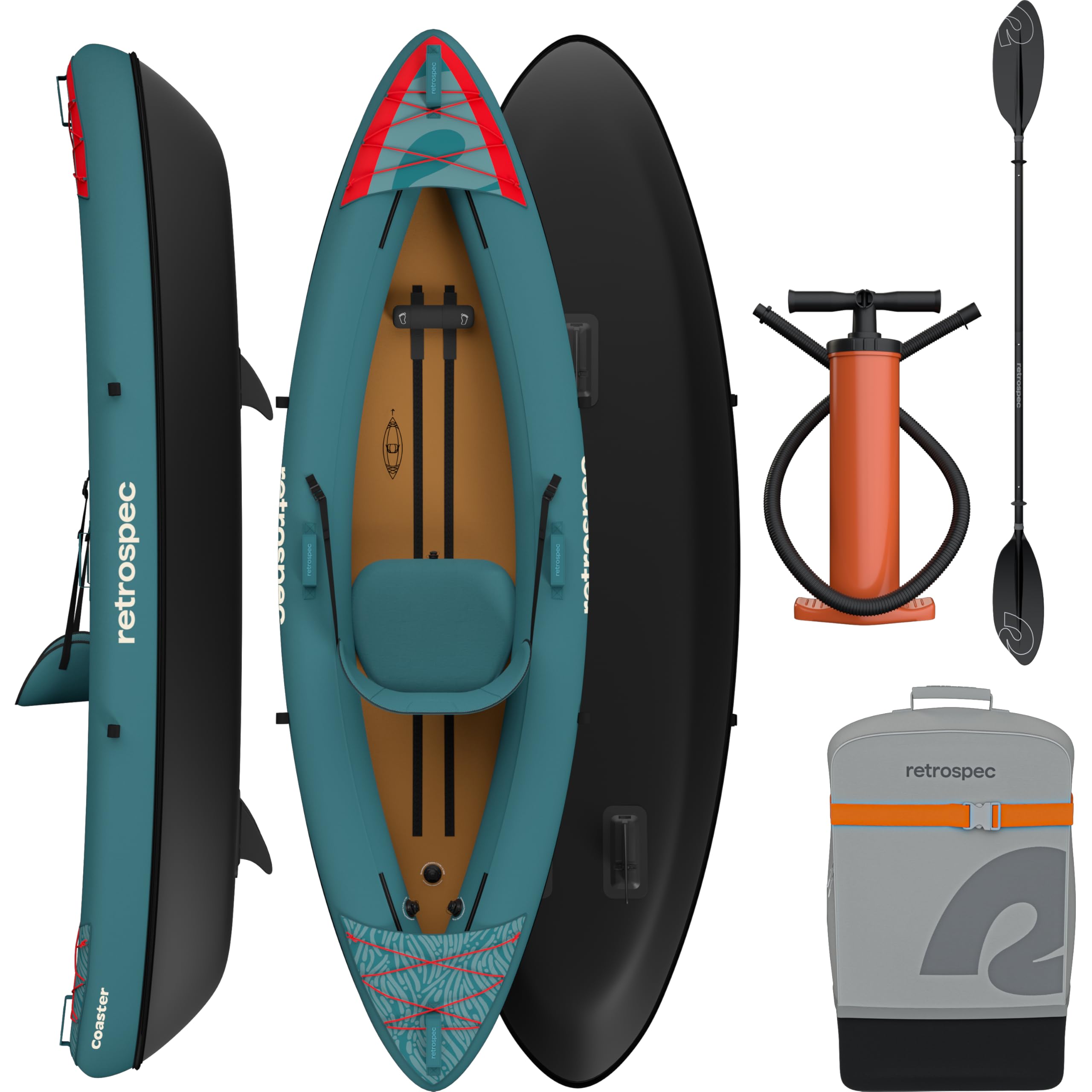
Retrospec Coaster
Key Features
- Weight: 23 lb
- Inflated size: 9 ft 10 in x 37 in
- Weight capacity: 220 lb
- Seating capacity: 1
- Price: Midrange
At 23 pounds, the Coaster is the lightest solo kayak in this set, and that is its whole reason for being. The 9-foot-10-inch hull and 37-inch beam make it stable enough to feel friendly, while the three removable fins help it track better than a plain flat-bottom inflatable. We liked that the backpack, pump, paddle, and footrest all come with it, because a light boat is only useful if the rest of the kit is not a pile of loose parts.
The 220-pound capacity is the number to check before you fall in love with the weight. This is a boat for a smaller adult or a paddler with minimal gear, not for a big paddler plus a cooler and a dog. On calm water, the width and fins give it a pleasant, predictable feel, and the open deck makes it easy to step in and out. It is a nice boat for a quiet morning on a protected lake.
The Coaster makes sense when the lighter carry and solo layout matter more than capacity or a tougher hull. For a paddler who stores gear in an apartment and walks to a local launch, that trade is easy to understand. For everyone else, the Challenger is the more sensible budget solo.
Pros
- Light 23-pound solo package
- Stable 37-inch beam with three fins
- Backpack and full kit included
Cons
- Premium price for a solo kayak
- Floor lacks extra reinforcement
We recommend the Retrospec Coaster to smaller solo paddlers who want a genuinely light kayak that fits in a closet and can be carried without help.
Best for Paddleboard Crossover
Tigerxbang SUP-Kayak

Key Features
- Weight: 24.8 lb
- Inflated size: 10.2 ft x 35 in x 8 in
- Weight capacity: 500 lb
- Seating capacity: 2
The Tigerxbang is less a traditional kayak than a stand-up paddleboard with a detachable seat and a kayak paddle. Its 35-inch width and 8-inch thickness make a stable deck for sitting, kneeling, or standing, and the 500-pound capacity is enough for two medium adults or one paddler plus fishing gear. If your idea of a kayak trip includes a lot of floating and a little paddling, the format makes sense.
The drop-stitch sandwich construction gives the board a firm, high-pressure feel, and the removable center fin helps it track when you are sitting and paddling. We liked the carry straps and paddle holder for short hops, and the included backpack and hand pump make it a self-contained kit. It is not a dry ride: you sit on top of the water, so splashes and a wet seat are part of the deal.
As a kayak, it has limits. The 8-inch hull sits high and catches wind, and the deck is wet in chop. The detachable seat is great for switching modes, but it does not give the back support of a proper touring seat. This is a boat for protected water and short outings, not for crossing a windy bay.
What we like is the versatility: it can be a paddleboard, a sit-on-top kayak, or a stable fishing platform, and it stores in a small space. For a calm lake, a slow river, or a family afternoon, that flexibility is worth more than a specialized hull. Just do not buy it expecting a dry, efficient touring kayak.
Pros
- Stable 35-inch paddleboard deck
- 500-pound capacity for gear or a passenger
- Converts from SUP to seated kayak
- Firm drop-stitch construction
Cons
- Paddle holders are too small
We recommend the Tigerxbang SUP-kayak to calm-water paddlers who want a stable paddleboard they can also sit on and fish from.
How We Chose and Tested Eight Inflatable Kayaks
We started with roughly 30 inflatables from brands with a real review history, then cut the list on the specs that decide a day on the water: chamber count, floor construction, packed weight and dimensions, valve type, and whether the pump in the box can actually reach the boat’s rated pressure. Price counted only as a ratio to what you get — a couple of the least expensive boats paddled nearly as well as the most expensive one. That left eight.
Each boat was inflated in a driveway with a stopwatch running, using only its included pump, and we noted how long it took to hit the printed max and how much work the last few pounds of pressure were. Over the six months, we carried every one fully inflated from car to launch and back, because a light boat with a bad handle is worse than a heavier one you can grip. All eight ran the same two-mile lake loop, a shallow river section twice, and an afternoon on the bay in a crosswind.
Stability got checked the unglamorous way: sitting still, kneeling, leaning hard into turns, and standing in the wider hulls to find where secondary stability kicked in. For durability we beached each boat on gravel, dragged it over a concrete ramp, and scraped through six inches of water, then pulled the floor, dried everything, and looked for abrasion, lifted seams, and water pooling in the footwell. Portability was a bathroom scale, a tape measure, and one honest question — does the whole thing fit back in its bag without a fight.
Fun is the one thing we didn’t score. We just kept track of which boats we grabbed on a day off, and the ones that felt like work by the second mile never got grabbed twice.
How to Choose an Inflatable Kayak
The right inflatable kayak starts with the water you paddle and the weight you can carry, not with the longest list of included accessories.
Match the hull and floor to the water
An I-beam floor is the basic inflatable design: light, inexpensive, and fine for calm lakes and slow rivers. A drop-stitch floor inflates into a much firmer panel, so the boat feels more like a hard-shell underfoot and tracks better with a fin. That rigidity is why the OceanBroad V420, Beyond Marina Explorer, and S AFSTAR cost more than the entry-level Intex boats; it is also why they weigh more.
For whitewater or rocky runs, look for self-bailing drain valves and a tougher hull, not just a stiff floor. The Sea Eagle 380x is the clear example here with its Class IV rating and 16 drain valves. For flatwater touring, a drop-stitch floor and a longer waterline are the useful upgrades.
Size the boat for paddlers and gear
Capacity numbers are maximums, not targets. Two adults plus a cooler, dry bags, and a dog add up quickly, so a 400-pound tandem like the Explorer K2 is best for two people and a day bag, while a 500-pound boat gives more margin. The Sea Eagle’s 750-pound rating is in a different class for loaded trips.
Length is the other half of the decision. A 10-foot kayak is easier to store and turn; a 12- to 14-foot tandem tracks better and feels less cramped on open water. If you paddle solo most of the time, a dedicated one-person hull is lighter and more efficient than a tandem with an empty seat.
Weigh portability against setup
The solo boats here weigh 23 to 26 pounds; the big drop-stitch tandems run 39 to 52. That difference matters most on the carry from car to water, especially if you launch alone. A wheeled bag helps, but it does not make a 50-pound boat easy to lift onto a roof rack.
Setup is a separate cost. Boston valves are simple and common on budget boats; Halkey-Roberts valves feel more precise and are easier to top off. A hand pump with a gauge is worth having, and a boat with three chambers gives you more inflation checks before you launch. We inflate at home before the first trip and check the seams again after the boat has sat in the sun.
Check seats, valves, and aftercare
A kayak seat is not a place to accept the cheapest option. Adjustable back support changes how a two-hour paddle feels, and seats that clip in at four points are easier to tune than a single strap. Check that the seat can move far enough for your leg length, especially in a tandem.
After the paddle, the seams, valves, and floor are the parts to inspect. Store the boat clean and dry, out of direct sun, and keep the repair kit with it. A puncture in one of three chambers is inconvenient; a seam that lets go on the water is the failure to watch for. Inflating at home before a trip is the simplest way to catch a slow leak before it becomes a swim.
Frequently Asked Questions
Can I paddle a two-person inflatable kayak by myself?
Yes, if the seats move far enough to center your weight. A tandem paddled solo sits higher and catches more wind, so keep the load low and use the skeg. The Explorer K2 is rated for solo or tandem use, but a dedicated solo like the Challenger K1 is easier to handle alone.
Are inflatable kayaks good for fishing?
Yes, if you choose a stable, wide hull and keep the load low. A 400-pound tandem like the Explorer K2 has enough capacity for one angler and gear, while the Sea Eagle 380x’s 750-pound rating leaves room for a second person or a lot of equipment. Add clamp-on rod holders if the boat does not come with them, and keep hooks and knives away from the PVC.
Can I use an inflatable kayak in the ocean?
Only in calm, protected water and close to shore. Wind, chop, and surf are much harder on an inflatable than a calm lake, and a wide recreational boat will get pushed around. Check the wind forecast, launch from a sheltered beach, and skip offshore crossings or surf zones.
What is the difference between a sit-in and a sit-on-top inflatable kayak?
A sit-in kayak has a cockpit around your legs, which keeps more splash off and feels more enclosed; it is harder to drain if water gets in. A sit-on-top is easier to climb back onto and self-bails through scupper holes, but you stay wetter. Choose sit-in for flatwater touring, sit-on-top for swimming stops and quick recreational paddling.
Final Verdict
Our default remains the Intex Explorer K2. It is the most complete, stable, and easy-to-live-with two-person kayak in this set for lakes and easy rivers, and it leaves room in the budget for life jackets and a dry bag.
If you paddle alone, the Challenger K1 is the lighter budget choice; if you need whitewater, the Sea Eagle 380x earns its premium. For a drop-stitch touring tandem, the OceanBroad V420 is the one we prefer, while the S AFSTAR gets close for less.