This post contains affiliate links. We may earn a small commission when you buy through our links — at no extra cost to you.
An inflatable kayak that goes soft halfway across a lake is not a kayak — it’s a swim with extra steps. The appeal of a two-person inflatable is obvious: it folds into a bag, lives in a closet, and turns a spur-of-the-moment lake afternoon into an outing without a roof rack. What separates a good one from a glorified pool float shows up when you’re pumping it up, carrying it to the water, and shifting your weight as your partner climbs in.
Over eight months, we paddled nine two-person inflatable kayaks on flat lakes, a slow river, and weekend camping trips. The ones worth buying held pressure after a full day in the sun, inflated without a 20-minute fight, and left leg room for a six-footer. They were also fun — stable enough to trade jokes without bracing for a capsize, light enough to carry from the car in one trip. Price matters, but a cheap boat that flexes under your knees or loses air by lunch is not a value; the picks below are the ones that got the balance right.

Best for First Tandem
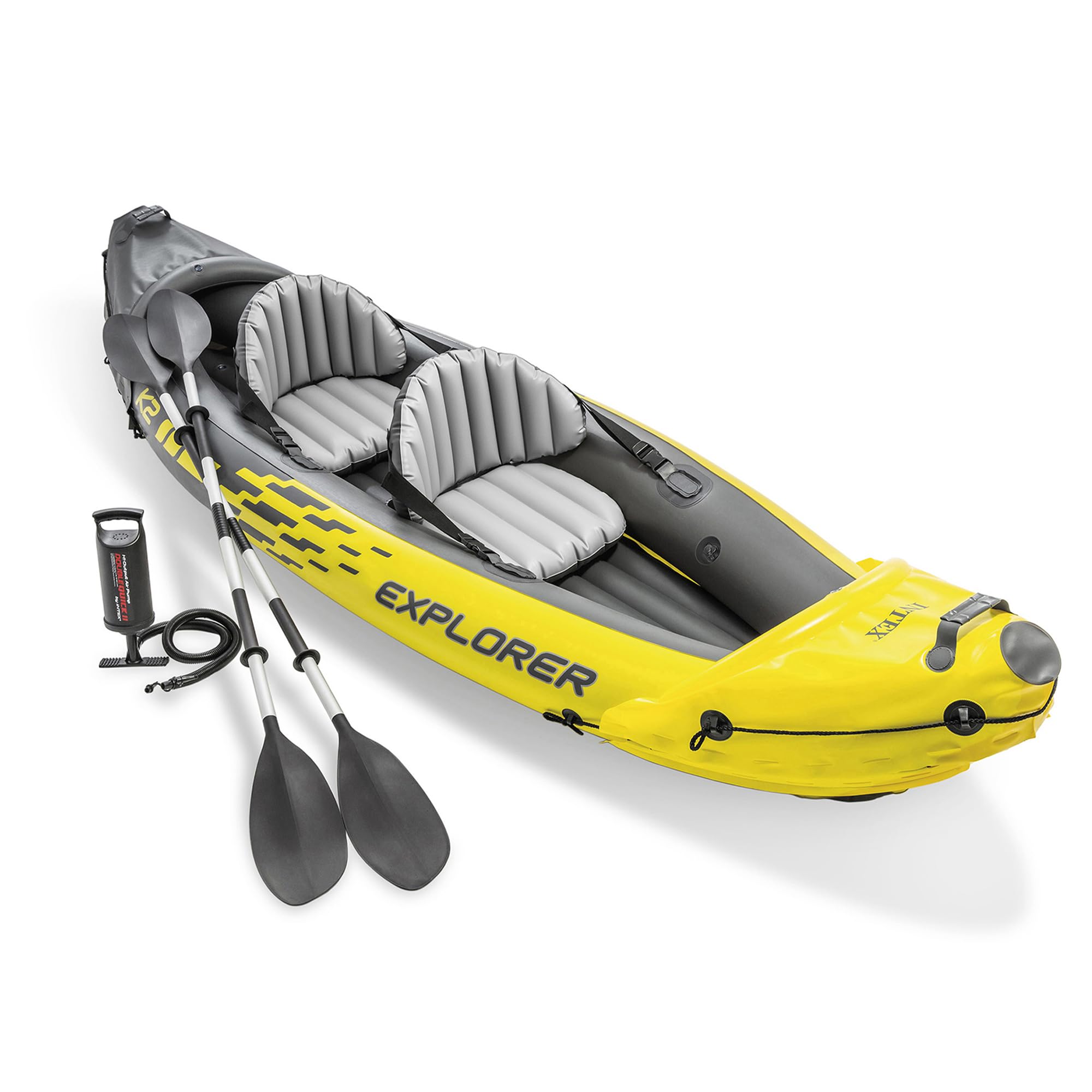
Intex Explorer K2
Key Features
- Weight: 35 lb
- Included kit: 2 paddles, 2 seats, pump, skeg, carry bag
- Inflated size: 123 x 36 x 20 inches
- Weight capacity: 400 lb
- Price: Budget
The Explorer K2 shows up as a complete boat: two 86-inch paddles, two inflatable seats with backrests, a high-output hand pump, a skeg and a tote bag. That matters more than it sounds, because the usual reason a first kayak ends up in the garage is discovering the paddles and pump are sold separately. At 35 pounds it’s also 4 pounds lighter than the GYMAX here, and light enough for one person to carry down to the water alone.
This is the one we point most couples to. The 10.3-foot, 400-pound-capacity hull has a low-profile deck and two Boston valves, so the included pump has it inflated in minutes and it packs back into a trunk without a roof rack. Two adults and a day bag sit low and steady in it. The compromise is windage: it’s a light boat with tall sides, so a crosswind pushes the bow around and chop comes up through the floor. On a calm lake with a cooler wedged between the seats, neither matters.
The material is where the savings show. Vinyl boats like this one give out at the seams and around the seat mounts rather than in the middle of a panel, and pinholes along the floor seam are what eventually retire an Explorer. Buy a patch kit before you need one, launch from sand or a mat instead of dragging it over gravel, and inflate it at home the night before your first trip so a bad seam announces itself in the garage instead of a mile from the ramp.
Pros
- Complete kit — paddles, seats, pump, skeg, bag
- 35 pounds, the easiest tandem here to carry
- Fast inflation with two Boston valves
Cons
- Included paddles flex under strong strokes
For most couples heading to a lake, this is the tandem we point to first — a complete kit at 35 pounds with 400 pounds of capacity.
Best for Two Big Paddlers
GYMAX Tandem Kayak
Key Features
- Weight: 39 lb
- Included kit: 2 paddles, 2 seats, pump, 2 fins, bag, repair kit
- Inflated size: 150 x 37 x 16 inches
- Weight capacity: 507 lb
- Price: Premium
Five hundred and seven pounds is the number that makes this kayak worth its premium. Two adults at 200 pounds each, a cooler, a dry bag and a dog still come in under the limit, and that’s a load none of the 400-pound tandems here can promise. We think the extra length is worth having too: at 12.5 feet it tracks straighter than a 10-footer when two paddlers can’t match strokes, and there’s genuine bow and stern space for gear rather than a decorative bungee.
The seating is the detail we appreciated most. Padded EVA seats with backrests and three-position footrests are a step above the inflatable cushions on most budget tandems — you can plant your feet and put your back into a stroke instead of riding along like a passenger. Three independent chambers mean you fill it in stages, and one chamber going soft leaves you with most of a boat rather than a swim. Paddles, pump, two fins, a repair kit and a carry bag all come with it.
None of that comes free. The GYMAX costs meaningfully more than the Explorer, and payload is the honest reason to pay it — if your crew is under 350 pounds combined and you paddle twice a summer, the smaller boat does the same job for less. Where the money shows up is a long day with two heavy paddlers aboard: this is the boat that never makes anyone do weight math at the launch.
Pros
- 507-pound capacity, the highest in this set
- Padded EVA seats with three-position footrests
- Reinforced laminated PVC hull with three chambers
Cons
- 39 pounds to haul with the pump and paddles
- 12.5-foot hull needs more storage room at home
If two big adults and a cooler are your usual load, the 507-pound GYMAX is the tandem that carries it without a weight argument.
Best for Open-Water Tracking
Intex Dakota K2

Key Features
- Skegs: Interchangeable long and short
- Included kit: 2 paddles, 2 seats, pump, 2 dry bags, carry bag
- Inflated size: 124.76 x 36 x 19.2 inches
- Weight capacity: 400 lb
- Price: Midrange
Two skegs ship with the Dakota, and the point isn’t redundancy. The long one drops in for open water and holds a straight line, so two paddlers with different strokes aren’t correcting each other every few minutes; swap in the short one and the boat turns quickly enough for a river bend or a crowded launch. It’s the most useful piece of design thinking in this group, and the clearest reason to look past the Explorer.
On a long, flat paddle this is the tandem we prefer of the three. Tracking beats top speed once you’re an hour from the put-in, and the 10.25-foot hull’s 400-pound capacity matches the Explorer’s, so you give up nothing in load. Two dry bags come in the kit as well — a throwaway extra until you’re the one holding the keys and the phone.
The rest of the package is complete: two 86-inch paddles, two removable and adjustable seats, a carry bag, and both skegs. Setup is the part to plan around, since three chambers and a hand pump add up to a real pumping session before you’re on the water. A 12-volt inflator is money well spent if you launch somewhere different every weekend.
Pros
- Interchangeable long and short skegs for tracking
- Two dry bags and a carry bag included
- Removable, adjustable seats with backrests
Cons
- Front footwell is cramped for tall paddlers
- Pushed around in chop and crosswind
The Dakota is the open-water choice: interchangeable skegs hold a line better than anything else here, and its 400-pound capacity matches the Explorer’s.
How We Tested Two-Person Inflatable Kayaks
We started by pulling together every two-person inflatable kayak we could find from established paddle-sports and outdoor brands, then narrowed the list by packed weight, claimed capacity, pump setup, and the kind of floor and side chambers each one used. That left nine models, which we tested side by side for eight months. We inflated each one in a driveway and at the water’s edge, timing the process from bag to firm and noting whether the included pump needed a workout or just a steady rhythm. Packed boats were weighed and carried—sometimes a few hundred yards—to see if one person could manage the bag alone.
On the water, we paddled them on flat lakes, a slow river, and a few weekend camping trips, usually with two adults and occasionally a dry bag between us. We paid attention to how the hull tracked when one paddler stopped, whether the floor flexed under a knee, and how much leg room was left for a taller paddler. To check stability, we shifted weight, leaned into turns, and had one person climb in while the other was already aboard. Durability got a less glamorous test: we noted scuffs after beaching on gravel, checked seams and valves after a full day in the sun, and watched for pressure loss overnight.
Fun is subjective, but it showed up in how often we reached for a particular boat. The ones we liked turned without a wrestling match, stayed dry enough for a day bag, and were easy to deflate and fold back into the bag at the end. Value came down to what came in the box and how the boat held up after repeated inflation—not just the sticker price.
How to Choose a Two-Person Inflatable Kayak
Buy for the water you actually paddle and the car you actually own: payload first, then packed weight, then hull shape.
Payload Is the First Number to Check
Two adults at 190 pounds each come to 380 pounds, which leaves only 20 pounds of headroom in a 400-pound boat — not enough for a cooler, a dry bag and a dog. Add your two weights, add 40 to 60 pounds for gear, and compare that total against the capacity rather than against the seat count. This is where the GYMAX separates itself from the Explorer and the Dakota: it’s the only tandem here that carries two big paddlers and a day of gear without the math getting uncomfortable. Under about 330 pounds combined, a 400-pound boat has all the margin you need.
Packed Weight Decides How Often You Go
A tandem that paddles beautifully is useless if getting it to the water takes two people and three trips. The Explorer is 35 pounds before you add paddles, seats and pump; the GYMAX is 39. Weigh the whole bag rather than the hull alone, then think about your worst launch — the long beach, the stairs, the muddy bank. If you carry the boat more than a couple of hundred yards, the lighter tandem earns its place even if it paddles a little slower once it’s floating.
Length, Skegs and Straight Lines
Longer hulls track straighter, which matters when two paddlers can’t match strokes. A 12.5-footer like the GYMAX covers distance with less correcting than a 10-footer, but it turns slower and takes more room at home. Skegs are the cheaper fix: the Dakota’s interchangeable long and short fins let you choose between a locked-in line on a lake and quick pivots on a river. The trap is buying for tracking you don’t need. On a pond you can walk around, a long skeg just makes the boat awkward to steer.
Check Seams and Chambers Before You Trust Them
Three separate chambers and an inflatable I-beam floor are the standard for this class, and they’re what stops one failure from becoming a swim. Vinyl boats give out at seams, valves and seat mounts rather than in the middle of a panel. So inflate a new boat at home the day it arrives, leave it overnight, and press along the floor seam and around the seat mounts while you can still send it back. A boat that holds air in a garage will usually hold it on a lake.
Seats and Leg Room Show Where the Money Went
Inflatable backrests are the weak point of every tandem here: they hold air but not shape, so hour four turns into a slouch unless you add a cushion or buy an aftermarket seat. Footrests matter as much — the GYMAX’s three-position rests give a shorter paddler something to push against, and a 10-foot hull can leave a tall front paddler with their knees up. Sit in the boat on dry land with your usual partner and settle who takes which seat before the first trip.
Frequently Asked Questions
Can one person paddle a two-person inflatable kayak alone?
Yes, with the trim adjusted. Sit in the rear seat, shift your gear forward so the bow stays in the water, and expect a boat that rides higher and catches more wind than a solo kayak — you’ll correct your course more and paddle slower into a headwind. It’s a fine way to use the boat on a calm morning, not a substitute for a solo hull on a breezy one.
Can you take an inflatable kayak in the ocean?
These are flat-water boats. The listings call for lakes and mild rivers, and a light, high-sided hull gets shoved around by swell and offshore wind quickly. If you paddle near the coast, pick a morning with no whitecaps, stay close to shore, and skip surf entirely — a breaking wave will swamp or flip an inflatable tandem. For regular open-coast paddling, a rigid sit-on-top is the safer tool.
How do you store an inflatable kayak between trips?
Deflate it fully, rinse off lake or salt water, and let it dry completely before folding — trapped moisture is what leaves a vinyl boat musty and stiff. Store it loosely folded in the bag, off a concrete floor, out of direct sun and away from a hot car. A closet shelf or the corner of a garage is enough, which is the whole reason to own an inflatable.
What do you need to buy along with the kayak?
Two personal flotation devices, first — no kit here includes one, and a kayak without a jacket for each paddler isn’t a complete setup. Then a dry bag for phones and keys, since only the Dakota ships with one, and a patch kit for vinyl repairs. Everything else, from paddles and seats to the pump and carry bag, comes in the box.
Final Verdict
For a couple who want to be on the water this weekend without a roof rack or a storage unit, the Intex Explorer K2 is the tandem we recommend. At 35 pounds it’s easy for one person to carry, it arrives with paddles, seats and pump, and 400 pounds covers most two-adult loads with room for a cooler.
Step up to the GYMAX if your combined weight plus gear tops about 380 pounds, and to the Dakota if your paddling happens on open water where holding a straight line matters more than saving money.